Connect with us
DAPA Banner
DAPA Coin
DAPA
COIN PAYMENT ASSET
PRIVACY · BLOCKDAG · HOMOMORPHIC ENCRYPTION · RUST
ElGamal Encrypted MINE DAPA
🚫 GENESIS SOLD OUT
DAPAPAY COMING

NewsBeat

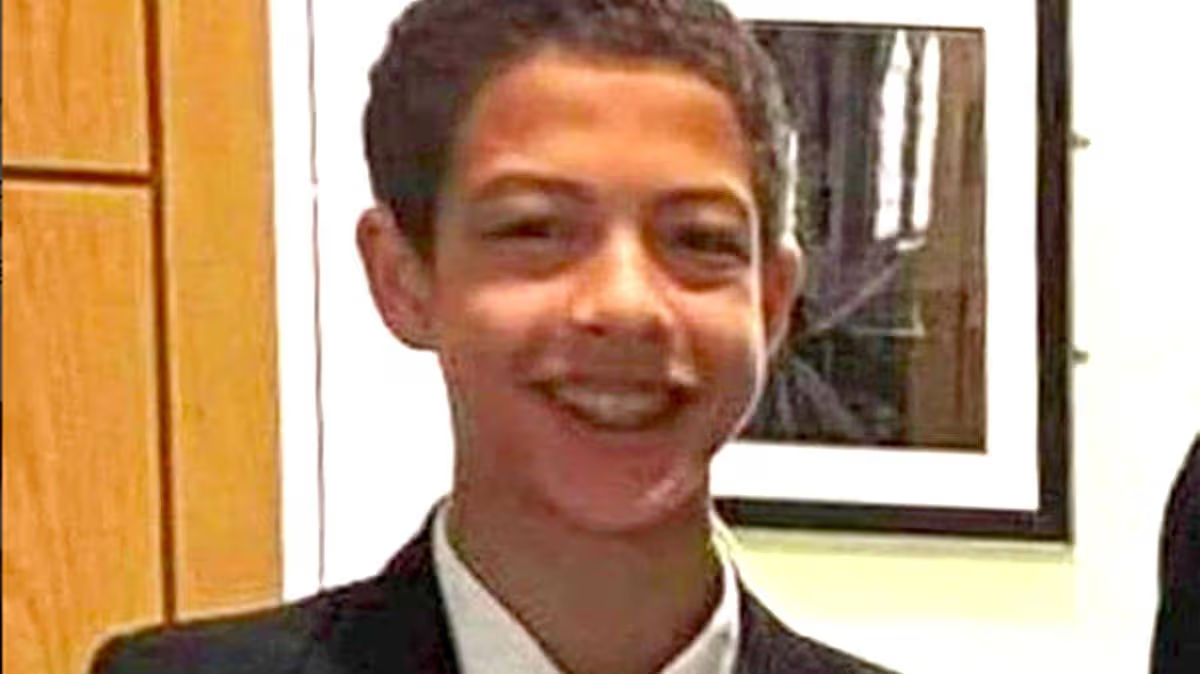
Noah Donohoe may have ‘lost touch with reality’ prior to death, inquest is told

Published

on

Belfast Live

However, jurors also heard a statement from a second expert who concluded ‘there is no psychiatric explanation for Noah’s disappearance or death’

It is possible Noah Donohoe “had lost touch with reality and was in a psychotic state” as he travelled through Belfast on the night of his disappearance, a psychologist’s statement that was read at the inquest into his death has said.

However, jurors at Belfast Coroner’s Court also heard a statement from another expert who concluded “there is no psychiatric explanation for Noah Donohoe’s disappearance or death”.

The 14-year-old had been planning to meet with school friends at Cavehill after setting out on his bike on Sunday June 21, 2020.

Advertisement

He was captured on CCTV cycling through the city centre and then towards the north of the city. In the final clip, the last footage of Noah before he disappeared, he is seen riding the bike naked.

His naked body was found in an underground water tunnel on June 27, six days after he left home.

A postmortem examination found the likely cause of death was drowning.

On Monday, the court heard a statement from Dr Louise Bowers, forensic psychologist, dated October 2021.

Advertisement

Among the items Noah had in his possession when he left home in June 2020 was the self-help book 12 Rules for Life, by the author Jordan Peterson.

Dr Bowers said Noah was “totally obsessed” with the 12 Rules for Life book which clearly had a “profound impact on Noah and almost certainly influenced some of the changes” seen in the days of June 2020, but alone is not enough to explain “troubling behaviour” before his death.

She said Noah was “adored by his mother” and the pair had a “strong attachment to each other”.

He also “did not have a history of mental health difficulties” and no evidence he was experiencing any mental disorders, with “no history of self-harming behaviour or suicidal ideation”.

Dr Bowers said it is possible Noah had some “traits of autism spectrum disorder (ASD)” but concluded he was a “quirky young man with some obsessional traits” that would not have met the threshold for diagnosis.

She described Noah as a “reasonably well-adjusted 14-year-old” but his mother had reported in the days before his death he had become “weepy, his mood was low, had become more affectionate physically and verbally towards her”.

He had become “extremely introspective” and “rejected offers” from his friends to talk, being “awake in the middle of the night and searching for things that at times had dark themes”.

Advertisement

While Dr Bowers found no events in Noah’s life that may have triggered depression, the illness can develop “without warning in children who were previously well-adjusted”.

She said it is “possible Noah was experiencing some symptoms of depression in the run-up to his disappearance”.

The psychologist also ruled that Noah was “showing signs of psychological disturbance before he left his house” which became “much more concerning” on departure, and then showed “increasingly disturbed behaviour as he cycled through the city of Belfast”.

He went on to discard his rucksack and laptop, before the rest of his clothing, in what Dr Bowers described as a “sequence of unusual and perplexing behaviour”.

Advertisement

She ruled that a postmortem examination of Noah’s body made it unlikely to be caused by taking drugs or alcohol or a head injury.

She said symptoms of a psychotic episode include hallucinations, delusions and confused and disturbed thought.

While 14 “would be very young to be having a first psychotic episode” and it is practically “unheard of” for a psychotic episode to instigate so quickly and be so dramatic, the psychologist said there was “something ritualistic” about how Noah discarded his possessions and that “religious and philosophical themes” can be present in delusions.

Advertisement

“It is possible Noah had lost touch with reality and was in a psychotic state leading him to believe he was being instructed to behave in these unusual ways,” her statement read.

The inquest then heard two statements from Dr Seena Fazel, a consultant psychiatrist.

In his first statement in November 2021, Dr Fazel ruled that Noah’s death was “likely suicide”, but in a statement from March 2026, given after he had seen further material, the doctor concluded “there is no psychiatrist explanation for Noah Donohoe’s disappearance or death”.

In his first statement, Dr Fazel said Noah’s “mood was lower and more unstable in the days before his disappearance”, potentially indicating an “acute episode of low and unstable mood which lasted a few days”.

Advertisement

In his revised statement based on new material – which amounted to more than 700 pages including another psychiatrist’s interview with Ms Donohoe and transcripts of Noah’s friends’ evidence to the inquest – along with discussion with other psychiatrists analysing Noah, Dr Fazel said he does “not think it was suicide on the balance of probabilities”.

He said Noah’s “changes to mental state were probably not consistent with an acute episode of low mood”, adding: “I do not think there were any mental health conditions prior to his disappearance.”

For all the latest news, visit the Belfast Live homepage here and sign up to our daily newsletter

Source link

Advertisement
Continue Reading
Click to comment

You must be logged in to post a comment Login

Leave a Reply

NewsBeat

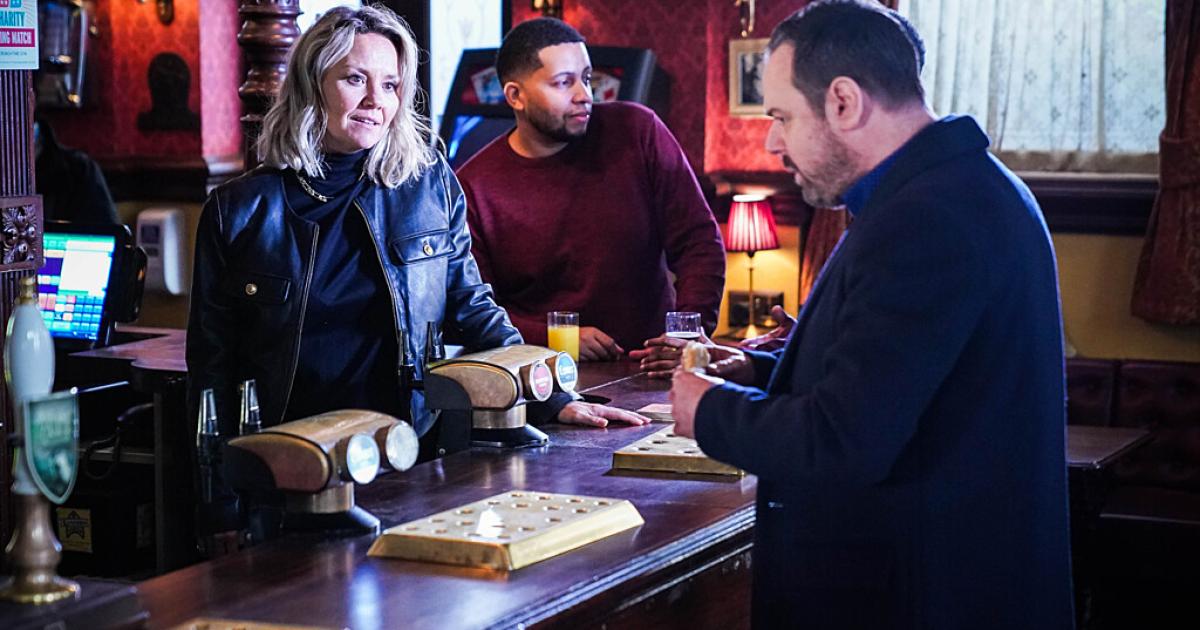
EastEnders star Charlie Brooks ‘returning’ as Janine Butcher

Published

on

EastEnders star Charlie Brooks 'returning' as Janine Butcher

Charlie Brooks is rumoured to be reprising her role as Janine Butcher for a brief but “explosive” storyline on the long-running BBC soap.

The plot could be linked to the show’s Christmas Day episode, according to reports.

EastEnders star Charlie Brooks ‘returning’ as Janine Butcher

“The bosses have several huge stories planned for this autumn, which will all start building towards Christmas,” an EastEnders insider told The Sun.

“Although Charlie is only reprising her role as Janine for a couple of episodes this time around, her involvement is bound to cause plenty of drama.

“The plans are being kept top secret as they are really keen fans don’t have the storylines spoilt for them.”

Advertisement

The source added: “But no doubt they are going to love seeing Janine back to cause chaos.”

The BBC did not comment when approached by Newsquest.

Brooks, who joined the soap in 1999, recently teased a possible return by suggesting that Janine’s release from prison was drawing near.

In a recent appearance on Good Morning Britain, the actress was asked whether she might “get out earlier” by entertainment editor Richard Arnold.

Advertisement

She replied: “We’ll have to see!”

Charlie Brooks as Janine BrooksCharlie Brooks last appeared in EastEnders in 2022 (Image: BBC/Jack Barnes/Kieron McCarron)

After a further prompt from Susanna Reid, Brooks added: “I mean, look, I get asked this question all the time.

“I love Janine, I love playing her.

“She’s a wonderful character.

Advertisement

“I always get blessed with such great storylines.”

“So, who knows?

“It’s always a home from home, EastEnders, you know.”

Janine’s long history on the Square includes the murder of her husband Barry Evans in 2004.

Advertisement

She helped to stab to death her fourth husband, Michael Moon, in 2013.

The character was arrested in 2022 after her fifth husband Mick Carter (Danny Dyer) supposedly drowned in the Channel.

Janine was sentenced to five years in jail for perverting the course of justice by framing Mick’s ex-wife Linda Carter for a drink-driving crash.

EastEnders star axed from BBC soap

In other EastEnders news, soap legend Michelle Ryan has been axed from the BBC show, just one year after her comeback.

Advertisement

Ryan returned to Albert Square last year after her character, Zoe Slater, had a 20-year absence.

The star originally appeared on EastEnders from 2000 to 2005, and Zoe’s return saw the character reconnect with her estranged mother, Kat Moon, played by Jessie Wallace.

But now Zoe is set to leave the BBC soap for good, with reports that scriptwriters have chosen to kill off the character.

Zoe’s exit reportedly has already been filmed, with EastEnders viewers able to watch the scenes later this year.

Advertisement

Discussing the characters depature, a source told The Sun, “Michelle’s long-awaited return has been somewhat flat and lacklustre.

“There’s been a backlash about her comeback, leaving some fans disappointed with her on-screen presence.

“There has been some disappointment backstage that the return was short-lived, as everyone loved Zoe Slater’s historic moments.”

Advertisement

Discussing the reports, an EastEnders spokesperson said: “We can confirm Zoe Slater will be departing EastEnders later this year.

“We wish Michelle Ryan all the best for the future.

“However, we never comment on future storylines as we don’t want to spoil it for the viewers.”

Who is your favourite character on EastEnders? Let us know in the comments.

Advertisement

Source link

Continue Reading

NewsBeat

Police hunt van driver after ‘despicable’ murder bid on two uniformed officers in Larkhall

Published

on

Daily Record

A white van was rammed into the two cops in the town yesterday afternoon.

A van driver is being hunted after attempting to murder two police officers in Lanark. A white Renault Traffic was rammed into the officers as they carried out enquiries at a property on Glen Avenue on Saturday at around 2:10pm.

Advertisement

Two male officers, aged 41 and 43, were rushed to hospital for treatment to serious injuries. The 41-year-old has since been released and the 43-year-old remains in hospital in a stable condition. There were no reports of any other injuries as a result of the incident.

The van was later recovered in Kirkstyle Place, Glassford, and police are treating the incident as attempted murder and desperately trying to trace the driver. He is described as a white male, 6ft tall, wearing dark shorts, a grey jumper and a beige baseball cap.

Detective Inspector Gary Smillie said: “This was a deliberate and despicable attack on two officers who were simply carrying out their duties.

“Extensive enquiries are ongoing and I am appealing for anyone who was in the area around the time and witnessed the incident to contact us.

Advertisement

“I would also appeal to anyone in the area who may have dash cam footage or private CCTV which could assist to get in touch. Any information, no matter how insignificant it may seem, could assist with the investigation.”

Chief Inspector Paul Doyle said: “Violence is not part of the job for police officers – it is not acceptable and will not be tolerated.

“I would like to reassure the community that we are working to trace the person responsible and will continue to carry out enquiries in the local area.

“We are speaking to members of the public and there will be additional patrols in the area, and would encourage anyone with any information or concerns to speak to officers.

Advertisement

“Our thoughts are with the officers, their families and colleagues at this time. We will continue to offer them all the necessary support.

“Anyone with any information should contact 101 quoting reference 1652 of 25 July, 2026. Information can also be given to Crimestoppers anonymously by calling 0800 555 111. “

Get more Daily Record exclusives by signing up for free to Google’s preferred sources. Click HERE.

Source link

Advertisement
Continue Reading

NewsBeat

Tools and equipment stolen from Ruddings Farm, Kirk Deighton

Published

on

Tools and equipment stolen from Ruddings Farm, Kirk Deighton

Police are urging witnesses to come forward following a burglary at The Barn, Ruddings Farm, Wetherby Lane, Kirk Deighton.

It happened sometime between Monday, July 20 and Friday, July, 24, when thieves broke into a metal storage container.


Recommended reads:

Advertisement

TV star buys iconic North Yorkshire pub made famous by hit show

RECAP: Major police incident at York venue – people told to stay inside

York garage confirms permanent closure as prime site faces uncertain future


A North Yorkshire Police spokesperson said: “This is a rural location, but we’re keen to hear from anyone who was in the area and may have seen anything unusual. Did you notice any suspicious vehicles, people, or activity around Ruddings Farm during this period?”

Advertisement

Police are also asking people to check any CCTV, doorbell, or dashcam footage from those dates.

Anyone with information is asked to contact North Yorkshire Police on 101, quoting incident number NYP-24072026-0230.

Source link

Advertisement
Continue Reading

NewsBeat

Trump’s tariffs are based on a forced-labor argument. Are they just a way to avoid Congress?

Published

on

Trump's tariffs are based on a forced-labor argument. Are they just a way to avoid Congress?

NEW YORK (AP) — The Trump administration has imposed double-digit tariffs on more than 60 countries, using a legal justification that permits the president to levy import taxes and other sanctions against countries found to engage in “unjustifiable,” “unreasonable” or “discriminatory” trade practices.

The new tariffs announced in recent days take effect just as temporary 10% worldwide tariffs expired, and critics say they are less about cracking down on forced labor than they are a way to replace those tariffs. The expired tariffs were themselves a temporary replacement for worldwide tariffs the Supreme Court struck down in February.

The tariffs were levied on countries that the U.S. says either don’t have or don’t effectively enforce a forced-labor import ban. The affected countries, which account for 99% of U.S. imports, were quick to protest, calling the Trump administration’s claims unfounded and arbitrary, as nations with vastly different records on forced labor received the same tariff level. The U.S. spent four months investigating but gave few details on how it arrived at the tariff rates, which are either 10% or 12.5%.

Sidestepping Congress

The tariffs were levied under Section 301 of the Trade Act of 1974 on countries that the U.S. determined had failed “to impose and effectively enforce a prohibition on the importation of goods produced with forced labor.”

Advertisement

During President Donald Trump ‘s first term, he cited Section 301 to impose sweeping tariffs on Chinese imports amid a dispute over the sharp-elbowed tactics Beijing was using to challenge America’s technological dominance. The U.S. is also using 301 powers to counter what it calls unfair Chinese practices in the shipbuilding industry.

“The 301s allow a permanent tariff without going to Congress to settle the dispute,” said Barry Appleton, a law professor and co-director of New York Law School’s Center for International Law. “That’s what all of this is about. The president doesn’t want to knock on the front door of Congress, so he’s trying every side door and every unlatched window to get in.”

Little evidence that countries failed to enforce import bans

The office of the United States Trade Representative (USTR) said it consulted with all 60 economies under investigation and held two rounds of public hearings, elicited more than 2,100 public comments, and had “engagement” with its trading partners about what they were doing to combat forced labor bans.

It didn’t detail its talks with the countries, saying those were confidential. Experts say it is fairly straightforward to investigate whether a country has a ban or not, but it is difficult to determine the government’s exact rationale for each country’s failure to enforce import bans.

Advertisement

“There’s not a lot of hard evidence there,” said Scott Lincicome, vice president for general economics and trade policy at the Cato Institute, a libertarian think tank. “It’s pretty laughable on its face to think that a country like the ones in Europe or in Norway or Switzerland aren’t doing enough to police forced labor.”

And even if countries do enact and enforce the forced-labor import bans the U.S. wants, they would still need to prove that they’re enforcing them to Washington’s satisfaction before the tariffs would be removed, said lawyer Patrick Childress, a partner at Holland & Knight and a former U.S. trade official.

“This suggests that no short-term path for countrywide relief from the new Section 301 tariffs will be available,” he said.

Countries and industries reject the forced labor argument

Many countries have pushed back against the Trump administration’s findings.

Brazil, which faces a 12.5% forced-labor tariff, called the U.S. move “arbitrary and unjustified.” The U.S. “chose to manipulate an issue of great importance to human rights and the struggles of workers worldwide in order to accuse 59 countries and the European Union of unfair practices,” it said in a statement.

Australia also questioned the justification for its 12.5% tariff.

Advertisement

“We believe that amongst all of the countries in the world, Australia does take the issue of slavery, modern slavery, seriously, and will continue to do that,” Trade Minister Don Farrell told reporters in Adelaide.

Carve-outs have riled some industries. The National Council of Textile Organizations (NCTO), which describes itself as the voice of the American textile industry, protested a mechanism that exempts the Section 301 tariffs for textile and apparel imports from Bangladesh, Cambodia, Indonesia, and Malaysia based on those countries’ imports of U.S. cotton and textiles.

“No other industry has been more disadvantaged by forced labor than the U.S. textile industry, which employs 453,000 workers and has lost 41 plants over the past two plus years,” NCTO chief executive Kim Glas said in a statement. “We remain strongly concerned that USTR’s textile mechanism will harm the very domestic manufacturers the administration seeks to help.”

US forced-labor bans don’t always work

The U.S. has two major pieces of legislation related to forced-labor import bans. The Tariff Act of 1930 gave Customs and Border Protection the authority to seize shipments where forced labor was suspected and to block further imports. But it had a big carve-out: If there was “consumptive demand,” meaning there wasn’t sufficient supply to meet domestic demand, imports were allowed regardless of how they were produced. The Trade Facilitation and Trade Enforcement Act that took effect in 2016 eliminated that loophole.

Advertisement

In 2021, the Uyghur Forced Labor Prevention Act was passed. It blocks imports from China’s Xinjiang region unless businesses can prove the items were made without forced labor.

But goods made with forced labor can still make it into the U.S. In 2015, an Associated Press investigation found that slave labor was used in the fishing industry in Southeast Asia. The seafood they caught made its way to supermarkets and pet food providers across the U.S.

An investigation by The Associated Press in 2020 into the $65 billion palm oil industry found labor abuses among an invisible workforce consisting of millions of men, women and children in Asia. The fruit they harvested made its way into the supply chains of major companies, including Unilever, L’Oreal, Nestle and Procter & Gamble.

Calls for a more comprehensive approach to combat forced labor

During hearings on the tariffs this month, National Retail Federation vice president Jonathan Gold, who was representing the business coalition the Joint Association Forced Labor Working Group at the hearing, said that in order for the import bans to work, they would have to be much more extensive.

Advertisement

He said there need to be “clear, measurable benchmarks” tied to tariffs for countries to hit, and that the U.S. should help countries build enforcement programs.

Kenya Davis, a partner at the Boies Schiller Flexner law firm, said an effective ban needs a “comprehensive approach” that provides transparency about what the investigations consisted of, along with programs that provide countries aid in enforcing bans.

Advertisement

Source link

Continue Reading

NewsBeat

A US-Russian space crew lands safely in Kazakhstan after an 8-month stint on the ISS

Published

on

Shootings at school and home in northeastern British Columbia leave 10 dead, including shooter

MOSCOW (AP) — A U.S.-Russian space crew landed safely in the steppes of Kazakhstan on Sunday after an eight-month stint on the International Space Station.

NASA astronaut Chris Williams and Russian crewmates Sergei Kud-Sverchkov and Sergei Mikaev touched down in their Soyuz MS-28 that landed smoothly by parachute in a designated area southeast of Dzhezkazgan.

Their 241-day stint on the orbiting outpost was the first space mission for Williams and Mikaev and the second for Kud‑Sverchkov.

The crew will be flown by helicopter to Karaganda, where Williams will board a plane to return to NASA’s Johnson Space Center in Houston, while Kud‑Sverchkov and Mikaev will take a flight to their training base in Star City, just outside Moscow.

Advertisement

Once bitter rivals in the space race during the Cold War, Russia and the U.S. cooperate on the space station and other projects. That relationship was marred by tensions after Moscow sent troops into Ukraine in 2022, but Washington and Moscow have continued to work together, with U.S. and Russian crews flying to the orbiting outpost on each country’s spacecraft.

On July 14, the crew of NASA astronaut Anil Menon and Roscosmos cosmonauts Pyotr Dubrov and Anna Kikina arrived at the International Space Station for an eight-month mission after launching from the Russia-leased Baikonur cosmodrome in Kazakhstan on July 14.

NASA Administrator Jared Isaacman attended the launch, the first visit to Baikonur by a NASA chief in eight years.

The newly arrived trio have joined NASA astronauts Jessica Meir and Jack Hathaway, European Space Agency astronaut Sophie Adenot and Roscosmos cosmonaut Andrei Fedyaev as part of Expedition 75.

Advertisement

Source link

Advertisement
Continue Reading

NewsBeat

Simon Jordan airs Anthony Joshua conspiracy theory after boxer knocked out rival despite hitting the canvas TWICE to set up money-spinning Tyson Fury fight: ‘Something not quite right’

Published

on

Anthony Joshua survived two knock downs in the first round against Kristian Prenga

Simon Jordan has questioned the nature of Anthony Joshua‘s victory over Kristian Prenga as he recovered from two knockdowns to set up a lucrative showdown with Tyson Fury.

Joshua, who had been returning to the ring after seven months of inactivity, appeared on the brink of defeat in the opening round against Prenga.

The Albanian heavyweight knocked Joshua down just 20 seconds into the contest with an uppercut.

Joshua then survived another knockdown later in the round, with fans fearing the long-awaited showdown with Fury was at risk.

Advertisement

The second round proved dramatically different as Joshua unleashed a series of heavy blows to force Prenga towards the ropes, before delivering a knockout blow.

Joshua’s stunning turnaround, coupled with Fury’s victory over Mariusz Wach just 24 hours earlier, cleared the path for the two British heavyweights to finally meet in one of the most lucrative fights in boxing.

Anthony Joshua survived two knock downs in the first round against Kristian Prenga

Advertisement
Joshua responded in the second by delivering a second round knockout of the Albanian

Joshua responded in the second by delivering a second round knockout of the Albanian

Simon Jordan questioned the nature of Joshua's victory given the difference between the two rounds

Simon Jordan questioned the nature of Joshua’s victory given the difference between the two rounds

talkSPORT presenter Simon Jordan controversially questioned the dramatic difference in the rounds between Joshua and Prenga.

Jordan declared ‘something not quite right’ as he appeared to reference the sums on offer for Joshua’s fight with Fury.

Advertisement

‘Not having that… #anthonyjoshua fight,’ Jordan posted.

‘Dropped twice and sets the tempo, how’s that ? … Prenga totally different in 2nd 

‘Something not quite right, all designed to rinse maximum amount of money…’

Punch stats for the fight revealed the stunning difference between the two rounds, with Joshua landing just five of his 22 attempted punches in the first, while Prenga connected with 15 of his 32.

Advertisement

The second round swung with Joshua landing with 13 of his 46 punches, as Prenga dramatically dropped off by landing three of 17 attempted.

Despite Jordan’s comments on social media, Joshua insisted that ‘champions rise’ in a post-fight interview after coming through the test.

Prenga had stunned Joshua in the opening round and landed 13 of his 32 attempted punches

Prenga had stunned Joshua in the opening round and landed 13 of his 32 attempted punches

He landed just three of 17 punches in the second round as Joshua became the aggressor

He landed just three of 17 punches in the second round as Joshua became the aggressor

Advertisement
Prenga was sent to the canvas by a brutal blow from Joshua, who later declared 'champions rise' when asked about the dramatic turnaround

Prenga was sent to the canvas by a brutal blow from Joshua, who later declared ‘champions rise’ when asked about the dramatic turnaround

‘He [Prenga] gave me a good test but this is what champions do, we rise,’ Joshua said.

‘We get knocked down and stand up. That is life, that is life’s motto.

‘I want to give a massive thank you to Prenga and his team for putting up a good fight. It means a lot to them and it means a lot to me and that is why you see what you see in the ring.

Advertisement

‘I want to give thanks to God. It was more than me in that situation, it can’t just be me in them type of situations. There is a higher power that is calling.

‘He’s a strong guy and I think Eddie [Hearn] wants to sign him now! He is going to do well and he has a bright future. 

‘Maybe with a bit more experience, he [Prenga] will be up there with the rest of us. He is strong and durable.’

Looking ahead to the showdown with Fury, with contracts having already been signed, Joshua said in the ring: ‘Have we got Tyson Fury in the room? Is he here or not?

Advertisement

‘I am the meanest, most vicious champion. Nobody can stop me. He is no Oleksandr [Usyk].

‘All jokes aside, there are two sides. One is the fighter and the other is respect. I respect everything he has done and everything that he has achieved, but as a fighting person, we’re here now. 

‘I hope the fans will be in for a lovely treat.’

Joshua had paid tribute to his two close friends, who were killed in a car crash in December.

Advertisement
Joshua will finally face Tyson Fury in a money-spinning contest with his rival having beaten Mariussz Wach a day earlier

Joshua will finally face Tyson Fury in a money-spinning contest with his rival having beaten Mariussz Wach a day earlier

Joshua paid tribute to his close friends Sina Ghami and Latif 'Latz' Ayodele, who died in a car crash in December

Joshua paid tribute to his close friends Sina Ghami and Latif ‘Latz’ Ayodele, who died in a car crash in December

Sina Ghami and Latif ‘Latz’ Ayodele died while the car they were travelling in struck a truck on a road near Lagos in December. The pair were on holiday with Joshua after he beat Jake Paul in Miami. 

The heavyweight boxer, who was also in the vehicle, was taken to hospital before being discharged and flying home to the UK – where he attended the funerals of his strength and conditioning coach Ghami and Ayodele, one of his trainers.

Advertisement

Fighting in honour of Ghami and Ayodele, Joshua paid tribute to his friends by having their names printed on his military camouflage trunks. 

He also walked to the ring wearing a military-style jacket to match his camo shorts. The jacket featured a medal bar displaying the IBF, IBO, WBA, and WBO titles – which he previously held – alongside pennants bearing Ghami and Ayodele’s names.

Meanwhile, ‘Latz x Sina, My Brother’s Keeper, MBK’ was printed on the canvas in his corner.

Asked about how he has been coping after beating Prenga, Joshua said: ‘It’s been tough,’ before becoming emotional. ‘That’s my brothers. I don’t want to talk about that.’ 

Advertisement

Speaking on DAZN, Matchroom Boxing chief Eddie Hearn admitted he feared the heavyweight had returned to the ring too soon after witnessing his struggles in the opening round.

‘Nobody can imagine what he’s been through in that last seven months. In that first round, I thought we’d come back too soon,’ Hearn said.

‘Boxing got him through. To even be in the ring tonight is astonishing. You don’t know what he’s been through. He had to go to the depths one more time to get up, like he has done the last seven months.’

In February, Joshua memorialised Ghami and Ayodele by having their names tattooed on his arm.

Advertisement

Source link

Continue Reading

NewsBeat

Whitby Steampunk Weekend 2026: 31 photos of amazing outfits

Published

on

Whitby Steampunk Weekend 2026: 31 photos of amazing outfits

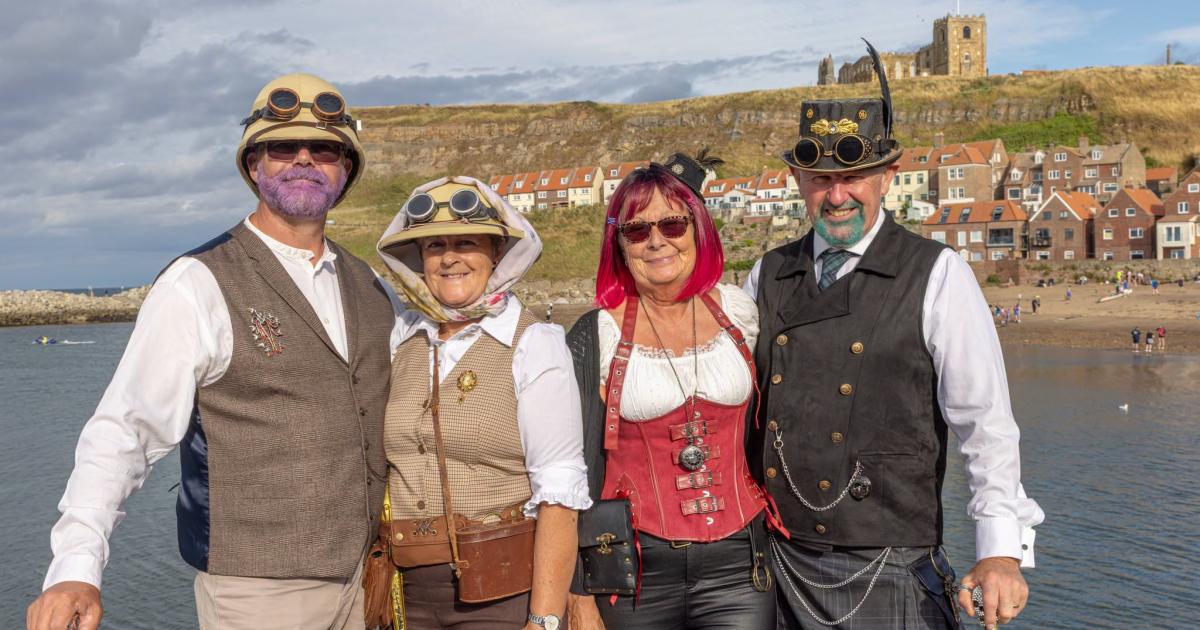
Visitors in elaborate Victorian-inspired costumes have gathered for the return of the popular festival.

Whitby Steampunk Weekend 2026. Photo: Garry Hornby, Press Camera ClubWhitby Steampunk Weekend 2026. (Image: Garry Hornby)

Photographers were spoiled for choice as Whitby’s streets and the pavilion filled with corsets, goggles and top hats, with many of the most eye-catching outfits captured on camera by The Press Camera Club’s talented members Garry Hornby and Simon McCabe throughout the weekend.


Recommended reads:

Delays building on A64 as traffic slows to just 5mph

Advertisement

Legendary singer James Taylor closes European tour with unforgettable Scarborough gig

Guests rescued after lift breakdown leaves five trapped at North Yorkshire hotel

Firefighters cut trapped casualty free after North Yorkshire crash


We’ve created this gallery of Whitby Steampunk Weekend 2026: 31 photos of amazing outfits to showcase all the fabulous photos – and to give the participants the audience their outfits deserve!

Advertisement

Whitby Steampunk Weekend 2026. Photo: Garry Hornby, Press Camera ClubWhitby Steampunk Weekend 2026. (Image: Garry Hornby)

The three-day event, held at Whitby Pavilion from Friday, July 24 to today, Sunday, July 26, is widely regarded as one of the largest free steampunk gatherings in the UK, attracting crowds from across the country.

Whitby Steampunk Weekend 2026. Photo: Simon McCabe Photographer/ Press Camera ClubWhitby Steampunk Weekend 2026. (Image: Simon McCabe Photography)

Organisers said the family-friendly festival, first launched in 2017, once again transformed the seaside venue into a hub of “fanciful extravagance”, with around 70 traders offering clothing, accessories, and handmade curiosities.

Whitby Steampunk Weekend 2026. Photo: Simon McCabe Photographer/ Press Camera ClubWhitby Steampunk Weekend 2026. (Image: Simon McCabe Photography)

Alongside the retail emporium, visitors are being treated to a packed programme of talks, workshops, and live entertainment.

Highlights have included presentations on Whitby’s ghosts and legends, Vikings and vampires, Viking mythology, the town’s links to Bram Stoker, and the history of Victorian funeral customs.

Advertisement

Whitby Steampunk Weekend 2026. Photo: Simon McCabe Photographer/ Press Camera ClubWhitby Steampunk Weekend 2026. (Image: Simon McCabe Photography)

Experts and guest speakers have included author and parapsychologist Paul Fitz-George, funeral director Emma Sparre-Newman covering how and why Victorian social conditions gave rise to the modern day funeral director and shaped so many funeral customs, and curators from Whitby Museum showcasing unusual artefacts from their collections.

Entertainment extended beyond the pavilion over the weekend, with performances from Ravens Morris from East Yorkshire, and sea shanty group Whitby Tillermen Friends drawing crowds outdoors.

Whitby Steampunk Weekend 2026. Photo: Simon McCabe Photographer/ Press Camera ClubWhitby Steampunk Weekend 2026. (Image: Simon McCabe Photography)

Evening events included a charity quiz and a tribute concert at the Whitby Pavilion Theatre featuring the Duran Duran Experience and Ant Trouble – Adam & The Ants Tribute.

Organiser Andy from WSW Events encouraged visitors to attend, saying: “Don’t wait for all the pictures to appear on social media and wish you’d come—make the effort and enjoy a day to remember.”

Advertisement

The event, which offers free daytime entry, is held every February and July.


Were you in Whitby for the Steampunk Weekend? Share your photos in the comments below – or join The Press Camera Club here.

Source link

Advertisement
Continue Reading

NewsBeat

Star Twinnie-Lee Moore gives boost for Ruby Rae’s York

Published

on

Star Twinnie-Lee Moore gives boost for Ruby Rae's York

Ruby Rae’s Country Bar is to open its doors on Thursday. August 6 in the former Jalou nightclub on Bridge Street.

Dean Saunders, co- founder of the Newcastle-based company, says he has ‘loved’ York for years.

He told the Press: “I have been coming down to York for years. I used toi come when the church contained Jalou. When I knew the building was available, an opening in York was a no brainer.”


RECOMMENDED READING:

Advertisement

Dan Cooke, Twinnie-Lee Moore and Dean Saunders open up the former Jalou. (Image: Jake Usman)

Dean says he has been working on developing the York site since February, which will be inspired by the world-famous Ryman stage in Nashville.

The venue will open Thursday to Sunday.

It will be situated a few doors away from York’s other main country and western-themed venue, the recently-opened Silver Spur in Bridge Street, and a short walk away from FortyFive Vinyl Café in Micklegate.

Clive Johnson Horsemanship and the team. (Image: Jake Usman)

Dean continued: “A lot of people who come to our Newcastle venue, they say they love the atmosphere. It’s a predominately female crowd, a about 65 per cent. People love the idea of dancing and dressing up. They might not initially be into country music but they might get converted.”

Advertisement

In the renovations of the former church, all the floors have been changed. Much LVT flooring has been used, which Dean says is great for line dancing.

Ruby Rae singers Ashleigh Bell and Harriet (Image: Jake Usman)

He said: “We have sanded some of the original flooring. We have removed the lighting to reveal a lot of the original features of the church. We have taken off the curtains to expose the brickwork. We have changed the bar to make it look more like Nashville.

“It’s all about the music. We are making the stage the main feature. It will have a deejay booth. Behind is a Ruby Rae’s York sign that will be epic.”

Furthermore, to add character will be plates reflecting the region, ‘dollar walls’, flags, lots of vinyls and ‘lots of neon signs everywhere.’

Advertisement

Singer Ashleigh Bell (Image: Jake Usman)

“It will be very Nashville,” Dean explained, adding lots of seats will be added.

“We want it to be somewhere where people can come in for hours and chill out. We have tried to expose as many of the original features of the church as it is such an epic building.”

Singe Ste Wilson (Image: Jake Usman)

And whilst the work has been underway, Ruby Rae received a boost with a visit from York-born country and western performer Twinnie-Lee Moore. The 39 year-old has appeared on the stage, as well as soaps including Hollyoaks and more recently Emmerdale as boxing promoter Jade.

Though based in Nashville, she regularly visits home and showed her support for Ruby Rae’s by turning up on a horse and with Ruby Rae singers Ashley Bell and Harriet.

Advertisement

Dean added that Twinnie-Lee will perform at Ruby Rae’s York one day.

What do you think of Country and Western music? Will you be going to Ruby Rae’s York?

Source link

Advertisement
Continue Reading

NewsBeat

how does the medieval warm period compare with today?

Published

on

how does the medieval warm period compare with today?

A heatwave lasting four months, followed by water shortages and crop failures. This is England in the 13th century, not the 21st.

What is often called the Medieval warm period saw elevated temperatures in many parts of the world between the 10th and 13th centuries.

These warmer temperatures were caused in part by an increase in solar irradiance. This is the amount of solar energy reaching Earth, which effects global temperature patterns and influences weather systems. There were also very few volcanic eruptions in this period, which can produce a temporary global cooling effect.

Water shortages and poor harvests

In England, the 13th century saw extreme droughts, devastating city fires and outbreaks of disease. The dry summer of 1212 contributed to the devastation of the Great Fire of Southwark in London, which killed thousands of people.

Advertisement

Contemporary medieval chroniclers recorded a severe drought in 1252. The English Benedictine monk Matthew Paris described four months of “intolerable heat and drought” between March and July, unrelieved by “any fall of rain or dew”.

The Tewkesbury Annals, a contemporary chronicle written by the monks of Tewkesbury Abbey, agreed that “drought prevailed for four months, causing the grass to disappear”. Rubbing the grass between one’s hands was said to turn it into dust.

The Chronicle of the Princes of Wales (Brut y Tywysogion), a medieval record of Welsh history, similarly noted that “the heat of the sun was so great that all the earth became so dry therefrom, that no fruit grew on the trees or [crops in] the fields, and neither fish of the sea nor of the river was obtained”.

Paris went on to describe the lack of available pasture, which led to cattle and livestock wasting away. The warmer weather produced an “abundance of fleas, flies and gnats”, and led to a surge in diseases, with reports of malaria – or the “sweats” and “ague” – in low-lying marshlands.

Advertisement


À lire aussi :
Six tips from the middle ages on how to beat the summer heat


Manorial accounts confirm the difficulties facing farmers, with one Bishopric of Winchester manor recording that the ground was so hard they could not plough for six weeks.

Illustration of agricultural workers in a wheat field in the medieval period.
Public Domain

The good and the bad

But it wasn’t just England and Wales that was experiencing unusual weather in this period.

Advertisement

Most of the northern hemisphere plus South America, China and Australasia recorded temperatures 0.3-1.0°C higher than those recorded for 1960-1990 – a period that includes the hot summer of 1976.

Conditions in the North Atlantic were so favourable that Norse people were able to cross oceans as the ice melted. They established settlements in Iceland and Greenland, and travelled as far as Vinland (Newfoundland).

South-east England was warm enough to support vineyards – 45 were recorded in the hands of Normans or great abbeys in the Domesday Book of 1086. Yet significantly cooler conditions prevailed in the eastern Pacific Ocean.

Warm water was pushed towards Asia, creating wetter conditions in Australasia, but limited rainfall in what we now refer to as the American west. And there were changes in the North Atlantic Oscillation (a weather system over the north Atlantic), which brought warmer and wetter conditions to parts of northern Europe.

Advertisement

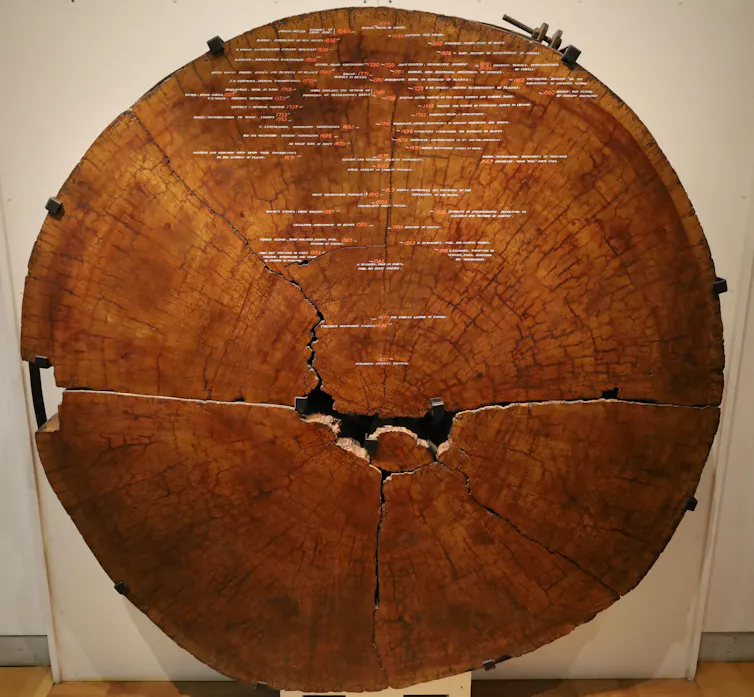
There are many sources of evidence for reconstructing past climates. These range from ice cores (long cylindrical samples drilled from glaciers which reveal hundreds of thousands of years of climate history) to tree rings showing the annual growing conditions – and from documentary evidence to the archaeological record.

Although some of the precise chronologies and contours of this evidence are still debated, the overall trends in reconstructed climates are becoming increasingly clear.

A large tree trunk section with different eras marked.
Tree rings in the Royal Ontario Museum,
Royal Ontario Museum, Public Domain., CC BY-NC

Not all regions experienced warmer temperatures during this period, however. Many scholars prefer the label Medieval Climate Anomaly instead. This better reflects the fact that climatic changes varied across the globe, and involved more than just rising temperatures.

Although the warmer temperatures produced occasional drought conditions, the overall economic effects of the Medieval Climate Anomaly were largely positive for northern Europe and parts of Asia. It led to large-scale and widespread agricultural expansion and population growth.

Between 600-900, the population of Eurasia only marginally grew from 167 million to 178 million. Between 900-1200, however, it nearly doubled to 324 million.

Advertisement

It was during the Medieval Climate Anomaly that a highly commercialised and monetised economy developed in large parts of medieval Europe, in what historians have described as its commercial revolution.

A map of Vinland.

A Yale University-owned map (believed to be a copy) of the area known as Vinland by the Vikings – now Newfoundland in Canada.
Public Domain

Yet, the period had far more serious negative consequences elsewhere. The warm storms led to drought conditions in the southern US and parts of South and Central America. This initiated the outbreak of exceptionally large wildfires in the Rocky Mountains. Severe droughts, exacerbated by extensive deforestation and ecological degradation, were a contributing factor in the decline of the classic Maya civilisation (250-900).

The Medieval Climate Anomaly period was brought to an end by climatic instability in the second half of the 13th century – including a volcanic eruption in 1257 that led to global dust clouds and crop failures. These resulted in mass starvation in medieval London.

The early 14th century saw a shift in weather conditions, with exceptionally heavy rain and cool temperatures preventing crops from maturing. This culminated in the Great Famine of 1315-17, which killed around 10% of the European population.

Advertisement

Other significant historic events of the period were also linked to unusual weather and atmospheric conditions. For instance, the Black Death of 1347-53, which killed between a third and two-thirds of the European population, was brought into Europe on grain shipments imported to alleviate famine caused by another volcanic eruption, around 1345.

A medieval illustration of a worker collecting grapes.
Around 45 vineyards were recorded in England during this medieval period, because of the warmer weather.
Public domain

Any parallels with today?

The Medieval Climate Anomaly was a largely regional episode of natural warmth. Today’s climate change is a rapid worldwide warming trend driven primarily by human greenhouse gas emissions.

Moreover, temperatures are rising today at unprecedented rates. Records continue to tumble, as weather that was once considered extreme is becoming normal.

There are, however, some salutary warnings from the past. As climates change, so too will the risk of diseases spreading and the possibility of weather extremes. With increasing temperatures, it is possible, for example, that malaria may once again become endemic in the UK.

As the medieval period has demonstrated, fire spread can be another acute risk in long periods of dry weather. But unlike the medieval period, we now have the technology to help us prepare, as well as national fire services and more ways to share information quickly. That gives us an advantage that medieval communities just did not have.

Advertisement

Source link

Continue Reading

NewsBeat

York – A64 delay near Tadcaster heading towards the A1(M)

Published

on

York - A64 delay near Tadcaster heading towards the A1(M)

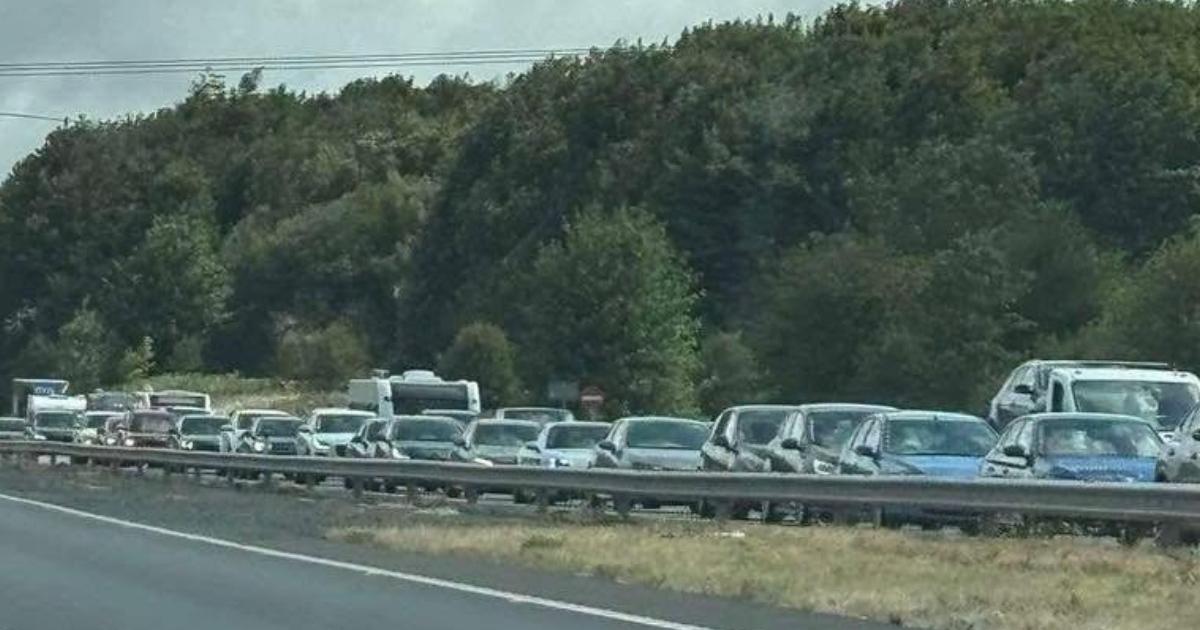
Traffic is building on the westbound carriageway near Tadcaster between the A162 and Paradise Lane.

Motorists are currently being delayed by more than 17 minutes, with an average speed of 5mph due to the congestion heading towards the A1(M).

The traffic situation on the A64 westbound at 11.35am, Sunday, July 26. (Image: Google Maps)

One person who has been held up has posted on social media: “Stuck on A64 in a massive traffic jam – nothing moving.”

Another motorist has reported that the outside lane is closed just before junction 44 to the A1, with slow-moving traffic.

Advertisement

She wrote on social media: “Just one car as we’ve just gone past, only police there and driver still in car, traffic moving freely once passed.”

More to follow.

Source link

Advertisement
Continue Reading

Trending

Copyright © 2025