WASHINGTON (AP) — President Donald Trump said Thursday that Pam Bondi is out as his attorney general, ending the contentious tenure of a loyalist who upended the Justice Department’s culture of independence from the White House, oversaw large-scale firings of career employees and moved aggressively to investigate the Republican president’s perceived enemies.
The departure of the country’s chief law enforcement officer followed months of scrutiny from angry conservatives over the Justice Department’s handling of files related to the Jeffrey Epstein sex trafficking investigation and failed efforts to please Trump through unsuccessful efforts to build criminal cases against prominent foes, investigations that in some cases have been rejected by judges or grand juries.
Trump named Deputy Attorney General Todd Blanche as the acting attorney general, though three people familiar with the matter have said he has privately discussed Lee Zeldin, the head of the Environmental Protection Agency, as a permanent pick.
Advertisement
President Donald Trump, stands with then-defense attorney Todd Blanche, May 14, 2024, in New York. (AP Photo/Craig Ruttle, Pool, file)
Advertisement
President Donald Trump, stands with then-defense attorney Todd Blanche, May 14, 2024, in New York. (AP Photo/Craig Ruttle, Pool, file)
Advertisement
Advertisement
Advertisement
“Pam Bondi is a Great American Patriot and a loyal friend, who faithfully served as my Attorney General over the past year,” Trump said in a statement. He added: “We love Pam, and she will be transitioning to a much needed and important new job in the private sector, to be announced at a date in the near future.”
Advertisement
Bondi, a former Florida attorney general, came into office last year pledging that she would not play politics with the Justice Department, but she quickly started investigations of Trump foes, sparking an outcry that the law enforcement agency was being wielded as a tool of revenge to advance the president’s political and personal agenda.
Attorney General Pam Bondi arrives before President Donald Trump speaks about the Iran war from the Cross Hall of the White House on Wednesday, April 1, 2026, in Washington. (AP Photo/Alex Brandon, Pool)
Advertisement
Attorney General Pam Bondi arrives before President Donald Trump speaks about the Iran war from the Cross Hall of the White House on Wednesday, April 1, 2026, in Washington. (AP Photo/Alex Brandon, Pool)
Advertisement
Advertisement
Advertisement
Advertisement
She ushered in a period of intense turmoil at the department that included the firings of career prosecutors deemed insufficiently loyal to Trump and the resignations of hundreds of other employees. Her departure continues a trend of Justice Department upheaval that has defined Trump’s presidency as multiple attorneys general across his two terms have either been pushed out or resigned after proving unwilling or unable to meet his demands for the position.
Bondi rejected accusations that she politicized the Justice Department and said her mission was to restore the institution’s credibility after overreach by President Joe Biden’s Democratic administration with two federal criminal cases against Trump. Bondi’s defenders have said she worked to refocus the department to better tackle illegal immigration and violent crime and brought much-needed change to an agency they believe unfairly targeted conservatives.
Advertisement
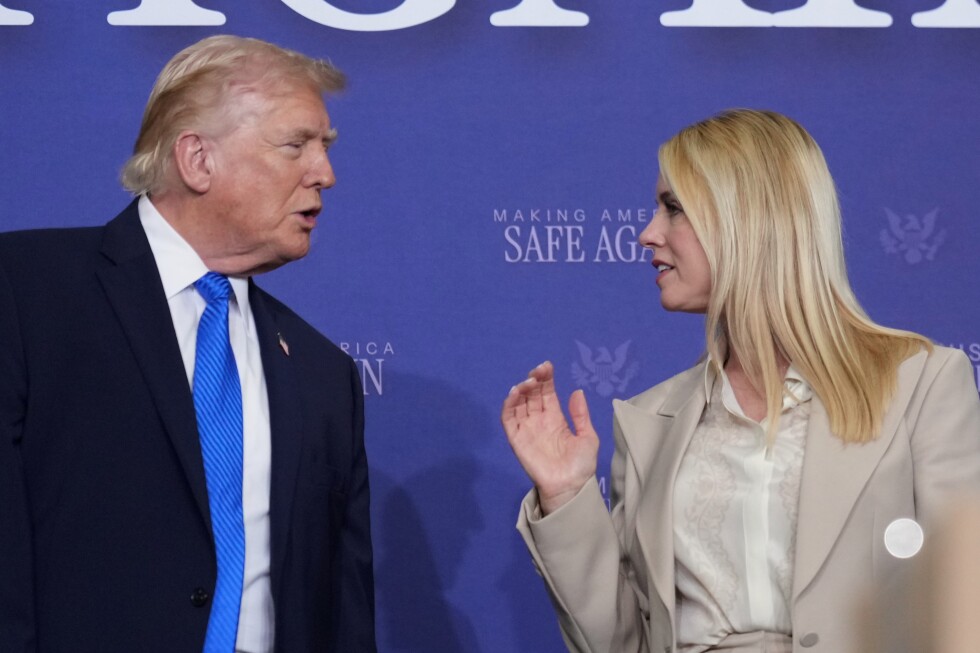
President Donald Trump speaks with Attorney General Pam Bondi during a roundtable discussion on public safety at a Tennessee Air National Guard Base, Monday, March 23, 2026, in Memphis, Tenn. (AP Photo/Mark Schiefelbein)
President Donald Trump speaks with Attorney General Pam Bondi during a roundtable discussion on public safety at a Tennessee Air National Guard Base, Monday, March 23, 2026, in Memphis, Tenn. (AP Photo/Mark Schiefelbein)
Advertisement
Advertisement
Advertisement
Embracing, supporting and protecting the president
Bondi’s public embrace of the president, however, marked a sharp departure from her predecessors, who generally took pains to maintain an arm’s-length distance from the White House to protect the impartiality of investigations and prosecutions. Bondi postured herself as Trump’s chief supporter and protector, praising and defending him in congressional hearings and placing a banner with his face on the exterior of Justice Department headquarters.
She called for an end to the “weaponization” of law enforcement she said occurred under the Biden administration, even though Biden’s attorney general, Merrick Garland, and Jack Smith, the special counsel who produced two cases against Trump, have said they followed the facts, the evidence and the law in their decision-making. Bondi’s critics, meanwhile, said she was the one who had politicized the agency to do the president’s bidding.
“You’ve turned the People’s Department of Justice into Trump’s instrument of revenge,” Rep. Jamie Raskin of Maryland, the top Democrat on the House Judiciary committee, said at a February hearing.
Advertisement
Bondi delivered a combative performance but few substantive answers at that hearing as she angrily insulted her Democratic questioners with name-calling, praised Trump over the performance of the stock market — “The Dow is up over 50,000 right now” —- and openly aligned herself as in sync with a president whom she painted as a victim of past impeachments and investigations.
Even Republicans began to challenge her, with the Republican-led House Oversight Committee last month issuing a subpoena to her to appear for a closed-door interview about the Epstein files.
Under Bondi’s leadership, the department opened investigations into a string of Trump foes, including Federal Reserve Chair Jerome Powell, New York Attorney General Letitia James, former FBI Director James Comey and former CIA Director John Brennan. The high-profile prosecutions of Comey and James were short-lived as they were quickly thrown out by a judge who ruled that the prosecutor who brought the cases was illegally appointed.
Trump repeatedly publicly praised and defended Bondi but also showed flashes of impatience with his attorney general’s efforts to meet his demands to prosecute his rivals. In one extraordinary social media post last year, Trump called on Bondi to move quickly to prosecute his foes, including James and Comey, telling her: “We can’t delay any longer, it’s killing our reputation and credibility.”
Advertisement
Bondi oversaw the exodus of thousands of career employees — both through firings and voluntary departures — including lawyers who prosecuted violent attacks on police at the U.S. Capitol on Jan. 6, 2021; environmental, civil rights and ethics enforcers; counterterrorism prosecutors; and others.
Attorney General Pam Bondi leaving after the end of President Donald Trump’s remarks to reporters in the James Brady Press Briefing Room at the White House, Feb. 20, 2026, in Washington. (AP Photo/Alex Brandon, File)
Advertisement
Attorney General Pam Bondi leaving after the end of President Donald Trump’s remarks to reporters in the James Brady Press Briefing Room at the White House, Feb. 20, 2026, in Washington. (AP Photo/Alex Brandon, File)
Advertisement
Advertisement
Advertisement
Advertisement
Fumbling the Epstein files
She struggled to overcome early stumbles over the Epstein files that angered conservatives eager for government bombshells about the case, which has long fascinated conspiracy theorists. She herself had fed the conspiracy theory machine with a suggestion in a 2025 Fox News Channel interview that Epstein’s “client list” was sitting on her desk for review. The department later acknowledged that no such document exists.
Bondi was ridiculed over a move to hand out binders of Epstein files to conservative influencers at the White House only for it to be later revealed that the documents included no new revelations. And despite promises that more files were going to become public, the Justice Department in July said no more would be released, prompting Congress to pass a bill to force the agency to do so.
The Epstein files fumbles led to a stunning public criticism from White House chief of staff Susie Wiles, a close friend of Bondi’s, who told Vanity Fair that the attorney general “completely whiffed.” The Justice Department’s release of millions of pages of Epstein files did little to tamp down criticism, prompting a House committee with the support of five Republicans to subpoena Bondi to answer questions under oath.
Bondi, who defended Trump during his first impeachment trial, was his second choice to lead the Justice Department, picked for the role after former Rep. Matt Gaetz of Florida withdrew his name from consideration amid scrutiny over sex trafficking allegations.
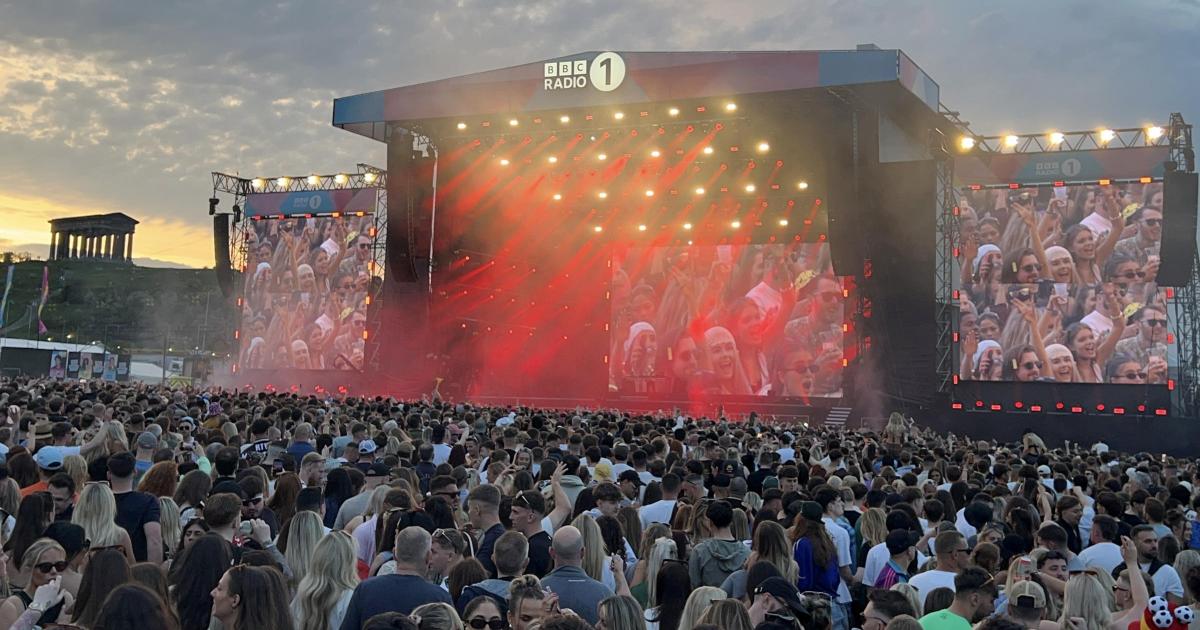
For three days the Wearside skyline was soundtracked by chart-toppers with barely a cloud daring to gatecrash the party, as festival ponchos were put aside for sunglasses and SPF.
More than 100,000 people swept passed the park over the weekend from far and wide – some travelling from as far afield as Southampton,
It was the first time the festival had been to Sunderland in 21 years, when Gwen Stefani headlined in 2005.
On Friday, legendary DJ Fatboy Slim brought the festival’s first full day to an end with a set of the pounding dance anthems which made him a household name. It topped off the Big Weekend’s first-ever dedicated dance music day.
Advertisement
Saturday brought about more big-name artists from the world of pop.
(Image: NNP)
Zara Larsson closed Saturday with a blitz of big choruses and fun dance routines that have come to symbolise her resurgence in recent years, partly down to viral trends on TikTok.
She played the last Big Weekend in the North East when she joined the likes of Miley Cyrus and Billie Eilish on the billing.
(Image: PA)
Ellie Goulding’s set earlier in the day was another nostalgia-filled journey on a day which felt like it may well have been 2016 all over again.
Advertisement
Louis Tomlinson added to that feeling with a rendition of One Direction hit ‘History’.
(Image: NNP)
(Image: NNP)
Olivia Dean brought the Big Weekend to a soulful close as Sunday’s headliner with her sunset set wrapping up three days of pop and sunshine.
(Image: JOSHUA NICHOL)
(Image: North News & Pictures Ltd)
(Image: NNP)
Bucket hats, denim shorts and football shirts were the uniform of choice, with grass banks doubling as sun loungers between sets as fans stretched out to the sound of new discoveries on the smaller stages.
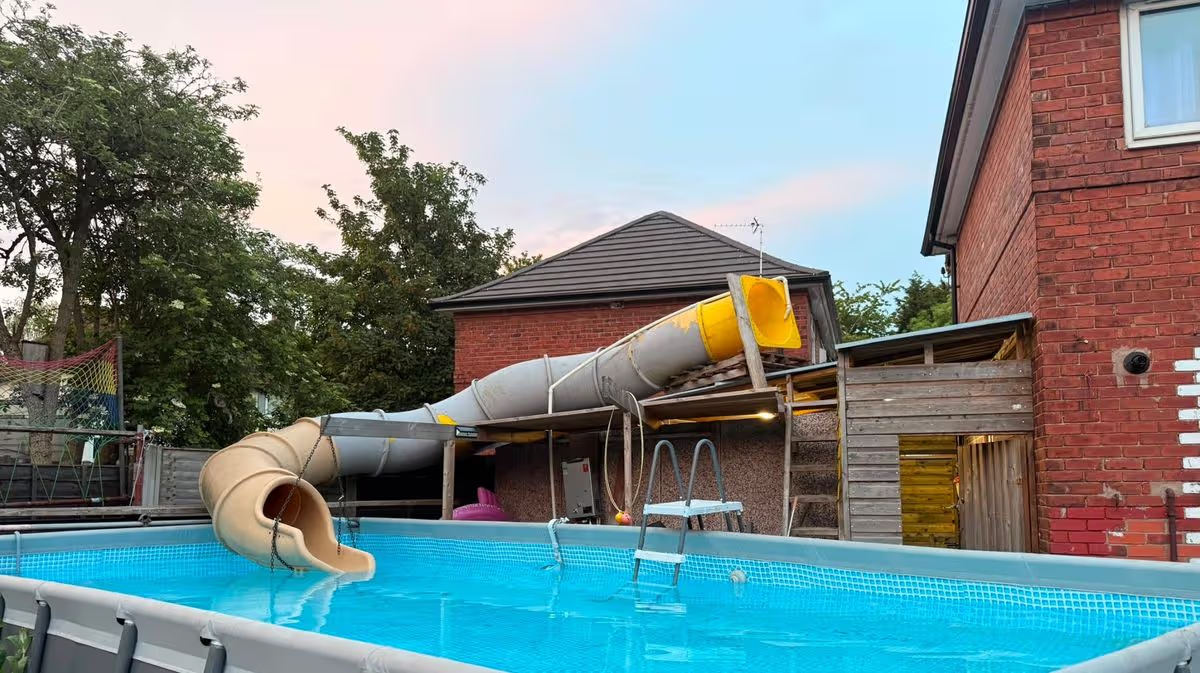
Paddling pools are a staple of British summer time, but one Wythenshawe dad has taken it to the extreme with a massive pool right in his back garden – complete with a waterslide.
Liam said he has had the pool since 2024 – and only half-jokingly puts the decision down to having ADHD. “That’s just how I am, once I get an idea in my head, I just have to have it,” he told the M.E.N.
Click here to get the biggest stories straight to your inbox in our Daily Newsletter
Returning from a summer holiday, Liam found that he didn’t want to leave the poolside fun behind. “I had just moved into a new house and it was my first time having a garden,” he said.
Advertisement
“I thought, I want my own pool at home. I started looking online before the holiday even ended.”
He ‘levelled’ most of his back garden to install the 12ft by 24ft pool, which cost about £1,000, and added a former playground slide which he sourced on eBay.
A mechanic by trade, he also erected a platform over the garage roof, which he attached the slide to. “I don’t see it as unsafe, I’ve made it easy to get up there and put netting around the sides,” he said.
“I’ve spoken to my neighbours and they don’t have an issue with it. As long as my kids are happy, I’m happy.”
Advertisement
The pool has its own filter and Liam uses chlorine to treat the water. “Let’s not talk about costs…” he says of his water bill.
Things ‘went a bit mad’ when another TikTok user posted a video of the pool. “She was staying in an AirBnB round the corner and took a video from her window,” he said. “It had been a bit of a secret until then.
“Now it’s gone viral I am expecting a visit from the council. But it’s a temporary structure and I can have it down in an hour.”
Advertisement
With the arrival of the year’s first proper heatwave and the beginning of May half time, Liam’s kids and their friends are flocking round to swim in the pool. “I kind of live through my children, I have three and I know how fast it goes,” he said.
“They’re only young once and once they’re grown up you don’t get that time back. And the love and support and positivity I have had has been absolutely amazing.
“It is nice to get credit as a dad cause I don’t think we get credit or appreciated very often. I go above and beyond for my kids.”
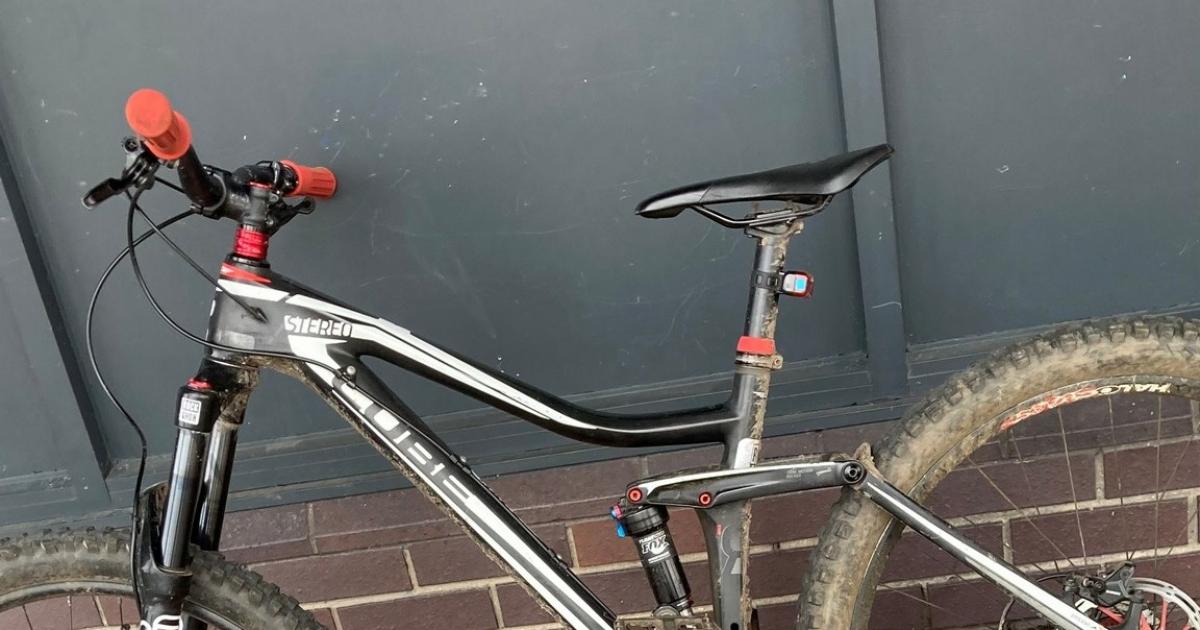
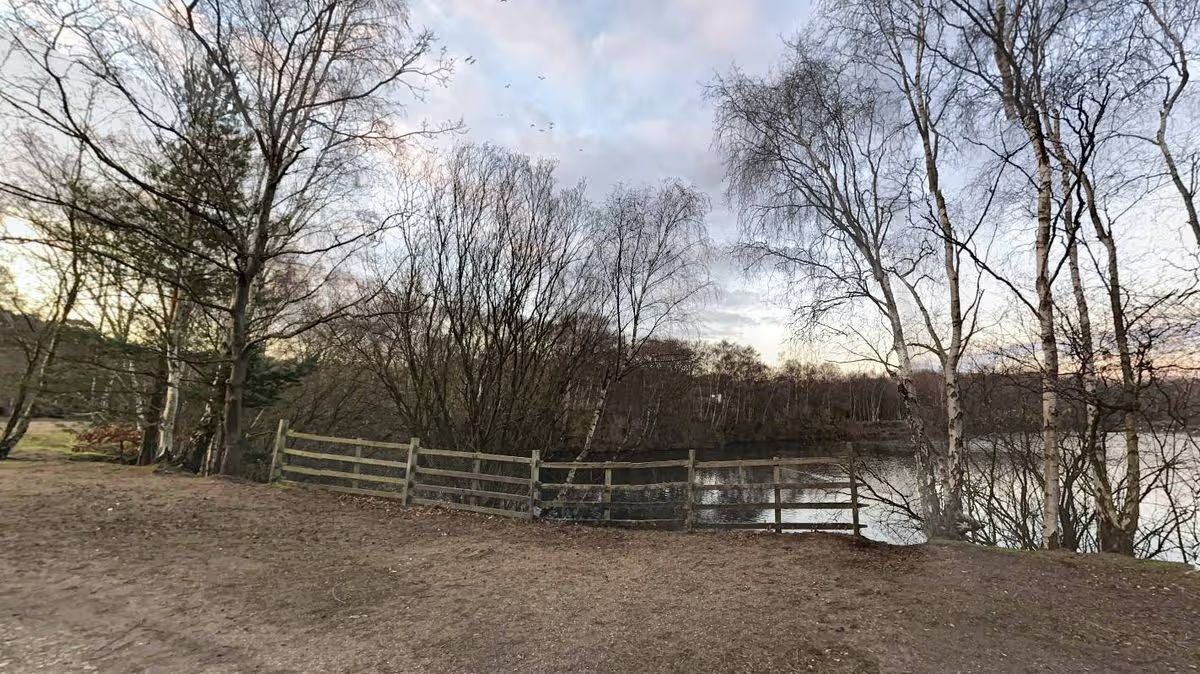
North Yorkshire Police said the black Cube Stereo mountain bike was taken from the banks of Rawcliffe Lake in the early evening of last Sunday (May 17).
The bike is “distinctive looking” and has red bar grips fitted, the force said.
Officers are urging anyone with footage of the bike being taken or who has seen it for sale to contact North Yorkshire Police.
Here’s what the stars have in store for your day (Picture: Metro.co.uk)
The Sun’s square to the mystic North Node heightens sensitivity but provides a guiding light. Tune into how the comsos advises you today.
Taurus, Aquarius and Pisces, this placement gets you in the perfect zone for self-discovery. You are at tune and at peace with yourself.
Harmony is on the cards, so use this oppirtunity to build relationships. Enjoy the peace offered by the day ahead.
Ahead, you’ll find all star signs’ horoscopes for today: Monday May 25, 2026.
Advertisement
Like checking your horoscope every morning? You can now sign up to our free daily newsletter to get a personalised reading for your star sign delivered straight to your inbox.
To order your unique personal horoscope based on your time, date and place of birth, visit patrickarundell.com.
Aries
March 21 to April 20
As the week begins, the Moon moves into a harmonising part of your chart, perfect for early-day connections. Exchanges can flow more smoothly, but your intuition will still be calling out to you. So even in the bubbliest of exchanges, let your inner voice nudge in the right direction. Not all that sparkles contains celestial gold, however charming someone might be.
Over the last eighteen months, the powerful North Node has been gently guiding your future direction and the company you keep. You have become more aware not just of who you like, but also of how their energy affects you and whether each person is uplifting. This process may get a reality check today, but one that can be in your best interests, Taurus.
Your personal identity is undergoing a major cosmic rebirth. So, these can be very exciting times for Geminis, especially if you’re a free spirit or a natural bohemian. If you’re a Twin who exists in a more conventional situation or work feels staid, this may now hit home. This can also be the case if you are used to expressing your personal talents in your free time.
The Sun’s square to the mystic North Node highlights finding a way through the day, when your sensitivities can be amplified. And your ruler, the Moon’s journey into your most emotional sector, accents this too. Something you strongly believe in may not be what you want to discuss, but circumstances may demand that you do so and stand up for yourself, Cancer.
There has been so much excitement in the last month, and in particular, the last few days. With sparkling friendships and future possibilities shining brightly, today gives you a chance to ask yourself some probing questions about what this all means. Someone you know well and trust can be the perfect sounding board. Look to get their perspective – don’t be too proud to ask.
Your star is most certainly in the ascendancy, but how will this impact your relationships? If you have the chance to take on a more senior role, are retraining or pivoting to do something different, the support of others could be important. Equally, being mindful of their needs and feelings will be key. Working together will increase your chances of success.
Cosmic messages for Cosmic messages for Virgo today
Libra
September 24 to October 23
The Moon returns to your sign today, Libra, helping your natural equilibrium. The Sun, however, forges a testing link with the North Node. Your desire to expand your boundaries can be strong. The unstinting discipline and sacrifice you have shown over the last few years does need a counterpoint, and greater freedom can likely be it. Just ask yourself, is it doable?
The Moon moves through a more introspective sector for you the next two days, Scorpio. And a complex interplay between the Sun and the North Node may find you deep in thought. Actually, this can be the perfect moment to untangle a complex issue. Although you have a natural talent for teasing out deeper strands, today it’s also about feeling them, Scorpio.
Strict Saturn moved through the tender Pisces between much of 2023 to early 2026 and taught you some tough lessons, be it around home, family, your inner emotional world, or where to live. Today, with the instinctive North Node in the same sector as Saturn was, and angling to the Sun, however much you’re drawn to someone, do be guided by what you learned then.
There can be a tension between thinking about what you need to do today and feeling what the right thing to do is. Your attention span may also be lower than usual, so the key is to take on one task at a time and not give yourself too much to get through. By not overthinking things, you can just go with the flow and perhaps get more done than in the process.
There is such a fabulous amount of bright and effervescent energy supporting you now, Aquarius. Do seize the moment. Not all of your ideas or moves will necessarily convert into something more tangible, or even work financially, but that doesn’t mean they don’t have value. Ironically, if you’re minded to be speculative, listen to your hunches.
With the Sun, Mercury, and Uranus all in the zone of feelings in your chart, but in the logical Gemini, it will be important not to be too detached about family or home changes that are in play. The powerful North Node – with you until late July – can help you to decipher these paradoxes, but also ensure that within your close connections, you do feel heard and seen.
Your daily Metro.co.uk horoscope is here every morning, seven days a week (yes, including weekends!). To check your forecast, head to our dedicated horoscopes page.
As a loyal Metro reader, we want to make sure you never miss our stories when searching for your news. Whether it is the latest politics news explained, live football coverage or a showbiz scoop.
Click the button below and tick Metro.co.uk to ensure you see stories from us first in Google Search.
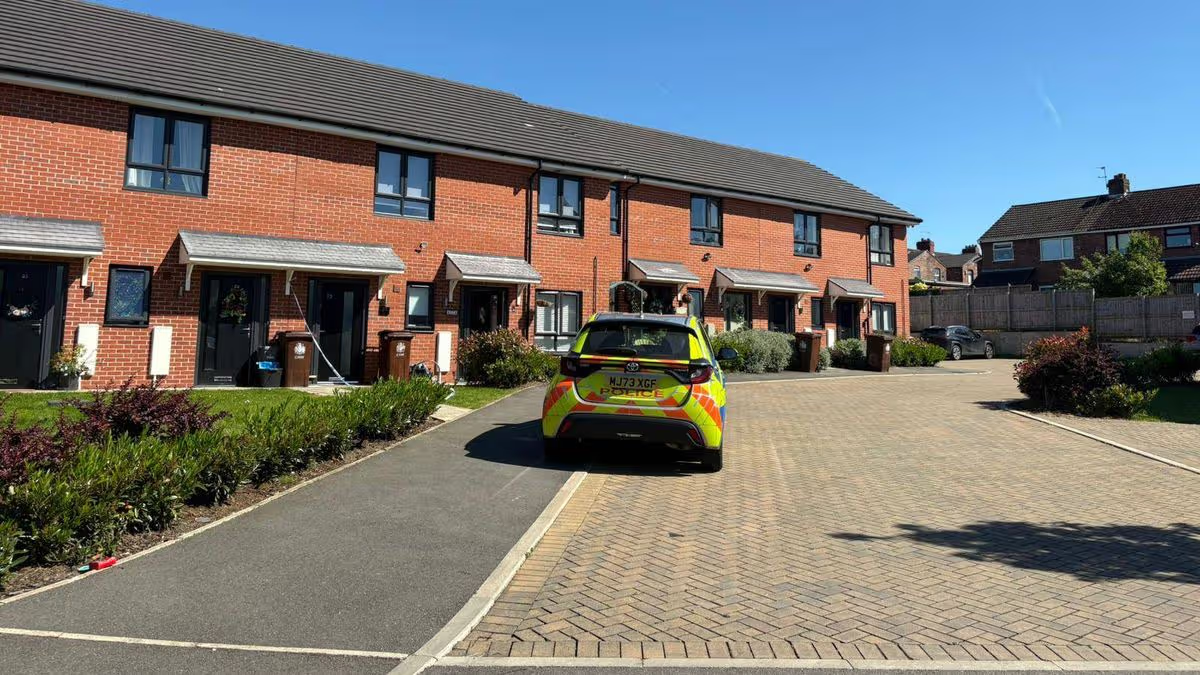
A man has been arrested on suspicion of murder after a woman in her 30s was found dead at a property in St Helens
Hannah Rees What’s On editor and Rachel Vickers-Price UK and World News Reporter
23:59, 24 May 2026Updated 00:00, 25 May 2026
A man has been arrested on suspicion of murder following the death of a woman in St Helens.
North West Ambulance Service alerted police at approximately 2.55am on Sunday, May 24 after a woman in her 30s was found dead at a property on Brook Cottage Close.
Advertisement
A 63-year-old man was detained at the scene on suspicion of murder and has since been taken to a police station for questioning. Investigations are continuing to establish the circumstances surrounding the incident and to formally identify the deceased woman.
The case is currently being treated as unexpected while these enquiries are under way.
Residents of Brook Cottage Close revealed they had heard arguing in the early hours and awoke to find police present on the street, reports the Liverpool Echo.
Merseyside Police has urged anyone with information to get in touch via @MerPolCC or by calling 101, quoting reference 26000410495.
Advertisement
Reports can also be submitted through their website. Alternatively, members of the public can contact the independent charity Crimestoppers anonymously on 0800 555 111, or via their website.
The leaders of Reform UK and Restore Britain have clashed ahead of the pivotal by-election that could return Labour’s Andy Burnham to Parliament
Tom Burnett Content Editor
22:57, 24 May 2026
Nigel Farage has criticised tech billionaire Elon Musk over his support for Restore Britain, warning he could “split the right” in the upcoming Makerfield by-election.
The SpaceX and Tesla boss posted a series of messages backing Restore Britain on his social media platform X, formerly known as Twitter.
Advertisement
Labour’s Andy Burnham hopes to use the Makerfield contest to return to Westminster, which could potentially see the Mayor of Greater Manchester potentially launch a bid to replace Sir Keir Starmer as Prime Minister.
Reform’s UK Robert Kenyon came second in the seat in 2024 and an opinion poll suggested Mr Burnham has a lead of just three percentage points over him.
But with Restore Britain’s candidate picking up support, Mr Farage said Mr Burnham would be “delighted” by Mr Musk’s intervention.
Speaking to the Telegraph, the Reform UK leader said: “Elon Musk has decided he will try to split the right of British politics as best he can.
“This is supporting a party that’s one man with a social media account. Quite what he’s trying to achieve, I have no idea.”
The Survation study in Makerfield had a sample size of just 504 respondents of whom 369 said they were likely to vote but is the first survey of the constituency since the by-election was called and the pollster said it should be treated as an “indicative early look”.
Advertisement
It put Mr Burnham on 43%, Mr Kenyon on 40% with Restore Britain’s Rebecca Shepherd on 7%.
Join our new Makerfield by-election WhatsApp community by clicking this link for the latest news. We also treat our community members to special offers, promotions, and adverts from us and our partners. If you don’t like our community, you can check out any time you like. If you’re curious, you can read our Privacy Notice.
Responding, Restore Britain UK leader Rupert Lowe, a former Reform UK MP, said: “Farage has just gone to the media to attack Restore Britain, again.
Advertisement
“He says that Elon Musk is supporting a party ‘that’s one man with a social media account’.
“This is where Farage is so very wrong.”
He said there were “millions of Brits who are with us” and “Farage can arrogantly insult me over and over, but he has never been more wrong”.
Mr Lowe, who has a long-running feud with Mr Farage said: “This party isn’t about me, it never has been.
Advertisement
“It is about our members, our people, our home. Not me. Them.
“That is something he will never understand, and ultimately it’s why he will lose.”
On Sunday, Mr Musk reposted a message from Mr Lowe with the comment “Restore Britain”.
He also posted “Restore Britain” in response to an interview by Reform’s Treasury spokesman Robert Jenrick.
Perhaps more significant than beating him in a straight fight in the sprint was the robust (but fair) way he defended the lead from Antonelli, who ended up finishing third in the final reckoning. Antonelli was not happy, said as much on the radio repeatedly before being publicly told to stop moaning about it by his race engineer first and then by team principal Toto Wolff.
It is unlikely there will be any lasting bad blood in this race, but you never know. I doubt it will be the last time the pair clash and have a disagreement. In any case, it is a good thing for the neutral that Russell has stiff competition. Long may it continue, hopefully in the form of Mercedes being challenged by McLaren and Ferrari.
Anyway the race starts at 9pm BST and we will be here for all of the build-up, live updates and reactions from what could be another intriguing race.
Parts of Wales are set to see highs of 31C on Bank Holiday Monday
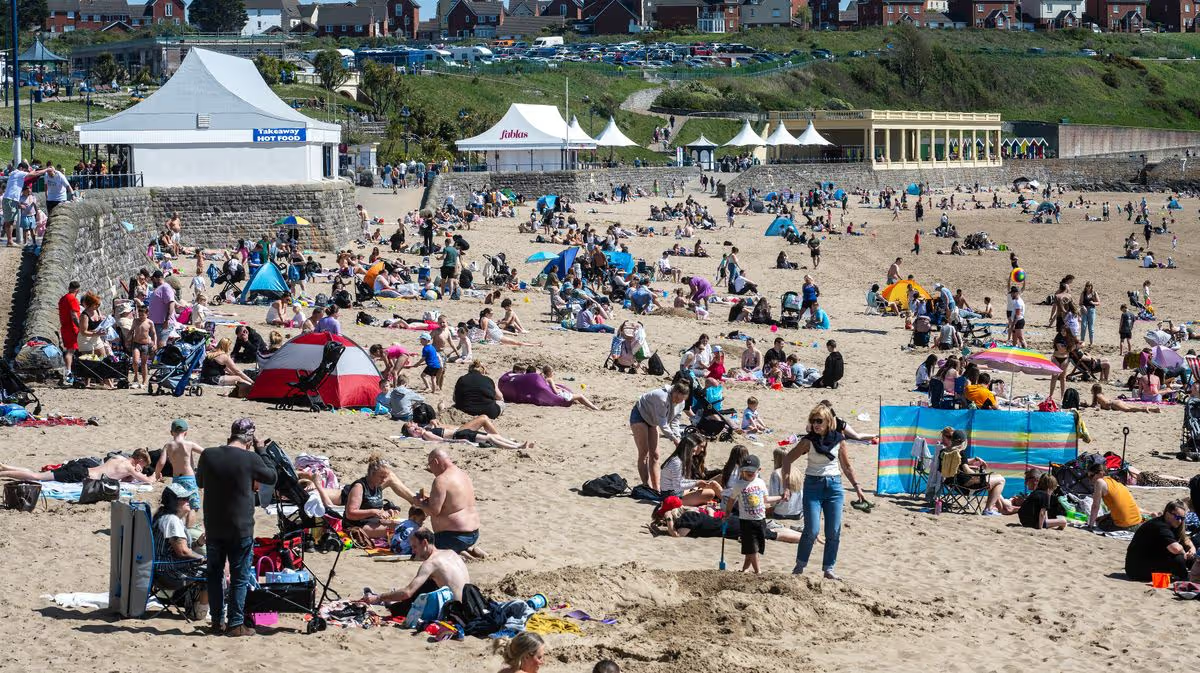
Temperatures across Wales soared on Sunday (May 24) as the UK basked in conditions more commonly associated with the Mediterranean. However, forecasters warn it’s going to get even hotter on Bank Holiday Monday.
Advertisement
Cardiff and Llysdinam recorded the highest temperatures in Wales at 27.5C on Sunday, while Usk closely followed on 27.0C as the country enjoyed one of the hottest May weekends in recent memory. Even the coolest parts of Wales remained exceptionally warm for late May, with Aberdaron reaching 19.2C, Valley 18.8C and Aberporth 17.8C overnight.
Forecasters say the heat is still building, with temperatures expected to peak on Monday when parts of south and mid Wales could hit 31C.
Cardiff, Newport, Abergavenny and Hay-on-Wye are all forecast to experience the highest temperatures in the country outside of southern England, while much of the rest of Wales is expected to remain in the mid to high twenties. Coastal areas including Pembroke and St Davids are likely to be slightly cooler at around 26C thanks to sea breezes.
The Met Office has described the conditions as “historic”, warning that temperatures will near 35C in England which is exceptionally rare for May in the UK. For the biggest stories in Wales first sign up to our daily newsletter here
Advertisement
A Met Office spokesperson said: “We rarely see temperatures above 35C, even in the summer months, so to see temperatures getting close to 35 in May is pretty historic.”
Saturday had already marked the hottest day of the year so far after temperatures reached 30.5C in Kent – the first time the UK has passed 30C this year and the first occurrence of such heat in May since 2012.
The Met Office confirmed heatwave conditions have officially been met in eight parts of England, including Heathrow in Greater London, Benson in Oxfordshire, Brooms Barn in Suffolk, High Beech in Essex, Kew Gardens in London, Northolt in London, Santon Downham in Suffolk and Writtle in Essex.
Advertisement
Santon Downham became the first location to meet the official heatwave threshold at around 11.30am on Sunday after recording temperatures above 27C for three consecutive days. Heathrow followed shortly afterwards at around 11.50am after exceeding its 28C threshold for a third consecutive day.
Forecasters also warned overnight temperatures may stay above 20C in some areas, creating uncomfortable sleeping conditions and potentially setting further records.
The Met Office said: “For many areas, this will feel more like mid-summer than late May, with temperatures rising well above average and the potential for some notably high values as the weekend progresses.
“The bank holiday Monday is expected to bring the peak of the heat. Temperatures may reach around 33C across parts of southern and central England, with the potential to challenge or exceed existing late-May records.”
Advertisement
An amber heat-health alert has also been issued for the East of England amid concerns over pressure on health and social care services. Officials warned indoor temperatures, including in hospitals, may rise above recommended safety thresholds.
Many made the most of the good weather today, as thousands of people across Wales headed to beaches, parks and beauty spots to enjoy the sunshine, prompting South Wales Police to issue safety advice to parents. This came after a noticeable increase in reports involving missing children. Officers confirmed all children involved were later safely reunited with their families.
Police are urging parents to take precautions in busy public places by taking an up-to-date photo of their children before leaving home, placing contact details in their pockets or writing a phone number on their arm, and establishing a clear meeting point upon arrival.
Officers are also encouraging parents to teach children to “stop and wait” if they become separated rather than continuing to wander, while reminding them to seek help only from uniformed staff, police officers or families with children nearby.
Advertisement
South Wales Police further urged the public to contact officers immediately if a child goes missing, especially in crowded locations such as beaches and parks where officers and PCSOs are often nearby.
Lincolnshire Police said in a statement on Sunday evening: “We can update that our dive team have sadly found a body in the water at Swanholme Lakes, Lincoln.
Click here to get the biggest stories straight to your inbox in our Daily Newsletter
“With agreement from the family we can share that the boy who died is 15-year-old Declan Sawyer.
“Our thoughts are with his family and we send our condolences at this incredibly difficult time.
Advertisement
“This is such a sad incident that will no doubt also affect many of Declan’s friends and the local community as well.”
Officers had scoured the lakes for the boy with the help of their underwater search team.
“As we are starting half-term week, we ask our community to make sure that anyone affected is looked after and that people are encouraged to seek help and support where they need it,” a force spokesperson said.
Lincolnshire Police asked people not to speculate or share information that had not come from an official source.
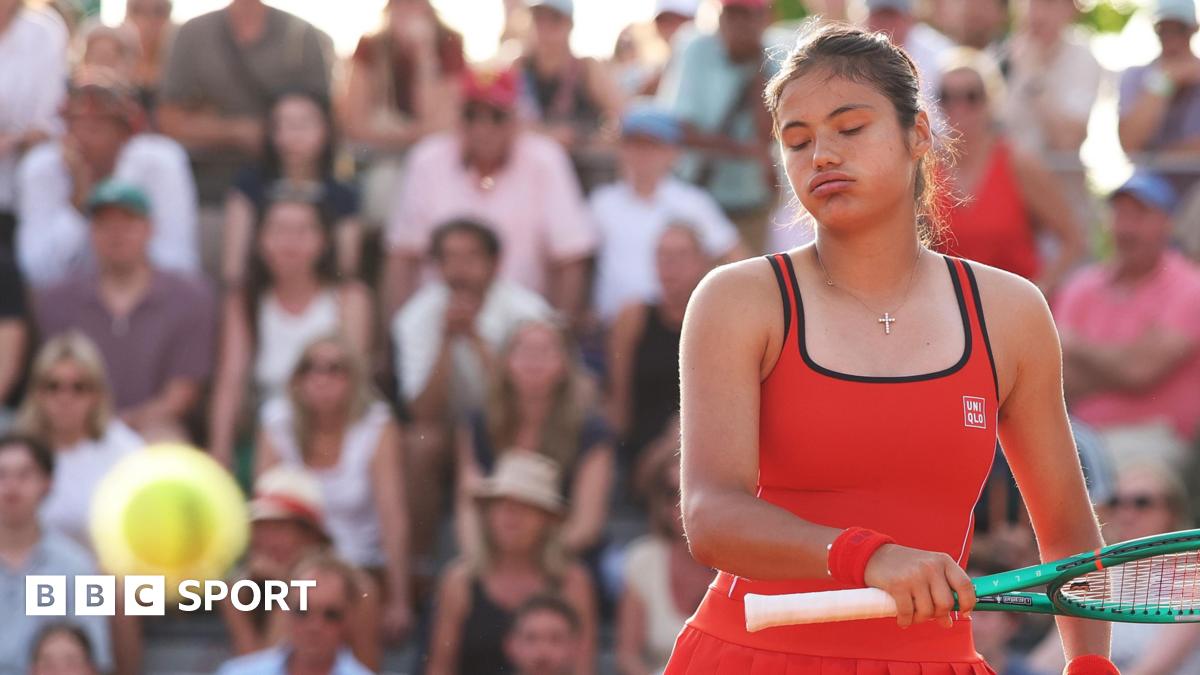
Raducanu losing to Sierra was not a surprise in itself, even though the Briton is ranked 29 places higher in the world.
Since Indian Wells in early March, Raducanu has only played one match – and that only came last week in a straight-set defeat by France’s Diane Parry in Strasbourg.
The post-viral issues have continued to have lingering effects and she was struggling with a cough in Paris.
A healthy Sierra, on other hand, has plenty of matches in her legs and more rhythm in her racquet.
Advertisement
The difference was clear in a woeful first set from Raducanu.
The 23-year-old’s tactic of aggressively hitting early in the rallies, and a reluctance to patiently wait for chances to attack, underlined her keenness to swarm her opponent.
Her lack of court time, plus the 30C heat in Paris, meant it made sense for Raducanu to try to end the points quickly.
However, her timing was well out and led to a high volume of unforced errors.
Advertisement
“I felt like the conditions were extremely lively, and I felt like I wasn’t able to kind of trust my shots in that and didn’t feel like I had control over the ball,” Raducanu said.
“It was a really difficult set-up for me to step into, having not had many matches.
“I think probably just a bit light on matches, a bit light on confidence coming into the tournament.”
Sierra was always going to provide a tricky test, especially at this early stage of Raducanu’s latest comeback.
Advertisement
Having started playing on the red dirt aged three, 21-year-old Sierra demonstrated her ability by recently pushing reigning French Open champion Coco Gauff in Rome.

















































You must be logged in to post a comment Login