Connect with us

NewsBeat

Prince George’s first day at Eton: King-in-waiting arrives with proud Prince and Princess of Wales by his side

Published

on

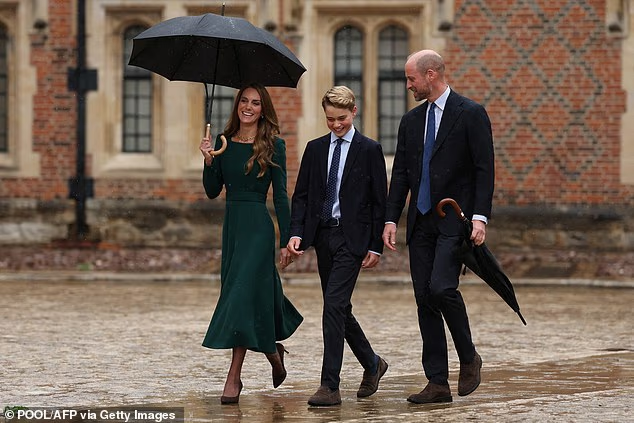
Prince George arrives with parents Prince William and Catherine for his first day at Eton today

Prince George has arrived for his first day at Eton College accompanied by his proud parents, the Prince and Princess of Wales.

He walked in as both a king-in-waiting and a nervous 13-year-old about to embark on a thrilling new chapter of his life.

The second in line to the throne wore a dark blazer, shirt, tie and chinos with brown suede shoes. He and his parents strode briskly through Eton College’s historic quadrangle – known to pupils as School Yard – given the heavy rain.

The family emerged from the arch beneath Lupton’s Tower, the 16th-century gatehouse clock tower, and walked across the cobbled Yard.

Advertisement

The Waleses paused level with a bronze statue of Henry VI, the school’s founder, which sits in the centre of the quadrangle, to shake hands with Simon Henderson, the headmaster of Eton College, and Sir Nicholas Coleridge, the school’s provost, who serves as the chair of the governing body.

Prince William was smartly dressed in a dark suit, while Catherine wore an elegant green flowing dress and heels and carried a large umbrella.

William was the first to shake hands with the headmaster, then George, as the princess slightly hung back.

Advertisement

Prince George arrives with parents Prince William and Catherine for his first day at Eton today

Prince William shakes hands with provost Sir Nicholas Coleridge, left, and headmaster Simon Henderson on Prince George's first day of school

Prince William shakes hands with provost Sir Nicholas Coleridge, left, and headmaster Simon Henderson on Prince George’s first day of school 

Prince George arrives with parents Prince William and Catherine for his first day at Eton today

William is greeted by Sir Nicholas, the school's provost and governing body chair

William is greeted by Sir Nicholas, the school’s provost and governing body chair

Advertisement

‘George welcome, good luck, enjoy,’ Mr Henderson smiled.

He then shook hands with Catherine before the provost introduced himself and they exchanged a few pleasantries

While there were clearly nerves on both sides, there were also smiles all round – although the heavy rain drowned out the sound of their conversation.

Catherine gazed at her eldest son proudly before Mr Henderson invited the family to get out of the rain.

Advertisement

The princess was seen placing a protective arm on her son’s back as the door was shut behind them. 

The Yard is the oldest part of the school alongside College Chapel, where pupils attend services three times a week.

After the welcome, George, William and Catherine were shown into the fourth form passage in the original school building, which is understood to house the world’s oldest classroom.

Like other families, the couple will help George settle into his new bedroom. Pupils from other years will return to Eton when the school starts tomorrow.

Advertisement

Following the brief photocall and the picture release, it is William and Catherine’s fervent wish that George’s education will take place away from public view.

Signs have been posted around Windsor warning the public not to photograph the pupils when they are moving around the sprawling campus of school buildings between lessons.

Kensington Palace announced in June that their eldest child would be attending the Windsor boarding school where fees cost more than £65,000 per year.

William struggles to close his umbrella as he and Catherine accompany George to Eton today

William struggles to close his umbrella as he and Catherine accompany George to Eton today

Advertisement
Catherine and William laugh with George as they arrive today for his first day at Eton College

Catherine and William laugh with George as they arrive today for his first day at Eton College

George arrives with parents William and Catherine for his first day at Eton this morning

George arrives with parents William and Catherine for his first day at Eton this morning

Catherine and William laugh with George as they arrive for his first day at Eton College today

Catherine and William laugh with George as they arrive for his first day at Eton College today

It seems hard to believe that the self-assured young man in front of us was, only a few years ago, being introduced to the world by William and Catherine on the steps of the Lindo Wing at St Mary’s Hospital, Paddington – or pictured tousle-haired, his back pack almost as big as him, on his first day at nursery.

Advertisement

The photocall had been arranged for 11am, half an hour or so before the rest of his fellow ‘F Blockers’ – Eton shorthand for Year 9 students – arrived. 

It is the only time during the next five years George is likely to get any special treatment, and the decision was more about protecting the privacy of the other students.

All new pupils arrive in their own clothes before changing into Eton’s distinctive and historic uniform including black tailcoat, waistcoat and white tunic shirt.

Kensington Palace are set to release a photograph of that separately.

Advertisement

The prince and princess have made clear how grateful they are for the way the media and public have allowed all their three children to grow up and enjoy their education away from the spotlight, in return for regular pictorial updates and occasional public appearances, and hope this will continue for George as he moves through his senior school years.

Henry VI established the school in 1440, naming it Kynge’s College of Our Ladye of Eton besyde Windesore.

Alongside fee-paying students, provision was made for 70 ‘King’s scholars’ to receive free lodging and tuition. The tradition continues today with the school offering bursaries to pupils from less well-off backgrounds.

The young prince’s arrival at the exclusive public school varied markedly from his father’s first day on September 6, 1995.

Advertisement

Then, William, sporting a grey tweed jacket over matching smart trousers and a navy patterned tie, was photographed arriving at his boarding house in front of a large group of the world’s media and signing the register.

Prince George starts his first day of school at Thomas's Battersea in London in September 2017

Prince George starts his first day of school at Thomas’s Battersea in London in September 2017

He was accompanied by his parents Prince Charles and Diana, Princess of Wales, who had by then been separated for three years, along with his younger brother, Prince Harry.

Only a small royal photographer rota captured such an historic moment in the now heir to the throne’s life.

Advertisement

Times change and, as royal aides now argue, it’s stressful enough joining a new school without doing it under the glare of hundreds of cameras.

Eton was always the front runner for William and Catherine when it came to choosing a senior school for their eldest child, but by no means a done deal.

The couple have been spotted checking out a number of boarding schools across the county, including Oundle in Northamptonshire and the princess’s own alma mater, Marlborough – although sources have indicated that the latter has always been a more likely choice for their daughter, Princess Charlotte.

What swung it was Eton’s proximity to the family’s ‘forever home’ at Windsor, Forest Lodge; the fact that the college has long experience of dealing with the complexities around high-profile students; and, of course, George’s own preference.

Advertisement

He is likely to be joined by a number of friends from Lambrook, the co-educational prep school in Berkshire he has attended with his siblings in recent years.

It also helps that William has genuinely fond memories of his own time there.

In an interview to mark his 18th birthday and imminent graduation from Eton, the heir spoke of how he had enjoyed attending Eton as ‘just another student’ and even admitted he’d ‘always liked the uniform’.

He also spoke of how much he had appreciated the support of staff such as his housemaster, Dr Gailey.

Advertisement

Ironically, given how synonymous Eton has become with royalty, it was something of a departure for William to even be sent there.

For centuries, generations of monarchs and their heirs were taught by tutors and had little experience of learning alongside their peers.

Princess Diana and Charles with William and Harry outside Eton on William's first day in 1995

Princess Diana and Charles with William and Harry outside Eton on William’s first day in 1995

However both William’s grandfather and uncle on the Spencer side of the family had attended the school, while his mother also preferred its proximity to Windsor and London.

Advertisement

Charles was also known to have had a less than happy time at his own Scottish alma mater, Gordonstoun – although other members of the Royal Family subsequently went there and adored it – and was content with the choice.

It also enabled William to spend time with his beloved grandmother Queen Elizabeth II, and he still fondly talks of being able to regularly wander over to Windsor Castle to seek tea and sage advice.

William and Catherine have also gone on to break with tradition when it comes to their own children’s education.

George first attended a little £5.50-an-hour Montessori nursery school, Westacre near King’s Lynn in Norfolk, when his parents were based there while William was working as a pilot for the East Anglian Air Ambulance Service.

Advertisement

When the family moved back to Kensington Palace in 2017, George and Charlotte were enrolled at Thomas’s Battersea – a very popular but not overly posh private London prep school.

In 2022, all three youngsters moved to Lambrook, a delightful but low-key day and boarding school in Berkshire, where George has regularly stayed overnight in preparation for Eton.

He is said to be a hugely outdoorsy, sporty boy, who has shown a talent for triathlon and sailing – and is obsessed by flying.

His time at Eton will, hopefully, be among the happiest years of his life, allow him to develop away from the spotlight and develop a tight-knit circle of friends that will support him for many decades to come.

Advertisement

The college was founded in 1440 as a charity feeder school to provide free education for 70 poor boys before they progressed to King’s College, Cambridge.

Prince Harry sets off for his first day at Eton in 1998. He attended the school until 2003

Prince Harry sets off for his first day at Eton in 1998. He attended the school until 2003

It has since become one of the most lauded public schools in the world, educating generations of British and foreign aristocracy and, in recent years, home-grown monarchy.

Former alumni include no less than 20 former British prime ministers, writers George Orwell, Aldous Huxley and Ian Fleming, as well as actors Eddie Redmayne, Tom Hiddleston and Damian Lewis.

Advertisement

Recent decades have seen a concerted effort to open up benefits of an Eton education to pupils from a more diverse background, with around 20 per cent on bursaries or scholarships.

The Good Schools Guide says it is an establishment that is chosen by people ‘despite its name, not because of it’ and insists: ‘Eton’s got normal families and normal children doing great things.’

Its fees remain, however, an eye-watering £65,000-plus a year and there is an enviable 7:1 pupil to teacher ratio.

And it is also still renowned for its traditions including the classic uniform of a black tailcoat (£165) with matching trousers (£65), waistcoat (£50) and white tunic shirt (£22).

Advertisement

Facilities remain first class with superlative music, drama and sports departments. As well as rugby and football, the school still boasts unique traditions such the ‘Eton wall game’.

All boarders have private rooms from their first day in one of 25 distinctive boarding houses run by the house master and dame.

Kensington Palace have broken recent tradition and chosen not to share the name of George’s house.

Teachers are known officially as masters, but colloquially as ‘beaks’.

Advertisement

The Waleses – who famously admit they have refused to give their children mobile phones – will no doubt be delighted with the school’s phone policy: just a Nokia brick phone for boys such as George in Year 9 with very limited use.


Source link

Continue Reading
Click to comment

You must be logged in to post a comment Login

Leave a Reply

NewsBeat

Telegraph readers react to the new 3-in-1 toothbrush

Published

on

Telegraph readers react to the new 3-in-1 toothbrush

Similarly, reader Paul Isaacs, a dentist, believes that “squirting stuff between teeth isn’t that good at removing a sticky biofilm”.

“If we don’t clean between the teeth properly it’s a bit like only washing your left side in the shower,” he adds.

For Paul, it’s the technique that matters, not necessarily the technology. “Toothbrushes are a personal thing, you can do a great job with manual or electric, if you do it right.”

“Getting bits of peanut out from between the teeth is not effective cleaning when it comes to gum health, so water jets are second rate,” he says.

Advertisement

“The gold standard is mechanical cleaning, in basic terms if you don’t wrangle it off, the biofilm won’t shift.”

The readers tempted by Dyson

These readers, however, are more optimistic about this new technology and can see how it could become a sophisticated investment, remembering when the electric toothbrush was dismissed when it first launched.

As a Dyson enthusiast, reader Irena Stoynova, 41, from Hampshire, was excited to hear about the launch of the CameraJet: “It’s because of the trust I have in the brand.”

As the owner of a variety of Dyson products from the hair dryer, fan and purifier and vacuum cleaner, Irena has found their products to be “innovative, effective and reliable”.

Advertisement

“They are the best in class,” she adds. “I believe that if somebody is going to disrupt the market it is going to be Dyson.”

Source link

Continue Reading

NewsBeat

Hardest and easiest County Durham secondary schools to get into

Published

on

Hardest and easiest County Durham secondary schools to get into

The Great British Schools Guide has released data naming the top 10 easiest and hardest secondary schools to get into in County Durham, ranked based on “an equal-weighted combination of catchment tightness and fullness relative to recorded capacity”.

The fullness percentage provides “an indication of demand” for places and does not mean a school is oversubscribed.

Here are the easiest and hardest secondary schools to get into in County Durham.

Does your child’s school feature on either of the lists? (Image: Getty)

Hardest County Durham secondary schools to get into

The Academy at Shotton Hall comes in first place on the Great British Schools Guide’s list with a fullness of 101%.

Advertisement

The school was given a rating of outstanding in its last OFSTED inspection, which was published in September 2024.

The school says it provides a “vibrant and stimulating learning environment” for its pupils.

Top 10 hardest County Durham secondary schools to get into:

Advertisement
  1. The Academy at Shotton Hall – 101%
  2. Seaham High School – 94%
  3. Easington Academy – 105%
  4. Hermitage Academy – 89%
  5. Woodham Academy – 93%
  6. Tanfield School – 102%
  7. Belmont Community School – 94%
  8. Park View School – 109%
  9. Dene Academy – 78%
  10. King James I Academy Bishop Auckland – 97%

Easiest County Durham secondary schools to get into

For the easiest school to get into in County Durham, Staindrop Academy has a fullness percentage of 69%.

The school was last inspected by OFSTED in October 2021 and received a rating of good in all of the categories judged.

The school aims to make all of its pupils feel “happy and valued” and wants them to “fulfil their potential and develop the skills and attributes to succeed in their next steps”.


Top 10 easiest County Durham secondary schools to get into:

Advertisement
  1. Staindrop Academy – 69%
  2. Teesdale School and Sixth Form – 71%
  3. Durham Academy – 57%
  4. Wellfield School – 90%
  5. Wolsingham School – 99%
  6. Framwellgate School Durham – 94%
  7. North Durham Academy – 57%
  8. Ferryhill School – 80%
  9. Greenfield Academy – 68%
  10. Bishop Barrington Academy – 74%

Do either of these lists surprise you? Let us know in the comments.

Source link

Continue Reading

NewsBeat

Antonelli walks on water while Hamilton rages from mountaintop

Published

on

Antonelli walks on water while Hamilton rages from mountaintop

The 20-year-old also benefited from a perfectly-timed (from his perspective at least) mid-race virtual safety car when Lance Stroll retired his Aston Martin, which allowed Antonelli a cheap stop to switch to fresh mediums while Russell stayed out on used hards. But at some point you just have to take your hat off to the youngster.

Antonelli was irresistible. He had already surged from 19th on the grid to 12th by the time the red flag came out at the end of lap 2. He was up to sixth a couple of laps after the race resumed. And by lap 18 of a 53-lap race, he had passed Russell for the lead for the first time. That is some going.

Having caught up to Russell, the two Mercedes drivers engaged in an entertaining battle for a few laps, the pair of them yo-yoing in and out of the lead before Russell got past Antonelli on lap 23 and managed to make it stick.

Advertisement

But the key moment of the race came on lap 27 when Stroll stopped at the first chicane and the VSC came out. For Antonelli, the decision to switch to fresh mediums was clear. He was going to struggle to make it to the end of the race. Far better to drop a few positions and fight back on fresh rubber.

For Russell, it was far trickier. He was in the lead of the race. He was on hard tyres which he knew could get to the end of the race. And he also had the problem of Red Bull’s Max Verstappen, who at the time he was struggling to shake off.

Mercedes chose to keep Russell out there. In hindsight, it may have been the wrong decision. Had he stopped at that point, he would at least have stayed ahead of Antonelli, and on the same tyres. By staying out, he kept the lead but found himself relentlessly hunted down by the Italian.

By lap 49, the Italian had caught up to him. Antonelli botched his first attempt at reclaiming the lead, going wide onto the gravel at the first chicane. But he made no mistake one lap later as Russell was once again left licking his wounds.

Advertisement

Source link

Continue Reading

NewsBeat

Paul Scholes urges Michael Carrick to drop Man Utd star against Man City | Football

Published

on

Paul Scholes urges Michael Carrick to drop Man Utd star against Man City | Football
Scholes wants to see Sesko start (Picture: The Good, The Bad and The Football)

Paul Scholes insists Benjamin Sesko must start up front for Manchester United ahead of Sunday’s derby showdown with Manchester City, unconvinced by Matheus Cunha’s role in the team.

Sesko averaged a goal every 85 minutes under Michael Carrick last season but is still to start a game this term having missed the entire pre-season campaign with a shin issue.

Cunha has led the line against Hull City, Ipswich Town and Everton with Sesko off the bench in the second-half in each of them.

The Slovenia international looked to have secured a big win for United at the Hill Dickinson Stadium on Sunday, meeting Luke Shaw’s cross with a fine header before Ainsley Maitland-Niles’ stunning equaliser at the death.

Advertisement

Exclusive Premier League previews

Get ahead of the start of the season with our weekly football newsletter. Sign up now for free.

Bryan Mbuemo and Marcus Rashford have started the season well on the right and left respectively but Carrick’s attack has been missing a true focal point with Scholes not convinced Cunha can provide that.

Advertisement

Most of the Brazilian’s football in Manchester since arriving from Wolves last year has come playing on the left with the United legend unsure what his best role in the side is.

United welcome City to Old Trafford on Sunday with Scholes hoping Carrick makes the decision to start a recognised centre forward.

LIVERPOOL, ENGLAND - SEPTEMBER 6: Manchester United's Matheus Cunha passes the ball with Everton's Harrison Armstrong close by during the Premier League 2026/27 match between Everton and Manchester United at Hill Dickinson Stadium on September 6, 2026 in Liverpool, United Kingdom. (Photo by Lee Parker - CameraSport via Getty Images)
Cunha has started up front for United this season (Picture: CameraSport via Getty Images)

‘I felt it was really timid against Everton,’ Scholes said on The Good, The Bad and The Football. ‘There was no aggression and Everton were there for the taking.

‘There was so much space and they never went for the throat. The centre forward position is a bit of an issue because he is not playing Sesko.

EDITORIAL USE ONLY No use with unauthorised audio, video, data, fixture lists, club/league logos or 'live' services. Online in-match use limited to 120 images, no video emulation. No use in betting, games or single club/league/player publications. Mandatory Credit: Photo by News Images/NurPhoto/Shutterstock (17137250bi) Benjamin Sesko of Manchester United scores to make it 0-2 during the Premier League match between Everton and Manchester United at Hill Dickinson Stadium in Liverpool, United Kingdom, on September 6, 2026. Everton v Manchester United - Premier League 2026/27, Liverpool, United Kingdom - 06 Sep 2026
Sesko came off the bench at Everton to score (Picture: Images/NurPhoto/Shutterstock)

Ask Metro


Use AI to go deeper into the stories you care about – powered by Metro and trusted publications.

Advertisement

‘He is a focal point. It is very difficult to watch a Manchester United team without a centre forward. With Cunha, we don’t really know what he is, a no10 or a wide player but he’s definitely not a no9 and watching United without a no9 is a struggle.’

City head to Old Trafford with a 100 per cent record having won their opening three games of the new season.

United meanwhile have taken four from a possible nine.

Advertisement

Source link

Advertisement
Continue Reading

NewsBeat

Dr Amir Khan issues health warning over ‘constant scrolling’ on phones

Published

on

Daily Record

Constant scrolling can create more problems than you think.

Many of us are guilty for sitting on our phones or tech devices for hours on end after a long day of work. While it can be an easy way to relax, being on your phone “too much” can actually be having an affect on your health.

Advertisement

Issuing a warning that some people may want to cut back on their phone usage, ITV’s resident doctor Amir Khan has taken to social media to share his advice.

While he does admit that phones have become a regular part of our daily lives, from keeping in contact with family, checking the news or streaming a new show, it can also be doing more damage than you think.

Taking to TikTok yesterday (September 7), the NHS GP has shared a few ways too much time phone use can affect your health. In the clip, he said: “Phones are amazing. We depend on them for lots of different things and for many people they are a lifeline. But constant scrolling can do more to your body than you think.

Below are five science-backed effects that may make you think twice about spending extra time on your phone after a long day.

Advertisement
Content cannot be displayed without consent

Five ways excessive phone use can impact your health

1. Digital eye strain

Otherwise known as computer vision syndrome, spending too much time on your devices can have an impact on your eye health.

According to Dr Amir, your blink rate can drop up to 60 per cent when you stare at screens. Drying out the surface of your eyes, this can cause headaches, blurred vision and eye fatigue.

To combat this, he recommends taking a break every 20 minutes and to go outside in nature. This will help as your eyes will be able to switch between focusing between items that are nearby and far away.

2. Tech neck and posture changes

The GP said: “Tilting your neck forward by 60 degrees to look at your phone increases the load on your neck to around 27kg. That is like carrying a seven-year-old on your neck all day.”

Advertisement

Over time, this can lead to muscle strain and could potentially change the curvature of your spine. Along with taking regular breaks, you should aim to do some neck exercises.

3. Sleep disruption

The blue light from your phone screen can suppress melatonin, which signals when it is time to go to sleep. Dr Amir warns that even 30 minutes of phone use before bed can delay you falling asleep, as well reduce deep restorative sleep.

4. Mental Health

The Good Morning Britain doctor adds: “Multiple studies link high screen time with increased rates of anxiety, depression and reduced life satisfaction, especially in teenagers and young adults.”

Advertisement

Due to constant notifications on our phones, the brain is kept in a state of alert which stops it from resting. It is important to keep meeting up with friends and family in person to keep the connection strong rather than staring blankly at your screen.

5. Reduced physical activity

Quite self explanatory, the more time we spend on your phones the less time we are engaging in physical activity. Constant sedentary behaviour has been linked to a variety of worrying health conditions, such as obesity, higher risk of heart disease and type 2 diabetes.

These concerns can also arise even if you exercise later in the day. The doctor advises moving regularly as “sitting is the new smoking”.

Source link

Advertisement
Continue Reading

NewsBeat

Miriam Margolyes Tells Reform Supporters To ‘F**k Off’ After Nigel Farage Criticism

Published

on

Miriam Margolyes Tells Reform Supporters To 'F**k Off' After Nigel Farage Criticism

Miriam Margolyes was nonplussed when her comments about the Reform party seemingly provoked some audience members to walk out of a recent Q&A.

Over the weekend, the Bafta winner took part in a public interview in Southend to promote her new book Miriam’s Full English, in which she reflects on modern British society.

Speaking from the stage, the always-unfiltered actor said (in footage that was later shared on TikTok): “Listen, if you think that Reform is going to make things better… fuck off out of ’ere!”

“Learn,” she then urged Reform voters. “Learn a bit about the world that you live in. Learn what it’s like to have nothing. Learn to be poor. Learn. Don’t just blame those of us who try to change things for the better, for caring for our children, for caring for your children…”

Advertisement

Stopping in her tracks, the Harry Potter actor appeared to have spotted audience members leaving, commenting: “There they go. Are you off? Right… all the best.”

Around a week earlier, Miriam had taken part in an interview with The Mirror, in which she made her feelings on both Reform and its leader Nigel Farage clear.

“I want Britain to be the best of itself. Not the worst,” she claimed. And if Nigel Farage gets to have any position of power, we are going downhill fast. And I don’t want that.”

Miriam continued: “I don’t think he tells the truth, and I think he knows that he doesn’t tell the truth, and that upsets me.

Advertisement

“If I had a Christian heart, I would say I feel sorry for him. But I don’t. I feel sorry for us, having to listen to the lies. And for some people who don’t have the background to be able to deal with the lies, to know how to sift the truth when it comes, and the lies when they come.”

“He’s bad for Britain. And he must be stopped at all costs,” she concluded.

Miriam’s latest Q&A session came days after a controversial appearance on This Morning, in which she faced widespread criticism for posing questions to presenter Andi Peters about his skin colour and race, including using outdated and offensive terms to describe him.

Speaking from the stage in Southend, Miriam addressed the furore for the first time, insisting that she never wanted to “embarrass or hurt Andi, because he seems very nice” and instead simply hoped to start a conversation about identity.

Advertisement

However, while explaining herself, Miriam ruffled feathers once again, this time for using a derogatory term for disabled people.

Source link

Advertisement
Continue Reading

NewsBeat

Moment enraged donkey owner attacks activist after she vowed to ‘defend’ animals being used to transport tourists in Santorini

Published

on

Footage shows the moment a donkey handler attacked a German Peta activist in Santorini

Advertisement

A donkey handler has violently attacked a female activist protesting against the use of the animals to transport tourists on the Greek island of Santorini.

The woman was among a small group of German activists demonstrating on the Karavolades steps – a steep, scenic route where donkeys and mules are used to carry holidaymakers – when the incident unfolded. 

Footage appears to show the activist walking away from a man brandishing a stick when he suddenly raises his hand toward her, hits her in the face and pushes her against a wall. 

The woman then lets out a scream and falls on to the paved steps as other activists yell: ‘Don’t touch her!’

Advertisement

She is then seen screaming and crying as onlookers rushed to her aid. 

Separate footage taken before the incident shows a group of donkey handlers surrounding the group of activists and telling them not to take photos, as one man appears to shove a camera out of a woman’s hands. 

One man is seen holding a stick, while another yells at the activists to leave and threatens to call the police. 

The activists are part of the animal rights group Peta. The organisation condemned the incident, which occurred while a small group of female activists were protesting at the steps.

Advertisement

Footage shows the moment a donkey handler attacked a German Peta activist in Santorini

The shocked woman was seen sitting on the steps crying and covering her face after the attack

The shocked woman was seen sitting on the steps crying and covering her face after the attack 

Video grab shows one of the donkey handlers holding a stick as he tells the group of activists to leave

Video grab shows one of the donkey handlers holding a stick as he tells the group of activists to leave

Advertisement

Peta Germany said the men ‘destroyed their protest signs and tried to prevent them from filming further’, adding they ‘roughly grabbed the young women, insulted them and forced them down the steps. At times, they pushed them against a wall. One of them punched one of the young women in the face.’

‘The animal rights activists wanted to make a statement against the exploitation of donkeys as “tourist taxis”. On Santorini, donkeys are forced to drag travellers up the 500 steps from the port of Fira to the town in sweltering heat. The Peta activists planned to demonstrate to locals how to climb the stairs in an innovative and animal-friendly way using robotic legs—so-called exoskeletons,’ it added. 

Peta Germany also said it will file criminal charges against the donkey drivers who attacked the activists, and has asked tourists who witnessed the incident to get in touch.  

For decades, donkeys and mules in Santorini have made countless journeys up and down hundreds of cobbled steps on the cliff-side path that leads to the town of Fira.

Advertisement

The plight of the donkeys, which are marched from fields at dawn in hot temperatures, has been condemned by locals and tourists but the practice continues. 

In recent years, there has been an increase in donkeys suffering spinal injuries, saddle sores and exhaustion, while images on social media showing overweight tourists riding donkeys have sparked anger. 

A five-cabin cable car was introduced on the island leading to donkeys being used less frequently by travellers ascending the steps.

When the volcanic isle became a popular tourist hotspot, attracting up to 17,000 holidaymakers each day from cruise ships, demand for the donkey rides increased again.

Advertisement

The animals walk up in lines of two to ten, offload at a ‘donkey station’ just before the summit of the steps and then return for their next load, often bumping into walkers or squeezing them into walls that look over steep drops.

In recent years, thousands of people have signed petitions calling for the use of donkeys to carry tourists to be banned. 

Advertisement

Source link

Advertisement
Continue Reading

NewsBeat

Wayne Rooney slams Man Utd board over two transfer mistakes | Football

Published

on

Wayne Rooney slams Man Utd board over two transfer mistakes | Football
Wayne Rooney says Michael Carrick ‘has been left short’ after Manchester United’s summer transfer window (Stick to United)

Wayne Rooney believes Michael Carrick has been ‘left short’ by Manchester United’s hierarchy after the summer transfer window.

United focused on bolstering Carrick’s midfield options in the summer window as the club spent around £150 million on the signings of Andrey Santos, Youri Tielemans and Carlos Baleba.

A move for Lewis Hall was also considered but United opted not to submit an offer to Newcastle United, who had no interest in selling the 22-year-old left-back.

Rooney feels United needed to sign a left-back to provide support for Luke Shaw and also insists a new striker was required to ease the burden on Benjamin Sesko, who is yet to start a Premier League game this season.

Advertisement

Exclusive Premier League previews

Get ahead of the start of the season with our weekly football newsletter. Sign up now for free.

‘I just felt, and the Everton game showed me what I felt as well, they [United] were the better team, had a lot of control in the game, but a lack of a No.9, so for whatever reason Sesko is not fully fit, he missed pre-season,’ Rooney said on Stick to United.

Advertisement

‘Lacking a No.9, full-back position in terms of competition for places.

File photo dated 09/09/2026 of Benjamin Sesko, who says Manchester United must try to take positives from the
Wayne Rooney believes Manchester United needed to sign a striker to ease the burden on Benjamin Sesko (PA Wire)

‘I thought Luke Shaw was really good [against Everton], possibly could have got closer for the first goal but I thought he played really well, and that connection with Rashford was good.

‘But I think with Dalot and Mazraoui coming on, for a team who want to compete and compete at the top end of the Premier League, great getting back in the Champions League but you want to get in the Champions League and try to compete as well. Are we going to win the Champions League? Probably not, you never know but probably not.

‘But you want a squad of players who are going to compete and I think Michael has been left short on that.

Ask Metro


Advertisement

Use AI to go deeper into the stories you care about – powered by Metro and trusted publications.

‘Luke is not going to play every game, Dalot and Mazraoui coming on at left-back, again, we’re seeing too many players player in unfamiliar positions to them. And I think that’s where the club should have went out and got players to help.

‘You would certainly be asking questions. I know Michael has come out and said he’s happy with the players they’ve got in. I don’t think any manager is happy, you always more more, more players and help for your team on the pitch.

Advertisement

‘The back line I don’t think is the strongest. Harry Maguire is probably the first-choice centre-back, then you’ve got Martinez who has got his injury problems, Heaven, who has got a lot of potential and I really like but it is potential and we’ve not seen enough of him. Full-back area is a big concern.’

For more stories like this, check our sport page.

Follow Metro Sport for the latest news on
FacebookTwitter and Instagram
.

Advertisement

Advertisement

Source link

Continue Reading

NewsBeat

US Open 2026: Carlos Alcaraz can end American dreams by beating Ben Shelton, plus Frances Tiafoe or Alex Michelsen, in New York

Published

on

Ben Shelton and Carlos Alcaraz hug after their 2025 French Open match

If Ashe can help 23-year-old Shelton earn his first career win over Alcaraz, there is guaranteed to be an American player in the final.

Home stars reaching the men’s semi-finals has not been uncommon this century, but only Taylor Fritz has reached the final – two years ago when he lost to Jannik Sinner – since Roddick was beaten by Roger Federer in the 2006 final.

Tiafoe, who is seeded 11th, lost to Fritz in another all-American semi-final and was also eliminated by Alcaraz at the same stage in 2022.

Now the 28-year-old is aiming for a third opportunity to reach his first Grand Slam final.

Advertisement

Tiafoe reached the Cincinnati final last month and, thriving off the energy of the New York crowd, has maintained his momentum.

On what it is like to receive such support, he said: “It’s an out-of-body experience, no question. No real explaining that type of feeling.

“It’s like you’re not even touching the ground at one point. Energy is so high, and it seems like the level of play matches that.”

While Tiafoe is one of the sport’s great entertainers, 22-year-old Michelsen is more understated.

Advertisement

The world number 46 admits he has been happy to fly “under the radar” at Flushing Meadows while the likes of Tiafoe, Shelton, Fritz and Tommy Paul soak up the attention.

But earning a place in a Grand Slam quarter-final for the first time, and not dropping a set on his way, means Michelsen will find himself under the spotlight on Ashe.

“First, second, third rounds, all matches I’m feeling nerves. It’s a human experience,” he said.

“But it’s just about going out there and managing them to the best of my ability. I feel like I’ve done that very well.”

Advertisement

Source link

Continue Reading

NewsBeat

They’re resilient, low-effort and beautiful: how to plant a rubble garden

Published

on

They’re resilient, low-effort and beautiful: how to plant a rubble garden

If you thought you needed soil to plant a garden, you’d be mistaken. Forward-thinking gardeners are using leftover builders’ waste – concrete, gravel, sand and the like – to create gardens that are drought-tolerant and full of biodiversity. Here’s how to do it

London’s Horniman Museum and Gardens is located just off a busy A road; buses thunder past at all times of day, while commuters pass on their walk to and from the Overground. With its original 1901 building and clock tower, it’s hard to miss. In fact, head of horticulture Errol Reuben Fernandes calls the entrance gardens their “shop window”. So, filling them with building waste might feel like a bold move.

But for Fernandes it makes perfect sense: so-called ‘rubble gardens’ offer an eco-friendly way to use discarded materials and create a perfect habitat for hardy, drought-resistant plants, something that’s becoming increasingly important as the climate shifts.

Advertisement

He also believes it can offer something beautiful too: “It was previously quite a monoculture; on one side of the path was Agapanthus, which were beautiful for maybe three weeks of the year, but the rest of the time not doing so much. And on the other side, you had bamboo and phormium; nice enough, but no flowers and no real multi-seasonal change.”

Want to find out more about climate-resilient gardening?
Errol Reuben Fernandes, John Little and Nathan Apperley will be speaking at the upcoming Yeo Valley Organic Garden Festival from 17-19 September. Hear from a host of expert gardeners on the future of nature-friendly gardening
Find out more

Now, with the help of 25 tonnes of waste concrete aggregate from a path redevelopment, the team has planted a diverse selection of xerophytes – plant species that are well-adapted to life without much water. At the Horniman, the selection hails from across the Mediterranean, as well as Peru, Chile, Bolivia and Mexico. “Plants in those regions often experience very hot summers and very cold winters,” Fernandes explains.

The Horniman isn’t the only one experimenting. Over in Malmö, Sweden, garden designer Peter Korn has pioneered the use of sand-based planting, while ‘brownfield gardening guru’ John Little has taken an innovative approach to these types of sites from his base in Essex. It feels like alternative garden designs are on the up, but this isn’t entirely true. After all, it was back in the ‘90s that leading gardeners Beth Chatto and Derry Watkins first experimented with gravel gardens.

Advertisement

For Nathan Apperley, head gardener at Yeo Valley Organic, rubble gardening is something that could have much wider implications for the way we design and build new homes. Last year, more than 40,000 new houses were built in England, but Apperley says the gardens of these homes can often leave incoming residents disheartened.

“Gardens on new build sites are notoriously bad,” he explains. “The house gets finished and then the builders will chuck over some topsoil and lay lawn from fence to fence, which will obviously fail. Because beneath that topsoil is often a poorly draining, compacted subsoil. This is hugely discouraging for the owner. Instead we should be inspiring people.” There is an alternative to the typical, lush English sort of garden that people are used to, which is also really beneficial for wildlife, explains Apperley. Rubble gardens, with their natural, wild feel, tend to attract diverse populations of bees, beetles and other insects like spiders. “Spiders and their predators create a brilliant little ecosystem,” he says.

Like Fernandes, Apperley and his team are building their own rubble experiment at Yeo Valley Organic’s home farm in Blagdon, Somerset. Using crushed building site materials, they’re creating something “totally different” to the rest of the garden. It’s still a work in progress, with the team getting used to techniques such as planting with pickaxes, but the results through the drought this year have been “incredible”, he says. Apperley will be speaking alongside Fernandes about rubble gardening at a panel discussion during the Yeo Valley Organic Garden Festival this September.

Professionals are getting in on the trend, but these gardens aren’t just for public enjoyment. Elizabeth Waddington is a permaculture designer based in Scotland, who focuses on creating regenerative spaces with long-term resilience. “My husband and I have been doing up this old stone barn for many years,” she says. “And, as we were doing it, there was quite a lot of waste material, so we just ended up with a pile of rubble at the front and I left a heap of the spoils.”

Advertisement

It’s since become home to a plethora of native wildflowers, and much fewer weeds than you might expect in a composted garden. “It’s not a manicured garden, it’s not going to be exactly the same as a really fertile bed. It looks like a hedgerow bank, or a wildflower meadow. That’s what happened without any intervention of planting.”

Fernandes agrees that rubble gardens might look a little different to what we’re used to, but that’s all part of the charm. He recommends explaining the vision to your neighbours.

“If you’ve got a great big heap of concrete, before it’s planted it can raise a lot of eyebrows,” he says, recalling a 92-year-old visitor who questioned the team’s pollinator garden. “She was asking me when we were going to remove it. I had to explain that actually it was quite purposeful and that we’re keeping it. But I think that intrigue is really important, that dialogue helps people to understand.”

Advertisement

5 steps to create your own rubble garden

Designing a beautiful space from waste materials isn’t too tricky, but you will get better results if you plan ahead. Here are Errol Reuben Fernandes’ top tips.

1. Use the right waste
Advertisement

Using materials that otherwise would have gone to landfill is a key part of rubble gardens’ eco credentials, but it’s important this isn’t offset by how far the material has travelled. “Wherever possible, we should be avoiding buying in waste material,” stresses Fernandes. “It’s really great if you can utilise what you have on site.”

If you’re not currently in possession of building waste, you could also team up with someone else in the local area. “We’re constantly building, doing construction in our cities. Wherever possible, strive to keep things as local as possible,” he adds.

Image: Yeo Valley Organic 

Advertisement
2. Shape your waste

While you can just let nature take its course, shaping your raw materials can make a big difference to a garden’s success. Ideally, you’ll want rubble of a variety of different sizes. Fernandes recommends looking at local tool libraries for equipment that can make the job easier, but that “taking out your frustrations with a good mallet” is also an option.

Image: Errol Reuben Fernandes

Advertisement
3. Choose appropriate plants

“It really is about plant selection,” stresses Fernandes, though he highlights that many common garden favourites can work well. The bold purple bulbs of Iris reticulata, for example, can offer colour in the early spring. And Echinaceas, also known as coneflowers, can actually perform better in rubble than soil. Other plants that have adapted to desert-like conditions include the Ethiopian Acanthus sennii, with its striking red flowers, the delicate and wiry Polygonum scoparium, or the wooly and carpeting lamb’s ear.

Advertisement

Image: Errol Reuben Fernandes

4. Mould a layered base
Advertisement

How you layer your waste materials is just as important as what you choose to plant in them. “We’ve mounded and heaped it,” explains Fernandes. “What that does is it creates a varied opportunity for growing a broad range of different species.” Crucially, you’ll want at least some of your rubble garden to be south-facing.

Then, create layers. Start with larger material at the bottom, getting finer and finer as you reach the surface. This allows you to build in drainage, and helps xerophytes survive wet British winters, something they’d struggle with in traditional soil.

Image: Errol Reuben Fernandes

Advertisement
5. Bed in properly

Finally, when it comes to planting, leave the compost at the garden centre. “It can feel sort of difficult, but you have to trust the process,” Fernandes explains. “Get rid of much of the soil that is in the pot; shake off the soil. And then you plant directly into aggregate.”

After an initial water, something he calls “puddling in”, it should take care of itself. He explains: “You fill the hole with water, you put the plant in, put some aggregate around, and then you’re watering in really, really well. But beyond that first year, you probably won’t need to water any more.”

Advertisement

Image: Errol Reuben Fernandes

Main image: Marina Lohrbach

Advertisement

Source link

Advertisement
Continue Reading

Trending

Copyright © 2025