A yellow rain warning has been issued for parts of central Scotland from 2pm until 9pm on Tuesday, which could lead to temporary flooding, while a yellow thunderstorm warning for large parts of Northern Ireland is in place from midday until 6pm, where hail, thunderstorms and flooding is forecast, the Met Office said.
A whole host of stars, including Katherine Jenkins, Mollie King and Cliff Richard, headed to the All England Lawn Tennis and Croquet Club for another action-packed day.
However, comedian Katherine seemingly struggled to stay awake during one moment in the day, after heading to SW19 for her 43rd birthday.
Advertisement
Katherine was pictured with her eyes closed and her head resting on Bobby’s shoulder. Sharing the photo on Instagram, she joked: ‘No disrespect to the sport’.
The couple sat next to David Gandy and Suley Suleyman in the stands.
It was Katherine’s second day of attending and the TV personality cut a chic figure in a black cardigan, tailored white trousers and cat eye sunglasses.
Advertisement
Katherine Ryan fell asleep on her husband Bobby Kootsra’s shoulder as they sat centre court at Wimbledon on Tuesday
Meanwhile opera singer Katherine, who was spotted on Monday in the Royal Box, attended again with her husband Andrew Levitas.
Katherine wore a white summer dress with gold buttons and strappy raffia wedges with a matching bag.
The radio presenter, 39, and the former professional cricketer, 40, took their place in the Royal Box on Centre Court.
Mollie looked lovely in her neutral skirt suit, which featured black detailing on the cuffs and collar, styled with a black quilted Chanel bag and shades.
Stuart was sporting pale double-breasted linen jacket with matching trousers, over a white shirt and orange tie with brown suede loafers for the occasion.
The couple, who have two daughters Annabelle, three, and Liliana, 18 months, are regular attendees at the annual tennis event.
Advertisement
Jameela Jamil, who attended day one on her own, was today joined by her long-term partner James Blake for another day of tennis action.
Katherine was pictured with her eyes closed and her head resting on Bobby’s shoulder. Sharing the photo on Instagram, she joked: ‘No disrespect to the sport’
The comedian seemingly struggled to stay awake during one moment in the day, after heading to SW19 for her 43rd birthday
The couple sat next to David Gandy and Suley Suleyman in the stands
Advertisement
Another returning guest of the club was Katherine Jenkins, who was spotted on Monday in the Royal Box, attending again with her husband Andrew Levitas
The opera singer posed for a photo in a chic white dress
It wouldn’t be Wimbledon without an appearance from devout attendee Cliff Richard
Sir Cliff, 85, was in great spirits as he arrived arm in arm with a frriend and looking dapper in a blue printed blazer and striped tie
Advertisement
The singer sat in the Royal Box during the Women’s Singles first round match between Taylor Townsend and Iga Swiatek
Katherine documented her day on Instagram and shared this selfie from the stands
The couple beamed for a photo. Katherine has been a guest at Wimbledon for the past three years
It was Katherine’s second day of attending and the TV personality cut a chic figure in a black cardigan, tailored white trousers and cat eye sunglasses
Advertisement
The second day of the tennis tournament sees the historic return of Serena Williams
Mollie King and Stuart Broad opted for matching cream suits
The radio presenter, 39, and the former professional cricketer, 40, posed for a photo before taking their place in the Royal Box on Centre Court
Jameela Jamil, who attended day one on her own, was today joined by her long-term partner James Blake for another day of tennis action
Advertisement
The actress cut a stylish figure in a tan and navy polka dot dress, which she accessorised with a pair of cream stilettos and a leather bag.
Another returning guest of the club was Katherine Jenkins, who was spotted on Monday in the Royal Box, attending again with her husband Andrew Levitas.
Katherine wore a white summer dress with gold buttons and strappy raffia wedges with a matching bag.
Other notable names who were invited to sit in the prestigious box were actresses Celia Imrie and Fiona Shaw.
Advertisement
The veterans of TV and film were spotted catching up, joined by Fiona’s wife Sonali Deraniyagala.
Other guests included TV host and author Richard Osman and his actress wife Ingrid Oliver, who looked chic in a cream and navy pinstripe suit.
Day two is underway at the All England Club, with many first-round matches still taking place after the prestigious competition began yesterday.
Nicola Peltz’s brother Will Peltz, 40, and his new model wife Kenya Kinski-Jones, 33, attended the day after David did – amid the Beckhams’ family feud
Advertisement
The newlyweds brushed off the family drama and enjoyed a day out watching the tennis, where Kenya stunned in Wimbledon whites
The actress cut a stylish figure in a tan and navy polka dot dress, which she accessorised with a pair of cream stilettos and a leather bag
Katherine wore a white summer dress with gold buttons and strappy raffia wedges with a matching bag
Emma and Katherine posed in their matching white looks
Advertisement
Other notable names who were invited to sit in the prestigious box were actresses Celia Imrie and Fiona Shaw (pictured)
The veterans of TV and film were spotted catching up, joined by Fiona’s wife Sonali Deraniyagala
Celia looked lovely in a printed shirt dress and shades
Centre Court features defending women’s champion Iga Swiatek against Taylor Townsend, followed by Alexander Zverev.
Advertisement
The headline event of the day is the singles return of Serena Williams, who is playing her first Grand Slam singles match in four years against Maya Joint.
British interest centres on Katie Boulter and Jacob Fearnley after a difficult opening day for the home players.
Stuart and Molly took their place in the box
Fiona appeared to be very amused by something
Advertisement
Emma Thynn, Marchioness of Bath, looked stunning in a sleeveless tweed jacket
Lady Amelia Spencer and Lady Eliza Spencer coordinated their looks, posing in their chic coords and cream accessories combos
Lady Eliza was also spotted arriving with Misse Beqiri, who looked gorgeous in a yellow tweed mini dress and kitten heels
Jameela caught up with Richard Gadd while at the match with her boyfriend James Blake
Advertisement
Richard sat alongside Taron Egerton, Christine Egerton and Noah Jupe (L-R)
Noah looked trendy in utility-inspired shades
He kept things cool as he reclined in his chair
Taron threw himself into the action as he jeered courtside
Advertisement
Nicky Hilton Rothschild was summery in a blue and white striped dress for her arrival at SW19
Range Rover celebrated The Championships at Wimbledon with an exclusive event featuring a host of actors and creatives in partnership with Esquire and Noah was pictured there
James and Jameela also popped inside the Range Rover event for a photo opp
Jameela looked stunning in her polka dot dress and heels
Advertisement
Taron Egerton was suited and booted for the occasion
Paapa Essiedu kept things casual in cargo pants and a denim bomber
Other Wimbledon guests included TV host and author Richard Osman and his actress wife Ingrid Oliver, who looked chic in a cream and navy pinstripe suit
Greg James looked smart in a navy jacket with camel trousers
Advertisement
Richard, who was sporting a pale plue suit, waved to fans as he passed by
Chris Robshaw and Camilla Kerslake were also seen arriving at the club
A smiling Dermot O’Leary dressed up in a suit and tie as he posed at the entrance
Jessica Gunning enjoyed the hospitality, looking chic in a navy and white coord
Advertisement
Traitors star Cat Burns enjoyed the Champagne Lanson suite with her makeup artist and influencer girlfriend Sarah New
Royal Navy double murderer sexually assaulted four teenage boys after luring them to his flat in similar circumstances to how he killed two sailors, court hears
A FORMER Royal Navy petty officer lured four teenage boys to his flat and sexually assaulted them in strikingly similar circumstances to how he killed two sailors, a court heard.
Allan Grimson, 66, was jailed for life in 2001 for the murders of sailors Sion Jenkins, 18, and Nicholas Wright, 20.
He had invited the two young Navy seamen back to his flat and murdered them both with a baseball bat before dumping their bodies on two dates exactly a year apart in the 1990s.
On Tuesday, a court heard that around the same time of the killings, Grimson sexually assaulted three other young men in the Navy and one teenage boy in the same flat in Portsmouth, Hants.
Advertisement
The alleged incidents, which are said to involve four teenage male victims, took place between February 1994 and November 1999. Grimson was charged in February 2025.
Grimson, who denies the offences, is now on trial at Winchester Crown Court, Hants, accused of 11 counts of indecent assault, one count of rape and one count of taking indecent photographs of a child.
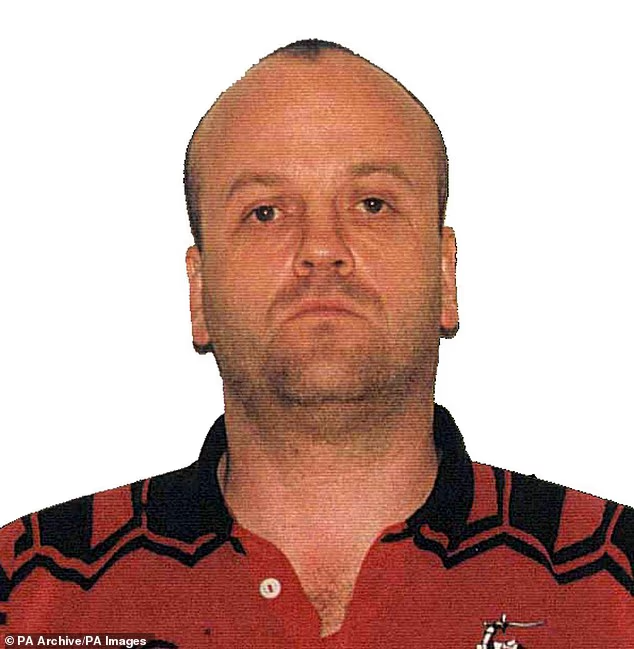
The court heard Allan Grimson, now 66, was jailed for life in 2001 for the murders of two sailors
Advertisement
Nicholas Wright, 18, and from Leicester, was killed by Grimson on December 12, 1997
Jurors were told Grimson molested the boys at his three-bed Portsmouth flat after inviting them back there, in similar circumstances to the killings of Mr Jenkins and Mr Wright.
The court heard he had been with them at the Portsmouth nightclub, ‘Joanna’s’ – which is also where he had been with his murder victims before taking them to his flat.
Advertisement
One of his four alleged sex attack victims said he could only tell police about the incidents after Grimson was jailed in 2001 because he then felt ‘safe’, it was heard.
Grimson served in the Royal Navy and in 1999 he was a Petty Officer Marine Engineering Mechanic and an instructor at the Royal Navy Firefighting School in Horsea Island, Portsmouth.
The court heard his position ‘brought him into contact with many young males aged in their late teens’ over whom he ‘exercised great authority, by reason of his status’.
John Price KC, prosecuting, said: ‘In the period with which the trial will mainly be concerned, the late 1990s, he was a man in his late thirties.
Advertisement
‘He had served with the Royal Navy since 1978. He was a big, powerful man and within the service admired as a capable instructor. He was a single man.’
Jurors were told that when his flat and that of his mother’s flat in the north east of England were both searched, images depicting naked men engaging in sexual activity were found on his computer.
The court heard the first alleged victim joined the Royal Navy in 1998 and attended one of Grimson’s firefighting courses – after which Grimson sent him letters and an 18th birthday card.
The pair then went on an evening out with another friend at Joanna’s nightclub in Southsea, Portsmouth.
Advertisement
At the end of the evening the three of them returned to Grimson’s flat and the alleged victim and Grimson shared a bed, with his friend sleeping in another bedroom.
The pair often went out drinking together and on another occasion he went back to Grimson’s flat. Grimson is accused of five counts of indecent assault and one of rape against him.
Mr Price said the victim claimed said: ‘Grimson tried to kiss me on my lips as we lay in bed. We had both been drinking.
‘I told Allan immediately to stop and that I wasn’t interested in anything like that. Allan stopped immediately and apologised.
Advertisement
‘We then talked about it and Allan told me that he wasn’t certain of his sexuality.
‘I told him that I didn’t have a problem if he was gay as long as he didn’t try anything on with me again.’
He later told police that Grimson had ‘taken advantage’ and ‘put pressure’ on him.
He also told them Grimson had once showed him his baseball bat which he described as his ‘pride and joy’.
Advertisement
Mr Price said: ‘As will be seen, Grimson has sought to portray his relationship towards that teenager as affectionate, if not loving and his towards him therefore as benign and caring.
‘On the other hand, [the victim] describes one which was exploitative, controlling and ultimately sexually abusive, including an act of rape.’
Grimson is also accused of four counts of indecent assault and one of taking indecent photographs of a child aged 14 in the spring of 1999 against another victim.
On one occasion he took him to Disneyland Paris and on another they watched the 1999 FA Cup Final at his flat in Portsmouth, the court heard.
Advertisement
The victim said Grimson took photographs of him naked and became angry when he asked him to stop and thought he would kill him were other people not in the flat.
In April 2001 the alleged victim contacted police and recorded a rape complaint, but found it ‘very difficult’ to speak about it in subsequent interviews.
Telling the jury about Grimson’s murder convictions, Mr Price KC said he killed them in his London Road flat and that ‘those two killings had occurred amidst sexual assaults by him upon them both’.
Mr Wright was killed on December 12, 1997, after he and Grimson had been at Joanna’s nightclub. After attacking him with a bat he put the body in the car before dumping it.
Advertisement
Two years later he told police where Mr Wright’s remains were then discovered.
Mr Price said: ‘Exactly the same thing occurred, exactly a year later, 1998, also on December 12.
‘Grimson and a man called Sion Jenkins, then aged twenty, left Joanna’s nightclub together and returned to Flat 143A, where Grimson killed Jenkins.
‘Again on his account he used his car to remove the body.
Advertisement
‘It was not until the evening of December 16, 1999, and after the police had found the body of Wright, that Grimson told them about Jenkins and identified for them the place where his body was concealed, which is where it was found.
‘Grimson told the police in December 1999 that he had killed Wright with a baseball bat, one which he said he had acquired in Diego Garcia, when he was there serving on a Royal Navy ship.’
“With a 6-3 judgment from the U.S. Supreme Court, President Trump suffered a stunning loss on a signature order he signed on day one of his presidency,”Anthony Romero, the executive director of the ACLU, said.
“This was one of the most important constitutional cases of the past 100 years. The president bet his legacy trying to secure this policy win — even attending the argument in person — and he lost. It was especially gratifying that the majority opinion was authored by Chief Justice Roberts, and that Trump appointees Brett Kavanaugh and Amy Coney Barrett agreed with the decision to strike down the order.”
Ariana Baio30 June 2026 17:30
Advertisement
Supreme Court will consider challenge to law banning semi-automatic rifles next term
Next term, the Supreme Court justices will hear two gun-related cases, this time concerning bans on semi-automatic-style rifles such as AR-15s.
The cases, stemming from challenges to laws in Illinois and Connecticut, argue that banning assault-style rifles infringes on the Second Amendment.
Ariana Baio30 June 2026 17:27
Advertisement
What did the justices who dissented on birthright citizenship say?
Justices Clarence Thomas, Samuel Alito and Neil Gorsuch dissented from the majority opinion in the birthright citizenship case,
Thomas argued that the Citizenship Clause of the Constitution was meant only to grant citizenship to Black Americans domiciled in the United States, but who had been denied citizenship in Dred Scott v. Stanford.
He said it was not meant to extend to temporary visitors or undocumented immigrants.
Advertisement
“The Court adds to the sad history of the Fourteenth Amendment, which was designed and understood to secure equal rights for the freed blacks but has instead been repurposed for political projects that the Reconstruction Congress did not support,” Thomas wrote.
In a separate dissent, Alito argued the Court should have used the ruling to rein in illegal immigration.
“We should not adopt an erroneous interpretation of the Fourteenth Amendment simply out of fear of the consequences of “rocking the boat” or as a reaction to current immigration policy,” Alito wrote.
In another dissent, Gorusch argued the court should have ruled narrowly, allowing some of Trump’s executive order to apply to the children of foreigners who are in the U.S. temporarily.
Advertisement
Ariana Baio30 June 2026 17:18
Florida Governor Ron DeSantis calls birthright citizenship ‘major defeat’
Republican Governor Ron DeSantis, who has closely aligned his policies with Trump, said Tuesday that the Supreme Court’s decision to uphold birthright citizenship was “a major defeat.”
The Florida governor lamented that the decision was “substantive,” rather than “procedural” – meaning it is a firm decision that would require much more to overrule.
Advertisement
“Will need either a constitutional amendment or a future court to overrule this,” DeSantis said Tuesday.
Ariana Baio30 June 2026 16:48
Jewish Council for Public Affairs welcomes birthright citizenship ruling
“As a community that found refuge in this country as immigrants, Jews know that the promise of belonging — the principle that if you are born here, you are from here — is a constitutional bedrock that has allowed our community, and so many others, to thrive in safety for generations,” Amy Spitalnick the CEO of the Jewish Council for Public Affairs said in a statement.
Advertisement
“As this administration continues to target immigrants and refugees with dehumanizing and draconian policies and bigotry, we will keep fighting to ensure that every human life is treated with dignity and that this country lives up to its highest ideals.”
Ariana Baio30 June 2026 16:45
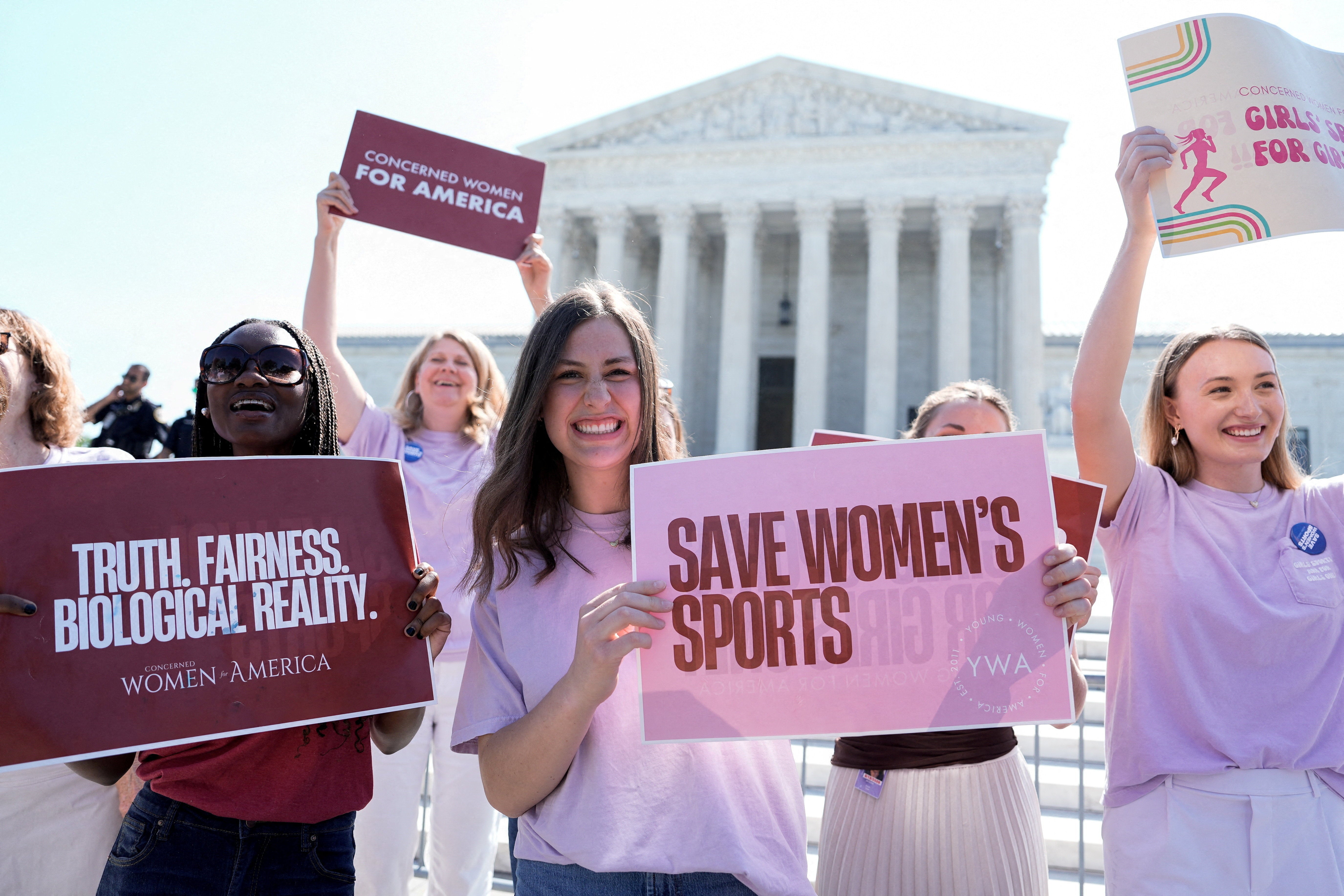
In Photos: Activists celebrate Supreme Court ruling on transgender athletes
Advocates of banning transgender women and girls from sports celebrate after the Supreme Court ruled in favor of states’ laws (Reuters)
Activists who support states banning transgender women and girls from competing on teams celebrate after the Supreme Court decision Tuesday (Reuters)
Ariana Baio30 June 2026 16:31
Advertisement
Attorneys for transgender athletes call ruling ‘deeply harmful’
Lawyers representing transgender athletes, who fought state laws barring their clients from participating on school sports teams, called the Supreme Court’s ruling “deeply harmful” and “heartbreaking.”
“This ruling is deeply harmful for transgender women and girls who only asked for the ability to participate in sports with their peers,” Sasha Buchert, the Senior Attorney and Director of the Non-Binary and Transgender Rights Project, for Lambda Legal said.
Burchert said, “Countless studies have demonstrated the myriad benefits that come with participation in team sports. Now, one population, transgender youth and collegians, are targeted for specific and baseless discrimination.”
“This is a heartbreaking ruling for our clients and transgender girls like them who’ve asked for nothing more than the same opportunities afforded to their peers.” saidJoshua Block, Senior Counsel for the ACLU’s LGBTQ & HIV Rights Project.
Advertisement
“It is profoundly unfair to deny a young person the benefits of teamwork and dedication because of who they are,” said Kelly O’Neill, Legal Voice’s Idaho attorney. “We should be removing barriers for girls and women in sports, not creating new ones.”
Ariana Baio30 June 2026 16:26
News outlet retracts report about Supreme Court justice retiring
NPR has retracted an apparently erroneous report that a sitting Supreme Court justice has retired, shortly after the final decision of this year’s term.
Advertisement
A public information officer for the court has stressed that no such announcements have been made. An editor’s note on the story now states that the outlet “erroneously published” the report.
Alex Woodward30 June 2026 16:19
Trump celebrates ruling expanding political campaign spending ruling
President Donald Trump celebrated the Supreme Court’s decision to strike down campaign spending limits for political parties in coordination with individual campaigns.
Advertisement
“The Supreme Court just took restrictions off political spending! A BIG WIN FOR REPUBLICANS and, more importantly, The First Amendment!” Trump wrote.
Ariana Baio30 June 2026 16:07
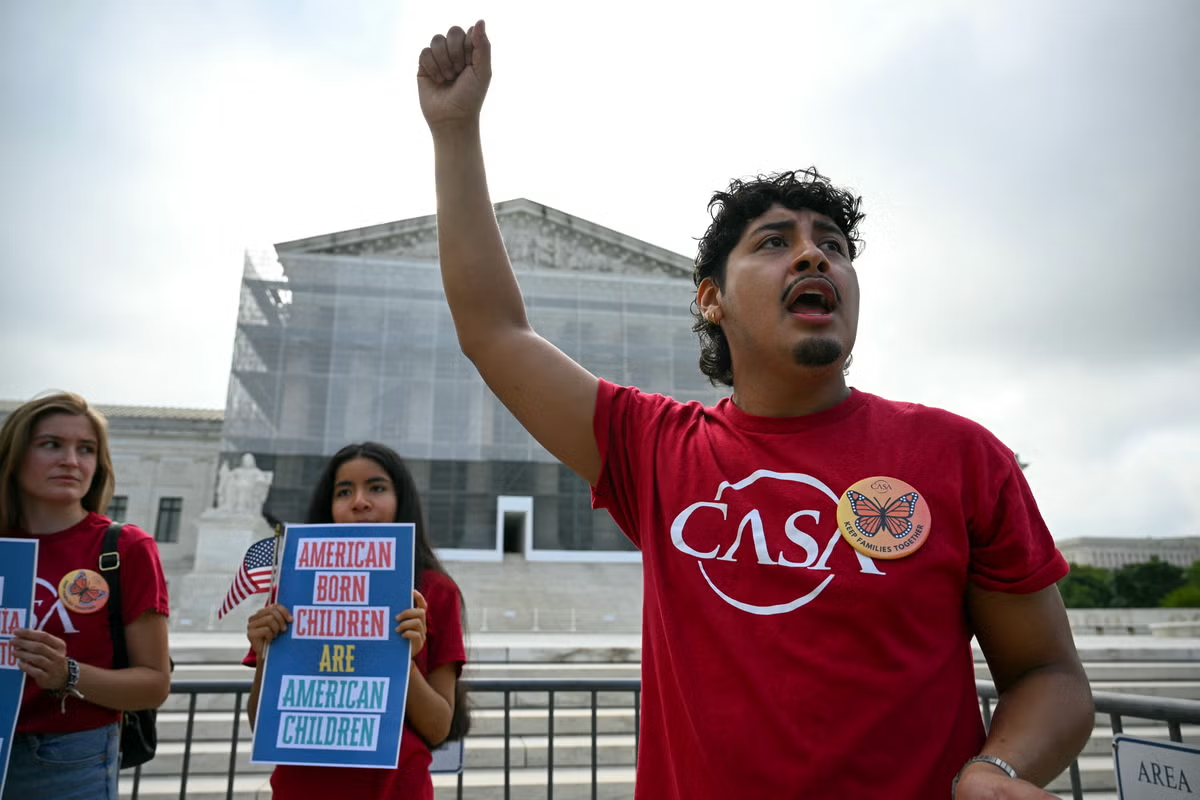
Immigration advocacy group applauds birthright citizenship ruling
“This is an historic victory for immigrant families, constitutional rights, and the principle that every child born in this country belongs in this country,” We Are CASA, a Latino immigrant advocacy group said Tuesdsay.
Advertisement
“The Trump administration’s attempt to deny citizenship to United States-born children, threaten generations of children with legal uncertainty, and overturn more than a century of settled constitutional law has failed.”
“The Supreme Court has reaffirmed what generations of children and families have known to be true: citizenship is a constitutional guarantee. No President has the authority to unilaterally rewrite the Constitution or decide which babies count as citizens and which do not.”
People with terminal illnesses could get earlier and easier access to their pensions
The Government has said one of its ‘clearly outdated’ pension rules could be overhauled as a review is set to take place.
Advertisement
People with terminal illnesses could get earlier access to their private pensions more easily, as the Government said it would revise the rules around how pension schemes work.
Treasury minister Lord Livermore acknowledged there were issues as he said the current definition of terminal illness was ‘clearly outdated’ as he acknowledged the difficulties for people trying to claim their pensions early.
Click here to get the biggest stories straight to your inbox in our Daily Newsletter
Lord Livermore had been asked by Labour peer Baroness Martin of Brockley whether current practices would be updated.
Advertisement
At present people with a life expectancy of less than a year may take a Serious Ill Health Lump Sum, but Lady Martin, who was previously Rachel Reeves’ chief of staff, said some people with terminal diagnoses may live up to 10 years or more.
The current scheme allows the sum to be taken tax-free for those below age 75, up to a sum of £1.073 million. Any amounts above that is taxed as income.
Responding to a question in the House of Lords, Lord Livermore said: “While the current rules are intended to provide flexibility, the Government recognises that the permissive nature of these rules means individuals may experience varying hurdles to access depending on their scheme.
Advertisement
“The Government wishes to ensure a fair and compassionate approach to allowing access to pension savings in cases of terminal illness, and will therefore now consider this issue in further detail.”
Lady Martin said: “It’s encouraging to hear the Government will look again at this important issue. The rules on access to private pensions for terminally ill people were designed for an era when terminal diagnoses often meant death within months, but medicine has moved on.
“For cancer alone, around half of patients now survive 10 years or more compared to just one in four in the 1970s.
“Can the minister confirm that when the Government looks at this issue, they will ensure that the access rules will reflect modern, clinical reality, rather than leaving people who may live for many years with a terminal diagnosis, unable to access funds that are rightfully theirs?”
Advertisement
Lord Livermore responded: “I agree with her that the current definition for when someone with a terminal illness can access their pension savings is clearly outdated and does not align with wider legislation, including the (Department for Work and Pensions) standard definition, so I can confirm the Government will now review this.
“Individual private pension schemes also have their own requirements for terminally ill people to access their pensions savings.
“The Government will therefore also examine the access options across these schemes and will consider what changes may be needed to ensure people have appropriate access while safeguarding against the risk of financial hardship later in life.”
He also told Labour peer Lord Pitt-Watson that the Government would consider ensuring the definition of terminal illness in pensions regulations is the same as that for the DWP.
Advertisement
“Although I can’t prejudge it, it would be ideal if there was now one standard definition,” Lord Livermore said.
NEW YORK (AP) — A self-exiled billionaire Chinese business tycoon once believed to be among China’s wealthiest men was sentenced Monday to 30 years in a U.S. prison for a massive financial fraud that a federal judge said cost over 1,000 people worldwide hundreds of millions of dollars.
Guo Wengui, who fled China a decade ago and reinvented himself as a U.S.-based Communist Party critic, was sentenced in a Manhattan courtroom packed with his supporters by Judge Analisa Torres. She said he “preyed on those seeking to bring Democracy to China,” taking their money so he could live lavishly.
Before he was sentenced, Guo protested his treatment in jail, saying he was taken to the hospital early Monday. He disputed a prosecutor’s portrayal of him as a malingerer faking illness, saying he repeatedly vomited as he was returned to jail before being brought to court.
“When I came here, I said: ‘I have a tummy ache, I need to go to the bathroom, I don’t feel well,’” Guo said through an interpreter of his courthouse arrival. Later, Guo wiped his mouth repeatedly with a tissue.
Advertisement
He only briefly addressed the criminal case, defending his intentions by saying in reference to the Chinese Communist Party: “The reason I came to the U.S. was to destroy the CCP.”
The judge, in sentencing him, read snippets of letters she received from victims who described losing their life savings and feeling severely anxious and shamed and having family members turn on them for their poor investment choice.
Torres said Guo “takes no responsibility for his actions and instead insists incredibly his conduct caused no loss and harmed no one.” She said he “has called upon supporters to harass and intimidate those who dare to speak out against him.”
The judge ordered Guo to forfeit $889 million in restitution.
Advertisement
Wei Chen, a victim who testified at trial, told Torres that Guo’s fraud “destroyed my life” and that of her family.
As Guo left the courtroom after the sentencing, supporters applauded and shouted toward him.
Before his arrest and detention without bail three years ago, Guo grew so close to conservative political strategist Steve Bannon that they announced a joint initiative to overthrow the Chinese government in 2020. He lived in a luxury apartment overlooking Central Park and had joined President Donald Trump’s Mar-a-Lago Florida golf club.
Advertisement
Sign up for Morning Wire:
Our flagship newsletter breaks down the biggest headlines of the day.
Advertisement
Prosecutors had requested he serve at least 30 years in prison, saying his “astonishing” fraud from 2018 to 2023 “destroyed hundreds of lives” and left “a wreckage of victims and families who have been devastated financially, emotionally, and psychologically.”
Prosecutors said in court papers that his ill-gotten riches fueled “a lifestyle of extraordinary excess and indulgence, a gilded life of mansions, yachts, race cars, designer clothes and luxury furnishings.”
Guo was convicted of nine of 12 criminal charges during a seven-week trial that prosecutors said showcased his deception of thousands of investors in bogus deals that enabled Guo’s lavish lifestyle.
Advertisement
In a court filing, Guo’s lawyers wrote that he was the victim of the Chinese Communist Party’s “grand, pervasive, and life threatening” pursuit of him. They alleged that the party recruited elites in U.S. business, entertainment and politics to conspire against him.
They said in presentence court papers that a lengthy prison term would only validate China’s smear campaign and “embolden further efforts to eliminate Chinese dissidents from public life” while defendants in similar cases received prison terms of two-to-four years.
The lawyers noted that a court probation officer wrote to the sentencing judge that Guo, also known as Miles Guo and Ho Wan Kwok, had scars and disfigurements from physical torture he endured in China and subsequent surgeries he underwent from 1993 to 2022 to repair the injuries.
Defense lawyers said Guo’s wealth grew as his family became the largest shareholder of China’s largest publicly traded securities company, but he became a target of Chinese government officials as he exposed them as corrupt. Eventually, the lawyers wrote, Guo moved to Hong Kong, London and then New York in 2017.
Advertisement
Chinese authorities accused him of rape, kidnapping, bribery and other crimes, but Guo said those allegations were false.
On Monday, China’s Ministry of Foreign Affairs said they had noted the sentencing, and that Guo is wanted by the Chinese government and has an Interpol “Red Notice” on him. The notice is a request to police forces around the world to arrest a suspect, pending extradition.
Prosecutors say Guo convinced hundreds of thousands of people to invest more than $1 billion total in entities he controlled, including his media company, GTV Media Group Inc., and his so-called Himalaya Farm Alliance and the Himalaya Exchange.
Guo, the government alleged in presentence court papers, was “entirely unrepentant” for his crimes after he took advantage of lax U.S. asylum laws to flourish in America.
In February 2025 Sir Keir committed to raising Nato-qualifying defence spending to 2.5% of GDP by 2027.
The prime minister also announced that the activities of the UK’s security and intelligence agencies would – by 2027 – be classified as Nato-qualifying defence spending. As a result spending would hit 2.6% of GDP by 2027.
The prime minister also stated a “clear ambition” to increase spending to 3% of GDP “in the next parliament”.
At a Nato summit in the Hague in June 2025 the UK and other members committed to spend 5% of GDP on defence and security with 3.5% going to Nato-qualifying “core defence” by 2035.
Advertisement
The alliance’s members agreed that the rest of the 5% (1.5% of GDP) could be made up of spending to “protect critical infrastructure, defend networks, ensure civil preparedness and resilience, innovate, and strengthen the defence industrial base.”
Sir Keir said on Tuesday that the measures in the DIP “takes us to 4.2% under that commitment”.
WASHINGTON (AP) — Students pursuing graduate degrees in nursing, physical therapy and several other fields will be eligible to take out higher federal student loan amounts — at least for now — after a federal judge blocked part of a Trump administration rule that held them to lower limits.
The U.S. Education Department issued a revised rule on Monday designed to follow the judge’s order from last week, officials told The Associated Press. Agency officials called it a temporary change while they fight in court to keep the original rule, which defined medicine, law and other fields as “professional programs” but excluded fields such as nursing.
The department disagrees with the judge’s order but will comply, even as officials plan to prevail in the case over which degrees are defined as “professional,” Undersecretary Nicholas Kent said in a statement. “We will continue to make the case that the definition is both lawful and appropriate,” he said.
The change represents a short-term win for groups that sued to stop the rule. Eight groups challenged the department’s definition in court, representing nurse practitioners, therapists, speech language pathologists and more.
Advertisement
But in strictly applying the judge’s order, the department is now striking some degrees from the list of professional programs, meaning those students will face lower loan limits. Theology studies programs are among the biggest to shift from professional to non-professional degrees in the shuffle, subjecting theology students to a lower student loan limit. The master of divinity degree — a common degree for pastors and ministers — remains on the professional list, with a more generous student loan limit.
The new rule, which takes effect Wednesday, comes from a student loan overhaul passed in President Donald Trump’s tax bill last year. Programs designated as professional degrees face federal loan caps of $200,000, while other graduate programs are capped at $100,000.
Previously, graduate students had been able to take out federal loans up to the full cost of their degree. Trump officials pushed for new loan caps to rein in student debt and lower tuition prices that they said had grown out of control.
The groups that brought the lawsuit said the rule would require students to forgo their studies or take out riskier private loans. Although many graduate nursing degrees fall within the lower loan limits, some can cost more than $100,000, including in high-demand fields like nurse anesthesia.
Advertisement
In a notification to universities on Monday, the Education Department said it’s confident the Trump administration’s initial rule will ultimately be upheld in court. The amended rule is expected to remain in effect during the judge’s preliminary stay, but the department warned that it “may change as litigation in the case proceeds.”
The original rule included about a dozen programs that were deemed professional, which Trump officials had said was not a judgment on their importance but part of a technical definition dating to the 1960s. Along with law and medicine, that list also included theology, pharmacy, veterinary medicine, clinical psychology and more.
The temporary rule expands that list to 29 specific degree programs, including master of science in nursing, doctor of nursing practice, and doctor of nurse anesthesia practice. Others newly added to the professional list include degrees for physical therapy, athletic training, speech-language pathology, physician associates and anesthesiologist assistants.
The department’s communication listed about 25 programs that are now considered non-professional degrees. Along with theology, that list now includes applied psychology, pharmaceutical sciences and others. (The doctor of pharmacy degree remains professional.)
Advertisement
Last week’s court ruling blocked parts of the Education Department’s definition that were added in a federal rulemaking process. U.S. District Judge Beryl Howell in Washington called it a “misguided” interpretation that strayed from a longstanding definition created by Congress.
The department’s definition laid out several criteria used to weigh if degrees count as professional programs. It said those degrees generally take six years to complete and require licenses to begin practicing, among other requirements.
It also said professional degrees cannot lead to employment that must be “be supervised by another professional” with “more education, training, and qualifications.”
Associated Press Writer Heather Hollingsworth contributed to this report from Kansas City.
___
The Associated Press’ education coverage receives financial support from multiple private foundations. AP is solely responsible for all content. Find AP’s standards for working with philanthropies, a list of supporters and funded coverage areas at AP.org.
Share or comment on this article:
Ivory Coast vs Norway – World Cup last 32 LIVE: Erling Haaland set to return as Emerse Fae’s side take part in knockout stages for first time ever
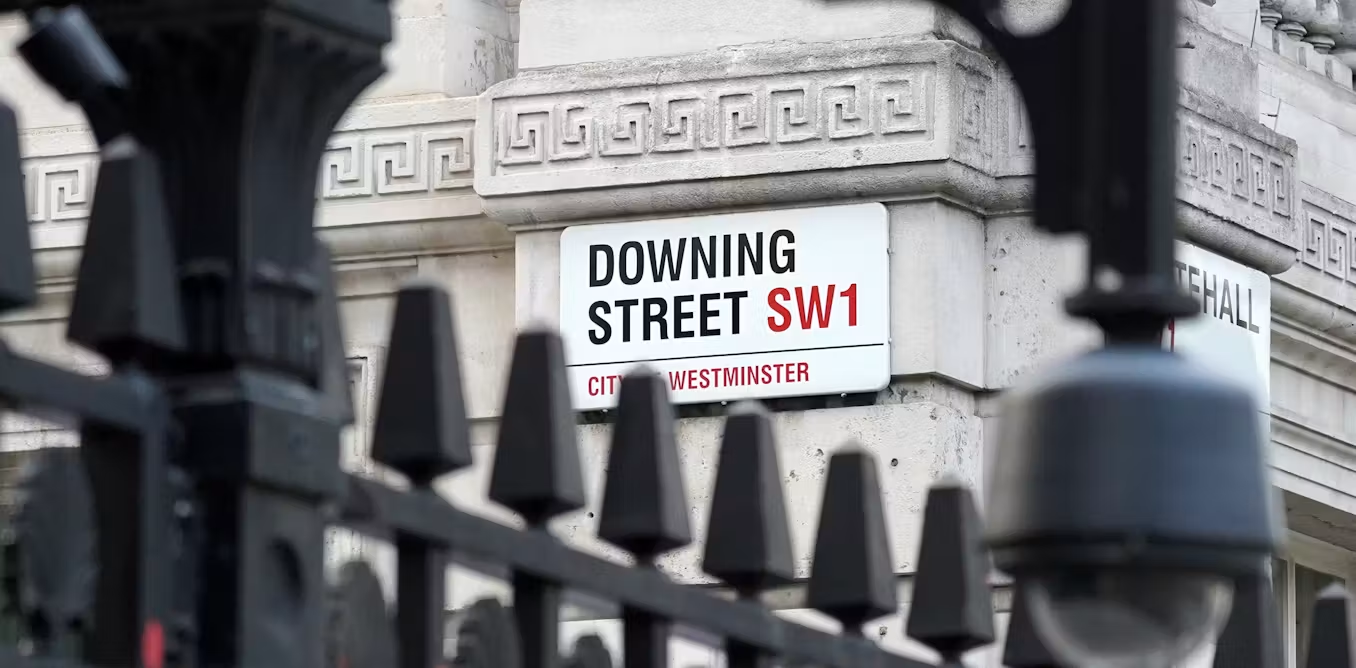
The UK is not usually thought of as the kind of country that’s prone to a coup d’état. Yet in the UK too, power can change hands without a general election. Boris Johnson, Rishi Sunak, Theresa May, Liz Truss – in each case, internal party dynamics determined who occupied 10 Downing Street.
In the current situation, all eyes are on the former mayor of Greater Manchester, Andy Burnham. It’s widely expected that Burnham will become prime minister through an internal Labour party manoeuvre rather than a general election. But this would reinforce the same uncomfortable point. The UK accepts major political transitions without the electorate ever casting a vote. Once again, the public may simply be expected to accommodate the outcome.
Keir Starmer won a landslide in the 2024 general election. But dissatisfaction within the party and across the country soon led to grumblings, cabinet resignations and a collapse in the PM’s public approval. In such a trigger-happy system, any political misstep (or series of missteps) becomes potentially fatal.
Advertisement
Normalising hierarchy
So why do voters accept pressure from within a PM’s own party as legitimate grounds for removal? The answer may lie in psychology, namely the human tendency to justify existing systems, defer to authority and treat hierarchy as normal. Understanding that process is the first step towards challenging it.
“Social dominance orientation” describes a preference for social hierarchy, in which some groups are seen as more deserving of power than others. People higher in this tendency are more comfortable with unequal relations and more likely to support policies, institutions or leaders that preserve hierarchy rather than reduce it. In social psychology, this matters because hierarchy survives when many people come to see it as normal.
One reason for this is that hierarchical settings themselves can make inequality feel natural. Military organisations, policing, workplaces that are structured around hierarchies and elite educational systems all expose people to repeated signals that some voices matter more than others. Over time, this can make hierarchy seem less like a political choice and more like common sense.
That helps explain why internal party decision-making can sometimes be accepted by the wider electorate. When groups such as the 1922 Committee of backbench Conservative MPs (which sets out the rules for Tory leadership contests) or a party’s national executive use internal rules to shape leadership outcomes, their language and formality can create an air of authority. This may make many voters more inclined to accept it.
Advertisement
During the tumultous Conservative years, the UK public got very used to hearing from Graham Brady of the 1922 Committee. EPA/ANDY RAIN
But this raises a deeper democratic question: if people simply absorb the outcome of these elite processes, how representative is that democracy really? One way of thinking about this is through voter apathy and disengagement, which can leave surrogate decision-making unchallenged.
There are ways to push back against this. Meaningful interactions between people from differing social groups (known in psychology terms as “high-quality inter-group contact”) can reduce support for hierarchies. This is especially true when it takes the form of genuine one-to-one contact, rather than just symbolic interaction.
And so can “cultural humility”: the willingness to recognise that we do not fully know other people’s experiences and should approach difference with respect, curiosity and awareness of inequality. These are practical ways of loosening the hold of hierarchy on politics.
Advertisement
Internalised classism adds another layer. This is the process by which people absorb negative beliefs about their own social group and begin to see themselves, or those like them, as less entitled to lead. That can make the acceptance of unelected elites easier, especially when those elites come from the upper classes. The privileged upbringing of Eton-educated Johnson, for example, did not prevent him from appealing to some working-class voters to win a general election in 2019 and lead the UK through Brexit.
Of course, the easiest way to alleviate internalised classism is for the governing party to change its rules to ensure that any new prime minister must be elected via a public vote, rather than leadership challenge. However, this small change would have a seismic effect and is unlikely to happen.
Ultimately, the strongest defence against unelected leaders is democratic accountability. That means questioning backroom power, reducing political apathy and encouraging citizens to care about who governs them and how. If democracies fail in this, they risk normalising elite rule and weakening the foundations of democratic life.
You know that feeling when you walk into a room and immediately forget why you came in? Maybe you were there to fetch your keys. On your way to the room, you were thinking about grabbing your keys. But once you arrive, your keys have completely disappeared from your mind.
This is sometimes known as the doorway effect, since it often strikes when you walk into a new room. Why does it happen? The answer has a lot to do with a faculty called working memory. Information gets stored in working memory when we need it for the tasks that we are engaged in right now (like remembering to grab your keys).
What makes working memory so intriguing is its close link to consciousness. The doorway effect suggests that when information is removed from working memory, it immediately seems to leave consciousness. It also suggests that it is easy for information in working memory to be forgotten.
The link between working memory and consciousness is getting increasing attention in psychology, philosophy and neuroscience. Could working memory somehow give rise to consciousness? In my new book, I explore the complex relationship between the two.
Advertisement
Working memory: both rich and poor
To understand the doorway effect, we’ll need to know a bit about working memory. One thing that makes working memory so special is that it’s so rich, both in terms of the information it has access to, and its processing power. According to recent models of working memory, it can draw information from sensory channels (vision, touch, smell etc), as well as from other memory systems such as long-term memory and also the brain’s system for processing language. In other words, working memory is where a lot of the information in your brain comes together.
Wait, why am I carrying boxes? Prostock-studio/Shutterstock
Once working memory has that information, there’s a lot it can do with it. Inside working memory are a host of different smaller systems for specific tasks, including visual and spatial reasoning (like solving a Rubik’s cube) and storing chunks of information (like a phone number). There’s even a “central executive” system (my favourite). The executive is like a merciless boss, assigning tasks to the different systems within working memory and keeping everything under control.
In other ways, what makes working memory so special is that it’s simultaneously very poor. Despite the riches of information available to it, working memory can only actually store a tiny amount of information at any one time.
Advertisement
In one classic experiment reported in 1997 people were asked to view a screen with several coloured shapes on it, which they were told to remember. The shapes then disappeared for about a second, and a new set of coloured shapes appeared. One of the new shapes might have changed colour. Participants were asked to spot whether there had been any changes between the two sets of shapes. This is called “change-detection”.
People were almost perfect at this when there were only 1-3 shapes involved in each set, but got steadily worse as the number of shapes was increased from 4-12. The experimenters argued that this is because it gets harder to store information as the number of shapes increases. This is because the capacity of working memory isn’t big enough to store lots of shapes. The experimenters concluded that the capacity of working memory is only about four “slots”. Once those slots are taken, working memory is full up: there’s simply no more room for any new information.
The idea that working memory has “slots” is closely related to something called “chunking”. Here are two strings of letters (nine in each). Try to memorise them both:
BBC FBI WWF
Advertisement
ZQK EWP WLJ
I bet you find the first string of letters easier to memorise. This is because they’re familiar, and so naturally your brain sorts them into three chunks. They can then be stored as three different chunks in working memory. For this reason, the first set only takes up three slots in working memory. The second string of letters is unfamiliar, and so requires us to store all nine letters as individual chunks. This is difficult because working memory quickly runs out of slots.
But like many features of working memory, its capacity is a hotly debated issue. A growing number of scientists have rejected the idea that it has “slots”, arguing instead that its capacity is more of a flexible resource that can be differently distributed across different pieces of information. According to this view, working memory’s capacity – far from being four rigid slots – might be more like a tank of water to be used in watering your garden: you can give a little bit of water to lots of different areas, or lots of water to just one or two areas.
In the same way, working memory might be able to store a little bit of information about lots of objects, or very detailed information about just one or two of them.
Advertisement
One study from 2004 supports this flexible resource view over the slots view. This experiment also used change-detection with shapes.
Crucially, the experimenters tried this with different kinds of shapes. Sometimes they used only very simple shapes, sometimes very complicated ones. They found that people seem able to store information about more of the simpler shapes in working memory. They were much worse at storing information about the complicated shapes. In fact, the experimenters suggest that the capacity of working memory for a very complicated object (like a cube with many different coloured sides) might only be between 1 and 2.
This seems to show that the capacity of working memory is “soaked up” much more when it tries to remember very complicated objects. This suggests that working memory doesn’t have a fixed number of slots, but that its capacity depends on how complicated the information you’re trying to store is.
To me, there’s something romantic about how rich working memory is in terms of how much information is available to it, and how poor it is in terms of its small capacity. It’s like it can always see the vast riches available to it, but can only ever sample a tiny portion at a time.
Advertisement
The low capacity of working memory can help us understand why the information it stores is so easily forgotten, like in the doorway effect. There’s not much room in working memory, so when new information comes in, old information needs to go.
As I mentioned at the beginning, research suggests that the very action of walking through a doorway might trigger forgetting. One experiment showed that people find it harder to remember things when they walk through a doorway, compared to people who walk the same distance but don’t cross a threshold. When we enter a new room, its like the brain flushes away the old facts from working memory, to get ready for the fresh information that we might need in our new setting.
From an evolutionary perspective, the doorway effect makes sense: forgetting old information is important in helping us to stay open and alert to novel information in the new environment.
Thinking about the capacity of working memory can help shed light on why it’s so easy to forget things, even when we were just this second thinking about them. But there’s an even more tantalising possibility here. When we forget things like our keys, they seem to drop away from our consciousness entirely. This raises the suggestion that working memory and consciousness might go hand in hand.
Advertisement
Working memory and consciousness
Consciousness is perhaps the biggest mystery facing both science and philosophy today. By “consciousness”, I mean the subjective experiences that we have of the world. Consciousness includes the visual image of a beautiful sunset, or the taste of chocolate, as well as emotions like love and anger.
The close link between consciousness and working memory is clear from some of the major theories of consciousness in psychology and neuroscience today. Personally, I’m a huge fan of the global neuronal workspace theory, which suggests that consciousness arises as a result of information being “broadcast” in a “global workspace” in the brain. This workspace is like a central information store, which can process information and distribute it globally to many different systems in the brain.
Does that sound like working memory to you? If it does, that’s no coincidence: the global workspace and working memory are similar notions. Their similarity can even be seen in the brain. There are still lots of open questions about where working memory is located in the brain but one important area is the prefrontal cortex. This is at the front of your brain, just above your eyes and behind your forehead. The same area also seems to be important for the sort of global broadcasting that global workspace theorists think is responsible for consciousness.
Advertisement
Scientists friendly to the global neuronal workspace theory have suggested that when we pay attention to information that is stored in working memory, that information gets boosted in volume and is broadcast across the brain – and that is what makes it conscious. According to this view, consciousness arises when working memory and attention work together.
The idea that attention and working memory might both be important for consciousness seems to fit with our own experience. When you’re trying to remember a phone number in your head, your attention stays on the phone number and you’re conscious of it. If someone distracts you by asking you a question, your attention is pulled away from the phone number and it immediately gets deleted from your consciousness. According to this picture, no attention = no consciousness.
The importance of both working memory and attention also fits with experimental data. One of my favourite experiments studied people walking across a courtyard on a spring afternoon. It was found that 75% of people who were on their mobile phones completely failed to spot a purple and yellow clown unicycling around the courtyard. This is even though the clown could have crossed their path, potentially causing a dangerous collision. They were on their phones, their attention was elsewhere, so the clown didn’t get into their consciousness. Again, this suggests that no attention = no consciousness.
I have a lifelong fear of clowns. The idea that there might be a clown nearby that I just haven’t spotted fills me with dread. (I mean come on, they’re clearly terrifying).
But like everything to do with consciousness, the link between consciousness and working memory is controversial. Some think that there’s just too much consciousness to fit into working memory. Others say that some bits of working memory aren’t conscious at all. Let’s have a look at these arguments.
Is working memory too small for consciousness?
We’ve seen that working memory has a small capacity. This raises an obvious question: if working memory is responsible for consciousness, doesn’t that mean that consciousness must have a small capacity as well?
This can be a difficult idea to swallow. Imagine you’re looking out at a countryside scene. You see rolling hills, the vibrant sunshine and a herd of cows. You hear the birds, smell the fresh cut grass and feel the wind on your skin. Surely you are conscious of this whole scene all at once. But we know that working memory has a capacity that is far too tiny to fit all of this information in at one time. If consciousness arises from working memory, then how can I be conscious of all this stuff at once?
Indeed, some philosophers and scientists have argued in just this way, saying that consciousness overflows the capacity of working memory. If this is true, it would be a problem for those who think that consciousness arises from working memory.
Advertisement
In response to this problem, supporters of the link between working memory and consciousness have argued that consciousness isn’t as big as you might think. With the countryside scene, you might think that you’re conscious of all those sights, sounds and smells together. However, according to this view, really you’re only ever conscious of a few scraps at any one time. The reason it feels like you’re conscious of more is because, whenever you pay attention to something, that attention boosts the information into consciousness.
This is known as the refrigerator light illusion. Imagine someone who thought the light in their fridge was always turned on, because whenever they open the door to check, the light is on. Obviously, the problem is that the very act of opening the door causes the light to come on.
In the same way, the very act of checking to see if you’re conscious of birdsong causes you to direct attention to it, which brings the birdsong to consciousness. According to this view, we are only ever conscious of a few little bits at a time, but the ease with which attention can make things conscious fosters the illusion that we’re conscious of a lot more.
As if it weren’t bad enough that doorways make us forget, or that phones make us ignore unicycling clowns, now we have to deal with our fridges hoodwinking us about our own consciousness.
Advertisement
Working memory without consciousness?
Another area where consciousness and working memory might come apart concerns unconscious information. We know that lots of processing in our brains occurs unconsciously. When it comes to information in the brain, we only get to be conscious of the very tip of a large iceberg. Some psychologists have suggested that some of the information in working memory is completely unconscious. If this is true, this would mark an important difference between consciousness and working memory (since by definition, unconsciousness can’t be part of consciousness).
One key experiment from 2011 involves showing participants an image of a rippled patch, tilted at a specific angle. In the psychology world, this is called a Gabor patch. This patch was only shown to the participants for the tiniest flash of time. It’s there on the screen for only 16.67 milliseconds, about 17 thousandths of a second. This is about as long as a bee takes to flap its wings three times.
Gabor patch. wikipedia
Flashing the patch on the screen so briefly prevents the patch from being consciously seen. Because of the brevity with which the patch appears, information about the patch enters the participants’ eyes, and participants see the patch but are not consciously aware of it. They see it, but unconsciously.
Still, we know that information about things we’re not conscious of must be processed at quite a high level in the brain. After the first patch disappeared, they were shown another different patch. This one was shown for longer, so it could be seen consciously. Participants were asked to indicate (by clicking a button) whether this second patch was tilted to the left or the right of the first patch that they had not consciously seen. Amazingly, they were able to do this at a level above chance. Even though the first patch was unconscious, people could still use information about it to make comparison judgements.
Advertisement
This is crucial for working memory and consciousness. The experimenters claimed that information about the briefly flashed patch must be stored in working memory, even though participants were completely unaware of it. From this, the experimenters concluded that some information in working memory is not conscious. If so, the link between consciousness and working memory is weaker than we might hope.
My idea: not all-or-nothing thing
When it comes to the experiment just discussed, I want to close with some of the ideas that I’ve been exploring in my book. I think that working memory might not be an all-or-nothing thing, that information might not have to be either “in” or “out” of working memory.
Sometimes, we can slip into the trap of thinking that everything in the human mind must be either one thing or another. This mindset is very natural, but in my book I argue that it must be rejected.
I suggest that there could be some information that is not “in” or “out” of working memory, but somewhere in between. I argue that working memory comes on a spectrum. Some information is definitely in working memory, and some is definitely not. But in between (I argue) is a large grey area where there is some information in our minds that falls in between being fully stored in working memory and not being stored.
This is certainly an unusual suggestion. But I argue that thinking about working memory as a spectrum sheds new light on the experiments I talked about above. Remember the patch that was flashed up in three beats of a bee’s wing – so fast you couldn’t consciously see it and preventing it from being fully encoded in working memory? I argue that this information sits in the grey area between being fully in and fully out of working memory.
This raises an interesting possibility with respect to consciousness. If we think that working memory is closely linked to consciousness, an obvious question is whether there can be a grey area between something being conscious and not being conscious. Indeed, some philosophers have suggested that there might be such a grey area.
At first sight, the experiments I’ve talked about might look a bit strange and obscure. When I tell people about these experiments at parties, they sometimes ask me how I can spend so much time thinking about doorways, unicycling clowns, or how we remember random shapes. I get visibly excited talking to people about all this, and I can almost see them making a mental note not to invite me back.
But these experiments are exciting. To see this, we need to step away from the technical details of these experiments and take a broader view. These experiments and others continue to unearth the mechanics of working memory. There is still much more to find out, such as where and how it is brought about in the brain, and the ways in which injury to the brain can impact on working memory. As these mysteries are slowly explained, perhaps we will be in a better place to tackle the arguably biggest conundrum in science: consciousness itself.






















































You must be logged in to post a comment Login