

Connect with us
DAPA Banner

NewsBeat

Relationship experts and couples say romance doesn’t need grand gestures to thrive

Published

on

Relationship experts and couples say romance doesn't need grand gestures to thrive

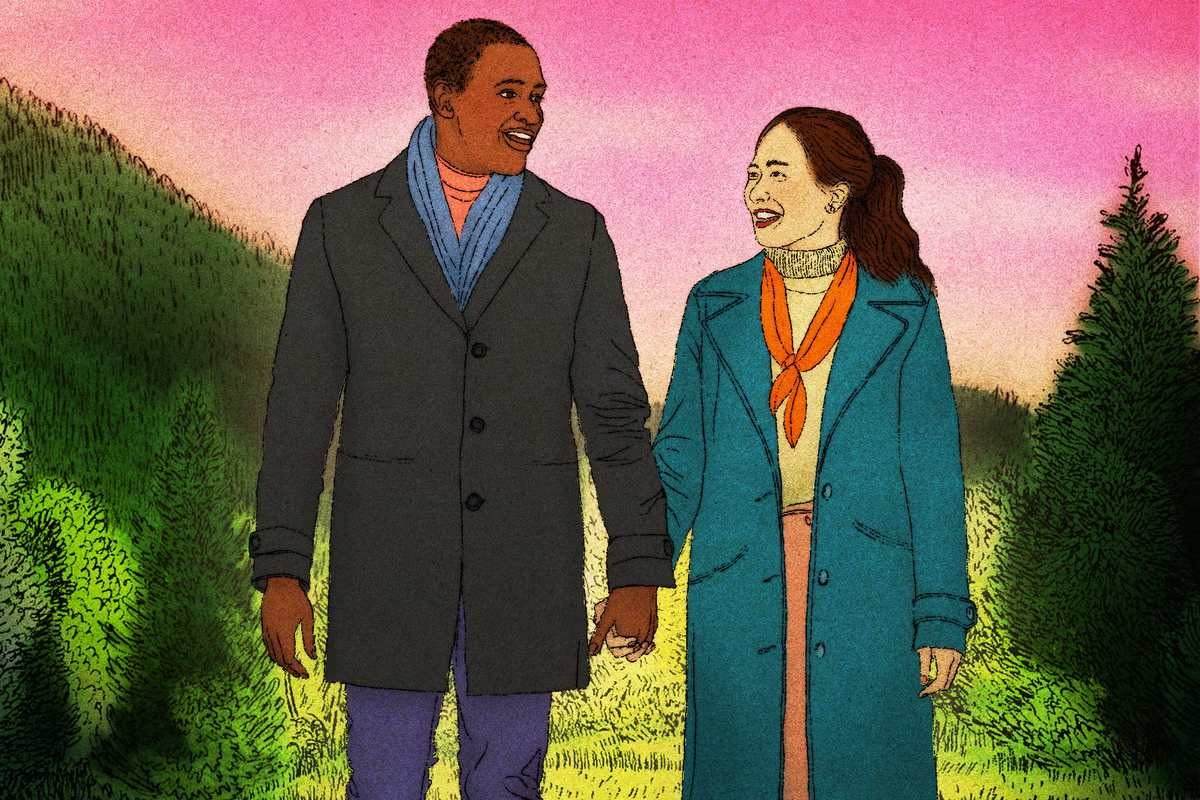
Doing something romantic for Valentine’s Day does not need to involve a heart-shaped box of chocolates, roses or an atypically expensive dinner, according to relationship experts.

In fact, therapists encourage couples craving intimacy and a deeper connection to focus less on grand gestures and more on expressing love with mundane acts that recognize what matters to their partner.

Romance is not one size fits all. For some people, it means holding hands, opening a car door or drawing a bath for their lover. Others respond to receiving a hilarious text, coffee in bed or an offer to run a nagging errand. Either way, demonstrating kindness and care in small ways over time helps to support relationships as they evolve, says Traci Lee, a licensed marriage and family therapist in Dallas.

“The more that early on, you as a couple are able to establish good habits of whatever romance is going to look like for you, the better it is,” Lee said.

Advertisement

Couples counselors and people in relationships share ideas for showing a romantic partner love throughout the year:

Romance is constantly evolving

Early in a relationship, it doesn’t take much to show romantic intentions, but that changes as couples learn more about each other as individuals, discover what their partner needs for emotional and physical well-being, and experience life together.

“Depending on what stage of the relationship you’re in, romance can mean different things,” Lee said. For example, couples with parenting and caregiving responsibilities have less time to devote to each other than they did during the honeymoon phases right after they started dating or got married.

Advertisement

Gabrielle Gambrell, who lives in New York with her husband of seven years and their two children, thinks romance “should be an evolution” and therefore takes work. One piece of advice she received before getting married stuck with her: Never stop dating.

“You keep romance alive by continuously dating,” Gambrell said. “No matter how busy or what happens in the world, me and my husband have a mandatory date night. And every single date night, we leave the date energized and happy and grateful, and reminded what means the most to us.”

Taking the pressure off Valentine’s Day

Valentine’s Day carries a heavy burden of social pressures, fantasies from movies and books, and individual desires and expectations that often go unexpressed. All can be managed with planning and communication, experts say.

Advertisement

“Some people will say, ‘If I have to tell my partner what to do, then it won’t be romantic.’ But I have to remind people that their partner is not a mind reader,” Lee said. “I try to blow up the myth that romance can only happen if it’s created spontaneously out of thin air.”

Gambrell, who describes herself as a planner by nature, says she typically starts asking her husband questions about their plans for Feb. 14 days before. Making assumptions about the best way to celebrate Valentine’s Day and comparisons with other couple’s relationships are likely to lead to disappointment, she said.

“Love is not perfect. Romance is not perfect. Relationships, there’s nothing perfect about them, but they are beautiful,” she said.

Clarence Smith IV, a 29-year-old middle school teacher and video content creator in Phoenix, remains a big believer in using traditional acts of chivalry to communicate respect and care for his girlfriend, such as positioning himself closer to the curb when they are walking together on a street.

Advertisement

“Romance today involves more seen gestures – let this be seen, let this be shown, let this be big,” Smith said, adding that in his dating experience some people see his gentlemanly behavior as old-fashioned. “I do little things like that, and they’re looked at as superbly impactful. We don’t do this anymore. But to me, baby, this is basics.”

Express love beyond February

While some relationship experts recommend establishing traditions around meaningful holidays, anniversaries and birthdays, others say that creating rituals to mark new seasons or weekends are equally valuable as part of the foundation for merging lifestyles and routines.

Lee says she often explains to her clients a popular analogy in the counseling industry: If you get in a fight with your partner and apologize with a dozen roses, that would be great, but bringing one rose every day for 12 days would communicate consistency and dedication.

Advertisement

She asks patients, “What are some small things that you can do that are going to be a way for you to show up for your partner in the way that they need it?”

Gambrell says gift-giving is the way she prefers to receive and show love. As a result, it touches her deeply and comes across as a romantic gesture when her husband buys her a scratch-off lottery ticket or stationery item, like a pen or notebook, at the store.

“It’s knowing that you’re thinking about me, that I’m on your mind, that you stop what you’re doing to think of me,” she said.

Smith encourages people to not be afraid of expressing love regardless of how experienced a dating life or how long a relationship they have.

Advertisement

“Do not be afraid to love in your own way,” he said. “It’s always worth it. You always win in the end.”

Source link

Continue Reading
Click to comment

You must be logged in to post a comment Login

Leave a Reply

NewsBeat

Man warned pals ‘it will go with a bang’ before fatal house explosion after rent increase

Published

on

Daily Mirror

David Howard had lived on John Street, Worksop, for 11 years when the massive explosion reduced the property to rubble on April 12, 2025, killing him and his dog

A man’s home blew up after he told his friend he’d “pulled off the gas pipes” when his landlord put up the rent by £80.

David Howard had lived at the Nottinghamshire property for 11 years before a massive gas explosion destroyed the house and killed him and his dog.

On April 12, 2025 he received a letter from his landlord saying she was putting up his rent, which was mostly paid by the local council, by £80 to £540.

Advertisement

Friends told how at around 3pm that afternoon Mr Howard started telling several people he was going to “blow the house up”, saying “you wait until the end of the day”, an inquest into Mr Howard’s death was told today.

DC Daniel Akehurst read to the court from an account by one of Mr Howard’s friends, she had told cops that on the day Mr Howard was “p****d off and could not cope anymore” due to his rent going up.

Shanelle Williams described how Mr Howard was “in a mood and depressed”. The woman was then called by Mr Howard at around 3pm, when he told her “he had pulled the pipes” and made comments about “blowing up the house”.

Advertisement

In another call at 3.29pm, Mr Howard told Ms Williams “I’ve done it, I’ve pulled the pipes off the gas. It’s going to go with a bang.”

The latter call lasted 42 seconds and was ended by Mr Howard before Ms Williams could say anything. Before this, Mr Howard had told friends he had been up for three days with no sleep and was “very upset” about the rent increase”.

A friend tried to give him advice but he wasn’t listening, with Mr Howard saying, “You watch”, “You wait until the end of the day” and “You wait to see what happens”.

The inquest was told Mr Howard had made similar comments before April 12.

Advertisement

Around 3pm, Mr Howard locked the doors to the property he was renting after two of his friends left to go to a shop, which was described as “strange”.

Upon returning, the two friends were told by Mr Howard to “go, I don’t want anyone else to get hurt. Please just go”.

Asked by his friends if they could at least take his dog, Roxy, Mr Howard said: “Roxy is staying with me.”

Advertisement

Another friend then went to the property and tried speaking to him but was told to “f*** off”. The same person said she could smell gas.

Another then told Mr Howard through the locked door: “You are being stupid, there are kids next door. You are a f****** idiot.”

The hearing wasn’t told any of the friends made any attempts to notify emergency services of the events.

A call was then received by the police at 7.39pm to say an explosion had occurred at 26 John Street.

Advertisement

DC Akehurst described how the house had “fully collapsed” by the time emergency services arrived to the “chaotic” scene and a major incident was declared.

The hearing was told up to 200 people were “milling around” the street, with these residents then evacuated.

DC Akehurst said the explosion was “large and powerful” and its force had also damaged the adjacent properties, as well as some opposite.

Advertisement

A statement from a first responder read out in the hearing said Mr Howard was still conscious when emergency services arrived and reported having significant difficulty breathing and “was slowly being crushed” as he was “trapped under a significant amount of rubble”.

Crew couldn’t get to him, however, due to the difficulty of the scene and he was pronounced dead at 9.58pm.

Christopher Trendowicz, fire investigator at Nottinghamshire Fire and Rescue Service, told the hearing that the explosion happened on the ground floor of the property, with its upper floor collapsing on top.

The Health and Safety Executive (HSE) instructed gas company Cadent to investigate any possible leaks from outside the property but this was not the case.

Advertisement

The gas meter, boiler and piping were also tested and found to be safe.

The only abnormality found was damage to the cooker, owned by Mr Howard, which had its flexible gas pipe “stretched to capacity”.

Mr Trendowicz said this was the likely cause of the gas leak, with the likely cause for the ignition being the capacitator of the fridge/freezer in the property being “ripped out”.

Advertisement

The fridge/freezer was found away from where it would be ordinarily, the hearing was told.

Coroner Nathanael Hartley concluded Mr Howard’s cause of death as 1a asphyxia whilst entrapped beneath collapsed building debris and 2 heroin and cocaine use.

Mr Howard had low levels of the two drugs and alcohol in his blood at the time of his death, which could have led to “mild cognitive impairment”.

He had a history of mental health issues, having been diagnosed with PTSD and moderate depression in 2021, as well as a substance abuse misuse history, which he first reported in 2012.

Advertisement

Mr Howard’s two daughters, Keely and Lauren Howard, both attended the hearing but refused to comment on their father’s mental health or to describe him as a person when asked by coroner Hartley.

No notes were recovered from the property during the investigation, coroner Hartley said.

The coroner said: “Having heard the evidence from the fire service about the damaged gas pipe cooker and the evidence that David had informed his friend that he had ‘pulled the pipes, was going to blow the house up and it was going to go with a bang’, I find that David caused the damage to the gas cooker intentionally.

“It’s possible that David did not appreciate the dangerousness of the situation. With that in mind, I do not find that David intended to end his life when he did. I find that David’s intentions cannot be established.”

Advertisement

Source link

Continue Reading

NewsBeat

Chopping down areas of tropical rainforest is causing rising temperatures linked to thousands of deaths

Published

on

Chopping down areas of tropical rainforest is causing rising temperatures linked to thousands of deaths

Tropical forests are hot, steamy places. But when large numbers of trees are cut down, they get even hotter. Our recent research shows that clearing large areas of the rainforest exposes hundreds of millions of people to higher temperatures, increasing heat stress (when the body’s way of controlling temperature fails) and, in some cases, contributing to death.

Research suggests that this could be contributing to 28,000 heat-related deaths each year across the tropics every year.

Apart from the shade that the rainforest canopy provides, trees also cool their surroundings by pumping water from the soil into the atmosphere – a process known as evapotranspiration. Like sweat evaporating from our skin, this uses energy and cools the air.

A single large tropical tree provides as much cooling as several air conditioners running continuously. Across the billions of trees in the Amazon or Congo, this “sweating” cools entire regions.

Advertisement

People living in or near tropical forests recognise these cooling benefits. When villagers in rainforest regions in Kalimantan, Indonesia, were interviewed about the benefits tropical forests provide, the most common answer was their ability to keep local temperatures cool.

Despite these benefits, tropical forests are being destroyed at an alarming rate. In 2024, more than 6 million hectares of primary tropical forests (nearly the size of Panama) were destroyed, the fastest rate since records began.


Nike Doggart, CC BY

Tropical deforestation reduces the cooling effect forests provide, leading to local warming – a pattern well documented by previous studies. But how is this warming affecting the lives of people living near tropical forests?

Advertisement

Deforestation is amplifying heat

To answer this, we used satellite data to track how deforestation has affected temperatures over the past 20 years. Over this period, large areas of forest in the Amazon, Congo and south-east Asia were cleared. We compared temperature changes in deforested regions with nearby areas that retained their forests. Tropical regions that retained their forest cover warmed by an average of 0.2°C. In nearby areas where forests were cleared, temperatures rose by 0.7°C – more than three times as fast. This shows that deforestation results in a dramatic regional amplification of climate warming.

An illustration showing temperature rises in South America based on data collated by the researchers.

An illustration showing temperature rises based on data collated by the researchers.
Author’s own research., CC BY-SA

To understand the impact on local people, we mapped this warming onto information on where people live across the tropics. We found that more than 300 million people were exposed to higher temperatures caused by deforestation. Exposure occurred right across the tropics: 67 million people in Central and South America, 148 million people in Africa and 122 million people in south-east Asia were exposed to warming.

Some countries with rapid rates of deforestation were particularly affected: 49 million people in Indonesia, 42 million people in the Democratic Republic of Congo and 22 million people in Brazil were exposed to hotter temperatures caused by deforestation.

A hidden public health crisis

Exposure to high temperatures has a range of negative effects on health. For instance, it can reduce the productivity of farmers and reduce the time it is safe to work outdoors. Exposure to high temperatures also causes heat stress that can be lethal. Heat waves in the Amazon are associated with a higher risk of mortality from cardiovascular diseases.

Advertisement
Infographic showing difference in temperature in tropical forest with deforestation, and where there hasn't been, based on author's research.


Author’s own., CC BY

We combined information on the number of people exposed to deforestation-induced warming with region-specific heat vulnerability information and non-accidental death rates. We used this to estimate that the heating from deforestation is linked to around 28,000 heat-related deaths each year across the tropics. This means that over the past 20 years more than half a million people have died from heat-related causes as a result of deforestation.

It is well known that tropical deforestation releases carbon dioxide and this contributes to global climate change. Indeed, arguments for reducing deforestation are often focused on carbon. But despite numerous international pledges, tropical deforestation continues to accelerate.

Recognising the public health impact of deforestation could help broaden support for forest protection. Although the local warming effects of deforestation are well recognised by local people, communities and decision-makers often lack precise data on how much deforestation is increasing temperatures in their area. To address this, we developed an online tool that provides information at province level on the warming linked to deforestation. We hope this locally relevant data will help communities and decision-makers make more informed decisions about managing their forests.

There are some promising new initiatives that recognise the value of tropical forests. Brazil is setting up a new fund that will pay tropical nations to keep their forests intact. It recognises the public services provided by tropical forests – including their ability to regulate local climate – and it rewards countries for protecting them. Some European countries supported the development of this facility but other than Norway, few have yet committed substantial funding. Perhaps given the current global crisis they think it is too far away to affect them, or are prioritising other areas. In doing so they are ignoring potential effects on migration flows, global air quality, loss of biodiversity and food supply chains.

Advertisement

For many years, tropical deforestation has been viewed as an environmental issue. Our research shows that it is also an urgent public health issue. Protecting tropical forests is not just about conserving nature or storing carbon. It is about protecting the health – and lives – of hundreds of millions of people.

Source link

Advertisement
Continue Reading

NewsBeat

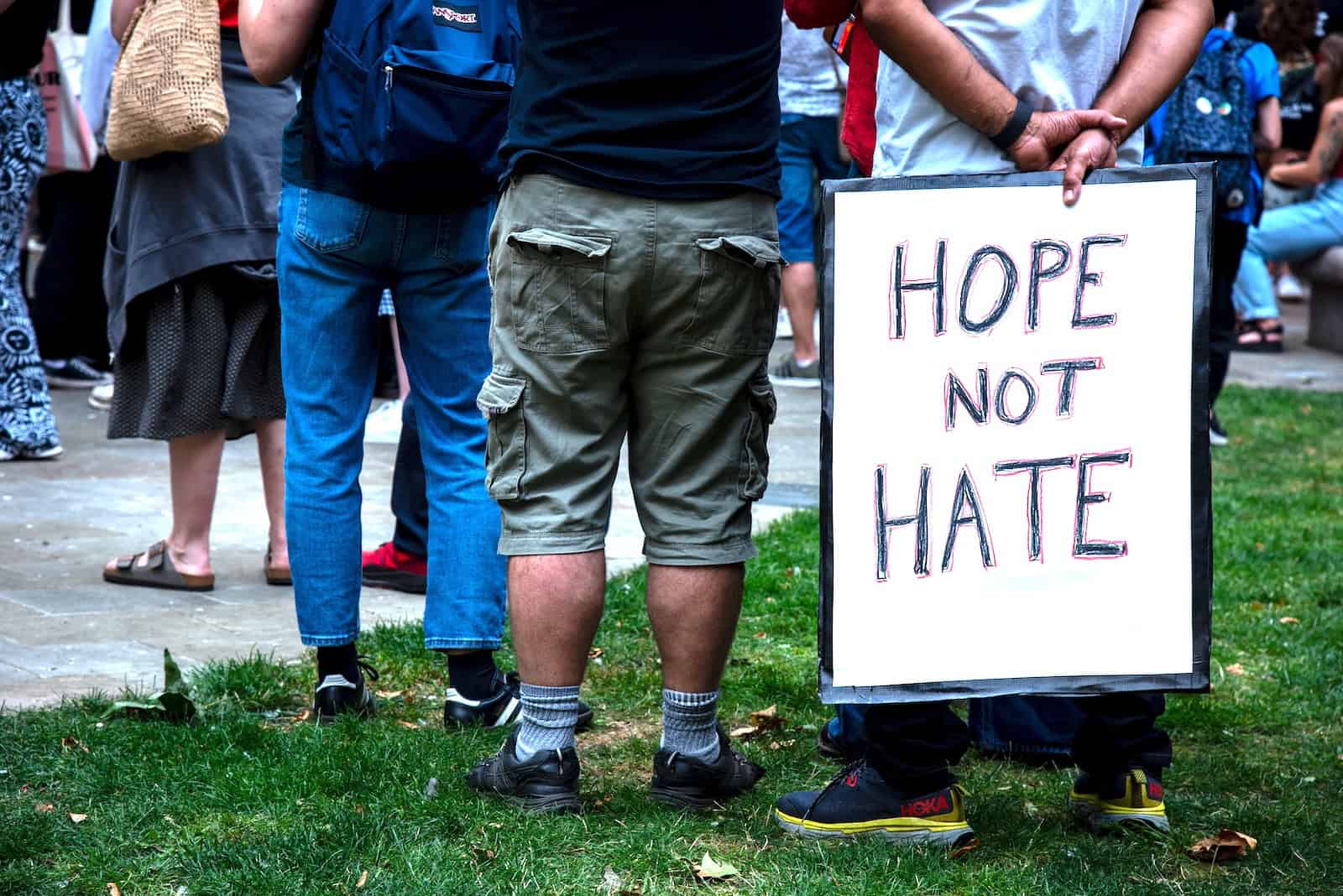
‘It’s time to act’: London’s march for unity draws thousands

Published

on

‘It’s time to act’: London’s march for unity draws thousands

Tens of thousands of people gathered in central London on Saturday for a peaceful protest described as one of the largest ever demonstrations against the far right in the UK.

The march took place amid growing evidence of democratic backsliding under right-wing governments – as highlighted in a report published today by the Civil Liberties Union for Europe.

High-profile figures including actor Sir Lenny Henry, singer Paloma Faith and comedian Steve Coogan were among those taking part the march, which was organised by the Together Alliance – a coalition of more than 500 organisations campaigning for unity over division. 

Advertisement

Together Alliance said that more than half a million people took part in the march, although police estimates put the figure at nearer 50,000. The demonstration, it added, was in response to last September’s far-right ‘Unite the Kingdom’ march, which saw crowds of more than 100,000.

“We believe that the majority of British people stand against the hatred and division and racism that was being encouraged at that demonstration,” said Sabby Dhalu, joint secretary of the Together Alliance. “It’s time to act.” 

With anti-racism placards in hand, demonstrators marched from Park Lane to Trafalgar Square, via Whitehall. Along the way were performances by Self Esteem, Jessie Ware and UB40. Politicians also addressed crowds, among them Green Party leader Zack Polanski, Your Party leader Jeremy Corbyn and Diane Abbott, a former Labour MP now sitting as an independent.

People want a different vision of society – one which places dignity, compassion and human rights at its heart

One attendee, a member of the campaign group Cut the Ties to Fossil Fuels, came wearing the grim reaper costume, and said that he’d come as the oil industry. “Big oil are one of the major funders of Reform UK,” he told the Guardian. “We’re here to make that link that we need to cut the ties to fossil fuels.”

Advertisement

The Metropolitan Police said that two protesters were arrested on suspicion of criminal damage and causing a public nuisance after allegedly attempting to climb pillars near Trafalgar Square. Separately, 18 people were arrested at a demonstration outside Scotland Yard on suspicion of supporting Palestine Action. The UK government proscribed the pro-Palestine group as a terrorist organisation in 2025 – a move ruled as unlawful by the High Court in February. The government is appealing. 

The human rights group Amnesty International UK described Saturday’s march as a “historic demonstration”, adding that protesters were calling for “a different vision of society – one which places dignity, compassion and human rights at its heart”.

Main image: Shutterstock

Advertisement

Be part of the solution

At Positive News, we’re not chasing clicks or profits for media moguls – we’re here to serve you and have a positive social impact. We can’t do this unless enough people like you choose to support our journalism.

Give once from just £1, or join 1,800+ others who contribute an average of £3 or more per month. Together, we can build a healthier form of media – one that focuses on solutions, progress and possibilities, and empowers people to create positive change.

Support Positive News

Source link

Advertisement
Continue Reading

NewsBeat

Best of the Easter Bank Holiday weekend sales

Published

on

Best of the Easter Bank Holiday weekend sales

  • Fashion offers

ASOS – Up to 70% off

& Other Stories – up to 60% off

Browns Fashion – Up to 50 per cent off designer labels

Debenhams – up to 90 per cent off bestsellers

Advertisement

Farm RIO – New items in sale

Fenwick – up to 30 per cent off

Free People – sale items under £50 and £100

H&M – 50 per cent off and over

Advertisement

Hush – Up to 70% per cent off and up

Jigsaw – up to 40% off

John Lewis – up to 70% off menswear

M&S – discounts across departments

Advertisement

Monsoon – up to 50 per cent off

Nobody’s Child – up to 20 per cent off

Reiss – discounts across women’s, men’s and kids’ fashion

Topshop – Up to 50% off

Advertisement

Uniqlo – Up to 20% off

  • Beauty offers

Beauty Bay – up to 30% off

Cult Beauty – up to 40 per cent off

Lookfantastic – up to 20 per cent off selected SPF

Sephora – up to 50 per cent off

Advertisement

Source link

Continue Reading

NewsBeat

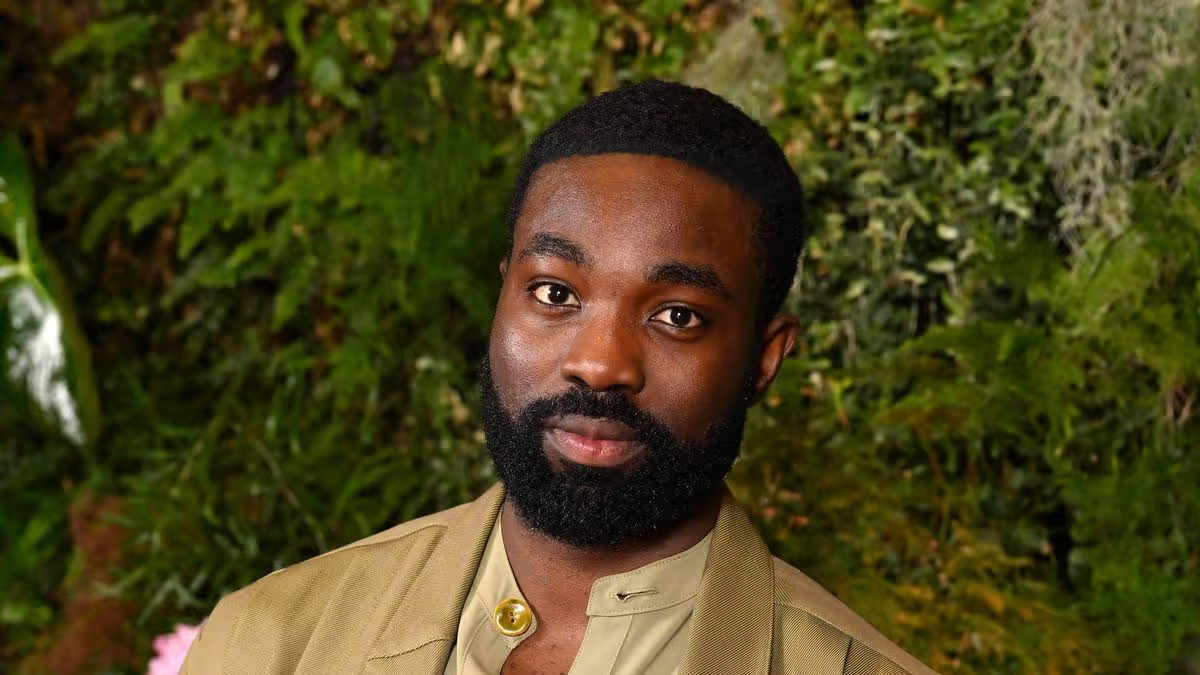
Harry Potter star Paapa Essiedu’s life from famous wife to death threats

Published

on

Wales Online

Paapa Essiedu has faced cruel threats ahead of appearing in HBO’s new Harry Potter series

Paapa Essiedu has been dominating headlines following his casting in HBO Max’s forthcoming Harry Potter series, which is anticipated to premiere on the platform in December this year.

The Shakespearean performer, 35, has previously featured in numerous prominent films, television programmes and theatrical productions. This evening, he appears on The One Show to discuss the poignant new BBC drama Babies with his co-star Siobhán Cullen.

Advertisement

He also created history in 2016 as the first Black performer to portray Hamlet for the Royal Shakespeare Company, securing the Ian Charleson award.

Furthermore, Paapa has worked alongside BAFTA Award winner Michaela Coel and performed opposite legendary actress Saoirse Ronan.

The London-born performer will already appear familiar owing to his remarkable acting portfolio, but where might you have encountered him previously?

Who is Paapa Essiedu playing in HBO’s new Harry Potter series?

Paapa will portray Severus Snape in the new Harry Potter series for HBO, continuing the legacy of the late Alan Rickman, who embodied the first on-screen version of the character between 2001 and 2011.

Disturbingly, the performer has encountered racist abuse and death threats following the casting revelation, telling USA Today: “If I look at Instagram, I will see somebody saying, ‘I’m going to come to your house and kill you.’”

Despite enduring backlash before his character has even materialised on screen, Paapa stated the experience had only reinforced his dedication to the part, declaring: “The abuse fuels me.”

Get HBO Max free with Sky

Advertisement
This article contains affiliate links, we will receive a commission on any sales we generate from it. Learn more
Content Image

£4.99

£0

Sky

Get the deal here

Sky is giving away free subscriptions to HBO Max with its £22 Ultimate TV bundle, which also includes Netflix, Disney+, discovery+, Hayu, and around 135 channels at no extra cost.

Where have you seen Paapa Essiedu before?

Paapa secured numerous prominent theatrical roles after joining the Royal Shakespeare Company in 2012, notably portraying the lead in Hamlet and Edmund in King Lear.

Advertisement

The performer achieved his breakout television role in 2020, appearing as Kwame in Michaela Coel’s I May Destroy You, reports the Mirror.

He has additionally featured in well-known programmes including Gangs of London, The Lazarus Project, Black Mirror and Channel 5’s Anne Boleyn.

Paapa made his cinema acting debut as a police officer in Kenneth Branagh’s 2017 film, Murder on the Orient Express.

Since then, he has featured in highly praised films such as 2024’s The Outrun, performing alongside Saoirse Ronan, and the 2022 horror production Men.

Advertisement

Paapa Essiedu’s life off-screen including famous wife

Paapa was raised in Walthamstow, London, and studied at the esteemed Guildhall School of Music and Drama, where he encountered and collaborated with Michaela Coel.

The performer heartbreakingly lost both parents during his youth, discussing his father’s passing when he was 14 and his mother’s death when he was 20 in a conversation with The Guardian.

When questioned about what he regarded as his greatest accomplishment, he recalled: “After losing my mum still managing to finish drama school, because that was really difficult. I lost her in the first year.”

Advertisement

Away from the cameras, Paapa is also wed to actress and comic Rosa Robson, 34, who was part of the Cambridge Footlights. ITV audiences may recognise Rosa from her portrayal of Ashley in the ITV2 comedy series Buffering, and she has additionally featured in programmes including Inside No. 9 and Disney Plus’ Extraordinary.

Paapa also revealed a brush with death he experienced in 2016, when his agent telephoned to inform him he’d landed the role of Hamlet for the Royal Shakespeare Company.

He told the aforementioned publication: “While I was on the phone, I looked to my left and turned to the right, and a bus whizzed by and the wing mirror was so close to me that it knocked my hat off.”

Catch Paapa Essiedu on The One Show tonight at 7pm and in Babies at 9pm on BBC One.

Advertisement

Source link

Continue Reading

NewsBeat

Do you have to pay council tax if you rent from a landlord?

Published

on

Do you have to pay council tax if you rent from a landlord?

But what are the rules if you rent?

If you’re over 18, you’ll usually pay council tax, whether you own or rent your home.

Who pays council tax?

Most of the time, it’s the tenant’s responsibility to pay council tax when renting. While some landlords might include bills in your rent, if you rent a property, the council tax bill is usually in your name.

Advertisement

The bill covers your whole household, so if you live with a friend or partner, you’ll get one council tax bill for both of you. If you’re both named on the lease, both of you are liable to pay council tax, but the total amount will stay the same.

If you are a renter, most of the time, you will pay the council tax.

However, this isn’t always true, and there are some uncommon situations where you won’t be responsible for covering this important bill.

When is the landlord responsible for paying council tax?

There are some instances where the landlord will shoulder the responsibility of paying council tax.

Advertisement

These are special circumstances and, generally speaking, the only times when liability is reversed.

So, tenants who find themselves fitting into any of the following categories may be exempt from paying council tax:


  • The occupant or occupants are all under the age of 18
  • The property in question is a care home, hospital, or refuge 
  • The occupant or occupants are asylum seekers
  • Temporary rentals to cover instances where your main residence is having emergency work carried out on it
  • The property in question is a HMO (House of Multiple Occupancy) and all occupants pay rent individually. However, while the landlord is technically responsible for paying council tax, the rent will likely be adjusted to cover the cost in this instance

If you find yourself in a position where paying council tax has become difficult, you need to address the situation sooner rather than later. 

Your first call should be to your local authority to explain your situation and ask for help.

Advertisement

Source link

Continue Reading

NewsBeat

eight technology leaps that changed our world

Published

on

eight technology leaps that changed our world

In the early 1970s, the idea of an ordinary person owning a computer sounded absurd. Computers back then were more like aircraft carriers or nuclear power plants than household appliances – vast machines housed in data centres operated by teams of specialists, serving governments, universities and large corporations.

Then came Apple.

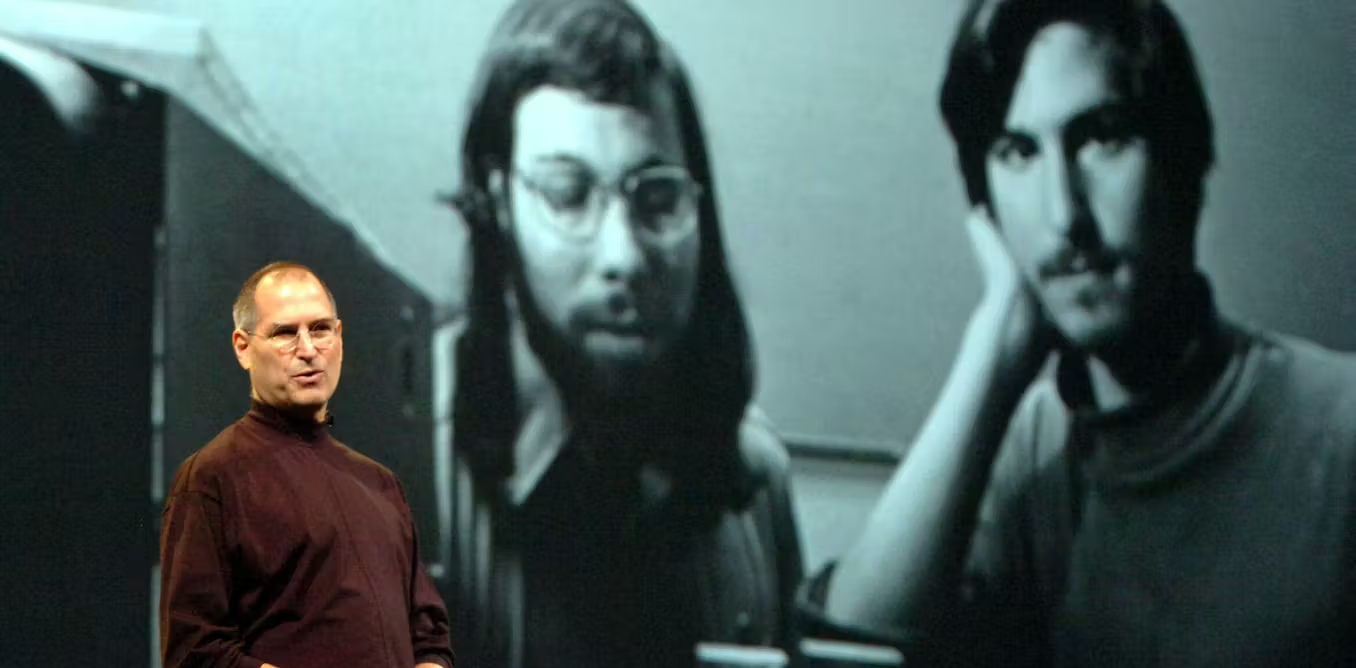
Founded on April 1 1976 by “college dropouts” Steve Jobs and Steve Wozniak, the Silicon Valley startup did not invent computing. What it did was arguably more important: it helped turn computing into a personal technology.

Before Apple, computers were largely sold in kit form. Jobs saw that people wanted them pre-assembled and ready to run. The earliest Apple I units, featuring handmade koa wooden cases, now sell for hundreds of thousands of dollars.

Advertisement

As an early Apple adopter and app developer, here’s my selection of the company’s (and Jobs’s) most significant technological achievements over the last 50 years.

Apple II – beige yet distinctive

Early personal computers were more curiosities than practical tools. The Apple II, launched in June 1977, introduced something new: style. Even its colour – beige! – was distinctive, contrasting with the black metal boxes common at that time.

The use of colour graphics was both new and exciting, and the keyboard felt satisfying to use. A simple speaker, with only a single-bit output, was ingeniously coaxed into producing tones and even speech-like sounds. The design revolution stretched as far as the packaging: Jerry Manock, Apple’s first in-house designer, placed the machine in a moulded plastic case which looked sleek and professional.

The mouse – a whole new way of interacting

By 1979, the 24-year-old Jobs – sensing that tech giant IBM was catching up with Apple – went looking for the next big thing. The photocopier company Xerox, wanting pre-IPO shares in Apple, offered a visit to its nearby research labs as an inducement. Jobs realised that researchers such as Alan Kay at Xerox’s Palo Alto research centre were creating the next generation of computing interfaces.

Advertisement

Central to this was a device invented by Kay’s mentor, Douglas Engelbart, at Stanford University in the mid-1960s and nicknamed “the mouse”. Engelbart’s vision of computers as machines to augment the human mind inspired Kay and colleagues to create graphical displays in which users interacted with scrollbars, buttons, menus and windows.

Macintosh – dawn of the modern product launch

Jobs thought anyone should be able to use a computer. In January 1984, the first Apple Mac pushed this idea to new extremes. The traditional need for obscure computer commands (and manuals) vanished. Early adopters such as myself felt we just knew how to do everything.

But the Mac’s launch was not just another technological leap for Apple. It also inspired the now-familiar cultural moment of the modern product launch. Following a teasing Super Bowl advert directed by Ridley Scott, Jobs used a 1,500-seat theatre on January 24 to create a stage performance centred on a single charismatic presenter. Jobs let a small, square and still-beige computer (then known as Macintosh) out of its bag – and it began speaking for itself, to rapturous applause.

Advertisement
Video: MacEssentials.

Pixar – Jobs’s side hustle

In its first decade, Apple grew at an exceptional rate – but it also came close to financial collapse on several occasions. This led to one of the most dramatic moments in Apple’s history when, in May 1985, the company forced Jobs out.

A year later and now in charge of the startup NeXT Inc, Jobs bought a division of George Lucas’s film company which was soon rebranded as Pixar. Its RenderMan software generated images by distributing processing across multiple machines simultaneously.

Pixar, jokingly referred to as Jobs’s “side hustle”, would become one of the world’s most influential (and valuable) animation production companies, having released the first fully computer-animated feature film in Toy Story (1995).

Advertisement
Toy Story (1995) official trailer.

iMac – a meeting of minds

After a failed attempt to develop a new operating system with IBM, Apple eventually bought Jobs’s company NeXT. In September 1997, he returned to Apple as interim CEO with the company “two months from bankruptcy”. The move, though welcomed by many Apple users, terrified some of its employees. Jobs quickly began firing staff and shutting down failed products.

During this restructuring, he visited Apple’s design studio and immediately hit it off with young British designer Jony Ive. Their meeting of minds led to the 1998 candy-coloured translucent iMac. Essentially smaller, cheaper NeXT machines, iMac (the i stood for internet) also kicked off another Apple habit: abandoning ageing technology. The floppy disk drive was ditched in favour of a CD drive – a move heavily criticised at the time, but later widely copied.

Video: TheAppleFanBoy – Apple & Computer Archives.

iPod – 1,000 songs in your pocket

For Apple, computing was always about more than, well, computing. In 2001, the company began focusing on processing sound and video, not just text and pictures. By November that year, it had released the iPod – a personal music player capable of storing “1,000 songs in your pocket”, compared with a maximum of 20-30 on each cassette tape in a Sony Walkman.

Advertisement

The iPod used an elegant “click wheel” to operate the screen. Music was synced through a new application called iTunes. By 2005, people were using iTunes to manage audio downloaded automatically from the internet using a process called RSS. This in turn put the pod in podcasting.

Video: xaviertic.

iPhone – a computer in everyone’s hands

By 2007, many mobile phone companies had approached Apple about merging the iPod with their phones. Instead, on January 9, Jobs unveiled Apple’s most ambitious product yet: a combined phone, music player and Mac computer – all at the size of a handset with no physical keyboard and huge screen.

Most media “experts”, from TechCrunch to the Guardian, predicted the iPhone would bomb. Steve Ballmer, then CEO of Microsoft, mocked the US$500 price tag, saying nobody would buy it. In fact, 1.4 million iPhones were sold by the end of the year – and over 3 billion more since then. This truly put a computer into everyone’s hands – and opened the door to social media as we know it today.

Advertisement

Video: Mac History.

App Store’s software revolution

By mid-2008, the iPhone enabled third-party developers the chance to to create a dizzying range of new applications. At the same time, the App Store – launched on July 10 2008 – addressed one of the most complex problems: how to distribute and commercialise these “apps”. Historically, they were often copied and distributed freely. The App Store changed this, using strong encryption to ensure the copy sold could only be used by that specific user, thus eliminating software piracy.

By establishing the first (eponymous) App Store, Apple changed the way people discover and purchase software. This led to an explosion of apps and a simple but powerful idea: whatever you wanted to do, someone, somewhere, had already built it. Apple captured this shift in a slogan that became part of everyday language: “There’s an app for that”.

Time and again, this extraordinary company has anticipated the value of opening up computing to everyone. Happy birthday, Apple.

Advertisement

Source link

Advertisement
Continue Reading

NewsBeat

Artemis II: How the weather will be a crucial factor in the launch

Published

on

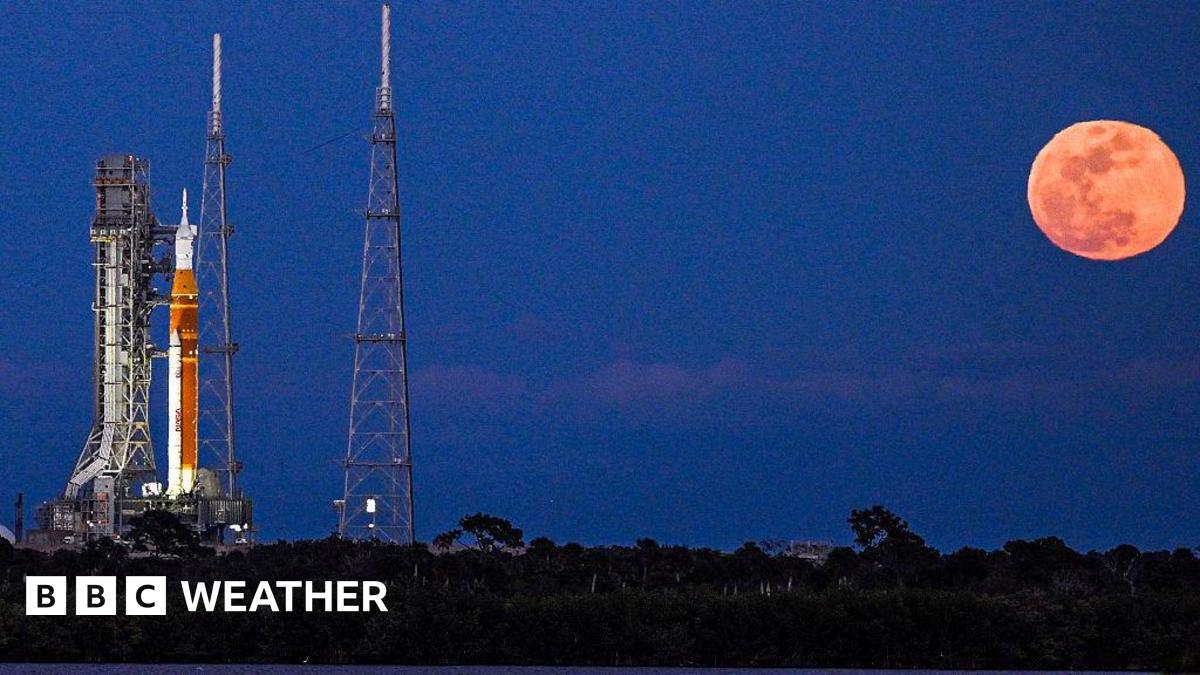
Artemis II rocket on the launch pad in Cape Canaveral with a full, bright and orange Moon rising in the sky next to it

The weather rules include atmospheric electricity, types of cloud, specifically cumulus and disturbed weather like rain or strong winds.

Using a percentage chance of a violation of the rules, launch weather officers use a combination of meteorological and climatological data, local knowledge, and experience to forecast this probability.

Lightning is one of the biggest risks, but it is not only the natural lightning from a thunderstorm – or cumulonimbus cloud – that forecasters will be concerned about.

Rocket-induced lightning from an enhanced atmospheric electric field is also a major risk.

Advertisement

“Some types of clouds, even if they’re not producing lightning, carry an electrical charge where a rocket passing through them at high speeds with a trail of exhaust can act like a lightning rod and trigger a lightning strike,” said Burger.

This rocket-induced lightning can be triggered much more easily than natural lightning.

Other events, external such as heavy rain, strong winds, high or low temperatures or extreme weather can also jeapordise a rocket launch.

Throughout a countdown the launch weather officer must be clear and convinced that none of the weather criteria are violated in order to give the weather ‘go’ call for launch.

Advertisement

Ahead of the Artemis launch window, the 45th Weather Squadron will not only be looking at conditions at Cape Canaveral but also in other areas such as potential recovery sites in the North Atlantic where “the weather is not particularly favourable at this time of year” in case things go wrong.

With the peak in the solar cycle, they will also be keeping an eye on solar activity and enhanced radiation which could affect the astronauts.

Source link

Advertisement
Continue Reading

NewsBeat

CalMac ferry chaos leaves Scots islanders unable to return home for Easter ‘for first time in 20 years’

Published

on

Daily Record

Fed-up islanders warned their “lifeline transport network is currently broken” with eight of CalMac’s largest ferries currently out of action.

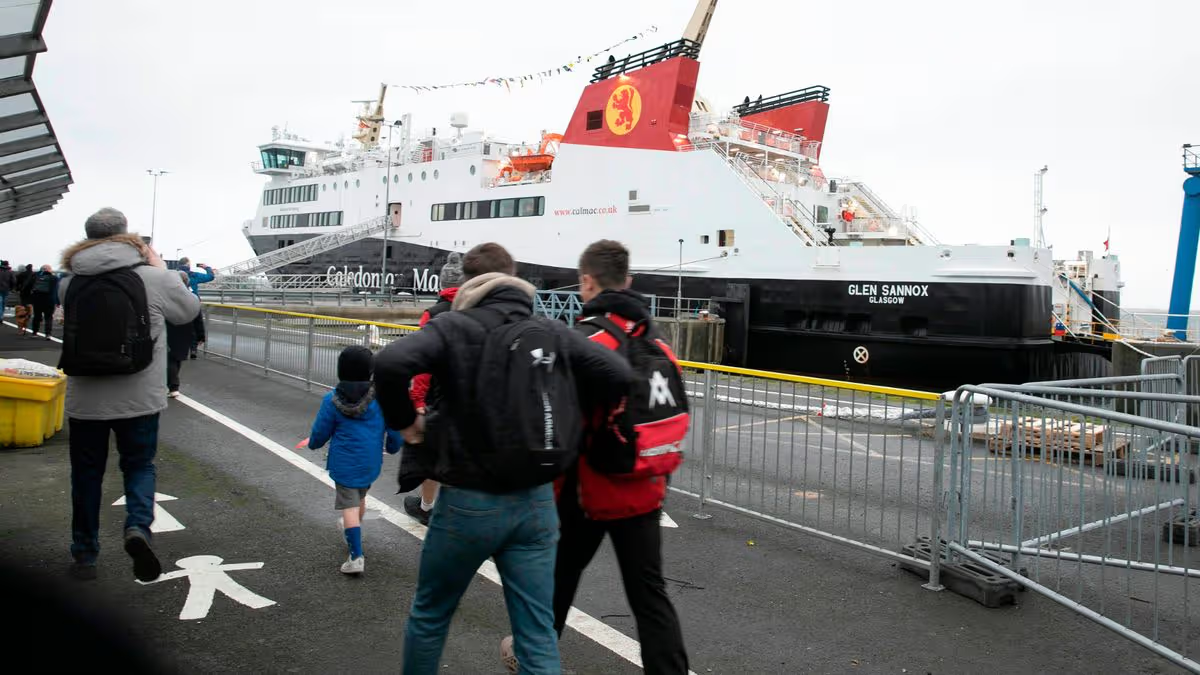
Chaos on Scotland’s ferry network has left islanders unable to return home for Easter for “the first time in 20 years”.

Advertisement

Eight of CalMac’s 15 largest ferries are currently out of action ahead of one of the busiest weekends of the year for travel – including the brand new Glen Sannox, which only entered service last year.

Fiona Hyslop, the SNP Transport Secretary, was today forced to admit the west coast ferry network faced “significant disruption”.

She said: “I want to assure all those impacted by the current shortage of ferries on the west coast island network that the Scottish Government and CalMac are urgently working closely to resolve these issues. Our shared priority is to ensure minimum disruption, and to restore services as quickly as possible.

“Work is being delivered at pace to bring the MV Glen Sannox back into service and introduce the MV Isle of Islay into service, alongside other actions to ensure we are able to provide services for passengers. This includes ensuring clear and effective communication to customers is prioritised.”

Advertisement

Michael Buchanan, a senior BBC journalist based in London, is among those whose travel plans have been scuppered.

He said: “For the first time in 20 years, we’re not able to get to Barra for Easter as huge CalMac disruption means it’s not possible to get there. Eight out of 15 of their largest ferries are out of action.

“This isn’t a problem that just happened – it’s been brewing for many years. Our inconvenience is annoying but minor in comparison to the economic costs for many small businesses who count on this week as the start of their season. Their lifeline transport network is currently broken.”

Anas Sarwar said transport issues hitting Scotland’s central belt in the same way as ferry disruption would be a “national scandal”.

Advertisement

The Scottish Labour leader took his party’s election campaign to Stornoway on the Isle of Lewis on Monday, where he pledged to cut bureaucracy in the ferry network by merging operator CalMac with ferry procurement body Caledonian Maritime Assets Limited (CMAL) to form a new agency.

The new body would also include representatives of islands on their board.

The announcement comes during a period of “unprecedented” pressure on CalMac.

Sarwar said a government he runs would “get the basics right”.

Advertisement

“We seek to meet the needs and aspirations of islanders,” he said. “But, right now, that’s simply not good enough and islanders see it every single day. Why should they have to accept this as tolerable?

“If this was a train service between Glasgow and Edinburgh, it would be fixed by now, it’d be a national disgrace and a national scandal and people would not be tolerating it.

“Why are we asking islanders to tolerate this mess?”

To sign up to the Daily Record Politics newsletter, click here

Advertisement

Source link

Continue Reading

NewsBeat

Travel updates from British Airways, Emirates, Qatar Airways & more

Published

on

Travel updates from British Airways, Emirates, Qatar Airways & more

US President Donald Trump has warned that the Iran war could still escalate.

Oil prices spiked after the US president said he was considering a military operation to seize Iran’s Kharg Island, a crucial part of the country’s export infrastructure.

As a result of rising oil prices, several airlines have confirmed that the cost of travel will increase.

Advertisement

Your rights if your flight is cancelled or delayed


These are the latest updates from some of the major airlines that operate in the area.

Qatar Airways travel update

Qatar Airways told passengers: “Qatar Airways has published its latest revised schedule, reflecting the gradual increase in flights to and from Doha.

The latest update, valid until April 15, provides additional frequencies to more than 90 destinations across Qatar Airways’ global network.

“All flights to and from Doha continue to operate through dedicated flight corridors. These routes are established in close coordination with the Qatar Civil Aviation Authority.

Advertisement

 “Passengers who currently hold a confirmed booking on a flight to one of the destinations listed in the new schedule will be contacted with new flight information.

“Please be sure to check the Qatar Airways website or app and ensure your contact details are correct and updated.”

You can view the 90 destinations here.

Qantas travel update

Qantas has told passengers who will be affected by changes to flights that they will be contacted as soon as possible.

Advertisement

In a statement on March 26, the airline said: “We’re closely monitoring the evolving situation and any potential impact to our flights. The safety of our customers and crew is our highest priority.

“Flights from Perth to London are currently operating via Singapore for a fuel stop due to adjustments required on flight paths.  The return service will continue to operate direct from London to Perth.

“We’re also making adjustments to our international schedule to operate more flights between Australia and Europe. The updated schedule will come into effect progressively for flights from mid-April and run until mid-July.

“As a result of the changes, flights to Paris will originate in Sydney and operate via Singapore instead of Perth. The return service will continue to operate direct from Paris to Perth until May.”

Advertisement

Emirates travel update

Following the partial reopening of regional airspace, Emirates is operating a “reduced flight schedule”.

The airline said: “We continue to monitor the situation, and we will develop our operational schedule accordingly.

“We would like to thank you for your understanding and patience.

“The safety and security of our passengers and crew remain our highest priority and will not be compromised.”

Advertisement

Customers due to travel within the next seven days are being contacted directly by Emirates.

British Airways travel update

In their latest update from March 16, British Airways told its passengers it has extended the temporary reduction in its flying schedule due to “continuing uncertainty”.

A statement from the airline said: “Due to the continuing uncertainty of the situation in the Middle East and airspace instability, and to provide more clarity to our customers, we’ve extended the temporary reduction in our flying schedule in the region.

“We’re keeping the situation under constant review and are directly in touch with affected customers to offer them a range of options.

Advertisement

“Since the situation in the Middle East began, we’ve helped thousands of customers return home and operated eight relief flights from Muscat in Oman.

“We are also operating additional flights to and from Singapore (x4) and Bangkok (x3) and continue to review options to bring back more customers who have been disrupted.”

Source link

Advertisement
Continue Reading

Trending

Copyright © 2025