

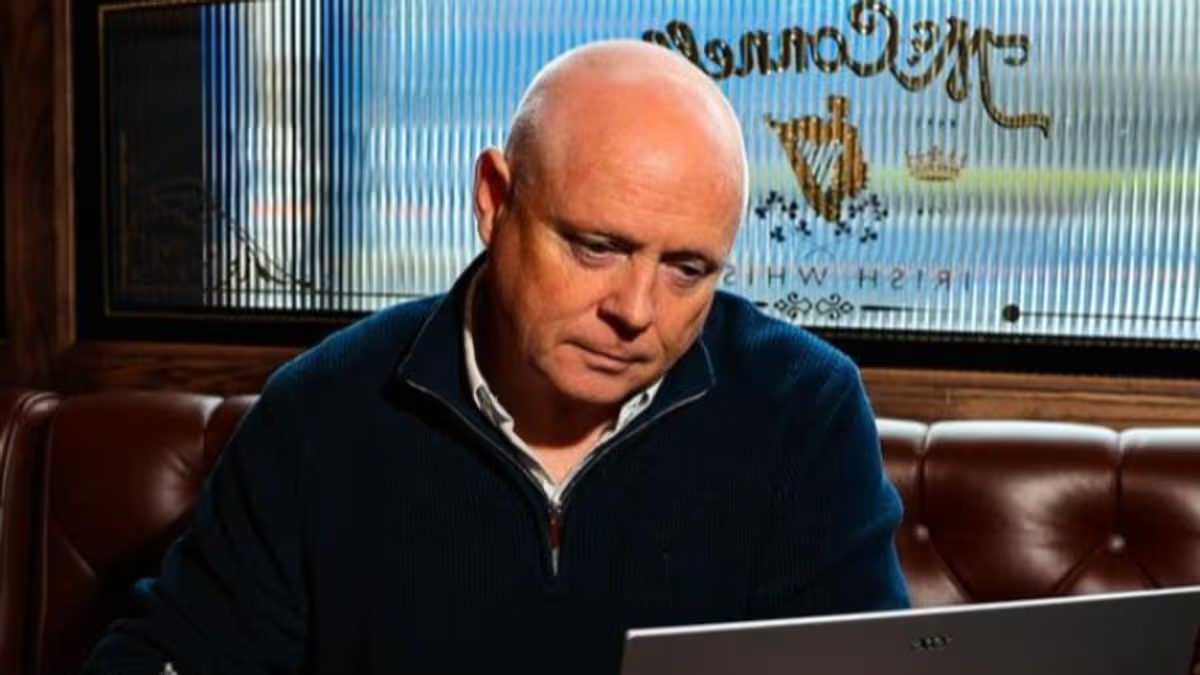
“I treated every call as a privilege, even the most horrible and gruesome ones, I was the one to go in there to try and help”
A semi-retired paramedic has written a memoir on his experiences of working on the front lines of the Troubles.
North Belfast Blues by Brendan Magill details his journey from a troubled childhood where dead bodies would be left in his neighbourhood, to returning to those same streets as a paramedic, helping those most in need.
Through a turbulent upbringing on Adela Street and the New Lodge, the now 61-year-old was shaped by the things he saw at such an early age. He told Belfast Live he was “terrified of death”.
He said: “I was forced to deal with death at a young age and where we lived on that corner of north Belfast, we had a couple of bodies dumped in our street.
“When I was growing up, it felt like if it wasn’t on the news, it was on your doorstep. During those early years in the Troubles, I was hounded by death.
Magill has previous experience in writing, including children’s novels to encourage them to learn first aid. But it was in writing North Belfast Blues that he discovered a therapeutic experience, even if he didn’t originally intend for it to be that way.
He continued: “The only way I could do my story was to deal with the calls I faced as a paramedic, but when I started chronicling them, they reminded me of similar incidents from when I was a kid, and it became a form of therapy for me.”
“Before I started writing I would have said my childhood would have been very unhappy.
“After writing, I rediscovered that there were good things, like when I went out with my dad, or playing football despite the hassle we had. I realised we tried to make the most of things, despite the horrible backdrop of the Troubles.”
Through the tough years of childhood, Brendan admits there was an element of trauma, something he “buried through his teenage years”.
“It wasn’t until I was dealing with the deaths in the ambulance service that I was forced to look back.
“When you go to so many sudden deaths and murders, you can’t help but go and look back at your childhood. It didn’t matter that I had tried to bury those experiences; they eventually came back around.”
The retired paramedic never had any desire to join the ambulance service while growing up, and in his early twenties, Magill roamed aimlessly from job to job searching for a purpose.
It was one morning on his way to work when everything changed for him.
“I heard sirens behind me walking up the Dublin Road in a suit, to a job I didn’t want to go to. I looked around and it was a fire engine. Everyone’s heads turned to see what was going on, and I imagined what it would be like to do that job, to put on a uniform and have a sense of responsibility.
“That night I saw an advertisement in the Belfast Telegraph for the ambulance service, and that was it.”
After working in the ambulance service for 37 years, with many of those being during the Troubles, the retired paramedic has seen a lifetime of hardship.
He was one of the first on the scene for the Sean Graham Bookmakers shooting, in which five people were murdered and nine were injured.
“One shift, I was called to Dan’s Bar on Roden Street, where the INLA had killed two people. Then two hours later on the same shift, we were called to another shooting, where a Catholic had been killed.
“It really showed the brutality of what was happening on a daily basis. Tit-for-that, retaliation killings.”
Despite the challenging aspects of his job, Magill still found an identity within the Ambulance Service, and for the first time in his life, he had a purpose.
He continued: “When you’ve dealt with so much trauma and fear in your life and no one was helping you, it’s a privilege to walk into someone’s house as a paramedic, when they are at their worst moments in life, and offer some form of comfort.
“It’s nice to be able to go in and help people when you weren’t getting any help yourself.
“I loved wearing the uniform and the respect you got from it. I treated every call as a privilege, even the most horrible and gruesome ones, I was the one to go in there to try and help.
“I’m under 5ft 6ins and was always called shorty and that’s how I’ve felt most of my life. But when you put that uniform on and walk into someone’s house when there’s mayhem happening, you feel like the biggest person in the room. When I put that uniform on, I’m not small anymore.
“That uniform and call gives you a sense of purpose, and all of a sudden that height doesn’t matter.”
Brendan’s novel, North Belfast Blues is available now as an e-book on Kindle, with a physical copy expected in April.
To ensure you don’t miss out on all the latest from Belfast Live, be sure to make us your preferred source on Google.













































You must be logged in to post a comment Login