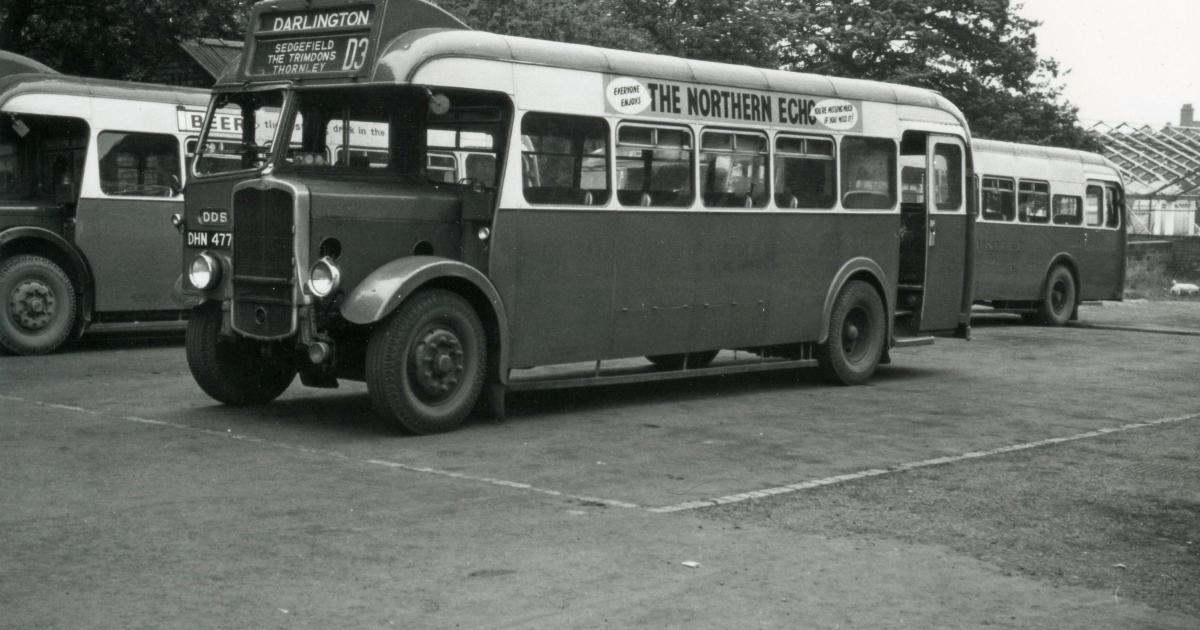
This month’s exhibition in Darlington library is all about buses in pictures and paraphernalia.
When there was a bus-based transport system, there needed to be places for buses to stop and for bus passengers to wait. The exhibition’s pictures show how High Row became lined, on both sides, with substantial waiting shelters, and also how from the 1920s to the 1960s, the Leadyard acted as a bus station.
![]() High Row, with bus shelters lining the roadside. Picture: Darlington Centre for Local Studies (Image: Picture: Darlington Centre for Local Studies)
High Row, with bus shelters lining the roadside. Picture: Darlington Centre for Local Studies (Image: Picture: Darlington Centre for Local Studies)
Leadyard was a street that led from the eastern side of the Market Place down to the River Skerne – it was beside the Bishop of Durham’s old palace and got its name because he apparently stored his lead here.
![]() Looking up the Leadyard towards Darlington Market Place when it was lined with buses. Picture: Darlington Centre for Local Studies (Image: Picture: Darlington Centre for Local Studies)
Looking up the Leadyard towards Darlington Market Place when it was lined with buses. Picture: Darlington Centre for Local Studies (Image: Picture: Darlington Centre for Local Studies)
It became a bus headquarters because United had an office in a former Unitarian church in the yard while Scott’s Greys, a legendary firm founded before the First World War by Fred Scott who owned only grey horses, had an office at the top of the yard.
![]() A bus in the Leadyard at the stand going to Croft and Hurworth. Picture: Keith Kitching (Image: Keith Kitching)
A bus in the Leadyard at the stand going to Croft and Hurworth. Picture: Keith Kitching (Image: Keith Kitching)
While High Row got its shelters, Leadyard remained uncovered, and the exhibition includes a cartoon from the Echo’s sister paper, the Northern Despatch, from 1956 showing how long-talked-about plans for a proper bus station were being used by waiting passengers to keep the rain off their heads.
![]() The Despatch cartoon of 1956 showing passengers trying to keep dry in the Leadyard before the Feethams bus station was built. Picture: Darlington Centre for Local Studies (Image: George Flynn)
The Despatch cartoon of 1956 showing passengers trying to keep dry in the Leadyard before the Feethams bus station was built. Picture: Darlington Centre for Local Studies (Image: George Flynn)
The Feethams bus station opened in 1961 and lasted until 2008 when it became embroiled in a headline-grabbing battle.
United had evolved into Arriva which leased the bus station from Darlington council, but Arriva were merging with Stagecoach and talking of leaving the station. Tesco then stepped in and gave Arriva £25,000 to stop it passing the 51 years left on its lease to another bus company.
Tesco drew up plans to demolish the adjoining town hall and create a massive supermarket, but in council consultations, 78 per cent of townspeople objected to the “tescofication” of Darlington and planning permission was refused.
Instead, the Feethams leisure development – cinema, hotel and restaurants – grew up on the site of the bus station.
![]() A 1950s recruitment advert, created by Arthur Hughes of the Art Shop, to go above the seats in Darlington’s buses. Picture: Darlington Centre for Local Studies (Image: Darlington Centre for Local Studesi)
A 1950s recruitment advert, created by Arthur Hughes of the Art Shop, to go above the seats in Darlington’s buses. Picture: Darlington Centre for Local Studies (Image: Darlington Centre for Local Studesi)
TED HOYLE writes: “Around 1944, my father, Harry, began driving the Teesdale Queen bus service which had been started in Mickleton under the guise of Fawn Lea by Joe Wilson.
My father started driving after Joe had died, and I think the vehicle was an old Commer although it was replaced by a new one purchased from Comberhill Motors (a Wakefield bus dealer).
“Around 1950, my father bought the business from Mrs Wilson and he operated several services from Harwood to Darlington twice a month, Barnard Castle on Wednesday, Holwick to Middleton and Harwood to Middleton.
He also ran mystery trips and excursions to Morecambe Bay, Blackpool, the Lakes and Dumfries which were very popular as very few people owned a car.
“When the Tees Valley Railway from Barnard Castle to Middleton-in-Teesdale was closed, he won the contract to transport pupils to school.
He was then running 29-seater Bedford Duplex coaches because there were very few turning places in the dale.”
The Teesdale Queen was garaged at Harwood at the top of the dale beyond even High Force, where the lanes could only accommodate a small bus.
However, there was big demand, particularly on a Saturday night when the Cosy Cinema in Middleton shut and last orders were being called in the pubs.
The record for the number of people crammed on the 10pm 29-seater Teesdale Queen out of Middleton, going through hamlets like Newbiggin, Bowlees, Forest and Langdon Beck, was 90!
“When I came out of the army in 1964,” continues Ted, “I passed my PSV licence and drove for my father until he retired and sold out to Fred and Colin Jewitt in 1967.
“There were a few other coach firms at that time, Percival’s, Maude’s, Howson’s, Wright’s from Alston and Bond Brothers of Willington.
They were all striving to provide a service and make a living, but with the coming of the motor car, it was the end of an era.
“But not many could say that their father drove the Queen, and I was teased about it at school.”
![]()
IN south Durham in the late 1950s and 1960s, the lanes were full of London double-decker buses that local companies had bought cheap, due to a post-war surplus (Memories 789, 798 and 800).
They were known as RT, which may have stood for their model name, Regent.
“When I visited London Transport’s Broadway history centre in the 1970s, I was told ‘RT’ did indeed stand for ‘Regent’, just as ‘RM’ stood for ‘Routemaster’,” says David Leishman.
“The versions of RT were then given an extra letter, like ‘RMF’ for the extended, higher-capacity version.
“RTs ended up all over the world.
I have pictures of them in Malawi and Zambia in the 1970s, operating in Blantyre and Lusaka respectively.”
![]() The Echo’s 1931 safe driving certificate (Image: Chris Lloyd)
The Echo’s 1931 safe driving certificate (Image: Chris Lloyd)
LAST week, we told how before the introduction of the driving test, prospective drivers for Heather Bell buses, of Tow Law, were put through their paces by having a matchbox placed behind their stationary rear wheels on the steep Newton Cap bank in Bishop Auckland.
If they could pull away without squashing the matchbox, they got the job.
Which prompted Ian Ferguson in Low Newton to send in a certificate he found in the back of a 1938 brochure about the launch of RMS Mauretania.
It is a Northern Echo Safety First Certificate from 1931 which says that its delivery van driver, W Rennison of The Crossway, Darlington, had gone the whole year “free from any accident for which he was to blame”.
In those pre-test days, this was another way for employers to single out competent drivers.
The first compulsory driving test came into effect on June 1, 1935, although drivers who already had a licence did not have to sit it so for many decades there were drivers on Britain’s roads who had never passed a test.
It wasn’t until the 1968 Transport Act that separate tests for Public Service Vehicles, like buses, and Heavy Good Vehicles were introduced.
![]() James & Mosley bus tickets from Croft Spa (Image: Chris Lloyd)
James & Mosley bus tickets from Croft Spa (Image: Chris Lloyd)
AN anonymous correspondent sends in these bus tickets from James & Mosley who operated from a garage in Croft Spa.
We guess they go back to before the Second World War.
“Croft Spa” then referred to the village in County Durham that is properly known as Hurworth Place even though it had Croft Spa railway station at its heart.
To this day there is a garage – the Oxford – in Hurworth Place where cars are repaired, but we think it was originally the home of Abbotts’ buses, founded by William Abbott and continued by his sons, Stanley, Walter and Frank.
They ran the first buses from Hurworth Place into the Leadyard in Darlington.
They were red and cream and had “Croft Spa” on their destination boards.
There was another bus garage on the North Yorkshire side of the river in Croft-on-Tees where the village hall is today.
We think this is where James & Mosley’s blue buses were based.
J&M, Abbotts and a third company, Hollands of Strait Lane, Hurworth, took it in turns to run hourly buses from Dalton, Croft, Hurworth and Neasham into Darlington.
Can you tell us any more about any of these companies? Do you have any old tickets relating to buses in our area? Please email chris.lloyd@nne.co.uk if you have a bus story…
And while we’re mentioning Croft, there are a couple of places left on this morning’s guided walk which leaves from the church at 10.30am, if you’ve not going anything better planned.
![]() Fred Robinson’s auction is at the centre of this fair on Feethams Field with St Cuthbert’s Church in the background. The bus station was built on the field (Image: Unknown)
Fred Robinson’s auction is at the centre of this fair on Feethams Field with St Cuthbert’s Church in the background. The bus station was built on the field (Image: Unknown)
TIM BROWN in Ferryhill joins the bus theme with reminiscences about Darlington market following the articles in Memories 795 and 797.
“The two most important traders for the farming community were in front of the gates of St Cuthbert’s churchyard, Sam and Charles Turner’s farm supplies.
Here all manner of hand tools, hardware such as nails of every size, farm clothing, grass cutter blades, and harnesses and halters could be bought.
More importantly, in the era before combine harvesters, you could get binder twine there.
This was needed at harvest time and during winter for binding straw on the threshing machines.
The twine was often referred to as ‘Charlie band’.
The closest modern equivalents to the stall are probably Sam Turner’s farm shops at Northallerton and Piercebridge.
Arable farmers visited the Corn Exchange which was set up by the corn dealers in the Town Hall.
The farmers would bring samples of their grain to haggle with the dealers to secure the best price.
The Market Place was the centre of most of these activities with the old open air bus stands in Leadyard beside the churchyard.
A colder place to wait for buses is hard to imagine.
Progressing south to Feetham’s Field, there were weekly auctions, conducted by Stanley Robinson, disposing of all manner of furniture and household goods.
Farmers will also remember the cattle market at Bank Top, convenient for the railway yards, where the mart canteen had a reputation for pie and peas with a big mug of tea.”
















































You must be logged in to post a comment Login