Connect with us
DAPA Banner
DAPA Coin
DAPA
COIN PAYMENT ASSET
PRIVACY · BLOCKDAG · HOMOMORPHIC ENCRYPTION · RUST
ElGamal Encrypted MINE DAPA
🚫 GENESIS SOLD OUT
DAPAPAY COMING

NewsBeat

Rugby player repeatedly punched woman in her 50s in the face

Published

on

Wales Online

The victim, who suffered multiple facial injuries and nerve damage, said her confidence has been shattered and her world has ‘become small’

Advertisement

A drunk rugby player repeatedly punched a woman in her fifties in the face as she sat in her car, a court has heard. Ben Jenkins reached through the open window of the vehicle to deliver a series of blows to his victim after she asked him to get out of the road.

The woman suffered multiple facial fractures and nerve damage in the attack. A judge said to describe what 28-year-old Jenkins did on the night in question as “disgraceful” would be to understate the seriousness of the incident.

The judge also said the defendant “did not have the guts” to admit his wrongdoing and tired to “brazen it out” at trial. Don’t miss a court report by signing up to our crime newsletter here

Swansea Crown Court heard that the incident took place on Guy Fawkes Night 2023 in the street outside the Nos Da bar on Victoria Road in Milford Haven.

Advertisement

When Jenkins – who had been “drinking heavily” – was asked by the victim to get out of the way so she could drive past he approached the driver-side door and repeatedly punched the woman in the face through the window. Georgia Donohue, prosecuting, told the court the victim was “unable to escape”.

The court heard that while the fractures have healed the victim continues to suffer facial swelling, has “mild facial asymmetry” which is likely to be permanent, and has “mild pain due to nerve damage” which again is likely to be permanent.

In an impact statement read to the court, the victim described the profound physical and psychological consequences of the assault. The woman said her confidence had been shattered and that her “world has become small”.

The court heard the Crown Prosecution Service originally decided not to charge Jenkins but the victim successfully appealed against that decision.

Advertisement

Ben Jenkins, of St Lawrence Avenue, Hakin, Milford Haven, Pembrokeshire, had previously been convicted at trial of inflicting grievous bodily harm when he returned to the dock for sentencing. He has no previous convictions.

John Hipkin KC, for Jenkins, said the defendant was of previous positive good character, and is due to become a father in August. He said his client wants to put the “sad and tragic incident” behind him, and said in his submission Jenkins “is not a defendant the courts are likely to see again”.

The barrister said his client lost his previous employment as a result of his conviction but had secured a new job and was in a position to pay compensation to his victim.

Judge Paul Thomas KC said to call what the defendant did “disgraceful” would be to understate the seriousness of it. He told Jenkins: “You viciously attacked a woman in her 50s by punching her repeatedly in the face through her car window. You did so simply because she asked you, in your drunken state, to get out of the way of her car. You had been drinking heavily. I repeat – you, a rugby player, punched a woman in her late fifties repeatedly in the face”.

Advertisement

The judge said the defendant then “did not have the guts” to admit what he had done but instead chose to “brazen it out” at trial where a jury saw through his “lies”. He noted that Jenkins had written a letter in which he expressed his remorse for what he had done, and he said to the man in dock: “What a shame, Mr Jenkins, you were not man enough to do that two years ago”.

The judge said given the length of sentence Jenkins was facing the court was obliged to consider whether it could be suspended – he told the defendant that “By the skin of you teeth” he would avoid immediate custody.

Jenkins was sentenced to two years in prison suspended for two years, and must complete a 90-day alcohol abstinence requirement and do 250 hours of unpaid work in the community. The defendant was ordered to pay his vicitm £3,000 in compensation, and was made subject to a three-year restraining order banning him from contacting her.

Get daily breaking news updates on your phone by joining our WhatsApp community here. We occasionally treat members to special offers, promotions and ads from us and our partners. See our Privacy Notice

Advertisement

Source link

Continue Reading
Click to comment

You must be logged in to post a comment Login

Leave a Reply

NewsBeat

Rangers manager appointment ‘most exciting since Gerrard’ reckons former star

Published

on

Belfast Live

“I’ve played with Derek, I’ve played against him, I’ve managed against him and know all about his make up, his strengths – and that’s why this appointment is the one that has excited me most at Ibrox since Steven Gerrard.”

Derek McInnes knows exactly what it means to pull on the blue jersey. A lifelong Rangers supporter, he fulfilled every boyhood dream when he rose through the ranks to represent the club he adored.

Yet as far as his former team-mate Stuart McCall is concerned, it’s not his credentials as a Rangers man that make him the ideal candidate to step into the Ibrox dugout as Danny Rohl’s successor.

Advertisement

It’s the departing Hearts manager’s qualities as a leader of men that makes him precisely what is required in Govan.

McCall has shared a dressing room with his fellow nine-in-a-row hero and gone head-to-head with McInnes on Premiership touchlines, reports the Daily Record.

And it’s that first-hand knowledge which has persuaded the former Motherwell boss that his old friend is the most thrilling managerial appointment at Ibrox since Steven Gerrard arrived in Glasgow.

McCall told Record Sport: “I’m not saying he’s a Rangers man, so he’s the right choice.

Advertisement

“I’m saying this because I know how Derek will be.

“He knows the Premiership, he knows the mentality needed, the characteristics you want in a player. Yeah it helps he played for the club and has experienced the pressures that come with that.

“He’ll have gone through tough times at Ibrox himself trying to get past Gazza and myself to get a game! Wink, wink! Only kidding!”.

“But that Rangers link isn’t what makes him the right man. It’s the man he is himself that makes him the right choice.

Advertisement

“Right now, Rangers are a club and a team that need someone to galvanise them, to lead them through the tough moments. That’s where they’ve failed in recent seasons.

“I’ve played with Derek, I’ve played against him, I’ve managed against him and know all about his make up, his strengths – and that’s why this appointment is the one that has excited me most at Ibrox since Steven Gerrard.

“The fact is you can be the best training ground coach in the world but if you can’t communicate with your players and have the ability to relate to them and have them relate to you, then it won’t matter.

Advertisement

“I’ve seen loads of coaches down in England who have loads of great ideas on the game. But if you don’t know how to get the best out of the players on an individual basis those ideas will fall apart.

“So what makes me more comfortable with Derek than any other boss since Gerrard is that I know we’ve got a manager going in with a wealth of experience, knowledge of the club and the league and someone with a proven track record getting the best out of the players at his disposal.

“I remember having some right ding-dongs against Del when he was Aberdeen boss and I was at Motherwell. You always knew his team would be up for the fight, they’d go to the last whistle, they’d never chuck the towel in.

“Yeah, there might be the odd poor performance – but they were never weak.”

Advertisement

McInnes now inherits a side so fragile they squandered their opportunity to clinch last season’s title, losing four of their final five matches under Rohl.

The German was brought in to sort out the chaos left in Russell Martin’s wake and, while he managed to drag the Light Blues back into title contention, they swiftly fell away once the pressure mounted in the closing stages of the campaign.

However, McCall is backing his long-time friend to succeed where the German came unstuck – drawing on invaluable wisdom passed down from his mentors Sir Alex Ferguson and the late Walter Smith.

“If it does go ahead and he becomes the new Rangers manager I’ll be delighted with that,” said the Preston assistant boss.

Advertisement

“You know, over the last couple of years working down here with Sheffield United and Preston, I’ve come up against Russell Martin and Danny Rohl.

“They were both good coaches but I just don’t think it’s a necessity right now for Rangers to be looking for a good ‘coach’.

“I’m not saying Derek isn’t that. He’s a more than capable coach.

Advertisement

“What Rangers need is someone who can motivate people.

“I go back to what Sir Alex Ferguson told me. He said management is about being a good communicator, man manager, getting your recruitment right is massive. Throw in a little bit of luck and that is the four things you need to be successful.

“If I look back to Sir Walter, that was just as true for him. Obviously he and Archie knew the game inside out but I wouldn’t say they were outstanding coaches, if you know what I mean.

“But they were outstanding leaders, man-managers.

Advertisement

“Now I don’t necessarily think you need to know a club to be successful there but one thing Derek does have is a knowledge of the league and what is needed to win up there.

“Sir Walter knew how to get the very best out of the players he had and I think Derek is cut from the same cloth.”

When McCall assessed Rangers’ performance last season, he identified a squad lacking that crucial winning mentality.

He said: “All last season when people were getting excited about Rangers, I couldn’t see them winning that league in a month of Sundays because of the mentality at the club.

Advertisement

“When you sign players for a club like that, ability takes a back seat to mentality for me.

“And for me, that’s not going on social media to spout off because you’ve had one good game. Mentality is doing it week in, week out for a full season.

“For me, that’s why I’m so excited about Derek. It’s easiest thing in the world to play for Rangers when things are going well, but it’s one of the hardest places to play when it’s not.

“That’s when you need your big characters to stand up and that starts with the management.”

Advertisement

Sign up to our free sports newsletter to get the latest headlines to your inbox

Source link

Continue Reading

NewsBeat

‘Imagination and creation are products of time and space’

Published

on

‘Imagination and creation are products of time and space’

Ireland’s basic income for artists has been made permanent after research showed that it boosted the economy. Other nations have similar schemes. With more homegrown artists now coming from privileged backgrounds and AI disrupting the creative industries, should the UK follow suit?

On the first weekend of July last year, Britain’s flatlining economy got a boost from two unlikely sources: heavy metal pioneers Black Sabbath and Britpop heroes Oasis. Who said rock ’n’ roll was dead?

Leaving aside for a moment the cultural significance of these iconic bands reuniting, there was an impact that could be measured in cold, hard economics.

Advertisement

Estimates suggest that Sabbath’s farewell gig in Birmingham – a city that has cut its arts budget to zero – injected £20m into the local economy. Meanwhile, the UK leg of Oasis’ tour, which kicked off in Cardiff the same weekend, provided a £1bn shot in the arm to the nation’s economy. Not bad for two bands whose members were on the dole before achieving rock star status.

Advertisement

For working-class creatives, music has long been an escape from hard lives. Less so these days. The record industry that propelled the likes of Sabbath and Oasis to fame is unrecognisable today. The collapse in physical record sales in the free-for-all streaming age has gutted the sector, leaving musicians struggling to make a living.

The loss of grassroots music venues – a third have closed in the UK over the last 20 years – has compounded the issue. Cuts to arts budgets have been similarly devastating, while the rise of generative AI poses further headaches for creatives of all stripes, not just musicians – and all that amid a cost of living crisis.

According to the charity Arts Emergency, such headwinds are having a disproportionate effect on working-class, disabled and minority ethnic artists, who have long been underrepresented in UK culture.

“It’s a time of great precarity for the cultural sector and society in general,” says Neil Griffiths, CEO of Arts Emergency. “Imagination and creation are products of time and space, but there isn’t the time and space anymore. Society is unequal, while culture is undervalued and underfunded.”

Advertisement

As a result, often only the privileged have time to create. “Just one in 10 people who work in culture in the UK are from a working-class background,” says Griffiths.

Artist Tobias Prytz, who creates large-scale installations using timber, is a beneficiary of Norway’s model for supporting artists, receiving around 330,000 NOK (£25,600) per year

Advertisement

For a country that glorifies Winston Churchill, the UK appears to have missed his memo on culture: “The arts are essential to any complete national life,” he said in a 1953 speech. “The nation owes it to itself to sustain and encourage them.”

Other nations recognise as much. In 2022, the Irish government trialled a first-of-its-kind basic income for artists to kickstart culture as the country emerged from the pandemic.

Offering participants a weekly stipend of €325 (£283), the €25m (£21m) pilot helped more than 2,000 artists. According to a study published last year, the scheme generated €100m (£87m) in “social and economic benefits” to Ireland’s economy, meaning it more than paid for itself.

Buoyed by the data, the Irish government made the scheme permanent in February. In the long history of basic income trials, it’s the first to become permanent.

Advertisement

Multimedia artist Elinor O’Donovan, from Cork, is among the 2,000 creatives to have benefitted from the scheme (though at the time of going to press she was unsure whether she would re-qualify).

Imagination and creation are products of time and space but there isn’t the time and space anymore

“I don’t want to sell this idea that artists are special creatures, or whatever, but to be able to do creative work, you need time and space to think, and often that kind of creative thinking is quite difficult,” says O’Donovan.

“Before I got [the income], I worked part-time as a receptionist just to be able to afford to pay my rent. Now I work full-time as an artist. The basic income has given me the flexibility that being an artist requires.”

The income, says O’Donovan, enabled her to experiment.

Advertisement

“It’s allowed me to take risks that I wouldn’t have taken otherwise. My work is better and more ambitious. I made a film for the first time and now filmmaking is a big part of what I do. Having the extra income meant that I was able to pay other people to work with me on my film.

The Irish scheme is not without critics. Some question whether the government should be funding artists at a time when other groups are slipping through the cracks. Homelessness in Ireland is currently at a record high. The scheme is also narrow in scope; while 2,000 artists benefitted, many more applied. Universal it is not.

‘With all the shitty things that are happening in the world, to bring people together through culture has never been more important’ says artist Tobias Prytz

Advertisement

But, in an era when artwork is being used to train generative AI without their creators receiving any remuneration, Ireland’s scheme places a value on art and the people who produce it. “It’s so validating,” says O’Donovan.

While artists in the UK can apply for grants to help support their work, state funding for the arts has dried up in recent years. According to official data, local government funding for culture in England fell by 48% between 2009 and 2023. Similar declines were reported in Wales (40%) and Scotland (29%). This despite the arts sector contributing an estimated £10.6bn to the UK economy each year.

Like Ireland, Norway has pioneered its own model for supporting artists. A reboot of the traditional grant-funding concept, the statens kunstnerstipend programme offers a monthly salary to creatives for up to five years.

Advertisement

“It’s awarded to the practitioner rather than tied to a predefined project, and may be freely used for livelihood, exploration and production,” explains Trude Gomnæs Ugelstad, head of the committee for the scheme. “This design recognises that artistic development, like other research, depends on open-ended inquiry, long-time horizons and freedom to pursue directions whose outcomes cannot be fully specified in advance.

The scheme means that I don’t have to worry about money so I have more time to write my play

Artist Tobias Prytz, who creates large-scale installations using timber, is one beneficiary. He receives around 330,000 NOK (£25,600) per year, which is roughly half Norway’s average salary.

“At first I thought ‘who am I to get this money?’,” he says. “But it has given me space to develop as an artist without having to hustle between jobs. I don’t have to compromise my art.

“With all the shitty things that are happening in the world, to bring people together through culture has never been more important,” he says.

Advertisement

With research showing that engaging with culture improves health outcomes, governments have a motive beyond hard economics to support creatives. And while not every basement band will go on to be the next big thing, grassroots artists don’t need to sell out stadiums to enrich the cultural fabric of a nation.

Esther Hammecker’s play was made possible in part by France’s income support scheme for artists

Advertisement

Parisian playwright Esther Hammecker is a case in point. In March, she put on her debut show in La Villette, Paris’s new cultural quarter where the city’s abattoirs used to be located. Her play– Scandaleuse, The Story of Cabaret – explores the lesser-told history of French cabaret, and was made possible in part by France’s income support scheme for artists.

“The idea that many people have of cabaret is influenced by the American vision of it, which is extremely extravagant,” she says. “But traditional French cabaret is basically just someone singing in a bistro while people have their meal. It’s more laid back, which is sort of what we’re going to do.”

Hammecker, who works part-time as an actor in a local theatre, La Scène Parisienne, is enrolled on France’s intermittents du spectacle scheme. The programme is an unemployment insurance scheme that allows performing artists and people in the entertainment industry to receive benefits during quieter periods. To qualify, participants must rack up 507 hours working in the cultural sector over a year.

“I only work at the theatre in the evenings and at weekends, so I have whole days to work on my projects,” she says. “[The scheme] means that I don’t have to worry about money or working other jobs, so I have more time to do my play.”

Advertisement

‘I only work at the theatre in the evenings and at weekends, so I have whole days to work on my projects’ says Parisian playwright Esther Hammecker

The scheme is still “stressful”, she admits. “You need to constantly find a new contract to meet your minimum hours. But it’s a blessing. I’m grateful.”

Advertisement

Given the parlous state of grassroots culture in the UK, and the myriad barriers faced by marginalised artists, there are calls to introduce a similar scheme to Ireland’s over here.

“There are risks,” admits Griffiths. “Will it capture people who are already privileged enough to be artists? Will it just be a Band-Aid when we need real structural change? And why just artists? We all need a safety net.”

“But,” he adds, “I think a basic income for artists is a pure necessity if we’re going to have anything like a thriving culture in this country. It’s vital that artists have the security and safety they need to be artists.”

Photography by Denis Vahey, Robbie Lee and Arne Terje Sæther

Advertisement

Be part of the solution

At Positive News, we’re not chasing clicks or profits for media moguls – we’re here to serve you and have a positive social impact. We can’t do this unless enough people like you choose to support our journalism.

Give once from just £1, or join 1,800+ others who contribute an average of £3 or more per month. Together, we can build a healthier form of media – one that focuses on solutions, progress and possibilities, and empowers people to create positive change.

Support Positive News

Advertisement

Source link

Continue Reading

NewsBeat

Kate Middleton’s hobby that helps keep the Princess looking trim

Published

on

Cambridgeshire Live

Princess Kate is widely reported to be a big fan of this type of exercise

It is no secret that the Princess of Wales has a deep passion for sport, and she rarely misses an opportunity to throw herself into a sporting challenge during royal engagements. This is especially true when it involves going up against her equally competitive husband, Prince William.

Advertisement

The couple have even instilled their love of sport in their three children, George, Charlotte and Louis, with Kate revealing during a visit to mark Rugby Inclusivity Day that Charlotte has inherited her competitive streak as well.

There is one notably demanding exercise that Kate is reportedly fond of, and given its high-intensity nature, it is likely at least partly responsible for her enviably lean physique. It has been widely reported that Kate is a big fan of CrossFit, a high-intensity interval training programme that combines strength work and conditioning.

Typically, it incorporates a variety of demanding bodyweight exercises alongside strength training using free weights, such as barbells or kettlebells. A session generally begins with the coach outlining all the exercises the class will undertake that day, followed by a warm-up and a skills practice, during which participants are taught the correct techniques required for that day’s training.

This is then followed by the workout itself and a cool-down period – according to CrossFit’s official website, and as reported by the Mirror.

Advertisement

Sport is clearly a significant part of Kate’s lifestyle, with yoga, cycling, daily running and trampolining with her children all reportedly featuring in her regular routine. During her time studying at the University of St Andrews, she also participated in both the hockey and tennis societies.

Her dedication to sport has been equally evident in the patronages she has taken on since becoming a senior royal. In early 2022, Kate assumed the role of patron of both the Rugby Football Union and the Rugby Football League – positions previously held by Prince Harry before he stepped away from his duties as a working royal in 2020.

Kate also serves as patron of the All England Lawn Tennis and Croquet Club, a role she inherited from the late Queen Elizabeth in 2016, which sees her as a familiar presence in the royal box at the annual Wimbledon Tennis Championships.

Source link

Advertisement
Continue Reading

NewsBeat

Coroner’s report after South Tyneside fire which killed man

Published

on

Coroner's report after South Tyneside fire which killed man

Malcolm Campbell, 84, died on January 15, 2023, at South Tyneside District General Hospital after inhaling smoke during a fire at his bungalow in South Shields the previous day.

Dementia, limited mobility, and hazardous behaviours such as smoking in bed had placed him at high risk, the inquest heard.

At Gateshead and South Tyneside Coroners Court on June 12, Assistant Coroner James Thompson concluded that South Tyneside social workers had missed “opportunities to assess Mr Campbell’s capacity” or seek his consent regarding where he lived or his safety.

Malcolm Campbell with his granddaughter Marie Campbell, bottom left, and daughter Sarah Desborough, right (Image: Supplied)

Mr Thompson said: “which were possibly causative of his death.”

Advertisement

Mr Campbell was rescued by firefighters but later died from the effects of carbon monoxide inhalation.

The fire had started from “his own discarded smoking materials” while he was in bed.

He managed to reach a chair in his lounge, where he was rescued by the fire service.

The bungalow had been fitted with a monitored alarm, door sensors, and other linked alarms to support his safety due to his frequent smoking in bed and growing mobility issues.

Advertisement

Malcolm Campbell (Image: Supplied)

He had been diagnosed with dementia in May 2022 and had been declining in terms of frailty, mobility and cognitive ability since November 2022.

An occupational therapist visiting in July 2022 raised concerns about Mr Campbell’s cognitive and functional ability.

The therapist questioned his understanding of the risks associated with smoking and his capacity to respond in an emergency.

By November 2022, Tyne and Wear Fire and Rescue Service had classified him as unable to self-rescue within five minutes of a fire starting.

Advertisement

They said Mr Campbell did not grasp the risks that could lead to a fire.

In the month before his death, he was admitted to hospital twice—once after a fall and again after being found wandering by carers.

On both occasions, hospital staff concluded he lacked capacity to decide on his care. Deprivation of Liberty (DoLS) authorisations were put in place, and Mr Campbell’s family were not informed of any capacity assessments or DoLS.

After both admissions, Mr Campbell was discharged back to his bungalow.

Advertisement

Carers visited him four times each day.

The coroner said social services considered his wandering a greater concern than his fire risk.

A tracking device was ordered but had not arrived before he was discharged.

Mr Thompson said no assessment of Mr Campbell’s capacity was undertaken by social workers during their involvement with him from November 2022 until his death.

Advertisement

The coroner found no measures had been put in place to prevent a fire in his home, and the reactive systems installed were not enough to mitigate the danger.

He said: “It would have been reasonable to consider removing Mr Campbell from that environment.”

Mr Thompson ruled that Article 2—the right to life—was engaged.

He said the state was aware of a real and immediate risk to Mr Campbell and was reasonably expected to take steps to protect his life.

Advertisement

He confirmed he would issue a Prevention of Future Deaths report to the Secretary of State for Health and Social Care.

He said: “There is evidence that since Mr Campbell’s death, the NHS Trust and the local authority have worked together to improve hospital discharge arrangements.”

Mr Campbell’s granddaughter Marie Campbell, and daughter Sarah Desborough, welcomed the coroner’s findings and expressed hope that lessons would be learned.

They said: “Today marks the conclusion of a long and difficult chapter for our family following the inquest into the death of our beloved father, grandfather and friend.

Advertisement

“We welcome the coroner’s conclusion and are grateful for the care and thoroughness with which he has investigated the circumstances surrounding his death.

“We hope that lessons will be learned from what happened and that meaningful improvements will be made so that other families do not have to endure similar circumstances in the future.

“He was deeply loved by his family and friends, and it is his life, rather than the circumstances of his death, that we wish people to remember.”

The family was represented by Leanne Devine of Leigh Day.

Advertisement

She said: “It is now on record that the state failed in its operational duty under Article 2 of the Human Rights Act to take reasonable steps to protect Malcolm’s life.

“This is a relief to Malcolm’s family, as is the Prevention of Future Deaths report that the coroner has said he will make.”

South Tyneside Council has been contacted for a comment.

Advertisement

Source link

Continue Reading

NewsBeat

Judge starts giving her rulings on the rioters who brought fire and violence to Ely in a night of mayhem – live updates

Published

on

Wales Online

The seventh day of the sentencing hearing of 30 people involved in the Ely riots is about to get underway. Today the defendants will learn their fate and know what sentence awaits them.

The courtroom is packed today with people in the public gallery, barristers and members of the press. Today will be the first time sentence is passed upon some of the defendants.

Violence began following the deaths of two teenage boys in an electric bike collision on May 22, 2023. Around 150 people attended the riot which saw hours of violence and vandalism take place on the streets on and near Wilson Road in the west Cardiff suburb.

Kyrees Sullivan, 16, and Harvey Evans, 15, were killed while riding an electric bike through the streets in the area. The two young boys were involved in a fatal collision and were later pronounced dead at the scene. Stay in the know by making sure you’re receiving our daily newsletter

Advertisement

Read more: The 30 rioters who brought anarchy to Ely and their exact roles in the bedlam

The mothers of the two teenagers attempted to run to their children, grief-stricken and in desperation, but their path was blocked by the police.

Shock and sadness quickly turned to distress and anger at how the police were handling the scene and as rumours circulated that the police were responsible for the death of Kyrees and Harvey who had previously been pursued by a police van.

Police officers to set up a cordon to protect the scene. As time went on a larger proportion of the crowd became hostile towards the police with that hostility quickly escalating to the point the police were facing a flat-out riot.

Advertisement

Hundreds of police officers were directed to assist colleagues as missiles were thrown from the crowd including bottles, bricks, plasterboard, and fireworks.

Cars parked in the street were rolled over and set alight, doors were taken off their hinges and thrown at officers, mattresses were set alight, and petrol bombs were thrown with one police officer engulfed in flames. Helicopters were overhead filming what went on below.

On Wednesday, Lee Robinson, Tyler Stapleon, Michaela Gonzales, Ashdon O’Dare, Jordan Bratcher, Harvey James, Luke Williams, Jaydan Baston, Keiron Beccano and McKenzie Pring are due to be sentenced. See the full 30 being sentenced here.

Source link

Advertisement
Continue Reading

NewsBeat

Americans see key freedoms under threat, new poll finds

Published

on

Americans see key freedoms under threat, new poll finds

WASHINGTON (AP) — Most Americans believe civil liberties like the right to vote are under threat, according to a new AP-NORC poll, while also continuing to agree that the rights expressed in the nation’s founding documents are still core to American identity.

The survey from The Associated Press-NORC Center for Public Affairs Research finds that most Americans across demographics believe the right to vote, the right to free speech and freedom of religion are integral to the country. But they were more divided on the importance of the right to bear arms, and few — about one-third or less — saw those rights as safe from threats.

The survey, which was conducted April 16-20 — before the Supreme Court’s recent ruling that winnowed a section of the Voting Rights Act — highlights an enduring consensus among Americans that personal freedoms are vital to the country’s national identity. But it also reveals deep anxieties about the nation’s trajectory on the cusp of a summer filled with celebrations of the country’s semi-quincentennial birthday.

“Our idea of rights has been very consistent in this country until the last few years,” said Louise Rochon, 85, of Connecticut. “Now, they’re all under threat. Every single last one of them.”

Advertisement

Americans see rights as vital, but threatened

About 9 in 10 Americans say the right to vote is “extremely” or “very” important to the United States’ identity, the poll found. About the same proportion of Americans consider freedom of speech to be highly important to the country’s identity. Meanwhile, about 8 in 10 Americans consider freedom of religion to be core to the national identity, while about 6 in 10 Americans consider the right to keep or bear arms as highly important to the nation’s identity.

But many in the country see those same principles as imperiled today. About two-thirds of Americans view the right to vote as under some threat, with about one-third saying voting rights are under “major threat” while about 3 in 10 said they faced a “minor threat.” Only about one-third of Americans said voting rights faced “no threat at all.”

Additionally, nearly half of Americans say freedom of speech is under major threat, followed by about 3 in 10 who said the same about gun rights and religious freedom.

The country is going “down the drain,” said Tracy Gonzales, an independent from San Antonio, Texas. Americans of all stripes, she said, have “thrown religion to the side at the moment” and allowed for other civil liberties to be eroded amid fierce debates over immigration and the economy.

Advertisement

“Given everything going on with our president, you really don’t have time to think of anything else,” said Gonzales, 37, of President Donald Trump’s immigration crackdowns. “There are so many other crimes that are being committed and people that actually need help, and you’re focused on the ones that are trying to get it together.”

Vast majority of Black Americans see threat to voting rights

The poll’s results also surfaced complicated opinions about democracy and identity among Black Americans. Those are likely rooted, at least in part, in the country’s history of denying voting rights and full citizenship to people of African descent for centuries.

Black Americans are less likely than white Americans to say the right to vote is “extremely” or “very important” to American identity, with about three-quarters agreeing with the sentiment compared to about 9 in 10 white Americans.

But about 4 in 10 Black Americans say that the right to vote is facing a “major” threat in the country today, higher than any other racial group.

Advertisement

“You cannot feel like you are a total and full part of the American experiment unless you have the right to vote,” said Antonio Williams, a school administrator in Dallas, Texas, who is Black. “And African Americans didn’t fully get to enjoy the right to vote until about 60 years ago, and I feel like it’s under threat right now.”

Younger adults see the right to vote as less important

Independents and younger adults are less likely than Americans overall to say voting and freedom of speech are central to American identity.

“My age group has grown up a lot more with social media as part of their existence in life and the microcosms that that creates in politics,” said Julian Goodwin-Ferris, 28, a professional dancer from New Jersey.

“I think we feel more like our voice doesn’t matter as much because it feels like we’ve grown up with our rights sort of being more ignored,” said Goodwin-Ferris.

Advertisement

Democrats and Republicans are divided on magnitude of threat

Americans at times diverged along partisan lines in their view of the threats to rights, with Democrats seeing a greater threat to freedom of speech, while Republicans were more worried about the right to keep and bear arms.

While Democrats and Republicans are similarly likely to say freedom of speech is at least “very important” to the nation’s identity, about 6 in 10 Democrats say freedom of speech is facing a “major threat” compared to about 4 in 10 independents and roughly one-third of Republicans.

Similarly, while most Americans believe the right to bear arms is at least “very” important to the nation’s identity, about 8 in 10 Republicans agree with that sentiment, compared to only about 4 in 10 Democrats. About half of independents shared that view. And about 4 in 10 Republicans found that the right to bear firearms was under threat, an increase from October 2025 not reflected among either Democrats or independents.

“We have the Bill of Rights for a reason,” said Nuri Simmons, a warehouse worker in New York and a registered Democrat. Simmons, 31, said that threats to different rights “bleed into each other” and that while he was most concerned about threats to voting rights today, he understood that others may feel differently.

Advertisement

“Like when people try to bring some gun control into it, I think some people look at that as an attack on their rights. I guess that all depends on your politics,” he said.

___

The AP-NORC poll of 2,596 adults was conducted April 16-20 using a sample drawn from NORC’s probability-based AmeriSpeak Panel, which is designed to be representative of the U.S. population. The margin of sampling error for adults overall is plus or minus 2.6 percentage points.

Advertisement

Source link

Continue Reading

NewsBeat

Fans unpack Brooklyn Beckham’s advert Easter eggs including ‘tasteless’ dig at David

Published

on

Fans unpack Brooklyn Beckham's advert Easter eggs including 'tasteless' dig at David

To view this video please enable JavaScript, and consider upgrading to a web
browser that
supports HTML5
video

Brooklyn Beckham’s controversial ad has sparked plenty of debate online, with viewers quickly spotting telling details in the short video.

Advertisement

When it first came out, many people agreed that the eldest son of David and Victoria had taken a very public dig at his parents in the new World Cup advert for food delivery service DoorDash.

The 27-year-old was seen smirking in the advert as he said: ‘You’re probably wondering why I’m watching the FIFA World Cup 2026 from home… It’s a long story.’

Brooklyn — who has been estranged from his family for more than a year –then throws his football tickets onto a table, which shows a stack of unopened letters, a camera, and a silver watch.

The words: ‘It’s complicated. More soon.’ then appear on screen.

Advertisement

Fans were quick to notice ‘clues’ visible on the tabletop alongside the tickets, speculating they were not-so-subtly coded references to the ongoing feud between Brooklyn and his family.

Fans quickly clocked telling details in the ad (Picture: Instagram)
Brooklyn Beckham World Cup door dash ad
There’s been huge backlash to the ad, with many accusing Brooklyn of capitalising on the family rift (Picture: Instagram)

A silver men’s watch was thought by some to be the Patek Philippe Nautilus watch gifted to him by his father, which has been much discussed in recent months as Brooklyn is still often seen wearing the £220,000 timepiece despite the rift.

Beneath the watch, a stack of unopened letters can be seen on the table, which is pretty conspicuous timing given that Harper Beckham – Brooklyn’s younger sister – was seen outside the LA house owned by Brooklyn and his wife last Friday, trying to hand-deliver him a letter.

The couple’s representatives immediately issued a statement, saying the pair were in New York at the time so not home to answer the door: ‘That photographers were in place as the letter was hand delivered says it all – this was choreographed for the cameras.’

The Beckham family camp immediately responded, with a source stating that: ‘[It] is incredibly sad that this horrible accusation is being leveled at an innocent young girl who just desperately misses her brother.’

Advertisement

Fans weren’t done there when it came to picking apart the ad, with viewers pointing out that the snow globe on the table at the beginning of the ad would be a remarkable coincidence, given Victoria’s huge snow globe collection was made public in her Netflix documentary series Victoria Beckham.

One Instagram commenter simply wrote, ‘tasteless,’ while another posted, ‘This is so, so bad. Watch that his father gave him on top of all those unopened letters—it sends a public message.’

Brooklyn has not been seen with his family at events over the past year, including the premiere of Victoria’s Netflix documentary, David’s knighting ceremony, and, most recently, the Hollywood Walk of Fame event, which was also attended by Tom Cruise.

Ahead of David’s ceremony, the footballer shut down a question in Variety about his family life.

Advertisement
WEST HOLLYWOOD, CALIFORNIA - MARCH 15: (Exclusive Coverage) (L-R) Brooklyn Peltz Beckham and Nicola Peltz Beckham attends the 34th Annual Elton John AIDS Foundation Academy Awards Viewing Party on March 15, 2026 in West Hollywood, California. (Photo by Maarten De Boer/Getty Images)
Brooklyn and Nicola have taken a firm stance against his family (Picture: Maarten De Boer/Getty Images)
Mandatory Credit: Photo by Matt Baron/BEI/Shutterstock (16921686do) David Beckham, Harper Beckham and Cruz Beckham David Beckham to be Honored with a star on the Hollywood Walk of Fame, Los Angeles, California, USA - 12 Jun 2026
The ad comes just after Harper Beckham was seen delivering a letter to Brooklyn’s house following her father’s Hollywood Walk of Fame ceremony (Picture: Matt Baron/BEI/Shutterstock)

He told the publication: ‘To be honest, I’m sorry to stop you there, but that’s a private matter. That’s the one thing that I don’t want to talk about.’

Although he further reflected: ‘Every day there’s a mountain to climb. I’ve got a life where I’m very busy with what I do.

‘I’ve got four grown kids, the businesses, the club in Miami, but I always want to achieve more. I’ve been like that from a very young age; I was like that as a player and I’ll always be like that. I’ll continue to strive for more.’

In January, Brooklyn made clear that he had no interest in making amends with his family.

‘I do not want to reconcile with my family. I’m not being controlled, I’m standing up for myself for the first time in my life,’ he said in a lengthy diatribe against them.

Advertisement
Advertisement

Source link

Continue Reading

NewsBeat

News, sport, weather and events from across Wales

Published

on

News, sport, weather and events from across Wales

At Reach and across our entities we and our partners use information collected through cookies and other identifiers from your device to improve experience on our site, analyse how it is used and to show personalised advertising. You can opt out of the sale or sharing of your data, at any time clicking the “Do Not Sell or Share my Data” button at the bottom of the webpage. Please note that your preferences are browser specific. Use of our website and any of our services represents your acceptance of the use of cookies and consent to the practices described in our Privacy Notice and Terms and Conditions.

Source link

Continue Reading

NewsBeat

Cash machine stolen in second ram raid in Cambridgeshire in a week

Published

on

Cambridgeshire Live

The front of the premises was smashed into with a stolen telehandler

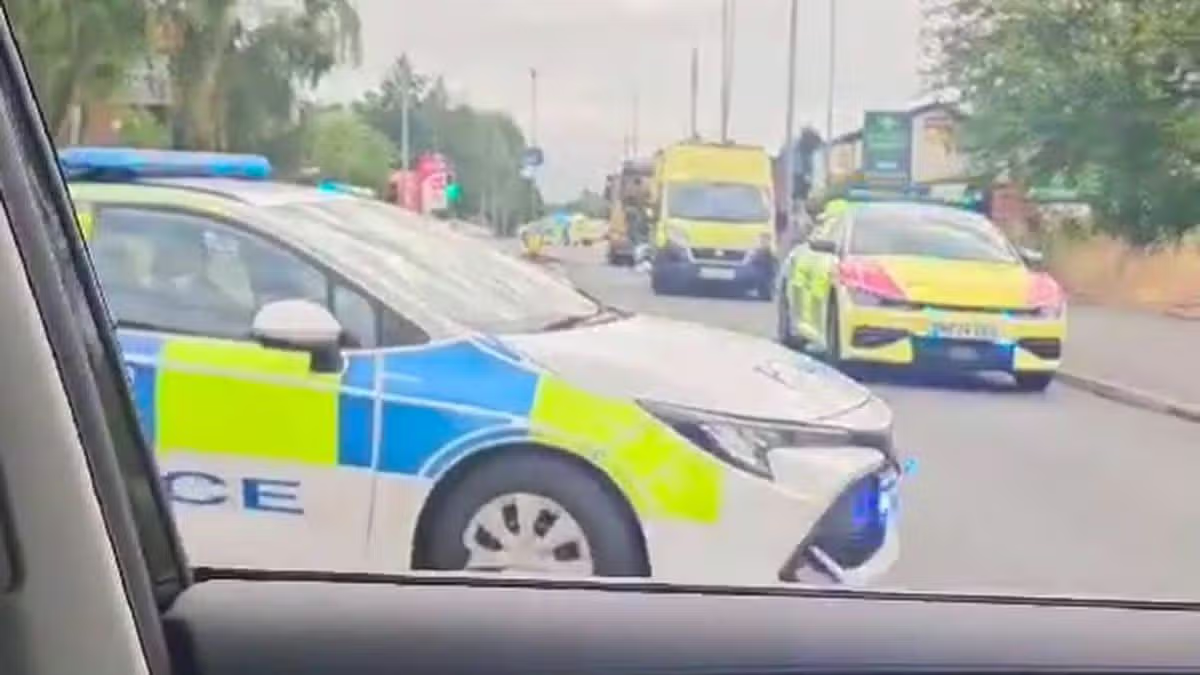
A cash machine has been stolen from a supermarket in a ram raid. Cambridgeshire Police were called to Asda in Ness Road, Burwell just before 5am today (Wednesday, June 17).

Advertisement

Officers received reports that a stolen telehandler, along with two other vehicles, were used to remove a cash machine from the front of the premises.

Detective Inspector Jim Donington said: “We understand incidents like this are concerning for local residents, particularly given this is the second ram raid in the county in two days.

“Dedicated patrols are in place and we are actively investigating both incidents. We would urge anyone who sees suspicious behaviour, or who knows of vehicles that may have been stolen or are being used in unusual circumstances, to report this to us. Information from the public is vital in helping us prevent further offences and identify those responsible.”

Officers are appealing for information, dashcam, doorbell or CCTV footage that could assist police. Anyone with information should call police on 101 and quote incident 51 of June 17.

Do you want more of the latest Cambridgeshire news as it comes in from across the county? Sign up to our dedicated newsletter to make sure you never miss a big story from Cambridge or anywhere else in the county. You can also sign up to our dedicated Traffic and Crime newsletters for the latest updates on the topics you are most interested in .

Source link

Advertisement
Continue Reading

NewsBeat

World Cup 2026: The VAR decision that dumbfounded the world’s best refs

Published

on

Senegal's Sadio Mane challenges France's Kylian Mbappe in the penalty area leading to a VAR review

It was a decision that stunned the world’s best referees.

France forward Kylian Mbappe was on the attack in the 58th minute against Senegal when he went down inside the box after a challenge by Sadio Mane.

With the game goalless at the New York New Jersey Stadium, referee Alireza Faghani was sent to the pitchside monitor to look at the challenge again.

He returned to the pitch and appeared to point to the penalty spot, much to the delight of the thousands of France fans inside the ground.

Advertisement

However, their joy was short-lived as Faghani had actually signalled for a goal-kick, before he explained that Mbappe had initiated the contact.

Speaking on BBC One, Darren Cann – the 2010 World Cup final assistant referee – said: “My phone has blown up with messages from several of the world’s best referees who also can’t understand why a penalty wasn’t given.”

Former Scotland winger Pat Nevin, at the game for BBC Radio 5 Live, labelled it a “rubbish decision”.

“Utter nonsense,” added Nevin.

Advertisement

“No chance at all. How can he [Mbappe] have initiated the contact? The most nonsensical line I have ever heard.”

Former England captain Alan Shearer, at the game for BBC One, said it was a “bizarre” decision not to award a penalty.

“I don’t get it,” added Shearer. “You can see the lunge from Mane and his left leg catches Mbappe.

“How can Mbappe initiate contact if he is in front of him? It’s bizarre, it really is.”

Advertisement

Source link

Continue Reading

Trending

Copyright © 2025