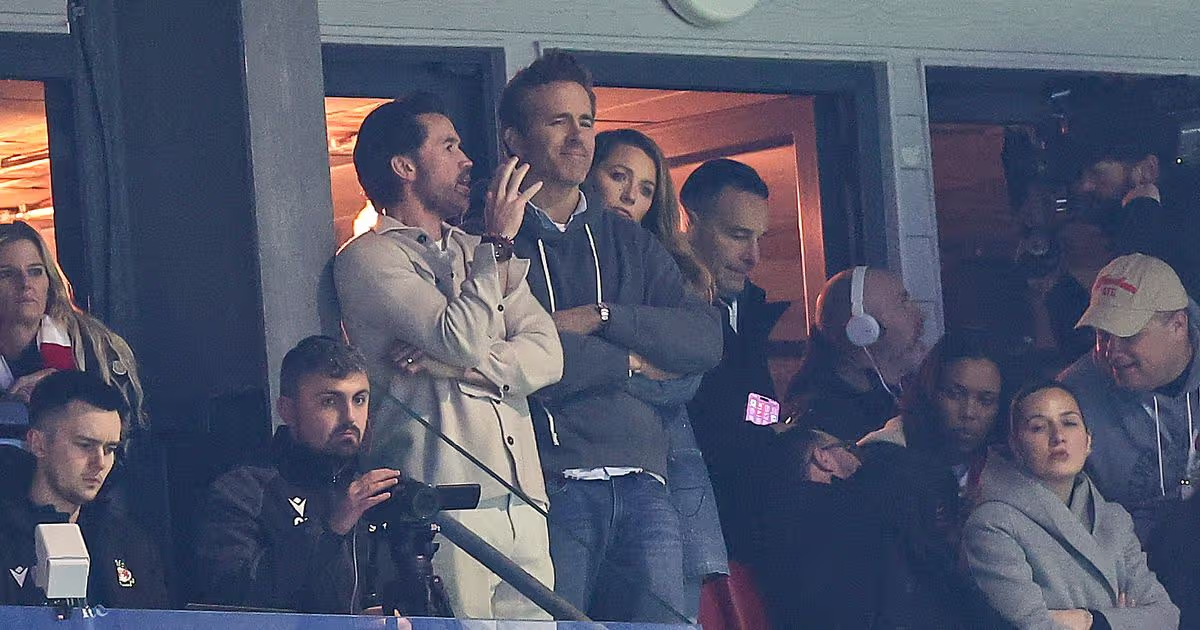
Ryan Reynolds and Rob McElhenney watched from the stands at the Racecourse Ground as Wrexham gave Chelsea one almighty scare in the FA Cup fifth-round
21:59, 07 Mar 2026Updated 22:46, 07 Mar 2026
Ryan Reynolds was incredibly proud of Wrexham’s performance against Chelsea even though his side were beaten at the Racecourse Ground.
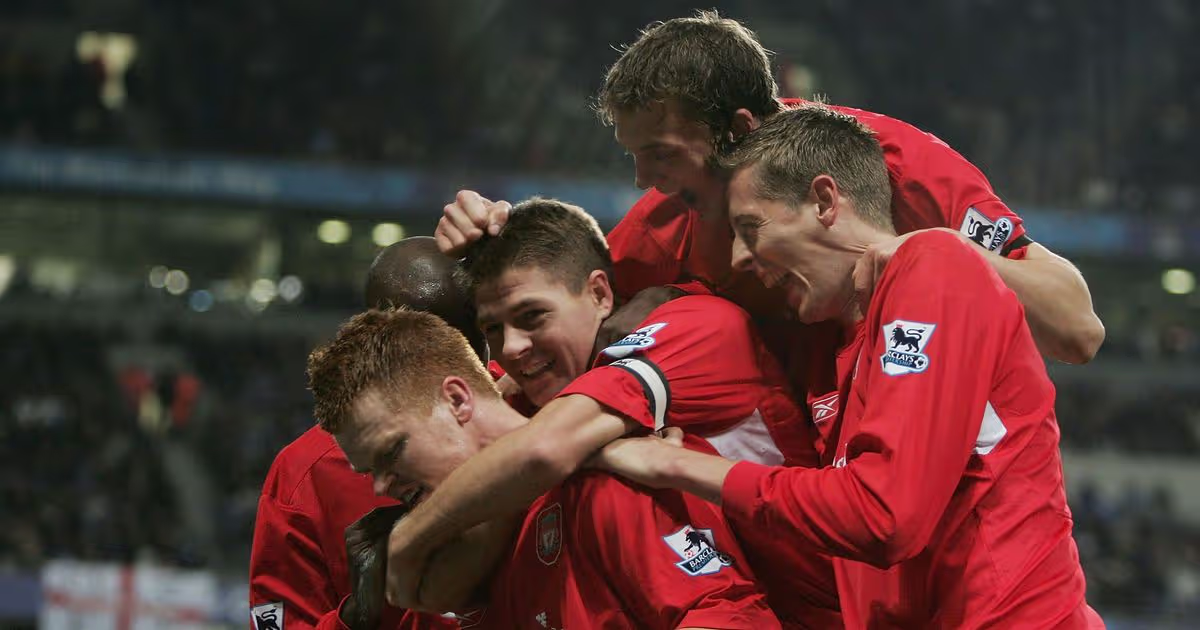
Reynolds and Rob McElhenney watched on from the stands as the Red Dragons saw their FA Cup hopes end against Liam Rosenior’s side, but only after they had given the reigning world champions one almighty scare. A fortuitous own goal allowed the Stamford Bridge club to draw level just before the break after Sam Smith had given the hosts an early lead.
An upset then looked on the cards when Callum Doyle restored Phil Parkinson’s side’s lead 12 minutes from time. However, it wasn’t to be for Reynolds’ side as Josh Acheampong levelled for a second time and Alejandro Garnacho and Joao Pedro secured Chelsea’s quarter-final spot in extra time after the hosts had George Dobson sent off.
But taking to X on Saturday night, the Wrexham co-owner wrote: “Three years ago this week, we battled Maidenhead United to a draw. Today we pushed Chelsea to extra time. So incredibly proud of Wrexham’s performance today.”
And a proud Parkinson said post-match: “The lads have been immense. Of course the dressing room is quiet, which you’d expect after a defeat, but when we wake up tomorrow the lads can be immensely proud – and the supporters will be – of the way we’ve played.
“Everybody knows that 11 v 10 in extra time, when so much energy has been used, is a difficult ask. But we said there would be a moment and there nearly was with the disallowed goal.
Advertisement
“I think we deserved, at the very least, to go to penalties, but some big calls went against us.”
While Chelsea boss Rosenior admitted his side got lucky, saying: “‘That was every reason why the FA Cup is what it is
“Wrexham were magnificent in their energy and how brave they were with their press and how they played. We had to be at a high level.
Advertisement
“We were pushed all the way by a very good team. We need to find a way to manage games better, but in these cup ties you can feel the emotion of the game. They’re very difficult games to play in.
“We went 1-0 down early against Aston Villa, we were 2-0 down at half-time against West Ham, we have to find a way not to be in that position, but what the players are showing me, no matter who is on the pitch, is a really good spirit and belief and a determination to win games of football.
“Now we need to keep working, we need to recover because we’ve got a big game on Wednesday and we need to start preparing for that.”
Watch the FA Cup on TNT Sports
Advertisement
This article contains affiliate links, we will receive a commission on any sales we generate from it. Learn more
TNT Sports broadcasts select FA Cup fixtures and fans can tune in on the TNT Sports Prime Video channel. A monthly subscription also includes select Champions League, Europa League and Premier League games.
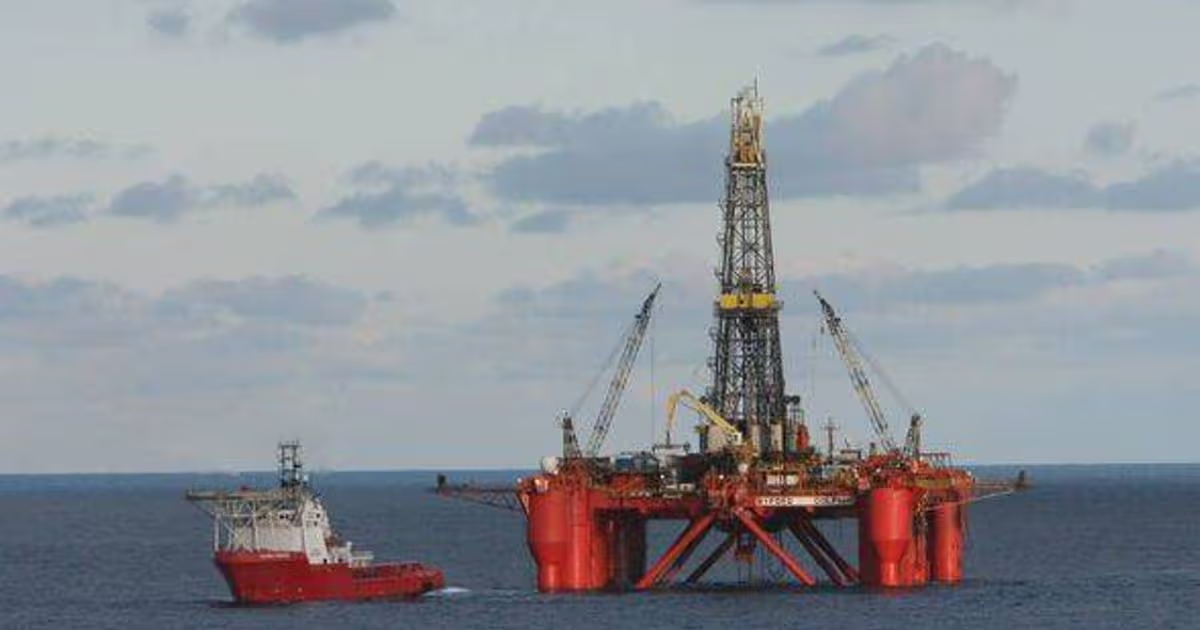
The Byford Dolphin diving bell accident killed five men instantly through explosive decompression in the North Sea – a catastrophic incident caused by human error on the oil rig
In a harrowing account, a catastrophic blunder beneath the waves resulted in what has been described as some of the ‘most gruesome deaths’ ever recorded, killing five of the six men present.
Advertisement
The horrific tragedy occurred on a semi-submersible oil drilling platform where the divers had been deployed to undertake a deep-sea operation. Whilst the rig looked ordinary enough, it became the location of multiple fatal incidents involving its crew throughout its years of service.
One particularly dreadful mishap occurred on the platform in 1983.
The devastating disaster of 1983
The Byford Dolphin, a semi-submersible oil drilling platform, worked throughout the British, Norwegian, and Danish zones of the North Sea, performing seasonal drilling operations for different firms, reports the Express.
In November 1983, a crew consisting of two British and two Norwegian divers – Roy P Lucas, 38, Edwin Arthur Coward, 35, Truls Hellevik, 34, and Bjørn Giaever Bergersen, 29 – alongside dive tenders William Crammond, 32, and Martin Saunders, 30, were positioned on the platform to complete a deep-sea diving operation.
When the tragedy struck, all six men were carrying out their responsibilities underwater, performing standard maintenance work on the rig at a remarkable depth of 295 feet.
To safely execute their assignments, the team were accommodated in specialist compression chambers for their scheduled 28-day deployment to avoid dangerous nitrogen accumulation in their blood.
Within these compartments, the divers inhaled a precisely calibrated mixture of gases, usually oxygen and helium, modified based on how deep they descended.
Advertisement
The crew employed a practice called ‘saturation diving’, allowing them to remain for extended durations at considerable depths beneath the waves.
This approach was used to help the team sidestep decompression sickness, widely referred to as ‘the bends’, upon their return to the surface.
The workers travelled via a specialist transport unit, a diving bell, to move securely between their accommodation and their submerged workstation.
Advertisement
On 5 November 1983, divers Hellevik and Bergersen were completing a 12-hour stint, assisted by dive tenders Saunders and Crammond. They were heading back to their rest area via the diving bell.
For the diving bell to function safely, it was vital that the team verified the transport unit was secured and properly reattached before returning to their heavily pressurised rest chambers.
This protocol was essential to avoid sudden decompression within the body, which could prove fatal.
Upon entry, the divers needed to shut the hatch and regulate the pressure within their rest chamber to form a hermetic seal.
Advertisement
This step would subsequently isolate the chamber and link it to the dive bell, which would slowly depressurise for the divers’ protection.
However, on that fateful day, the pressure within inner crew chambers 1 and 2 – typically maintained at nine atmospheres – dropped catastrophically to just one atmosphere in mere milliseconds.
The disaster unfolded when an external diver committed a critical error, releasing the diving bell’s latch prematurely whilst full depressurisation remained incomplete.
This blunder meant the clamp securing the chambers opened before Hellevik had properly sealed the chamber door. Consequently, the sleeping chamber’s pressure shifted instantaneously from conditions equivalent to 295 feet beneath the waves to ordinary surface air pressure, according to the Mirror.
Advertisement
Coward and Lucas were understood to be recuperating in chamber 2, experiencing nine atmospheres of pressure when catastrophe struck. The violent, explosive expulsion of air from the chamber propelled the diving bell with tremendous force, smashing into Crammond and ending his life immediately.
Three divers positioned inside the sleeping chambers are thought to have died instantly as nitrogen within their bloodstreams transformed into bubbles, essentially causing them to boil internally and obliterating their bodies into innumerable pieces.
Hellevik, positioned closest to the partially secured chamber door, was forcibly drawn through a narrow 60cm opening, causing his internal organs to be expelled from his body.
The post-mortem examination recorded: “The scalp with long, blond hair was present, but the top of the skull and the brain were missing. The soft tissues of the face were found, however, completely separated from the bones.”
Advertisement
His abdominal and thoracic organs had been expelled.
Hellevik’s body was reportedly sent for autopsy in four separate bags collected from various locations around the rig. Each part of his body inside the bags of bone and tissue reportedly displayed some sign of injury.
Saunders, the sole survivor of the catastrophic incident, suffered devastating injuries including collapsed lungs, spinal fractures and a broken neck.
The tragedy was also attributed to engineering deficiencies. The Byford Dolphin oil rig was operating with an obsolete diving system dating back to 1975, which lacked fail-safe hatches, outboard pressure gauges or an interlocking mechanism.
Advertisement
This vital safety feature would have stopped the divers’ sleeping chambers from opening whilst the system remained pressurised. Notwithstanding these deficiencies, the Byford Dolphin oil rig remained operational with modifications and underwent ownership changes until its eventual decommissioning in 2019.
It was subsequently sold for scrapping in the 2020s.
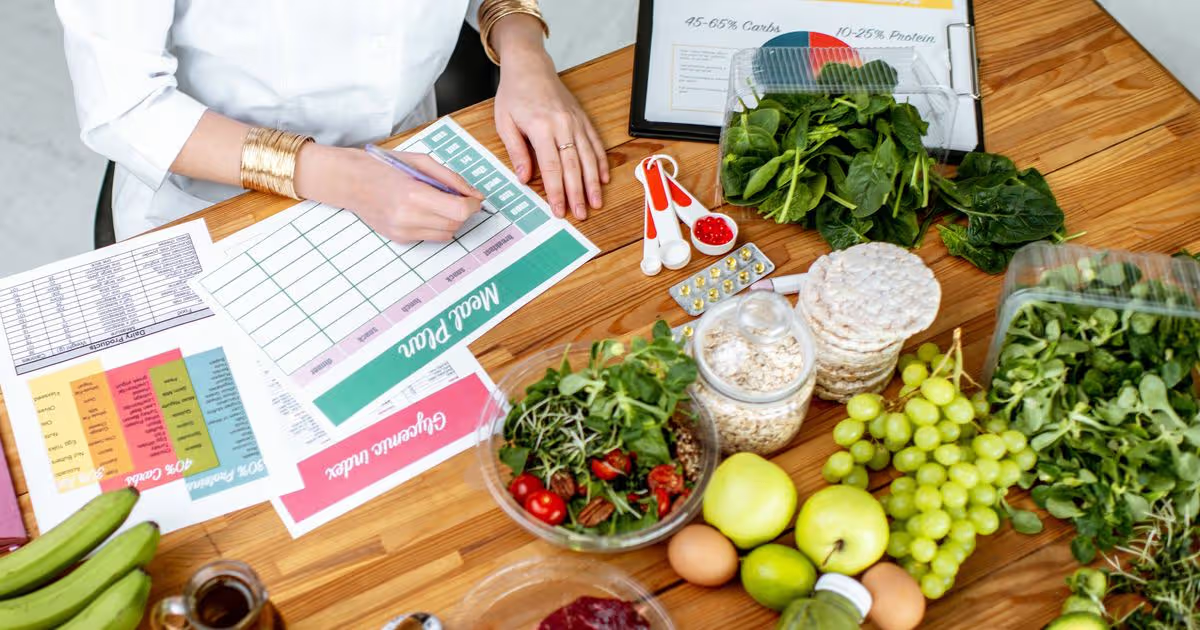
A cancer dietitian has urged everyone to cut two things from their diet in order to reduce their risk of the disease – as she said all other food and drink is perfectly fine to eat
Navigating healthy eating advice can be a minefield. Depending on what your goals are with following a diet, you can receive conflicting information over what is right for your body, but the most important thing to remember is that a balanced diet is the key.
Advertisement
If your goal when cutting out junk food is to ditch things that might increase your risk of cancer, however, then there are only two items you need to stop consuming. According to a cancer dietitian on social media, there is one type of food and one type of drink that have been proven to increase your risk of cancer, so if you cut those out, you can continue to enjoy the rest of your favourite food without worry.
Nichole Andrews, a registered oncology dietitian, claimed in a TikTok video that in order to slash your risk of cancer by as much as 38%, you need to stop consuming two things: alcohol and processed meat.
She said: “There are only two foods that increase cancer risk. Only two. Which is actually good news [because it means] you can literally have all other foods and beverages. Those two are alcohol and processed meats.”
The dietitian added that it angers her when people in the comments of her videos say they will continue to enjoy foods like pepperoni pizza, wine, and beer because “you only live once” and don’t want to limit their intake of food and drink they enjoy, just because it can increase their cancer risk.
Advertisement
She said those who have had cancer know how important it is to take care of their bodies and make sure they minimise any risk of the disease coming back again.
Content cannot be displayed without consent
Ensure our latest headlines always appear at the top of your Google Search by making us a Preferred Source.Click here to activate or add us as your Preferred Source in your Google search settings.
She continued: “You have never had cancer, because when you truly do consume processed meats or alcohol, you are increasing your risk. Someone who has had cancer or has said the words ‘gone through treatment’ is absolutely ready to do whatever they can to reduce their risk of recurrence.
“If you really want to keep drinking alcohol and have processed meats that increase your risk, that’s for you. But this [attitude of] ‘YOLO, I’m eating pizza and wine’? Get out of here.”
Advertisement
Nichole claimed that alcohol can increase your risk of cancer by up to 20%, while processed meats, which include deli meats like salami, pepperoni, and even sliced ham, can increase your risk by up to 18%.
Does processed meat cause cancer?
According to Cancer Research UK, processed meat increases the risk of bowel cancer. They claim that research shows that even eating a small amount of processed meat can increase your risk, and while you’re not guaranteed to get cancer if you eat this type of food, the less you eat of it, the lower your risk.
Processed meats that carry a cancer risk include:
Ham
Bacon
Corned beef
Some sausages, like chorizo and hot dogs
Deli meats, like salami and pepperoni
There is also a link between red meat, which includes beef, pork, lamb, and goat, and bowel cancer. However, this type of meat is classed as a probable cause of cancer, as there is less evidence than there is for processed meat.
Does alcohol cause cancer?
Alcohol can cause seven different types of cancer, according to Cancer Research UK. The charity states that while some alcoholic drinks are often thought to be “better” for you than others, all types of alcohol increase the risk of cancer as it’s the alcohol itself that causes the damage, even in small amounts.
Advertisement
Alcohol can damage our cells and stop cells from repairing the damage, as well as affect chemical signals which can make cells divide more often. It also makes it easier for cells in our mouth and throat to absorb harmful chemicals, all of which can increase our risk of cancer.
Types of cancer that can be caused by drinking alcohol include: breast cancer, bowel cancer, mouth cancer, liver cancer, and some types of throat cancer that affect your oesophagus, larynx, and pharynx.
Last month, Christopher Sharp lived with CarsGuides’ 2026 car of the year to find out what it was like to live with and got a major surprise
If you’re looking to buy a family sized SUV there are plenty of options out there. From the Land Rover Defender and KIA EV9 to the Mercedes G-Wagen and Volkswagen Tayronn, there are a bevvy of options for families to choose from if they want a high riding vehicle with space for them, their loved ones, and some stuff.
Advertisement
So how does CarsGuide’s 2026 car of the year, the Hyundai Santa Fe, fair? Full disclosure, I’ve never been the biggest fan of SUVs and have felt recently that most people would be better off buying a large estate because of the handling and fuel economy advantages. So would the Santa Fe change my mind?
The Santa Fe we had on test was the Hybrid Ultimate, 1.6T 239PS Hybrid 6AT, Automatic, 4WD. What it is in simpler terms is a large £55,895 petrol hybrid SUV with seven seats, a large boot, and some tasty optional extras.
Specifications
From a dimensional perspective the car is 4.8m long, 2.2m wide, 1.72m high. It has five doors. The boot space with the seats up is around 620litres, but with them folded flat is anywhere between 985 to 1,949litres.
Advertisement
Up Front
Get yourself into the driver’s seat and this is where things change a little. The car can remember what position you like to have the seat in; you can even save your position. What this means when you open the car door, the seat and steering wheel move apart. Once you’re on the seat they move into your preferred position. Sounds weird, but a good feature if you’re switching drivers.
The infotainment is a mix of haptic touch pads, screens, and dials. You spend most of your time using the touch screen to make various changes to the car. In terms of ease of use it’s decent, although adjusting the heated seats and aircon on the move is a bit of a faff with the touch pads.
The Santa Fe can come with a massive sunroof and also has a cavernous storage compartment between the driver and the passenger. However, the bottom of the middle compartment has some non-smooth material on it so best avoid putting any unwrapped sweets or chewing gum down there.
Advertisement
Overall, the interior is habitable and comfortable and I had no awkward bodily feelings after a long round trip to Caffeine and Machine. The journey was also a decent opportunity to have a comprehensive look inside and find out where the charging ports are. There are six, four plugged and two wireless.
In the middle and rear
The middle row of seats heated like the front, and also come with blinds to go over the side windows. Meanwhile, the rear seats, which can be folded up via toggles, have phone chargers and cup holders. However, it was pointed out to us by one owner that if you don’t use the third row very often, having aircon that the second row passengers can’t access is a bit unnecessary.
The rear seats can be pulled up using toggles on top and behind them, so they can be raised whether coming through the front or rear of the car. Before this can be done you move the second row first by pulling a lever under the second row of seats or by pushing a button on top of them. To get them back in place you reverse the process.
Advertisement
Aesthetics and Driving
Whilst the Hyundai may look long, big, and heavy, it doesn’t drive like that. It feels through the controls more like a small estate or a hatchback. Driving across London it was very easy to forget how big a car I was in.
Whilst you’re far from the front and rear of the car, the steering gives you very good feedback.
Meanwhile, the hybrid system is engaged in a constant dancing act between moving the car along and charging the battery. It can run on electric only mode for a while, but doesn’t stay on electric only mode for very long. There is a sport driving mode, but you’re better off leaving it in eco. However, there are terrain modes, useful for when winter comes back around.
Advertisement
Overall the car feels very genuine and likeable, and I think this comes from it not feeling very sporty.. Aesthetically, it replicates the cool boxy style better than Land Rover’s Defender whilst being very comfortable. On the road the cornering is very flat with a little low speed understeer.
This SUV set B roads on fire, but then again it’s family focussed so you’re not after lap times. Furthermore, the dreaded lane assist isn’t that intrusive and easy to turn off.
Conclusion
The Santa Fe isn’t perfect. The amenities of the third row of seats should be moved to the second row and the haptic touch pads should be replaced with buttons instead.
Advertisement
What’s more, the four cylinder engine sounds quite stretched when it’s charging the battery. There were several occasions when I was at town speeds with the battery at 50 percent, but the engine was still charging it and I thought ‘Why isn’t it waiting until the battery is at 20 percent to start charging?’.
In the grand scheme of things these are only very little problems to consider; and it has changed my mind that SUVs aren’t all leaning too much towards the S side of the acronym. If you’re looking for a capable family SUV that isn’t German or British, give this a look.
Arthritis UK has warned the Work and Pensions Committee that people with arthritis risk missing out on benefits like PIP and Universal Credit as the state pension age increases
Experts have raised concerns about changes to the state pension qualifying rules. MPs discussed the risk of people “underclaiming” and not receiving the full range of DWP benefits they are entitled to.
Advertisement
From April 2026, the age at which you can begin claiming your state pension will rise from the current 66, gradually increasing to 67 by April 2028. Policy experts fear the extended wait could have a significant impact on some individuals, particularly those who have medical conditions.
The Work and Pensions Committee recently discussed the increase in the state pension age. Joe Levenson, assistant director of UK Advocacy and Health Intelligence at charity Arthritis UK, told the MPs: “Everyday, 1,200 people are diagnosed with arthritis, and we know that a significant number of them are unable to work at some stage because of arthritis.
“Around half the people tell us that they struggle to work. Arthritis has an impact on their ability to be employed. That is the context for our worries about the transition to a higher state pension age.”
He said the organisation had conducted a large survey of people with arthritis, which had some concerning findings, reports the Mirror.
Advertisement
Mr Levenson said: “It showed that once people were over the state pension age, they were far less likely to report struggling to get by financially, and almost twice as likely to struggle to get by financially as the cohort immediately before state pension age. I think that speaks volumes.
“It shows we are failing people, and we are worried that people who live with arthritis and many other long-term health conditions are collateral damage in the changes that we have seen, including a rise in state pension age without mitigation.”
He had some suggestions for what extra support should be offered to help people approaching retirement age.
Mr Levenson stated: “Given we know that people approaching state pension age can be at greater risk of poverty, we need to focus on income. Part of that is making sure that people are aware of existing benefits that they can claim.
Advertisement
“We know that there is still underclaiming. We know that that is because of a lack of awareness, but the complications in the system can also be bewildering even to the most well-informed.”
What other benefits can people with arthritis claim?
One form of assistance for individuals of working age living with arthritis is PIP (Personal Independence Payment). This can be claimed to help cover the additional costs associated with living with a long-term health condition, if it impacts either your mobility or your daily living needs.
Through this scheme, you can receive up to £749.80 every four-week pay period. If you’re on a low income, you might also be eligible for Universal Credit.
For those aged 25 and over, this provides £400.14 a month for single claimants or £628.10 for couples, at the standard rate.
Advertisement
Additional amounts may be available depending on your circumstances. Upon reaching state pension age, you may be eligible to apply for Pension Credit, which supplements your income to £227.10 per week for single claimants and up to £346.60 if you have a partner.
Further amounts are available on top of this, such as £82.90 per week if you have a severe disability.
If you have a health condition that affects you to the extent you need someone else to care for you, you may also qualify for Attendance Allowance, which pays £73.90 or £110.40 per week.
This year also marks the 50th anniversary of punk music, and once again the Rebellion line-up reads like a who’s who of punk, bringing together hundreds of acts from punk’s various eras.
The festival runs from Thursday, August 6 to Sunday, August 9. But for the first time there will be additional events – the Rebellion Run Up on Tuesday, August 4 and Wednesday August 5 which will also being a host of must-see names.
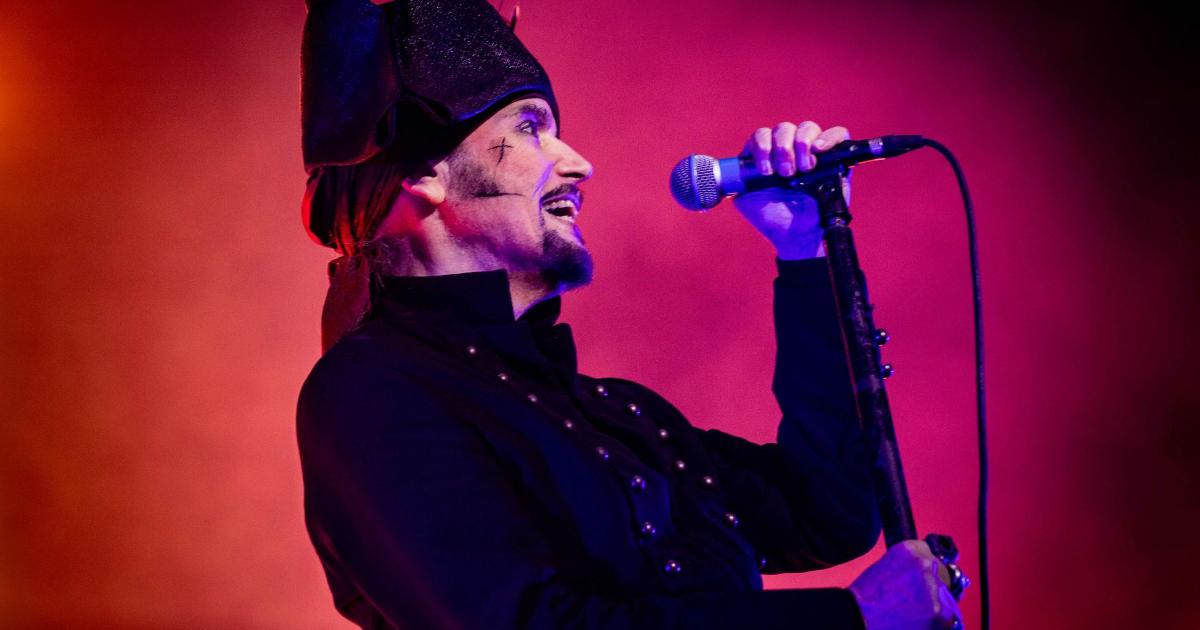
Adam Ant, the Undertones and Altered Images fronted by Clare Grogan will be playing on the Tuesday and Neville Staples, Death of Guitar Pop and Arthur Kay and the Originals are confirmed for the Wednesday.
As for the official festival, The Stranglers provide the opening day headline act.
Advertisement
And Jimmy Pursey’s Sham 69, who penned the anthem Hersham Boys, have landed top billing on Friday.
German punk giants Die Toten Hosen play on Saturday with 999, Spizz Energi and The Skids.
Burnley’s Notsensibles, performing a rare live show, are also confirmed to play on Saturday at the Winter Gardens.
Belfast’s Stiff Little Fingers, whose first album Inflammable Material, a punk classic, was recorded to the backdrop of the Troubles and sectarian violence in Northern Ireland, are Sunday’s headliners.
Advertisement
When released in 1979, Adam and the Ants debut album Dirk Wears White Sox was hailed as one of post punk’s most original works.
Adam Ant later enjoyed huge commercial pop success with hit singles Prince Charming, Stand and Deliver and Kings of the Wild Frontier.
“Adam and the Ants were my band, my big obsession as a teenager,” recalled Jennie Russell-Smith, the co-founder of Rebellion.
“I was 13 and had Adam and the Ants posters all over my bedroom wall.
Advertisement
“I remember my dad taking me on the bus to Middlesbrough to buy Dirk Wears White Sox.
“The excitement of hearing songs like Car Trouble and Never Trust a Man (with egg on his face) did change my life and I found other new music through that album.
“The funny thing is I’ve never seen Adam play live so I thought ‘Wow’ it would be amazing to try and get him to play Rebellion for our big anniversary.
“When we got in touch, he loved the idea and straight away Adam Ant wanted to be part of it.
Advertisement
“He was one of the first acts to say yes.”
Jennie added: “It is a dream come true and I can’t tell you how excited I am to finally see Adam play.
“He said he is going to delve into the back catalogue and play some tracks from Dirk Wears White Sox so I think it will be a hard-edged set with all the hits too.
“I can’t wait.”
Advertisement
With all four days of the main festival having sold out Adam Ant will kick-start the punk jamboree on Tuesday August 4, with support from The Undertones and Altered Images.
Adam Ant (Picture: rockstarimages.co.uk)
“I’m so proud of what Rebellion has become, the creativity of it, the fun and what it means to so many people,” said Jennie.
“This year we’ve even got a punk tea-room.
“When I moved house, I sorted out my best China so anybody having a cuppa at Rebellion will probably be drinking out of my teacups.”
Advertisement
Jennie adds: “I was 27 when we staged the first Rebellion in Blackpool and it was carnage; absolute mayhem.
“It is a lot more serene now but importantly it is not just a retrospective festival.
“In the last four to five years the younger generation have embraced Rebellion too and given it even more vibrancy and excitement.
“There are amazing young bands like Idles and Wolf Alice and some of today’s generation have found Rebellion because those bands have referenced punk.
Advertisement
“To see the old bands still performing at Rebellion alongside some of the most talented musicians of the next generation is so special.”
Clare Grogan of Altered Images
Rebellion remains a fiercely independent festival with no sponsorship and Jenny says it feels like welcoming close friends when the Rebellion doors swing open each year.
“It does feel like that, yes,” she says.
“Some people come alone, some with friends but they all know how kind and good-natured the atmosphere at Rebellion is.
Advertisement
“Both Darren (festival co-founder) and me can now say we’ve been running this festival for over half of our lives, but it’s what we love.
“Punk was never dead because here we are, still living our dreams.”
For more information about who’s playing when and tickets, visit www.rebellionfestivals.com
A former Liverpool star desired a return to Merseyside but claimed his return was blocked after a relationship breakdown
Stephen Warnock has claimed that a “jealous” Gerard Houllier thwarted his return to Liverpool from Aston Villa. The 44-year-old alleges he even proposed to slash his wages in half to facilitate the move, but his appeal was dismissed.
Advertisement
Warnock kicked off his career with the Reds and racked up 67 first-team appearances before departing in 2007. Following a stint at Blackburn Rovers, he found himself at Villa Park playing under the legendary former Liverpool manager Houllier, who died in 2020.
After a disagreement, the full-back sought a transfer and his childhood club were ready to welcome him back initially on loan. However, his Anfield reunion never came to pass despite his willingness to reduce his salary and Warnock believes Houllier was responsible.
Speaking on In The Mixer, sponsored by Sky Bet, Warnock revealed: “So Gerard Houllier was the manager of Aston Villa and I had a falling out with him. I was basically put on the reserve team squad. Then Gary McAllister came to me, another assistant manager doing the manager’s job, to say, ‘Kenny Dalglish has been on the phone.
“He wants to re-sign you for Liverpool.’ It was at least on loan to start with, with a view to a permanent. So I was like, ‘Yeah, brilliant. Get it done.’ And he was like, ‘It’s the right thing for you. Go back and enjoy your football.’
“But I think there was an element of Gerard Houllier being jealous of the fact that I could go and play for Liverpool and I could go back there and be happy. It’s a bad look. So they turned around at the last minute and put I think a half-million-pound loan fee on. Liverpool were like, ‘Hang about, you’ve just changed the goalposts.’
“Anyway, the deal fell through and I ended up sitting in the reserves for the rest of the season. Head loss completely. I mean, it got to the point where they had to move me off the reserve team pitch because I was booting balls into the middle of their training sessions.
“When I was supposed to be going back to Liverpool, I said to them with the loan deal, ‘Well, if we can make it work, chop my wages in half.’ I was like, ‘I’ll take less. I don’t care. Just let me go back and play.’
“They were like, ‘No, no, we can’t do that.’ That was Villa saying that. I was like, ‘Yeah, you can. You’re making half my wages back for doing nothing. Just let me go. And Liverpool are going to cover my wages there.’ They wouldn’t do it.”
Houllier stepped down as Villa manager at the conclusion of the 2010/11 season after a period of ill health. Warnock was reintegrated by his successor, Alex McLeish, and remained at Villa Park for another season before a loan spell at Bolton and a subsequent permanent move to Leeds.
He later played for Derby, Wigan, Burton Albion and Bradford before hanging up his boots in 2018 and transitioning into punditry.
STEPHEN WARNOCK EPISODE ON YOUTUBE: Subscribe now to be the first to watch the latest episodes of In The Mixer and other original shows, brought to you by Sky Bet.Watch All Out Football’s episode with Stephen Warnock here.
Will the PlayStation 6 learn from the mistakes of the current gen? (Metro)
With more news about the PlayStation 6 starting to appear, a reader feels that the appearance of Valve’s Steam Machine will have a big impact on Sony’s plans.
You’d think the demise of Xbox would be cause for celebration amongst PlayStation fans, but it hasn’t turned out like that at all, from anything I’ve seen. Maybe it’s because Xbox hasn’t been a true rival for a while now but the exit of Phil Spencer and the annoucement of Project Helix hasn’t even been a blip on the radar of anyone I’ve spoken to.
Most of them are too busy complaining about the current state of PlayStation 5 and while the rumours about Sony moving away from the PC are promising they are only rumours and we don’t know anything for sure.
But I’m optimistic about that change, assuming it’s real, because it seems to show that Sony is wiling to listen to fans when it comes to the PlayStation 6. I like the idea of a PlayStation 5 handheld too but the thing I’m most interested in is the Steam Machine because, unlike Xbox, it could provide some actual competition to Sony.
Advertisement
Any sensible fan will tell you that they need competition. It’d be awful if Xbox or PlayStation became too dominant and I think a lot of problems with the PlayStation 5 generation is it’s been made obvious that it doesn’t really matter what Sony does, because people haven’t got an alternative.
There’s a lot of reasons that they’ve stopped making as many single-player games but I think one of the big ones is that they don’t need to. Exclusives are one of the main reasons that anyone picks one console over another, but if PlayStation 5 is the only choice, when it comes to high-end games, that’s not really an issue, so why bother spending the money making them?
Expert, exclusive gaming analysis
Sign up to the GameCentral newsletter for a unique take on the week in gaming, alongside the latest reviews and more. Delivered to your inbox every Saturday morning.
Advertisement
But with Steam Machine, Sony is going to have to think about what it’s doing again. Remember, coming off the back of the PlayStation 3, Sony was in high alert mode. If the Xbox 360 hadn’t sabotaged itself, it would’ve won that generation and Sony knew it. So they went all out with the PlayStation 4 and its games.
The PlayStation 5 was off to a similar start but while there were multiple factors for why things stopped, I think one of them was that they realised the Xbox Series X/S was such a flop out of the gate there wasn’t any need.
Advertisement
We don’t know what exactly Valve’s approach is going to be for the Steam Machine but there’s talk of Half-Life 3 and that is not going to appear on PlayStation 5, I would guess. There may be other Valve exclusives but even if there’s not the Steam Machine can run any PC game, which includes many great games that aren’t on PlayStation.
I’m sure this is one of the other reasons that Sony is pulling away from PC. They don’t want PlayStation games appearing on the next gen Xbox, but no one’s going to buy that so it’s not as big a deal. But a Valve PC/console hybrid that will probably do very well? That’s a real danger.
So while we know very little about the PlayStation 6 at the moment, I feel the signs are all good: rumours of going back to exclusives and single-player games, and real competition that will force Sony to make an effort.
I’d also hope that they’ve generally learnt from the mess this generation has been and welcome a new start just as much as we would. So while there is some grim news out there, I’m looking forward to the future of PlayStation.
Advertisement
By reader Iceman
Will the Steam Machine be the PlayStation 6’s biggest rival? (Valve)
The reader’s features do not necessarily represent the views of GameCentral or Metro.
You can submit your own 500 to 600-word reader feature at any time, which if used will be published in the next appropriate weekend slot.
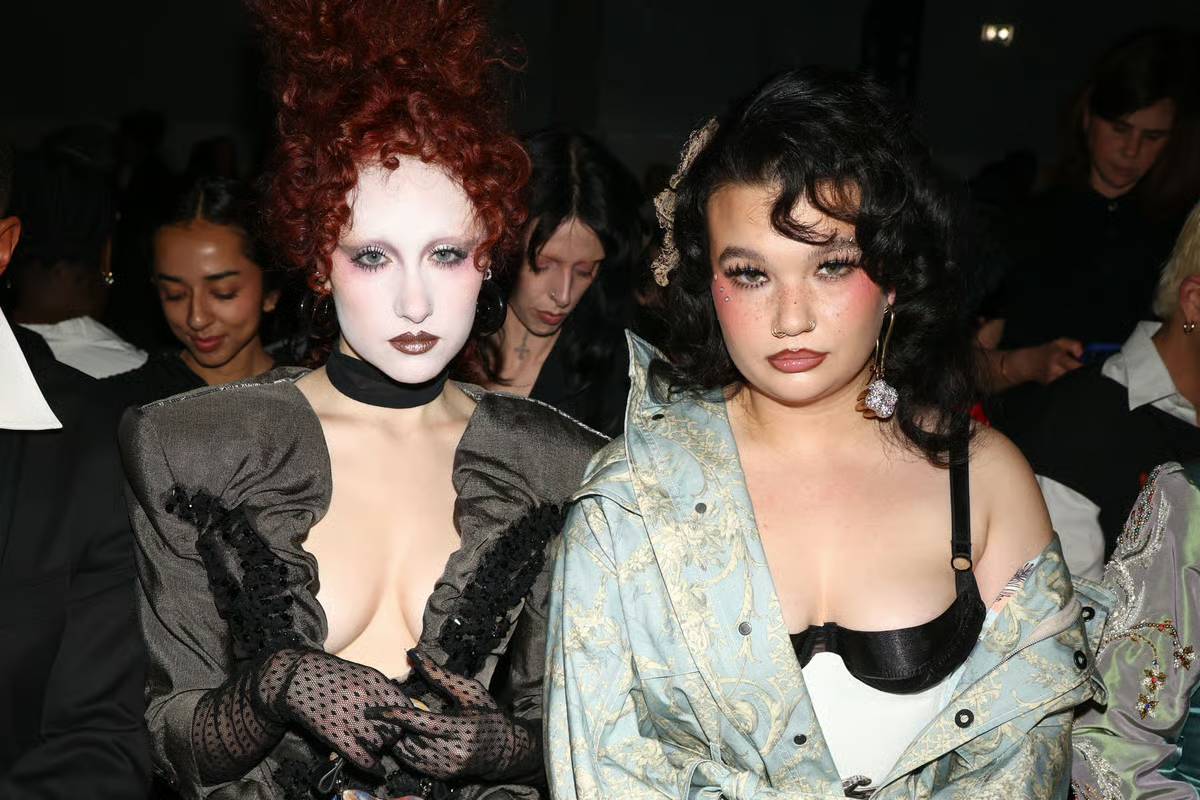
Models emerged from dramatic lighting that cast long reflections across the runway floor, creating a stage-like atmosphere that suggested the show was as much performance as it was a fashion presentation, a hallmark of the Westwood house, long known for challenging conventions of class, gender and historical dress.
A couple of years ago I dug up an artefact buried under soil, grass and leaves in a park close to my home in Exeter. It was not some ancient object but rather a granite memorial plaque laid down by the local city council only three years before. Dedicated to regional victims of the COVID pandemic, it had been created, forgotten and swallowed by the ground in swift succession.
This illustrates our conflicted relationship with remembering the pandemic in Britain. The urge to memorialise sits awkwardly alongside forces of forgetting and indifference. COVID killed over 230,000 people in the UK and had profound effects on health, wellbeing, child development and economic stability. Yet many people treat it with the ambivalence of waking from a strange dream.
Following its official response to the UK Commission on Covid Commemoration late last year, the British government is now formally stepping into this slippery space of remembering and forgetting. March 8 has been designated as a day of reflection on the pandemic, with the Department for Culture, Media and Sport taking the lead.
Advertisement
And yet how much difference will this day make? What media coverage will it receive? How much public appetite is there for it? In my own work on British remembering and forgetting of the pandemic, I have found much evidence of uncertainty about what should be remembered, who should be centred and when commemoration ought to begin.
Despite the death toll and social consequences, public memory of the COVID pandemic has been marked by hesitancy about what should be remembered, when commemoration should happen, who it should involve and how it should be enacted.
A key challenge is the absence of a unified narrative. Pandemic experiences ranged from bereavement, illness and profound suffering in lockdown to mild inconvenience or even a welcome respite from normal life. Depending on luck and the situation with which you entered into the pandemic, it was anything from deeply traumatic to something people are quietly nostalgic about.
When I asked for short public recollections of the period, I received stories of loss, disrupted lives and exhausted health workers, but was also inundated with descriptions of birdsong and country walks. The responses were later compiled into an online audiobook. Public memory of the pandemic has to find a way of holding these incongruities together.
Advertisement
The day of reflection also has a disorientating relationship with time. COVID had no neat end point, no convenient armistice day around which to orient ourselves. The question of when public remembrance should begin was therefore unclear. Some informal memorials were created not long after the pandemic started, but when the government launched the UK Commission on Covid Commemoration in 2022, it was criticised for being too soon. In reality there is probably no perfect moment for public memorialisation, with the time always feeling either too early or too late for different people.
The question of who should organise remembrance is equally fraught. The state’s slow response to recommendations from the UK Commission on Covid Commemoration has been shaped in part by an awareness that this is politically sensitive terrain. Perhaps remembrance should not be led by the state at all. The grassroots activist group COVID-19 Bereaved Families for Justice UK created the National Covid Memorial Wall in London, and the bereavement charity Marie Curie oversaw earlier versions of the day of reflection.
Focusing collective recollection solely around loss of life nonetheless leaves major gaps in terms of the variety of people’s experiences. But there are also risks in wholly levelling the playing field. The loss of a loved one is not equivalent to Zoom quizzes and sourdough baking. Nor should collective memory erase the extent to which the pandemic’s impacts were systemically uneven, with higher mortality rates in some ethnic minority communities.
Advertisement
Remembering through the lens of war
The day of reflection also sits awkwardly alongside existing patterns of how British people remember. These habits are most prominently shaped by rituals of war memory. The various memorial spaces associated with fundraiser and veteran Captain Sir Tom Moore emerged partly because he so neatly fused thoughts of COVID and the second world war.
But the pandemic was not much like a military conflict. While there were praiseworthy instances of public service, most deaths did not fit a narrative of heroic sacrifice, the virus was not an ideological or national enemy, and comparisons between prime ministers Boris Johnson and Winston Churchill have not endured.
Despite the difficulties of what is remembered, when it should happen, who should lead it and what form it should take, there has been an abundance of memorial creation since 2020.
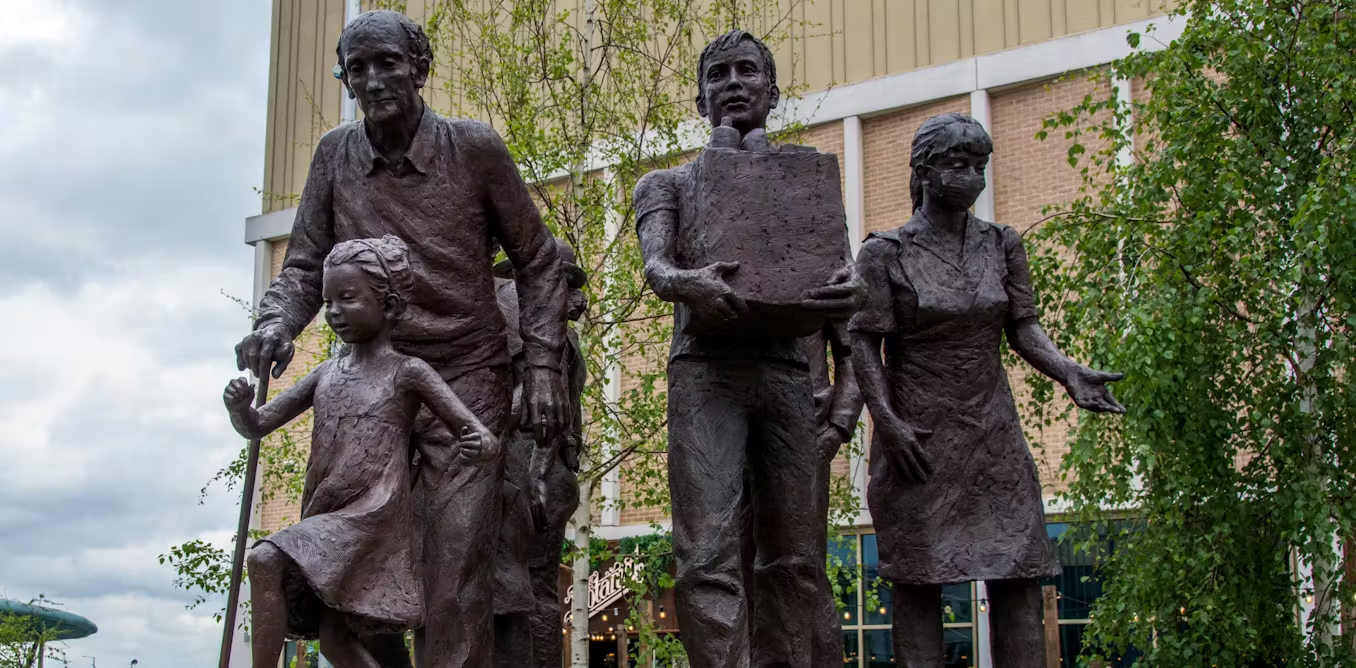
When researching a book on the topic, I visited one built high up a Welsh mountain. I saw one constructed elaborately from wood and later ceremonially set ablaze. Another was framed as a defiant celebration of working-class heroism. One depicts exhausted medical staff cast in bronze. There were many others. Their narratives, forms and origins vary considerably, but what they share is a tenuous grasp on public consciousness. Generally they are little known and, in some cases, their long-term survival is uncertain, dependent on funding, maintenance or continued public interest.
Advertisement
The March 8 day of reflection will not settle the question of how Britain remembers or forgets COVID, but it will reveal how willing we are to try. Any national act of remembrance will only feel meaningful if it can hold together grief, inequality and ambivalence without pretending they are the same.
A woman from East Belfast who was shot nine times and “left for dead” has now set up a beauty training salon to help other women follow their dreams.
Jemma McGrath was attacked in September 2013 and underwent one of the longest operations ever carried out at the Royal Victoria Hospital in Belfast. She was left with a broken arm, broken leg, and pins and screws holding her body together.
The now 36-year-old admitted to using drugs in her youth, and previously said she let her life spiral out of control after her dad’s death. After the shooting, she suffered post-traumatic stress disorder which gave her such severe panic attacks she thought she was dying.
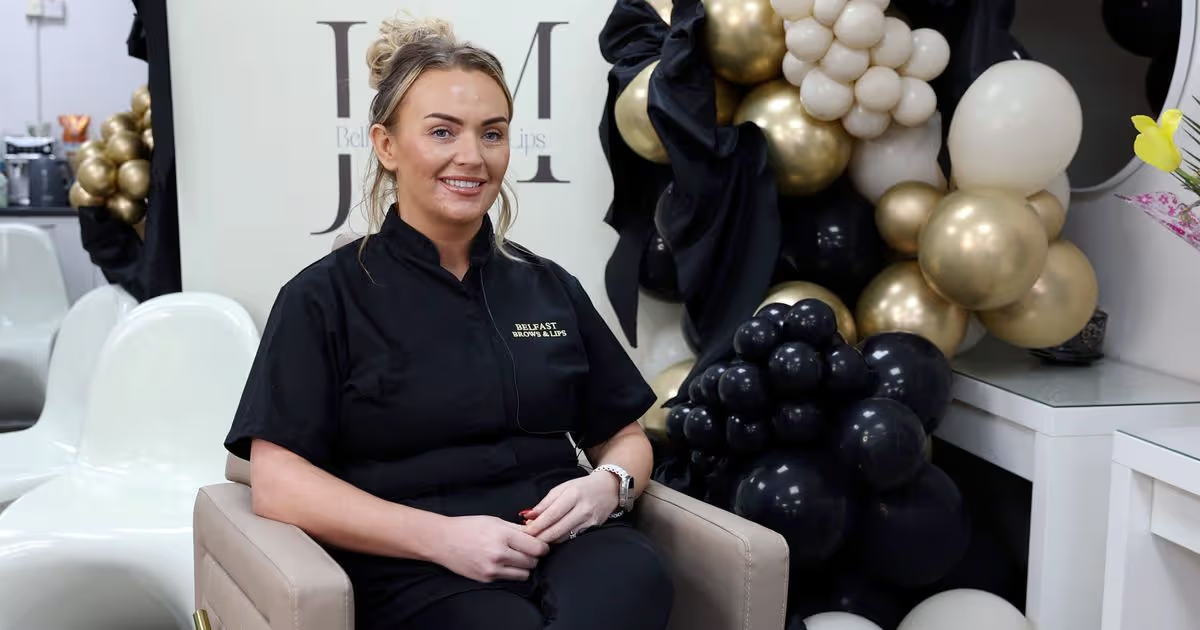
Jemma had to rebuild everything from the ground up, including having to learn how to walk again after being in a wheelchair for months. Now, she is working hard to empower young women and give them a chance to become self-employed through her new training beauty salon on the Shankill Road, Belfast Brows & Lips.
Speaking to Belfast Live, Jemma reflected on being shot 13 years ago, as well how it led to her turning her life around.
She said: “In 2013 I was shot nine times, which left me fighting for my life. I had to learn to walk again, with pins and bolts holding my whole body together, and scars from head to toe.
“For other people that would probably be the end of the road – but for me it was just the beginning. It gave me the determination to create the life I have today.
Advertisement
“I was in a wheelchair for three months and then obviously the mental side of recovery was tough too, but I’ve always been very positive and determined. If I’m really honest with you, I don’t know I would have had the determination that I’ve got today if that hadn’t happened.
“I’m actually a bit emotional when I look back because I literally feel like I’ve created the life I want, where I’ll jump out of bed an hour early for work. After all the hard work, stress, and everything I’ve been through it feels amazing to get to this stage.”
In 2018, Jemma won the Prince’s Trust award for the most innovative business in Northern Ireland and since then has worked with groups such as the Training for Women Newtork (TWN) and the Women Involved in Community Transformation programme.
Through this, she was put through qualifications to be able to teach others the beauty treatments she is passionate about. In the years since, she has taught 130 girls in brows and other treatments, and will soon be offering regulated courses in aesthetics and diplomas in semi-permanent makeup.
Jemma said she is delighted to be able to give back to the community, and help get women onto a good path, working towards being their own bosses.
“It’s amazing so see the growth and how it’s afecting them, they’re all so excited to come to work. They said they couldn’t wait for the weekend to end so they could come in, and if I’m honest I was exactly the same. It’s amazing what we’re doing here,” she added.
Advertisement
“Seeing their passion and their work improve so much, and knowing it was me who trained them, it’s an amazing feeling, you can’t describe it. Just to be able to create this place now where we can all come and learn and grow together as a team, it’s amazing.
“I feel I have the right girls around me, especially when we’re getting started. They’re all so driven and excited to see what can come out of this.
“Whenever I set out I always said I wanted to take women down a different road to what I took, and I feel like I’ve done that. It’s about giving different opportunities so they can grow their own businesses. We’re all about empowering young women here.”
Advertisement
Offering advice to anyone who finds themself in a difficult position, similar to Jemma’s years ago, she said: “If I can build this from where I’ve started, there’s nothing that can stop you as long as you really want it. With a bit of faith, a lot of hard work, you can keep going – never stop and it’ll happen.”
Video by Belfast Live videographer Justin Kernoghan.