












When one of Michael Porter’s brothers rang to say their mother had gone missing on the Greek island of Crete, he knew instinctively something terrible had happened.
‘My mind jumped to a worst-case scenario – I didn’t know what it was but I knew it was bad,’ he says.
Nonetheless, Michael could never have imagined that moment would mark the start of a near two-decade quest for justice that is only now approaching a resolution.
For while 53-year-old Jean Hanlon’s body was recovered from Heraklion harbour in March 2009 with head injuries and other signs of trauma, police ruled her death was a tragic accident.
She had, they declared, simply drowned, likely under the influence of alcohol.
Along with his older brothers David, 47, and Robert, 51, Michael refused to believe this. The injuries his mother had sustained – among them a broken neck and shattered coccyx – told them otherwise.
Then there was the haunting final text message she had sent to a friend which read simply: ‘Help’ – and diary entries in which she spoke of being stalked and harassed by a former lover.
None of it made any difference. ‘The Greek police weren’t interested. They didn’t care and they didn’t undertake even a basic investigation,’ Michael, 41, tells me now. ‘Why, we’ll never know.’
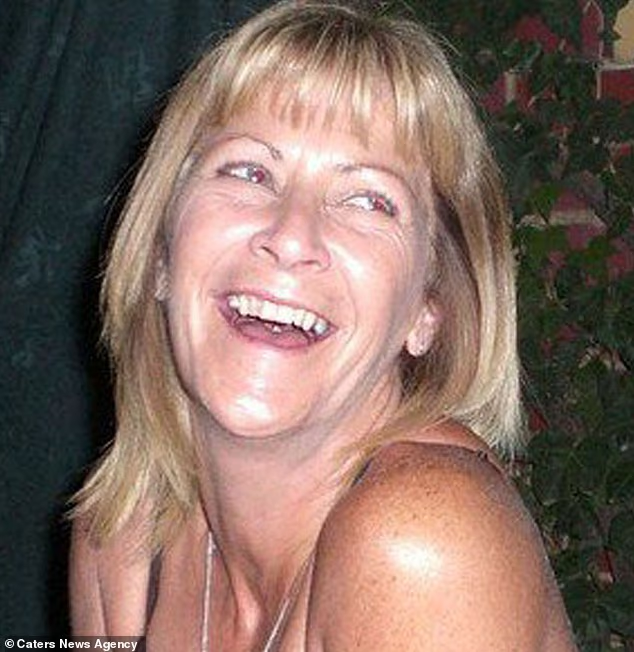
Pictured: Jean Hanlon. Her body was recovered from Heraklion harbour in March 2009 with head injuries and other signs of trauma, but police ruled her death was a tragic accident

Michael Porter, pictured, could never have imagined that moment would mark the start of a near two-decade quest for justice that is only now approaching a resolution

With Jean’s phone going straight to voicemail, her anxious sons scrambled to catch a flight, learning from Greek police before they boarded their plane the dreadful news that the body of a woman had been recovered from Heraklion harbour, pictured
In the event, it took 17 years – throughout which the family continued to campaign vigorously for justice – for the police to make an arrest and bring charges, and earlier this month a man was finally found guilty of Jean’s murder at the island’s Lasithi Law Courts in Neapoli.
But the conviction has come with a sting in its tail.
For despite being jailed for ten years last week following a four-day trial, the man – who under Greek law cannot be identified until the entire court process is over – has launched an appeal and will remain free until it is heard.
‘Seeing him walk out of court with his hands in his pockets, not cuffed behind his back, made me furious,’ says Michael.
‘At the same time his conviction is a massive victory and we all feel like Mum’s voice has finally been heard after years of the Greek authorities trying to sweep her death under the carpet.’
In fact, the toll that Michael’s quest has taken is all too evident when we talk shortly after his return to the UK after attending the trial alongside his brothers.
Speaking from his home in London – one wall adorned with a print of a favourite photograph of Jean smiling at the camera – Michael, who works for the Royal Theatrical Fund, is clearly tired.
He and his mum were close, sharing a love of dancing and musical theatre.
‘She was also a bit of a drama queen like me,’ he laughs.
A single mum from Dumfries in Scotland – Michael’s parents divorced when he was five – Jean worked several jobs to make ends meet, supplementing her day job as a secretary at Dumfries & Galloway Royal Infirmary with an assortment of odd jobs.
‘She supported us through everything, really. She didn’t have a lot but she made sure we had the best of what she could get,’ he says. It was not until she was 40 that Jean had her first holiday abroad, booking a trip to Crete with a friend.
‘She fell in love with the island,’ says Michael. So much so that, in 2003 and then in her late 40s, she decided to move there full-time, initially employed by a local tour operator, before she started working independently in local tavernas, returning home during the winter season.
‘She figured she hadn’t left an office job in Dumfries to do the same thing in Crete,’ says Michael. ‘She didn’t earn a lot of money but she was just so happy.’
To such an extent that by 2008 Jean, by now surrounded by new friends and settled in the Cretan seaside town of Kato Gouves, decided to make her move more permanent.
That summer, she returned to Scotland for what would be the last time to attend Robert’s wedding. ‘None of us had any idea that this would be the last time we would be together as a family,’ Michael says now.
He last spoke to his mother on March 6, 2009, three days before she vanished. ‘She seemed happy,’ he says. ‘There was nothing untoward.’
Then, on March 11, he received that ominous phone call: two days earlier, Jean had failed to arrive at the house of a friend, having arranged to care for her disabled daughter.
‘It raised alarm bells as Mum would never let people down but when the friend contacted police they told her to come back in 48 hours. When there was still no sign, Interpol then got involved.’
Back home, with Jean’s phone going straight to voicemail, her anxious sons scrambled to catch a flight, learning from Greek police before they boarded their plane the dreadful news that the body of a woman had been recovered from Heraklion harbour.
‘They told us they thought it was a woman aged 30 to 35 who had been in the water for weeks, so that gave us a little bit of hope to cling on to,’ says Michael.
It wasn’t to be. After being taken to the island mortuary on arrival by a representative from the British Consulate, it was clear the body was Jean’s.

Jean’s sons, pictured L-R, Robert, Michael and David Porter. Even when they gave police their mum’s diary, they took no interest

Jean pictured with Michael. As each anniversary rolled by, Michael – who became the public face of the family’s campaign for justice – tried to keep his mother’s name alive
‘Her clothes were laid out and we could instantly recognise some of them,’ Michael recalls.
He chokes back tears as he recalls seeing the body of his mum, sporting what was clearly a deep head injury.
‘It’s hard to process. You’re trying to understand how the hell this has happened, that somebody has done this. Because it was instantly obvious there had been foul play.’
This sentiment was not shared by the police, however, who told her sons that Jean had been the victim of a tragic drowning.
‘It didn’t chime with what we’d seen with our own eyes on the mortuary table but it felt like nobody wanted to listen, nobody cared and certainly no one wanted to investigate,’ he says.
Even when, early on, the brothers gave police their mum’s diary, in which she had written that she was being pestered by a local man – identified only by his first name – with whom she had ended a brief relationship, they took no interest.
‘This man was stalking and harassing her, coming to her house uninvited, asking her for money, asking her for sex,’ says Michael. ‘Later on the police claimed they didn’t get the diary until 2014.’
And so it was Jean’s sons, rather than the police, who pieced together their mother’s last known movements.
‘At the trial we learned they hadn’t even bothered searching her apartment,’ he says.
She had spent the day shopping before meeting a friend for coffee – mentioning in passing that she thought a car had been following her – before heading to a local taverna, where she was hired as a waitress for the summer season.
‘After that things become hazy, although the fact there was a pile of worn clothes and an ironing board at her home suggests she returned home and changed,’ says Michael. ‘We think a man was there too and used the toilet as the seat was up which mum would never do.’
That evening, a Belgian friend named Peter had called Jean’s mobile phone. ‘She told him she was in the Marina Cafe bar near the port in Heraklion with a man,’ says Michael.
‘Peter worried that she sounded drugged, so he asked her to pass the phone to the man and had a brief chat with him. The man did not give a name but said he was from Kato Gouves.’
An hour later, she sent Peter that one-word text saying: ‘Help’.
‘He told police he called her back and she insisted everything was fine. I think it was more out of frustration than because she genuinely felt unsafe, because if Mum had really been frightened she would have screamed,’ Michael insists.
Jean also called Peter later that evening but he had already gone to bed and failed to pick up.
After that, nothing.
None of this convinced the police to investigate further, although by December 2009 – nine months after Jean was killed –family pressure led to a second coroner’s report.
This revealed Jean had died from multiple injuries, including a broken neck, inflicted before she entered the water. It appeared to present irrefutable evidence that Jean’s death was far from an accident but the police verdict remained unchanged. ‘It was still, “She had too much to drink, she drowned”,’ says Michael.
‘They stereotyped her as this middle-aged woman who liked to go out. It made me so angry.’
In fact, cajoling an apathetic local police force into delving deeper into this perplexing mystery would develop into a grinding battle of wills that would last for years to come.
As each anniversary rolled by, Michael – who became the public face of the family’s campaign for justice – tried to keep his mother’s name alive, continually pleading with the Greek authorities for help to unravel the truth surrounding her death.
On two occasions hopes were raised when prosecutors grudgingly agreed to reopen the case, only for them to quickly fade when the files were closed once more.
Her sons battled on regardless, doing whatever they could to keep Jean’s name alive.
Then, in 2023, came an apparent breakthrough: further family pressure led to a fresh inquiry into their mother’s death, which ruled for the first time that it was the result of ‘foul play’.
Then came the Kafkaesque twist: while she may have been unlawfully killed, too much time had passed, meaning there was little chance of identifying her killer.
‘It was devastating,’ says Michael. ‘Getting the case reopened required so much work in a foreign country with different rules. It’s incredibly stressful and it takes away your grief or your connection to your loved one.’
Later that year, Michael contacted a private investigator. ‘Within three months he produced a 29-page dossier with all the information and evidence available, the biggest part being Mum’s diary,’ says Michael.
The investigator also pointed the finger at a suspect: the man who, two years later, would appear in that Cretan courtroom. He was the same man who had been harassing Jean and whose voice Peter immediately recognised as belonging to the man he’d spoken to on Jean’s phone on the night of her death.
‘When police asked how he knew that voice after 17 years, Peter said he would never forget the night he didn’t save his friend,’ says Michael.
‘He felt incredible guilt that he had been asleep when she rang him again.’
Yet they were to face even more hurdles.
While the man was charged with Jean’s murder early last year, the prosecutor subsequently closed the case citing a lack of evidence.
‘The lawyer and the private investigator put together an appeal and, for the first time in Greek history, the senior prosecutor overruled his predecessor.’
Finally, last December, he was charged with intentional homicide, although to the brothers’ astonishment, as he had no previous convictions, he wasn’t placed on remand but told instead not to leave the island.
The eventual trial last month – Michael describes it as a ‘circus’ – was traumatic, not least because he learned the exact nature of his mum’s appalling injuries.
‘We found out for the first time that she died from a blow to the back of the head with a blunt object which splintered the brain stem and that she wasn’t fully dead when she entered the water. That was horrible,’ he says quietly.
They also learned that the suspect had been diagnosed with schizophrenia and bipolar disorder and was on daily medication which, if not taken, led him to become aggressive.
Today, while confident that his mother’s killer’s appeal will not succeed, Michael cannot be sure. ‘History has shown us not to take anything for granted,’ he says.

In the event, it took 17 years – throughout which the family continued to campaign vigorously for justice – for the police to make an arrest and bring charges
Michael will never know for sure the exact events of that terrible night, although he has his theory.
‘I think mum was in a good mood because she had just got a job and she let this man take her for a drink against her better judgment. Then something happened to upset him,’ he says.
Seventeen years on, the impact of Jean’s loss still looms large. ‘I don’t think any of us have properly grieved, because we had to instantly go into fighting mode,’ Michael says.
‘It’s sad because in the fight for justice, you can actually forget that’s your mum. So many years were wasted.’
He takes solace in the fact that his mother would have been so proud of the way her sons never gave up.
‘It didn’t feel like a choice,’ he says. ‘She fought for us our whole lives – and she deserved for us to fight for her.’



















































You must be logged in to post a comment Login