




Connect with us
DAPA Banner
DAPA Coin
DAPA
COIN PAYMENT ASSET
PRIVACY · BLOCKDAG · HOMOMORPHIC ENCRYPTION · RUST
ElGamal Encrypted MINE DAPA
🚫 GENESIS SOLD OUT
DAPAPAY COMING

NewsBeat

Shanice Brookes death: New arrests made in connection with altercation outside bar before shooting

Published

on

Shanice Brookes death: New arrests made in connection with altercation outside bar before shooting

Three men have been arrested over an altercation outside a bar just before a mother-of-one was shot dead.

Shanice Brookes, 30, was fatally shot near the One Four One bar on West Street in Sheffield, in the city centre, shortly before 2.45am on 25 May.

Detectives have said “she was simply an innocent bystander”.

Jemele Rhone, of Outram Road, Sheffield, is due to go on trial next year charged with murdering Ms Brookes.

Advertisement

South Yorkshire Police said on Thursday they had arrested two 21-year-old men and a 31-year-old man, all from Rotherham, on suspicion of affray. They have been bailed pending further inquiries.

The arrests followed an investigation into the events leading up to the fatal shooting, the force said.

A police cordon at the scene near the One Four One bar on West Street, on Monday (Dave Higgens/PA)
A police cordon at the scene near the One Four One bar on West Street, on Monday (Dave Higgens/PA) (PA Wire)

Detective Inspector Matt Bolger said: “We are determined to provide answers for Shanice’s family and friends who have had their lives shattered by this heartbreaking and devastating incident.

“Words cannot do justice to describe the unimaginable loss Shanice’s loved ones have experienced and we remain committed to securing justice for them.

“These arrests relate to an altercation that took place shortly before a firearm was discharged and Shanice was sadly fatally shot.

Advertisement

“We continue to explore every line of inquiry and will leave no stone unturned in our efforts to get justice for Shanice.

“Since our investigation launched, two people have been charged in connection with the shooting and we are continuing to appeal to anyone that saw what happened and hasn’t come forward already to do so.

“I am also urging anyone with information on the weapon used to kill Shanice to contact us.”

Rhone is charged with murder, possession of a handgun and possession of criminal property, namely £10,000.

Advertisement

His co-accused, Deiryen Dyce, 32, of Ellesmere Road North, Sheffield, is charged with assisting an offender, possession of ammunition, possession of heroin, cocaine and cannabis with intent to supply, and possession of criminal property, namely £2,000.

Source link

Continue Reading
Click to comment

You must be logged in to post a comment Login

Leave a Reply

NewsBeat

Taylor Swift and Travis Kelce wedding LIVE: Date confirmed as guests arrive in New York

Published

on

Daily Mirror

13 is Taylor’s lucky number – and it’s been rumoured she’ll be having 13 bridesmaids.

“The bridesmaids are likely to be Lena Dunham. Taylor was a bridesmaid at her wedding in 2021, so she’s likely to return the favour,” biographer Anna Pointer tells us.

(Image: FILE)

“Selena Gomez I think is a shoo-in for bridesmaid. They’re inseparable really. The Haim sisters, – Esther, Danielle, and Alana have all been mentioned as possible bridesmaids, as have Emma Stone and Gigi Hadid.

Advertisement

“And then the cutest I’m sure will be Jason and Kylie Kelce’s daughters. Taylor and Travis are both really close to their nieces. There are four of them, Wyatt, Elliott, Bennett, and Finley and they’re all super cute, and they’ll be the scene stealers.

“And then Taylor’s best friends from high school days. There’s Abigail Anderson. Taylor was a bridesmaid at her wedding and another of her best friends, Ashley Avignone is likely to be there as well. That takes you to the magic number 13.”

Source link

Advertisement
Continue Reading

NewsBeat

Britain’s Arthur Fery produces tenacious display fit for a princess at Wimbledon

Published

on

Britain’s Arthur Fery produces tenacious display fit for a princess at Wimbledon

Hello and welcome to coverage from Wimbledon as Arthur Fery plays Finnish qualifier Otto Virtanen.

Frey earned his place in the second round after beating Bosnian opponent Damir Dzumhur ‌3-6, 6-2, ​6-2, 6-1. The match ⁠was overshadowed by Fery being called dishonest by Dzumhur.

But Fery, one of 12 British wildcards, kept his cool and even used earplugs while Dzumhur complained to the umpire. 

Advertisement

“It was expected, to be honest,” said Fery, who is through to the second round for a second straight year. “He does that with everyone. I guess I was just ready for it before the match. If it’s a let, it’s a let for everyone, right, it’s not just a let for him. Whether the point carries on or not, it’s the same for both of us.

“He obviously wants to make a problem with the umpire and then is trying to speak to me about it. But there is nothing to really speak about. Just trying to get the other player involved for no reason.”

Fery is now on the verge of breaking into the top 100 after also reaching the quarter-finals at Queen’s Club earlier this month.

The British No 3 is the higher-ranked player but Virtanen has also shone on grass this summer and knocked out fourth seed Ben Shelton in the biggest upset of the tournament so far.

Advertisement

“It’s a surprise, definitely,” said Fery. “But it’s an opportunity. He’s obviously a great grass-court player.”

Fery grew up five minutes from Wimbledon and would often visit the tournament as a child. He is the heir to an estimated £275m fortune thanks to his father, Loïc Fery, a hedge fund manager and president of Brittany-based Ligue 1 club FC Lorient.

Source link

Advertisement
Continue Reading

NewsBeat

Prehistoric plague could have caused population collapse in stone age Europe

Published

on

Prehistoric plague could have caused population collapse in stone age Europe

Did a major epidemic of plague trigger a prolonged collapse in Europe’s population in late neolithic times – from around 5,600 to 4,000 years ago?

In Europe, the neolithic is part of the stone age, spanning the time from the introduction of agriculture by migrant groups from Anatolia, up until the bronze age.

Scientists now know that prehistoric plague infected neolithic farmers in Europe.

What hasn’t been clear until now is whether these early strains of the plague bacterium were even deadly. New evidence shows that they were, but other factors still don’t line up to support the evidence for a late neolithic epidemic.

Advertisement

Plague DNA found in human remains from over 4,000 years ago is genetically quite different to the plague strains which caused the Black Death in Europe. Prehistoric plague strains lack a gene that allows the bacteria to effectively hijack fleas, turning them into bubonic plague delivery systems.

They also have ancestral forms of other genes that are known to be important in promoting virulence. Detections of prehistoric plague cases were also quite scattered across archaeological contexts, without evidence of mass mortality accompanying outbreaks – until very recently.

All this has meant that researchers have hotly debated whether these infections caused by the plague bacterium Yersinia pestis would have been a death sentence in prehistory, or something more like a stomach bug that only occasionally causes severe complications, like plague’s ancestor, Yersinia pseudotuberculosis.

Plague was recently discovered in neolithic remains from Orkney, where stone age farmers built a complex settlement (Skara Brae).
RobNaw / Shutterstock

Nonetheless, the detection of many cases of plague in Europe at around the same time as a major inferred population slump – the late neolithic demographic decline – has led some to implicate these plague outbreaks as the cause of around 500 years of prolonged population decline.

Advertisement

New results published in Nature show extensive plague outbreaks among prehistoric hunter-gatherers 5,000km east of Europe, at Lake Baikal in southern Siberia. The findings clearly show that early plague strains could indeed cause mass death.

Baffling deaths

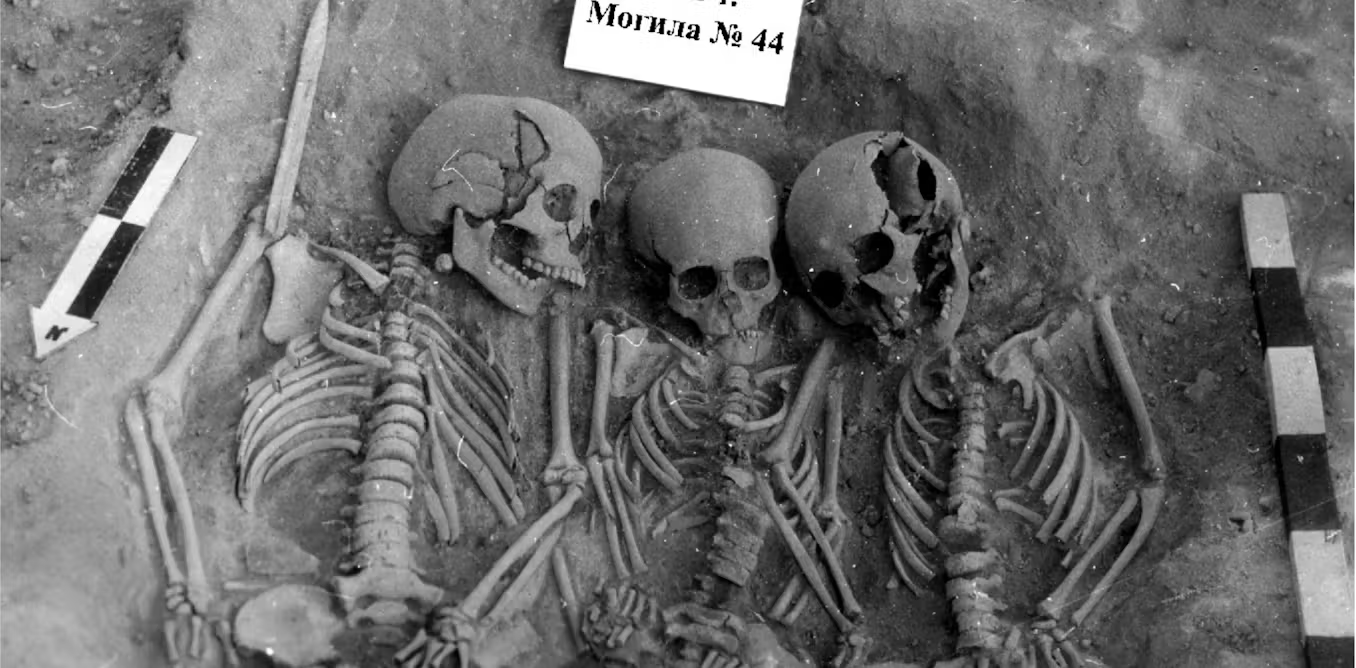
The two outbreaks at Lake Baikal took place around 5,500 years ago and 5,000 years ago. The largest of the hunter-gatherer cemeteries analysed in the study, called Ust’Ida I, had previously baffled archaeologists.

Radiocarbon dating showed that the deaths occurred at the same time and that there was an unusually high proportion of dead children and adolescents. However there was no clear indication of a cause (such as mass violence).

Scientists retrieved plague DNA from the skeletons and carried out genetic analysis of the individuals buried in the cemeteries. The latter analysis revealed that small family groups were affected, which is indicative of human-to-human transmission of the disease.

Advertisement

The genetic findings emphasise the human impact of these outbreaks: young siblings died of plague infection and were buried in shared graves, with parents buried close to their children.

As far as we know, these hunter-gatherers were isolated from contemporary neolithic cultures in Asia, and certainly had no means of contact with late neolithic farmers in Europe. One interpretation, given in that study, is therefore that plague independently spilled over from wild animal “disease reservoirs” in both Europe and at Lake Baikal. Catching the disease from a wild animal still happens very frequently today (both in parts of Asia and in the US.

Artistic reconstruction of Lake Baikal hunter-gatherers burying the plague dead in shared graves.

Artistic reconstruction of Lake Baikal hunter-gatherers burying the plague dead in shared graves.
Kelvin Wilson.

Discovering that the first evidence of deadly mass outbreaks of prehistoric plague comes from isolated hunter-gatherer communities is important because it challenges our assumptions about disease in the past. For one thing, it shows that plague infections by themselves were not a unique factor in the late neolithic decline. For an epidemic to have happened, other factors would have to be involved. People travelling around more would have spread the disease, and higher population densities would have maintained it in populations.

Yet while population densities were certainly higher in the neolithic, we know that overall mobility actually fell among neolithic farmers compared with the hunter-gatherer populations that preceded them, at an individual level (based on ancient genome data). It’s also puzzling that we don’t have similar evidence of mass mortality from plague in Europe yet, despite vastly more sampling for ancient DNA having been undertaken here than in Asia.

Advertisement

A drop in density?

The most obvious hole in the evidence for a late neolithic plague epidemic is that the dates of the plague cases detected so far don’t match the timing of the late neolithic decline. Based on thousands of radiocarbon dates, the modelled population density in the late neolithic follows a boom-then-bust trajectory in north west Europe, with a peak around 5,600 years ago, followed by a series of sharp declines.

If plague were the cause of this, then we would expect to find the most cases soon after 5,600 years ago, when population collapse is at its most dramatic. Instead, we still only have evidence of plague cases from around 400 years after this date.

Comparison of the population density in late neolithic north west Europe with mean radiocarbon dates of plague infections in prehistoric individuals. Hunter-gatherers are in red (dotted lines are outbreaks at Lake Baikal), late neolithic farmers in blue. Inferred population density changes are from summed calibrated radiocarbon date distributions.
Adapted from Figure 1 published by Colledge et al., 2019.

Before plague was proposed, the main explanation for the late neolithic population decline across Europe was that it resulted from a decline in agricultural production associated with climatic deterioration. Researchers analysed data on the distribution of cereals and weeds across north west Europe during a period of boom and bust following the arrival of farming. They found a correlation between population decline and decreasing cereal production.

For different parts of the British Isles, the same pattern emerged in more detail, and its beginning coincided with a shift to cooler, wetter conditions. The fact that there has been no evidence of plague in Britain and Ireland at this time seems like further evidence against plague as an explanation.

Advertisement

However, a very recently discovered case of plague from Orkney, in Scotland, dated to between 4,961-4,833 years ago, might change that.

The population decline from 5,600 years ago is also not the only one archaeologists have found – earlier instances from central and south east Europe suggest that these could have been part of a more cyclical pattern of boom and bust across the neolithic.

Finally, another explanation for the late neolithic decline could also be that we’re interpreting the data for this incorrectly. A possibility, suggested by archaeologist Amy Bogaard, is that it could be evidence of prolonged population dispersal, rather than an absolute decline in numbers: people being forced to move elsewhere, into lower population densities, due to too much strain on resources.

There are also many other reasons why we should be cautious about inferring demographic processes based on substantial datasets of radiocarbon dates.

Advertisement

Right now, we think that a lot more evidence is still needed to support the idea that a plague epidemic lies behind a late neolithic decline in population, or population density.

Source link

Advertisement
Continue Reading

NewsBeat

Updated eGate travel rules coming to 13 UK airports

Published

on

Updated eGate travel rules coming to 13 UK airports

It will mean that up to 1.5 million more children will be able to use eGates, therefore speeding up journeys for them and their families.

The change will help families returning from their holidays with young children.

Here is all you need to know and when the change takes effect.

Automated e-gates with electronic screens at an airporteGates are used at airports across the UK and Europe for border control (Image: Getty Images)

eGate rules to change for children next week

Children aged eight and nine, who are at least 120cm (3ft 11in) tall and accompanied by an adult, will become eligible to use eGates in the UK.

Advertisement

Under current rules, children need to be 10 to use the eGates, and before 2023, it was 12 years old.

Height restrictions are due to children needing to be able to see and be captured by biometric screens.

The change will speed up the process for children and their families, as they typically have to see a border force officer.

Based on 2025 UK arrival figures, an estimated 1.5 million more children will be eligible to pass through eGates with their families over the next year as a result of the age change.

Advertisement

The expanded access is set to begin from next Wednesday (July 8).

Minister for Migration and Citizenship, Mike Tapp, said: “Travel with young children can be stressful for parents.    

“By expanding eGate access, more families can experience a swifter and smoother journey home – freeing up precious time this summer holiday season. 

“We are delivering continued improvement to the passenger experience, while keeping our borders safe and secure.”

Advertisement

The 13 UK airports that will have updated eGate rules

There are 13 airports that use eGates across the UK that will see the updated rules come into effect.

These are:

  • London Heathrow
  • London Gatwick
  • London City
  • London Luton
  • London Stansted
  • Manchester
  • Birmingham
  • Bristol
  • East Midlands
  • Newcastle
  • Cardiff
  • Edinburgh
  • Glasgow

It will cover more than 290 eGates in the UK and accompanying ports where border checks take place in Europe.

There are also 48 EU airports that are allowing British holidaymakers to use eGates.

Advertisement

These include places in Spain, France, Italy and Portugal.


Recommended reading:


The rules will also impact other travel methods such as Eurostar and the Eurotunnel.

People travelling from non-Schengen countries in Europe, along with the US, Australia and Japan, can also use the eGates.

Advertisement

What do you think about the new eGate change? Let us know in the comments.

Source link

Advertisement
Continue Reading

NewsBeat

Arrest after police vehicles involved in collision to stop suspected drug dealer

Published

on

Belfast Live

The incident took place in the Donegall Quay area on Wednesday

A man has been arrested as police seized suspected drugs worth £225,000 after two police vehicles were involved in a collision as they stopped a vehicle in Belfast.

Advertisement

Officers from the PSNI’s Paramilitary Crime Task Force made the arrest on Wednesday, July 1, after they signalled for a vehicle to stop in the Donegall Quay area. The vehicle attempted to make off from officers and collided with two police vehicles.

Police say they then recovered a “large quantity of suspected Class A controlled drugs” from the vehicle with follow-up searches in the Newtownabbey and Mallusk areas uncovered further drugs.

Detective Inspector Maguire said: “While conducting a proactive policing operation yesterday in the Donegall Quay area in relation to the supply of Class A controlled drugs, officers signalled for a vehicle to stop. It failed to do so, attempting to make off instead, which resulted in a collision with two police vehicles.

“Thankfully, there were no reports of any injuries and a subsequent search of the vehicle uncovered a large quantity of suspected Class A controlled drugs, which were then seized.

“The driver, a man in his thirties, was arrested on suspicion of possession of a Class A controlled drug, possession of a Class A controlled drug with intent to supply, providing money or property for the purposes of terrorism, failing to stop for police and driving without due care and attention.

“He remains in police custody at this time.

Advertisement

“Follow-up searches conducted in the Newtownabbey and Mallusk areas resulted in further suspected drugs being seized, along with a number of vehicles, with the total estimated street value of all drugs seized as a result of the searches £225,000.

“These searches and the arrest demonstrate the PCTF’s commitment to tackling the harm caused by illegal drug use and supply in our communities.

“Our enquiries are ongoing and I would encourage anyone with information about the supply or use of illegal drugs to contact police on the 101 number.

Advertisement

“You can also report to police online, via www.psni.police.uk/report or contact Crimestoppers anonymously on 0800 555 111 or online at http://crimestoppers-uk.org/.

For all the latest news, visit the Belfast Live homepage here and sign up to our daily newsletter here.

Source link

Advertisement
Continue Reading

NewsBeat

Keir Starmer speaks out on children staying up for 1am England vs Mexico match after Thomas Tuchel plea

Published

on

Manchester Evening News

The Prime Minister was asked whether he backed the England manager’s call for children to stay up for the Mexico game

Parents should ‘make their own decision’ as to whether schoolchildren should stay up to watch England’s 1am World Cup match on Monday, Sir Keir Starmer has said.

Advertisement

The Prime Minister’s spokesperson was asked whether Sir Keir backed England manager Thomas Tuchel’s call for children to stay up late and watch the match. The game against Mexico kicks off at 1am on Monday morning.

“We want everyone to enjoy the game but kids should be in school on Monday,” the Prime Minister’s spokeswoman said. Sir Keir will face the ‘same dilemma’ as other England fans over whether to stay up, she said.

Click here to get the biggest stories straight to your inbox in our Daily Newsletter

“The PM has his usual packed schedule on Monday, so he’ll be facing the same dilemma as everyone else on whether to stay up. Win or lose, I think millions of England supporters will be at work on Monday, and the PM will be doing the same.”

Advertisement

Skills minister Baroness Jacqui Smith earlier said she planned to take a ‘disco nap’ on Sunday afternoon and then stay up late to watch the match. Schools and employers have often allowed England games in the latter stages of major tournaments to be shown during working hours, but Monday’s early-morning kick-off poses a unique obstacle.

“Write an excuse for school and let them watch football,” Tuchel pleaded after Harry Kane’s two late goals saw England squeeze through the round of 32. “Come on.

“There’s so much school to go to, but the World Cup is every four years. Let them watch. There will be a big, big match on in four days and we need the support of everyone, and especially of the children.”

What do you think? Have your say:

Advertisement

Source link

Continue Reading

NewsBeat

Hour-long delays after ‘multi-vehicle crash’ on A14 – live updates

Published

on

Cambridgeshire Live

Cambridgeshire Police were called to the A14 eastbound between J20 and J21, near Huntingdon, just before 10am today (Thursday, July 2). The crash involved “at least three vehicles”, a police spokesperson said.

The spokesperson added that a woman was injured, but the detail of the woman’s injuries were unknown. Cambridgeshire Fire and Rescue also attended the scene at around 10.30am.

National Highways reports there are around 60 minutes of delays along the road and around three miles of congestion. Traffic monitor site Inrix also reports there are “long delays” along the road.

Advertisement

CambridgeshireLive awaits further comment from the East of England Ambulance Service. More as we have it.

Source link

Continue Reading

NewsBeat

Comet from another star has a composition unlike anything else in our solar system

Published

on

Comet from another star has a composition unlike anything else in our solar system

Astronomers have revealed new details about the make-up and age of a visiting comet that was born around a distant star. They conclude that the composition of 3I/Atlas is strikingly different from any object found in our solar system.

A trio of recently published studies shed light on the origins of this exotic comet. 3I/Atlas appears to have been born in a cold environment, possibly around 12 billion years ago.

The comet is an interstellar object (ISO), meaning an asteroid or comet that originated outside the solar system. It is the third such object found, after 1I/ʻOumuamua and 2I/Borisov. It was discovered almost exactly one year ago, travelling inbound on a trajectory that has taken it through the inner solar system and out the other side.

These distant origins make ISOs incredibly interesting to astronomers because they are physical pieces of other planetary systems, delivered to us on galactic tides so that they can be studied from the comfort of our own solar system.

Advertisement

As a comet, 3I/Atlas contained frozen ices that “sublimated” – turned directly from a solid to a gas. These escaped (outgassed) from the comet as it was heated by the Sun, creating a visually spectacular coma (bright atmosphere surrounding the object) and tail.

A comet has no internal light source of its own, instead dust in its coma reflects sunlight and its volatiles (chemicals that readily vaporise or sublimate) display fluorescence.

3I/ATLAS originated in a cold protoplanetary disk around a distant star.
Eso/L. Calçada

But this is no mere light show: each fluorescing molecule leaves a spectral fingerprint on the light reaching our telescopes. These fingerprints allow us to identify the chemicals contained within the comet.

They are revealed by splitting the light into its constituent wavelengths with a technique called spectroscopy, allowing astronomers to deduce the comet’s chemical composition.

Advertisement

Unique chemical cocktail

This revealed in 3I/Atlas a cocktail of water, carbon dioxide and monoxide, methane, cyanides, sulphides, and even free-floating iron and nickel atoms. These ingredients are actually quite expected, as each of them are regularly detected in our own domestic solar system comets. However, their relative abundances are different in 3I/Atlas: high levels of carbon dioxide (CO₂) and low levels of ammonia (NH₃) mark it as an outsider.

Additionally, molecules made up from atoms with different isotopes (distinct forms of the same chemical element) also have subtly different spectral signatures. With a bright comet such as 3I/Atlas, and with our largest and most sensitive telescopes, these signatures can be distinguished, allowing astronomers measure the comet’s isotope ratios.

One of the new studies, published in Nature, uses the spectral signatures of water and carbon dioxide measured with the James Webb Space Telescope to calculate 3I/Atlas’s ratio of two different isotopes of carbon, ¹²C and ¹³C, and its ratio of deuterium (a heavy form of hydrogen) to standard hydrogen – known as the D/H ratio.

Images of 3I/ATLAS
The Webb telescope’s Nirspec (Near-Infrared Spectrograph) instrument can detect specific chemical and molecular signatures. These images of comet 3I/ATLAS each highlights a part of the comet’s contents.
Nasa, Esa, CSA, STScI, M.Cordiner (Catholic University of America, GSFC)

These are very exciting results, because the isotope ratios present in an ISO such as 3I/Atlas should match the ratios in the protoplanetary disk in which it formed. This allows us to make detailed inferences about the conditions 3I/Atlas formed in and the star it must have formed around.

3I/Atlas’s water was found to have a D/H ratio of around 1%, significantly higher than all observed solar system comets. These high levels of deuterium are only found in very cold environments, with temperatures of less than 30 Kelvin (-243°C).

Advertisement

In these conditions, normal hydrogen atoms get replaced by heavier deuterium atoms in the water ice that coats tiny dust grains. Over time, these icy dust grains stick together to form comets.

Ancient traveller

3I/Atlas’ ¹²C/¹³C ratio was equally extreme, far above all solar system values. The ratio of these isotopes function like a cosmic clock. In the beginning, the first generation of stars produced carbon with a high ratio of ¹²C/¹³C, but subsequent cycles of star formation and death have lowered it. For 3I/Atlas to have formed with such a high value of ¹²C/¹³C, it must have formed in the very early history of the Milky Way, around 12 billion years ago.

Studies from shortly after its discovery suggested 3I/Atlas was likely to be at least 7 billion years old based on its velocity, meaning the ancient status of 3I/Atlas is now supported by multiple independent lines of evidence.

Though the night sky beyond the limits of our solar system can feel static and unchanging, both the universe and our galaxy do evolve on billion-year timescales.

Advertisement
NEO Surveyor
Nasa’s upcoming NEO Surveyor mission will help find other interstellar objects.
Nasa

When 3I/Atlas formed, the universe was just a fraction of its present age, and the Milky Way in which it formed was still in the process of assembling itself through violent collisions and mergers with other galaxies.

If the star that 3I/Atlas formed around was the same mass as our Sun, it is likely to have already reached the end of its life, outlived by the ISOs it released shortly after its birth.

Over the next ten years, cutting-edge discovery telescopes such as Nasa’s NEO Surveyor and the Vera C. Rubin Observatory in Chile will increase the number of known ISOs by an order of magnitude. This will provide astronomers with a fossil record of the evolution of planetary systems across galactic history.

Source link

Advertisement
Continue Reading

NewsBeat

Transfer news LIVE: Arsenal FC get Barcola boost; Man Utd want Tchouameni; Chelsea done deal; Tonali medical

Published

on

Transfer news LIVE: Arsenal FC get Barcola boost; Man Utd want Tchouameni; Chelsea done deal; Tonali medical

The World Cup is not getting in the way of the summer window hitting remarkable heights as Arsenal, Chelsea, Manchester United, Tottenham and Liverpool work on strengthening their squads with new signings. The Gunners are said to be exploring a deal for Bradley Barcola, despite Paris Saint-Germain being reluctant to sell. Morgan Rogers is a priority signing, and Bruno Guimaraes has been sounded out – and potentially had his head turned.

Source link

Continue Reading

NewsBeat

Sewing Bee confirms return date after fan confusion

Published

on

Sewing Bee confirms return date after fan confusion

Fans, including a local celeb, of The Great British Sewing Bee have finally had their answer after confusion over the show’s return date prompted questions online.

The official Great British Sewing Bee Instagram account confirmed the BBC One favourite will return on Tuesday, July 14 at 8pm, after some viewers spotted reports suggesting a later launch date.

The programme’s social media team shared a post announcing: “The Bee is back” alongside details of the new series.

However, one fan quickly queried the date, commenting: “Hubby checked BBC website yesterday and it said 28th July! Please can you confirm which it is? Thanks.”

Responding directly, the official account reassured viewers that July 14 is the correct date.

Advertisement

The account replied: “This is the date. Was it definitely the BBC website he checked? A few outlets have been misreporting but it’s never confirmed unless it comes directly from us or the BBC.”

The response appears to have helped clear up uncertainty among fans who had seen conflicting reports about when the popular sewing competition would return to screens.

Others were quick to celebrate the news.

One viewer wrote: “Eeeeee I am sew excited.”

Advertisement

Former RuPaul’s Drag Race UK star Danny Beard, from Bolton, also commented: “Loveeeeeeee.”

(Image: PA)

The new series will once again see amateur sewers compete in a series of challenges as they attempt to impress the judges and be crowned Britain’s best home sewist.

With the launch date now seemingly stitched up, fans can mark Tuesday, July 14 at 8pm firmly in their calendars.

Bringing her own trademark wit and warmth, Sophie will join judges Patrick Grant and Esme Young to lead Britain’s most creative stitchers through their challenges when the new series arrives on BBC One. She made her debut on the Christmas Celebrity Special.

Advertisement

Source link

Continue Reading

Trending

Copyright © 2025