Fire crews were called to Buckhaven after fires broke out in an area of grassland near to the Firth of Forth coast, covering an area of around 150m².
‘Multiple’ wildfires have broken out near a Fife town this evening with smoke and flames rising over the coastline. Fire crews were called to Rising Sun Road in Buckhaven shortly after 9pm on Wednesday, April 22.
Advertisement
Four crews were sent to tackle the fires which had been extinguished shortly after 10.20pm. Crews remain on scene to ensure the area is made safe.
Photos shared on social media show the fires in an area of grassland near to the Firth of Forth coast. Orange flames could be seen raising from the grass and gorse which the Scottish Fire and Rescue Service said covered an area of around 150m².
Other photos showed an orange glow above houses in Buckhaven as the flames continued into the night while smoke billowed into the sky. Another image shows smoke hanging in the air in the middle of the town as firefighters and police are in discussion next to a fire engine.
Advertisement
It is not currently known if the fires were deliberate. A fire service spokesperson told the Record: “We were alerted at 9.02pm on Wednesday, April 22, to reports of a wildfire near to Raising Sun Road, Buckhaven.
“Firefighters found multiple areas of grass and gorse alight covering approximately 150m2. Operations Control mobilised four appliances. Crews remain in attendance.”
Get more Daily Record exclusives by signing up for free to Google’s preferred sources. Click HERE.
The 79th Cannes Film Festival is underway, kicking off 12 days of nonstop premieres, photo calls and red carpet glamour. ___ This is a photo gallery curated by AP photo editors.
Nominations for the annual event, held by The Press, have been coming in thick and fast – but readers are being reminded that they still have time to vote for a special person or group who go above and beyond in their duties.
The first voting stage of the competition will end on June 5 – with finalists invited to a glittering award ceremony at York Racecourse on Thursday (September 5).
Recommended reading:
Advertisement
We have 11 different award categories this year and featured among these is Health Service Hero.
The Press is searching for an unsung healthcare worker whose dedication to their patients and work is second to none.
Last year, we presented Chloe Slater with the award.
Chloe was recognised for her efforts on York Hospital’s maternity unit supporting vulnerable women and babies by organising a collection to help refugee families at Christmas.
Advertisement
Speaking about Chloe, York and Scarborough Teaching Hospitals NHS Foundation Trust said: “Chloe collected donations of essential items such as nappies and baby grows to make sure the new mums, many of whom arrived in York with nothing, had what they needed.”
At the time, Chloe said that winning the award meant an enormous amount, both professionally and personally.
She added: “Knowing that somewhere there is someone that really did believe in me enough to nominate me is something that I will always remember.”
Chloe had spoken about plans to extend her collection to become a year-round baby bank, with support from colleague and midwife Jill Robertson.
Advertisement
If you know someone like Chloe who deserves recognition, please nominate them by using the link here.
Other award categories include Against All Odds, Charity Fundraiser of the Year, Education Hero of the Year, Volunteer of the Year, Young Person of the Year Award, Sports Person/Team of the Year, York Community Pride Outstanding Contribution Award, Carer of the Year, Best Community Project and School of the Year.
Nominations must include a supporting statement with each entry.
He said he has been involved in politics for 15 years, “from the UKIP days all the way to Reform”
09:39, 13 May 2026Updated 11:28, 13 May 2026
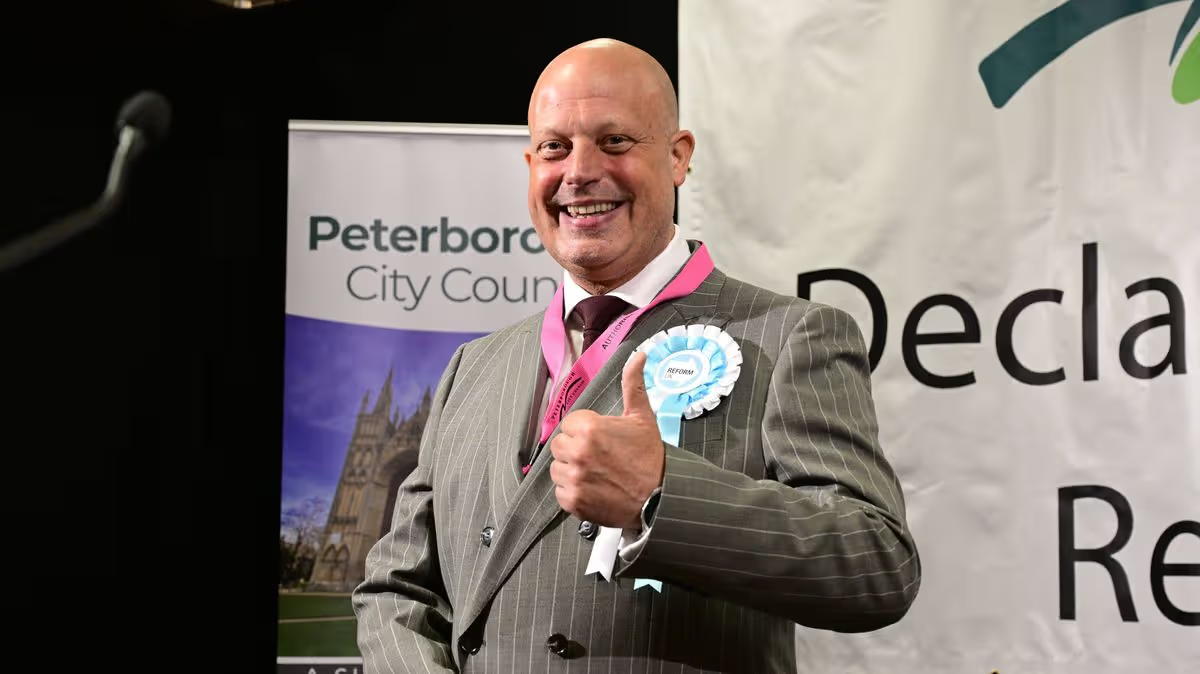
A Reform UK councillor who has become the star of a viral video has spoken about his now-infamous “UKIP” gaffe.
Peter Reeve, who won the Stanground South ward seat on May 7, has achieved notoriety after mistakenly referring to his former party, UKIP, in a television interview at Peterborough’s local election results.
Speaking to the press during the early hours of May 8, a jubilant Mr Reeve said: “Our message is: ‘UKIP’s here, working hard with local communities.”
Advertisement
He subsequently corrected himself, quickly clarifying that he had been involved in politics for 15 years “from the UKIP days all the way to Reform”.
The clip has since gone viral after being posted on social media. So was it a simple mis-speak or more of a Freudian slip?
“So, essentially; [it was] four o’clock in the morning, [and the] tenth interview in a row,” Cllr Reeve told the Local Democracy Reporting Service (LDRS).
“It wasn’t deliberate,” he continued, chuckling at his own faux-pas: “some people are suggesting that [as] I’ve had so much media coverage off the back of it.”
Advertisement
Deliberate or not, it’s fair to say that the newly installed councillor definitely has received a lot of attention as a result. “The national coverage I’ve got from that mistake is absolutely huge,” he acknowledged.
The councillor said he bears no grudge at all with the broadcaster that aired his clanger. “I don’t see a real problem with the ITV interview itself,” he said, adding “they made light of it.”
However, Cllr Reeve was keen to clarify that Reform UK “is an entirely different party with an entirely different agenda,” to UKIP.
At the same time, he was also eager to confirm “I’ve got no shame in what we did with UKIP.”
Advertisement
One thing that has irked Cllr Reeve is how the clip has since been manipulated by some on social media, an arena which he admits he has only modest experience dealing with.
He said: “The.. thing I’ve learned is how brutal social media is. [The] really, really nasty comments on there have made me realise just how toxic social media is.
“It’s really opened up my eyes at what some kids and the younger generation are… going through and the level of trauma it can cause.”
Though he has not enjoyed this curt introduction to the darker side of digital fame, he still believes the experience has been “really useful.”
Advertisement
“I’ve got a much better insight into how social media can affect people in a toxic and negative way.”
City of York Council’s executive approved plans to close the market on Tuesdays to improve access to the city centre, despite warnings it could cost between £2.6 million and £7.82 million in lost spending.
Cllr Pete Kilbane, the council’s Labour economy spokesperson, said they would not bar some from the city centre during the event but they had a difficult balance to strike.
The move follows traffic restrictions which saw vehicles including Blue Badge holders barred from driving into the city centre when last year’s market was running.
RECOMMENDED READING:
Advertisement
Speaking at the Executive meeting on Tuesday, May 12, Amanda Cooper of the York Disability Rights Forum said barring disabled people’s access to essential services was already causing stress for some.
Ms Cooper said: “There’s a deaf and bling person who needs to access the bank, restricting access causes them stress over their finances.
“It could also result in others going into financial difficulties or debt.”
Lee Clayton, who runs Nutty’s Emporium and has traded at the market for five years, said the closures may force him to do business elsewhere in the future.
Advertisement
The trader said ahead of the meeting: “A lost day’s trade, which is in effect five or six days across the whole market, is crippling for a small business like myself.
“It be a real shame as I love being part of the market for both the success it brings my business and the atmosphere it creates.”
York Christmas Market is set to close on Tuesdays this year (Image: Staff)
Disability rights activist Flick Williams said she was dismayed by what she said was the ableism from some in the business community in the run up to the decision.
The campaigner said: “Disabled people aren’t a homogenous mass with the same access needs.
Advertisement
“Businesses who say we just need to suck it up in response to being totally excluded for six weeks of the year might do well to examine their own access arrangements.”
Resident Gwen Swinburn said she was concerned about the financial, legal and safety risks if the council is liable for anything which happens as a result of the closures.
York Access Forum’s Diane Rowarth said running the market all week shut disabled people out of the city through no choice of their own.
Ms Rowarth said: “York city centre must be a place for all residents, disabled people have been excluded for a whole period during the Christmas Market.
Advertisement
“This isn’t a perfect solution, but it’s one day a week more than we have now.”
Rob Collins, owner of Parliament Street’s Days café, said his business relied on earnings during the market to tide them through January, February and March.
The café owner said: “A city centre full of empty chalets will kill it for one day a week.
“This is one of the worst times in history for the hospitality industry, we need your support not another nail in the coffin.”
Advertisement
Marketing profession Charlotte Bodman said she feared that getting the message out about rest days would be difficult.
She said: “Visitors who arrive on a closed Tuesday are unlikely simply to return another day, many will have planned specific travel dates, overnight stays or day trips around their visit.
“Reducing trading days sets a precedent that may prove difficult to reverse.”
Concerns over the effects of the closures were also raised by York’s Business Improvement District (BID), High Street Forum, Made in Yorkshire and the Grand Yorkshire steam train tours company.
Advertisement
North Yorkshire Police requested an Anti-Terror Traffic Regulation Order (ATTRO) to deter terror attacks and the restrictions are now available for use all year round on a case-by-case basis.
Police and counter-terror advice ahead of Tuesday was that keeping the market open all week offered the most security but said the decision rested with the council.
Measures approved for this year would see Blue Badge holders allowed onto the ‘Goodramgate loop’ on Tuesdays between Deansgate, King’s Square and Colliergate but Church Street would be closed.
Rest days will be trialled this year, with a return to a seven-day-a-week market not ruled out as council officials work on long-term solutions to access issues.
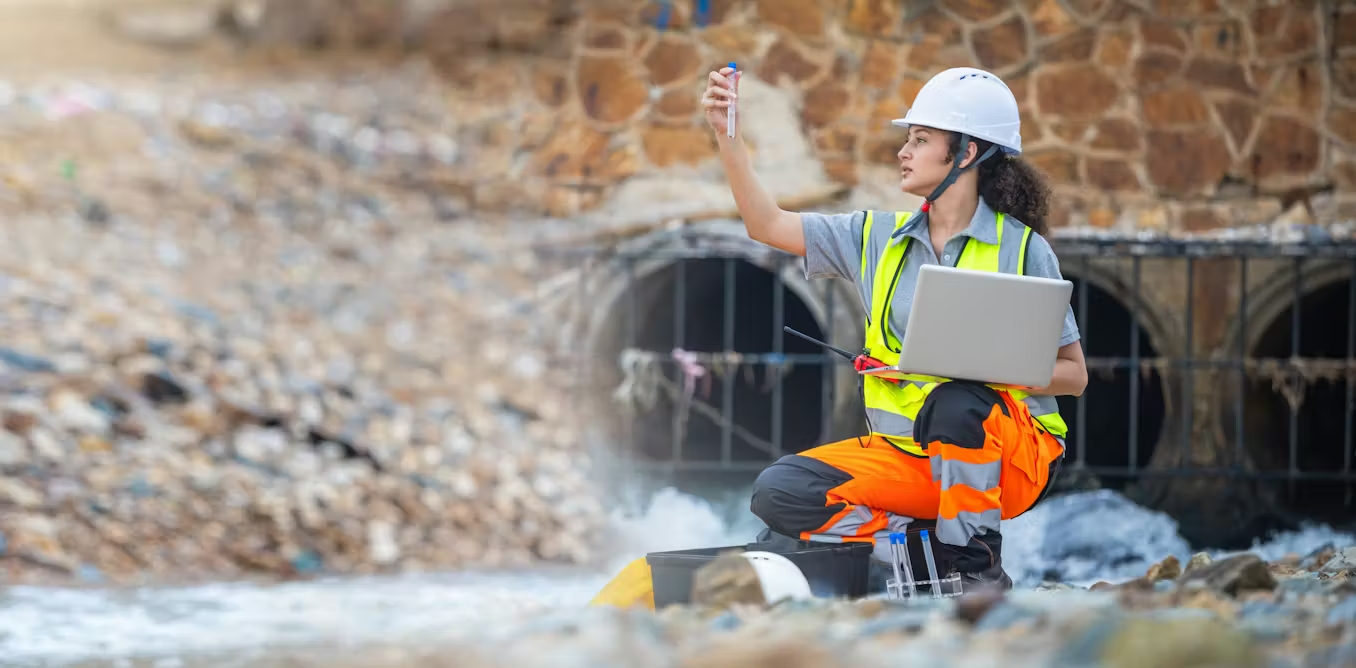
Water bills are rising, public anger over sewage pollution has not abated, and the government has now set out a major overhaul of water regulation in the king’s speech.
The proposed water reform bill signals a shift in emphasis. Rather than focusing solely on water companies, the legislation aims to address pollution more broadly, including contributions from agriculture and industry. This wider lens has long been missing from water policy and is, in principle, a welcome change.
The bill also promises a more unified regulatory system. The financial regulator Ofwat, the Drinking Water Inspectorate and the water-related arms of the Environment Agency and Natural England would be brought together under a single regulatory umbrella. The intention is to end the fragmented oversight that has characterised the sector for decades.
These proposals follow the recommendations of the Independent Water Commission, as outlined in the 2025 Cunliffe review which critiqued England’s privatised water industry, and Labour’s white paper. Yet despite the language of reform, the vision looks less like a radical reset and more like a reboot of privatisation.
Advertisement
The Clean Water Now coalition – a group of over 40 environmental groups – has put forward proposals that include three main asks: to fix the system, stop the polluters and restore nature.
Public opinion polling consistently shows strong support for bringing water back into public ownership. Labour’s white paper, however, places clear emphasis on “making water a more attractive and reliable sector for investors seeking stable and fair returns”. It is this focus that will worry campaigners, as it suggests continuity with an economic model widely blamed for underinvestment, rising bills and environmental harm.
The government also promises more joined‑up and longer‑term regional planning for water. Solutions don’t just involve tightening regulations and enforcement within the water industry. Everything from agricultural fertilisers, road runoff and chemical factory waste can contribute to pollution. Preventing the release of contaminants is vital, before pollution reaches the water treatment system.
Advertisement
But some of the most pressing challenges appear to receive surprisingly little attention. Climate change, for example, is mentioned only once in the government’s 53‑page white paper, in a brief statement about “future‑proofing” the regulatory framework against emerging pressures.
That omission matters. Changing rainfall patterns are already increasing sewage discharges, placing additional strain on ageing infrastructure. Periods of low river flow and drought make pollution events more damaging, not less, because contaminants are more concentrated in a smaller volume of water. Water scarcity, meanwhile, will intensify demand for water and competition between households, agriculture and industry. Clean water is becoming even more valuable as a commodity.
Ignored warning signs
Ofwat reports from more than 20 years ago warned that climate change would require long‑term planning and major infrastructure investment. The Ofwat annual reports for 2007-08 states: “We have also started to develop guidance for companies to assess the robustness of their infrastructure to extreme events so that they can take best account of the challenges of climate change in planning and delivering services to consumers.” The industry failed to respond and the regulator failed to regulate.
After three decades without a single new reservoir being built, the government is now legislating for several over the coming years – a tacit admission that those warnings were ignored.
Advertisement
The government argues that a new, integrated regulator will provide greater stability, transparency and a clearer view of both economic and environmental performance. That ambition will only be realised if transparency is actively safeguarded.
Decisions about whether revenue is directed towards shareholder returns, infrastructure investment or environmental protection will increasingly sit within a single body. This makes scrutiny of that internal decision-making crucial.
The reforms promise coherence and long‑term thinking. Whether they deliver genuine environmental improvement – or simply a more streamlined version of the status quo – will depend on how robustly the new system is designed, and whose interests it ultimately serves.
Nasa is developing ways to use nuclear power to send spacecraft to their destinations. Nuclear propulsion could greatly reduce the journey time to Mars, perhaps cutting a voyage of more than six months to three or four months.
The idea of nuclear propulsion in space goes back to the cold war. But Nasa has been pursuing it more aggressively since Jared Isaacman took over as the agency’s chief in December 2025. Isaacman is a well-known advocate of the technology and says it can “truly unlock humankind’s ability to explore among the stars”.
In March 2026, the agency even announced an uncrewed, nuclear-powered mission to the red planet, targeted for late 2028.
Every spacecraft begins its journey fighting Earth’s gravity by burning chemical fuel. Rockets mix fuel with an oxidiser, ignite them, and force the expanding gas through a nozzle. According to Isaac Newton’s third law, when gas pushes downward, the rocket gets an equal push upward.
Advertisement
Chemical propulsion is powerful, reliable, and quite simply the only practical way to leave Earth’s gravity. But it comes with a severe limitation. Rockets must carry both their fuel and, in most cases, the oxidiser needed to burn it.
That means much of a rocket’s mass at launch is propellant, not payload. The longer and more ambitious the journey, the more propellant is needed, and the heavier the rocket becomes.
Nasa chief Jared Isaacman has repeatedly made the case for nuclear-propelled spacecraft. NASA/Aubrey Gemignani
Mars is far enough away that a long journey time, the threat to astronauts from cosmic radiation, the mass required to carry life-support systems and constraints on the return journey all pose serious problems for planning a mission.
This is why engineers keep looking for more sustainable alternatives to chemical rockets.
Nuclear thermal propulsion follows a three-step process. First, the nuclear reactor inside the engine splits uranium atoms to generate massive amounts of heat. Second, liquid hydrogen is pumped through the reactor core, where it flash boils and expands into a high-pressure gas. Third, this super-heated gas is blasted out of a nozzle at high velocities to push the spacecraft forward.
How does a nuclear thermal propulsion rocket work? (US Department of Energy)
According to the US Department of Energy, nuclear thermal propulsion can reduce travel times to Mars by up to 25% and, more importantly, limit a crew’s exposure to cosmic radiation. It would also widen the launch windows in which spacecraft can feasibly fly to Mars.
Advertisement
These depend on alignments of Earth and Mars that come along every couple of years. Greater flexibility with launch windows would allow astronauts to abort missions and return to Earth if necessary.
Nuclear electric propulsion, on the other hand, uses a nuclear reactor to generate electricity. This powers a type of engine called an ion thruster that accelerates charged atoms (like xenon) out of a nozzle. If nuclear thermal propulsion is the sprint approach, nuclear electric propulsion is the marathon option. Nuclear electric propulsion produces very low thrust, but it can run continuously for years.
This fuel efficient technology is perfect for sending robot explorers or heavy cargo (like habitats and food supplies) to Mars months before the humans arrive. In deep space, a small thrust applied for a long time can matter enormously.
Ion thrusters, which accelerate charged atoms out of a nozzle, are a key component of nuclear electric propulsion. Nasa / Jef Janis
A chemical rocket is like a powerful kick. Nuclear electric propulsion is more like a persistent hand on the shoulder.
It could make it easier to move heavy cargo through deep space, provide abundant onboard power, and remain effective far from the Sun, where the energy available to solar arrays is weaker.
This is the main idea behind Nasa’s Space Reactor-1 Freedom mission. SR-1 Freedom is a nuclear electric propulsion mission, which Nasa is currently targeting for launch in December 2028.
It would be the first nuclear-powered interplanetary spacecraft. It will journey to Mars to prove that nuclear energy can provide the sustained, high-efficiency power needed for deep space travel.
The SR-1 Freedom mission has been given a very ambitious launch date of 2028. Nasa
On arrival at Mars, roughly one year after its launch, SR-1 Freedom is expected to deploy the Skyfall payload. This is a set of small helicopter drones that will scout the Martian surface.
Nasa says the mission will establish nuclear hardware that can be used on other flights. It could also create a regulatory precedent and activate an industrial base for future systems based on nuclear fission.
Advertisement
For human exploration, the combination of both nuclear electric propulsion and nuclear thermal propulsion is very attractive. Because nuclear electric propulsion is incredibly fuel-efficient, it can move massive amounts of weight (habitats, years of food, rovers, and life-support machinery) using very little propellant.
It might not matter so much if cargo takes more than nine months to arrive on Mars. But our fragile human bodies mean that longer stays in space increase the risk of cancer from cosmic radiation and cause bone and muscle loss.
The second of these issues is because bones and muscles are not being exercised in microgravity. Nuclear thermal propulsion provides the high thrust needed to reach Mars in three to four months, drastically reducing these health risks.
Steep path
Despite the clear benefits, the path to the launch pad is steep, and the 2028 launch of SR-1 Freedom appears incredibly ambitious. A nuclear electric spacecraft needs a reactor, shielding, heat management, power conversion, radiators, electric thrusters, control systems and fault tolerance. Each of these components of the mission requires testing and careful integration for them to work together.
Advertisement
Reactor heat must be controlled without damaging other components. Thrusters
must operate reliably for months. Other factors can interact in ways that only emerge when spacecraft subsystems are put together. If SR-1 Freedom is to make its December 2028 window, Nasa has very little time to assemble a mission that would normally require years of design, integration and review.
If humans are to settle on Mars, space agencies will need faster ways of getting there. Nasa
Nuclear propulsion has spent more than 60 years somewhere between engineering reality and technological myth – even though the physics has always been sound.
What has proved harder is making the technology safe, affordable, licensable (able to meet regulatory safety standards) and ready to fly on a real mission schedule. So far, the US has launched only one fission reactor into orbit, SNAP-10A, in 1965.
SR-1 Freedom could create the pathway for more capable systems to follow. Nuclear electric propulsion will not make Mars easy. But it might start to break down barriers to travelling to Mars, and that is a prospect we should be excited about.
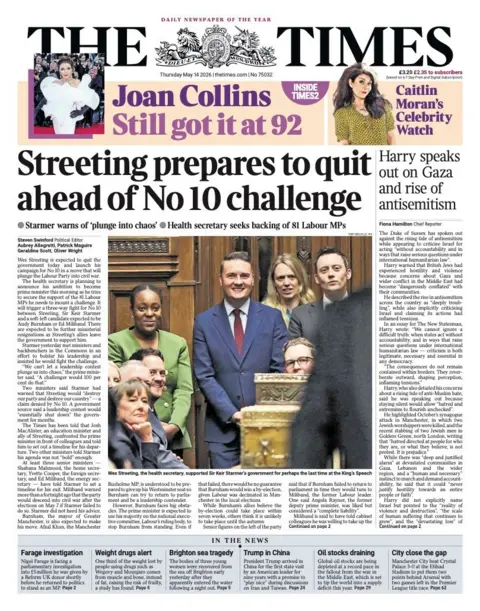
Health Secretary Wes Streeting dominates the front pages, as Sir Keir Starmer continues to try and retain his premiership. “Wes, prime minister?” asks the Metro, reporting that Streeting has told his allies he will challenge Sir Keir on Thursday. It comes following what the paper describes as a “bombshell 16-minute face-to-face confrontation” in Downing Street on Wednesday, just hours before the King’s Speech.
The Sun says the Labour Party is in “civil war”, and Streeting is planning to “fire the starting gun” on a “bloody” leadership contest. Catherine, Princess of Wales, is pictured front and centre of the paper in a fitted blue suit with flared trousers. “My flare lady” is visiting Italy on her first overseas trip following treatment for cancer.
“Streeting prepares to quit ahead of No 10 challenge” reads the Times, which says the health secretary is expected to quit the government on Thursday morning to formally launch his campaign for No 10. The paper says this will trigger a three-way fight between Streeting, Sir Keir and a soft-left candidate, which it predicts will be Mayor of Greater Manchester Andy Burnham or Energy Secretary Ed Miliband. A government source has told the Times that a leadership contest would “essentially shut down” the government for months.
Streeting’s move to force a race has prompted a “frantic scramble”, the Guardian says, as the left of Labour looks for a candidate to oppose him. The paper suggests that Miliband and former Deputy Prime Minister Angela Rayner are their key contenders, noting that while Burnham is a “favoured replacement” for Sir Keir, he does not have a Commons seat.
The Daily Telegraph is leading on Miliband’s possible bid for leadership, and says Sir Keir is expecting the energy secretary to “throw his hat in the ring” shortly after Streeting’s anticipated resignation. Sources told the paper that Miliband was the most likely proposition for the soft-Left faction of the Labour party, as Rayner was still dealing with unresolved tax issues. Much like the Times, the Telegraph has been warned that the leadership contest is likely to “plunge the country into chaos” by “paralysing” government and spooking the bond markets.
One of the few front pages not to feature a photograph of Streeting, the Mirror’s, instead focuses on an inquiry launched into a £5m gift received by Reform UK leader Nigel Farage. Political opponents have said that the gift, which was from billionaire Reform backer Christopher Harborne, should have been declared in the MPs’ register of interests. Farage has said he was under “no obligation” to declare the gift because it was given before he was an MP.
“The whole experience has been very traumatic for all involved. It was a case of sliding doors, right place, right time.”
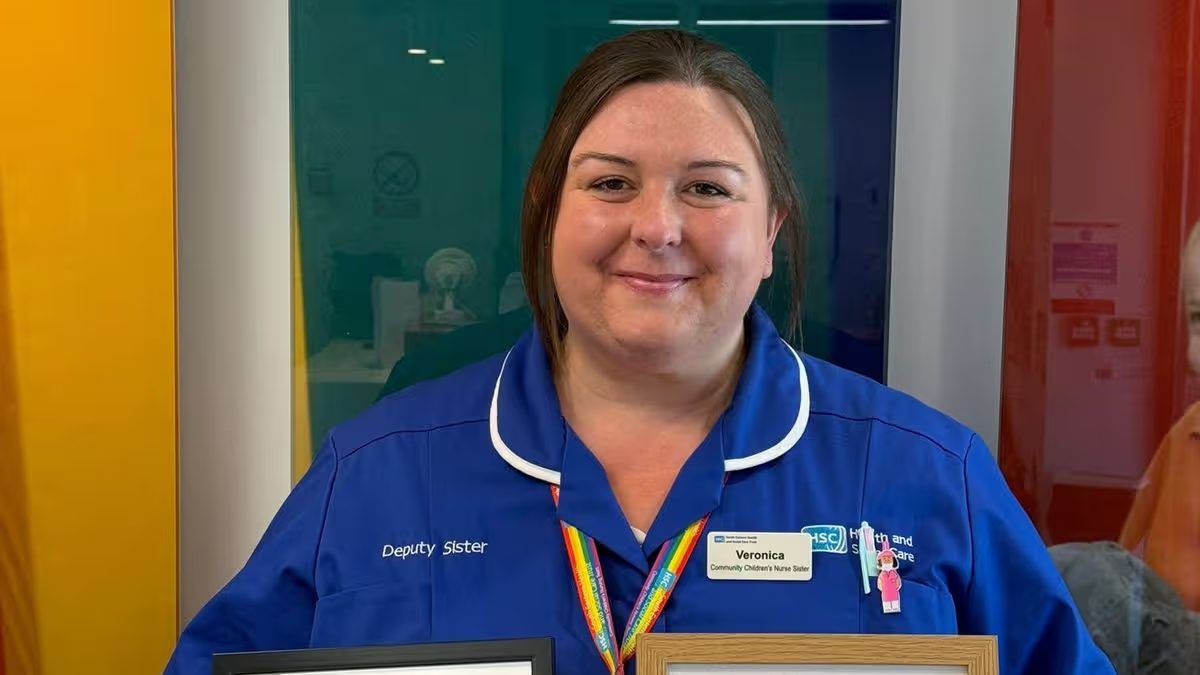
A paediatric nurse has been recognised for her outstanding bravery after helping to save the lives of a family of five young children last summer.
Advertisement
The extraordinary sea rescue took place on the July 13 2025 at Rossglass beach in Co Down. Although the tide was initially out, it began to turn as the children, who are all siblings, went for a swim.
The Newcastle Coastguard team was called to the beach near Downpatrick at around 9.30pm after reports that the five children – Catherine, Cecilia, Mary, Maria and their brother Francis Smyth from Ballynoe – had been caught out by the rising tide.
After two initial responders from the Coastguard team arrived at the beach, they found the children had been brought ashore by two off-duty nurses who spotted that the children were in danger and went into the sea to bring them to safety.
Advertisement
Veronica Sloan, together with friend and fellow Belfast sea swimmer Sinéad Deane, acted immediately. Wading into the water, they first reached Francis, Maria, and Cecilia, sending them safely back to their mother.
Veronica, carrying her phone in a waterproof bag, called 999 from knee-deep in the sea, triggering a rescue operation.
Meanwhile, Sinéad swam out to Mary and Catherine, who were treading water, and got the children back to shore with Veronica. Both ladies helped keep them safe and provided essential care until Coastguard and emergency service teams arrived.
Both Veronica and Sinéad were recently awarded Honorary Testimonials from the Royal Humane Society for their courageous actions and also received Certificates of Recognition from the Coastguard and the Royal Lifesaving Society.
Advertisement
A special letter from the President of Ireland, Catherine Connolly, was also gifted to the pair.
Veronica, Ards Hospital’s Community Children’s Deputy Sister said she and Sinéad’s experience was very much a case of “right place, right time.”
Veronica said: “The whole experience has been very traumatic for all involved. It was a case of sliding doors, right place, right time. Myself and Sinéad’s nursing skills played a big part that night in keeping the children safe until help arrived.
Advertisement
“I feel very proud to have been presented an extremely special certificate by my mother Mary, herself a nurse of 48 years. I feel very overwhelmed and honoured to have been presented with these acknowledgements especially from the Chief of the Coastguard of Scotland and Northern Ireland and the President of Ireland.”
South Eastern Trust Executive Director of Nursing David Robinson said: “I’m so proud of Veronica. There is no doubt that her courage and quick thinking – and that of her friend Sinéad too – helped save the lives of five children. They both deserve to be honoured for their incredible bravery last year.”
Colman Domingo has spoken out in defence of the recent Michael Jackson biopic.
In fact, the movie was originally supposed to include scenes depicting the allegations, until the discovery of a legal clause in the settlement between Jackson and one of his child accusers, forbidding his name or likeness from ever being used in a film.
In a new interview with The Hollywood Reporter, Domingo conceded that Michael was “not an easy shoot”.
Advertisement
Colman Domingo as Joe Jackson in Michael
“Every time the film was changing in some way, shape or form, there were discussions with me just to make sure that we’re clear about the story we’re telling,” he explained.
Still, Domingo said that he stands by the finished movie, claiming that it serves as an “examination of how Michael became Michael, before we deal with anything else”.
“Everyone thinks there’s one way to tell his story, and there isn’t,” he continued. “One can’t deny Michael’s genius and his extraordinary legacy in the music industry.”
“I will want to know what story we will be telling in part two,” the Euphoria actor noted.
Jaafar Jackson in character as Michael Jackson
Filmmaker Antoine Fuqua said last month that if a Michael sequel were to go ahead, he’d be keen to not “sensationalise anything”.
“Being a movie star, rock star, superstar like Michael, there’s enough of that already,” the director claimed. “You don’t have to do much. But I think the key is, like, who was he as a human being?
“Stay on that path and then we’ll be OK, because that’s what it’s about. It’s a biopic, it’s about a human being, he’s a real person. So that’s the key. People have to remember that.”
Everything you need to know about Connie the only girl diagnosed with rare immune disease CGD in NI | Belfast Live
Need to know
Connie has a rare disease that leaves her immune system unable to fight off infections and will soon go to Great Ormond Street Hospital
21:58, 13 May 2026Updated 22:01, 13 May 2026
Connie who has been diagnosed with a rare disease and will soon be getting treatment at Great Ormond Street Hospital
Advertisement
Carrie McKeown is preparing to take her eight-year-old daughter Connie to Great Ormond Street Hospital for treatment on a rare disease called Chronic Granulomatous Disease that leaves her immune system unable to fight off infections.
The disease is usually diagnosed in children aged two and under, but Connie only received her diagnosis last year.
Since she was a baby she has regularly developed infections, particularly around her nose and ears, requiring multiple courses of antibiotics to clear.
A serious infection developed on Connie’s ear after she got a piercing aged six which later required surgery to remove. Following this her wounds would not heal and she eventually had tests carried out which showed she has CGD.
He mum has said she always believed that there was something more serious wrong with her daughter and has told other parents to always keep fighting for answers.
Connie will soon receive treatment for CGD at Great Ormond Street Hospital which will include a bone marrow transplant and chemotherapy. Despite receiving these treatments, she does not have cancer.
Carrie is a self-employed make-up artist and beauty therapy who also has two four-year-old twin daughters. She has recently been unable to work due to caring for Connie and will not be able to for another six months when she returns from London.
Carrie’s friends have launched a Gofundme page to support her and her family in the coming months so that she is able to cover her bills and care for her children when not working.
Carrie has said more support should be available for self-employed parents during a medical emergency like this.





























































You must be logged in to post a comment Login