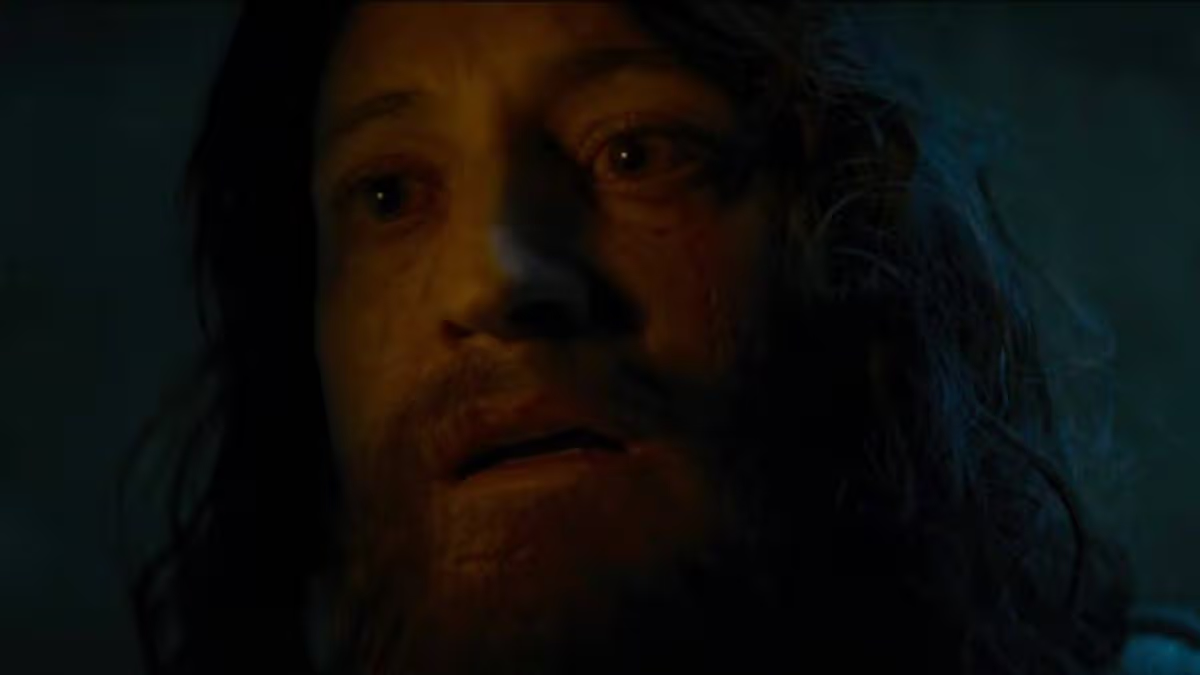
The Count of Monte Cristo is a 2024 film adaptation of Alexandre Dumas’ celebrated 1844 novel.
Pierre Niney leads the cast as Edmond Dantes, a young sailor wrongfully imprisoned for treason on his wedding day.
Advertisement
After escaping the fortress where he has been held for over a decade, he reinvents himself as a wealthy Count, forging a new life beneath a false identity.
Concealed behind this façade, he embarks on a mission to exact revenge upon those who betrayed him, reports the Mirror.
The synopsis reads: “Falsely accused, imprisoned for 15 years – now he’s out for revenge on those who wronged him. An epic drama of betrayal, love and vengeance starring Pierre Niney.”
The 2024 film has been split into four parts for BBC iPlayer after becoming a huge hit when it first premiered.
One fan hailed it an “excellent adaptation from the beautiful novel, with another calling it “absolutely terrific”.
One viewer branded it a “masterpiece”, while someone else said: “I truly loved this movie and I am not an avid movie watcher, easily one of the best movies I’ve ever seen.”
“A dream come true for Monte Cristo fans,” one said, as another review was titled “Absolutely stunning”.
Advertisement
“Go out of your way to see this one,” one viewer advised, while someone else called it “unmissible”. They continued: “I was absolutely captivated by the film from start to finish. Every moment kept me on the edge of my seat, and I wasn’t bored for a single second.”
“A gorgeous modern production of timeless epic,” another person said, while one fan called it “spectacular”.
Despite the widespread praise, French actor Pierre Niney previously admitted he was “pessimistic” about the project at the start.
Advertisement
He told Forbes: “I remember thinking ‘It’s not going to be made, they’re not going to find the money’. It would take people crazy enough to embark on a 1200 pages book to make one movie.
“So I was pessimistic at the start, thinking it was too good to be true. And actually it’s even better than what I had imagined, so it will stay engraved in my memory forever.”
The Count of Monte Cristo is available to watch on BBC iPlayer.
HM Revenue and Customs has issued a scam alert after an “increased” number of people have been targeted by fraudsters claiming they are owed a tax refund
Fiona Callingham Lifestyle writer
03:39, 09 May 2026
Britons are being urged to stay vigilant following “increased reports” of individuals being targeted by fraudsters. HM Revenue and Customs has issued a warning that scammers may get in touch claiming you’re owed a tax refund in a bid to steal your personal information.
If you’re “unsure” about any communication you receive, you should avoid clicking on links or sharing any details. You can also flag suspected scams to the authorities.
Advertisement
In a post shared on social media platform X, HMRC said: “SCAM ALERT! We’re receiving increased reports of customers being contacted by scammers claiming they are due a tax refund.
“Always take the time to stop and think if the request is genuine before sharing personal information or clicking on any links. If you’re unsure, don’t click on any links and report it to us.
“To find out if you are due a tax refund, you can log into your HMRC online services account on GOV.UK or the HMRC app.” On the Government website, HMRC has provided additional guidance on staying safe.
Use the following checklist from HMRC to work out whether the contact you’ve received is a scam. You can apply it to phone calls, emails and text messages.
Advertisement
Content cannot be displayed without consent
According to HMRC, it could be a scam if it:
Rushes you
Is threatening
Is unexpected
Asks for personal information like bank details
Tells you to transfer money
Offers a refund, tax rebate or grant
Below are other signs to look out for.
Suspicious phone calls
HMRC will never:
Leave a voicemail threatening legal action
Threaten arrest
Text messages
GOV.UK said: “HMRC does send text messages to some of our customers. In the text message we might include a link to GOV.UK information or to HMRC webchat.
“We advise you not to open any links or reply to a text message claiming to be from HMRC that offers you a tax refund in exchange for personal or financial details.”
To help fight phishing scams, you can send any suspicious text messages to 60599 (network charges apply) or email: phishing@hmrc.gov.uk, then delete them.
Advertisement
WhatsApp messages
If you have subscribed to the UK Government Channel on WhatsApp, you will receive updates that might include occasional tax-related reminders. These will be single message alerts and you will not be able to reply. GOV.UK said: “HMRC will not communicate with you for any other reason using WhatsApp.”
QR codes
HMRC uses QR codes in letters and correspondence. It said: “The QR code will usually take you to guidance on GOV.UK. We will tell you if the QR code takes you anywhere else.
“You will never be taken to a page where you have to input personal information. When you are logged into your HMRC account, we may use QR codes to redirect you. For example, to take you to your bank’s login page.
“If we’re using QR codes in communications you’ll be able to see them on the list of genuine HMRC contacts.” To help fight phishing scams, you can send any suspicious emails containing QR codes to phishing@hmrc.gov.uk then delete them.
Advertisement
Gift or payment vouchers
HMRC will never ask you to pay with gift or payment vouchers.
Report a scam
You can report a disclosure of personal information to the HMRC security team online here.
If you’ve been a victim of a scam and suffered financial loss, you can report it to Report Fraud through their website or by calling 0300 123 2040.
As Memories told last week, the country was shut down, with violence breaking out in many places as police battled with pickets to get food supplies – and copies of The Northern Echo – out to the people.
Leading the strike in the North East was Will Lawther, a miner from Chopwell, in Gateshead, which was known as “Little Moscow” due its left-wing politics which Will, a member of Durham County Council from 1925, fully embraced. He was also the Labour candidate for the Parliamentary seat of Barnard Castle.
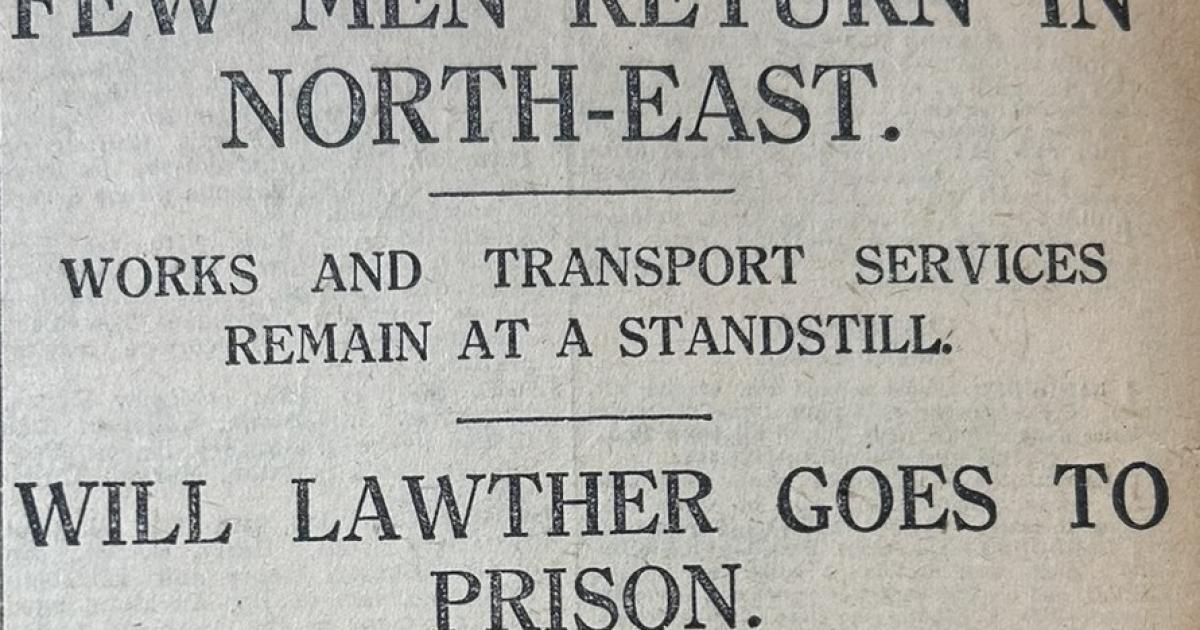
The Northern Echo of May 11, 1926 (Image: Chris Lloyd)
As our reproduction front page shows, he was arrested on May 10, 1926, and charged with “interfering with food distribution and police intimidation” – it seems he was trying to stop food convoys reaching Consett from Newcastle by blocking the roads. The authorities presented this as an attempt to steal the food and sell it on the black market; Will probably saw it as lawful picketing and making sure the strike committee was in charge of the neighbourhood.
Advertisement
That front page from May 11, 1926, really is a page in history: as well as Lawther’s arrest, it features the first report of the most notorious incident during the General Strike in the North East when pickets targetting a coal train they believed was being operated by blacklegs instead managed to derail the Flying Scotsman at Cramlington.
Will Lawther, the MP for Barnard Castle from 1929 to 1931, who was arrested during the General Strike (Image: wikipedia)
As the strike came to a messy end, Lawther was tried at Gateshead on May 13 under the Government’s “Emergency Regulations” designed to crack down on strikers’ activities.
“Lawther denied that he was a Communist and that the people of Chopwell were terrified out of their wits by mob law,” said the Echo. “There was a demonstration outside the court. The police charged the crowd and two men were arrested.”
Advertisement
The Northern Echo of May 14, 1926, reporting on Lawther’s imprisonment (Image: Chris Lloyd)
Realising that Lawther was a political hot potato, and heeding Conservative Prime Minister Stanley Baldwin’s plea that “bygones should be bygones” now the strike was crumbling, the magistrates fined Lawther only £50 – the most lenient sentence possible. However, he refused to pay and was jailed for two months in Durham.
In 1929, the people of Barnard Castle – who have a surprising history of electing early Labour MPs – returned him to Parliament, although they booted him out two years later.
He became the first president of the National Union of Mineworkers and had Communist sympathies until the Second World War, after which he used his position on the Trades Union Congress to defeat the hard left.
He was knighted in 1949 – reputedly the first miner ever to be so honoured – and lived in Whitley Bay until his death in 1976.
Advertisement
A podcast series looking at Lawther’s role during the strike and at his remarkable career has just been created by the Find My Past genealogy website and features Jonathan Kindleysides, the Head of Industry at Beamish Museum. Google “A Family History of the General Strike” to find it.
Two lots of father and sons, as well as one mother and daughter were elected in the South Cambridgeshire elections
It was a family affair for some of the winning candidates in the South Cambridgeshire District Council elections. The Liberal Democrats won a clear majority in South Cambridgeshire today (Friday, May 8), winning 43 out of 45 seats.
Advertisement
The party initially held 34 seats, however they have gained back seats from the Conservatives, leaving the Conservatives with only two seats in the council. Amongst the Liberal Democrats that won were three sets of family members.
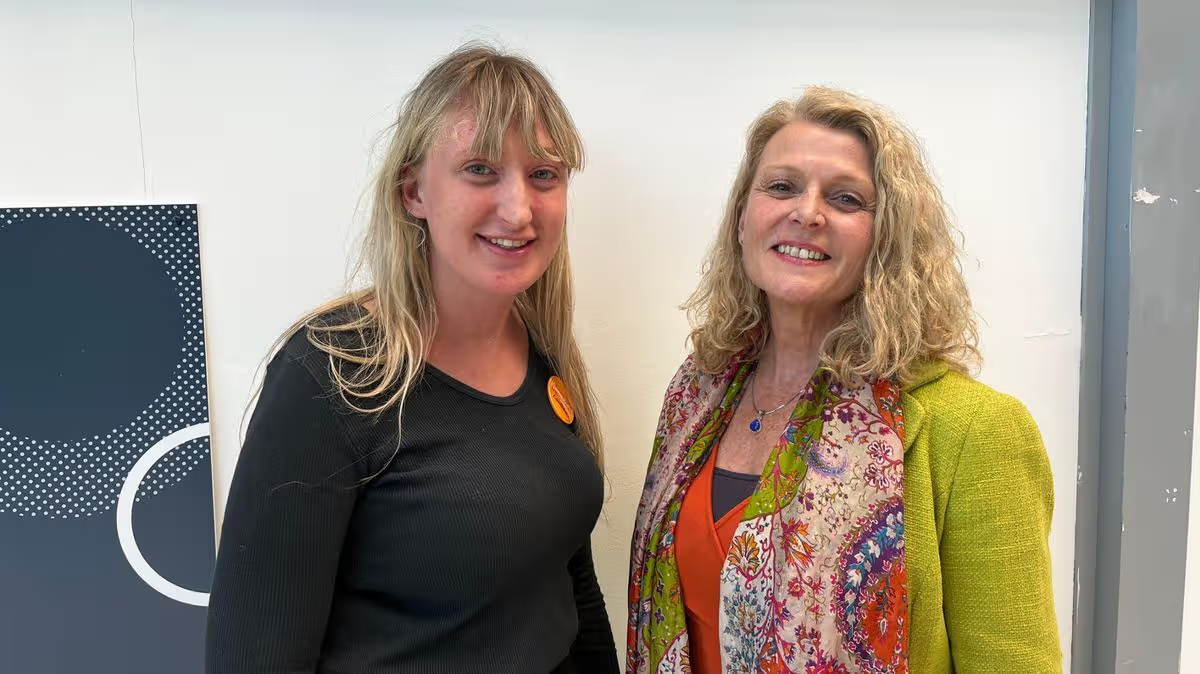
Father and son John and Henry Batchelor retained their seats for the Linton ward. There was also Natalie Warren-Gunn, who retained her seat for Longstanton, and her daughter Yasmin Deter winning the seat for Cottenham.
Henry Batchelor said he was “very honoured” to be re-elected for Linton, and also alongside his father. He added: “We are very happy to be given the public’s trust again and for me, I was born in Linton, and my roots are in Linton.”
Advertisement
John joked that his son gained around 40 more votes than him. However, he said he was “very proud”.
Natalie Warren-Gunn said she was “really pleased” to be re-elected for Longstanton. She added: “I can continue with the work I started.”
Natalie said that there is a “lot of change and transition” in the areas she oversees. She said she can “carry on with the momentum” in those areas.
Yasmin said it was “really exciting” to be elected in the same council as her mum. She added: “In particular, because of devolution that is ahead, [it will be good] being able to see each side with the district and county.”
Advertisement
Father and son Martin and Ariel Cahn were also elected under the Liberal Democrats. Martin won his seat for Histon and Impington, while Ariel won in Harston and Comberton.
Organised by Vogue, the Met Gala this year was based around the theme of “costume art”. An accompanying exhibition of the same name opens at New York’s Metropolitan Museum of Art on May 10, with a focus on the dressed body.
Responses to the Met Gala – the US fashion event of the year – and its related Costume Art exhibition have been sharply divided. On the one hand, critics have applauded the exhibition’s use of an inclusive range of mannequins, representing a wide group of bodies that go far beyond the normal “model physique”.
On the other, this apparent celebration of diversity has been contrasted with the overwhelming thinness of the red carpet at the Gala, as well as the involvement of its honorary chairs, Amazon founder Jeff Bezos and his wife Lauren Sánchez Bezos. The couple were said to have sponsored the event to the tune of $10m (£7.4m), sparking calls for a boycott.
As the influential fashion commentators Diet Prada noted, this year’s Met Gala was more poorly received than ever before, with speculation rife about why some celebrities were missing the event.
Advertisement
An activist group called for a boycott of the Met Gala in a protest against billionaire Jeff Bezos, who sponsored the event for a reported $10m (£7.4m) dollars. Zuma Press / Alamy
As artwashing is now an established media tactic, the positive elements of the exhibition could be viewed as a distraction from the negative capitalistic associations of its sponsors.
However, in an age dominated by Ozempic and other GLP-1 drugs, an exhibition celebrating bodies of all shapes and sizes does far more than pay politically expedient lip service to the idea of diversity.
Diversity fights back
The exhibition – masterminded by Andrew Bolton, the British-born curator of the Costume Institute at the Met – pairs garments and artworks “organised into a series of thematic body types that reflect their pervasiveness and endurance through time and cultures”.
The choice of these thematic body types – which divide into sections including the Naked Body, the Classical Body, the Ageing Body and the Disabled Body – had been the subject of media coverage long before column inches were filled with the usual discussions of celebrity outfit choices.
Advertisement
Over the past month, a series of articles and related social media posts have trailed that the show would feature a physically diverse array of mannequins. This would support the exhibition’s stated aim of exploring distinct bodies across time and space. On April 21, sculptor Frank Benson – most famous for his figurative works – posted on social media that it had been the “honour of a lifetime” to create a group of mannequins for the Met’s show.
These newly commissioned mannequins allow the show to present its garments on an array of bodies – variously abled, fat and thin, and in different states of pregnancy and undress. These are not one-off pieces. As Benson confirmed, the mannequins will be transferred afterwards into the Costume Institute’s permanent collection and used in future exhibitions.
Each of the figures wears a mirrored mask, encouraging viewers’ identification with these more “realistic bodies”. In so doing, the curators utilise a highly literal but effective means of reflecting the norm within clothing and spaces usually reserved for the thinnest of bodies.
Advertisement
Variously abled bodies are strong represented in the Met exhibition. Anna-Marie Kellen / The Metropolitan Museum of Art
Alongside the forms of the mannequins themselves, “the Corpulent Body” (the Met’s somewhat unfortunate wording) is also invoked through specially commissioned photography and fashion design, including work by designers Karoline Vitto and Michaela Stark.
Stark has created some of her highly recognisable undergarments that truss the body in silk organza ties – resulting in pockets of fat and bulging extrusions that encourage speculation on what the beautiful erotic body might look like.
Is there a future for body positivity?
Despite this, recent data from industry insiders suggests a broader backward slide in representation that counters the narrative pushed by the exhibition. The model Felicity Hayward has done pioneering work season after season recording plus-size representation on the runways: the autumn/winter 26 lineup (shown in Europe and US in February) had the lowest numbers of size inclusive models for years.
Of the 3,840 looks shown at New York Fashion Week, only 20 were shown on plus-sized bodies. This was a staggering 50% lower than it had been the previous year.
Vogue Business interviewed a number of casting directors on this notable shift. One, Chloe Rosolek, described this “regression in inclusion” as the literal “erasure of women’s bodies”. The Costume Art exhibition seems to stand firm against this shift.
Advertisement
The ageing body is also part of the inclusive display in the Costume Art exhibition. Anna-Marie Kellen / The Metropolitan Museum of Art
But as many social media observers have noted, the exhibition’s attempts at representing equality and body positivity feel at odds with a red carpet that was populated by an ever-thinner group of celebrities. With weight-loss easier to achieve than ever thanks to the widespread use of GLP-1 drugs, many figures in the public eye have appeared to lose significant amounts of weight.
The Gala guestlist did include a more diverse crowd, including the disabled transgender model Aariana Rose Philip, whose body one of the mannequins was based upon. But in event roundups dominated by influencers, singers and actors, this bodily diversity makes little impression.
While Instagram feeds suggest the most important and fashionable of red-carpet appearances belong to the thinnest bodies, the exhibition itself does seem to achieve its goals in furthering representation of diverse bodies. And it does so on one of the most influential and public stages.
Fat studies scholar Jeannine A. Gailey argues that people who are fat are simultaneously paid undue attention on account of their “taking up too much space”, and are also ignored due to the perception of fatness as both undesirable and morally questionable.
Conversations around what kind of bodies are valued through forms of representation feel very relevant to the aims of Costume Art, thanks to its prominent portrayal of fat, ageing and disabled bodies.
Despite its problematic associations with Bezos, Costume Art nevertheless provides a highly visible – and thereby meaningful – counter to the world of ever-shrinking thinness that Hollywood appears to cling to, perhaps offering the body positivity movement a much needed life raft. However, now that anyone can access these weight-loss shortcut drugs, one wonders how long body positivity can remain afloat.
A Utah judge has ruled that cameras will be allowed in the courtroom during proceedings for Tyler Robinson, the man accused of fatally shooting Charlie Kirk, rejecting defense arguments that extensive media coverage could taint a future jury pool.
Judge Graf also moved Robinson’s preliminary hearing to July 6 through July 10, citing the massive volume of evidence still being reviewed in the high-profile death penalty case.
He claimed this move was necessary so that Robinson’s attorneys would have enough time to review discovery materials. He did, however, acknowledge the public’s interest in moving the case forward without unnecessary delays.
Advertisement
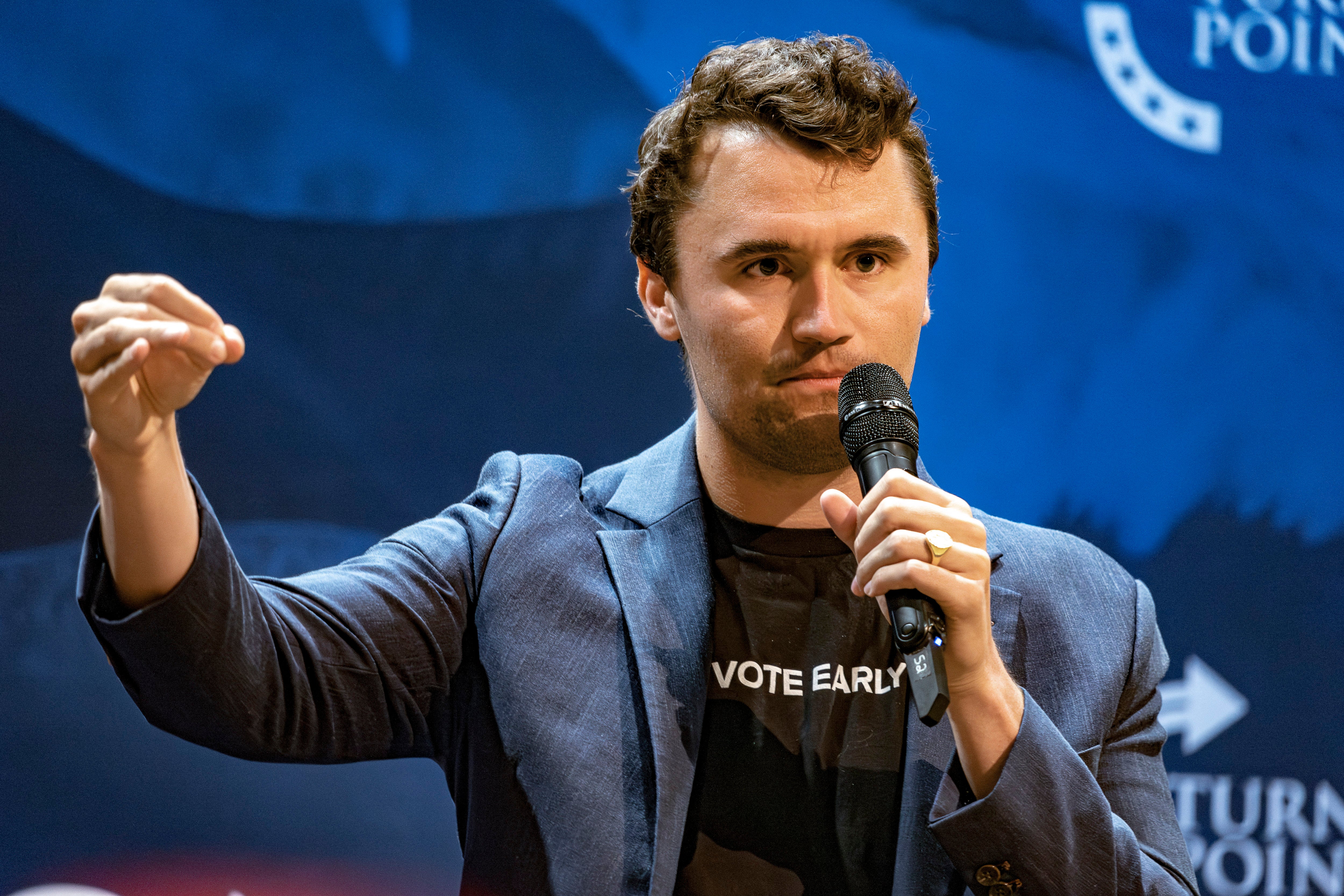
Robinson faces multiple charges, including aggravated murder, in the September 10, 2025, killing of Kirk, the founder of Turning Point USA. The charges are eligible for the death penalty.
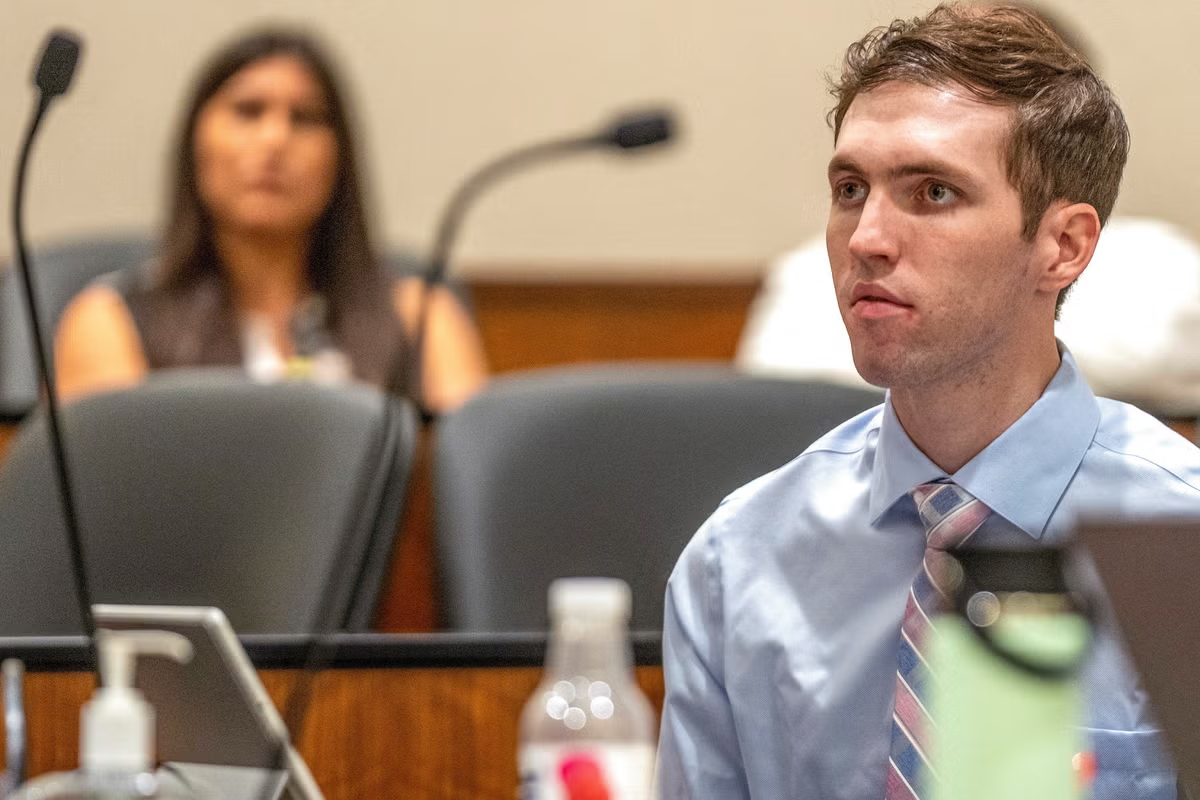
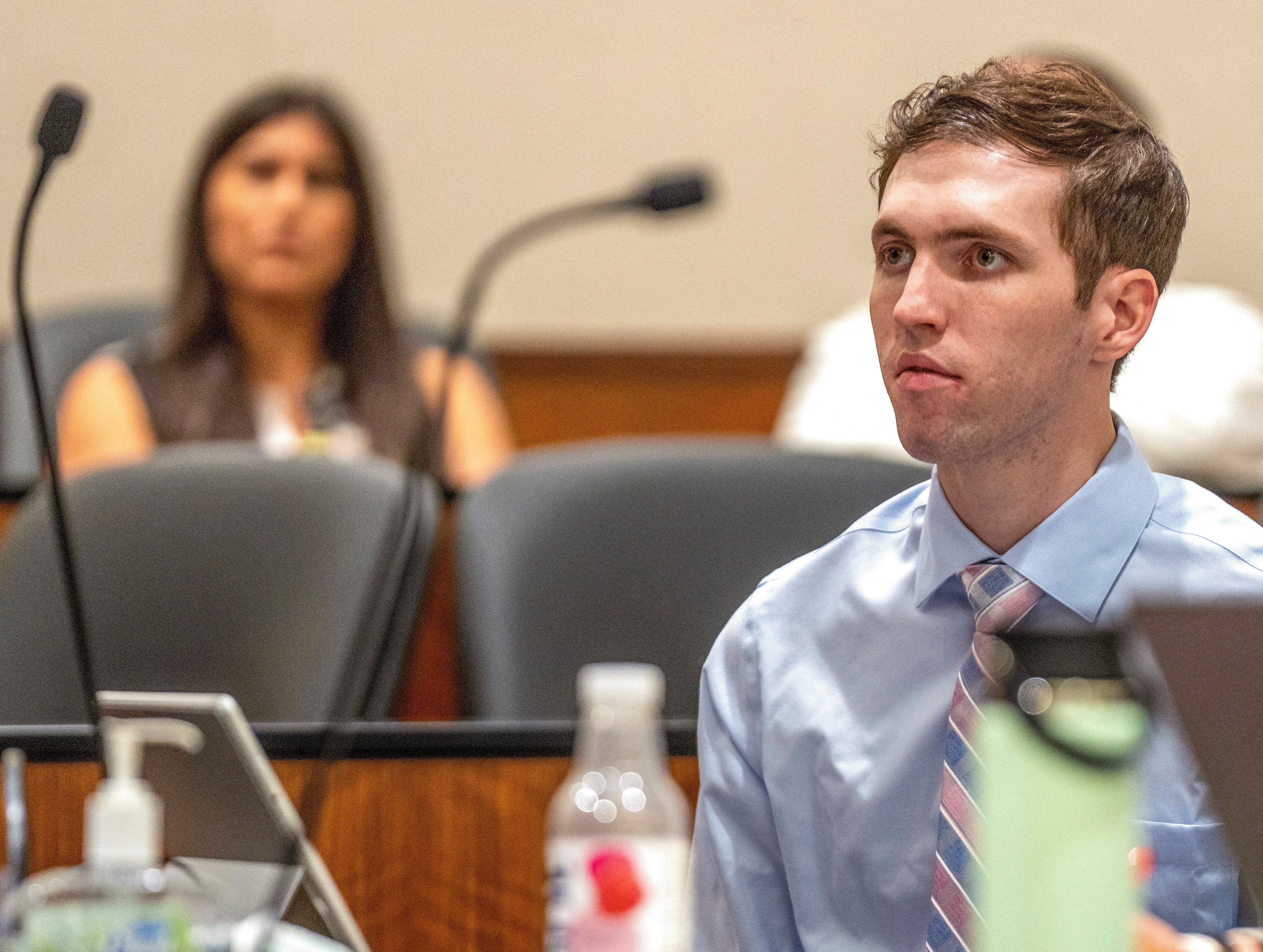
Tyler Robinson, pictured in court on April 17, during a hearing in the case involving the fatal shooting of Charlie Kirk. On May 8, a judge ruled that cameras would be allowed in the courtroom during future proceedings (Reuters)
In the immediate aftermath of Kirk’s killing, conspiracy theories spread rapidly across social media, podcasts and political forums before authorities had publicly identified a suspect or motive.
Some commentators falsely claimed the shooter was transgender, echoing broader anti-trans narratives pushed by extremist groups. Others alleged the assassination was part of coordinated political violence by the left, despite federal research showing most political violence in the United States is linked to right-wing extremism. And some conspiracy theories promoted antisemitic claims or alleged that Robinson had been radicalized by college professors.
The defense had sought to block cameras and electronic media coverage, arguing the intense publicity surrounding Kirk’s killing could prejudice potential jurors. They also presented experts who testified that livestreamed proceedings and online commentary could reinforce public bias.
Advertisement
Graf ultimately rejected those arguments, finding they did not justify a blanket ban on cameras.
Policies on cameras and livestreaming vary among states, and many, including Utah give judges discretion over whether to allow cameras. Cameras are generally prohibited in federal courts.
Robinson faces multiple charges, including aggravated murder, in the September 10, 2025 killing of Charlie Kirk, the founder of Turning Point USA (AFP/Getty)
Investigators also disputed claims that media coverage had been uniformly biased against the defense.
“I think the tone of it went both ways. I think some of the tone of it was negative toward the prosecution and some of it was negative toward the defense as well,” Utah County Attorney’s Office investigator Cole Christiansen testified in April. “Some of it was negative toward Erika Kirk, and some of it was negative toward Charlie Kirk.”
The judge also noted that most people consume information about the case through commentary and social media rather than watching proceedings live, meaning a camera ban would not necessarily limit exposure to potentially prejudicial coverage.
Advertisement
Graf further pointed to safeguards already in place, including restrictions on camera placement, courtroom decorum rules and limits on what attorneys can publicly say about the case.
Robinson is scheduled to return to court on May 19.
Ian Watkins was attacked and died in HMP Wakefield where he was allegedly slashed with a make-shift knife with Rico Gedel and Samuel Dodsworth on trial for his murder
20:28, 08 May 2026Updated 20:31, 08 May 2026
A nurse started “screeching” at Ian Watkins’ injuries before the singer “gargled” on his own blood after being attacked in jail, a prison officer said. Rico Gedel, 25, also known as Rashid, and Samuel Dodsworth, 43, are both accused of murdering the former Lostprophets frontman at HMP Wakefield on October 11 and are on trial at Leeds Crown Court.
Watkins, 48, was jailed for 29 years in December 2013 with a further six years on licence, after admitting a string of sex offences – including the attempted rape of a fan’s baby, The Mirror reports.
The court heard how prison officers went to the aid of Watkins after he was allegedly attacked with a makeshift knife, and a nurse also attending to him made a “screeching” sound when she saw the extent of the injuries. It was after this that Watkins began “gargling” before going into cardiac arrest and dying.
Advertisement
Jurors sitting on the trial have so far heard how he suffered three injuries caused by a makeshift knife during a 20-second attack. Footage showing a blood-soaked Watkins emerging from his cell has been released by West Yorkshire Police after jurors were shown it by prosecutor Tom Storey KC.
Both Gedel and Dodsworth deny murdering Watkins. Gedel is accused of carrying out the attack, while Dodsworth is accused of keeping watch and disposing of the weapon in a bin in the recess area.
On Friday, two prison officers gave evidence from the witness box, with one noting he first became aware of Watkins’ injuries while on the landing of B wing.
He said: “I don’t remember the time, but I remember seeing something. From what I remember, I remember stood looking down the landing. I kind of had a bit of a view down the landing but not much of one.
“From what I saw, I saw Mr Watkins come out of his cell, wearing a white T-shirt, and I remember seeing blood down the front of his shirt. He didn’t really do anything, he just kind of stood there and looked towards where me and two other officers were stood.
“He went back towards his cell, like he was trying to get back in for whatever reason. I alerted the two staff members I was stood with in case they didn’t see it and all three of us went to his cell.”
The officer said a colleague went to help Watkins, while he and another went to apprehend Gedel, who he saw punch another inmate. After being apprehended, Gedel was taken to his cell, neighbouring Watkins’. Officers were then said to have carried out a strip search before one kept watch.
Advertisement
Peter Moulson KC, for Gedel, asked the officer if he heard any sentences uttered by Watkins such as: “Get away from my cell you s***stain.” Mr Moulson said: ” And then the ‘N’ word is used in this context, Watkins said: ‘This is an – N word – free zone.’
“Did you hear Watkins to the effect of: ‘If you don’t move from the cell now, I’m going to f****** stab you.’ And finally, from Watkins: ‘I’m going to count to three’ and then the words, ‘One, two’.” The officer said he did not hear any of those statements, but was close enough that he would have heard it if it was said.
Another officer was then called into the courtroom to give evidence and told how he had been in charge of unlocking the cells on the left-side of the wing – where Gedel’s and Watkins’ were situated – on October 11 last year. He said he interacted with both inmates.
Of Gedel, he said they spoke and added: “As I opened his door, I saw it was Mr Gedel and basically said to him, ‘What you done this time?’ And we laughed a bit and had a smirk and I went onto unlock the other cells.”
Advertisement
He said the comment was due to his move onto B wing. He said “sometimes it is just a normal move, but other times prisoners will be moved if there’s been an incident or something similar to that,” reported YorkshireLive.
The next cell the officer unlocked was Watkins. He said: “As I opened his door, he was sat on his bed doing a drawing. I asked what he was drawing and he showed me. It was a picture of another prisoner’s partner and we had a chat and that was that. He did a lot of paintings and drawings.”
After he unlocked the cells, the officer said he then began to carry out cell searches to make sure everything, including the locks and windows, were secure. The officer said he did not think Gedel was in his cell when it was searched, but Watkins was in his. He added: “He was still doing his drawing…”
The officer said he then joined other officers on the landing. He told the court: “I made an observation to the left to look down the landing, and there were two workmen and as they got past Watkins’ cell, one made a gesture, to the left-hand side of his neck, as in a slicing motion.
Advertisement
“At that time, that’s when Mr Watkins’ put his head out of his cell. Mr Watkins’ was leaning out of his cell, so his head was present just outside of the cell structure, and at that moment in time, that’s when I noticed a lot of blood coming away from his neck.
“First instinct, I told the two other members of staff, and we made our way down to Mr Watkins’ cell, and [a colleague] held him and helped him into his cell and we made our way down the stairs to apprehend Mr Gedel.” The officer said it was “fair” to assume Gedel had been involved. He said: “Experience, from myself, I know of Mr Gedel from previous wings. He has carried out numerous assaults from other locations.”
Once Gedel was apprehended, the officer said he went back to Watkins’ cell to assist with treating him. He said: “I could see a cut to his right ear, a large laceration to his right cheek, and also a very large laceration from his left cheek to lower neck.”
The officer said Watkins was “sat in his bed” and was “still conscious and spoke to me”. He said: “I asked if he was ok when I first went in and he said that yes he was fine. I was trying to keep him awake and keep him talking.
Advertisement
“As I showed the nurse the injury to his neck, the nurse was quite shocked and made a ‘screeching’ noise and at that point, I think that’s when Mr Watkins realised what had happened and he deteriorated even further. He fell back onto his bed and was gargling.”
The officer said the nurse then expressed the opinion Watkins was going into cardiac arrest and CPR was administered, but Watkins’ died.
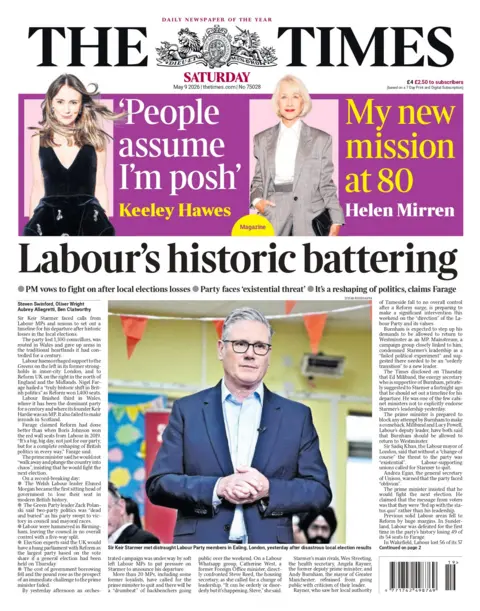
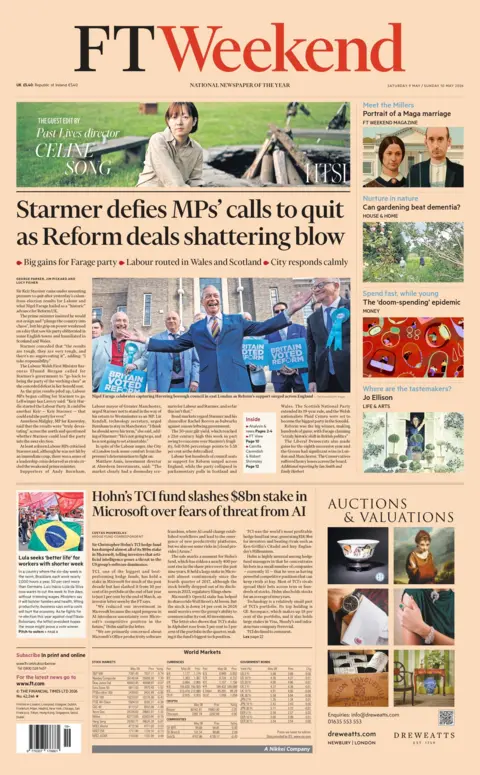
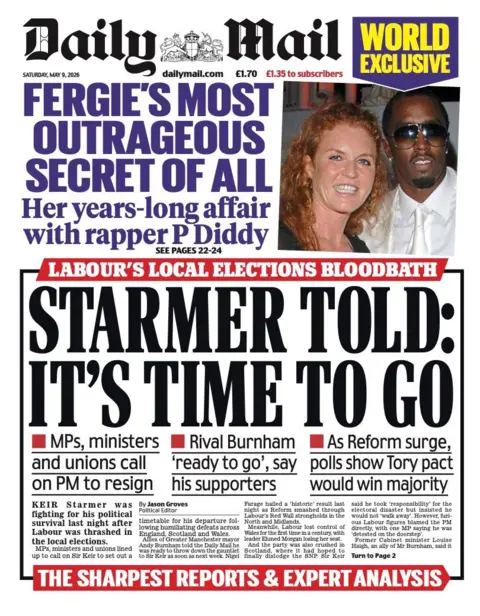
Many of the front pages lead with the immediate fallout from Labour’s election losses across England, Scotland and Wales. The Times calls the election results “Labour’s historic battering”. The paper says the party faces an “existential threat” after it lost “1,300 councillors, was routed in Wales and gave up areas in the traditional heartlands it had controlled for a century”. In addition to losing seats across the north of England and Midlands to Reform UK, “Labour haemorrhaged support to the Greens on the left in its former strongholds in inner-city London”.
“Starmer defies MPs’ calls to quit”, is the FT Weekend’s take, summarising the results as “big gains” for Nigel Farage’s Reform UK party and “Labour routed in Wales and Scotland”. Financial markets “had a doomsday scenario for Labour and Starmer”, Investment director Matthew Amis tells the paper, as bond markets regard Sir Keir and his Chancellor Rachel Reeves as “bulwarks against a more leftwing government”.
The prime minister is told “it’s time to go”, according to Labour MPs and union leaders who are calling for a change after the party was “thrashed in the local elections”, the Daily Mail says. Allies of Greater Manchester Mayor Andy Burnham told the paper he was “ready to throw down the gauntlet to Sir Keir as soon as next week”, the Mail writes.
The other big news to grace the front pages of the newspapers is the split of Tess Daly and Vernon Kay. The Daily Mirror reports that the celebrity couple are breaking up after 22 years of marriage. “The ex-Strictly host, 57, and the Radio 2 DJ, 52, said the decision was mutual,” the paper writes.
Starting from under £60,000, the BMW iX3 has a very distinctive front end with a new version of the brand’s ‘kidney’ grilles in the centre which are illuminated for visual drama.
In this instalment of Drive Time, Johngets behind the wheel of an exciting BMW Electric SUV and finds out that Mazda is using biofuel on the new CX-5 launch.
Advertisement
The UK market is being flooded with electric SUVs and most of the arrivals have lacked the Wow factor.
BMW has changed that with the launch of the new iX3 which delivers on all fronts.
This newcomer can go up to 500 miles on a single charge and it also boasts a superb interior with lots of new tech and striking exterior looks.
Starting from under £60,000, the iX3 has a very distinctive front end with a new version of the brand’s ‘kidney’ grilles in the centre which are illuminated for visual drama.
Advertisement
The car has clean lines and does without ugly plastic cladding and there are nice LED lights front and rear.
The looks may not be appreciated by everyone but it does stand out from the crowd.
And if the exterior does not blow you away, the interior certainly will.
The view from the comfortable seats is dramatic. There is no traditional instrument panel as BMW has dropped it to launch ‘Panoramic iDrive’ – a full width display which runs along the total length of the windscreen and provides all the information you could ever need without having to take your eyes far off the road.
Below that you also get a very large 17.9-inch infotainment touchscreen in an unusual shape.
It is fairly easy to operate but there are lots of menus and sadly you no longer get the rotary dial to operate it.
I only had the car a few days so I did not master it completely but owners should be able to programme their own shortcuts to make things easier.
Advertisement
There is bags of space for four adults to travel in comfort and a 520-litre boot makes it practical for family use.
Another 58 litres of space is available under the bonnet and the cabin has numerous storage areas for smaller items.
The car’s real trump card is its fantastic range. BMW claims it can go 500 miles on a single charge but even if you cannot match that in real world motoring, you will still get over 400 miles without much trouble.
That is truly impressive and puts all its rivals in the shade.
Advertisement
A 11kW home charger will take about 11 hours to charge the car fully and if you can find a 400kW unit at a charging station the car can go from 10-80 per cent in just 20 minutes.
The iX3 is ideal for town driving and it is also a very quiet motorway cruiser.
On twisty country roads it is surprisingly agile despite its hefty 2.3 tonnes and there is very little body roll while the steering is very responsive.
Advertisement
It can sprint to 62mph in just 4.9 seconds and can hit a top speed of 130mph.
The steering wheel is a nice shape but the buttons on it are very small and difficult to use.
All the latest safety kit is fitted to the iX3 including adaptive cruise control, blind spot monitoring, driver attention alert and autonomous emergency braking.
Tax-wise, it will cost you just £10 in the first year but £620 for years 2-6.
Company car drivers will enjoy low Benefit In Kind rates as it falls into the lowest bracket of just three per cent.
This car boasts an astonishing electric range, is great to drive and striking to look at and in my opinion is the best electric SUV on sale at the moment.
In further motoring developments, to demonstrate the potential role sustainable fuels can play in reducing greenhouse gas emissions when used as an alternative to fossil fuels, the launch cars on the Mazda UK all-new Mazda CX-5 launch in Scotland will be powered by a 100 per cent second-generation biofuel with no fossil fuel component.
Advertisement
Provided by SUSTAIN Fuel Technologies, the SUSTAIN 100 95 RON E10 second-generation biofuel is created from biomass such as food and agricultural waste and other non-food by-products.
This content utilises the carbon that already exists in our atmosphere, which plants absorb as they grow, recycling it rather than releasing additional CO2 that is currently locked underground in fossil fuels.
The all-new Mazda CX-5 is powered by a 2.5-litre e-Skyactiv G 141ps petrol engine, paired with 24V Mazda M Hybrid technology, replacing the previous 2.0-litre base unit.
This engine delivers confident performance with improved torque for quicker response, seamless acceleration, and better driving comfort.
Producing 141ps and 238 Nm of torque, the front-wheel drive variant accelerates from 0-62mph in 10.5 seconds, while cylinder de-activation enhances efficiency.
Powering this engine with SUSTAIN 100 95 RON E10 fuel requires no modification and delivers no change in performance.
Continued internal combustion engine development blended with electrification is a well-established example of Mazda’s powertrain innovation, enhancing vehicle efficiency as part of Mazda’s Multi-Solution Approach.
Advertisement
This strategy is well-suited to the application of sustainable fuels as a compelling alternative to fossil fuels and a way of reducing greenhouse gas emissions in combination with efficient engines.
*Don’t miss the latest headlines from around Lanarkshire. Sign up to our newsletters here.
And did you know Lanarkshire Live had its own app? Download yours for free here.
Footage circulating on social media has captured the moment giant waterspouts spiralled off the coast of a popular tourist spot ahead of the summer holidays
Footage circulating on social media has captured the moment giant waterspouts spiralled off the coast of a popular tourist spot.
Advertisement
Southern Spain has been hit by flash floods as violent storms moved through the region head of the summer holidays. Torrential rain triggered flooding on the roads parts of Murcia. Cars could be seen floating in deep floodwater as downpours battered the area.
Several marine tornadoes appeared offshore and witnesses reported seeing at least three waterspouts. The vortexes stretched from dark storm clouds down towards the Mediterranean, the Sun reported.
A waterspout is a rotating column of air that forms over water. It can cause destructive wind gusts. Extreme cases can see winds of up to 250km/h.
Advertisement
Spain’s state weather agency AEMET reiterated severe weather warnings across Campo de Cartagena and authorities issued a yellow alert for thunderstorms, warning of possible hail and powerful gusts of wind.
An orange alert remained in place for torrential rain. Forecasters predicted up to 40mm of rainfall within a single hour.
The conditions are part of a wider storm system hitting eastern and southern parts of the country after weeks of warm weather. Meteorologists have warned of downpours, electrical storms and quickly changing conditions across the region.
This intense weather comes weeks after storms hit Spain in March, killing one person.
Advertisement
More than 250 litres of rain per square metre were recorded in some regions and rivers surge to dangerous levels.
Trains were cancelled, schools were closed and mass evacuations were carried out earlier this year after Storm Leonardo dumped more than 15 inches of rain in just 24 hours.
In Portugal, Storm Leonardo also claimed a life and forced thousands more from their homes.
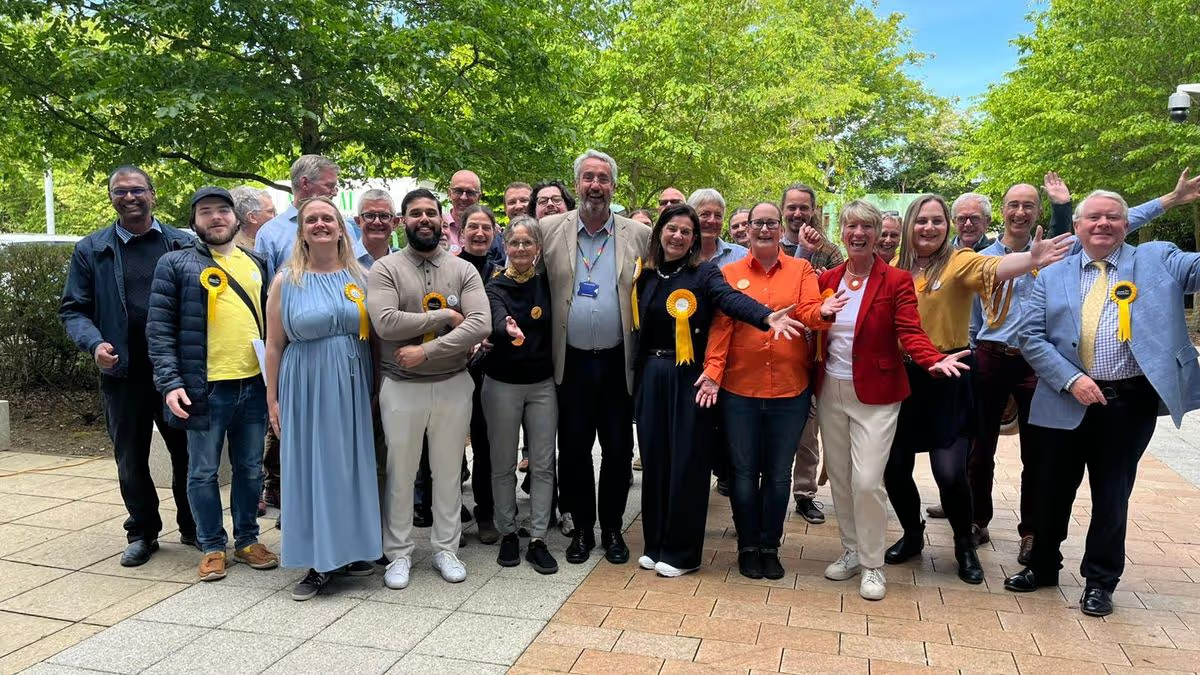
The Liberal Democrats won 43 out of 45 seats in South Cambridgeshire
South Cambridgeshire’s MP has praised the “stonking” majority won by the Liberal Democrats in South Cambridgeshire today (May 8). The Liberal Democrats won 43 out of 45 seats in the South Cambridgeshire District Council elections, with Conservatives winning the remaining two.
Advertisement
This increases the Liberal Democrats overall seats, as they previously had 34 seats. MP Pippa Heylings (Lib Dem) shared her thoughts on the win.
MP Heylings said it was a “stonking” win for her party. She added that Reform had “completely taken over the Conservatives” across Cambridgeshire, but also nationally.
However, she said those who had voted for the Liberal Democrats in South Cambridgeshire had “rejected the more divisive and Trump-like” politics by voting for the party.
She added that the win was “evidence in South Cambridgeshire and across the country that the Liberal Democrats can beat Reform” and people were “choosing” them.
Earlier in the day, Councillor Bridget Smith, leader of the council and Liberal Democrat candidate, retained her seat for the Gamlingay ward. She said she was “delighted” with her win. She added that it was “lovely” that the voters put their “faith” in her.
Before the majority win was announced, Cllr Smith said she “expected the Liberal Democrats to have a really exciting day”.
With the Liberal Democrats winning the majority, it mean the Conservatives lost out on seven seats they previously held. Of the two seats that the Conservatives lost included longstanding councillors Bunty Waters for Bar Hill and Sue Ellington for Swavesey.
Advertisement
However, leader of the opposition Councillor Heather Williams retained her seat for The Mordens ward. On the loss, she said: “It’s not unexpected, nationally it’s quite clear there were going to be losses. We are in a five party situation, all of us have to adapt to that.”
She added that she was “very proud” of the Conservative candidates that won, and also the others that put themselves forward.
She also said: “I’ve had a cursory look and When you look at the votes compared to previous years, that vote has come down.”
However, Heather did offer her congratulations to the Liberal Democrats.












































You must be logged in to post a comment Login