

Connect with us
DAPA Banner

NewsBeat

Starmer-Mandelson latest: McSweeney denies pressuring civil servants into approving US ambassador vetting

Published

on

Starmer-Mandelson latest: McSweeney denies pressuring civil servants into approving US ambassador vetting

Officials requested Mandelson’s vetting details days after Independent revealed he failed

Cat Little, the most senior official in the Cabinet Office, told MPs on Thursday that details were requested on 15 September.

You can read the full story below:

Nicole Wootton-Cane24 April 2026 01:00

Advertisement

Comment: As his cabinet cracks, how does Keir Starmer carry on regardless?

At PMQs on Wednesday, Keir Starmer looked more assured than he has for some time – but there is something almost delusional in his upbeat demeanour, says John Rentoul.

Nicole Wootton-Cane24 April 2026 00:00

Advertisement

McSweeney says he ‘doesn’t recognise’ himself in pressure claims

Morgan McSweeney has denied claims he pressured civil servants into appointing Lord Peter Mandelson as US ambassador.

Sir Keir Starmer’s former chief of staff, widely regarded as a protege of Lord Mandelson, resigned in February over his part in the peer getting the coveted job.

Ahead of his appearance at the Foreign Affairs Committee on Tuesday, the political strategist reportedly told a security forum in Kyiv: “I find it strange reading about a character with the same name as mine sometimes.

“I don’t recognise that character,” he said, as first reported by The Times.

Advertisement

It comes after former Foreign Office chief Sir Olly Robbins said there was an “atmosphere of pressure” and “constant chasing” from within the private office about Lord Mandelson’s vetting.

Downing Street has already denied that civil servants were bullied or cajoled by Mr McSweeney.

Nicole Wootton-Cane24 April 2026 00:00

Advertisement

Labour risk being ‘stonked’ in London elections over Mandelson scandal, Sadiq Khan warns

In a stark warning to Sir Keir Starmer, the London mayor admitted Labour are having a tough time in the capital with Westminster scandal threatening the party’s foothold in London’s councils.

Describing the Mandelson crisis as “an omnishambles from start to finish”, Sir Sadiq said he was “really frustrated” that the scandal was making it harder to engage voters in the party’s local achievements.

Nicole Wootton-Cane23 April 2026 23:15

Advertisement

Morgan McSweeney denies pressuring civil servants

The prime minister’s former chief of staff has denied claims he pressured civil servants into appointing Lord Peter Mandelson as US ambassador.

Morgan McSweeney, who resigned in February over his role in appointing Lord Mandelson, is alleged to have told Sir Philip Barton, then permanent secretary at the Foreign Office, to “just f***ing approve” Mandelson’s appointment.

Speaking at a conference, The Times reports he said: “I find it strange reading about a character with the same name as mine sometimes. I don’t recognise that character.”

He said he resigned because he “took responsibility” for recommending Lord Mandelson for the role of ambassador.

Advertisement

Mr McSweeney will appear in front of the Foreign Affairs Committee next week.

Nicole Wootton-Cane23 April 2026 22:58

Watch: Starmer looks less like prime minister and more like lawyer desperately defending himself

Starmer looks less like prime minister and more like lawyer desperately defending himself

Nicole Wootton-Cane23 April 2026 22:00

Advertisement

Starmer made ‘biggest mistake of his life’ appointing Mandelson – Red Wall chair

Sir Keir Starmer made the “biggest mistake of his life” by appointing Lord Peter Mandelson as British ambassador to the US, the leader of a prominent group of backbenchers has said.

Jo White, who chairs the Red Wall group of Labour MPs, said the government must “cleanse” itself of the problems that have emerged from the vetting scandal.

Amid reports of a split in his cabinet, the prime minister has accused his opponents of making politically motivated allegations.

Advertisement

Asked if she agreed with calls for Sir Keir to quit, Ms White told GB News: “Obviously I’ve heard these conversations at the side lines.

“I’ve been out and about in my constituency, speaking to local residents, and nobody has said to me they think it’s time for Keir Starmer to go.

“They obviously expressed concerns about exactly what’s happened and the way where we are now.

“But people have said to me, there’s a big job of work to be done, and their focus is on sorting out the cost-of-living crisis, and I met with the Red Wall group with Sir Keir yesterday, and our discussion wasn’t about Peter Mandelson.

Advertisement

“Our focus was on re-building industry and growth in our constituencies.”

She added: “He’s made the biggest mistake of his life.

“He’s admitted that, and I think that the biggest thing he has to do is re-iterate his commitment to clean up our politics, because we can only re-build trust if we cleanse ourselves of the problems.”

Nicole Wootton-Cane23 April 2026 21:42

Advertisement

‘He’ll be toast by August’: Readers on Starmer’s precarious position after Mandelson scandal

Our community sees Keir Starmer’s position as increasingly fragile, with many arguing he is clinging on to power amid mounting doubts over his leadership, authority and electoral prospects.

You can explore our community’s thoughts below:

Nicole Wootton-Cane23 April 2026 21:00

Advertisement

Recap: Starmer could face sleaze inquiry, The Independent understands

The prime minister could face a parliamentary inquiry over the Lord Peter Mandelson scandal, it has been reported.

The Independent understands Conservative leader Kemi Badenoch is urging the Speaker of the Commons to refer Sir Keir Starmer to the privileges committee over concerns he misled MPs over the vetting process.

Any move would be subject to a vote by all MPs.

Advertisement

Nicole Wootton-Cane23 April 2026 20:30

Ex-Labour MP calls PM’s decision to sack Robbins the ‘biggest act of political self-harm’

A former Labour MP has blasted the sacking of Sir Olly Robbins as the “biggest act of political self-harm anyone ever saw” as he joined calls for the prime minister to face the privileges committee over the Mandelson vetting scandal.

Karl Turner, who had the Labour whip removed last month, told Sky News he is “not suggesting the prime minister has deliberately misled parliament” but added “integrity is important”.

Advertisement

He said he doesn’t want the PM to resign, but instead “improve and get a grip of things”.

Karl Turner is the MP for Kingston upon Hull East (Chris McAndrew/UK Parliament/PA) (PA Media)

Nicole Wootton-Cane23 April 2026 20:06

Source link

Advertisement
Continue Reading
Click to comment

You must be logged in to post a comment Login

Leave a Reply

NewsBeat

support for headteachers or unnecessary legislation?

Published

on

support for headteachers or unnecessary legislation?

The announcement by the government that a legal ban will be placed on mobile phones in English schools marks a continued shift in tone, if not necessarily in substance, around the control of devices in educational settings.

What is being presented as a decisive intervention into children’s wellbeing is, in practice, the legal amplification of a reality that already exists across most schools. According to research last year by the Children’s Commissioner, around 90% of secondary schools and almost all primary schools already restrict phone use in some form.

These restrictions range from outright bans to locking phones away or “not seen, not heard” approaches (where phones are allowed on school premises, and may be kept in pupils’ bags, but must not be used). The ban will make existing guidance for schools statutory.

This raises an immediate question: if the practice is already widespread, why make it law?

Advertisement

There are, on the surface, reasonable arguments for moving from guidance to legislation. First, this gives school leaders clarity. A statutory footing removes ambiguity and may strengthen schools’ position when challenged by parents.

Second, it provides consistency between schools. A legal requirement creates a baseline expectation across the system, reducing variation between schools.

And finally, there is political signalling. The government is able to demonstrate action on an issue that resonates strongly with public concern.

However, the policy also illustrates a dynamic in education and online safety policy I have written about at length – a move from practice to performance.

Advertisement

If nearly all schools already restrict phones, then the legal change risks being largely symbolic. Sector leaders have acknowledged that “a statutory ban… doesn’t really change very much”.

More critically, it reframes a question of professional judgement as one of compliance. Since 2011, headteachers have had the authority to discipline pupils and set behaviour policies, including banning phones. What changes here is not capability, but the removal of discretion or, arguably, trust in school leadership.

Need for clarity

And, paradoxically but predictably, while the policy may be unnecessary for some, it is insufficient for others. Campaigners and politicians have already criticised the move for potentially retaining flexibility – particularly the “not seen, not heard” model – which they argue fails to meaningfully remove phones from the school day.

Olivia Bailey, parliamentary under-secretary of state in the Department of Education, insisted in the most recent debate that “We are categorically crystal clear that there is no access to phones at any point during the school day”, and that references to “not seen, not heard” approaches had been removed from guidance.

Advertisement

But she also stated: “It is not for me to determine how a headteacher enforces their discipline and behaviour policies in their school.” Therefore, there is a chance a school adopting such an approach might not be challenged without a particularly fastidious Ofsted inspection.

The majority of schools already restrict phone use.
Rawpixel.com/Shutterstock

Perhaps the most significant gap in the policy, therefore, is not its intent, but its execution, which has resulted in professionals asking for more guidance. Schools currently use a range of methods: confiscation, lockers, locked pouches, or behavioural rules. These approaches carry costs – financial, logistical, and in how they affect relationships between staff and pupils. Sector leaders have already pointed to the need for funding to support secure storage systems. Enforcement, too, remains ambiguous.

A legal requirement does not eliminate the day-to-day realities of managing compliance. This includes managing pupils concealing devices, disputes with parents, uneven application across staff and varying support from senior leaders around classroom discipline.

Facing pressure

The government had previously resisted calls for a statutory ban, arguing it was unnecessary. The new announcement appears to have been driven less by new evidence and more by political pressure in the House of Lords and from campaign groups.

Advertisement

There is a broader cultural push toward restriction, whether school phone bans or proposals for wider social media limits. Some countries have already put social media bans in place, although their effectiveness remains to be seen.

Banning phones in classrooms is not, in itself, particularly controversial. Many schools have done so for years with little fuss. What is new is not the ban, but the decision to legislate it.

That shift tells us less about phones and more about the current policy climate: one in which guidance becomes law, discretion becomes compliance, and familiar practices are recast as solutions to increasingly expansive problems.


Advertisement

Source link

Continue Reading

NewsBeat

Slovenia refuses to air Eurovision song contest after pulling out of event

Published

on

Slovenia refuses to air Eurovision song contest after pulling out of event

Slovenia’s national broadcaster, RTV Slovenia, has said it will not air this year’s Eurovision Song Contest following the country’s decision to withdraw over Israel‘s continued participation.

The main competition, featuring 35 nations, is scheduled to take place in Vienna from 12-16 May.

Slovenia joins a growing list of countries, including Iceland, Ireland, the Netherlands, and Spain, in boycotting the event.

Ksenija Horvat, RTV Slovenia director, confirmed the move to The Associated Press, stating: “We will not be broadcasting the Eurovision Song Contest.”

Advertisement

She added, “We will be airing the film series ‘Voices of Palestine,’ featuring Palestinian documentaries and feature films.”

Organisers’ December decision to allow Israel to compete prompted the walkout. Slovenia has been a vocal critic of Israel’s conduct in the ongoing conflict in Gaza.

Fans watch the screen at the end of the first semi-final of the Eurovision Song Contest 2025, at the St. Jakobshalle arena in Basel on May 13, 2025
Fans watch the screen at the end of the first semi-final of the Eurovision Song Contest 2025, at the St. Jakobshalle arena in Basel on May 13, 2025 (AFP via Getty Images)

While Eurovision aims to prioritise pop music over politics, it has frequently found itself entangled in global events, notably expelling Russia in 2022 after its full-scale invasion of Ukraine.

The current Israel-Hamas war has similarly roiled the contest, leading to protests and stricter rules against political displays at venues.

Slovenia’s announcement comes days after Paul Weller, Kneecap, Massive Attack and Paloma Faith and 1,000-plus artists signed an open letter calling for fans to boycott the event.

Advertisement

“As musicians and cultural workers, many living within the reaches of the [EBU], we reject Eurovision being used to whitewash and normalise Israel’s genocide, siege and brutal military occupation against Palestinians,” the letter, organised by No Music for Genocide and the BDS movement, said in part.

“We stand in solidarity with Palestinian calls for public broadcasters, performers, screening party organisers, crew, and fans to boycott Eurovision until the EBU bans complicit Israeli broadcaster KAN.”

Source link

Advertisement
Continue Reading

NewsBeat

High Shincliffe’s Benny Bahmanizad begins cancer treatment in Rome

Published

on

High Shincliffe's Benny Bahmanizad begins cancer treatment in Rome

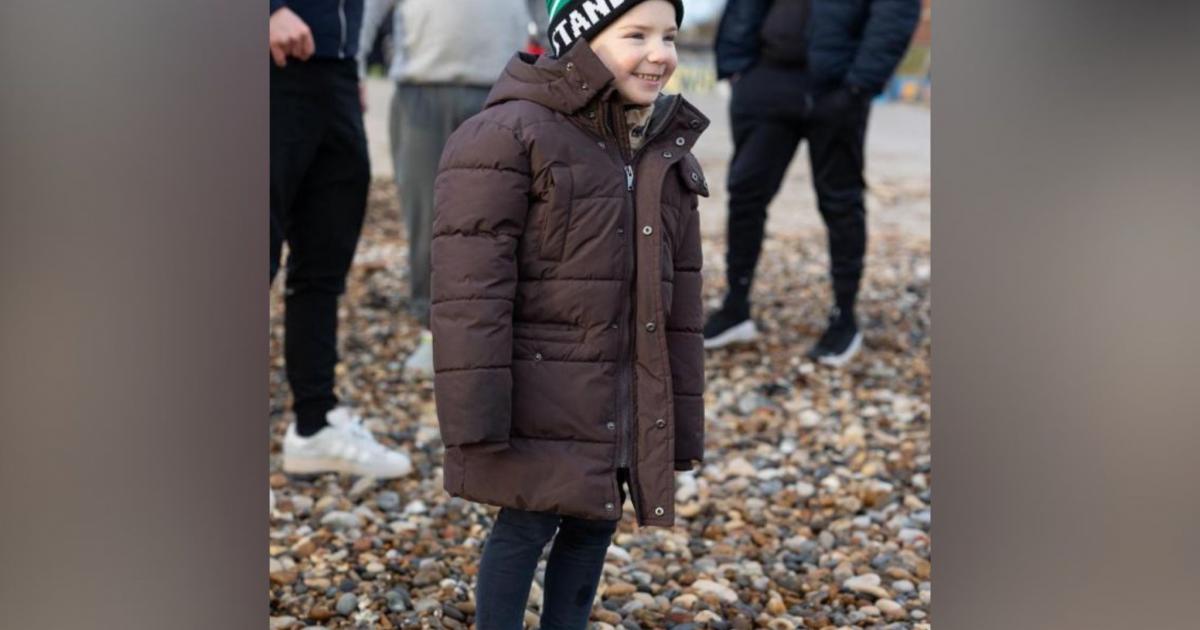
Five-year-old Benny Bahmanizad, from High Shincliffe, had been due to fly at the end of March to begin CAR T-cell therapy, a type of immunotherapy, after a huge fundraising drive.

However, the trip had to be postponed after Benny was suddenly admitted to hospital after developing a temperature, where doctors discovered an infection in his central line.

After landing in Rome on Monday (April 20), his mum, Nicola, said getting to Rome has been “an important milestone” for the family, adding they were “forever thankful” to hundreds of donors who helped fund the trip.

Benny and his family landed in Rome this week to start his treatment. (Image: Nicola Bahmanizad)

She said: “We’re so grateful to have made it to Rome. It’s just the start of the treatment journey but it feels like a really important milestone.”

Advertisement

Little Benny was first diagnosed with stage four neuroblastoma in February 2023, shortly after his second birthday.

His parents Nicola, 37, and Daniel, 39, first noticed something was wrong when Benny started experiencing viral infections, disrupted sleep and a loss of appetite.

They took him to the University Hospital of North Durham after he developed a limp and became unable to walk, and it was there the family were told the devastating news that their son had cancer.

Benny Bahmanizad (Image: Nicola Bahmanizad)

Benny underwent two years of intensive treatment, which included a stem cell transplant, 12 rounds of chemotherapy, 20 sessions of radiotherapy and six months of immunotherapy.

Advertisement

After briefly going into remission last March, a scan six months later uncovered a small irregularity in his lung and the family were told the cancer had returned, with Benny starting a second round of chemotherapy in December.

Benny Bahmanizad (Image: Nicola Bahmanizad)

Nicola and Daniel then launched a fundraiser to raise £393,000 in a desperate bid to fund CAR T-cell therapy in Rome, which is not available in the UK.

Since starting treatment this week, despite the difficulties of adjusting to a new country, Nicola said Benny has been “brave as always”.  

Benny Bahmanizad (Image: Nicola Bahmanizad)

She said: “It’s been challenging for Benny to be in such different surroundings and in a country where we don’t speak the language, but he’s been so brave as always and he’s been in good hands with all of the staff at the hospital.

Advertisement

“He has now had his blood cells extracted and the hospital will begin the process of engineering the cells to recognise and fight neuroblastoma cells in his body.

Benny Bahmanizad (Image: Nicola Bahmanizad)

The family plan to return to Rome every four to six weeks to complete his treatment.

The mum of two said the family were “overwhelmed with emotion” as they walked into the hospital to have Benny’s T-cells extracted from his blood.

She said: “We’ve felt overwhelmed with emotion today while walking into the hospital and then seeing the bag of cells that they extracted.

Advertisement

Benny Bahmanizad (Image: Nicola Bahmanizad)

“We really hope that this is the start of a new journey for Benny.

“This is something that wouldn’t have been possible without the help of all of the wonderful people who have donated and supported us in so many ways.

“It’s been such a big community effort, and it was really special to see everyone come together to support us. We’ll be forever thankful.”

Advertisement

Source link

Continue Reading

NewsBeat

James Trafford: Man City goalkeeper on learning this season and World Cup hopes

Published

on

James Trafford holds the Carabao Cup trophy

Trafford is no stranger to winning silverware.

He was the hero for England in the 2023 Under-21 European Championship final, saving a last-minute penalty to help the Young Lions beat Spain and win the competition for the first time in nearly 40 years.

Last season, he amassed an incredible 29 clean sheets in 45 matches to help Scott Parker’s Burnley bounce immediately back to the Premier League and became the first goalkeeper to claim the Championship Player of the Year prize at the PFA awards.

This season, he kept another shutout to help City beat Arsenal in the Carabao Cup final at Wembley, while he is also expected to start Saturday’s FA Cup semi-final against Southampton after saving a Mohamed Salah penalty against Liverpool in the previous round.

Advertisement

Trafford said: “Everyone enjoys the bigger games, the tougher games, but I might be speaking differently if we got beaten in them. The cup game you have to win, because if you don’t win then unless I get in [for] the league – which I haven’t so far – then there is no game [for me].

“It’s obviously a new experience for me because it is the first time I have had this kind of moment where you come in for the cup games, but the good thing about this club and this season is we have progressed in both the cups as far as we possibly could have so far.”

Source link

Advertisement
Continue Reading

NewsBeat

Election expert claims John Swinney’s rivals have “less than 1% chance” of becoming First Minister

Published

on

Daily Record

EXCLUSIVE: The expert claimed the chances of a non-SNP politician entering Bute House after May 7th are negligible.

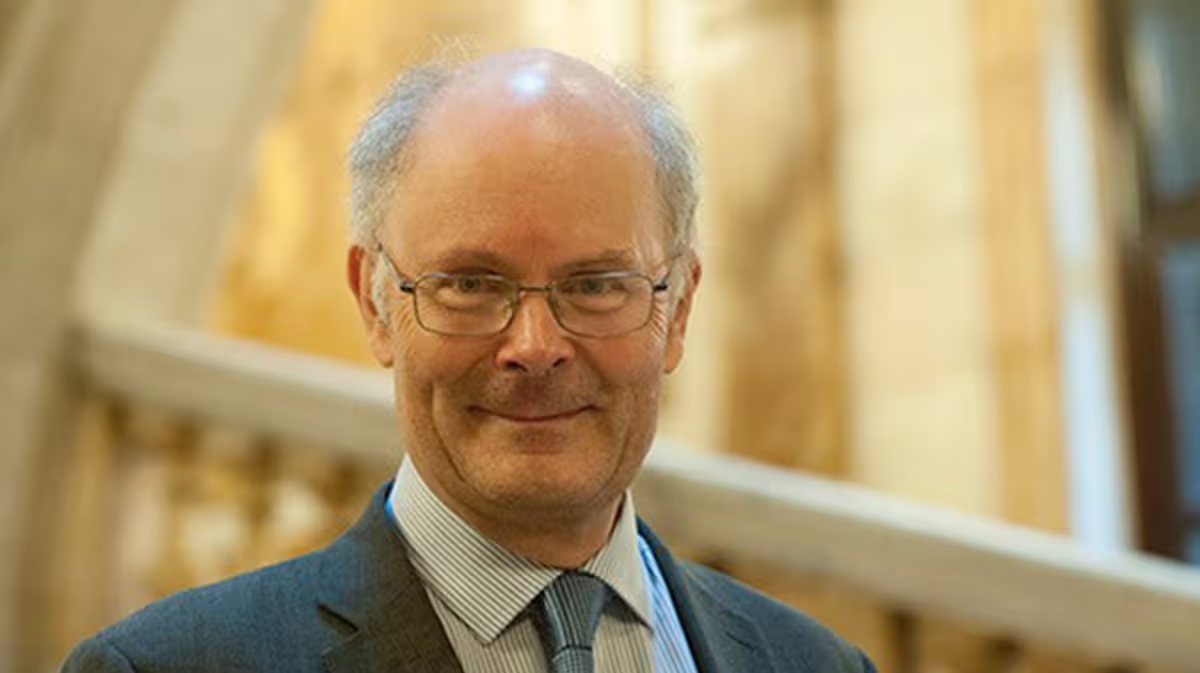
Polling guru Sir John Curtice says there is a “less than 1% chance” of one of John Swinney’s rivals becoming First Minister after the election.

Advertisement

The expert said the SNP leader’s chances of staying on were so high because of his party’s strong lead in the constituencies.

The SNP continues to have a strong poll lead over Labour and Reform with less than two weeks to go.

Swinney’s party are in line to do well in the 73 constituencies, while rivals battle it out on the regional lists.

Labour insiders also admit the surge for Reform is harming their chances of winning seats off the SNP.

Advertisement

Speaking to the Record, Curtice said: “I’m saying there is a less than 1% chance of anybody other than John Swinney becoming First Minister.

“Why am I saying that? Well, because the SNP are something like 17 points ahead of everybody else on the constituency. QED.”

“It’s the way the system works. If you are that far ahead and you’ve got a geographically evenly spread vote, you are bound to pick up the vast bulk of constituency seats.”

READ MORE: Scottish Lib Dem leader likened indyref2 to referendum on capital punishment

Advertisement

Author avatarPaul Hutcheon

One poll at the weekend showed a narrow majority of pro-UK MSPs could be returned, but even in these circumstances Curtice said:

“It’s still undoubtedly the case that you are talking about a minority SNP Government.”

He also claimed an attempt to install Sarwar could result in parliament failing to elect a First Minister and Scots going “back to the polls again”.

However, a new poll by Survation for the Ballot Box Scotland website has found support for the SNP is falling.

But the snapshot still throws up a pro-independence majority of MSPs, which would be enough to re-elect John Swinney as First Minister.

Advertisement

Swinney is fighting for an outright SNP majority – 65 MSPs – which he says would trigger indyref2.

The SNP is on 35% in the constituencies – no change from a previous Survation poll – while Reform and Labour are tied on 20% each.

The Tories were in fourth place on 13%, followed by the Lib Dems on 10% and the Greens on 1% – they are only contesting a small number of constituencies.

Advertisement

On the regional Lists, the SNP was on 29% – down 3 points compared to a previous poll by the same company – with Reform on 19% and Labour on 17%.

The Tories came in at 13%, the Green polled 11% and the Lib Dems 8%.

The all-important seat projection puts the SNP on 57, a net loss of seven compared to the 2021 election and significantly short of a majority.

Reform would be second with 21 MSPs, Labour third with 18, the Tories on 13, Greens on 11 and the Lib Dems on nine.

Advertisement

With the Greens and the SNP commanding 68 MSPs between them, such an outcome would almost certainly result in Swinney going back to Bute House.

The poll spells bad news for Labour as their campaign is based on framing the contest as a two horse race with the SNP.

A Scottish Labour spokesperson said: “This election will be decided by the people of Scotland on May 7.

“While commentators speculate, Scottish Labour is working to earn the trust of the Scottish people and demonstrate that we can deliver the change our country so badly needs.”

Advertisement

Source link

Continue Reading

NewsBeat

Kym Marsh shares late dad’s devastating statement after prostate cancer diagnosis

Published

on

Manchester Evening News

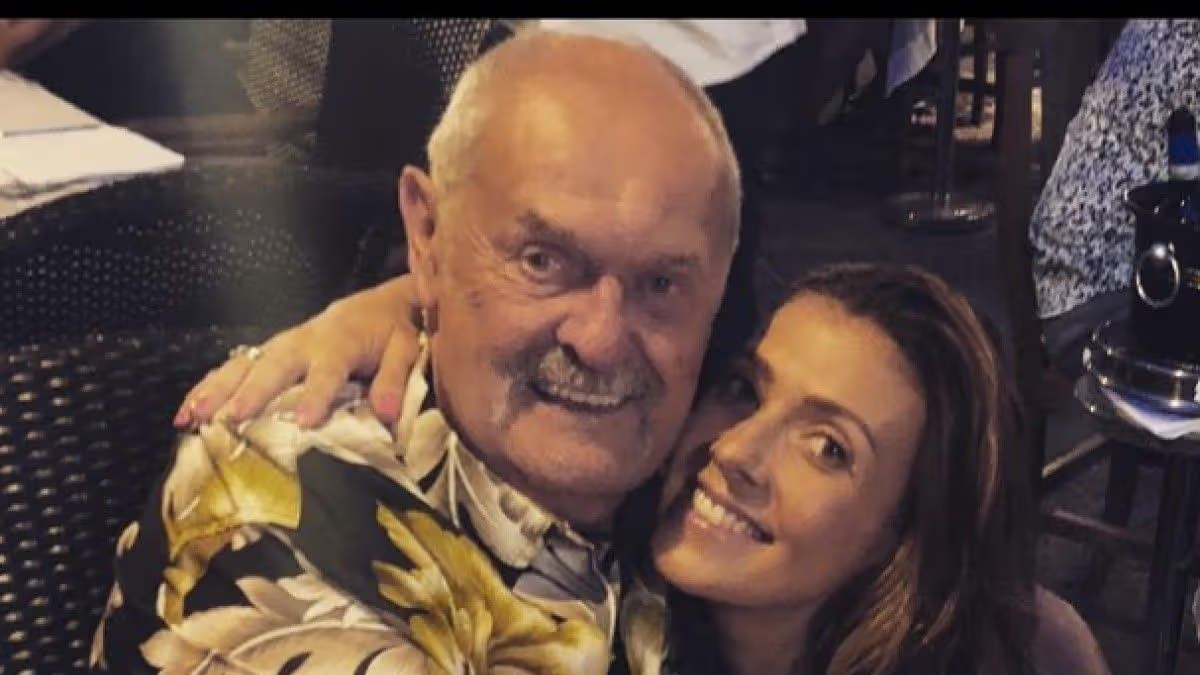
The former Coronation Street star’s father, Dave Marsh, died aged 74 in 2024 after a three-year battle with the disease

Kym Marsh has said it “broke” her family when her late father revealed his “heartbreaking” prostate cancer diagnosis.

Advertisement

Dave Marsh died aged just 74, in 2024, after a three-year battle with the disease, after it spread to other parts of his body when he put off going to the doctor during the pandemic. Former Coronation Street star Kym, 49, has since worked to keep his legacy alive and raise awareness for prostate cancer, with her advocacy emphasising how a diagnosis can be “so devastating to a family” if it is found too late.

In an interview with the Press Association, the actress and presenter hailed her father as the “don of the family”, and said: “He was only little in terms of his height, but he had the heart of a lion. He was just dad. He was everything to everyone – he was brave, funny and so supportive. He adored the bones of my mum, they were so close. They were always together.”

Click here to sign up for more Coronation Street updates in our newsletter

Kym said her mother, Pauline, has been “left devastated” since her husband of 60 years died, and said: “When we found out dad was terminally ill and his cancer was incurable, it broke us. Nothing seemed to get him down. If he had been ill, he would get back up again.

Advertisement

“But he said to us: ‘This is a fight I’m going to lose, I can’t beat this one.’ That was devastating to hear him say that, and for us to realise that was really heartbreaking.”

Prostate Cancer UK states the condition is the most common cancer in men and one in eight men will receive a diagnosis in their lifetime, with the risk increasing if you are over 50, black, or have a family history of the disease.

Prostate cancer develops slowly, so there may be no signs for years, but signs may include an increased need to urinate, straining while urinating and a feeling that the bladder has not fully emptied, according to the NHS.

Advertisement

Kym said that “trying to help other people” was the “first thing” her dad wanted to do after finding out about having prostate cancer, and the pair campaigned to raise awareness in the years leading up to his death.

The star and her family have since continued to dedicate themselves to campaigning for prostate cancer, and her son-in-law Mikey Hoszowskyj ran the TCS London Marathon in 2024 to raise money for Prostate Cancer UK. She said: “We’ve done everything we can to make sure that dad’s legacy is continuing, and that his memory lives on and to hopefully help other people.

“When we come together as a family, we all do very much feel like he’s with us. He is always in our memories. I strongly believe that my dad is always with us, on everything that we do.”

The former Hear’Say singer also said she was so moved when her future daughter-in-law Carmen Dickinson offered to run the London Marathon on Sunday in memory of her father. Kym said: “(Carmen) never met my dad, but it’s just so lovely she wants to do this for us and for him, and for prostate cancer.

Advertisement

“It just was so gorgeous. It’s a very personal journey that we all went on with dad and for her to do this means such a lot to us. She has got such a good heart. We’ll all be heading down there to cheer her on. She’s a gorgeous girl, and I know she’s gonna absolutely smash it.”

She also said her and her family raise awareness for prostate cancer as they hope to bring “something positive” out of her father’s death, adding: “It is so devastating to a family. It was devastating to us and to my dad to think that he’d left it too late. And that’s something we don’t want to happen to anyone else.”

Source link

Advertisement
Continue Reading

NewsBeat

NTSB: Firefighter heard warning but unsure who it was for in deadly LaGuardia crash

Published

on

NTSB: Firefighter heard warning but unsure who it was for in deadly LaGuardia crash

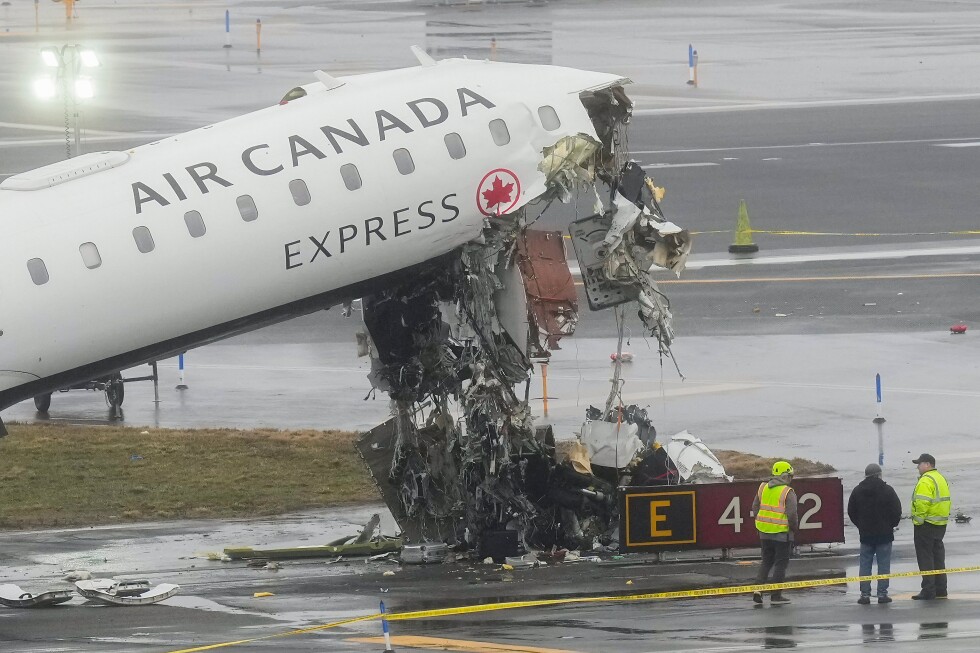
NEW YORK (AP) — A firefighter whose truck collided with an Air Canada Express jet last month on a runway at New York’s LaGuardia Airport, killing both pilots, heard an air traffic controller warn “stop, stop, stop” but didn’t know who it was for, federal investigators said Thursday.

Just seconds earlier, the controller had cleared the fire truck to cross the runway, but the truck started moving while warning lights that act as a stop sign for crossing traffic were still lit, the National Transportation Safety Board said in a preliminary report on the March 22 crash.

Because the truck lacked a transponder, a surface monitoring system in the control tower was unable to reliably determine its position, “did not predict a potential conflict” with the landing plane and did not generate an audio or visual alert, the report said, pointing to a series of failures that contributed to the crash.

“There were so many opportunities where this accident could have been prevented,” aviation safety expert Jeff Guzzetti said after reviewing the report.

Advertisement

In addition to the control tower and truck driver, he said the report suggests the pilots had a chance to recognize the danger and pull up. But, he said, they may have been too dialed into landing.

After the air traffic controller’s initial stop warning, the fire truck’s turret operator heard the controller say, “Truck 1, stop, stop, stop,” and realized he was telling the truck to halt, the report said. By then, the truck was already on the runway as Air Canada Express Flight 8646 was landing and speeding toward it.

Aviation safety consultant John Cox, CEO of Safety Operating Systems, said it might be understandable that the truck driver didn’t recognize the first “stop” call was meant for him because the controller had just been directing a plane on a taxiway and didn’t say Truck 1 at the start of the command.

The turret operator, one of two crew members in the fire truck, told investigators that as the vehicle turned left, he saw the airplane’s lights on the runway, the report said. The plane registered a speed of 104 mph (167 kph) just before the collision. The truck was going about 30 mph (48 kph).

Advertisement

The fire truck was leading a convoy of vehicles, including four fire trucks, a police car and a stair truck, responding to an emergency involving a strong odor that was making flight attendants feel ill aboard a departing United Airlines jet.

The air traffic controller cleared the truck to cross the runway just 12 seconds before the plane touched down, investigators said. About eight seconds later, the controller frantically began calling for the truck to stop.

Pilots killed, 39 people hurt, including fire crew members

The plane, a CRJ900 regional jet from Montreal, was carrying 76 people. Pilots Antoine Forest, 30, and Mackenzie Gunther, 24, were killed. It was the first deadly crash at LaGuardia in 34 years.

In addition, 39 people were taken to hospitals, including six described as seriously injured. The two fire truck crew members are recovering at home after being released from the hospital, according to the Port Authority of New York and New Jersey, which operates LaGuardia.

Advertisement

A flight attendant still strapped in her seat survived after being thrown onto the tarmac.

Another flight attendant reported taking his seat in the rear of the plane for landing and described the flight as normal until he felt an impact, the report said. He didn’t know what had happened and attempted to call the pilots but received no response, the report said.

The Port Authority said it is conducting a comprehensive review of the NTSB’s initial findings. “Our focus is straightforward: ensure our safety procedures and protocols are as strong as they can be and take action to strengthen them as needed,” the agency said.

LaGuardia was busier than usual the night of the crash because flight delays pushed the number of arrivals and departures after 10 p.m. to more than double what was scheduled, according to aviation analytics firm Cirium. Two air traffic controllers were on duty, consistent with normal scheduling, the report said.

Advertisement

Planes were landing every few minutes, with a dozen flights arriving between 11 p.m. and when the crash happened less than 40 minutes later. At the same time, the controllers had to shuffle their duties because of the odor issue on the United plane.

While the more senior controller coordinated the United emergency response, the other controller took over directing vehicles on the ground while continuing to authorize takeoffs and landings.

“These controllers were just way busy, just too busy,” Guzzetti said.

Airport had technology designed to prevent crashes

The warning lights — known as runway entrance lights — were lit until the fire truck reached the edge of the runway, about three seconds before the collision, the report said. By design, they turn off two or three seconds before a plane reaches a runway intersection, the report said.

Advertisement

The runway warning lights in place at 20 of the nation’s busiest airports are one of the backup systems designed to help prevent a crash. Cox said the truck should have never entered the runway while the warning lights were illuminated.

“That’s an automated system so even though the controller says you’re cleared to cross, the lights mean that there’s an airplane that is either on the runway or about to be,” Cox said. “So the truck driver is going to have some questions to answer there.”

LaGuardia is one of 35 major U.S. airports with an advanced surface surveillance system that combines radar data with information from transponders inside planes and ground vehicles to help prevent runway incursions. Controllers have a display in the tower that’s supposed to show the location of every plane and vehicle.

The system, known as ASDE-X, didn’t sound an alarm partly because the radar had trouble distinguishing the closely spaced trucks and the radar targets intermittently merged on the display. Only two targets were displayed just before the crash, even though there were seven vehicles. None were equipped with transponders that would have helped the system to precisely track their movements.

Advertisement

According to air traffic control transmissions, Flight 8646 was cleared to land on Runway 4 at 11:35 p.m.

About two minutes later — and 25 seconds before the crash — the fire crew asked to cross the same runway, which was between the airport’s fire station and where the United Airlines jet had parked.

Five seconds later, with Flight 8646 approaching the runway a little more than 100 feet (30 meters) above the ground, an air traffic controller cleared the fire truck to cross.

Then, just nine seconds before the crash, the controller frantically told the fire crew: “Stop, stop, stop, stop. Truck 1. Stop, stop, stop, stop.” A second later, the plane’s landing gear touched down.

Advertisement

___

Funk reported from Omaha, Nebraska. ___

This story has been corrected to show that pilot Antoine Forest was 30, not 24; and pilot Mackenzie Gunther was 24, not 30.

Advertisement

Source link

Continue Reading

NewsBeat

Frustration grows among Pakistanis with capital under indefinite lockdown for stalled US-Iran talks: ‘Like living in a cage’

Published

on

Frustration grows among Pakistanis with capital under indefinite lockdown for stalled US-Iran talks: ‘Like living in a cage’

Bilal Mazhar Khawaja, 44, runs three restaurants in Islamabad. For the past few days his business has been severely hit, with food supply chains disrupted and movement of staff restricted as the Pakistani capital remains in an indefinite lockdown in anticipation of the stalled US-Iran talks.

Pakistan has mediated the first round of peace talks to end the seven-week-old war between US and Iran. It appeared confident to get both sides talking again as US president Donald Trump indefinitely ​extended the ceasefire withTehran this week, hours before it was set to expire, to allow the two countries to continue the the peace negotiations.

No date for the talks has been set, but the city remains under sweeping security restrictions, forcing locals to grapple with uncertainty.

Khawaja tells The Independent over the phone: “They (the administration) have blocked all main roads leading to Islamabad. Trucks full of bread and cooking oil, which have been denied entry to the city, have not been able to deliver supplies.”

Advertisement
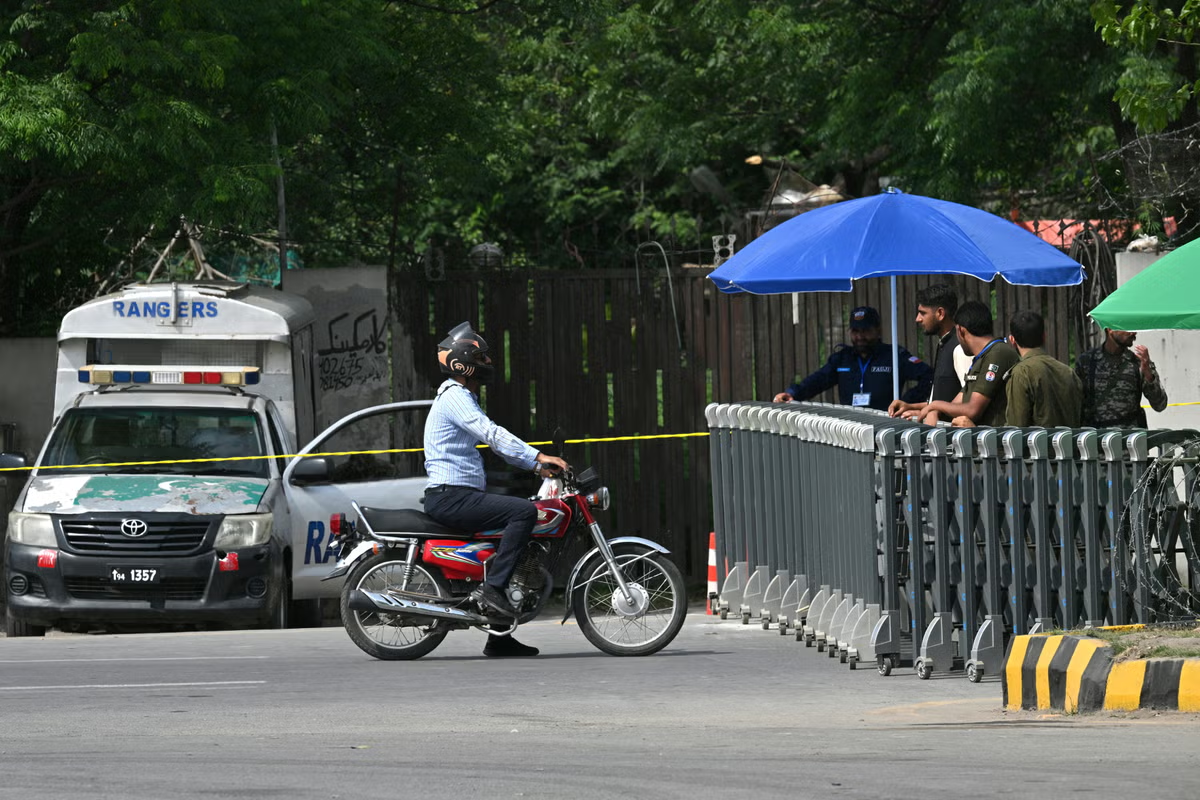
Security personnel stand guard at a closed road leading to the Serena Hotel in the Red Zone area of Islamabad on 23 April 2026. - Pakistan's capital was still locked in gear on 22 April to host high-stakes US-Iran talks that were pushed back at the last minute overnight, but many residents began to tire of the heavy personal and economic toll of tight security restrictions
Security personnel stand guard at a closed road leading to the Serena Hotel in the Red Zone area of Islamabad on 23 April 2026. – Pakistan’s capital was still locked in gear on 22 April to host high-stakes US-Iran talks that were pushed back at the last minute overnight, but many residents began to tire of the heavy personal and economic toll of tight security restrictions (AFP/Getty)

His staff have not been able to travel to the restaurants because movement of public transport has been restricted. “Earlier, they would spend, say, 50 to 60 (Pakistani) rupees to reach their work using the public transport. Now, if they hire a taxi, for example, it will cost them 300. Most of them prefer to stay home.”

Khawaja, whose businesses have been impacted severely, says if in the next few days the administration doesn’t ease out the restrictions, he would be forced to let some of his staff go. “It is impacting everyone.”

“Near the (Islamabad) airport, there are no shops open. Not even chemists. Fuel stations have no fuel.”

It was previously reported that US vice president JD Vance would lead the US delegation to Pakistan. The visit got delayed even though there were reports that Iran was reconsidering its initial refusal to engage in further talks.

Islamabad remains hopeful that the talks will take place soon. On Wednesday, Pakistan’s prime minister, Shehbaz Sharif, met with Iran’s ambassador, and according to one official who was briefed on the talks, the second round of negotiations could take place within the next few days.

Advertisement

However, Iran’s capture of two cargo ships in the Strait of Hormuz on Wednesday has led to fresh uncertainty in Islamabad over the plans for the second round of peace negotiations to end the war in the Middle East.

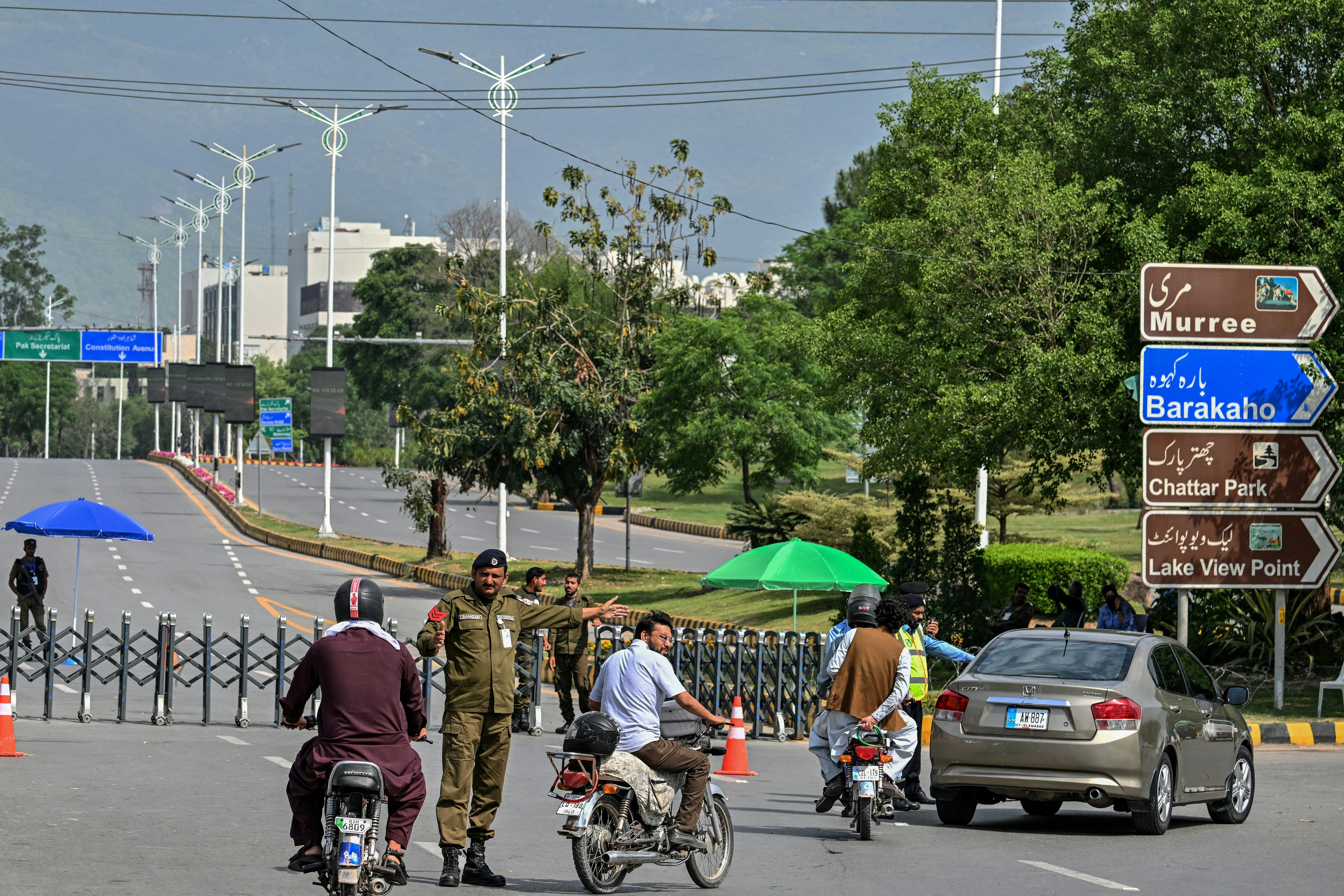
Residents who have had to deal with high security, road closures, and scarce public transport for days now, say their daily lives are badly impacted by the stringent measures.

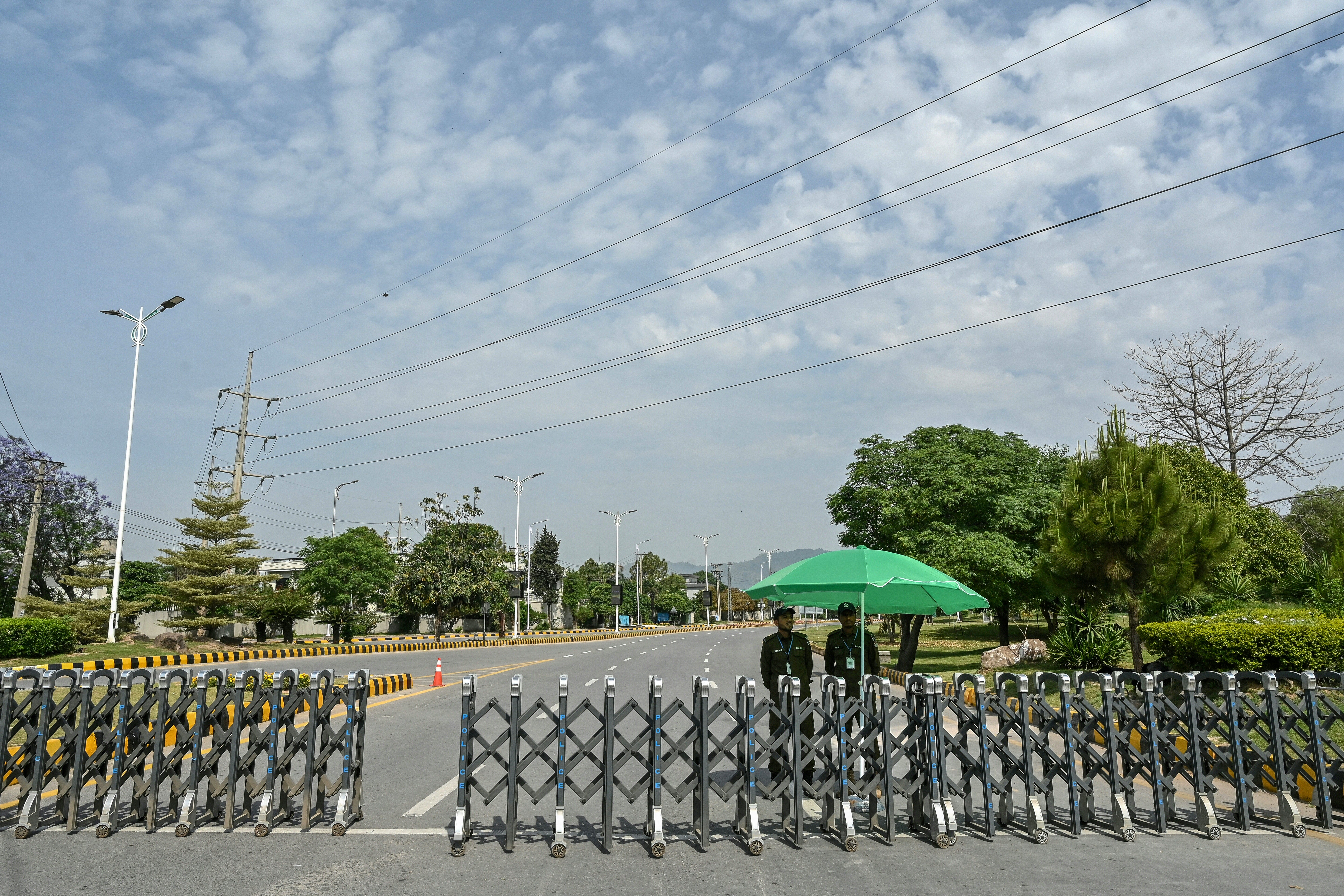
The government has asked offices to close and urged employees to work from home. Schools have been moved online. Streets which were once crowded are mostly empty.

Several areas, especially “red zone”, which houses critical government institutions, including the parliament, Supreme Court, the prime minister’s secretariat, and foreign embassies.

Advertisement

Al Jazeera said that for ordinary Islamabad residents, the impact has been “devastating”.

An X user wrote: “Islamabad was turned into a lockdown zone for days leaving ordinary people stuck in traffic missing flights work and daily routines. Security is important but when an entire city suffers before talks even begin it raises serious questions about priorities and planning.”

Another person wrote: “Islamabad & Rawalpindi are in lockdown with public transport & electric buses suspended in anticipation of US & Iran delegations’ arrival…The public is going through hell!”

A security personnel manages traffic at a closed road leading to the Serena Hotel in the Red Zone area of Islamabad on 23 April 2026
A security personnel manages traffic at a closed road leading to the Serena Hotel in the Red Zone area of Islamabad on 23 April 2026 (AFP/Getty)

“Take the red zone out of Islamabad and move it outside, and kindly let the people of Islamabad and Pindi live a normal life,” wrote another social media user.

Daily wage earners have been among the worst affected. Muhammad Zubair, 45, a labourer, told The Guardian: “A lockdown means no work and no work means no food. The government does not care about the poor. We need work to feed our children.”

Advertisement

He has not been able to find work for the past six days. Small business owners are struggling too. Earnings have dropped sharply.

Muhammad Ahsan, 35, the owner of a small jewellery kiosk, told AFP: “The impact of the lockdown is that we are not seeing any customers here in the market… the government does not know what one day of their lockdown does to our households.”

“Our stoves do not run, we do not find food (in the markets).”

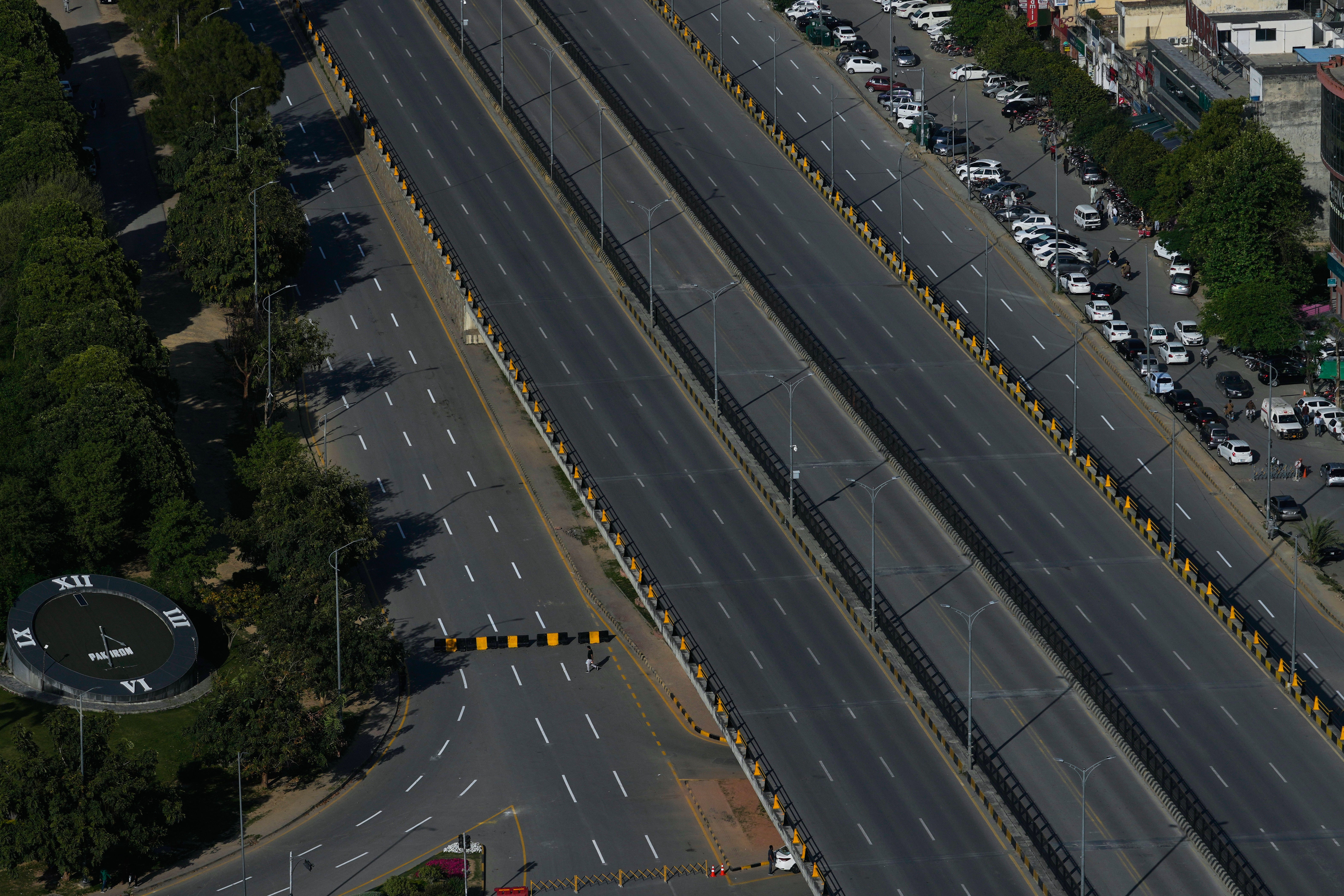
A man crosses a deserted road barricaded by authorities due to security arrangements for the US and Iran talks, in Islamabad, Pakistan, Wednesday, 22 April 2026
A man crosses a deserted road barricaded by authorities due to security arrangements for the US and Iran talks, in Islamabad, Pakistan, Wednesday, 22 April 2026 (AP)

Areej Akthar, a health officer at Pakistan Institute of Medical Sciences, told The Guardian: “Saturday was chaotic. I am lucky enough that my village is a three-hour drive away. But many people [who] were from distant cities and province[s] had to beg their colleagues, friends and relatives to allow them to stay until the US-Iran negotiations took place.”

With transport services suspended, commuting has become difficult or impossible.

Advertisement

Akhtar added: “It is like we are living in a cage.”

Students are also feeling the strain. Some exams have been moved to another city, forcing candidates to travel long distances.

The ongoing conflict in the Middle East has already disrupted global energy supplies. Pakistan has also been hit hard. Fuel shortages have led to long power cuts. Gas shortages have forced restaurants to close. The latest lockdown has only deepened these problems for the citizens.

However, despite the difficulties, there are locals who back the administration’s decision to put the city in an indefinite shutdown. “We are giving a small sacrifice to reduce the size of the larger sacrifice. So we will continue to sacrifice,” a local was quoted as saying by AFP.

Advertisement

Pakistani officials are hopeful that the diplomatic channels will reopen.

Maleeha Lodhi, a former Pakistani ambassador to the US and UK who was also briefed on the continuing diplomatic efforts, told The New York Times: “The cease-fire has opened a space that Pakistan thinks is enough for the diplomatic path to resume. Neither side has rejected the talks.”

Source link

Advertisement
Continue Reading

NewsBeat

Zack Polanski’s wishful thinking is really Green on major issues

Published

on

Daily Record

English Green leader Zack Polanski’s head is in the clouds on so many issues, says Record View.

Green leader Zack Polanski is in Scotland today campaigning ahead of the Holyrood election.

Advertisement

While the charismatic politician is in town, at least that means Scottish Green candidates aren’t the dumbest people in the country – for a wee while at least.

His solutions for the serious problems we face as a society may appeal to the naive and those who like to indulge in wishful thinking.

But on so many issues – like defence jobs, the need for clean nuclear energy, the oil industry – his head is in the clouds.

With Polanski in charge, thousands of well-paid oil and energy jobs would disappear almost overnight – to be replaced by what?

Advertisement

Wind farms and solar energy jobs? That’s just fantasy. Scotland needs a “just transition” from fossil fuels to clean renewable energy.

Not a short, sharp shock that would destroy jobs and send bills soaring.

On defence, he wants to scale back spending on the armed forces.

Thousands of well-paid civilian jobs on the Clyde and at Rosyth in Fife are dependent on defence contracts.

Advertisement

With the Scottish election round the corner, many might be tempted to give the Greens a try because it sounds like a nice thing to do. But voting Green isn’t a vote to save the planet.

In a previous life, Polanski worked as a hypnotist who claimed he could increase the size of women’s breasts through the power of thought.

If you believe him on that corker, you might well fall for his other ludicrous claims. Otherwise, give this chancer a wide berth.

Heed the warning

The roll-call of young men killed by violence in Scotland last year is heartbreaking.

Advertisement

The deaths of Dylan Geddes, 24, Kayden Moy, 16, and Amen Teklay, 14, rightly sparked calls for change.

The Record’s Our Kids… Our Future campaign has reflected the concerns of our readers – highlighting growing concerns over youth violence.

Our campaign led to anti-violence summits and sincere promises from First Minister John Swinney to tackle the issue.

One of our main campaign aims is to make sure every community in the country has a place for kids to go to keep them out of trouble. But with another summer now here, warnings have been made council cuts are leading to the closure of these vital venues.

Advertisement

Kevin Martin, from Easterhouse Sports Centre in Glasgow, claims in the Record today a lack of facilities could lead to more violence this summer.

We call on politicians fighting for votes in the upcoming Holyrood elections to heed Kevin’s warning.

Get more Daily Record exclusives by signing up for free to Google’s preferred sources. Click HERE.

Source link

Advertisement
Continue Reading

NewsBeat

Toddler diagnosed with brain tumour after mum spotted change in her colouring in

Published

on

Daily Record

Jessica Macrae spent weeks in intensive rehab after life-saving surgery left her unable to move or speak — but the determined four-year-old is now back on her feet and enjoying life again with her family.

A mother has said she is “so incredibly grateful” to medics who saved her daughter’s life and helped her learn to move and speak again after she suffered a brain tumour.

Four-year-old Jessica Macrae, from Bearsden in East Dunbartonshire, underwent surgery at the Royal Hospital for Children (RHC) in Glasgow last year after a tumour was discovered on the back of her brain.

This was followed by 12 weeks of intensive neuro rehabilitation, which saw her go from being unable to speak, eat or move, to getting her life back and enjoying every minute with her family.

Advertisement

Her parents Jude Pender, 40, and Andrew Macrae, 43, first noticed “worrying changes” in Jessica’s health in the summer of 2025.

“What started as headaches and feeling sick in the mornings gradually progressed to problems with balance and coordination,” Ms Pender said.

“It was very incremental, but there were lots of things that didn’t feel right.

“Her colouring in went from being fine for her age to very messy, she disengaged from gymnastics because she said it made her dizzy, and I noticed her walk had changed.”

Advertisement

After an initial visit to Accident and Emergency in August and several GP appointments, Jessica’s parents returned to the RHC in October when her symptoms worsened.

A CT scan revealed a mass at the back of Jessica’s brain, along with a build‑up of fluid.

“When the neurosurgeon came to speak to us, we knew it was serious,” Ms Pender said. “We were told Jessica would need surgery immediately.”

Advertisement

Jessica underwent surgery on October 17, and following a short stay in intensive care she was transferred to a ward.

Her recovery was initially extremely challenging, with little movement or responsiveness, and severe sickness, so medics took the decision to fit a “shunt” to drain excess fluid.

Although Jessica began to stabilise, she was unable to move or speak and required a feeding tube.

She also needed full assistance from two staff members for any movement.

Advertisement

Ms Pender continued: “The neurosurgeons did a great job with Jessica to get her to that point, and we are so grateful to them for saving her life.

“We also knew that it would take a team following the surgery to progress her movement, but we were never sure what the outcome would be.”

Ms Pender credited the intensive neuro‑rehabilitation Jessica then received with the RHC physiotherapy team for progressing her recovery to where she is today.

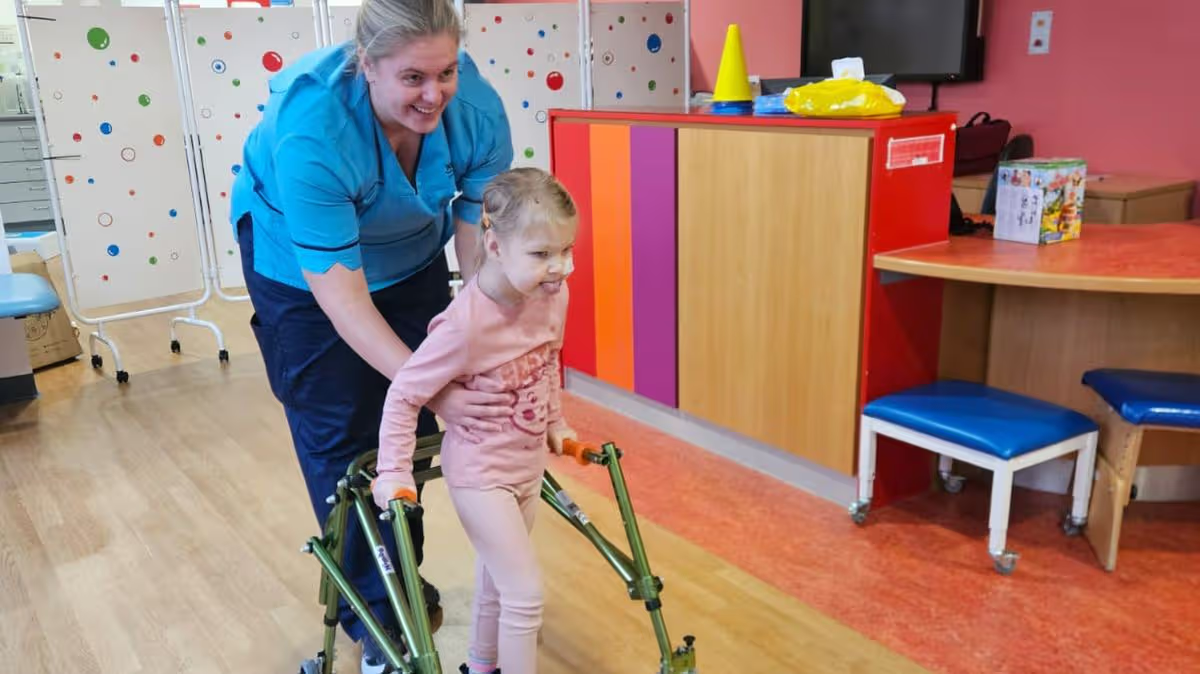
Jessica remained in hospital for 13 weeks, with daily physiotherapy sessions taking place at her bedside, in the sensory room, gym and hydrotherapy pool.

“At the beginning, her rehabilitation was like fast‑tracking a baby’s development, learning to hold her head up, sit, crawl, eat and walk again,” Ms Pender said.

“Her main physio, Fiona (Norval), tailored every session to what Jessica enjoyed.

“They played games, set up obstacle courses and made everything feel fun. Jessica looked forward to her physio, and that made such a difference.”

Advertisement

Jessica was discharged in January and is continuing her recovery.

Her speech has returned, she is eating independently, her motor skills have “significantly improved”, and she is now able to walk with more stability and confidence.

She is now looking forward to celebrating her fifth birthday in April, with a fun-filled trip to a farm park with her cousins.

This is something her parents feared might not be possible just six months earlier.

“Jessica is such a happy little girl and has shown incredible resilience and determination,” Ms Pender said.

Advertisement

“She knows she has been unwell, but I don’t think she realises just how far she has come. We are so incredibly grateful to the teams who cared for her.”

Fiona Norval, a paediatric physiotherapist with NHS Greater Glasgow and Clyde, said Jessica’s determination throughout her recovery had been “incredible to see”.

“Her rehabilitation was intensive and challenging, but she approached every session with curiosity and enthusiasm,” she said.

“Our aim in paediatric physiotherapy is always to make therapy engaging and meaningful for the child, and Jessica’s progress is a testament to her hard work, her family’s support and the dedication of the wider multidisciplinary team involved in her care.”

Advertisement

Get more Daily Record exclusives by signing up for free to Google’s preferred sources. Click HERE

Source link

Continue Reading

Trending

Copyright © 2025