



Authorities in Ceuta will round up migrants and hold them in warehouses before sending them back to Morocco.
It is estimated that more than 70,000 people flooded into the Spanish enclave last month, taking advantage of lax security and swimming around a border fence that separates Ceuta and Morocco.
Up to 100 people died during the mass influx which occurred over 48 hours, with Ceuta President Juan Jesús Vivas declaring a ‘humanitarian emergency’ as the enclave became overwhelmed with new arrivals.
And authorities said at least five migrant girls under the age of 14 have allegedly been raped since arriving in Ceuta.
Though most of the migrants who entered Ceuta have now left, up to 8,000 remain.
The Telegraph reported that Spain‘s government will be using a warehouse in Tarajal, yards from the Moroccan border, and another in the enclave to temporarily house them.
Officials are hoping to return the migrants within 72 hours of finding them, during which time they will be sent to the warehouses to be formally identified and processed.
But there are serious questions yet to be answered about migrants who apply for international protection, whose applications have to be examined under EU and Spanish law.
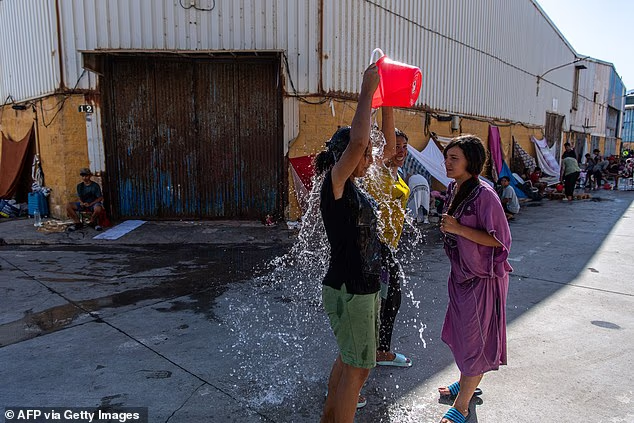
Migrants cool off with water in the Spanish North African enclave of Ceuta on August 7, 2026
Though Spain’s foreign minister vowed to send ‘every last person’ back to Morocco on Tuesday, these plans do not override migrants’ rights to have an asylum claim processed.
The 1,342 unaccompanied children who went into Ceuta last month also pose a problem. While children who went into the Spanish territory with an accompanying adult are expected to be sent back to Morocco with little to no problem, the cases of lone children have to be examined on their own merits.
Before minors can be deported, their age, family, identity and safety back home must be established, weighing up the best interests of the child.
It comes after the revelation that several young migrant girls have allegedly been raped since arriving in Ceuta.
The victims sought treatment at the University Hospital of Ceuta (HUCE) this past week, health services told the El Pueblo de Ceuta newspaper.
Judicial sources said many of the alleged rapes were prevented by the direct intervention of residents of Ceuta.
Some residents of the autonomous city were also among the accused, however.
The Ceuta Prosecutor’s Office previously said it was aware of two of the cases of alleged sexual assault and had opened preliminary proceedings.
It confirmed that no arrests had yet been made.
The legal procedures required for these allegations to result in convictions include medical reports, victim testimony, security camera footage, witness statements and police reports.
Judicial sources said they had been made aware of ‘many cases’ of attempted sexual assault, and that the figures will be higher as the days go by.
Authorities have confirmed that two educational centres in the city will be repurposed as shelters for unaccompanied minors.

Migrants queue to receive food staples from local NGO Media Luna Blanca in an industrial area where they are sleeping amid recent mass crossings by migrants on foot and by sea from Morocco into the Spanish territory, in Ceuta, Spain, August 6, 2026

It is estimated that more than 70,000 people flooded into the Spanish enclave last month

Though most of the migrants who entered Ceuta have now left, up to 8,000 remain
The first one to be opened is the CEIP Reina Sofía, in the Príncipe Alfonso neighbourhood, which was housing more than 110 girls and teenagers and operating as an exclusively female shelter.
Neighbourhood associations are using the La Reina football field, in the Sidi Embarek neighbourhood, as a night shelter so that women can sleep safely.
The CEIP Príncipe Felipe will act as another shelter for minors, although this educational centre will also be used to house young men.
The city is working on preparing two other spaces, one in the port area and another in Loma Margarita, where all children will be transferred from educational centres to ensure that the school year in September can begin as planned.
Spain’s Youth and Children Minister Sira Rego said Friday that 1,342 unaccompanied migrant minors had been registered in Ceuta following the mass influx from Morocco.
Aid groups have warned that the minors, many of whom are sleeping rough on the streets of Ceuta, are at risk of abuse and exploitation.













![Editorial use only Mandatory Credit: Photo by ITV/Shutterstock (996239u) 'Loose Women' TV - 2008 - [l-r]: Jackie Brambles, Coleen Nolan, Carol McGiffin and Denise Welch. ITV ARCHIVE](https://metro.co.uk/wp-content/uploads/2026/08/SEI_197075039-fb16-e1786654640884.jpg?quality=90&strip=all&w=646)


![LISA - 'MONEY' Dance Practice [Mirrored]](https://wordupnews.com/wp-content/uploads/2026/02/1770259125_maxresdefault-80x80.jpg)





































You must be logged in to post a comment Login