“But, as with so many questions of the challenges that we face, the Prime Minister is distracted by his own failures and can’t take the proper actions to protect jobs and employment within Scotland, and that’s an example of the weakness and the failure of a Labour Government,” Mr Swinney said.
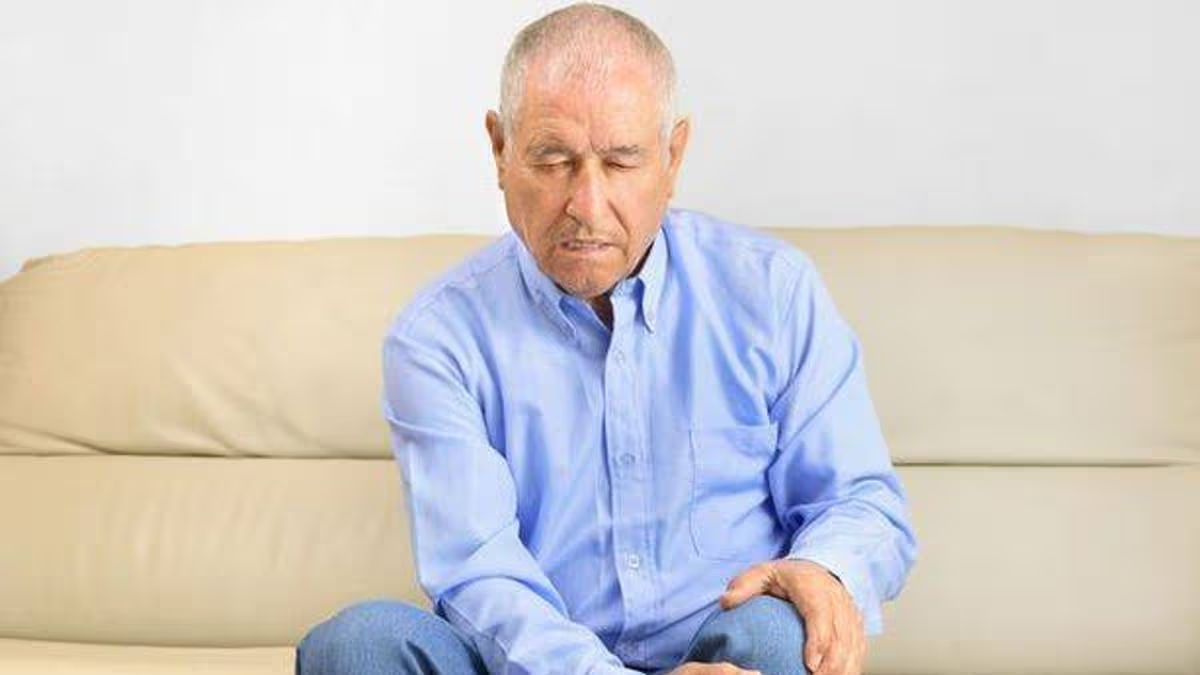
Personal Independence Payment (PIP) is available to people of working age who have a disability or long-term health condition
Linda Howard Money and Consumer Writer
20:00, 02 May 2026
The most recent figures from the Department for Work and Pensions (DWP) reveal there are currently over 3.9 million people receiving Personal Independence Payment (PIP). The statistics also show that 683,994 individuals of State Pension age were claiming the disability benefit at the end of January, increasing their monthly income by up to £1,670.80.
Following the annual State Pension and benefits uprating in April, that amount has now increased to up to £1,743.40 – although paid in two separate instalments. The full New State Pension is valued at £965.20 every four-week payment period, while PIP – or Adult Disability Payment (ADP) in Scotland – is worth up to a maximum of £778.40.
Advertisement
Numerous people over 56 approaching State Pension age may be unaware of a change to PIP guidance in 2019 which states “claimants whose review would have taken place when they were of State Pension age means they are now generally awarded ongoing awards”.
Ongoing awards generally last for 10 years, although award types and review periods are determined on an individual basis, depending on the claimant’s circumstances and the probability of those circumstances changing. This considers factors such as planned treatment or therapy, or learning to manage a condition.
It’s also worth noting the State Pension age began a phased increase to 67 last month, with the transition expected to be completed by 2028, reports the Daily Record.
PIP awards
Guidance from DWP states:
Advertisement
For fixed length awards, the review period usually ranges from a minimum of nine months to a maximum 10 years
Review periods of less than nine months are set only in exceptional circumstances
An award of two years or less is considered short-term
Combined incomes
The full New State Pension is worth £2421.30 each week (£965.20 every 4-week pay period) and the Basic State Pension up to £184.90 (£739.60 every 4-week pay period) – the amount you receive is determined by the number of National Insurance contributions made.
While State Pension, PIP and ADP payments are issued separately, they could together provide a combined monthly income of up to £1,743.40 – based on an individual receiving the full New State Pension alongside the highest rate of PIP or ADP awards for both the daily living and mobility components.
PIP and ADP payment rates
An assessment will be required to determine the level of financial assistance you are entitled to, and your rate will be periodically reviewed to ensure you are receiving the appropriate support. Payments are issued every four weeks.
Cambois is a small former fishing village between Blyth and Ashington in Northumberland, with a long stretch of sand that gets glowing reviews on sites like TripAdvisor.
Reviewers have hailed it as a “completely unspoiled area” and a “lovely place to visit with your dog”, making it an appealing option if you want space to breathe away from the crowds.
With Saltburn, Tynemouth and Whitley Bay expected to be packed over the bank holiday, Cambois offers a quieter coastal walk, sea views and dog-friendly sands a short drive from the A189.
Advertisement
But how do you actually say “Cambois”?
One of the most common questions people ask online about Cambois is how to pronounce its name.
Visitors often guess at “cam-bwah”, influenced by the French-looking spelling, or “cam-ber”, as if it were the better-known East Sussex resort. Locals, however, flatten the word right down.
The pronunciation most widely given by residents and local guides is “CAM-iss”. Think “camera” without the “era”, followed by “iss”.
The emphasis is on the first syllable – “CAM” – and the final “bois” is said like “iss”, not “bwah” or “boys”.
Advertisement
Other North East coastal names people get wrong
If you’re heading for the coast this bank holiday, Cambois isn’t the only name that might catch you out.
Here are a few more commonly mispronounced coastal or coastal-linked places in and around Northumberland:
Alnmouth – Often read as “Aln-mouth” with a hard “l” and a full “mouth”. Many locals say something closer to “AAN-muth”, with the “l” and “mouth” softened and run together.
Alnwick (a key stop on the way to the coast via Alnmouth) – Frequently said as “Aln-wick”. In reality, it’s closer to “AN-ick”, with the “l” and “w” effectively disappearing.
Bamburgh – Many visitors go for “Bam-burg” or “Bam-borough”. Locally, you’ll often hear “BAM-berr-uh” or “BAM-bruh”, with the “gh” silent and the ending softened.
Warkworth – Sometimes pronounced exactly as spelled, “Wark-worth”. You’ll often hear something nearer “WORK-worth” or “WORR-kuth” in local speech, with the “a” shortened and the ending blurred.
Newbiggin-by-the-Sea – Occasionally mangled as “New-BIDGE-in”. Locals typically say “NEW-biggin”, with a soft “g” as in “begin”.
Those are just a handful, and different families and villages will have their own twists, so we want to hear yours.
If you’ve got a North East coastal name everyone seems to say differently – from Lynemouth and Cresswell to Seaton Sluice or somewhere more obscure – let us know in the comments how you pronounce it and where you’re from.
Stacey Solomon and Joe Swash put on a united front as the shut down speculation of a divorce with a joint appearance on Britain’s Got Talent
20:25, 02 May 2026Updated 20:26, 02 May 2026
Stacey Solomon was all smiles as she shut down divorce rumours with an appearance on Britain’s Got Talent. Rumours had been rife that the reality TV star and her actor husband Joe Swash were in troubled waters in their marriage.
The former X Factor star, 36, was in the audience for the ITV contest on Saturday and she happily sat beside Joe and some of their kids. And she was clearly wearing her wedding ring for the appearance as she spoke to hosts Ant and Dec.
The duo looked happy together despite the rumours, which came after she had been spotted on a number of occasions without her band. While Stacey continued to deny any fallout, speculation continued be intense. But now, Stacey was in the crowd with her clan to watch on as her Golden Buzzer act took to the BGT stage.
Earlier this week, Stacey returned to social media to share an adorable family update. She shared a roundup of snaps taken in April, as she welcomed the month of May.
Breaking her social media silence of a month, she shared snaps of the family enjoying some time outdoors. Joe wasn’t in the images, but Stacey a number of shared adorable snaps of her children and pets. There were also aesthetic photos of nature.
Advertisement
She captioned the upload: “A slow April, in our little world…missed coming on here and chatting to you all, but had a lovely April shutting off from the world and just being. Hope you’re all OK.”
Stacey met her husband Joe while filming ITV’s I’m A Celebrity Get Me Out Of Here! in 2010. The began their relationship in 2016 and later tied the knot in 2022. The couple live in a stunning home called Pickle Cottage in Essex.
In recent months there had been huge speculation on their relationship. The TV favourite was spotted flashing a smile despite reports that she and her husband of almost four years had hit a rocky patch – and shock claims the pair were never officially married.
Advertisement
It was confirmed last week, despite claims their popular show had been cancelled, that their fly-on-the-wall show Stacey & Joe had been renewed for a third series. The BBC cameras returned to Pickle Cottage for more family drama.
As in the previous two series’, this latest offerings will give viewers an insight into the pair’s hectic work and family lives. While the family remain together, it’s said Joe is attempting to make his dream come true of building a fishing lake and glamping site on the grounds of their £1.2m Tudor-style Essex home, Pickle Cottage.
President Donald Trump has pulled 5,000 troops from Germany (Picture: AP)
Nato is at risk of ‘disintegrating’ after Donald Trump pulls 5,000 troops out of Germany following arguments over the Iran war.
The US President has repeatedly lashed out at German chancellor Friedrich Merz over claims the US had been ‘humiliated’.
Merz said Iranian leaders were ‘negotiating very skilfully, denouncing the lack of a US exit strategy’ and had humiliated the US when it got officials to travel to Pakistan for talks with no real result at the end.
In a rant on Truth Social, Trump then accused Merz of tolerating a nuclear-armed Iran, telling him he needed to ‘fix his broken country’.
Advertisement
Following this Germany’s defence minister Boris Pistorius has said Europeans must take greater responsibility for their own security.
Poland’s prime minister Donald Tusk warned Nato is ‘disintegrating’.
Sign up for all of the latest stories
Start your day informed with Metro’s News Updates newsletter or get Breaking Newsalerts the moment it happens.
Advertisement
Advertisement
He wrote on social media: ‘The greatest threat to the transatlantic community are not its external enemies, but the ongoing disintegration of our alliance.
‘We must all do what it takes to reverse this disastrous trend.’
A NATO spokesperson said the alliance was working with the US to understand the details of the decision.
Merz is among many European heads who have been on the receiving end of Trump’s rants.
Advertisement
Even UK Prime Minister Keir Starmer was told he was no ‘Winston Churchill’ after he would not let the US use British bases for Iranian attacks at first.
German Chancellor Friedrich Merz, France’s President Emmanuel Macron and Keir Starmer, Prime Minister of the United Kingdo (Picture: AFP)
Starmer also said he did not support a Nato operation in the Strait of Hormuz.
Trump has said for years about reducing the American military presence in Germany, and has railed against Nato for its refusal to assist Washington in the war, which began on February 28 with US-Israeli strikes on Iran.
Mr Trump wrote Wednesday on social media that the US was reviewing possible troop reductions in Germany, with a “determination” to be made soon.
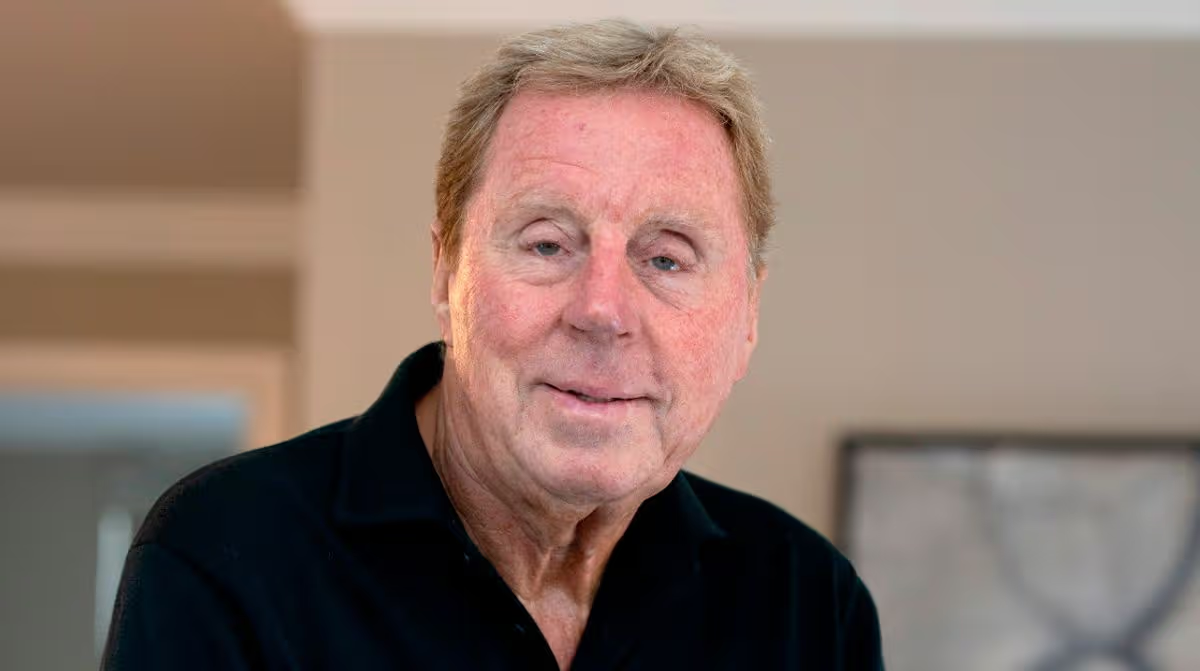
West Ham legend Harry Redknapp talks jungle drama, wanting to leave his grandkids ‘a few bob’ and his enduring love story with wife Sandra
This article contains affiliate links, we will receive a commission on any sales we generate from it. Learn more
Advertisement
Charismatic EastEnder Harry Redknapp is recovering from the not insignificant drama of the I’m A Celeb final.
Having become the oldest contestant at 71 to ever win the show in 2018, he was back for the All Stars series in South Africa – and again, rolled his sleeves up, winning hearts all over again and breezing through to the final.
Here, the sprightly 79-year-old, a former West Ham player and top footie manager, opens up about his experiences in the jungle, why considering his tough childhood it was a walk in the park, and his beautiful love story with his wife Sandra…
Harry! Have you recovered from ‘that’ eventful I’m A Celeb final you called a ‘nightmare’?!
Ha, yes. There was a lot of drama – but I’m just someone who gets on with things. I’m not one for making a fuss about anything much, you know. I just get on with it.
That can-do attitude is probably why you did so well during both jungle stints…
Probably. That’s how I was brought up. We didn’t have anything when I was a kid. You used to go hop-picking for six weeks in Kent, with my nan. And let me tell you, hop-picking makes the jungle look like a luxury holiday camp.
Advertisement
Wow. What did you have to do?
We’d get up at five in the morning, trudge down to the hop fields and pick hops in deep mud for six shillings a day. Your hands would bleed. But that was our holiday. Kids from the East End like me, we’d jump on the back of an old lorry and trundle down to Kent. Suddenly we’re seeing grass, cows; it was another world, coming from a concrete jungle.
What else do you remember from childhood?
Advertisement
Well, we grew up playing on bomb sites. Both ends of the street that I lived in, in Whitechapel, had gone – they were bombed. Both ends of it were just still rubble from the war. So you get on with it, and I think that way of approaching things has always stayed with me. When I was five, rationing was on. So, eating raw fish guts in the jungle? Not a bother.
In the jungle you mentioned you were never “much of a drinker”. Is that why you’re still in such good shape?
As a young player at West Ham, we used to drink Bacardi and Coke. But I never drank a glass of beer in my whole life. I just have the odd glass of wine now, if Sandra and I go out for dinner, and I do look forward to that. But I haven’t been in a pub for about 50 years. Seriously.
Your son Jamie was at Jack Whitehall’s wedding – do you get on well with Jack?
Advertisement
Oh, he’s very funny – he’s a great fella. Jamie had a fantastic time. Me and Jamie did a programme with Jack actually [2022 Sky TV show Jamie & Harry’s World Cup Challenge] where we had to go all over the country getting a selfie with 11 World Cup legends, that was great.
And how is Jamie – and the grandkids?
They’re all great. Jamie’s boy Charlie’s back from America. He did a rugby scholarship in Tucson, Arizona, spent four years out there playing rugby and had a great time. Beau is a midfielder for Brentford FC.
Advertisement
What sort of a grandad are you?
If they need a few quid, I’m always available! That’s probably one of the reasons I keep working, to be honest. I could put my feet up. I want to give them all a few quid when I go.
You and Sandra are a beautiful couple. What’s kept you together all these years?
I’m quite shy, actually. I’m not one for… gushing or kissing when we’re out and about. But Sandra’s my life. Simple as that.
Any exciting things coming up this year?
Advertisement
I’ve got Soccer Aid. I always look forward to that. We raise lots of money for UNICEF. You meet lots of great characters. And I’ve got my theatre tours.
Tell us more about the tours…
I go on stage and tell stories. We have funny videos of stuff that I’ve done, bits from the jungle. I enjoy it. If I didn’t enjoy it, I wouldn’t do it. It keeps me active, keeps me busy.
Any regrets when you look back at your career?
Advertisement
Nothing to lose any sleep over. You’re saying things on the spot sometimes, especially as a football manager!
Tell us about the iD Mobile campaign you’re backing…
You can go away on holiday and you use your phone all day. Mine never stops; you get back and you’re hit with massive phone bills. With this iD Mobile campaign, you get inclusive roaming in 50 countries. So, wherever you are in the world, you don’t get stuck with big roaming charges after your trip. That’s really important.
Advertisement
Do you and Sandra travel a lot?
Not so much abroad – a bit. Sandra and I are short-holiday people. We like to go on four-or five-day trips, like Croatia last year. We’ll get away somewhere I’m sure!
Harry Redknapp has partnered with iD Mobile to highlight the brand’s inclusive Roaming available in 50 destinations worldwide – more than any other UK network. Visit www.idmobile.co.uk/roaming for more.
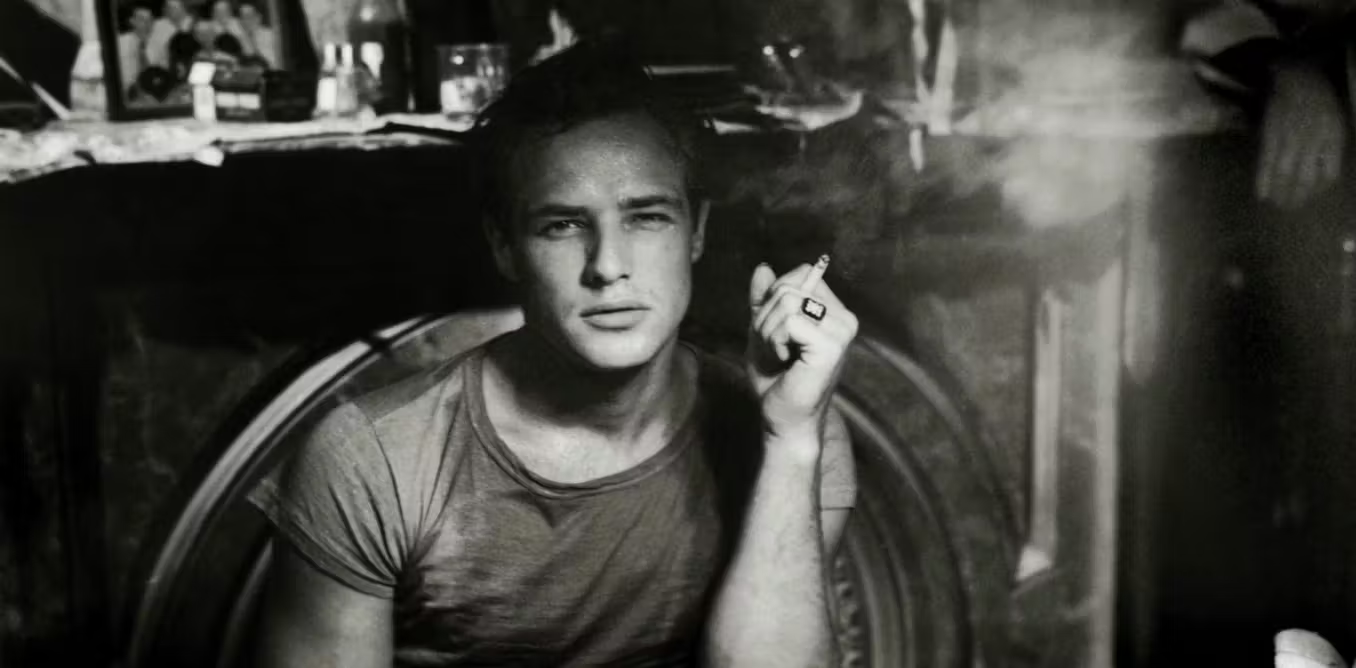
What people see on screen can shape what they do off it. When actors such as James Dean and Marlon Brando lit cigarettes in 1950s rebel films, smoking came to signify cool, defiance and desire for an entire generation.
Among 12- to 17-year-olds in the US, smoking initiation rose from about 20% in the early 1950s to roughly 35% to 40% by the mid-1960s, according to retrospective data from national surveys. Screen media do not simply reflect society. They can also influence how people think about health, risk and behaviour.
Film and television reach vast audiences, embedding health-related behaviours in dramatic storylines. Medical dramas such as Grey’s Anatomy and ER have brought hospital life into living rooms around the world, shaping public ideas about medicine and, for some viewers, even inspiring careers in healthcare.
Sometimes films become accidental public health educators. During the COVID-19 pandemic, the 2011 film Contagion surged in popularity as viewers returned to it for insight into viral spread, quarantine and contact tracing. Its depiction of outbreak control closely mirrored real public health responses, reinforcing messages about handwashing and physical distancing, as described in this report from the Centers for Disease Control and Prevention, the leading US national public health agency. When storytelling aligns with science, entertainment can improve public understanding of health risks.
Advertisement
But screen influence can also be harmful. Bollywood has long shaped popular culture across south Asia, and iconic films in the 1990s and early 2000s often presented smoking and drinking as stylish, casual and glamorous. These portrayals are not trivial. Research suggests that adolescents heavily exposed to tobacco imagery in Indian films are roughly twice as likely to experiment with tobacco as those with lower exposure.
Global evidence shows similar patterns. A systematic review found that adolescents who frequently see smoking in movies are significantly more likely to start smoking themselves. Despite growing awareness of the issue, tobacco imagery remains common: more than half of major box-office films released in 2024 included some form of tobacco depiction. Anti-smoking warnings shown before films can reduce pro-smoking attitudes slightly, but repeated on-screen smoking scenes often have a stronger effect.
Alcohol follows a similar pattern. Teen films often frame drinking as harmless fun while downplaying addiction, injury and long-term health consequences. Studies link heavy exposure to these portrayals with earlier and riskier alcohol use among adolescents. More recently, streaming series have helped make casual vaping seem socially routine, reinforcing the idea that e-cigarettes are acceptable and relatively harmless.
Advertisement
Screen storytelling shapes more than substance use. Hollywood’s beauty ideals, centred on thin bodies, flawless skin and effortless glamour, can distort body image, especially among teenage girls. A striking example occurred in Fiji after western television arrived in the mid-1990s. Within three years, self-induced vomiting to control weight had risen from 0% to 11.3% among adolescent girls, while the proportion showing high levels of disordered eating attitudes rose from 12.7% to 29.2%. In interviews, some girls explicitly linked their interest in weight loss to television characters.
Some portrayals carry even greater risks. Research shows that graphic depictions of suicide in films and television dramas can trigger short-term increases in similar behaviour among vulnerable viewers. These concerns have prompted growing collaboration between mental health experts and entertainment producers to encourage safer storytelling.
Yet screen media can also improve health understanding. The World Health Organization has long supported entertainment-education, in which health messages are woven into dramas and soap operas. In parts of Africa and Asia, television narratives addressing HIV prevention, maternal health and malaria have increased clinic visits, testing uptake and awareness. In Ghana, culturally relevant health films have encouraged women to attend cervical cancer screening and antenatal care.
Some films have also helped shift public attitudes. In 1993, Philadelphia humanised the AIDS epidemic, helping reduce stigma and foster empathy towards people living with HIV. In India, the 2007 film Taare Zameen Par helped destigmatise dyslexia and encouraged schools to take learning difficulties more seriously. Hollywood blockbusters such as Outbreak have heightened awareness about infectious disease threats and preparedness.
Young audiences may be especially responsive to these messages. Children and teenagers spend hours consuming films and streaming content, often absorbing fictional lifestyles as cues about what is normal, attractive or desirable.
Creative media can also support wellbeing in less obvious ways. In my own research exploring online dance sessions for people with pulmonary fibrosis, a chronic lung disease, participants exercised to familiar Hollywood songs and simple choreography. The programme improved mood and engagement while offering modest health benefits, showing that film, music and movement can be harnessed positively.
Advertisement
Film-makers may not think of themselves as health educators, yet their work can shape real-world people’s beliefs and behaviours. A single scene can glamorise smoking or reckless drinking. It can also reduce stigma, encourage people to seek help, or make complex health information easier to understand.
Films are shaped by the societies that produce them, but they shape society in return. The next blockbuster may aim only to entertain. Even so, the story it tells may subtly influence how audiences think about their bodies, their habits and their health.
Be sure to plan your journey in advance, whether participating or spectating
19:10, 02 May 2026Updated 19:17, 02 May 2026
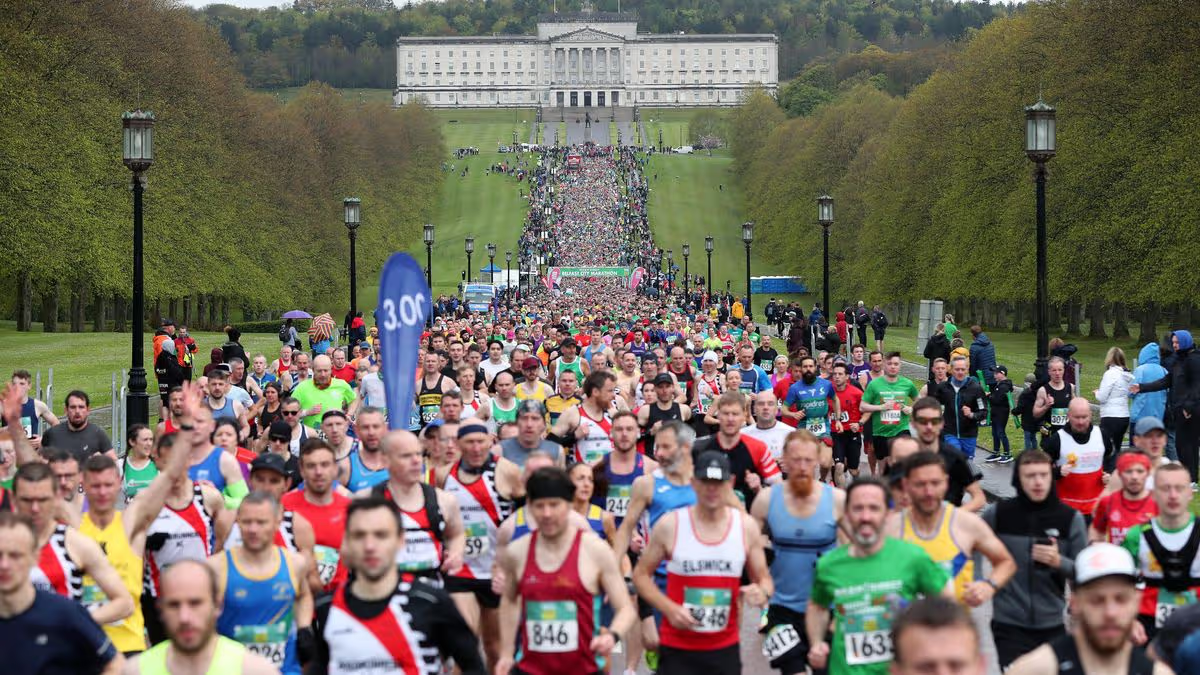
It isn’t long now until the Phoenix Energy Belfast City Marathon takes over the city for 2026.
On May 3, thousands will take to the streets of Belfast to complete the 26.2-mile race, team relay and 8-mile walk events.
If you are participating or spectating, you may be wondering how you are going to arrange your travel to or around the city on race day – whether getting to the start line or to Ormeau Park after your relay leg.
Advertisement
All transport for the marathon is free for spectators and participants – excluding rail services.
Here is what you need to know about transport and travel ahead of the Belfast City Marathon :
Getting to and from the start/finish line
Getting to the start line – a shuttle bus will be available from Belfast City Hall (outside SS Moore’s) 07:00am – 8:00am and Lanyon Place Train Station 7:30am – 8:00am to the Start Line.
Spectator Transport from Stormont – a shuttle bus will pick spectators from Massey Avenue to Ormeau Park after the start of the race at Stormont.
Getting back to Belfast City Centre – a shuttle bus will transport participants from Ormeau Embankment to Belfast City Centre. This service will run from 11:45am – 4:00pm.
Getting back to Stormont – every 3rd shuttle bus leaving Ormeau Embankment will transport spectators back to Stormont
Team Relay transport
Content cannot be displayed without consent
A shuttle bus service will run 8:00am – 10:00am from Annadale Embankment at Dunnes Stores to drop runners off at their designated relay changeover point:
Montgomery Road – 08:00 – 08:30
Boucher Road – 08:30 – 09:00
Falls Road – 09:00 – 09:30
Duncairn Gardens – 09:30 – 10:00
Additional Translink Rail Services
Translink is set to once again support the Phoenix Energy Belfast City Marathon by operating a series of early morning train services on Sunday 3rd May, helping participants and supporters get to the start line on time.
Early trains will run from Derry, Larne, Bangor and Newry, with all services arriving into Belfast’s Lanyon Place Station before 8:00am – well ahead of the 9:00am race start at Stormont Estate.
Shuttle buses will operate from Belfast’s Lanyon Place Station for participants.
Advertisement
Parking for Belfast City Marathon
According to the Belfast City Marathon, car parking will be discounted for all participants.
Q-Park (Victoria Square) – 20% off using discount code BMAR26
APCOA (Lanyon Place & Oxford Street) – Payment is through the APCOA App. It will charge £2.50 for 1hr, £4.00 for 2hrs max and all day will cost £6.00. Pay using the app, click HERE to view instructions on how to claim your discount
Value Car Park (McCausland) – Participants can avail of a 10% off for their parking on marathon event day on presentation of their bib at the car park kiosk
Advertisement
Parking in Stormont – parking will be available at the start line within the Stormont Complex for FREE. Please note the Upper Newtownards Road from the Stormont Entrance will close from around 8.00am to facilitate traffic management solutions for the start of the event. Access will be from the Dundonald side ONLY.
The England international was left lying motionless on the pitch after the brutal hit
19:18, 02 May 2026Updated 19:23, 02 May 2026
England star Immanuel Feyi-Waboso was knocked out cold on the field of play following a sickening collision with Ireland international Jacob Stockdale during Exeter Chiefs’ Challenge Cup semi-final clash with Ulster.
The Cardiff-born wing was on the attack for his side just before the half-hour mark at the Affidea Stadium when he was put on the receiving end of a brutal hit by Stockdale, who then drove him into the ground by his head as he attempted to haul the Chiefs man down.
The challenge immediately drew groans from the crowd in Belfast, with referee Pierre Brousset immediately bringing the game to a halt as Feyi-Waboso lay motionless on the turf.
After lying there for several seconds as his concerned teammates rushed to his aid, the England international suddenly jolted awake and attempted to get up, leading Brousset to tell him not to move as a medic arrived on the scene.
Feyi-Waboso was immediately withdrawn for a head injury assessement (HIA) and did not return, with the referee left to decide the fate of Stockdale, who also did not return to the action after half-time.
Replays appeared to show the Irish back making initial contact with Feyi-Waboso’s shoulder before the tackle rode up and made contact with his head. In the immediate aftermath, however, Stockdale was shown grabbing the Exeter star’s face and driving him down into the ground with force.
Advertisement
After consulting the replays with TMO Eric Gauzins, Brousset reached his decision, telling captains Dafydd Jenkins and Iain Henderson: “The first contact is on the shoulder, with most of the force, and then we’ve got the head contact, so it will be a yellow card.”
“I think that’s well explained and the right decision,” said ex-Ireland star Andrew Trimble, on punditry duty for Premier Sports.
“I think we’ve got the right decision there,” added fellow former Irish international Gareth Steenson. “It’s a big collision as well. Jacob Stockdale probably saw Feyi-Waboso coming round the corner and thought this is my opportunity to take him.
“It’s an incredible defensive read and he’s just a couple of inches too high,” Trimble continued. “His head just bounces off his shoulder and indirectly makes head contact, so a yellow card is the right decision.”
Advertisement
However, many viewers were outraged at the decision, arguing that Stockdale got away incredibly lightly for what they described as a “disgusting” challenge.
“That’s absolutely shocking,” wrote one on X. “Embarrassing from the referee with a player who’s taken a serious injury. Two independent horrendous actions from Stockdale, yellow is so soft. No bottle in big games anymore.
“Jacob Stockdale is possibly the luckiest man alive,” added another. “How on earth was that only a yellow?”
A third wrote: “Awful decision, Stockdale has a black eye and Manny was out cold. Should be a red and a lengthy ban,” while another added: “Disgusting dog shot from Stockdale, how it’s only a yellow is a joke.”
Russian “gingerbread” mines dropped by drones are reportedly turning Kherson into a deadly minefield, with civilians and children at risk from hidden explosives
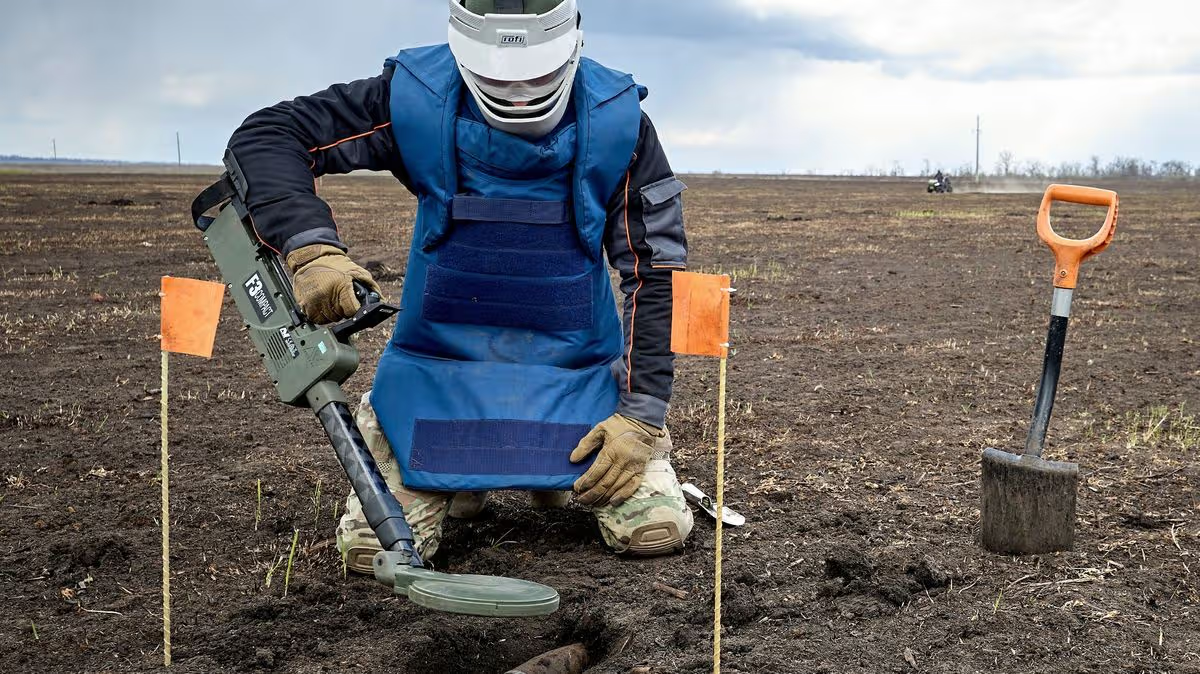
Children are being “lured to their deaths” by toy-like mines dropped from the sky in a chilling new escalation of the war in Ukraine, with frontline cities described by aid workers as turning into a deadly patchwork of hidden explosives.
Advertisement
The devices, known as “Pryanik”, which is Russian for “gingerbread”, are small, round munitions designed to look deceptively harmless at first glance. But in reality, they are reportedly capable of causing severe injury or death, lying unnoticed in grass, rubble and residential streets until triggered.
The tactic, according to humanitarian groups, is part of a wider strategy that has turned everyday life in southern Ukraine into a constant gamble with survival.
Yuriy Boyechko, founder of Hope For Ukraine, said the city of Kherson has effectively become a “minefield”, after Russian forces began deploying cheap first-person-view drones to scatter the disguised explosives across civilian neighbourhoods.
Advertisement
He continued: “Russia is using FPV drones to drop these mines all over residential areas in Kherson. If an adult steps on it, or a child finds it while playing in the grass … it will blow them up, or wound them badly. The deliberate weaponisation of backyards and doorsteps is a calculated attempt to make life uninhabitable.”
Boyechko warned that civilians now face two overlapping dangers in the city – direct drone strikes from above and invisible explosives below their feet, the Sun reports.
He explained: “Right now, there are two types of dangers that civilians face – one is from the air, the FPV drones that target them directly. The other is the minefield underneath their feet.”
The evolution of this tactic, aid workers say, represents a disturbing shift in modern warfare. Unlike traditional landmines buried in fixed positions, these devices are being actively dispersed by drones, making entire residential zones unpredictable and constantly changing danger areas.
Kherson, located near the Black Sea and close to the front line, has endured months of sustained attacks, including drone strikes and what officials previously described as “human safari” operations. Russian forces, positioned across the Dnipro River, are said to monitor and target civilians in real time.
Residents are now reported to spend much of their lives underground in basements, venturing outside only when absolutely necessary. Even then, every movement carries risk.
Boychecko said even walking to the pharmacy is becoming a game of chance of a “gamble with mutilation,” and that the situation is becoming a “big problem”.
Advertisement
The “gingerbread” mines themselves are small enough to fit in the palm of a hand and are often wrapped or shaped in a way that makes them difficult to distinguish from harmless objects. Some reports suggest they can resemble toys or debris, increasing the risk to children who may not recognise the danger.
Officials say the activation pressure is extremely low, meaning even a small child stepping on one could trigger an explosion. There are also warnings that the devices can detonate unpredictably if disturbed.
Volodymyr Prepepelytsia, from the National Police in the Kherson region, has previously described upgraded versions of these mines as more sophisticated and more powerful, making them even harder to detect and clear. He also warned that the shortage of specialist demining teams and equipment has left authorities struggling to keep pace with the scale of contamination across the region.
Advertisement
As of April 1, a total of 1,431 people, including 147 children, have been injured by mines and explosive remnants of war since the start of the full-scale invasion, according to official figures. In Kherson alone, authorities have opened hundreds of criminal cases linked to civilian casualties caused by explosives.
Humanitarian operations have also been severely disrupted. Aid groups say delivering food and supplies often turns into a dangerous operation, with drones circling overhead and attacks occurring within minutes of activity being detected.
Boyechko said his organisation, Hope for Ukraine, is the only NGO still operating regularly in parts of the city, but even their work has become increasingly difficult.
Advertisement
He explained: “A lot of people are hesitant to get out of their hideouts when we bring out aid. Every time they open the door, they listen for the high-pitched buzzing sound in the air.
“When we make deliveries, we try to schedule them during bad weather as it is much safer. In open air you become a target in a matter of minutes.”
Aid workers say even basic survival routines have been transformed. Residents reportedly time movements carefully, avoid open spaces, and remain alert to any sound of drones overhead. The psychological toll is also growing, with civilians living under constant uncertainty, unsure whether danger lies above or beneath them.
Boyechko said: “The worst part is that residents are forced to spend most of their time in basements. There is always something hanging in the air.”
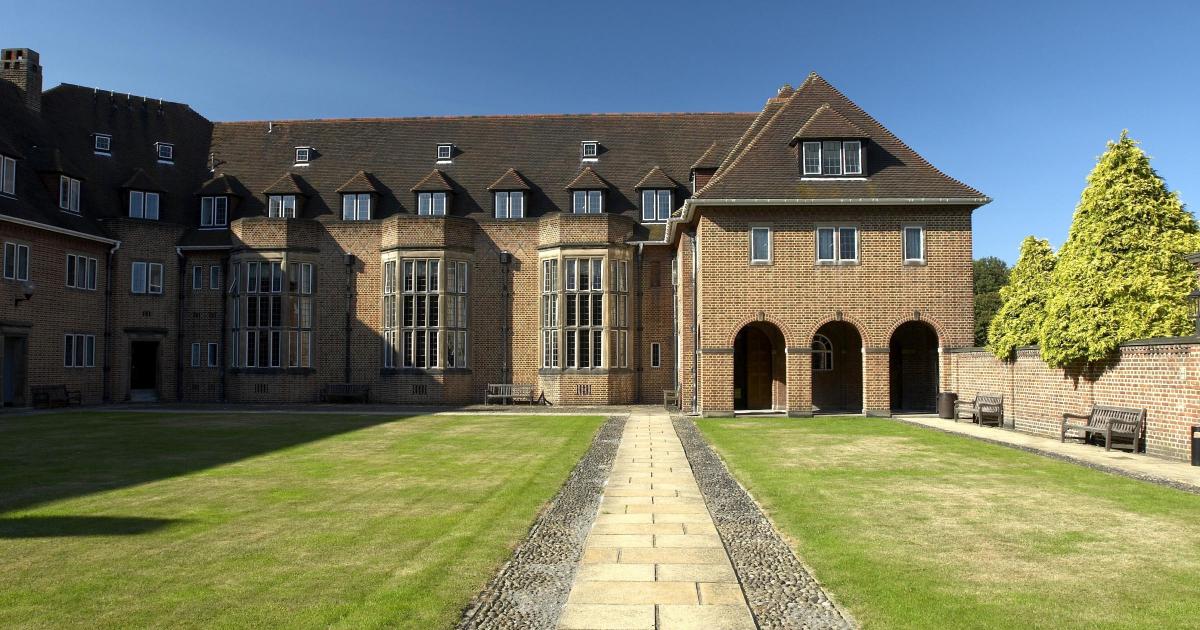
Henderson Old Hall, a Grade II-listed building in the High Heaton area of Newcastle, will undergo repairs to its external façade, roof, windows, and doors as part of efforts to bring it back into use.
A Newcastle University spokesperson said: “We’re really pleased that work to start to repair Henderson Old Hall is now able to begin.
“Our immediate priority is to ensure the building is permanently weatherproof and watertight, while carrying out the repairs with the care and sensitivity that a historic building like Henderson Hall requires.”
Advertisement
The fire-damaged building, owned by Newcastle University, has remained out of use since the incident nearly three years ago.
The university’s estates team has worked with insurers, the local authority, and consultants to secure the site and fully assess the damage.
Robertson has been appointed as the main contractor for the project, which is expected to take between 12 and 18 months.
The work will include constructing a replacement roof structure, installing new and refurbished windows and doors, repairing or rebuilding sections of the external façade, and carrying out structural repairs.
Internally, water-damaged finishes will be removed and new electrical works—including lighting—will be installed.
Advertisement
The restoration marks an important step in safeguarding a historic part of the university’s estate, though discussions are still ongoing regarding the long-term future use of the hall.
Henderson Old Hall was used for many years as student accommodation.
















































You must be logged in to post a comment Login