
Connect with us

NewsBeat

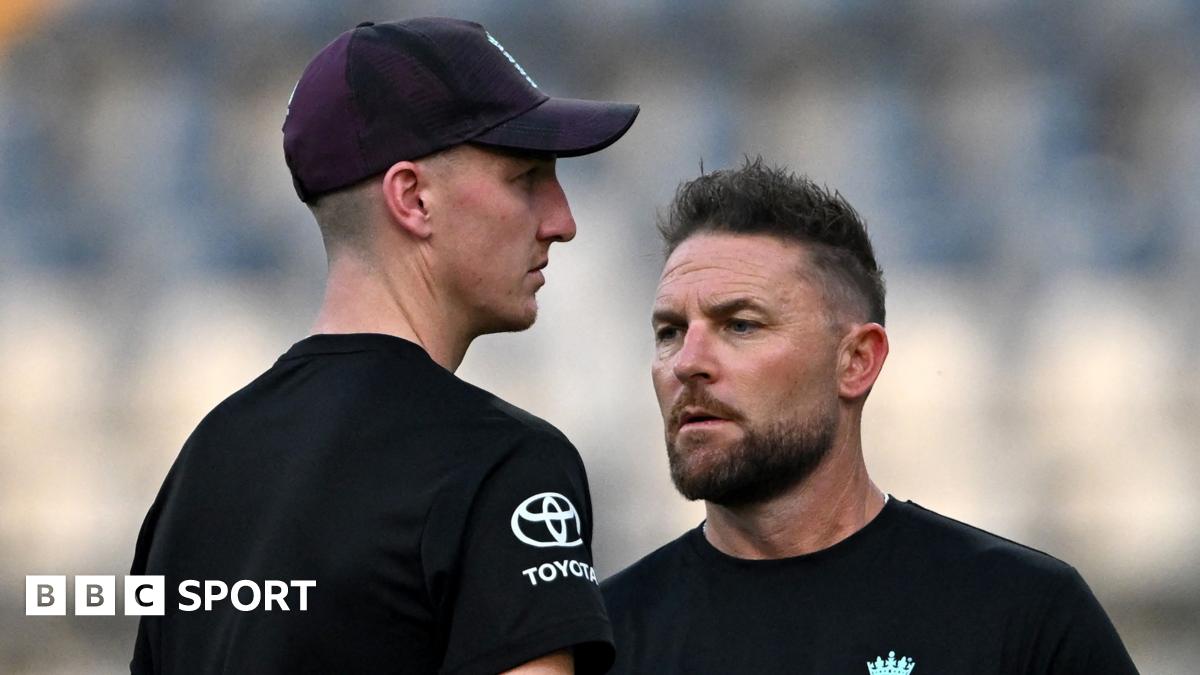
T20 World Cup: Brendon McCullum wants to stay as England coach – but will that be enough?

Published

on

Preview: F1's New Era Dawns

Brook and McCullum have also kept spirits high on this trip, an impressive feat given what had come before.

The tour began with Brook standing up in front of the group in a Colombo hotel and apologising to his team-mates for his Wellington escapades.

In the end he took the blame again, but this time for a dropped catch rather than any trip into the night.

Brook’s drop of Sanju Samson should not distract from a definite improvement in fielding during this tournament, under the eyes of rehired fielding coach Carl Hopkinson.

Advertisement

A slapdash approach to training was another accusation made in Australia but here England have trained hard, often longer into the night than expected.

And while that should be seen as par for the course, McCullum and Brook also deserve credit for their tactical calls on this trip.

Liam Dawson and Sam Curran were recalled to relative success, while Will Jacks excelled in a new role as a finisher.

Brook played the innings of his T20 career after McCullum suggested moving to number three.

Advertisement

But doubt clearly remains whether that is enough to save McCullum, having taken England to a point viewed as the bare minimum before a ball was bowled.

Having your future hinge on a World Cup semi-final against India in Mumbai is the toughest of schools but this was a situation of McCullum’s making.

It was he who oversaw the Ashes planning that did not include a warm-up game, and allowed the mid-series trip to Noosa.

It was on McCullum’s watch Brook, Jacob Bethell and Josh Tongue felt able to visit a nightclub the night before an international fixture.

Advertisement

Just how bad the Ashes were should not and can not be forgotten.

Other key stakeholders are managing director Rob Key and Test captain Ben Stokes, who are both back in the UK after beginning the week stranded in the United Arab Emirates with England Lions.

Key spent time around the squad during this tournament and his position will also be discussed by those above.

Stokes is the most secure, though he and McCullum appeared conflicted in their messaging at times in Australia.

Advertisement

Stokes batted 152 balls for 50 runs in Brisbane and called for his team to “show a bit of dog” in Adelaide but when another defeat came five days later, thus confirming Australia would hold onto the urn, McCullum spoke of his disappointment that England had drifted from their attacking style of play.

Despite that, Stokes backed McCullum before and after the fifth Test in Sydney when he could have been more vague.

Brook was also steadfast in his defence of McCullum on Thursday night, saying the former New Zealand captain was “125%” the man to continue.

“The things he’s done over the four years since he took over has changed English cricket for hopefully the best,” Brook said.

Advertisement

“He’s the best head coach I’ve ever had.”

Critics would say it is no surprise players would back a coach whose key philosophy is a relaxed environment.

There is plenty to be considered over the weeks ahead.

McCullum wants to stay and his players still believe in him. Will that be enough?

Advertisement

Source link

Continue Reading
Click to comment

Leave a Reply

Your email address will not be published. Required fields are marked *

NewsBeat

Messi and Inter Miami meet Trump at White House

Published

on

Messi and Inter Miami meet Trump at White House

Lionel Messi, owner Jorge Mas, and members of the Inter Miami team visited the White House to celebrate their 2025 Major League Soccer Cup victory.

Messi and Mas presented President Donald Trump with an Inter Miami jersey with his name on it and a glittering pink soccer ball trophy.

Trump jokingly asked the team and audience who was better: Pele or Messi?

Source link

Advertisement
Continue Reading

NewsBeat

Four County Durham buildings up for architecture awards 2026

Published

on

Four County Durham buildings up for architecture awards 2026

A new building for the national railway museum and the transformation of a historic walled garden are among the projects shortlisted for the Royal Institute of British Architects (RIBA) North East Awards 2026.

The 17th-century walled garden at Auckland Castle in Bishop Auckland, the New Hall at the Locomotion museum in Shildon, the Pockerley area of the Remaking Beamish project, and The Goods Shed at Hopetown, Darlington, have all been nominated.

Andrew Thompson, RIBA North East Jury chair and associate at Faulkner Browns, said: “The RIBA North East Award shortlist for 2026 captures the richness and ambition of architectural practice in the region.

Walled Gardens at Auckland Castle. (Image: RIBA)

“This year’s projects range from finely crafted homes in picturesque landscapes, sensitive restoration of industrial heritage and a playful creativity applied to seemingly ‘everyday’ typologies.

Advertisement

“A deep sense of commitment to care, craft, and quality runs throughout the shortlist.”

Each project will be visited by a regional jury.

Beamish. (Image: RIBA)

Winners of the RIBA North East Awards will be revealed later this spring and will then be considered for several special awards, including the RIBA North East Sustainability Award and RIBA North East Building of the Year.

Mr Thompson said: “Great architecture should delight, challenge expectations and carry a deep sense of responsibility to client, community, and climate.

Advertisement

Locomotion, Shildon. (Image: RIBA)

“The jury looks forward to visiting each project across the region and assessing them against this high standard.”

Regional winners will then be considered for a highly coveted RIBA National Award, which will be announced in summer.

The shortlist for the RIBA Stirling Prize – the UK’s best new building – will be drawn from the RIBA National Award-winning projects and announced in September. The Stirling Prize winner will be announced in October.

Advertisement

Source link

Continue Reading

NewsBeat

Woman dies after 23-hour ambulance wait following stroke

Published

on

Wales Online

A coroner issued a Prevention of Future Deaths report after Angela Darlow, 73, missed the critical treatment window

A coroner has raised serious concerns after a North Wales woman waited more than 23 hours for an ambulance after suffering a stroke at home. Angela Darlow, 73, collapsed at her home in Flintshire on January 6, 2025, prompting her husband to dial 999 for help.

Advertisement

The emergency call was correctly categorised by the Welsh Ambulance Service, but “unprecedented” pressure on the system meant an ambulance did not arrive for 23 hours and 20 minutes.

By the time Ms Darlow was taken to the Countess of Chester Hospital, the delay meant doctors were unable to carry out key investigations for a thrombectomy – a procedure used to remove a blood clot from the brain. The treatment is most effective when performed within around six hours of stroke symptoms first appearing, reports North Wales Live. For the biggest stories in Wales first sign up to our daily newsletter here.

Instead, she was treated with antiplatelet medication and admitted to the hospital’s stroke ward. Her condition stabilised and she was moved to Mold Community Hospital on March 7, 2025, with a poor prognosis.

She passed away from the effects of the stroke at hospital three months later, on June 7. She was aged 73.

Advertisement

An investigation into her death began on June 13, 2025, and concluded following an inquest on February 5, 2026.

The inquest returned a narrative conclusion, finding that Ms Darlow died of natural causes but that opportunities for medical investigations and possible treatment were missed due to the lengthy delay in ambulance response and transport to hospital.

Kate Robertson, Assistant Coroner for North Wales (East and Central), submitted a Prevention of Future Deaths Report to the Cabinet Secretary for Health and Social Care, Jeremy Miles. Copies were additionally forwarded to the Chief Executive of Betsi Cadwaladr University Health Board and the Chief Executive of the Welsh Ambulance Service Trust.

Within the report, she stated: “The facts in Angela’s death speak for themselves. I continue to remain concerned about the time it is taking for ambulances to arrive in the context of the multifactorial reasons for this which include patient flow in hospitals and limited social care provision. People are dying due to these issues and yet we are no closer to improvement.”

Advertisement

She added: “In my opinion action should be taken to prevent future deaths and I believe you have the power to take such action.”

Get daily breaking news updates on your phone by joining our WhatsApp community here. We occasionally treat members to special offers, promotions and ads from us and our partners. See our Privacy Notice.

Source link

Advertisement
Continue Reading

NewsBeat

Extra 53,000 households on disability benefits to receive water bill help

Published

on

Extra 53,000 households on disability benefits to receive water bill help

The scheme, which caps the bills of certain households who use high amounts of water, is to expand eligibility to include those on disability living allowance, attendance allowance, or personal independence payments (Pip), the Department for Environment, Food and Rural Affairs (Defra) said.

Source link

Continue Reading

NewsBeat

‘A chance for freedom’ – Kurdish fighters desperate to join battle against Iran | World News

Published

on

A biker proudly displays a Kurdistan flag

I have witnessed Iraqi and Iranian Kurdish fighters working with American forces in Iraq and Syria over many years.

The Kurds were instrumental in stopping Islamic State (IS) fighters from spreading into much of northeastern Syria and Iraq.

Could they be called again to help the West? It’s a thought that’s being widely talked about.

Iran latest: ‘Security incident’ near Cyprus RAF base

Advertisement

Advertisement

Iran war: Day 5 with Michael Clarke

For their part, the Iranian-Kurdish militia living in neighbouring Iraq are literally chomping at the bit to cross the border and join a popular uprising against the Iranian regime.

I know this because they’ve told me.

In recent days, like the American bases, the bases of Kurdish armed groups have been struck by rockets and drones from Iran as well.

Advertisement

For safety, they spend as much time as possible off base as they prepare for war, which is why I met a senior political figure in the Kurdish Democratic Party of Iran, in a deserted building, in a town nestling below mountains that lead to Iran.

Karim Parwizi will command one of the armed elements preparing to cross the border.

He told me they have been planning to take up arms against Iran for years, but believe that now is the time to join the American-Israeli war.

“For many years, for decades, this regime has attacked us, killed our people, and carried out acts of genocide against us,” he said.

Advertisement

“Now that the regime is becoming weaker and weaker, we see this as an opportunity to finally move toward achieving our freedom.”

Karim Parwizi says the war has provided a chance to win freedom for the Kurdish people
Image:
Karim Parwizi says the war has provided a chance to win freedom for the Kurdish people

Iran has threatened to bomb Kurdish towns and cities over the border if they get involved.

I asked Parwizi if they’re worried about those threats.

“The regime does not need an excuse to attack us,” he replied. “For the past 47 years, they have targeted us regardless.”

He added: “Even though this is described as a conflict between the United States and Iran, we have been attacked repeatedly whether we are involved or not.

Advertisement

“We have lived under constant threat. So no, they do not need any justification to attack us, they have been doing it for decades.”

Advertisement

Iran jet downed over Tehran after ‘dogfight’

How much military cooperation remains, or has even increased, between the Americans and Kurds since the war against Islamic State is the subject of some conjecture.

Officially at least, neither American nor Kurdish political leaders have indicated it has changed one way or another.

Advertisement

Strategic American bases and runways lie in Iraqi Kurdistan, so the US military presence here is a constant.

‘This time is different’

Zanyar, a member of the Peshmerga – as Kurdish fighters are called – told me he and others want to follow the encouragement of US President Donald Trump to Iranian civilians to rise up against the government and its security forces.

I met him in a safe house for families of the fighters actively preparing for battle.

Advertisement
Zanyar's wife and child were killed in an Iranian missile strike
Image:
Zanyar’s wife and child were killed in an Iranian missile strike

Zanyar’s wife and infant were killed in an Iranian missile strike here four years ago – remember Iran has been attacking the Kurds on and off for years.

Crossing the border to fight the regime and its forces is now personal for him, and he, like so many others, says now is the time.

Read more:
Sky News reporter forced to take cover from rocket fire
Spain PM unafraid of Trump’s wrath – analysis

Advertisement
A biker proudly displays a Kurdistan flag
Image:
A biker proudly displays a Kurdistan flag

“It’s true that in the past there were moments when people tried to rise up, but the efforts were not coordinated, but this time is different,” Zanyar told me.

“You have people inside Iran who are openly dissatisfied with the regime, you have opposition groups that are more united and determined to remove it, and importantly, much of the international community now agrees that this regime must go.

“That coordination makes this moment different, and it gives us hope that this could be a real opportunity for change.”

Would a Kurdish ground incursion kickstart a nationwide uprising in Iran – or herald the start of ethnic sectarian chaos instead?

Like so much in this war, nobody is sure of the endgame.

Advertisement

Source link

Continue Reading

NewsBeat

Premier League Darts 2026 results: Luke Littler spoils Welsh party with win in Cardiff

Published

on

Luke Littler 'reels in the big fish' with a 170 checkout against Gerwyn Price

Luke Littler beat Premier League leader Jonny Clayton 6-4 in a top quality final at Utilita Arena in Cardiff.

Littler broke Clayton in the opening leg of the final, but ‘The Ferret’ hit straight back with a break of his own after ‘The Nuke’ failed to checkout 68 with three darts in hand.

A bullseye finish from Clayton gave the home crowd in Cardiff more to celebrate, as the 51-year-old took a first lead of the final.

But Littler showed why he is the back-to-back world champion, hitting the ‘Big Fish’ checkout of 170 – just as he had done to clinch victory in the semi-final against Gerwyn Price.

Advertisement

Both players held throw as the final reached its halfway stage with the score level at three legs each.

Littler almost sent the crowd wild with a nine-dart finish, only to miss double 15 and see Clayton return to the oche to check out the 41 remaining in an incredible leg.

The 19-year-old levelled proceedings with a hold of throw before a second break of the game moved Littler to within a leg of victory.

And Littler sealed his first night win of the 2026 Premier League campaign in the following leg, checking out 52 with his last dart in hand to climbed into the top four.

Advertisement

“It took me a little while to get settled in to this tournament, as it did in the first year,” Littler told Sky Sports.

“I’ve done really well tonight and I’m proud of myself.

“The table looks good now, it wasn’t looking good when I was in seventh. It just goes to show that tonight I had to focus on myself.”

Another final appearance for Clayton sees him remain top of the table, as he continues to thrive on his return to the Premier League.

Advertisement

Source link

Continue Reading

NewsBeat

The war’s toll so far on Iran’s military and leadership

Published

on

The war's toll so far on Iran's military and leadership

CAIRO (AP) — The U.S. and Israel are striking a much wider array of targets in Iran than they did during 12 days of war last summer, when their focus was on the country’s nuclear enrichment sites. Now, the aim appears to be destroying Iran’s military and weakening the grip of its theocratic rulers, experts say.

U.S. Central Command alone says it has hit more than 2,000 targets in less than a week, a far heavier barrage than any American bombing campaign in the Middle East in more than a decade, according to Airwars, an independent group that tracks global conflicts. Israel says it has hit hundreds of sites.

From the capital of Tehran to cities across the country, the U.S. and Israeli airstrikes have bombarded the Islamic Republic — its leaders, military bases, weapons factories, soldiers and police, and state TV.

The totality of the damage is not clear. But it is “a more significant blow than anyone expected might happen in such a short time,” Armed Conflict Location and Event Data, an independent monitoring group, said in a statement. Still, even after the killing of Supreme Leader Ayatollah Ali Khamenei, the emergency leadership team still appears to have “the ability for domestic coercion,” said the group, which goes by the acronym ACLED.

Advertisement

The mounting death toll is also difficult to independently assess because of poor communications. An Iranian government agency says at least 1,230 people have been killed. More than 165 people were killed when a school in southeastern Iran was hit, most of them of children, according to Iranian state media.

Here is a deeper look at what has been targeted so far:

Many top officials have been killed

U.S. and Israeli strikes hit Khamenei’s residential compound in central Tehran, killing him in the opening barrages on Feb. 28. Airstrikes also killed the defense minister, the head of the Republican Guard, Khamenei’s top security adviser and other senior figures.

A religious site connected to Khamenei’s predecessor was partially destroyed, and an airstrike smashed a hole through the dome of a building belonging to the Assembly of Experts, a council of senior Shiite clerics tasked with appointing the next supreme leader.

Advertisement

The Revolutionary Guard and Basij come under heavy fire

Many airstrikes have been directed at the Revolutionary Guard, Iran’s most powerful military force, and the Basij, a paramilitary force that brutally enforces Islamic law and crushes any public dissent.

In more than 280 strikes that ACLED documented as of Wednesday, over 20% targeted Revolutionary Guard or Basij positions, mostly in Tehran and in western and southern Iran. Garrisons, air bases, underground complexes, ammunition depots, weapons factories and command buildings have all been attacked.

At the Revolutionary Guard’s headquarters in northern Tehran, several buildings have been demolished, according to satellite photos from Vantor, a U.S. imaging company. Small, local branches of the Basij have also been targeted, according to ACLED.

On Thursday, two sports facilities in Tehran were struck, including the sprawling Azadi Sports Complex, where Iran once hoped to host the Olympics. There is now a giant hole in the roof of a 12,000-person arena, according to video verified by AP. The Guard and Basij have been known to use sports facilities as mobilizing points.

Advertisement

Not every bomb delivers meaningful impact. “A lot of empty buildings” are also being struck, ACLED said.

Destroying missile factories and storage sites is a priority

Eliminating Iran’s missile arsenal and launchers is a top priority, Israeli and U.S. officials say.

A suspected missile site deep in the barren mountains overlooking the central city of Isfahan was struck, as was another outside the western city of Kermanshah. There, roads leading into tunnels beneath a mountain are now pockmarked with craters, according to satellite photos provided by Planet Labs PBC.

On the outskirts of Tehran, several buildings at the Garmdarah missile site were also heavily damaged.

Advertisement

Before the war, Iran was believed to have several thousand short- and medium-range missiles. It is still firing missiles and drones at Israel, American bases in the Persian Gulf, and at energy facilities across the region. A senior Western official, speaking on condition of anonymity to discuss intelligence matters, said Iran has several days’ worth of ballistic missiles if it continues firing at current rates, but it may hold some back to wage a longer campaign.

The military and national police are key targets

Many buildings and assets belonging to Iran’s armed forces have been hit. Satellite photos from Vantor show a capsized ship in the waters of the Konarak Naval Base on Iran’s southern coast after strikes there. A U.S. submarine sank an Iranian warship off the coast of Sri Lanka, which on Wednesday recovered 87 bodies and rescued 32 Iranian sailors.

Manufacturers with ties to the military have also been attacked. In the central city of Isfahan, ACLED documented a strike on Isfahan Optics Industries, which is under international sanctions for its suspected connections to Iran’s nuclear program.

At the main police headquarters in Tehran, strikes flattened multiple buildings, according to satellite photos from Planet Labs. The national police, commanded by a Revolutionary Guard general, is key to Iran’s internal security apparatus and has been involved in violently halting anti-government protests.

Advertisement

Local police stations have also been in the line of fire, including one across the street from Tehran’s Grand Bazaar, where protests began in late December that swelled into massive nationwide demonstrations across the country, before being crushed in early January.

Iranian state TV still on air after multiple barrages

The state TV and radio broadcaster IRIB has faced multiple barrages, though it has continued to stay on air. Its main headquarters, located in a large park in northern Tehran, shows signs of damage.

A strike on Sunday hit an IRIB station elsewhere in the capital, bringing down an antenna. The strike caused heavy damage to the Gandhi Hospital across the street, shattering its façade and sending debris across its wards inside.

So far, nuclear facilities have not been a focus of the attacks

Nuclear facilities have not appeared to be a priority yet, though Israel has indicated it will attack them. Satellite images on Monday show newly damaged buildings at the Natanz nuclear facility in central Iran, the country’s main enrichment site. The International Atomic Energy Agency said there was “no radiological consequence expected.”

Advertisement

The Israeli military said it also struck mountains north of Tehran where it said Iran had secretly moved some nuclear activities to underground bunkers after June’s 12-day war.

Iran maintains its program is peaceful, though its officials had threatened to pursue a bomb while enriching uranium to near-weapons-grade levels.

——

El Deeb reported from Beirut, Biesecker from Washington. Associated Press reporters Sam Metz and Julia Frankel in Jerusalem and Jill Lawless in London, contributed to this report.

Advertisement

Source link

Advertisement
Continue Reading

NewsBeat

The Royal Navy’s destroyer will arrive too late for Cyprus – the French are already here | UK News

Published

on

HMS Dragon will take between five to seven days to get to the region. Pic: PA/Royal Navy

Twice, the air raid sirens sounded around RAF Akrotiri in Cyprus this afternoon. We were rushed inside as soldiers lay on the floor in body armour. It was over quickly.

The British defence secretary, visiting the base at the time, was taken into “a windowless room” just before he was due to dial into a COBRA meeting.

Image:
Defence Secretary John Healey interviewed at RAF Akrotiri in Cyprus

The warning system at the base is quite unsophisticated, unable to be specific like the Israeli equivalent, and so the alarms are sounded out of caution, not necessarily because something is incoming, but it did underline the threat to the island, so close to Lebanon and the Iranian proxy Hezbollah which is believed to be responsible for the attacks.

One drone did get through the defences on Sunday. It flew undetected, low to the sea, and was described as “tiny”.

Advertisement

But it still managed to put a hole in a hangar normally used to house American U2 spy planes.

It probably wasn’t a lucky shot: the hangar, with two U2s parked outside, is clearly visible on Google maps.

The two US U2 spy planes seen on Google Maps satellite view sitting on the tarmac next to hangars at RAF Akrotiri. Pic: Google Maps
Image:
The two US U2 spy planes seen on Google Maps satellite view sitting on the tarmac next to hangars at RAF Akrotiri. Pic: Google Maps

In my interview with John Healey I asked him when the option to deploy a Royal Navy destroyer first hit his desk. He suggested he’d had options for weeks. I pressed him to clarify it was his decision to delay then, and he didn’t disagree.

But afterwards, defence sources told me the Royal Navy only gave him the option on Tuesday.

Advertisement

Either way, whether military planners or the defence secretary himself, the plan came too late for the Cypriot government and people on the island.

The ship won’t depart until next week. A French frigate, the Languedoc, has already arrived off Cyprus. Based in Toulon, it was already much closer of course, but notably able to leave port immediately.

Read more from Sky News:
Day Six of Iran war

Kurds chomping at the bit as they prepare for war

Cyprus is being targeted because of the presence of British military, and they expect the UK to defend it accordingly.

Britain did take some precautions before the war with Iran started. Six F35 jets were sent to complement eight Typhoons permanently stationed in Cyprus.

Advertisement
Vehicles that are part of a convoy carrying British Defence Secretary John Healey. Pic: Reuters
Image:
Vehicles that are part of a convoy carrying British Defence Secretary John Healey. Pic: Reuters

Some of those F35s have been used to shoot down drones over Jordan in recent days.

Ground based, short range air defences have also been deployed and Wildcat helicopters, which have a capability to detect drones, are due to arrive in Cyprus over the weekend.

Senior military commanders argue that events have moved quickly, which they have, although the drumbeat to war was getting louder for weeks and Iran made no secret of its threat to attack widely across the region in response.

Royal Navy Type 45 destroyer HMS Dragon at the Upper Harbour Ammunition Facility (UHAF) in Portsmouth harbour, Hampshire, ahead of being deployed to protect British military personnel in Cyprus. Pic: PA
Image:
Royal Navy Type 45 destroyer HMS Dragon at the Upper Harbour Ammunition Facility (UHAF) in Portsmouth harbour, Hampshire, ahead of being deployed to protect British military personnel in Cyprus. Pic: PA

Attacks on RAF Akrotiri, which houses US personnel and belongs to Britain, still historically one of Iran’s main enemies, should not have come as a surprise.

The British government originally denied the Americans access to use British bases for attacks on Iran because they didn’t agree with the legal basis for the war. It has now reversed that decision based on the theory that American strikes on Iranian missile batteries are helping defend the region, and thereby British interests, from Iranian attacks.

On those grounds, would Britain go further and join in with offensive attacks, I asked the defence secretary. Three times he refused to rule that out.

Advertisement

Source link

Continue Reading

NewsBeat

Premier League: Tottenham Hotspur 1-3 Crystal Palace match highlights

Published

on

Tottenham manager Igor Tudor

Tottenham stay just one point above the Premier League relegation zone following a 3-1 home defeat by Crystal Palace, having had to play more than 45 minutes with 10 men after Micky van de Ven was sent off.

MATCH REPORT: Tottenham Hotspur 1-3 Crystal Palace

Available to UK users only.

Source link

Advertisement
Continue Reading

NewsBeat

Ellers Farm Distillery unveils Three Ridings malt whisky

Published

on

Ellers Farm Distillery unveils Three Ridings malt whisky

Three Ridings has been created by the Ellers Farm Distillery, near Stamford Bridge, in partnership with Castleford maltings company Fawcett & Sons and brewery T&R Theakston Ltd of Masham.

Ellers Farm Founder Chris Fraser says he has wanted to make a whisky since building the Ellers Farm Distillery in 2021, which is noted for its Dutch Barn Vodka.

He told the Press: “The equipment was always designed with that in mind. We had discussions with Theakston and it was something we thought we could do as a team.”

RECOMMENDED READING:

Advertisement

The first whisky was made three years ago but to be sold as whisky it must be aged for three years and a day or more.

Chris continued: “We are just past that and our first release is later this year.”

And the whisky aims to be different to other single malts.

A bottle of Three Ridings whisky (Image: Pic supplied)

Chris explained: “It comes from a couple of things. We take the philosophy that if we could make it with Theakston beer full of flavour, rather than a traditional approach.

Advertisement

“Our processes start by making a brilliant tasting beer and then the distillation takes it forward.”

“It’s also bringing that flavour forward and bringing that characteristic to the whisky.”

“A lot of other whisky distilleries rely on wood in the cask for flavour. We are seeking a balance in flavour from the spirit and the maturation in the wood.”

“We think that makes for a really complex, interesting, great tasting whisky. Really interesting flavours come through when you get to the full whisky being released.”

Advertisement

The first release is of 1,000 bottles and the first 500 can be secured through the Evolutions Collection on the Three Ridings website.

A bottle of Three Ridings whisky (Image: Made with Google AI)

As part of the unveiling, a four part documentary series has been created, showing the collaboration between the maltster, brewer and distiller.

Each episode explores a different chapter in the whisky’s creation, from barley and fermentation to distillation, maturation and the shared belief that flavour should always come before efficiency.

Chris explained: “We thought we had an interesting story to tell with Theakston and Fawcett.

Advertisement

“The really unique thing about English whisky is that unlike in Scotland, you do not have to do it all in one place.”

Both Theakstons and Fawcetts have been around 200 years, he continued, and coupled with the relatively new Ellers Farm, this gave for a “fascinating story.”

Ricky Gervais and Chris Fraser at Ellers Farm Distillery (Image: Pic supplied)

Thus the barley is malted in Castleford and the fermentation and brewing is done in Masham, with the distillation, maturing and blending done at Ellers Farm.

Ricky Gervais, Co-owner of Ellers Farm Distillery said: “I love working with people who care more about doing something properly than doing it quickly. Three Ridings is the result of the pursuit of excellence, and I am very proud of what we have created.”

Advertisement

Simon Theakston, Chairman of T&R Theakston Ltd, said: “The development of Three Ridings Single Malt whisky has been a wonderful adventure, shared with our supremely talented partners, Ellers Farm Distillery and Thomas Fawcett & Sons, building on our near two hundred years of brewing the finest Yorkshire beer here in Masham.

“Developing the ‘wash’ for a new malt whisky is a natural extension of what we do every day and will enable us to extend our reach into this new and exciting market. We could not be any more proud than we are of our association with Three Ridings Single Malt Whisky.”

For more information see: www.threeridingswhisky.com

Advertisement

Source link

Continue Reading

Trending

Copyright © 2025