Netflix’s The Crown actor Ben Miles has landed a role in an upcoming series on ITV
17:40, 07 May 2026Updated 17:41, 07 May 2026
The Crown’s Ben Miles is to star in ITV‘s “suspenseful” new space thriller about a woman who vanishes during a lunar mission.
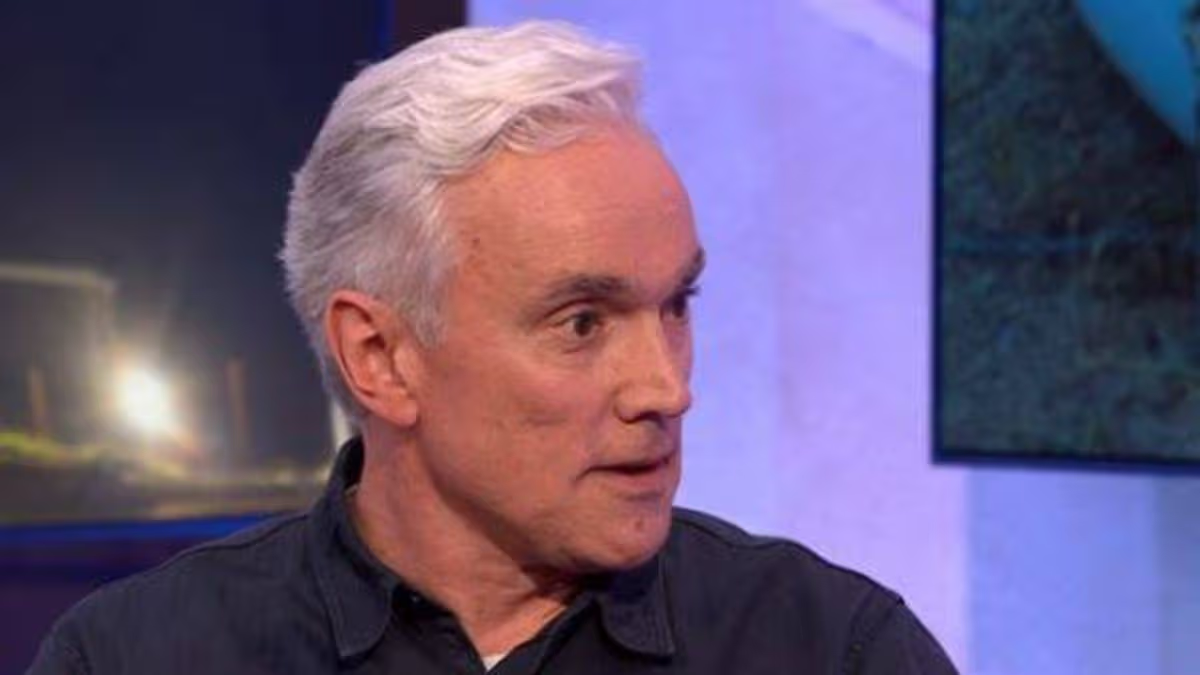
The actor, who played British Royal Air Force officer Peter Townsend in the royal drama, joins Adolescence star Ashley Walters in six-part series First Woman.
Ashley plays Ben Reith, who wakes up one morning to discover his wife Claire (Andrea Riseborough) has disappeared. It marks the beginning of an international news story “because Claire is an astronaut crewing the UK’s first moonbase and she’s disappeared into the long lunar night”, according to the broadcaster‘s synopsis.
Advertisement
It adds: “Claire is the first woman to set foot on the moon.
“A biologist taking part in a groundbreaking research project, her disappearance throws suspicion on her fellow astronauts and China’s rival base.
“With hundreds of thousands of miles between them, can Ben uncover the truth behind his wife’s disappearance?”
The cast also includes Pride and Prejudice star Jennifer Ehle and Alex Hassell, who will soon be seen reprising the role of Rupert Campbell-Black in the second series of steamy Disney+ hit Rivals.
Ben, who is also known for conspiracy thriller The Capture, is joining the cast of First Woman alongside The Tower’s Jimmy Akingbola, Fra Fee from Unchosen, You’s Kathryn Gallagher, Nautilus’ Shazad Latif and Neuromancer’s Christian Ochoa Lavernia.
Sharing the cast update on Instagram, ITV teased: “A groundbreaking project. A missing biologist. A mystery that reaches across the stars.”
Polly Hill, ITV’s director of drama, said the series would take viewers on “an incredible journey”, adding: “I wanted ITV to make this the moment I read it.
Advertisement
“The team that has come on board on and off screen is incredible, and a testament to the wonderful and original scripts.”
When the series was announced, creator Lydia Yeoman said: “Set in the exciting (and as-yet-unexplored) world of private space travel, First Woman is a thriller unlike anything else we’ve seen.
“This is the story of a marriage put through the ultimate test. It’s rare that you get given the opportunity to tell a story with such ambition and scope, and we’re eternally grateful to Polly at ITV and Alcon for allowing us to do that.”
Aija Cernevica, 30, struck and kicked the dog before strangling it to death.
A sick carer who battered and strangled a dog to death in front of children in a park has been struck off.
Advertisement
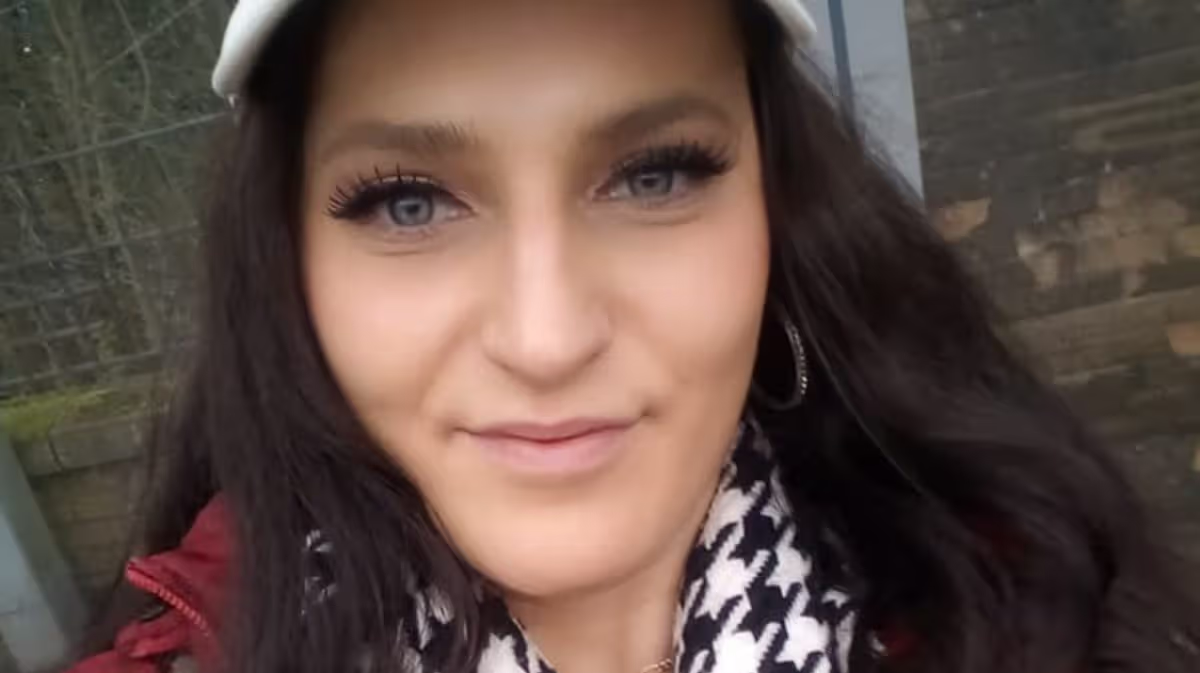
Aija Cernevica, 30, was banned from working in the profession on Thursday, May 7. The brute, of Kilbirnie in North Ayrshire, is currently in jail serving a three-year sentence for the depraved attack.
She was caged at Kilmarnock Sheriff Court after admitting the crime in January. Cops were called to the horrendous incident after receiving reports of a dog being assaulted at Orr’s Trust Public Park in Beith in May last year.
By the time officers arrived at the scene, the helpless pooch was found dead. The court heard how Cernevica repeatedly struck the dog, which was in her care, with her hands.
She then kicked and stamped on it, bit it and seized it by the collar.
Advertisement
Cernevica went on to swing the animal across a fence before going on to drag and throw it around the ground in front of horrified children.
Evil Cernevica then straddled the dog, pinned it to the ground with her body weight, held it by its throat and strangled it to death. She committed the sickening offence while on bail.
The details of the horrifying incident were laid bare during a Scottish Social Services Council (SSSC) hearing this week. The watchdog also revealed that Cernevica was in the possession of five blades when she launched the frenzied attack on the dog.
Advertisement
She was removed from the care register indefinitely.
A statement from the SSSC reads: “Your actions caused the suffering and death of an animal in your care. You reactions are likely to have caused significant emotional harm to members of the public who may have witnessed your behaviour. You engaged in a course of violent and abusive behaviour over the course of a day, which indicates a pattern.
“Your behaviour is indicative of significant attitudinal and values issues which have the potential to place others at risk of serious harm. Your actions amount to a significant abuse of power and trust, albeit that trust was not derived from your registrable role.
“The behaviours which led to your convictions were very serious. There are significant public protection concerns arising from your behaviour. We consider the public interest to be high and that the reputation of the profession could be damaged as a result of your behaviour. A finding of current impairment is necessary to maintain confidence in both the social services profession and the SSSC in an effective regulator.”
Advertisement
It concluded: “A condition would not be appropriate because there are no conditions which could be placed on you which would address why your fitness to practise is impaired. The type of behaviour at issue is not the type of behaviour which Page 5 of 6 conditions would rectify. You are not currently working in the sector. A condition would not be workable or enforceable.”
Get more Daily Record exclusives by signing up for free to Google’s preferred sources. Click HERE.
The One Show presenter Alex Jones has revealed there will be a change in scheduling
The One Show’s Alex Jones has announced the show will be taken off air.
Advertisement
The TV star shared the update as she hosted the latest instalment of the BBC programme, telling viewers that the show would not air on Friday (May 8).
While the magazine-style show usually airs from Monday to Friday at 7pm, she revealed this week’s final episode will not be broadcast due to local election coverage.
Alex, who was hosting the show on Thursday, May 7 with fellow presenter Roman Kemp, told viewers: “We are off tomorrow because of the election coverage.
“But we will be back on Monday with Sir Ian McKellen and star of Killing Eve and Grey’s Anatomy, Sandra Oh.”
Advertisement
As she signed off, Alex also said “Happy Birthday to David Attenborough”, who will turn 100 on May 8.
“Bye-bye, see you next week,” she said, as she and Roman waved at the cameras.
Thursday’s instalment of the programme saw the presenters welcome Springwatch host Chris Packham, director Jon Favreau and Pedro Pascal and Sigourney Weaver, the stars of The Mandalorian and Grogu film.
Advertisement
They were also ‘joined’ by Grogu, with Alex admitting she was “absolutely transfixed” by the green puppet.
“I’ve never seen you this starstruck before,” Roman remarked as he saw Alex’s reaction.
“Honestly, I just want him to come for a playdate,” she confessed. “Would he want to come?”
She asked director Jon what the puppet was like to work with, and he replied: “He is actually controlled by multiple puppeteers who have been working together with this character like a jazz quartet. Bryce Dallas Howard, who was directing during the television show, used to just talk right to him, and that started a tradition.”
Advertisement
Pedro added that Grogu was “an amazing scene partner” and that he was great “at improv”.
Viewers were also charmed, with one posting on X: “Grog on The One Show, how freaking cute.”
“The Grogu puppet is amazing, I want one, suspect he cost lots and lots of money,” someone else posted on the platform, which was formerly Twitter.
Advertisement
“Mesmerised by the Grogu puppet I can’t lie,” she said.
The One Show airs at 7pm on BBC One on weeknights.
Dwayne Johnson has shared how his outfit at this year’s Met Gala featured a subtle nod to his heritage.
Asked how he felt about the skirt on his way into the event, Johnson said (as reported by Variety): “I feel great!”
He explained that designer Thom Browne first sent his design plans over to Johnson’s team, asking: “Hey, is Deej going to be cool with this pleated skirt?”
“I was like, ‘Look, in our culture, Polynesian culture, we rock lavalavas, we rock skirts’,” he responded.
Advertisement
“The most masculine men – not that I’m one of them – but the most masculine men wear lavalavas and skirts,” Johnson added.
On Tuesday, Thom Browne’s fashion brand also posted footage of Johnson and his wife Lauren Hashian posing for photographers outside the Met Gala.
“Together, Dwayne and Lauren embody Thom’s vision of strength and elegance playing on the mortal and immortal duality of bodies past, present and future,” the post read.
The blaze broke out at the Billington Road bakery on May 4.
In an update issued at 2pm on May 6 the fire service confirmed crews have now left the scene.
Firefighters remained at the site as they worked to bring the incident under control and continue the investigation into the cause.
Advertisement
A spokesman for Warburtons said: “We can confirm there has been a fire at our Burnley bakery.
“Thankfully, everyone at site is safe and we are grateful for the hard work of the local fire service who remain on-site today.
“The fire is now under control and has [was] contained to one side of the building.
“When the site is safe, a full investigation will take place to determine the cause, and to assess the full extent of the damage.”
Advertisement
Production at the bakery was suspended and Warburtons increased output at its other UK sites to minimise disruption to supply.
The company said it is exploring options to scale up production across its 11 other UK bakeries.
At the height of the incident, 12 fire engines, specialist units, police, ambulance, and on-site staff were in attendance.
Lancashire Police and Lancashire Fire and Rescue Service have confirmed that the fire is not believed to be suspicious and remains under investigation.
Krums Sandwich Bar, on Greenwell Road, announced the news on social media.
The sandwich shop made The Northern Echo’s Best Sandwich Bar competition last year.
The business said the support it had received from its customers had meant a “great deal” throughout the years.
Advertisement
Writing on Facebook, Krums Sandwich Bar said: “We would like to inform you that, after much consideration, we have made the difficult decision to close our business permanently.
“This decision was not made lightly, but due to ongoing operational and personal circumstances, we are no longer able to continue.
“We want to sincerely thank everyone who supported us, visited us, and showed kindness throughout this journey. Your support has meant a great deal to us.
“We truly appreciate every customer and every memory shared with us.
Advertisement
“Thank you again, and we wish you all the best.”
Customers have been left devastated by the news, with one saying it was “such a shame”, with another adding: “That’s really sad.”
The 83-year-old had been observed earlier that day tearing pages from a magazine and placing them in her mouth
Changes are needed to the protocol used to dispose of used surgical gloves in care homes with dementia patients, a coroner has warned.
Advertisement
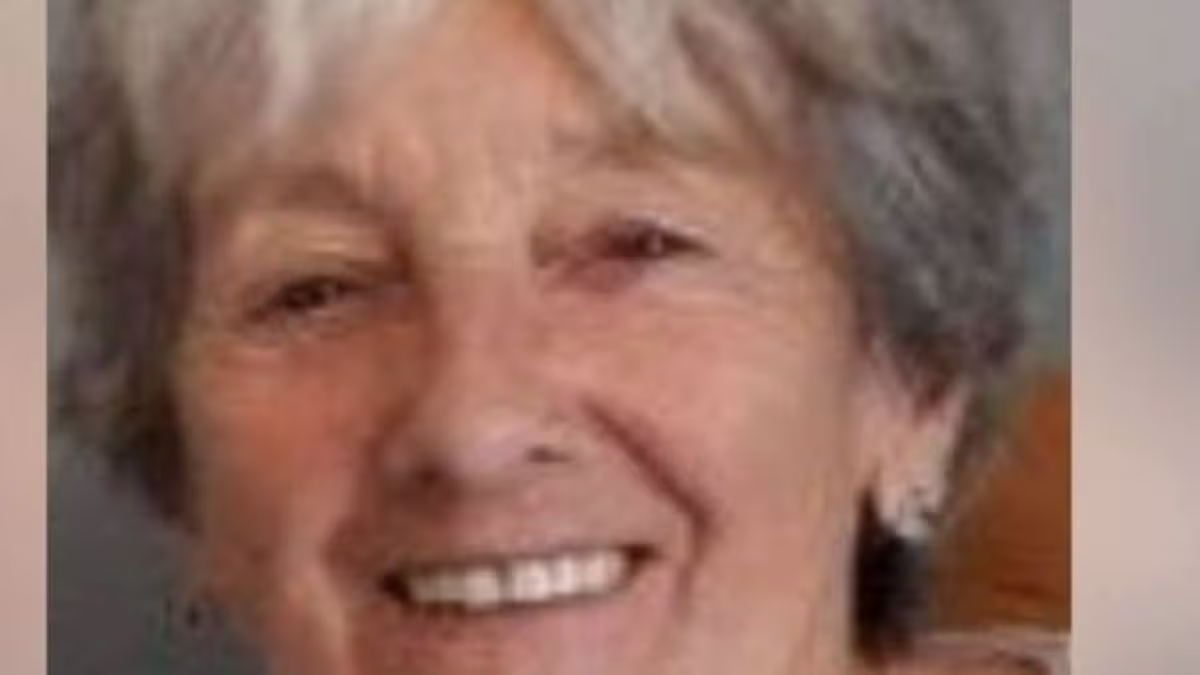
It follows the death of 83-year-old Margaret Wilson, who passed away on August 10, 2022, after choking on used surgical gloves she removed from a lidded pedal bin found in a bathroom in Oakridge Care Home. Ms Wilson had a diagnosis of dementia and Alzheimer’s disease and had been living in the care home in Ballynahinch since May 2022.
Earlier that day, Ms Wilson had been found tearing pages from a magazine and placing them in her mouth, with this being the first time she was observed placing foreign objects in her mouth. The 83-year-old was known for wandering the corridors of the care home and was known to be unsettled in the evenings, which is a recognised and common feature of dementia.
On Thursday, May 7, 2026, in an inquest hearing at Belfast Laganside Court the coroner delivered her findings into Ms Wilson’s death.
Advertisement
The inquest heard from Ms Wilson’s son, Andrew Wilson, who described his mother as a “stalwart” who was “well known and well regarded.” He said the family were satisfied with her care at Oakridge Care Home, and were “generally content” with her placement there.
The coroner heard from Kelly Kilpatrick, the manager of Oakridge at the time, that staffing levels were determined in accordance with guidelines issued by the Regulation Quality Improvement Authority, otherwise known as RQIA.
On the evening of August 10, 2022, there were three staff on duty; one nurse and two healthcare assistants covering the first floor for the duration of the night shift, which began at 8pm.
Healthcare assistant Louise Wilson said she observed Ms Wilson pacing along the corridor shortly before commencing her shift, and became aware she was tearing pages from a magazine and placing them in her mouth. The coroner said Miss Wilson responded to this incident “appropriately,” by reporting the matter to Nurse Badza, who she was on duty with.
Advertisement
The coroner said “it is not clear what steps were taken immediately” by Mr Badza after becoming aware Ms Wilson had been eating pages from a magazine. Mr Badza documented the incident in evaluation sheets, but the coroner found there does not appear to have been a documented review or any assessment of the surrounding environment.
Mr Badza told the inquest there was no opportunity to amend Ms Wilson’s care plan to highlight any risks associated with her ingesting foreign objects, as she had no history of this until the day of her death.
The inquest heard that Nurse Badza later found Ms Wilson leaning on a railing outside the nurse’s station on the first floor of the care home, before he assisted her to a nearby chair, where she “quickly became unresponsive.”
The coroner found he appropriately sounded the emergency buzzer and shouted for assistance from colleagues, prompting the immediate attendance of two care assistants and the nurse on duty on the ground floor. He also contacted emergency services.
Advertisement
Ms Wilson was moved to the floor for CPR, with the coroner accepting that Miss Wilson tilted the deceased’s head back to check her airway and saw a blue item at the back of her throat. Miss Wilson then retrieved what transpired to be a pair of blue surgical gloves, which were used due to the manner in which they were rolled into one another.
Although it isn’t possible to determine exactly where Ms Wilson came by the used gloves, the coroner found “on balance” she is satisfied they were removed from a lidded pedal bin located in a bathroom on the first floor of the care home.
CPR efforts were sustained for a “considerable period of time” with a defibrillator also employed by care home staff. A “do not resuscitate” instruction had been placed on Ms Wilson’s file prior to her placement at Oakridge Care Home, and it was unclear whether this was still present.
However, the coroner found the resuscitation efforts deployed by staff were “appropriate, reasonable, and necessary” in what “cannot be considered a naturally occurring event.”
Advertisement
Following resuscitation efforts by both care home staff and paramedics, Ms Wilson’s life was sadly pronounced extinct at 11.20pm on August 10, 2022. The coroner found her death was the result of asphyxia caused by choking on surgical gloves.
Following Ms Wilson’s death, surgical gloves in Oakridge Care Home are now stored in secure cupboards along the corridors, which can only be opened by a magnetic key. The coroner commended taking this step to reduce risks, however, highlighted that the procedure for the disposal of used gloves “remains unchanged” and they continue to be discarded in pedal bins.
The coroner has called for changes to be made to this protocol, and intends to write to the relevant authorities to highlight this.
She said: “I acknowledge that this is compliant with the applicable regional protocol for waste disposal and is deemed necessary for infection control. However, it is wholly conceivable that such an incident could occur again in the future, whereby a resident in the care home could remove items from a bin and place them in their mouth, which could potentially lead to choking and possible death.
Advertisement
“I therefore intend to write to both the Department of Health and RQIA, including a copy of these findings, with a view to highlighting the risks associated with little pedal bins as a waste disposal system, particularly to patients suffering from dementia, and urge them to consider implementing and utilising a safer method of waste disposal in residential units where patients with dementia reside.”
The coroner closed the inquest by giving her condolences to Ms Wilson’s family.
Science has offered a boost to self-identified ‘night owls’, confirming that some individuals naturally operate on a later chronotype, or sleep pattern, than early risers.
An Imperial College London study further found that these night owls, particularly older individuals, demonstrated superior performance on cognitive tests during their preferred mental peak.
This cognitive advantage was observed to be less pronounced among younger participants.
Nonetheless, most would agree the world is stacked in favour of early risers. But a 2024 study by Stanford researchers (published in Psychiatry Research) found that it’s not all unfounded bias – falling asleep past a certain hour seemed to be linked to worse ageing, regardless of chronotype.
Advertisement
How does bedtime affect ageing?
The study looked at the mental health and sleep patterns of 73,888 participants from the UK Biobank.
The researchers wanted to look at how our natural preference for sleep, combined with how we actually slept, affected our mental wellbeing.
night owls who went to bed later (aligned evening types),
night owls who slept earlier than they preferred (misaligned evening types),
morning larks who got up early (aligned morning types),
and early birds who slept later (misaligned morning types).
Misaligned morning types had a higher risk of mental health conditions like depression and anxiety.
But night owls who didn’t get to sleep as late as they wanted to had lower incidences of those conditions.
Advertisement
This surprised the researchers, who had expected better mental health among people who slept when their chronotype wanted them to.
Dr Jamie Zeitzer, lead author of the study, told Stanford: “We found that alignment with your chronotype is not crucial here, and that really it’s being up late that is not good for your mental health.”
The study was run on middle-aged to older adults – 14% of people over 60 worldwide have mental health issues, which can affect our physical wellness too.
Per the paper: “To age healthily, individuals should start sleeping before 1am, despite chronobiological preferences.”
Advertisement
Why would that be?
This paper only looked at existing health data, which means it didn’t find a cause – only an association.
Dr Zeilter himself said his team thought the data “didn’t make any sense” and spent six months trying to disprove it, but couldn’t.
While he has no firm reasons for the link, though, Dr Zeilter theorised that it could be down to the decisions we make when we hit our mental stride.
Advertisement
“If I had to hazard a guess, morning people who are up late are quite cognisant of the fact that their brain isn’t working quite right, so they may put off making bad decisions,” he told Stanford.
“Meanwhile, the evening person who is up late thinks, ‘I’m feeling great. This is a great decision I’m making at 3 o’clock in the morning’.”
He also suggested that “there are fewer social constraints late at night because you have fewer people around who are awake”.
The special offer is for one day only tomorrow in honour of the legendary natural history broadcaster.
A spokesman said: “As Sir David reaches this incredible milestone, we’re honouring the impact he’s had on wildlife conservation, education and inspiring generations to care about the natural world.
“For decades, Sir David Attenborough has brought the wonders of the natural world into homes across the globe, inspiring millions to better understand and protect wildlife.
Advertisement
“At Knowsley Safari, those same values are at the heart of everything we do — from supporting endangered species breeding programmes to educating future conservationists through immersive learning experiences.
“Many of our own team members were inspired by Sir David’s work to pursue careers in conservation and animal care.”
How to Claim Your Free Ticket
Your name, or one of your party’s name, must have the first name David.
Pre-book the rest of your group online (all the non-Davids)
Bring valid photo ID showing your name with you
Show at the pay lanes when you scan the rest of your group’s ticket
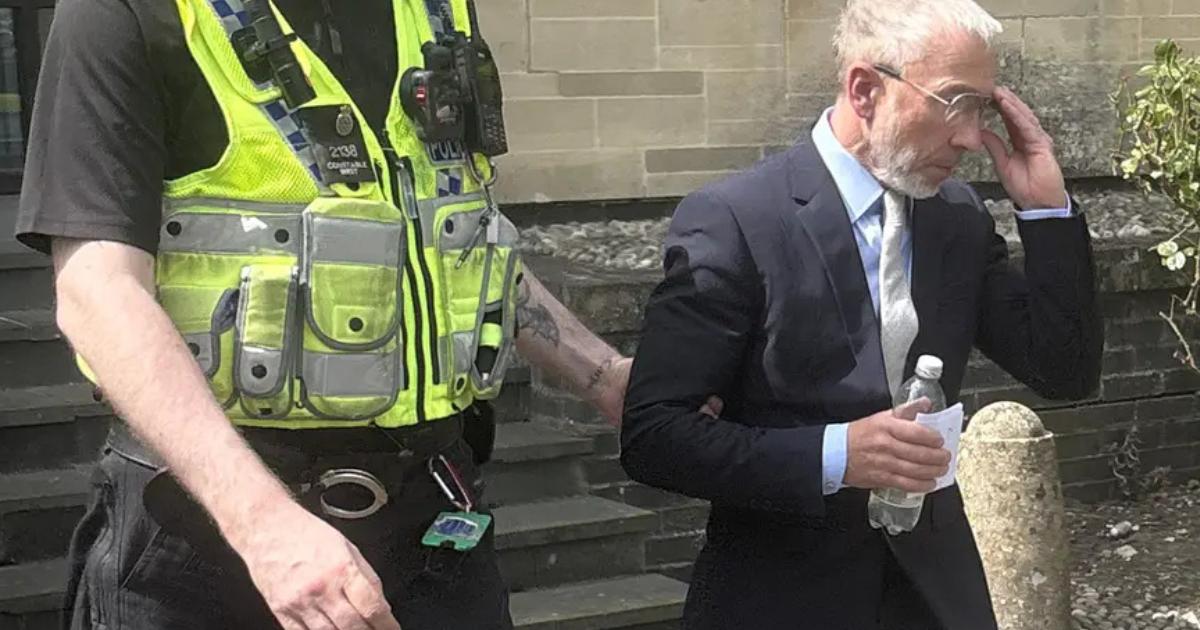
James Holder, 54, had gone back to the woman’s home, went to the toilet and then promptly fell asleep on her bed snoring.
The multi-millionaire fashion boss then woke up and beckoned the woman, who was trying to sleep in the lounge, into her bedroom and raped her.
Holder had denied charges of assault by penetration and rape and said what sexual activity took place between them was consensual.
Advertisement
A jury at Gloucester Crown Court, sitting in Cirencester, acquitted Holder of assault by penetration but found him guilty of rape after deliberating for four hours.
The defendant, of Cheltenham, Gloucestershire, was remanded into custody ahead of sentencing at Bristol Crown Court today (May 7).
At Bristol Crown Court today, Recorder David Chidgey told Holder that he had committed a “despicable piece of sexual violence”, reports the BBC.
Holder appeared via video link from prison and was said to have shown no reaction when the sentence was given.
Advertisement
Holder’s victim said, in a statement read to the court, he had taken her “choice, dignity and body”.
She added: “What you did that day has followed me, it has cast shadows where there should be light.”
In his 1873 book On War, the great Prussian military strategist Carl von Clausewitz wrote that: “War is the realm of uncertainty.” He would have been at home in Washington this week where Clausewitz’s “fog of war” appears to have descended on the White House, at times obscuring reality.
On Tuesday, the US secretary of state, Marco Rubio, briefed reporters that the US plan was to get the Strait of Hormuz “back to the way it was: anyone can use it, no mines in the water, nobody paying tolls”.
This was, of course, the way things were before the war actually started.
But uncertainty about what this war was actually all about has been a hallmark of the past two months. When the conflict began on the last day of February, the US said it was about preventing Iran from developing a nuclear weapon. Although the US president, Donald Trump, added a layer of complexity by saying it was also about regime change.
Advertisement
Trump’s closest ally, the Israeli prime minister, added another later by insisting this was also about getting rid of Iran’s ballistic missiles and launchers and neutralising its proxies in the region.
Christian Emery, an expert in international relations at University College London – who specialises in US-Iranian affairs – sees this lack of coherence about what the war is for as underscoring “that this entire enterprise has been a colossal strategic failure”.
As things stand it now appears possible that an interim deal could well open the Strait of Hormuz to allow the global economy to return to something like normal. But the main reasons the US and Israel launched the war are unlikely to be resolved any time soon and the episode has proved to Tehran – and the rest of the world – that Iran can use its geography to its strategic advantage whenever it chooses.
For Bamo Nouri and Inderjeet Parmar, experts in international security at City St George’s Unversity of London – who have been regular contributors to our coverage of the conflict – the episode has been an object lesson in the limits of power. The US and Israel exercised considerable military superiority to Iran and have used it to devastating effect. But this is not how conflict works in the 21st century.
The US and Israel were chasing different outcomes so there was no strategic coherence to their war aims. And they underestimated Iran’s durability under pressure. Iran didn’t need to win, just to endure. “As the war progressed” they write, “the fantasy of decisive victory collapsed under the weight of economic, political and strategic reality”.
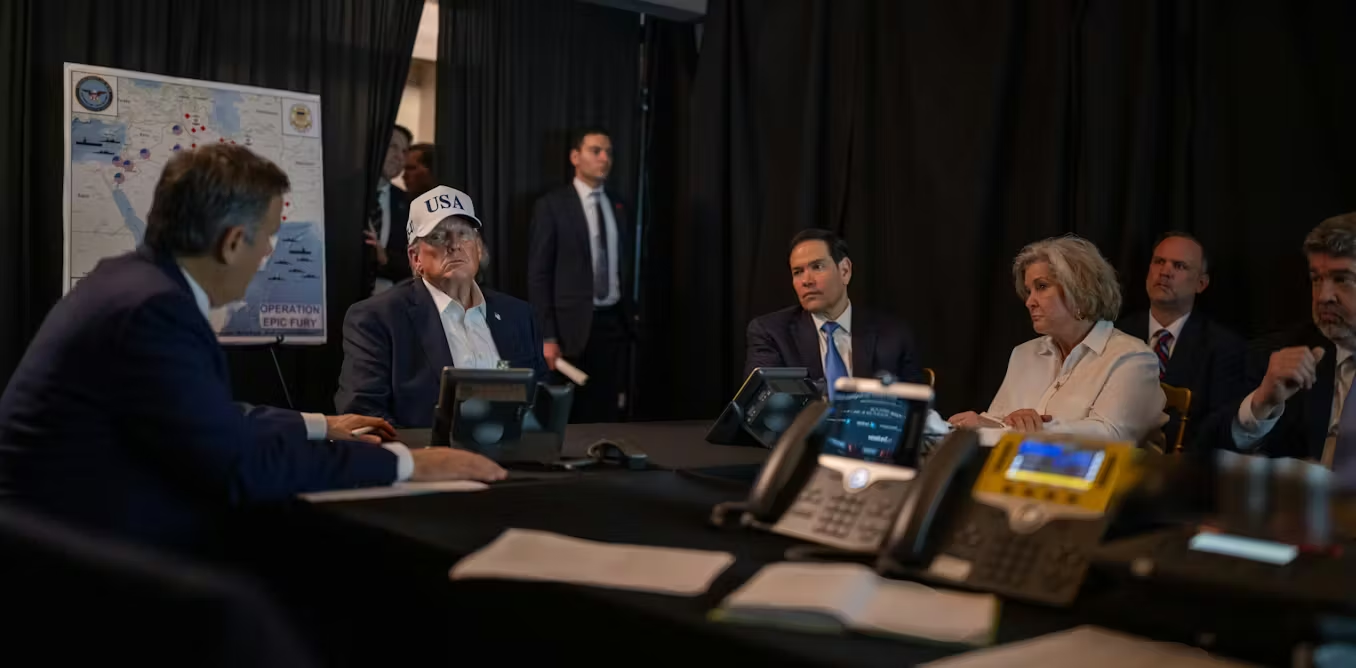
Interestingly, the Trump administration is now saying that Operation Epic Fury finished about a month ago. US forces are now engaged in Project Freedom, a humanitarian operation to help ships stranded in the Strait of Hormuz to transit the waterway.
Advertisement
As Andrew Gawthorpe, an expert in US foreign policy from Leiden University, notes, this change of emphasis appeared to emerge as Republicans in Congress were insisting that the administration was legally obliged under the War Powers Act to seek authorisation for the conflict.
Gawthorpe believes the war’s unpopularity is allowing Congress to claw back some of the influence it had over the way the US uses its military.
As we’ve noted before, the main theme of the past few weeks, since the US launched its blockade of Iranian ports to match Iran’s closure of the Strait of Hormuz, is which side can absorb more pain and pressure. US consumers are facing increased prices at the gas pumps which has fed through to a higher inflation rate generally.
Advertisement
But the headline US CPI increase of 3.3% last month is dwarfed by inflation in Iran which is reported to have hit 50%. It’s worth noting that it was inflation and the general economic malaise which kicked off the huge protests that wracked Iran in January.
The oil price shock is feeding into fuel prices in America, undermining support for the Trump administration. EPA/John G. Mabanglo
More pressingly, Iran’s inability to export its oil thanks to the US blockade means that sooner of later it will need to close down its oil production. As engineers and oil production experts Nima Shokri and Martin J Blunt explain, this can be done, but it’s by no means easy and risks seriously damaging the wells.
They’ll be watching this all very closely in Beijing of course. The US president is due to visit Beijing next week to meet Xi Jinping for the first time since the two met on the sidelines of the Apec conference in South Korea last October.
Advertisement
So it was interesting to see that Iranian foreign minister, Abbas Araghchi, visited Beijing this week to meet with his Chinese counterpart, Wang Yi. In normal times, China buys between 80% and 90% of Iran’s seaborne oil exports – and it has been very clear that it wants to see the Strait of Hormuz opened and “a complete cessation of fighting…without delay”.
But China-watcher Tom Harper of the University of East London, believes that Beijing can see advantages in the US getting bogged down in a fullscale war in the Middle East and might go as far as to offer military support to Tehran if that happens. While China has denied providing shoulder-launched Manpad missiles to Iran, Tehran is using its BeiDou satellite navigational system (a sort of Chinese GPS) to aim its missiles.
If you find these expert takes on an increasingly dangerous world useful, please consider supporting us with a donation.
Wang also said that China recognises Iran’s “legitimate right to the peaceful use of nuclear energy” – something it sees as a sovereignty issue. Which should all make for an interesting encounter between Trump and the Chinese president, Xi Jinping (if the trip goes ahead, that is).
The surprise player in all this has been Pakistan, writes Natasha Lindstaedt, an international affairs expert at the University of Essex. But as Lindstaedt points out, Pakistan has a long diplomatic track record with both the US and Iran. In 1981, two years after Washington and Tehran severed relations in the wake of the revolution that brought the Islamic Republic into being, Pakistan established a dedicated section of its Washington embassy to handling Iranian affairs in the US.
Washington and Islamabad have had their ups and downs, but things have grown closer with Trump in the White House – and Pakistan has tried to do all the right things to court Trump, including nominating him for the Nobel Peace Prize and joining his board of peace. Lindstaedt walks us through this intriguing ménage à trois.











































You must be logged in to post a comment Login