The pub used to be a hive of activity but has been empty for many years.
Movement spotted at derelict Zebra pub in Cambridge
Cambridge is a city known for its high density of pubs. Whether you are looking for somewhere to soak up the sun next to the River Cam in summer or want a historic pub with a roaring fire in winter, the city has plenty of options for drinking spots.
However, over the years, the city has lost a lot of its popular pubs that many residents might remember. Found on the busy Maids Causeway, the Zebra is one of the lost pubs in the city that has been boarded up for a number of years.
The old Zebra pub building is right next to the Grafton Centre, which is currently being redeveloped into new labs and offices. References to the pub date back to 1861, and it has gone through a range of different landlords.
The pub was known for its “excellent pizzas” and was described as being “always busy and well regarded” by people in the area. The Zebra was briefly closed to allow for it to be refurbished and opened under new management in September 2010.
Advertisement
The reopening didn’t last long, as the pub closed for good in 2011. It briefly opened as a toy shop with people living in the accommodation upstairs. According to CAMRA, “a string of licensee changes left it somewhat in limbo”.
After the toy shop closed, the building was boarded up and a planning application was approved in 2014 to turn the building into student accommodation for Anglia Ruskin University. A second application was submitted in 2017 to completely demolish the Zebra pub.
Advertisement
The plan was to build six new two-bedroom apartments. Since the second application was proposed, little to no work has been done to the Zebra pub over the last few years. The building has now been covered by scaffolding and plastic sheets.
If you are walking past the pub any time soon, you might notice some builders going in and out of the area. It is still not known what will happen to the building but it does seem like there have been some developments. Cambridge City Council was approached for more information about the planning process regarding the Zebra.
Del Naja, whose Bristol-based trip hop collective is best known for the classic 1990s hit Unfinished Sympathy, added: “I think that the actions of Palestine Action were highly patriotic because they were pretty much protecting our country from getting involved in serious war crimes, and breaking international law. How much more patriotic can you be than that?”
This week, the host was accompanied by Richard Ayoade, Alex Jones, Stephen Bailey, Nadia Jae, Gyles Brandreth and Roisin Conaty.
Nevertheless, certain viewers were underwhelmed by the episode, with some labelling the questions “ridiculous”, reports the Mirror.
Writing on X, previously known as Twitter, one viewer commented: “Not funny anymore really. Maybe past its selll by date and celebs aren’t good #BlanketyBlank.”
Another contributed: “The blank questions don’t seem to be like they used to be. #blanketyblank.”
A third individual stated: “Most of the questions are so ridiculous with no obvious answer. No wonder they don’t score. #blanketyblank.”
Advertisement
Someone else shared: “#BlanketyBlank questions are a lot more random than there used to be.”
ITV The Chase host Bradley initially began presenting Blankety Blank six years ago, succeeding the late Paul O’Grady.
He has invited numerous major celebrities onto the programme including Joanna Lumley and Alison Hammond, though not all well-known personalities are enthusiastic.
Bradley previously revealed to The Sun: “I tried to persuade Jodie Whittaker and Mandip Gill from our Doctor Who days to come on.
Advertisement
“They won’t have it because they’re frightened to make themselves look a bit silly but that’s what it’s all about. For me, you’ve got to come on and have some fun. You really do.”
The programme, which originally launched in the 1970s and was presented by the late Terry Wogan, features high-profile celebrities assisting participants in completing the missing words in questions posed by Bradley.
The latest series showcases famous faces including Jonathan Ross and Julian Clary on the celebrity panel.
Advertisement
When questioned about whether they engaged in any “mischief”, Bradley responded: “Well, loads! Jonathan Ross especially, he’s really the only person who’s a non-comedian but he’s got a wealth of experience.
“He’s so funny and Julian’s obviously steeped in this sort of stuff. So his dry remarks, his dry wit is perfect for the show, it really is.”
Blankety Blank continues Saturday, April 18 on BBC One and BBC iPlayer
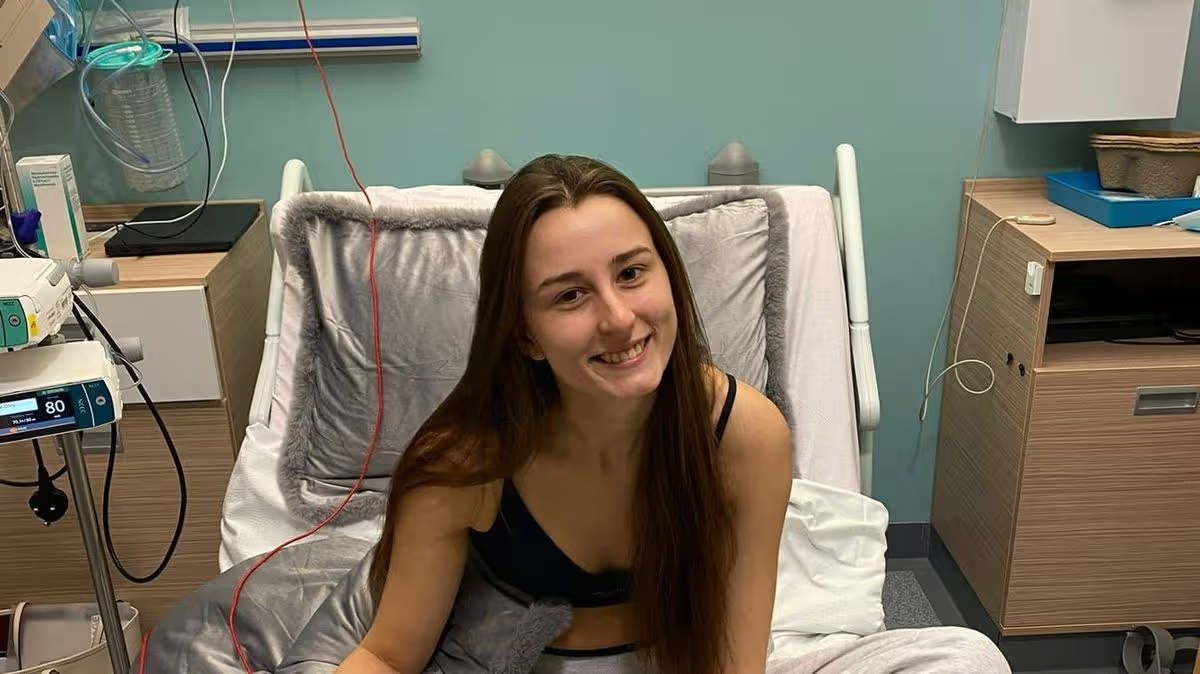
Grace Measor, 19, died on Friday, due to complications following a stem cell transplant. She had written letters to her family and friends to be opened in the event of her death, urging them to live their lives to the fullest
23:43, 11 Apr 2026Updated 23:50, 11 Apr 2026
The devastated parents of a Hartlepool teenager who lost her courageous battle with leukaemia have described her as “a gift to the world.”
Grace Measor passed away on Friday as a result of complications following a stem cell transplant. The kind-hearted 19 year old had penned letters to her loved ones to be opened upon her death, encouraging them to embrace life to the fullest and reassuring them “it’s okay”. The letters are bringing enormous comfort to dad Graeme, mum Nichola and sister Sophie, 17, as they struggle to come to terms with their heartbreaking loss.
Diagnosed with acute lymphoblastic leukaemia in 2017, Grace’s initial treatment proved successful and she went on to excel at school, college and university before embarking on a career as a scientist with Johnson Mathey. Graeme and Nichola revealed she had dreamed of travelling the world and pursuing a career in research and development into renewables.
“Basically she wanted to save the planet,” said mum Nichola, 51, an occupational therapy care assistant. Graeme, who works as a senior lecturer at Teesside University, said they watched her flourish into “an absolutely amazing woman” after previously conquering the leukaemia.
“As parents, we decided at that point, that she had earned the right to do anything she wants,” he said. “She got a travel bug and wanted to go places and if we could possibly make it happen we said yes and I’m glad we did.” Grace’s travels took her to Nepal, Turkey, Florida, Spain, Austria and France. “We took the opportunities when they arose – we made memories not material things,” Nichola explained, reports Teesside Live.
Advertisement
“Grace managed to make friends and collect people everywhere she goes. She is just loved in all directions, whether it was at school, college or work.”
Grace was a pupil at Seaton Holy Trinity Primary School and Dyke House Academy in Hartlepool before continuing her studies at Middlesbrough College, then securing a degree apprenticeship at Manchester Metropolitan University. While at college, she entered a chemistry competition and reached the national finals in Cardiff.
However, on her journey to the contest, she started experiencing excruciating back pain. Following multiple hospital visits and examinations, her parents took her to the RVI in Newcastle in December, where a blood film confirmed their worst fears – her leukaemia had come back.
Advertisement
“The consultant said, ‘you will have to go to the Freeman Hospital for a stem cell transplant,’” Graeme, 52, recalled. “She was told the treatment for the bone marrow transplant was total body radiation, followed by really strong chemotherapy to kill the bone marrow and then you get the stem cells which is an infusion.
“She was told it would make her sterile so, in order to preserve her fertility, she was brave enough, prior to coming in, to go to the RVI and have one of her ovaries harvested and frozen so that in the future she could have babies. At 19 to make that decision – her heroism was just unbelievable.”
After the treatment, Grace developed a chest infection and rare complications which struck her body simultaneously. This resulted in a catastrophic brain injury with no prospect of recovery, and the heartbreaking decision was taken by doctors to withdraw treatment. Grace passed away in the arms of her devoted parents and sister. She had penned letters to her family and friends to be opened if she didn’t survive treatment.
“They are full of so much maturity for somebody so young and they are giving us so much comfort,” said Graeme. “One of the lines says: ‘When you walk the dog along the seafront, I’m in the roaring of the ocean, I’m in the air that you breathe, I’m at one with nature, and it’s okay’.
“She said, ‘go and live your life for me’. She was so brave, she was our amazing Grace. She doggedly, determinedly fought every single thing. She beat it but in the end the toll was just too many things. She was a gift to the world. She was pure of heart and soul, kind, generous and all the best attributes you could wish to have in a human being.
“The important thing we want to get across is love your kids, you never know when anything could change. And register for stem cell treatment- it’s literally a transfusion, it’s not an invasive thing and it’s almost painless. And blood donation. Grace had so many transfusions. It’s a simple thing to do and you save someone’s life.”
Rather than cards or flowers, the family has asked well-wishers to donate to the wards at the Freeman Hospital, whose devoted care for their daughter they described as “second to none”.
Advertisement
Funds raised via the JustGiving page have already reached £7,000, which will go towards the hospital wards and a cancer research charity the family are currently looking into, with the aim of helping others in Grace’s situation. The JustGiving page is here.
Commander Reid Wiseman and crew return to Earth after historic moon mission, breaking Apollo 13’s distance record and witnessing the lunar far side
Astronaut Reid Wiseman has declared it is a “special thing to be on planet Earth” as the Artemis II crew described what it was like aboard their record-breaking journey around the Moon.
Advertisement
The Artemis II astronauts brought humanity’s first lunar voyage in more than 50 years to a close with a Pacific splashdown on Friday.
It was a breathtaking finale to a mission that not only unveiled vast stretches of the lunar far side never previously witnessed by human eyes, but also captured a total solar eclipse and a procession of planets — most strikingly our own glittering Earth set against the infinite black expanse of space.
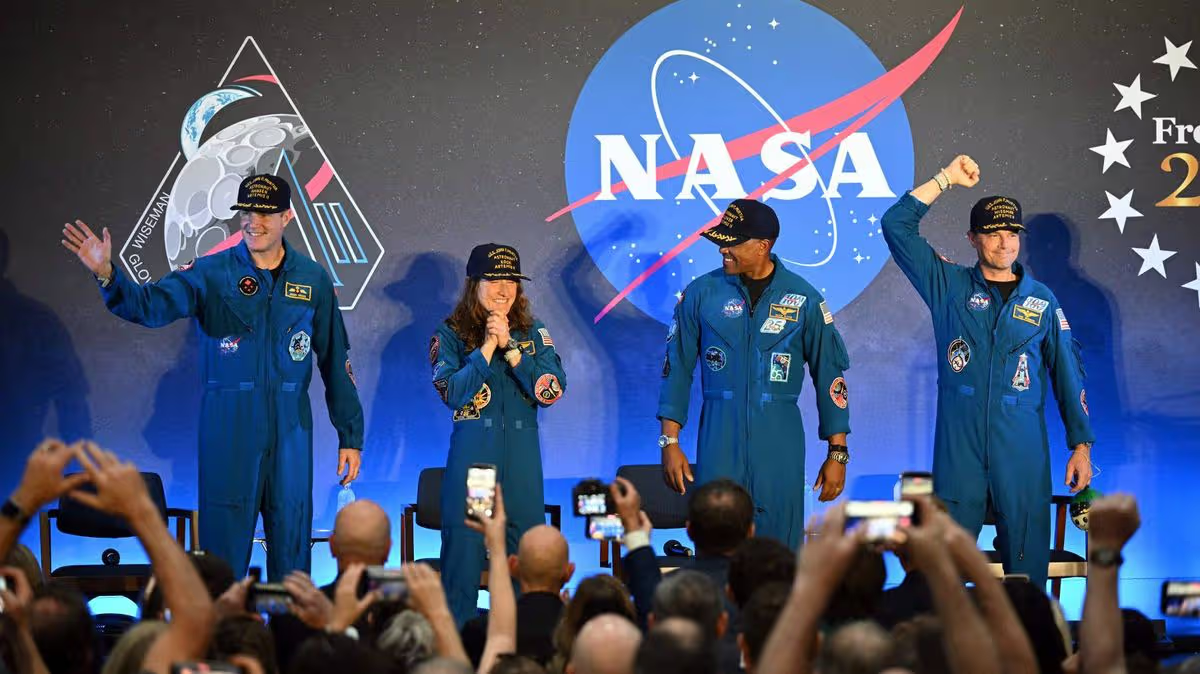
The crew were greeted with a standing ovation and rapturous cheers as they strode out to meet NASA chief Jared Isaacman in Houston.
Commander Reid Wiseman opened his address to the crowd by saying: “I have no idea what to say” before turning to his three crewmates and declaring “we are bonded for life”, reports the Mirror.
The four-strong crew touched down at Ellington Field, near NASA’s Johnson Space Center and Mission Control, having flown in from San Diego where they had splashed down just off the coast the previous evening.
Following a brief but emotional reunion with their partners and children, the astronauts took to the hangar stage, surrounded by space centre staff and specially invited guests.
Texas congressman Michael Cloud spoke of how the triumph of the Artemis mission must now serve as a springboard for the future. “Thank you for all you’ve done to inspire us,” he told the four Artemis 2 astronauts. “Us as a nation desperately needed this, the world needed this… You’ve inspired us and you’ve given us something we can build upon for the future.” Astronaut Victor Glover then spoke, saying: “The gratitude of seeing what we saw, doing what we did and being who I was with, it’s too big,” while also thanking their families for their support.
Advertisement
Christina Koch described how the journey began 10 days earlier “with our mission manager knocking on my door,” before adding “it ended last night when my nurse on the ship put me to bed and said, ‘Ma’am, can I get a hug?’ A lot has happened between those two moments but the start and the end were human events on Earth.”
Jeremy Hansen expressed his desire to share the human side of their experiences, beginning with “gratitude” towards his family, NASA and the Canadian space agency, alongside praising the “bravery and courage” of everyone taking part in the mission.
Among those gathered were NASA Administrator Isaacman, flight directors and the launch director, Orion capsule and exploration system managers, senior military officers, the space agency’s full complement of blue-suited astronauts including retired personnel, and numerous others.
Advertisement
Wiseman and his U.S.-Canadian crew’s return held particular significance: They arrived back at their Houston base on the 56th anniversary of Apollo 13’s launch, whose “Houston, we’ve had a problem” call turned potential catastrophe into legendary success.
Throughout Artemis II’s almost 10-day mission, they travelled further into space than the lunar pioneers of previous generations and captured images of the moon’s far side never before seen by human eyes. A total solar eclipse enhanced the celestial spectacle. During their record-shattering flyby, the astronauts reached a peak distance of 252,756 miles (406,771 kilometres) from Earth before looping around the far side of the moon, surpassing Apollo 13’s long-standing distance record.
The mission also offered a breathtaking new perspective of our planet, capturing an Earthset photograph depicting our Blue Marble descending behind the moon’s grey, crater-scarred surface. The striking image drew comparisons to the iconic Earthrise photograph captured in 1968 by the world’s first lunar travellers, Apollo 8.
Advertisement
Despite these remarkable achievements, the Artemis II astronauts were forced to grapple with a rather more prosaic headache – a faulty space toilet. NASA has pledged to redesign the unit ahead of lengthier moon-landing missions.
Wiseman, pilot Victor Glover, Christina Koch and Canada’s Jeremy Hansen became the first humans to journey to the moon since Apollo 17 brought NASA’s inaugural era of lunar exploration to a close in 1972. Twenty-four astronauts travelled to the moon throughout the Apollo programme, among them 12 who walked on its surface.
Apollo 13 commander Jim Lovell – who also flew aboard Apollo 8 – sent his encouragement to the Artemis II crew via a wake-up message recorded before his death last summer.
The success of Artemis II was vital for NASA. The space agency is already gearing up for next year’s Artemis III, during which a new crew will practise docking their capsule with a lunar lander in Earth’s orbit – laying the groundwork for the pivotal Artemis IV moon landing in 2028, when two astronauts will attempt to touch down near the lunar south pole.
There’s nothing more predictable than a boxer retiring for the umpteenth time only to step back into the ring. So it’s no shock to see Tyson Fury back again, talking a good game about getting his world-title belts back.
The former heavyweight champion is back and set to fight Arslanbek Makhmudov at the Tottenham Hotspur Stadium this evening. And, it’s no surprise to hear him being optimistic.
“Whoever has the belts I want to get them back. I was undefeated for 17 years and took it for granted,” he said at Friday’s weigh-in in London.
Advertisement
“I had two losses in a row and I’m not the hunted now but I’m the hunter. It feels great to be the young, fresh hunter again.
“I want to make a statement, so I’ve come in nice and light and lean.”
The defeats he talks about are the back-to-back loses against Oleksandr Usyk, both in 2024. Before then he was unbeaten and he says a decent time in the sun in Thailand was all he needed to get back to thinking about boxing again.
“I was feeling so good I thought I’m just going to go into camp over here [in Thailand], train over here and get a fight. And that’s exactly what I did. I had zero intentions of making a comeback when I came here in December, none, I was happily retired,” Fury said of his time in south-east Asia.
Advertisement
“And then the sunshine, a bit of training and one thing led to another and next thing I’ve signed a massive contract.
“The next thing it’s at Tottenham Hotspur Stadium and the world’s going to watch it.”
The record of Fury’s Russian opponent is 21-2, with 19 of his wins coming by way of knockout. His most recent bout was against David Allen in October 2025.
Stay here for all the big-fight action and best of the undercard, with the ring walks expected just gone 10pm.
On April 10, Artemis II – humanity’s first mission to the Moon in more than half a century – will draw to a close when the Orion capsule carrying four crew members detaches from its service module.
The capsule will then make a fiery plunge towards Earth, travelling at a speed of 25,000 miles per hour. As it plummets through the atmosphere, Orion’s heat shield will encounter temperatures of more than 1,600°C as the spacecraft decelerates rapidly.
A series of 11 parachutes will deploy in sequence to bring Orion to a relatively sedate 25mph splashdown off the coast of San Diego in California. Splashdown will round out a remarkable flight which took the astronauts Reid Wiseman, Victor Glover, Christina Koch and Jeremy Hansen on a looping lunar flyby.
Clockwise from left: Artemis II astronauts Christina Koch (mission specialist), Jeremy Hansen (mission specialist), Reid Wiseman (commander), Victor Glover (pilot). Nasa
Reaching a distance of 252,756 miles from Earth, they travelled further from our planet than humans have ever been – exceeding a record set by the crew of Apollo 13 in 1970.
The four-day journey out to the Moon was remarkably smooth, barring a few minor hiccups. The capsule’s 3D-printed titanium toilet malfunctioned early in the flight and had to be fixed by mission specialist Koch who, during a group interview, declared: “I’m the space plumber!” A communications dropout about 50 minutes into the flight was quickly resolved.
The Moon is tidally locked to Earth, meaning it completes one rotation on its axis in the same time it takes to orbit the Earth (28 days). This means we always see the same face of the Moon.
The night side of Earth, captured by Reid Wiseman during Orion’s journey to the Moon. Green aurora can be seen over the North and South magnetic poles. The planet Saturn is visible bottom right. Nasa
The lunar far side therefore remains permanently out of view from Earth, and has often been referred to as the dark side of the Moon. In fact, it receives just as much sunlight as the near-side face.
The two faces are, however, remarkably different. On the near side, the darker regions (the lunar maria) that we can see from Earth are vast smooth plains of solidified, iron-rich lava.
This lava has been gradually powdered by meteoroid impacts over the aeons. The lighter regions we see are comprised of mountains and densely packed impact craters.
The stages of Orion’s flyby of the Moon. Nasa / Gareth Dorrian
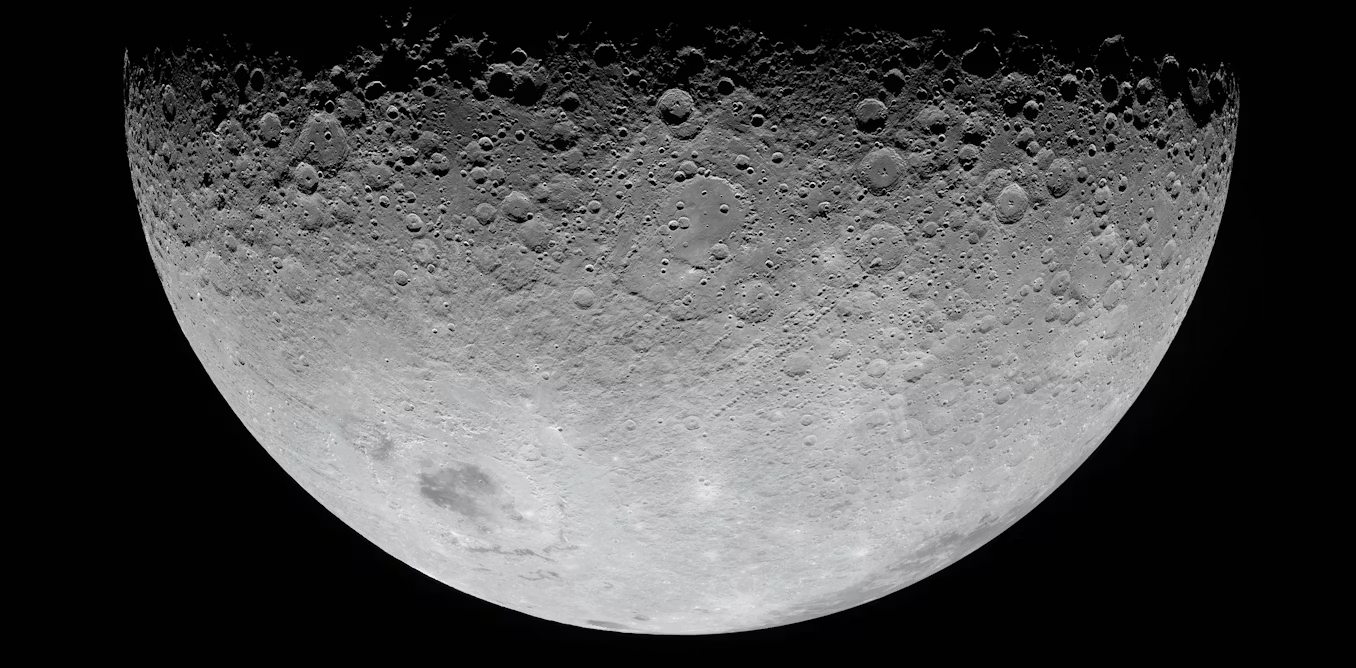
Compared with the face we see from Earth, the lunar far side is extraordinarily rugged. It is peppered with impact craters and has very few smooth lunar maria. Why this disparity exists is still debated.
The Artemis II astronauts were struck by this difference during their flyby, remarking on the shadows cast by lunar topography near the far-side terminator (the boundary between day and night).

Orion’s loop around the Moon brought the crew to a distance of 4,067 miles from the lunar surface. From this remarkable vantage point, high over the lunar far side, the astronauts were treated to a grand view of the full lunar disk.
Advertisement
Mare Orientale at the centre of the lunar far side has a ‘bullseye’ appearance. The image also reveals the ruggedness of the terrain near the day-night terminator (top right). A portion of the near side, Oceanus Procellarum (Ocean of Storms), is visible on the left. Nasa
They captured some beautiful imagery of our nearest, yet still-enigmatic celestial neighbour.
One of the few distinct far-side maria is Mare Orientale, a circular bullseye-like impact basin which was subsequently flooded with lava.
Orientale was formed by a powerful impact some 3.8 billion years ago, towards the end of the Late Heavy Bombardment – a surge of enormous meteorite impacts which struck the planets of the inner Solar System. Mare Orientale measures 180 miles across, roughly the distance between London and Leeds in the UK.
Advertisement
Artemis II astronauts describe the lunar flyby (Associated Press).
One advantage of sending astronauts to directly view terrain like this is the human eye. Despite the advances of modern imaging technology, our eyes are still one of the best instruments for perceiving colour.
While high over the lunar far side, the astronauts reported seeing not just shades of grey on the lunar surface far below them but also subtle tones of browns and greens, hinting at the complex mineral make-up of this ancient terrain.
During their flyby, the crew also observed two unnamed craters which they named Integrity, after their spacecraft, and Carroll, after Wiseman’s wife who died of cancer in 2020 aged 46. Canadian astronaut Hansen’s voice cracked with emotion as he announced the name during Nasa’s live mission coverage.
Advertisement
Artemis II astronauts dedicate a lunar crater to the commander’s late wife Carroll (C-Span)
As the Orion spacecraft passed behind the Moon (from our perspective), the astronauts were treated to a stunning view of Earthset where, from their perspective, the Earth dipped below the lunar horizon.
During this time, radio signals between Earth and the spacecraft were blocked, causing a 47-minute communication blackout. But the astronauts remained busy with tasks, including photographing the part of the lunar far side that was in darkness, to see if any flashes from meteorite impacts could be seen.
The crew captured this image of a crescent Earth setting on the Moon’s limb. The edge of the visible surface of the Moon is called the ‘lunar limb’. Nasa
Wiseman, the mission’s commander, explained: “As soon as we went out of [contact] with planet Earth, we did have maple cookies … and then right back into the science. We had to take a moment to honour that time going behind the Moon and out of touch with Earth. That was a very surreal moment.”
Shortly after regaining contact with Earth, the astronauts were treated to yet another stunning perspective: a total solar eclipse, but seen from space near the Moon.
Advertisement
From Earth, a total solar eclipse at a given location typically lasts a few minutes and, by coincidence, the visible size of the lunar disk is approximately the same size as the visible size of the solar disk.
Rugged terrain near the Moon’s far-side terminator. Nasa
However, from near the Moon, the lunar disk appears much larger and the eclipse lasted nearly an hour. By blocking the powerful light from the Sun, it revealed part of the Sun’s extended atmosphere called the corona (Latin for crown).
This diffuse atmosphere is more than a million times fainter than direct sunlight. When the Moon blocked this out, the astronauts could clearly see the corona extending out far into the solar system. It is actually a combination of diffuse gas flowing out into space and dust particles which scatter sunlight (called the F-corona).
Earth, the Moon and Artemis II, taken from a camera on one of the solar panels as the Earth passed behind the limb of the Moon – shortly before the loss of signal. Nasa
The F-corona is more extensive in the plane (an imaginary flat surface in space) in which the planets all orbit the Sun. This effect can be seen in the image below, where the corona extends outwards towards the planet Venus (bottom left).
Total solar eclipse as seen from near lunar space. The bright point of light (bottom left) is the planet Venus. Nasa
Technically, Artemis II is an engineering mission designed to test the performance of the Orion spacecraft in supporting human crews in deep space for extended periods.
However, when one looks at the images it has returned and the stories of the astronauts, it is hard not to think of this as a mission of exploration in its purest sense. The crew were heading out into the unknown, just to see what’s out there.
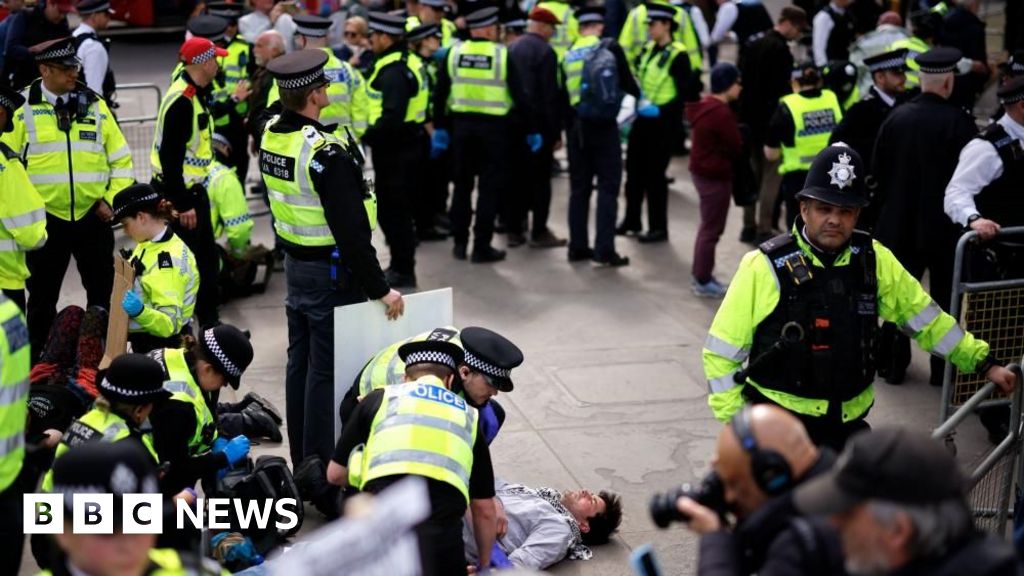
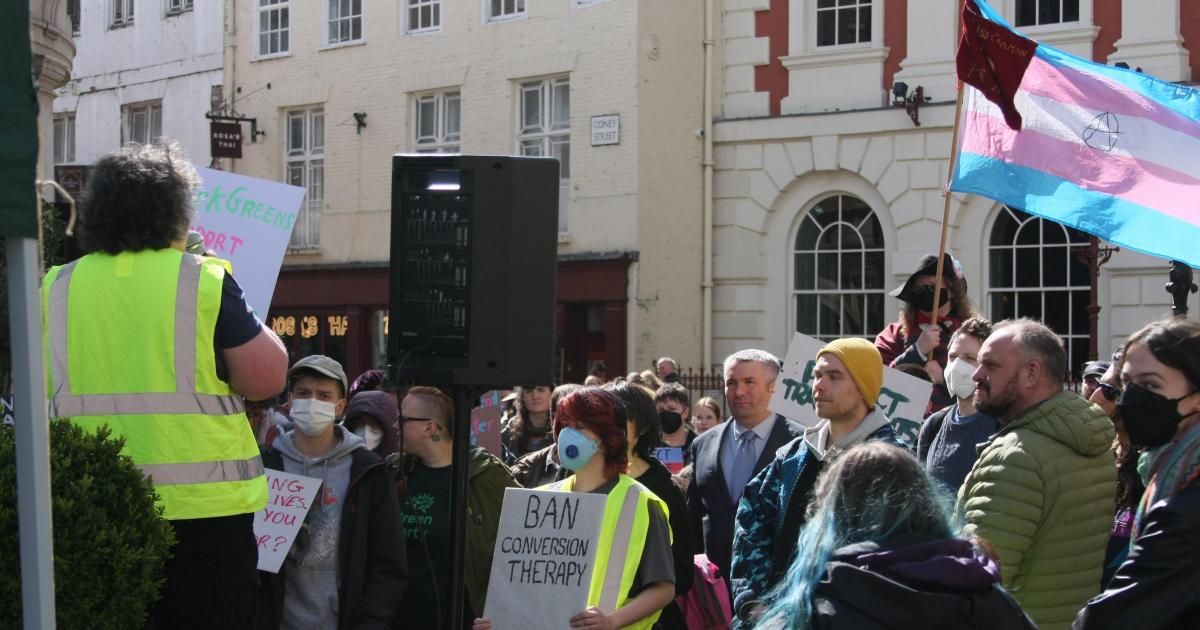
Dozens of people demonstrated in St Helen’s Square from 1pm on Saturday (April 11).
It followed the ruling by the UK’s highest court last April that the terms “woman” and “sex” in the 2010 Equality Act “refer to a biological woman and biological sex”.
Judges, at the time, stressed their ruling did not diminish transgender women’s protections against direct discrimination.
But the protesters in York felt the ruling had resulted in uncertainty for transgender people, including around daily tasks such as which public toilet they should use.
Advertisement
Julie Forgan, from the York branch of the Unison union, during the protest on Saturday (April 11) (Image: Dylan Connell)
A trans rights activist in St Helen’s Square, York, on Saturday (April 11) (Image: Dylan Connell)
Julie Forgan, from the York branch of the Unison union which represents public sector workers, said what the ruling means for some of its members remained unclear a year on.
“People have gone into workplaces and been concerned about what their employer’s going to say about where they can use the toilet, which is a disgrace,” she said.
“People should be able to use the toilet where they want to use the toilet and not feel intimated by that kind of thing.
“As trade union reps, we’ve had to step in and sort out issues around that.
Advertisement
“That should not be something that needs to happen – it’s a human right to be able to use the toilet where you want to use the toilet.”
Trans rights activists in St Helen’s Square, York, on Saturday (April 11) (Image: Dylan Connell)
Trans rights activists in St Helen’s Square, York, on Saturday (April 11) (Image: Dylan Connell)
Julie said Unison is “very strongly in favour of trans rights because anything that divides communities means that we can’t fight effectively in unity”.
“Unison has a very strong trade union policy in support of trans rights.
“I’m here to show solidarity with everyone else who is here.”
Advertisement
Julie called for change to happen on a national level, saying: “People’s human rights need to be respected nationally, and positions should be made very clear that we respect everyone’s rights.”
Green Party representatives at the trans rights protest in St Helen’s Square, York, on Saturday (April 11) (Image: Dylan Connell)
A placard during the trans rights protest in St Helen’s Square, York, on Saturday (April 11) (Image: Dylan Connell)
She called on leaders to call out incidents of discrimination and abuse against transgender people.
“I think a lot of it has happened because people like the far-right have taken up the issue of trans rights and discriminating against trans people,” Julie said.
“It’s very important that everyone else speaks out against it, and that trans rights become integral to what we’re all fighting about together.”
Advertisement
Karen Cook during the trans rights protest in St Helen’s Square, York, on Saturday (April 11) (Image: Dylan Connell)
Karen Cook, the mother of a transgender teenage boy, attended the protest from Lincolnshire.
“I’m here because I’m really cross that trans people are being removed out of normal society,” she said.
Karen said transgender people had become ostracized, adding that it was negatively impacting a “small group of society who are absolutely lovely”.
The mother said she had previously been involved with Girlguiding and held a sign with the Girlguiding promise: “A guide is a good friend and a sister to all guides”, in protest to the organisation telling its members transgender girls must leave Girlguiding by early September.
Advertisement
Girlguiding said that since the Supreme Court’s ruling, it had undertaken “detailed considerations, expert legal advice and input from senior members, young members”, its council and board of trustees.
In an update last month, the organisation said trans girls who are members can stay until September 6.
It added that any trans girl or trans woman who is currently volunteering in a role open to women only will be required to move by this date to a position that is open to males or females.
Britain’s Armed Forces have been “hollowed out”, Retired General Sir Richard Barrons has said, adding that £10 billion needs to be annually to give the UK the security it needs
He estimates that a yearly increase of £10 billion needs to be found every year so Britain’s defence can be properly funded. Sir Richard called this the “bargain of the century” if it ensures Britain never have to pay the huge costs of fighting a war.
“The war in Iran and Russia’s aggression in Europe must be a wake up call for the entire country,” Sir Richard wrote in the Sun. “We must all unite in a national effort to beef up our defences while there is still time, otherwise it could be too late.”
He added: “Russia thinks it is already ‘at war’ with Europe. They hack us, try to meddle in our politics and even hire ‘organised crime’ to sabotage our businesses.
Sir Richard also said the missiles that “rain down” on Ukraine could one day be pointed at Britain.
He said this threat was not “imminent”, but “we need to be ready if the day ever comes”.
Advertisement
The retired general questioned politicians who have failed to fund the military because they “see no votes on it” and that MPs need to “make the hard choices to keep us safe”.
Sir Richard was one of the writers for the government-commission Strategic Defence Review, published last year.
Speaking to BBC Four’s The World At One, he said he had expected it to be enacted through a defence investment plan that took the 62 recommendations and turned them into a 10-year programme of funded activity, but that they are “still waiting for that plan to be issued”.
Sir Richard added that the UK’s armed forces are “grounded in the state the post-Cold War era left them”, but noted that the economic position means the Government is choosing to transform the country’s defence over a period of longer than 10 years, when “you’ve probably got three to five years”.
Advertisement
He argued that it is “not a question of affordability”, but of “hard choices to do without something else to put more money into defence, because it’s vital”.
On the US’s position in NATO, Sir Richard said: “What I think has become more difficult on the back of Greenland and the difficult rhetoric around the war in Iran is the degree of trust between the US and European NATO, and I think that is very dangerous.
“I very badly want to believe that, below the level of rhetoric, substantial things are still holding, and I think they are.”
However, the US cavalry is “not going to come now in the way we’ve become accustomed to since 1949”, he said, which makes the urgency to restore European defences greater, especially if the US exit is “some sort of cliff edge”, rather than managed.
Advertisement
Pressure has mounted on the Government to publish its long-delayed defence investment plan as global tensions simmer following the US-Iran ceasefire.
Defence Secretary John Healey last month denied that the Treasury was holding up the publication of the plan, and rejected suggestions there had been requests to scale it back.
Labour MP and Commons Defence Committee chairman Tan Dhesi warned its absence risks undermining Britain’s standing in NATO.
Advertisement
Mr Dhesi said the UK’s “inability to deploy a single ship swiftly” after the outbreak of war in the Middle East had left many “embarrassed”.
“The Defence Committee has repeatedly raised concerns around the UK’s lack of mass and capabilities, and the urgent need for investment in UK defence,” he said.
“While the strategic defence review set out the long-term strategic vision for our military, the defence investment plan was meant to provide the details, and its publication has been delayed several months.
“The lack of a public plan now runs the risk of undermining the UK’s ability to play a full and leading role in NATO.”
Advertisement
Real-terms defence spending fluctuated under the successive Conservative governments between 2010 and 2024, falling by 22% by 2016/17, after which it steadily rose and has recently returned to 2010 levels.
Sir Keir’s Labour Government has pledged to spend 2.5% of gross domestic product (GDP) on core defence by 2027, rising to 3% in the next parliament.
Defence minister Luke Pollard accused the Tories of having “hollowed out” the armed forces and “leaving our brave servicemen and women exposed”.
He added: “Prime Minister Keir Starmer is delivering the biggest sustained uplift in defence spending since the end of the Cold War, with every pound of our defence uplift delivering for British workers, British businesses and Britain’s national security.”
Advertisement
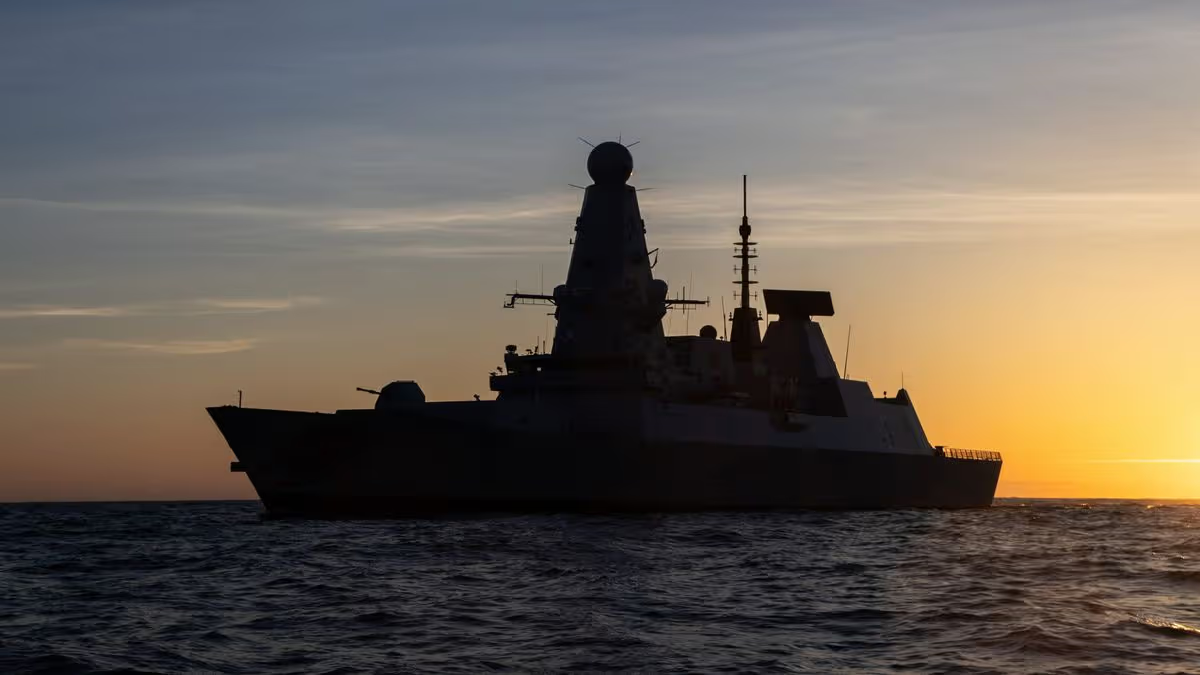
Mr Healey, meanwhile, revealed on Thursday that the UK and its allies tracked three Russian vessels off the UK’s northern coast.
A British warship and aircraft were deployed to deter “malign” activity by Vladimir Putin’s regime in waters off the UK’s northern coast, John Healey said.
He said Putin had sought to capitalise on the world being “distracted” by the Iran war and that he poses “the primary threat to UK security”.





















































You must be logged in to post a comment Login