

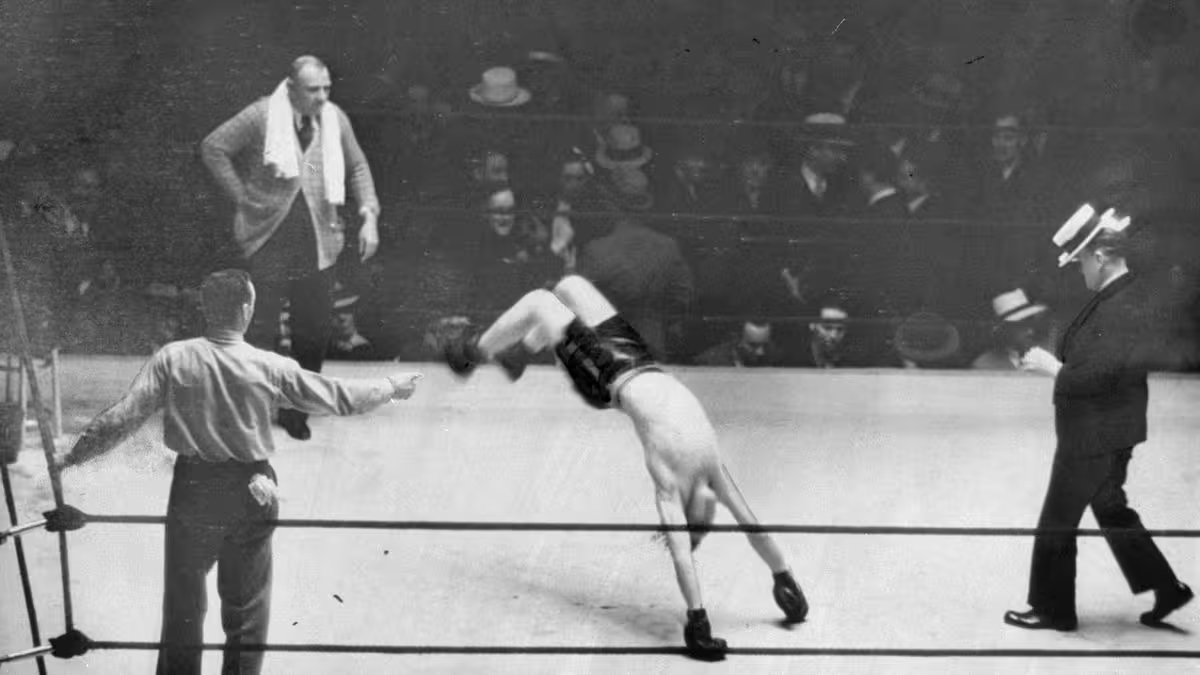
A strict north of the border criteria has been applied, ruling out Barry McGuigan, but the list features
We’ve all heard of the Fighting Irish, but here’s a variation on that theme; the Fighting Northern Irish.
Here’s an admittedly personal selection of the 10 best fighters from the region …
10 BRIAN MAGEE
IRELAND’S shortest ever reigning world title holder; his tenure as WBA super-middleweight champion lasted just 29 days, from when, in 1912, he was upgraded from interim title holder on November 9 until he was beaten in three rounds by Mikkel Kessler in Herning in Denmark on December 8.
Before that, though, the stylish southpaw had won the lesser IBO title and made seven successful defence of it, as well as capturing the British and European belts, winning the latter belt by stopping Mads Larsen in Aarhus on his first trip to Denmark.
9 RYAN BURNETT
AN amateur star who in the space of less than four months in 2010 won a silver medal at the World Youth Championships in Baku and then topped it with gold at the Junior Olympics in Singapore, he made his pro debut in May 2013, and beat Jason Booth to win the British bantamweight title in his 12th fight, in November 2015.
Four more wins followed and then, in June 2017, he dropped Lee Hoskins twice en route to dethroning him as IBF bantamweight champion. Zhanat Zhakiyanov was beaten to add the WBA title to his collection and then the WBA crown was retained against Yonfrez Parejo. Then, against multi-weight champion Nonito Donaire, in Glasgow in November 2018, he suffered a freak back injury and was forced to retire at the end of the fourth round. He did try one more fight six months later but then hung up his gloves on medical advice.
8 JOHNNY CALDWELL
AFTER a reputed amateur record of 234-6 that included an Olympic bronze medal, he turned pro in early 1958 and by the end of the following year his unbeaten record was 14-0. In his first two fights in 1960 (in the space of just two weeks), he beat recent European flyweight champ Young Martin from Spain and then Martin’s successor as continental champion, Risto Luukkonen from Finland.
He then beat his fellow flyweight bronze medallist at the Olympic Games in Melbourne in 1956, Rene Libeer from France and followed this up by knocking out Frankie Jones in three rounds to win the British title. In late May in 1961, in his first fight at bantamweight, he beat Alphonse Halimi to win European recognition as world champion, a win he repeated five months later. At just 23 days past his 23rd birthday for the first Halimi fight, he remains Ireland’s youngest ever world champion.
In mid January 1962, in a fight refereed by former featherweight champ Willie Pep, he was stopped in ten rounds by Eder Jofre in Sao Paulo in a bout for the undisputed world title. Nine months later he was stopped by Freddie Gilroy on a cut eye in nine rounds and was never the same again, although he did win the British and Commonwealth titles from George Bowes but then lost them to Alan Rudkin.
7 FREDDIE GILROY
THE only non world champion in the list, so how did he manage it? Well, for one thing he beat Caldwell in a classic head to head in the Kings Hall in October 1962 in what proved to be the final bout of his near six year pro career.
Before that, he had won an Olympic bantamweight bronze medal in Melbourne in 1956 and as a professional he won the British, Commonwealth and European titles and beat former world champion Mario D’Agata from Italy before his winning streak was snapped at 23 when, hampered by a dose of influenza, he was outscored by Ignacio Pena from Mexico in Manchester in April 1960.
Six months later he was again outpointed, by Alphonse Halimi in a bout for European recognition as world champion following the retirement of Jose Becerra. Belgian referee Philippe De Backer was probably the only person at the Empire Pool in Wembley who thought the French Algerian had won.
He bounced back with four wins in three months but was then stopped in nine rounds by Pierre Cossemyns – whom he had knocked out in only his ninth pro fight in March 1958 – in a European title bout in Brussels in March 1958. A genuinely charismatic fighter, he retired after his win over Caldwell, departing with a 28-3 record.
6 RINTY MONAGHAN
Probably the most colourful fighter on the list, he was, remarkably, four months short of his 14th birthday when he made his professional debut in April 1932. It took him 55 fights (41-7-7) and almost 14 years to win his first title, capturing the Northern Ireland flyweight crown with a fourth round knockout of Bunty Doran in the Kings Hall in November 1945.
The following year, in June, he forced world champion Jackie Paterson to retire at the end of the seventh round of a non-title bout in the Kings Hall, and 16 months later he outpointed Dado Marino from Hawaii in a fight for the vacant NBA title. That set up a unification return with Paterson and Rinty scored three knockdowns en route to a seventh round knockout.
In April 1949 he retained the title by outpointing Maurice Sandeyron and added the latter’s European title to his collection. Then, after beating Otello Belardinelli from Italy in a non-title bout, he defended against Terry Allen from London in the Kings Hall. He survived a second round count to earn a draw and announced his retirement with a record of 52-9 and eight draws.
5 EAMONN LOUGHRAN
AFTER winning a light-welterweight silver medal at the World Junior Championships in Havana in July 1987, he made his pro debut five months later and five years further on from that he won his first title with a third round knockout of Commonwealth welterweight champ Donovan Boucher from Canada in Doncaster.
Three months later he successfully defended the belt with a sixth round knockout of Michael Benjamin from Guyana in Cardiff and then, in October 1993, he won the vacant WBO welterweight title with a unanimous decision win over Lorenzo Smith from Chicago.
Five successful defences followed, including a clash of heads unduced no=contest against Angel Beltre from the Dominican Republic in the Kings Hall. In mid April 1996, at the Everton Park Sports Centre in Liverpool, his sixth defence turned into a disaster; he was floored three times by Jose Luis Lopez from Mexico … and stopped in just 51 seconds. He never fought again and finished with a record of 26-2 plus one draw and one no-contest.
4 DAVE McAULEY
AFTER making his pro debut in October 1983 (drawing with Tanzania born John Mwaimu in the Ulster Hall), he spent much of the first half of his career as a supporting act to Barry McGuigan but came into his own in October 1986 by journeying to Glasgow to win the vacant British flyweight title with a ninth round knockout of Joe Kelly at the Albany Hotel.
Six months later, he fought WBA champion Fidel Bassa from Colombia in the Kings Hall. The world title shot may have been a bit of a surprise but the fight turned out to be one of the greatest ever at the famous venue, McAuley, dropped in less than a minute after the opening bell, fought back to floor Bassa three times – including twice in the ninth round – and was ahead by three, two and two rounds on the scorecards at the end of the 12th, before being counted out at 1:45 of the next round.
Just under a year later he was outpointed in a return but, after a break of almost a year and a quarter he pulled off a surprise by unanimously outscoring IBF champion Duke McKenzie at the Wembley Arena in London.
He followed that up with five successful defences, including one against Bassa’s compatriot Rodolfo Blanco in which he had to survive four counts. That was at the Kings Hall in September 1990; in June of 1992 he faced Blanco in a return in Bilbao and lost a controversial decision. He never fought again and retired with a record of 18-3 and two draws.
3 WAYNE McCULLAGH
THE Olympic silver medallist from Barcelona in 1992 – who beat future world champions Arturo Gatti, Tim Austin and Willie Jorrin in the amateur ranks – made his paid debut in Reseda in California in February 1993 and was 10-0 by the end of the year.
The following year he added five more wins, including among his victims former world champions Fabrice Benichou and Victor Rabanales, retaining the North American bantamweight title he’d won against Javier Medina in the latter bout.
After starting 1995 with an inside the distance win over Geronimo Cardoz in Kenner in Louisiana, he travelled to Nagoya in Japan to challenge WBC champion Yasuei Yakushiji in his home town – and came away with a split decision win and the world title. Two successful defences, against Johnny Bredahl in Belfast and Jose Luis Bueno in Dublin, followed before he relinquished the title to move up to super-bantamweight, but his unbeaten record was broken at 20-0 when he lost a split decision to Mexican southpaw Daniel Zaragoza in Boston.
He would go on to have five more world title chances – against Naseem Hamed, Erik Morales, Scott Harrison and two against Oscar Larios – but lost them all. After his second loss to Larios he was inactive for almost three years before coming back to face Juan Ruiz for the vacant North American featherweight title in George Town in the Cayman Islands. He was forced to retire after six rounds and never fought again. His final record was 27-6, with only his final loss not being against a world title holder.
2 CARL FRAMPTON
THE only Northerner to become a two-weight world champion, he turned pro in June 2009, shortly after winning his second Irish amateur title and by the end of the following year had notched up eight successive wins and won the Celtic super-bantamweight crown with a second round stoppage of Scottish opponent Gavin Reid.
He won the vacant Commonwealth belt with a fourth round stoppage of Mark Quon from Australia in September 2011 and retained it three times within a year, most notably a six round beating of Canada’s former IBF champion Steve Molitar. The European title followed when he stopped Kiko Martinez in the ninth round in February 2013.
Three fights and 20 months later he had his first world title shot, again against Martinez, who in the interim had won the IBF crown with an upset sixth round beating of previously undefeated Jonathan Romero. This time Frampton won a unanimous and near runaway verdict with two scorecards of 119-108 and one of 118-111.
He retained the crown first against Chris Avolos in Belfast then against Alejandro Gonzalez in El Paso (where he survived two first round counts) in 2015 and the following year, after retaining the IBF title and adding the WBA one by beating Scott Quigg in Manchester in April and then moved up to featherweight and captured the WBA title with a unanimous decision win over Leo Santa Cruz at the Barclays Centre in Brooklyn. Those efforts against two previously unbeaten opponents earned him a unique distinction – the first and still only Irishman to win the Ring magazine Fighter of the Year award.
His unbeaten record ended at 23-0 when, in January 2017, when he lost a majority decision to Santa Cruz in Las Vegas and he never regained quite the success thereafter. Despite winning the interim WBO featherweight title, he failed in an attempt to dethrone Josh Warrington as IBF champ in Manchester, he fought just once each in both 2019 and 2020 and retired in April 2021 after being stopped in six rounds in a super-featherweight title challenge to Jamel Herring in Dubai. His final record was 28-3.
1 JIMMY McLARNIN
BORN in Hillsborough, his family briefly moved to Inchicore in Dublin and then to Canada, first to Saskatchewan before eventually settling in Vancouver. There, in his first year as a teenager, he was ‘discovered’ by Charles ‘Pop’ Foster, a former booth fighter from Liverpool.
McLarnin made his pro debut on his 16th birthday, in December 1923, and over the next four and a half years he put together a record of 36-4 and three draws with two of his losses being to future bantamweight champion Bud Taylor.
In mid May of 1928 he was outpointed by Sammy Mandell in a lightweight title challenge at the Polo Grounds in New York; he was six months shy of 21, which makes him Ireland’s youngest ever world title challenger to this day.
“Gee, I’m tired. I fought the gamest man I ever faced. I’m still the champion, but the next lightweight king will be Jimmy McLarnin,” Mandell said of their battle in front of 25,000 fans. Over the next two years McLarnin would twice beat still champion Mandell in non-title bouts in Chicago.
Mandell’s prophecy about McLarnin proved incorrect – because Baby Face moved up to welterweight and went on a roll, beating contenders such as Stanislaus Loayza, Joe Glick, Ray Miller, Sergeant Sammy Baker, Ruby Goldstein, Young Jack Thompson, Al Singer, Benny Leonard, Billy Petrolle and Sammy Fuller.
Finally, five years and one week after his first world title attempt, he challenged welterweight champion Young Corbett III at Wrigley Field in Los Angeles – and floored Corbett three times en route to stopping him in just 157 seconds.
A year later he was dethroned on a split decision by reigning light- welterweight champion Barney Ross in episode one of a trilogy that would draw an aggregate of 120,000 fans. McLarnin won the second bout but was again deposed as title holder in the third.
Six weeks before he turned 29, he beat reigning lightweight champion Lou Ambers in a non-title bout in a full Madison Square Garden and then promptly announced his retirement with a record of 55-11 and three draws. During his career he fought 23 times against former, current or future world title holders and beat all but one of them, former welterweight and future middleweight champion Lou Brouillard.
Pop Foster? He adored Jimmy and Jimmy’s wife Lillian, so much so that he bought a house in the same estate as them and when he died in 1976 he left his entire estate – some $260,000 – to Jimmy. Jimmy himself died in October 2004, just seven weeks before his 97th birthday.
NOTE: A strict born north of the Border criteria has been applied here, but if Clones man Barry McGuigan were to be included as an honorary Northerner – he did, after all, have 19 of his 35 professional fights in Ulster – he would occupy the number two slot, not just for his ring achievements but also for his incredible popular appeal. Current world champions Anthony Cacace and Lewis Crocker are unranked as their reigns are only beginning; who knows where they will place at the end of their careers?








































You must be logged in to post a comment Login