Connect with us
DAPA Banner
DAPA Coin
DAPA
COIN PAYMENT ASSET
PRIVACY · BLOCKDAG · HOMOMORPHIC ENCRYPTION · RUST
ElGamal Encrypted MINE DAPA
🚫 GENESIS SOLD OUT
DAPAPAY COMING

NewsBeat

The little-known government body – whose only shareholder is Net Zero fanatic Ed Miliband – that now stands accused of covering up how close Britain came to a catastrophic heatwave blackout: ROSS CLARK

Published

on

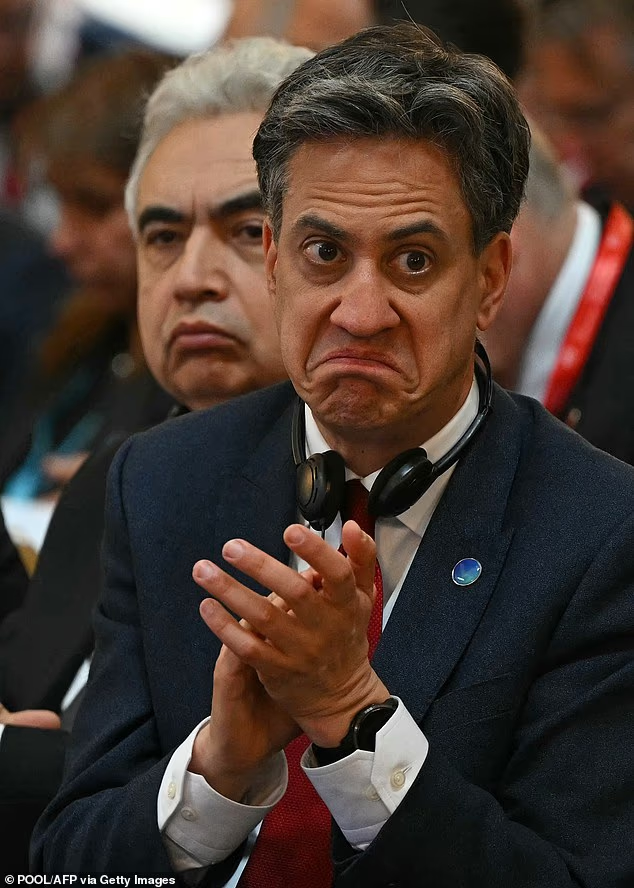
The National Energy System Operator (Neso) is a company with a single shareholder: the Secretary of State for Energy Security and Net Zero, currently Ed Miliband

On the afternoon of June 23, many were enjoying the start of a heatwave that would take temperatures up to 37C, surpassing the June record set in the scorching summer of 1976.

As we sweated, most of the country was blissfully unaware that a potentially catastrophic energy crisis was unfolding.

It emerged this week that on that baking Tuesday, we came close to suffering an event as dramatic as the blackout that occurred in Spain and Portugal in 2025 when trains stopped, industry and commerce were suspended, and hospitals were forced to switch to emergency backup supplies to prevent patients from dying.

Control room engineers at the National Energy System Operator (Neso) the little-known government body responsible for balancing Britain’s electricity supply and demand, were panicking. The grid’s frequency had destabilised and dropped below Neso’s strict operating limit, threatening widespread blackouts.

Advertisement

Yet it was alleged this week that bosses were less concerned by the system failures and more by the reputational impact of the public discovering that the grid was not being run securely. This allegedly involved ordering staff not to keep records of operational decisions to ensure there was no paper trail, in case they might have to be revealed in a Freedom of Information request.

Meanwhile, members of Neso’s corporate affairs team, who manage media and government relations, are said to have interfered in the control room, telling operators what to do to protect the body’s reputation.

This unbelievable tale was revealed by Shadow Energy Secretary Claire Coutinho, after she was approached by several whistleblowers. ‘They are coming to me because they are worried that the grid is becoming unmanageable and they do not have faith that their concerns are being taken seriously’, she said.

Coutinho further revealed that at a meeting on Monday, the Chief Executive, Fintan Slye, told staff that allegations that grid security standards were breached were false. What’s worse, the whistleblowers were openly criticised by senior management for letting the company down. The Government now confirms there is an independent inquiry into what happened on June 23.

Advertisement

The National Energy System Operator (Neso) is a company with a single shareholder: the Secretary of State for Energy Security and Net Zero, currently Ed Miliband

The UK came close to suffering an event as dramatic as the blackout that occurred in Spain and Portugal in 2025 when trains stopped and hospitals were forced to switch to backup supplies

The UK came close to suffering an event as dramatic as the blackout that occurred in Spain and Portugal in 2025 when trains stopped and hospitals were forced to switch to backup supplies

Before this week’s events, few had heard of Neso. Fewer still appreciated how finely balanced Britain’s electricity system is, or how difficult it has become to keep supply and demand in equilibrium as Ed Miliband pushes towards his target of a carbon-free electricity grid by 2030.

Advertisement

Neso was created under the previous Conservative government’s Energy Act 2023, taking over many of the functions previously carried out by the private company, National Grid ESO, with two principal objectives: to ensure the lights stay on and to prepare the national grid for the transition to Net Zero.

Based in an unassuming office block in Warwick, Neso employs around 2,200 people. According to its own calculations, it costs the average household £6.46 a year through energy bills. Yet its 2024/25 annual report also recorded a loss of £409 million, which will have had to be covered by taxpayers. While Neso manages our energy system, it owns little of it. The pylons, substations and infrastructure remain in private hands. Nor does it own the country’s power stations, wind farms or solar farms, all of which are also owned and operated privately. Instead, Neso acts as a glue holding together this patchwork of private assets, coordinating them into what is supposed to function as a single, seamless network.

Although often described as ‘independent’ of government, Neso is a company with a single shareholder: the Secretary of State for Energy Security and Net Zero, currently Ed Miliband.

In other words, it is a public sector body, although the pay packages of its senior staff might not suggest it. In 2024/25, chief executive Slye received a basic salary of £288,167 – more than £100,000 higher than the Prime Minister’s. Once pension contributions and performance-related payments were included, his total remuneration reached £773,650. Chief operating officer Kayte O’Neill received £564,311, while chief financial officer Charlie Pate was paid £317,451.

Advertisement

If you’re wondering what Neso’s 2,200 staff do all day, look no further than the interactive game on its website, which invites visitors to ‘run the national grid yourself’. Even this simplified version conveys the extraordinary complexity of the task. At every moment, electricity supply has to be matched almost perfectly with demand. In front of you is a dial showing the frequency at which the grid is operating. Britain’s mains electricity uses alternating current, meaning the flow of electrons through the wires continually reverses direction. The number of times this happens each second is measured in hertz (Hz).

The grid must be kept as close as possible to 50Hz. In real life, the acceptable operating range is even tighter: within a range of 0.4 per cent either side.

If too much electricity is generated relative to demand, the frequency rises above 50Hz. If too little, it falls below. Either scenario risks damaging equipment and, in the worst case, triggering widespread power outages.

Neso’s game gives players a range of tools to keep the system in balance. You can buy more electricity from gas-fired, nuclear or biomass power stations (the latter controversially fuelled by imported wood pellets). You can import or export electricity through subsea cables or charge and discharge batteries and hydroelectric plants.

Advertisement

What you cannot do – and this illustrates why running the grid is becoming harder – is simply manipulate renewable generation at will. ‘You can’t control renewables’, the game explains (in real life you can turn them off but not up if there’s no sun or wind). ‘But keep an eye on the weather forecast so you can adjust the other energy sources accordingly.’

Therein lies the problem. As Britain moves towards a carbon-free electricity system, around 80 per cent of generation is expected to come from wind and solar. The greater the share supplied by weather-dependent sources, the smaller the proportion of the system that grid operators can directly control when balancing supply and demand.

Britain's grid was designed around coal power stations in the Midlands and South Yorkshire ¿ and even Ed Miliband has downgraded his ambition for a carbon-free grid by 2030

Britain’s grid was designed around coal power stations in the Midlands and South Yorkshire – and even Ed Miliband has downgraded his ambition for a carbon-free grid by 2030

With a heatwave anticipated, Neso had expected a surge in demand for electricity-guzzling air con units while the excessive heat would also cause problems for solar farms

With a heatwave anticipated, Neso had expected a surge in demand for electricity-guzzling air con units while the excessive heat would also cause problems for solar farms

Advertisement

The first time I played Neso’s game, I crashed the grid within a couple of minutes. On the second, I managed to keep the lights on until the end of my shift, but only just. The biggest hiccup came when I was suddenly informed that a heatwave had led to all solar farms having to be switched off to prevent the heat from damaging them. This, coincidentally, is close to what seems to have happened on June 23.

According to Kathryn Porter, who runs independent energy consultancy Watt-Logic, on several occasions that day, the frequency of the grid dropped dangerously below 50Hz, suggesting that not enough power was being supplied. This was despite Neso issuing a ‘margin call’ in advance: a request for help put out to electricity generators when there is a predicted imbalance between supply and demand.

With a heatwave anticipated, Neso expected a surge in demand for electricity-guzzling air con units. At the same time, the excessive heat was expected to cause problems for solar farms.

To absorb sudden changes in frequency and voltage, our energy grid relies on buffers in the form of heavy spinning turbines. But these turbines mostly operate in traditional power plants (such as coal, gas, or nuclear).

Advertisement

So when solar generation dominates, as it did on the day the Spanish grid failed, there are too few of these ‘buffering’ turbines working to cushion the system against sudden disturbances.

At the time of Spain’s blackout, solar was supplying around 58 per cent of its electricity. We’ll have to wait to see what Neso’s independent inquiry turns up about last month’s events. But if it really is struggling to balance the grid now, what happens when the system is even more heavily dependent on wind and solar?

The trouble is we have a grid which was designed around a clutch of coal-fired power stations in the Midlands and South Yorkshire. It is far less suited to a system powered by dispersed, weather-dependent renewables.

Ed Miliband has already quietly downgraded his ambition for a carbon-free grid by 2030 to one which is 95 per cent carbon-free. In 2024, Neso declared that this slightly watered-down target was possible to reach, estimating the required grid upgrades would cost £58 billion. Yet, by June this year, that estimate had risen to £89 billion – more than £1,000 for every man, woman and child in Britain. And that is only the cost of upgrading the grid, not building large-scale wind and solar farms, nor the cost imposed on housebuilders, whom Miliband has ordered to install solar panels on new homes, even where roofs may be heavily shaded. A lot of the cost is down to Miliband’s rush to transition to renewables. The previous Conservative government had already set a target of decarbonising the electricity system by 2035, but Miliband judged that too slow.

Advertisement

‘If a target is set to do the practically impossible in around 60 months, then the logical consequence is that it will cost whatever it costs,’ according to Sir Dieter Helm, Professor of Economic Policy at the University of Oxford. Others argue that a Net Zero electricity system by 2030 is unattainable at any price. According to Gary Smith, general secretary of the GMB union – not usually a critic of the Labour government – there simply isn’t enough specialist equipment in the world to build the offshore wind farms needed to meet the target.

There is another nasty contained within Neso’s plans.

To achieve a 95 per cent carbon-free electricity system by 2030, it says Britain will require between 10 and 12 gigawatts of ‘consumer-led flexibility‘.

That means encouraging – or forcing – people to reduce their energy use at peak times, perhaps through surges in the electricity price when the supply is struggling to keep up with demand.

Advertisement

One way or another – through blackouts or price gouging – Neso will make sure it is customers paying the price of the transition to a carbon-free grid.

Source link

Continue Reading
Click to comment

You must be logged in to post a comment Login

Leave a Reply

NewsBeat

Geely EX2 arrives in Britain… but China’s best-selling car costs three times as much here

Published

on

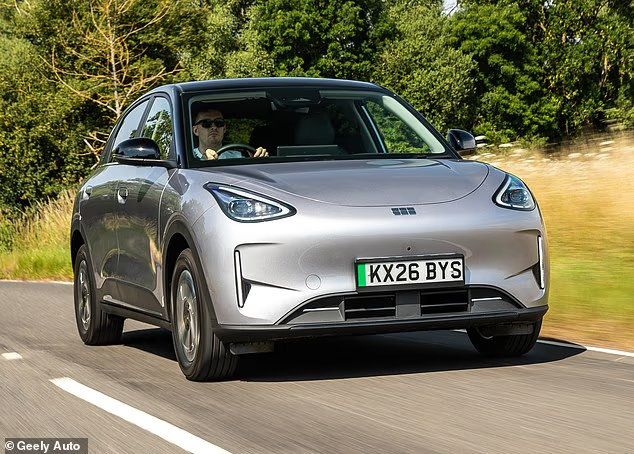
China's best-selling car is officially coming to the UK in a matter of weeks - but the £7,000 price tag in its home market will be massively inflated for British showrooms

China’s best-selling car is officially coming to the UK in a matter of weeks – but Britons will have to pay a lot more for one than Chinese drivers do.

Geely’s electric EX2 – called the Galaxy Xingyuan in its home market – was China’s most popular new model in 2025.

The brand – which set up in the UK only last year and already sells the electric EX5 and Starray EM-i plug-in hybrid SUVs – shifted 465,775 examples in its home market last year.

To put that number into perspective, that’s almost a quarter of all car registrations in the UK in 2025 and more than eight times the number of units sold by Britain’s most popular model, the Ford Puma (55,488 registrations).

Advertisement

So, what’s making it such a hit in China? One of the main reasons is price; the electric supermini costs just £7,000 new.

How is it so cheap? Partly due to supply chain control, with every component produced in China, cutting out any middleman premiums. But it is also thanks to government subsidies and a fierce price war between brands.

It’s the case for all models sold in both China and the UK: the BYD Dolphin, for instance, starts from £30,230 in our showrooms but in its domestic market rings in from ¥99,800 – just £11,000. 

The bad news for drivers in Britain is that the EX2 won’t have the same bargain-basement price tag it has at home – and that could be a major stumbling block. 

Advertisement

China’s best-selling car is officially coming to the UK in a matter of weeks – but the £7,000 price tag in its home market will be massively inflated for British showrooms

Starting at £20,990, it’s competing with seriously strong competition backed by years of heritage in Britain – think the Renault 5 E-Tech, Citroen e-C3 and Peugeot e-208.

It too is a massive £9,000 more expensive than the cheapest electric car sold in Britain, the Dacia Spring, which is likely to limit its showroom appeal.

Advertisement

The car maker says the ‘modern compact all-electric’ EX2 is ‘designed to make advanced electric mobility more attainable for UK customers’.

It’s likely to be among the roomiest electric superminis on the market, much larger than a Fiat Grande Panda or VW ID.Polo.

But its £21,000 price tag won’t get you very far… literally.

The entry-level version is the Pro model, with a relatively puny 35kWh battery and an 81bhp electric motor sending power to the rear wheels.

Advertisement

Based on official tests, Geely reckons it will be capable of 155 miles between charges – though in the real world, that figure is likely to be somewhat lower.

To put that into perspective, the cheapest Renault 5 currently costs £21,495, inclusive of the Government’s lower tier Electric Car Grant (ECG) of £1,500.

Yet the funky French hatchback has a 40kWh battery and a claimed range of 190 miles, easily gazumping the Geely for an extra £500 up front.

Thankfully, the EX2’s mid-spec Max and Ultra trim levels have the larger 47kWh battery linked to a 114bhp e-motor, returning a claimed 214 miles on a full charge – a distance most buyers shopping in this segment should find acceptable.

Advertisement

Yet with prices of £23,490 and £25,490 respectively, this is no match for the range-topping Renault, which for £23,945 (inclusive of the upper tier £3,750 ECG) has a 52kWh battery pack and can travel 252 miles between charges.

All variants of the EX2 feature DC rapid charging at up to 80kW and a 6.6kW onboard charger. Using a public fast charger, owners can replenish the battery from a 30 per cent state of charge to 80 per cent in around 25 minutes.

Starting at £20,990 in the UK, it is £9,000 more expensive than the cheapest electric car in the UK, the Dacia Spring and three times what it costs in China

Starting at £20,990 in the UK, it is £9,000 more expensive than the cheapest electric car in the UK, the Dacia Spring and three times what it costs in China

The EX2 will be one of the roomiest small electric hatchbacks on the market, much larger than a VW ID.Polo or a Renault 5 E-Tech

The EX2 will be one of the roomiest small electric hatchbacks on the market, much larger than a VW ID.Polo or a Renault 5 E-Tech

Advertisement

While the EX2 won’t set any pulses racing with its performance and range, it is brimming with gadgets and equipment.

Even the entry model features a 14.6-inch touchscreen infotainment system, a secondary 8.8-inch digital driver’s display, Apple CarPlay and Android Auto, keyless entry and start, and LED headlights.

The safety kit is pretty comprehensive too; adaptive cruise control, autonomous emergency braking, lane-keeping assist, blind-spot detection, rear cross-traffic alert and a driver monitoring system are all standard equipment.

Oddly, the mid-spec Max trim includes no additional features, only the larger battery pack and more potent electric motor.

Advertisement
As is the case with most Chinese brands, the Geely EX2 will be very well equipped, featuring a mass of big car safety and luxury features as standard

As is the case with most Chinese brands, the Geely EX2 will be very well equipped, featuring a mass of big car safety and luxury features as standard

For the top-spec model - which costs £25,490 - the only optional extra is this white interior finish, which costs just £200 more

For the top-spec model – which costs £25,490 – the only optional extra is this white interior finish, which costs just £200 more

Geely is another of a dozen Chinese newcomers to arrive in the UK. It launched late last year with the Starray EM-i plug-in hybrid SUV (middle) before the arrival of the electric EX5 (right) in 2026. The EX2 takes the range to three cars across two segments

Geely is another of a dozen Chinese newcomers to arrive in the UK. It launched late last year with the Starray EM-i plug-in hybrid SUV (middle) before the arrival of the electric EX5 (right) in 2026. The EX2 takes the range to three cars across two segments

The range-topping Ultra adds two-tone paint, a power tailgate and a 360-degree parking camera.

Advertisement

It also comes with a few luxuries usually reserved for larger premium cars, including ambient lighting, heated seats, a heated steering wheel and an upgraded sound system.

It seems the only optional extra customers can choose is a white interior, which comes at a £200 premium – much less than you’d typically pay for a different cabin colour elsewhere.

Michael Yang, general manager at Geely Auto UK, says the EX2’s arrival ‘represents an important step in our mission to make intelligent electric mobility accessible to more customers across the UK’.

The big question is: how comfortable will British car buyers feel about paying £21,000 for a new car that costs a third as much in another market? Time will tell when it hits UK showrooms next month.

Advertisement

Daily Mail and This is Money will be driving one in August to find out if it can compete with established EV rivals around its UK price point.

Source link

Advertisement
Continue Reading

NewsBeat

Wanted fugitive who absconded custody arrested in Lancashire

Published

on

Wanted fugitive who absconded custody arrested in Lancashire

Marwan Jumaa had been receiving medical care at North Manchester Hospital when he absconded.

Wanted appeals were put out across Wednesday and Thursday. Following extensive enquiries, he was arrested by Lancashire Constabulary.

Detective Superintendent Nicola McCulloch of GMP’s Serious Crime Division said:

“This has been a fast-paced investigation which has involved a significant number of officers and resources from Greater Manchester Police.

Advertisement

“An observant Lancashire Constabulary officer recognised Jumaa and acted swiftly to arrest him.

“He will now be returned to a secure hospital facility.

“I would like to thank the public for their support following our appeal.

“Our call handlers received a considerable amount of information from members of the public and that assistance has been invaluable in helping us locate Jumaa.

Advertisement

“We are extremely grateful for the support shown throughout this investigation.”

Marwan Jumaa was taken to North Manchester hospital (Image: GMP)

GMP had appealed to the public for help tracing Jumaa, a 20-year-old serving a custodial sentence for assault.

He was described as having links to Bury, Prestwich, Crumpsall, Leeds, and London.

The public had been warned not to approach Jumaa during the appeal, and had been asked to contact police with any sightings or information regarding his whereabouts.

Advertisement

Source link

Continue Reading

NewsBeat

Three England players ‘complained privately’ about Thomas Tuchel decision in World Cup defeat | Football

Published

on

Three England players 'complained privately' about Thomas Tuchel decision in World Cup defeat | Football

Close Overlay

In The Mixer’s World Cup special

Everything you need to know about the World Cup – England updates, the games to watch and stories you missed – in five minutes, at 1pm, every day.

Source link

Advertisement
Continue Reading

NewsBeat

Andy Burnham live: PM-in-waiting to become Labour leader as Starmer says he can win next election

Published

on

Daily Mirror

Mirror Political Correspondent Sophie Huskisson here…

While Andy Burnham is expected to become Labour leader today, he won’t become PM until Monday. We’re likely not going to find out who is in his Cabinet until after he enters Downing Street – which means more days, hours and minutes of speculation over who is in his top team.

The role most spoken about is the Chancellor: Who will replace Rachel Reeves in the Treasury?

Advertisement

Ed Miliband, the Energy Secretary and former Labour leader, had been widely tipped to take her place. That is, until this week. Shabana Mahmood, the current Home Secretary, is now the name on everybody’s lips. But she’s quickly facing the same pushback Mr Miliband did.

When he was the frontrunner, the Energy Secretary – who is considered on the left of the party – faced constant briefings from MPs, unions and businesses who feared his direction at the Treasury. Tensions with unions over his net zero agenda exploded, with Unite’s Sharon Graham warning Mr Miliband’s appointment “would be a noose around the neck” of job creation.

Rumours suggest Mr Burnham is getting cold feet over putting Mr Miliband in the Treasury amid fears he’ll become a lightning rod for criticism during his premiership. But, conveniently, Ms Mahmood is facing her own briefing wars now she is in the spotlight.

Reports swirled this morning that Mr Burnham could face a revolt from MPs on the Labour left over fears Ms Mahmood – who has faced strong criticism from some in her party over her hardline immigration reforms – lacks an economic vision.

Advertisement

“Shabana has no sense of the economics,” one senior Burnham ally told The Times. Another Labour MP said: “It’s baffling a lot of people because nobody knows what her views are on the economy.”

Mr Burnham’s team has insisted the PM-in-waiting is still making decisions about who he wants in his top team. Sometimes dripping possible Cabinet names out there into the world is part of a strategy to test the waters. Though sometimes, it’s definitely not.

Source link

Advertisement
Continue Reading

NewsBeat

Gosport care worker named as a finalist Homecare’s Got Talent competition

Published

on

Gosport care worker named as a finalist Homecare’s Got Talent competition

From powerhouse singers and acoustic duos to dance and drag, 12 acts from across the UK have secured their place in the grand final of Homecare’s Got Talent 2026. The finalists will take to the stage at The Crescent Theatre in Birmingham on Friday 7th August, performing in front of a live audience and celebrity judging panel in the hope of being crowned this year’s Homecare’s Got Talent champion.

Source link

Continue Reading

NewsBeat

Under threat from the rise of padel: Tennis club with nearly 200 members fights for survival as it faces being replaced by padel courts in row over rent

Published

on

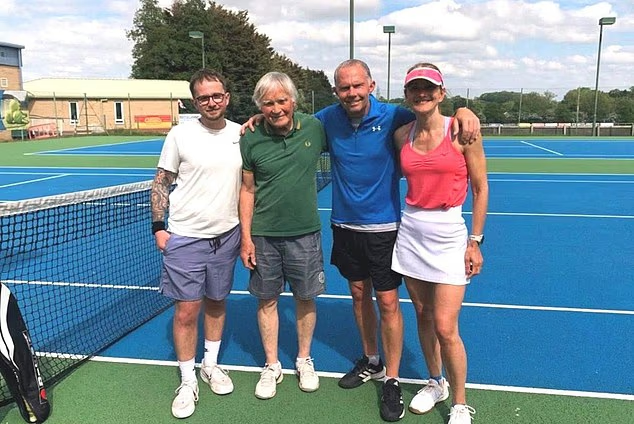
Mr Daniel said the 180 members of the tennis club were willing to fight to preserve their existence but admitted: 'We haven’t got a bottomless pit of money.'

A tennis club that dates back to the 1950s is facing extinction after an organisation proposing to replace it with a padel court offered the site owner six times more rent for the site.

Victory Ground Tennis Club currently pays £4,000 per year to rent the land for two courts at a sports ground in Bury St Edmunds, Suffolk.

But landowners of Victory Sports Ground, which was founded 106 years ago, have asked them to increase this following an alleged offer of £25,000 to build four padel courts.

The dispute is a stark reminder of the ‘tennis versus padel’ backlash happening across the UK, as people take up the new sport – leaving facilities for the traditional game under threat.

Advertisement

Critics of the upstart sport, whose fans include Prince William, David Beckham and Stormzy, have attacked the loss of decades-old or cherished tennis facilities, while neighbours of padel courts have complained about its ‘gunshot’ noises and foul-mouthed players.

Padel fans argue theirs is a growing sport and its devoted fan base needs places to play.

Victory Ground Tennis Club spokesman Steve Daniel told the Mail: ‘It’s the loss of a facility as a community sport to be replaced by a money-making venture.’

He added: ‘It would be a crying shame if we ended up in Bury St Edmunds with just one set of tennis courts and obviously multiple padel courts.

Advertisement

Mr Daniel said the 180 members of the tennis club were willing to fight to preserve their existence but admitted: ‘We haven’t got a bottomless pit of money.’

Victory Sports Ground, founded 106 years ago, with the tennis club's two courts shown in the bottom left

Victory Sports Ground, founded 106 years ago, with the tennis club’s two courts shown in the bottom left

‘There’s no guarantee that this padel is still going to be a thing in five or ten years. It’s not like tennis that’s obviously been running for hundreds of years.’

Advertisement

He also argued the padel courts could be accommodated elsewhere in the grounds, which have football and cricket pitches, a sports hall, dance studio, croquet club and pavilion including a bar and kitchen.

The sports ground, which celebrated its centenary in 2020, was provided by a director of Green King Brewery to celebrate his male children who had survived the First World War.

It was sold to St Edmunsbury Borough Council in 1975 and later handed over to a not-for-profit, volunteer-run Community Interest Company, with £2 million raised for its redevelopment in 2013.

Paul Whittaker, a director of Victory Sports Ground CIC who is also chairman of Bury St Edmunds Cricket Club, confirmed there had been an offer from a ‘national organisation’ to invest ‘hundreds of thousands’ in building the padel courts.

Advertisement

But he refused to reveal who the organisation is, stating the CIC is subject to a Non-Disclosure Agreement, even though discussions are informal at the moment.

He also claimed the bid received was not £25,000 but wouldn’t say how much it was.

Mr Whittaker said the facility needed to ensure it had ‘sufficient income coming in’ as it lost money last year, despite an overall income of around £50,000.

This included a grant of £15,000 from West Suffolk Council – although he said ten years ago it had been £40,000.

Advertisement

‘We haven’t set a figure [for the tennis club] and were open with them about the situation and that all the tenants within the Victory Ground would be looked at in terms of their payments because the support we’ve enjoyed from the council for many years is declining,’ he told the Mail.

‘To be honest, tennis was making such a small payment that it was hardly worth looking at the rent they were paying.

‘It’s somewhat disappointing that we had discussions with them earlier this year and said we’d be prepared to give them a long-term lease rather than just annual rent and then they’d be able to get further funding from the Lawn Tennis Association. That’s how it works.

‘We asked them to come up with some thoughts on what they could do financially if granted a long-term lease and they offered to pay an extra £500 [per year] which, to be frank, was pretty ridiculous.

Advertisement

‘They agreed to go away and come back with a proper proposal but we’ve heard diddly squat until this week, when they went beserk.’

Mr Whittaker also claimed there were other tennis facilities available in the town including one on the outskirts with ’13 courts, including some which are indoors’.

But Mr Daniel, whose club has around 180 members including a third who are under-18, added: ‘We’re definitely digging our heels in.

Victory Ground Tennis Club spokesman Steve Daniel told the Mail: ‘It’s the loss of a facility as a community sport to be replaced by a money-making venture’

Victory Ground Tennis Club spokesman Steve Daniel told the Mail: ‘It’s the loss of a facility as a community sport to be replaced by a money-making venture’

Advertisement

‘We are willing to fight this 100 per cent. There’s no backing down from us but, unfortunately, we haven’t got a bottomless pit of money.’

Padel was founded in Mexico in 1969 – compared to 12th century roots for tennis – and is claimed to be the world’s fasted growing sport.

As of last year, there were 893 courts for the racquet sport, which is described as a mix between tennis and squash as it is played in an enclosed area.

Around 400,000 people play in Britain, up from 15,000 in 2019 according to the Lawn Tennis Association (LTA), which has invested more than £6 million in the pastime.

Advertisement

The courts are around a third the size of a tennis court and matches are always played as doubles, not singles.

Supporters argue it is more accessible than tennis as there is more emphasis on tactics than power and speed.

But it has upset fans of tennis – including 24 times Grand Slam winner Novak Djokovic, who warned his sport is becoming ‘endangered’ by venues converting to padel or pickleball courts.

Neighbours of padel courts have also complained about their lives being ruined by noisy players.

Advertisement
Around 400,000 people play in Britain, up from 15,000 in 2019 according to the Lawn Tennis Association (LTA), which has invested more than £6 million in the pastime

Around 400,000 people play in Britain, up from 15,000 in 2019 according to the Lawn Tennis Association (LTA), which has invested more than £6 million in the pastime

Paul Whittaker, a director of Victory Sports Ground CIC, confirmed there had been an offer from a ‘national organisation’ to invest ‘hundreds of thousands’ in building the padel courts

Paul Whittaker, a director of Victory Sports Ground CIC, confirmed there had been an offer from a ‘national organisation’ to invest ‘hundreds of thousands’ in building the padel courts

Last month, Barnt Green Sports Club in Bromsgrove, Worcestershire, lost an appeal against a Noise Abatement Notice issued by the district council after ‘explosive and unpredictable’ noise from padel throughout the day was found to have caused a statutory nuisance.

The club – which said it had taken action including reducing operating hours and erecting signs urging considerate use of the facilities – was ordered to pay the council’s £48,500 legal costs from the appeal heard at Kidderminster Magistrates Court.

Advertisement

Wealthy homeowners living by one club in the cathedral city of Winchester, Hampshire, said they have to put up with loud bangs from padel courts at all hours of the day.

The popularity of padel has ‘boomed’ over the last couple of years, but people living near the courts have said the noise would be classed as ‘antisocial behaviour’ in any other setting.

The residents next to Winchester Racquets and Fitness in Hampshire said the ‘thwack’ of the ball being struck is so loud it is like a gunshot.

They said the noise starts just after breakfast and leaves them cowering inside for the entirety of the day.

Advertisement

Jenni Chilvers, 76, complained that the noise of the ball hitting the bat created a loud ‘cracking’ sound that was similar to ‘gunshots’.

To make matters worse, she also heard ‘foul language’ coming from the courts, with people would be ‘shrieking’ and ‘shouting’ while playing padel.

Elsewhere, residents in Harrogate, North Yorkshire, say that padel courts built without planning consent at a nearby gym has ruing their summer with the constant zinging of balls.

People living near David Lloyd’s Club are up in arms about the racket which they say began when the two outside courts was built in December 2023.

Advertisement

The area on the outskirts of the town includes protected woodland, and is rich in wildlife such as bats, owls and squirrels.

Residents say the noise had been going on all summer, with many residents claiming they are frightened to go in their gardens because of it.

Before then, the club only offered tennis facilities, which the householders insist was not a problem.

Bob Wilkinson, 77, said: ‘We have lived here for years. We have had tennis courts which were a smooth gentle noise. Then suddenly these padel courts were built. The noise is very different.

Advertisement

‘It is a like a rifle shot. It can sometime be three or four minutes continuous. The local authority measured 78 loud strikes in just four minutes. It is just really annoying.’

In August last year, plans for a padel court in Norwich were approved by city councillors despite objectors warning the noise would cause ‘psychological harm’.

Barbara Goodwin, who lives nearby, said: ‘Padel noise is concentrated in one small area on a court surrounded by glass and metal mesh walls, which amplify the sound.’

Plans were announced last year to replace tennis courts built at Lee Valley Hockey and Tennis Centre in north-east London for the 2012 Olympics being replaced with padel courts.

Advertisement

They were shelved following a backlash that included a petition signed by more than 2,000 people.

An LTA spokesman said: ‘As the national governing body for both tennis and padel, the LTA wants to see the two sports sit by side-by-side, rather than one developing to the detriment of the other. 

‘While we are supportive of venues that wish to integrate new padel facilities alongside their existing operations to evolve their offering, we do not support the straight replacement of tennis courts for padel courts, particularly in cases such as Victory Ground where tennis participation is strong. 

‘We hope a solution can be identified which can retain the existing tennis courts on the site whilst allowing for the development of new padel facilities for the local community.’

Advertisement

Source link

Continue Reading

NewsBeat

‘The Lions Way’: Jude Bellingham breaks his silence after England’s heartbreaking World Cup exit as star shares poignant message from the squad’s Kansas City bus driver

Published

on

Jude Bellingham broke his silence after England's 2-1 defeat to Argentina in the semi-finals of the World Cup on Wednesday

Jude Bellingham has broken his silence after England‘s heartbreaking World Cup exit at the hands of Argentina in poignant fashion, with the midfield star sharing a touching poem titled ‘The Lions Way’. 

The Real Madrid man was one of the standout players for the Three Lions in North America and he took defeat in the semi-finals in Atlanta every bit as hard as his team-mates. 

Bellingham was seen in tears surrounded by friends and family in the stands after the final whistle. 

The 23-year-old admitted that putting his feelings into words had been a challenge, but used the poem shared with the group by their driver in Kansas City to express himself. 

Advertisement

‘Was really struggling to find the right words for yesterday and the last few weeks but this pretty much hits the nail on the head from our driver in Kansas,’ he wrote on social media. ‘Thank you for the unbelievable support from back home and to those who spent their hard earned money to travel to America and get behind us. 

‘Don’t let the unity and love we’ve seen in our country end with this campaign. When we’re together we can achieve big things… And we will! Love yous! (red heart, England flag emojis).’ 

A picture of the poem was attached, with the first verse beginning: ‘The Lion does not boast aloud, Nor chase the praise of every crowd. He knows the roar that shakes the night, Is born when fear is met with might. 

Advertisement

Jude Bellingham broke his silence after England’s 2-1 defeat to Argentina in the semi-finals of the World Cup on Wednesday

The Three Lions star shared a touching poem titled 'The Lions Way' stressing the values of spirit and conduct beyond the final whistle

The Three Lions star shared a touching poem titled ‘The Lions Way’ stressing the values of spirit and conduct beyond the final whistle

‘The match is not with foe alone, The truest pitch is self unknown. Before one pass is struck with grace, The heart must first have won its race. 

‘For strength is more than driving speed, Or planting firmly every cleat. It lives within the iron will, To climb again the steeper hill. 

Advertisement

‘The body tires. The lungs grow tight. The legs grow heavy in the fight. Yet steadfast minds refuse retreat, They drag the weary to their feet. 

‘Endurance is a faithful friend, It walks beside you to the end. While others yield to pain’s command, It whispers low, “Hold your stand”.

‘The clever mind outplays the strong, Who rush with fury all day long. A patient pass, a measured pace, Will forever conquer reckless haste. 

‘The hawk may see the pitch above, The lion wins through steadfast love/ Of every movement, every run/ Where many minds become but one. 

Advertisement

‘For tactics are not tricks concealed, But wisdom sharpened on the field. To know when pressing serves the day/ And when restraint becomes the way.

‘The storm may rage. The crowd may cry/ The score may yet refuse the sky. Yet none of these command the soul/ Whose purpose governs every goal. 

‘No referee can steal your choice, No hostile song can drown your voice. The world may shake, the night may burn/ Your answer shapes the final turn. 

‘England wore Three Lions bright, Not chasing glory’s fleeting light. They sought instead a nobler prize, To master self before men’s eyes. 

Advertisement

‘They trusted feet that years had trained/ They trusted minds that calm had gained/ They trusted hearts that would not bend/ Though every minute neared the end. 

‘One perfect move/ One selfless pass/ One moment born from countless tasks. 

‘The net gave way/ The crowd arose/ The thunder rolled through friend and foe. 

‘The victory belongs to those/ Who rule themselves before the blows/ And therefore earned a greater name/ Than those who merely played the game. 

Advertisement

‘The whistle blew/ The contest done/ Three Lions work had been won.

‘Victory now was the score/ Lifting gold evermore/ But greatest triumph, clear to see/ Was quiet self mastery. 

‘For trophies tarnish/ And crowds grow still/ Time itself outlasts all skill.

‘But those who govern both heart and mind/ Leave fear and doubt far behind/ So walk the Lion’s ancient road/ Carry calmly every load/ Meet each trial firm and true/ Let discipline be the strength in you. 

Advertisement

‘For fortune favours not the loud, Nor always crowns the largest crowd/ She often walks beside the one/ Whose hardest battle has been won. Not on the pitch beneath the lights/ But deep within through sleepless nights. 

‘And when the final whistle sings/ And victory lifts its golden wings/ The truest roar will still be heard/ A soul made strong, A soul assured.’ 

The poem was signed by the author – driver Michael Chandler – and dated for July 15, the day of England’s meeting with Argentina.   

The poem was written by the squad's driver in Kansas City Michael Chandler the day of the tie

The poem was written by the squad’s driver in Kansas City Michael Chandler the day of the tie

Advertisement
Bellingham cut a heartbroken figure at full-time as England were knocked out of the World Cup

Bellingham cut a heartbroken figure at full-time as England were knocked out of the World Cup

Join the discussion

Does England’s heartbreaking exit say more about their spirit or their failure under pressure?

The post was commented on by a number of his England team-mates, with Reece James, Anthony Gordon, and Jordan Henderson among those to simply share red heart emojis underneath it. 

Advertisement

Just a few hours earlier, Harry Kane had shared a similar message to his fans, describing the loss in Atlanta as ‘hard to take’, while insisting his team would ‘go again’. 

‘We were close, really close to another final but it wasn’t enough,’ he said. ‘We’ve given everything over these last seven weeks and to fall short is hard to take! 

‘I know the expectations are high and rightly so, we’ve been knocking on the door for eight years now but again are missing that final piece of the jigsaw!’ 

Kane added his pride at the group of players for the fight they had displayed throughout the tournament, and Bellingham was among those who had battled the hardest, helping England get over the line in style against Norway with his match-winning brace. 

Advertisement

Bellingham struggled against Argentina however as the repeated target of first-half challenges from his opponents’ attritional play. 

At full-time, he was pushed to breaking point by unused substitute Valentin Barco, with Bellingham smacking the young Strasbourg player’s head from behind, and sparking a brief melee involving players from both sides.

It remains unclear what triggered the reaction from the Real Madrid midfielder, though footage has circulated showing Barco running onto the pitch after Enzo Fernandez’s 85th-minute equaliser and celebrating in front of the England players rather than joining his team-mates by the corner flag.

Former England goalkeeper Paul Robinson, commentating for BBC Radio 5 Live, described Barco’s actions as ‘probably the worst example of sportsmanship we’ve seen at this World Cup’.

Advertisement

Barco was also seen appearing to mouth something to Bellingham before the pair physically interacted. 

As for his post-match assessment, Bellingham said: ‘I think we can take a lot from the experience, but it’s so gutting.

‘I wanted to be a part of an England squad that had finally done it, finally got it over the line. And to be here telling the fans unfortunately the same things that they’ve probably heard for years and years, it’s really gutting.

‘I wish I could say more. I wish I could give one more win or two more wins. But at the moment I’m kind of – my head’s a bit fuzzy with disappointment.’

Advertisement

How much is David Beckham set to pocket from his World Cup brand deals? Take on our quiz in our newsletter HERE 

Source link

Continue Reading

NewsBeat

Queen Camilla had ‘blunt response’ to King Charles and said ‘can’t we get away from this’

Published

on

Wales Online

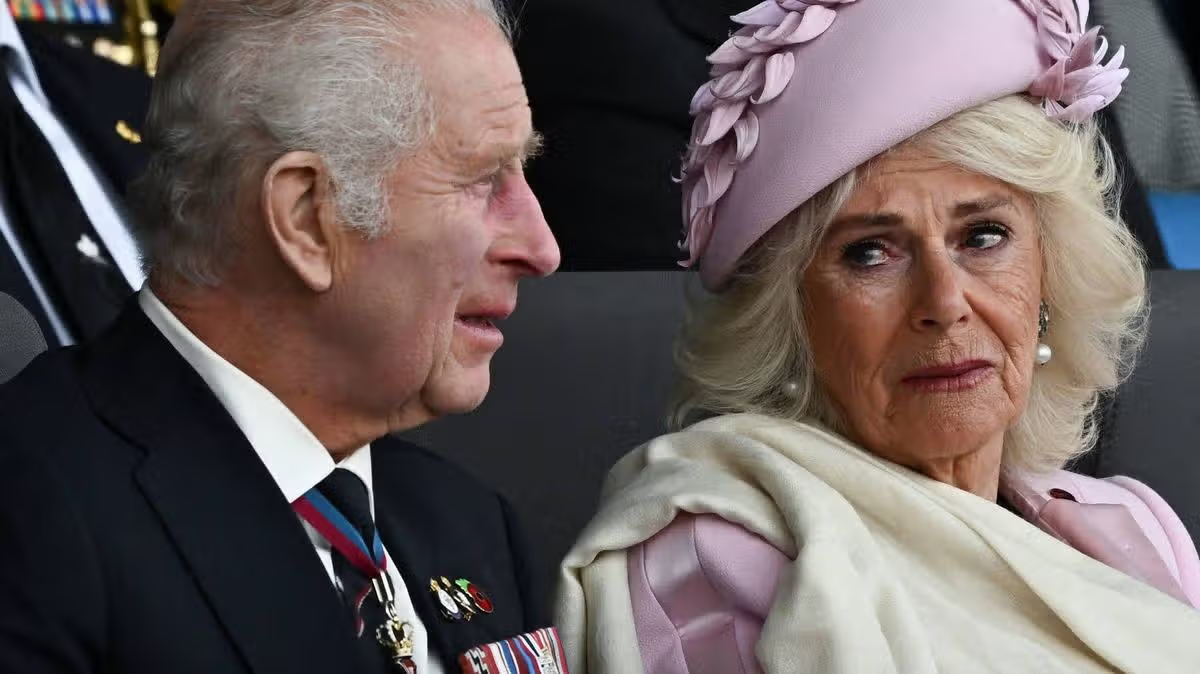
Queen Camilla and King Charles have been married for almost two decades, but haven’t always seen eye to eye on everything – particularly when it comes to her new royal title, according to an insider

Queen Camilla delivered a brutal three-word response to King Charles regarding her new title she received when he ascended the throne, a royal insider claims.

Advertisement

Charles and Camilla, who turns 79 today (Friday, July 17) have been married for more than two decades. Like most married couples, however, they don’t see eye to eye on everything. One such occasion was reportedly when he was preparing to ascend to the throne and his wife disagreed with her new title.

Camilla was far from pleased about the alteration to her royal title, with the couple holding differing views on the subject, according to The Times’s Tom Quinn.

He writes: “One member of staff told me that at one point, Camilla hated the idea of being queen and would regularly say to Charles, ‘Can’t we get away from all this protocol? It’s all b******s.’”

The Buckingham Palace source reveals that His Majesty, who is renowned for disliking profanity, would courteously respond: “You’re doing it [becoming queen] for me, darling.”

Advertisement

She received a gift she was far happier with for her birthday last year, however. Charles gave Camilla a clingfilm holder, which was presented by a submarine commander whose crew once used the everyday household item to keep a nuclear vessel operational.

The present came with a small plaque bearing the inscription: “Clingfilm keeping nuclear submarines at sea.”

Camilla later said: “There’s nothing more useful, brilliant how wonderful.”

Advertisement

Despite her aristocratic upbringing, Camilla is recognised for her irreverently cheeky sense of humour. Royal biographer Penny Junor told Vanity Fair: “She always has a twinkle in her eye and is a terrible giggler, often reducing Charles to fits of giggles too,” reports Cambridgeshire Live.

She had no significant aspirations to travel or pursue a high-powered career, the expert wrote in her biography of the then duchess: “She wanted no more from life than to be happily married to an upper-class man and live a sociable life in the country with horses, dogs, children, and someone to look after them all and do the hard graft.”

The profound connection with Charles, Junor notes, stemmed from Camilla’s unwillingness to be overly formal: “She treated him like a normal person, as she had when they were together, and if ever he behaved badly, or was selfish or thoughtless, she wasn’t afraid to tell him so. She was a proper friend.”

Advertisement

Charles was instantly captivated by the aristocratic horsewoman he encountered at a polo match, Junor writes in The Duchess: The Untold Story: “He loved the fact that she smiled with her eyes as well as her mouth, and laughed at the same silly things as he did.

“He also liked that she was so natural and easy and friendly, not in any way overawed by him, not fawning or sycophantic. In short, he was very taken with her, and after that first meeting he began ringing her up.”

By contrast, Prince Harry and Prince William took considerable time to warm to their stepmother, calling her by various unkind nicknames. Nevertheless, Kate Middleton enjoys reminding her husband that Queen Camilla is a descendant of Alice Keppel, who was the favourite mistress of King Edward VII – whom William increasingly resembles.

Cambridgeshire Live contacted Buckingham Palace for comment.

Advertisement

Source link

Continue Reading

NewsBeat

Dad exposes shocking UK ‘food deserts’ where it’s easier to buy vapes than fruit

Published

on

Daily Mirror

A stand-out moment for Dominic Watters, as he took part in a national food inquiry, was eating a plate of scrambled eggs at Yolk Farm near York.

“Not only was it the best scrambled eggs I’ve ever had in my life,” Dominic says, “it’s a stark difference to the food available where I live. The only hot food available on my estate in Kent is breaded, processed, imported chicken that’s not even cooked on site but just kept warm. There’s not even a KFC or a Tescos. I live in a place where you can buy blueberry vapes and blueberry energy drinks, but you can’t get a packet of blueberries. It’s a food desert in the garden of England.”

Loading up the “Queen of Greens” mobile greengrocer bus at Kindling Farm, just outside Knowsley, on Merseyside, Lucy Antal is also talking about food deserts – defined as places where people have to walk 1k or more than 15 mins to be able to buy any fresh food.

“When you’re living in a space where it’s easier to buy a vape than an apple, that makes it very difficult for people to follow public health advice,” she says, as she loads trays of freshly-picked cucumber. “Yet people are always being told ‘you need to eat more healthily…you need more fresh food’.”

Advertisement

Queen of Greens is just one of the projects visited by a Citizen Advisory Council (CAC) that has been working with the Department for Environment, Food and Rural Affairs (Defra) to help shape The Good Food Cycle – a strategy for the food sector that works for farmers, food businesses and the people who eat it.

Dominic is one of the members of the CAC, who have met more than 80 people across the country with different connections to food. The result is an ambitious new report, ‘From the Ground Up’ which calls for a new approach to food – that helps create fairer, more equal country.

Advertisement

It is backed by new polling released today by More In Common – which shows huge public support for action on food across parties and across postcodes. At a moment when risks to food systems are highly visible – from the blockaded Strait of Hormuz, to the current heatwave – the polling, commissioned by The Food Foundation (FF) and the Food Farming and Countryside Commission (FFCC), reveals a striking consensus.

Less than one in ten people (7%) think the food system works well and should be left as it is. More than two in three (69%) say the government should do more to make sure food is healthy – including 88% of Green voters, 80% of Labour voters, and 59% of Reform voters. Two in three (65%) say the government should ensure people are able to eat healthy foods. Meanwhile, nine in ten (90%) say farmers deserve a fair price.

Sue Pritchard, Chief Executive, FFCC says: “Having enough good, healthy food, sustainably produced by UK farmers, is important to people across the political spectrum – a quite remarkable consensus. Yet 9 in 10 of them think the food economy is not working for them, right now. For a new PM, intent on making a real difference in peoples’ everyday lives, this is a clear steer towards the kinds of policies that people want to see delivered.”

Advertisement

Hannah Brinsden, Head of Policy and Advocacy, The Food Foundation says: “Across the country, and across parties, it is clear that the public wants government to take decisive steps to ensure everyone can access healthy, affordable and local food. All eyes are on the next Prime Minister to step up to ensure this happens.”

Maria Chukwu-Nsofor, 48, is on the CAC with Dominic. Also from Kent, she is a full-time carer for her son Adebambo, 19, who is autistic and attended the Cornwall ‘What Works Here?” inquiry with her. “I got involved after responding to an advert in the paper,” she says. “It’s been enlightening and empowering for me as a member of the general public.

“I am a carer to my son, and I wanted to be a voice for the SEN community. When Adebambo goes to a shop he can manage the shopping list, but he can’t think about healthy choices as well. I just want him to be able to choose something healthy and be okay, and it all starts from that.” Maria and Adebambo enjoyed visiting the Kellehand Trust in Camborne, where people with disabilities are growing and serving food. “Food brings people together, just like music and like football is doing at the moment,” Maria says. “It’s not just about survival.”

Back on Merseyside, at the Children and Family Centre in Everton, a steady stream of customers is waiting for Queen of Greens, which serves around 400 families a week. “We all love the strawberries, but because the prices are lower here I can get new things for my family to try too,” says mum-of-three Asma Omer. “There is nowhere like this near my house.”

Dorcas Udugbai, 41, a full-time mum who lives down the road, says: “Every week I come for apples, strawberries, bananas…everything is so good and so cheap.” Mum Sara Sabine, 39, agrees. “You can taste the difference,” she says. “When you have kids it all goes fast – but it’s helping them make healthy choices.”

Driver Aaron Rossiter, 53, from Anfield, says he enjoys seeing familiar faces. “We have one lady who buys 21 satsumas a week,” he says. “It’s great for older people – they might just want to get two carrots and a spud, and that’s fine with us.”

When the bus calls at a women’s refugee project at St James in the City, many of the women have Healthy Boost vouchers – a city-wide public health scheme. Among them is pregnant mum Giftie Epine, 36. She found the project online after struggling to find fresh food – taking two buses and walking half an hour each way, to trek to a market.

Advertisement

“I asked Chat GPT where I could get fresh food locally,” she says. “I’ll definitely be back.” Ahead of her in the queue is Augustina, 33, and her 18-month-old daughter. “In other places the food goes bad very easily,” she says.

What’s striking about CAC’s report is that it highlights the ways our food system is currently failing everyone apart from the Big Food multinationals – from single dads to food retail workers, farmers to doctors seeing patients struggling with health problems caused by a lack of access to healthy food. But it also highlights the amazing projects across the country that are tackling these problems with imagination and flair.

Farming Minister Stephen Morgan says that CAC’s “vital work shines a light on the values we want to see in our food system that are already alive in communities across England, from farmer cooperatives to city-wide food alliances.”

Advertisement

Back on his estate in Kent, Dominic is reflecting on what he has learned. “I raised my child on free school meals,” he says. “I know what it’s like to not always have access to food, electric, internet. Sometimes I would be able to feed her but not myself. Sometimes the electric wasn’t on.

“There is a 12 year difference in life expectancy between people who live on our estate and people just over the road. We need to reflect that unevenness in the country, and build a food system that works for everyone.”

Source link

Advertisement
Continue Reading

NewsBeat

PlanBEE Rail apprentices graduate at National Railway Museum

Published

on

PlanBEE Rail apprentices graduate at National Railway Museum

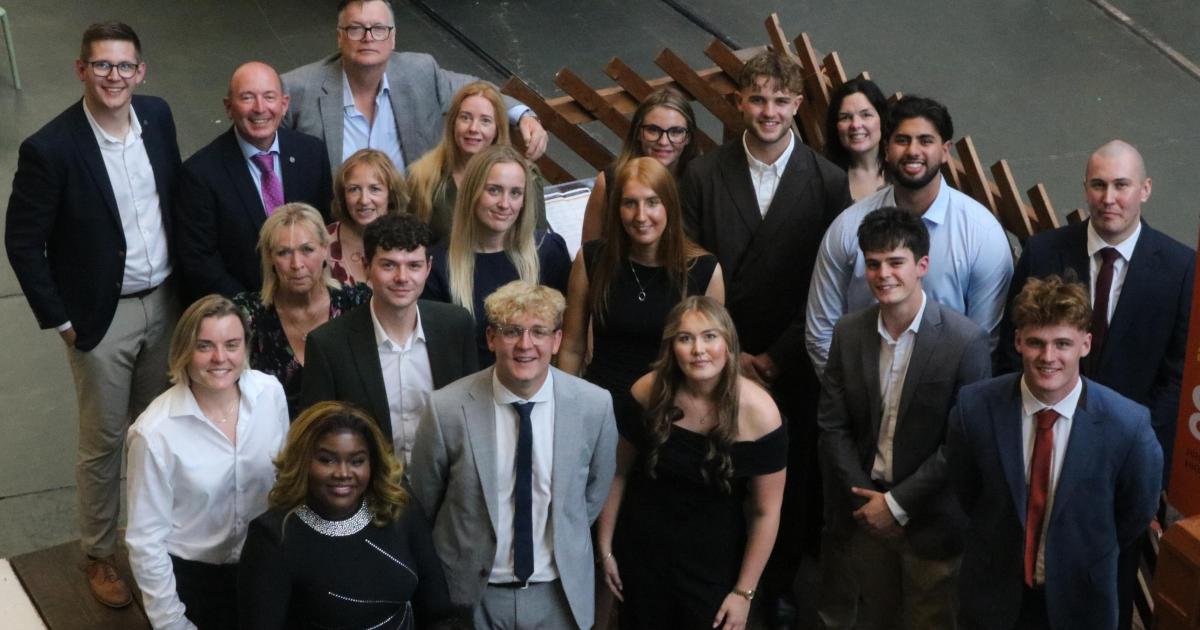
PlanBEE Rail recently celebrated its first cohort of graduates during a ceremony held on July 15 at the National Railway Museum in York, recognising the achievements of apprentices and the start of long-term professional journeys.

Two of the graduates, Amelia Abbott and Nick Bell, will be joining the Transpennine Route Upgrade (TRU) on a Level 6 degree apprenticeship starting in September.

Ms Abbott, who will take up a role as a project management apprentice, said: “Being part of the first cohort of PlanBEE Rail has been an incredible experience.

Advertisement

“The rotational model meant I was able to build skills and confidence across a variety of organisations within the industry, and that breadth of experience has been invaluable in shaping me as a project professional.

“To now be joining TRU is something I’m really proud of, and I’m excited to bring everything I’ve learned on the scheme into such a significant infrastructure project for the North.”

The PlanBEE Rail apprenticeship is designed to develop future multi-disciplinary project managers through a two-year programme.

The apprentices gain experience by rotating across four different employers, with TRU being a founding member of the scheme.

Advertisement

Source link

Continue Reading

Trending

Copyright © 2025