Connect with us
DAPA Banner

NewsBeat

The oil price surge is just one symptom of a supply chain network that is not fit for this age of global tensions

Published

on

The oil price surge is just one symptom of a supply chain network that is not fit for this age of global tensions

The escalating conflict between Iran, the US and Israel has taken a critical turn. The strait of Hormuz – one of the most important shipping routes for oil and gas – is facing significant disruption. The strait is the main route connecting Persian Gulf ports in Iran and some of the region’s other oil producers to the open ocean.

The strikes on Iran are already having tangible effects: energy flows are slowing, markets are reacting and supply chains are under pressure. This is not just a regional conflict – it is a global supply chain crisis unfolding in real time.

As an expert on supply chains, I am acutely aware of how central the strait is – not only for the stability of the region but also to the functioning of the global economy.

This narrow corridor is one of the world’s most critical chokepoints – around a fifth of the world’s oil passes through the strait daily. Its sudden disruption represents a “chokepoint failure” – a breakdown at a critical node that triggers cascading effects across global systems.

Advertisement

Tanker traffic has dropped sharply, with vessels waiting in surrounding waters as ship owners reassess the risks. Oil prices surged in response to the strikes and the threat to shipping routes. Analysts have warned that prices could climb significantly higher if the disruption persists.

But crucially, this reaction was not driven solely by actual shortages. Markets respond to uncertainty itself. The mere possibility that several million barrels per day could be disrupted is enough to push prices up, even before supply is properly hit. This reflects a broader feature of geopolitical risk: expectations and perceptions can be as economically powerful as material disruptions.

Because energy underpins almost every sector, these price increases transmit rapidly through supply chains. Higher fuel costs raise transportation expenses, increase production costs and ultimately feed into inflation across goods and services that eventually land with consumers.

The strategic importance of the Gulf states

The disruption is not confined to the strait. Instability across the wider Gulf region also affects the United Arab Emirates, as well as other strategically important energy producers and logistics hubs, such as Qatar, Kuwait and Saudi Arabia.

Advertisement

This dimension matters because the Gulf functions not only as an energy supplier but also as a crossroads in global trade and logistics.

Ports such as Dubai handle vast volumes of international shipping, linking Asia, Europe and Africa. As tensions spread, the reliability of these logistics systems is increasingly called into question.

The result is a shift to more widespread insecurity, where both energy flows and trade infrastructure – things like major container ports, shipping lanes, export terminals and storage facilities – are simultaneously at risk.

Energy is the heart of global supply chains. Manufacturing depends on electricity and fuel, transport relies on oil-based logistics and agriculture depends heavily on natural gas-derived fertilisers. When energy flows are disrupted or become more expensive, the effects propagate across entire networks.

Advertisement

Research on geopolitical crises shows that disruptions to key inputs such as oil and gas quickly translate into broader supply chain instability. This affects production, trade and the availability of goods far beyond the conflict zone. The Iran crisis reflects this dynamic. What begins as disruption in a maritime corridor can become a global economic issue within days.

For decades, global supply chains have been optimised for efficiency. This means that they concentrate sourcing and production in regions that minimise costs. This model has delivered large economic benefits, but it has also created weaknesses in the structure.

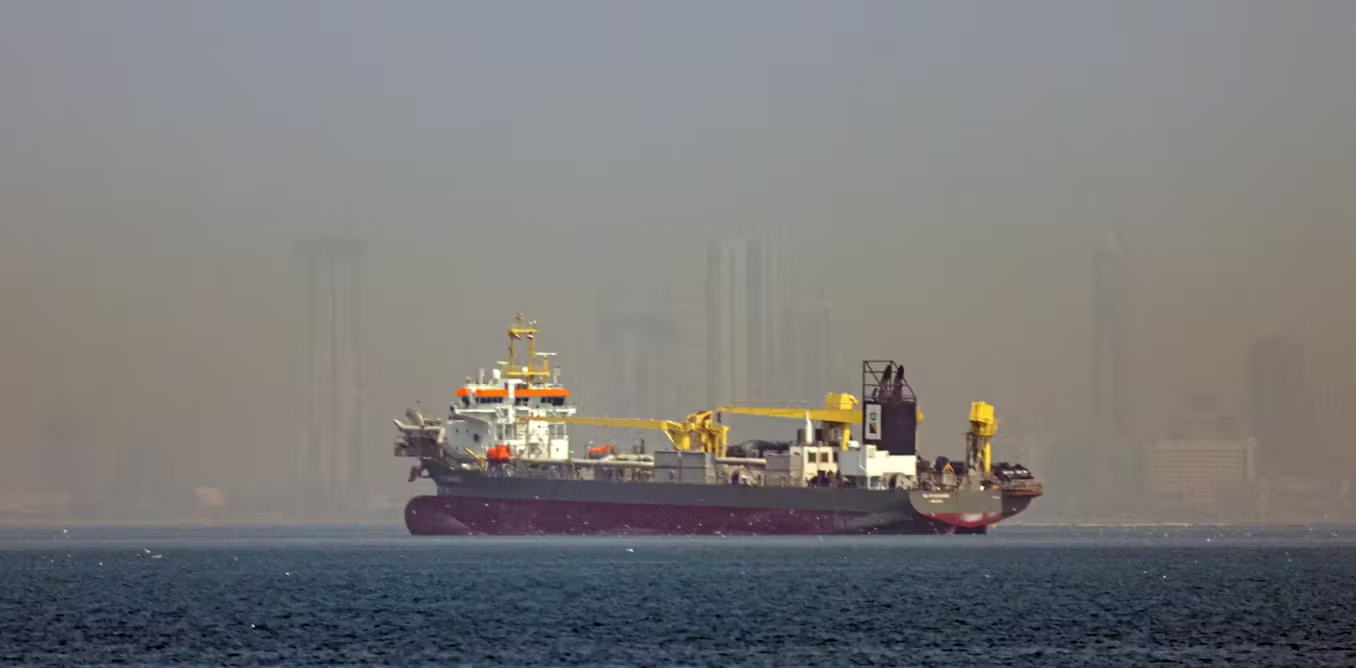
The crisis in the strait of Hormuz is a prime example of a chokepoint failure.
AustralianCamera/Shutterstock

The concentration of energy flowing through a single chokepoint such as the strait of Hormuz exemplifies this trade-off. When it is disrupted, the system lacks resilience.

Advertisement

In response, supply chains are likely to accelerate efforts to diversify and invest in alternative energy routes and sources. Countries that are heavily dependent on oil transiting through the Gulf will seek to expand strategic reserves, diversify their import routes and invest in pipelines that bypass maritime chokepoints.

But at the same time, geopolitical instability strengthens the case for renewable energy, electrification and regional energy integration. Expanding solar, wind and green hydrogen capacity reduces exposure to concentrated fossil fuel corridors. And cross-border electricity connections can improve flexibility during shocks. In this sense, resilience is also an energy transition issue.

At the same time, instability in conflict-hit regions can fuel the rise of informal and illegal supply chains, particularly where governance is weakened. These can include things like unregulated oil trading, goods being smuggled through informal maritime routes and labour exploitation hidden within subcontracting chains.

What’s more, supply chains themselves are increasingly shaped by geopolitical forces, as states use trade, energy and logistics networks as instruments of power.

Advertisement

For consumers, this could mean greater price volatility, shortages and reduced choice as firms adjust sourcing strategies in response to sanctions, trade restrictions or security risks. In some cases, it may also mean higher costs over the long term, as businesses prioritise resilience over efficiency.

A turning point for globalisation?

The situation in the strait of Hormuz may mark a turning point in how global supply chains are understood. It has shone a light on a fundamental tension at the heart of globalisation. Efficiency depends on sourcing and production being concentrated in a few locations, but resilience depends on diversification. When critical links in the chain fail, the consequences extend far beyond their immediate location.

This war demonstrates that supply chains are not merely economic systems. They are deeply embedded in geopolitical realities. The challenge ahead is not simply to manage disruption, but to redesign supply chains and energy sources for a world in which geopolitical risk is no longer exceptional, but structural.


Advertisement

Source link

Continue Reading
Click to comment

You must be logged in to post a comment Login

Leave a Reply

NewsBeat

Families explore Durham Castle during special open day event

Published

on

Families explore Durham Castle during special open day event

Durham Castle forms part of the twin UNESCO-designated World Heritage sites along with the cathedral.

As part of World Heritage Day on Saturday (April 18), both medieval “jewels” in Durham’s crown were open to the public.

The event was intended to bring the history of Durham and its twin World Heritage Sites to life, combining entertainment with discovery to appeal to visitors of all ages.

Family group pictured on the steps of the Great Hall, taking advantage of free tours of Durham Castle as part of World Heritage Day, on Saturday (April 18) (Image: Durham University)

Organised by Durham Castle and Cathedral World Heritage Site Partnership and County Durham Forum for History and Heritage (CDFHH), it tied in with this year’s World Heritage Day theme of, ‘Living Heritage’.

Advertisement

By day, the castle is a working building, forming part of University College, the founding college of Durham University, and provides novel halls of residence to some of its students.

It can only usually be visited on occasional pre-booked, paid for tours, so Saturday’s free event was a rare opportunity for members of the public to cast a glance at some of its historic nooks and crannies.

The castle hosted ‘The People’s Story’ with a Heritage Fair and family activities in the Great Hall, showcasing local history societies, including the World Heritage Site Youth Ambassadors.

Following a formal welcome to visitors by The Mayor of Durham, councillor Gary Hutchinson, the castle opened for four-and-a-quarters with free entry and self-guided tours of the Tunstall Chapel, Tunstall Gallery, the Norman Chapel and Senate Room, where medieval wall painting was recently discovered.

Advertisement

The Norman Knights of Vanguard re-enactment group was also in action in the castle courtyard, with displays of their swordsmanship.

Vanguard re-enactment group gave displays of their swordsmanship as part of World Heritage Day open day event at Durham Castle (Image: Durham University)

Nearby sites such as Palace Green Library, the Museum of Archaeology and World Heritage Site Visitor Centre were also open for visitors to explore.

The day’s events begin at 10am with a tour of St Margaret’s Allotments, off South Street, Durham, the quarry site from which the stone to build the castle and cathedral was taken.

A series of talks and presentations took place during the day in the Bishop’s Dining Room of the castle, including a reflection on the 40th anniversary of Durham being awarded UNESCO World Heritage Site status.

Advertisement

Durham Cathedral and the Cathedral Museum was also to the public, with 30-minute talks on its conservation.

Anne Allen, World Heritage Site Manager, said: “The day’s activities were planned in response to feedback from recent public consultation.

“We focused on opening the castle free of charge and co-creating an intergenerational people’s heritage programme, so everyone could experience the best of the World Heritage Site.”

World Heritage Day is a worldwide annual event, officially known as the International Day of Monuments and Sites, celebrated at UNESCO Sites across the world on 18 April each year. 

Advertisement

Source link

Continue Reading

NewsBeat

150 artists welcome visitors during York Open Studios 2026

Published

on

150 artists welcome visitors during York Open Studios 2026

Today was the second of four days when artists working in a huge range of disciplines in the city invite the public into their studios.

They will open their doors again on Saturday and Sunday.

Printmaker Susan Bradley at the 2026 York Open Studios (Image: Newsquest)

Susan Bradley was a furniture designer, designing products that were sold across the world until she had children and decided they were more important than attending the international fairs and exhibitions that were an integral part of her work.

So she changed careers, trained as a yoga teacher and turned herself into a print maker, using lino cut and intaglio techniques.

Advertisement

“I no longer do 3D,” she said. “I am now a print maker, in 2D”.

She said she enjoyed being able to do all of a project herself, from conception through the final artwork. Previously, she only designed a product which others then made.

As well as printing onto pristine paper, she particularly likes printing onto paper that has already been printed on, such as an unwanted music score.

“I like doing something unique,” she said of her work on pre-printed paper. “It cannot be duplicated.”

Advertisement

Metalworker Laura Duval at the 2026 York Open Studios (Image: Newsquest)

Another artist who works at South Bank Studios at Southlands Road Methodist Church, is metalworker Laura Duval.

She was a painter, but when doing an art degree at York St John University, realised it wasn’t what she wanted to do.

So she moved to a course at York College where one of the projects was making a spoon.

As she tackled it, she knew she had found her form of art – working with metal.

Advertisement

“I love the hammering,” she said. “It’s therapeutic.  I’m not a jeweller, I’m not a metalsmith, I’m something inbetween, a metalworker.”

Her preferred metal is copper because it’s “warm”, malleable and she can relate to it.

Her art includes jewellery and larger ornaments.

Painter Carolyn Coles at the 2026 York Open Studios (Image: Newsquest)

Both are among more than 150 artists at more than 100 venues across York taking part in this year’s Open Studios, including Carolyn Coles, painter, of South Bank Studios.

Advertisement

They will receive visitors again from 10am to 5pm on Saturday and Sunday.  Full details are on the event’s website: https://yorkopenstudios.co.uk/.

Source link

Advertisement
Continue Reading

NewsBeat

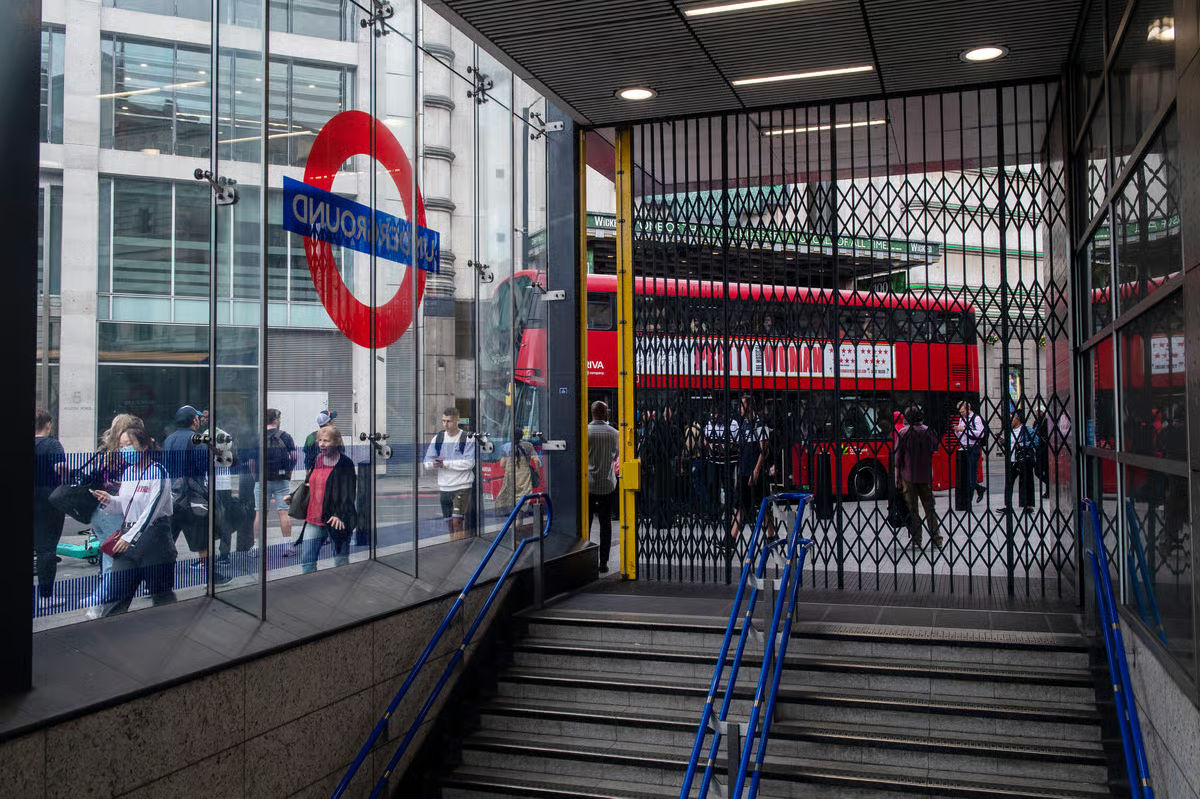
Tube strikes to go ahead next week as RMT accuses TfL of refusing to negotiate to avoid walkout chaos

Published

on

Tube strikes to go ahead next week as RMT accuses TfL of refusing to negotiate to avoid walkout chaos

“We urge the RMT to call off this action, which will disrupt Londoners, and continue to engage with us. If this strike action goes ahead customers should check before they travel as on some days during the strike, there will be significant disruption and the level of service we can provide will vary across lines.”

Source link

Continue Reading

NewsBeat

Danny Murphy column: Why Man City will win Premier League ahead of Arsenal

Published

on

Graphic for Danny Murphy's BBC Sport column

Arsenal have lost two league games on the spin, so the next time they step on the pitch, at home to Newcastle on Saturday, they are going to have doubts instead of momentum and confidence.

No matter how much quality their players have and how good their preparation, tactics and everything else is, what they have to deal with now is pressure.

Their fans are turning up at the Emirates as nervous as kittens and transferring their fears and frustrations to the players.

City, though, are not under any pressure because they are in a situation they probably never expected, and they have also won the league so many times recently.

Advertisement

There was a time during Sunday’s game when I thought it was not going to be their day. It was 1-1 and they had hit the woodwork twice after Gianluigi Donnarumma’s mistake let Arsenal back in the game.

You think that way when you are watching a game more than you do if you are playing in it, and City certainly never had a negative attitude.

They were relentless with the way they attacked when it was 1-1 and, rather than sit back, they kept attacking when they went 2-1 up.

I was talking to MOTD pundit Wayne Rooney after Sunday’s game and he said Sir Alex Ferguson used to tell Manchester United to do the same. It was a case of “go and score another”, and never shut up shop and be cautious.

Advertisement

City’s relentlessness comes from their manager too, and also having top quality players with an elite mentality like United did.

On top of that, it definitely helps having a lot of players in their team who have won so much.

Their players look so comfortable, even the ones who have not won anything. Rayan Cherki just seems to be enjoying himself.

The desperation you see from Arsenal is not there. City’s fans are not worried – they are just enjoying it.

Advertisement

Danny Murphy was speaking to BBC Sport’s Chris Bevan.

Source link

Continue Reading

NewsBeat

NBA MVP finalists: Gilgeous-Alexander, Jokic and Wembanyama

Published

on

NBA MVP finalists: Gilgeous-Alexander, Jokic and Wembanyama

Oklahoma City’s Shai Gilgeous-Alexander might be adding a couple more trophies to his collection. San Antonio’s Victor Wembanyama has a shot at doing the same.

And for the eighth consecutive year, the MVP will be an international one.

Gilgeous-Alexander — the reigning NBA MVP — is one of the finalists for this year’s top individual honor, along with Denver’s Nikola Jokic and the Spurs’ Wembanyama, who is also a finalist for defensive player of the year.

The NBA’s run of international MVPs started in 2019 and 2020 with Milwaukee’s Giannis Antetokounmpo, who is of Greek and Nigerian descent. Jokic, a Serbian, won in 2021, 2022 and 2024. Philadelphia’s Joel Embiid, who was born in Cameroon but since became a U.S. citizen, won the award in 2023, and Canada’s Gilgeous-Alexander won last year.

Advertisement

Gilgeous-Alexander is also a finalist for Clutch Player of the Year this season.

The NBA announced the finalists for seven individual awards Sunday night and will start announcing winners on Monday. The Defensive Player award — widely expected to be going to Wembanyama — comes out then, followed by Clutch Player on Tuesday and Sixth Man on Wednesday.

Meanwhile, the appeal that got the Los Angeles Lakers’ Luka Doncic onto the award ballots might earn him All-NBA, but did not lead to him getting his first MVP award. He was not among the top three in the balloting for MVP; voters cast their ballots last week after Doncic and Detroit’s Cade Cunningham won appeals that got them on the ballot even though they didn’t satisfy the terms of the NBA’s 65-game rule for eligibility in most cases.

Minnesota’s Anthony Edwards lost his appeal — but might get an award after all.

Advertisement

Edwards is a finalist for Clutch Player of the Year. He wasn’t on the ballot for MVP, All-NBA and other honors, but was on the Clutch ballot because those nominees were selected by the league’s coaches.

The finalists

— MVP: Shai Gilgeous-Alexander, Oklahoma City; Nikola Jokic, Denver; Victor Wembanyama, San Antonio.

— Defensive Player of the Year: Wembanyama; Chet Holmgren, Oklahoma City; Ausar Thompson, Detroit.

— Clutch Player: Anthony Edwards, Minnesota; Gilgeous-Alexander; Jamal Murray, Denver.

Advertisement

— Most Improved Player: Nickeil Alexander-Walker, Atlanta; Deni Avdija, Portland; Jalen Duren, Detroit.

— Sixth Man: Tim Hardaway Jr., Denver; Jaime Jaquez Jr., Miami; Keldon Johnson, San Antonio.

— Coach of the Year: J.B. Bickerstaff, Detroit; Mitch Johnson, San Antonio; Joe Mazzulla, Boston.

— Rookie of the Year: VJ Edgecombe, Philadelphia; Cooper Flagg, Dallas; Kon Knueppel, Charlotte.

Advertisement

MVP

Gilgeous-Alexander is trying to go back-to-back, Jokic — who has been first or second in five straight seasons, entering this year — is seeking his fourth MVP in six years and Wembanyama is a finalist for the first time.

Coach of the Year

Bickerstaff won the award from the National Basketball Coaches Association, selected by his peers, and is the likely favorite for the official NBA honor. Johnson and Mazzulla both led teams that widely exceeded most preseason expectations.

Advertisement

Rookie of the Year

This will likely be a two-person race in the end, with Flagg and Knueppel — both former Duke players — the presumed frontrunners. That would suggest Edgecombe likely finishes third.

Defensive Player of the Year

Wembanyama was the likely frontrunner to win it last season, but wound up falling short of eligibility after being diagnosed with deep vein thrombosis at the All-Star break and missing the rest of the season.

Minnesota’s Rudy Gobert’s bid for a fifth DPOY award — which would break a record — will continue for at least one more year.

Clutch Player

Gilgeous-Alexander led the league in clutch scoring per game, with Edwards second. Denver had two legitimate candidates with Murray and Nikola Jokic; voters clearly gave Murray the edge.

Advertisement

Clutch scoring is defined as points that come in the final five minutes of a game where the point differential between teams is five or less.

Sixth Man of the Year

Jaquez averaged 15.4 points in 74 appearances off the bench, Johnson averaged 13.2 points — after playing in all 82 Spurs games as a reserve — and Hardaway also averaged 13.2 points in the 74 games where he came off Denver’s bench.

The winner will be a first-time selection for the award.

Most Improved Player

Avdija averaged 24.2 points and led Portland’s surge to the playoffs, while Alexander-Walker — bidding to give Atlanta its second consecutive MIP winner after Dyson Daniels last season — averaged 20.8 points, by far the most his career.

Advertisement

Duren was a first-time All-Star selection and averaged 19.5 points, almost double what he averaged last season despite playing basically the same amount of minutes.

___

AP NBA: https://apnews.com/hub/NBA

Advertisement

Source link

Continue Reading

NewsBeat

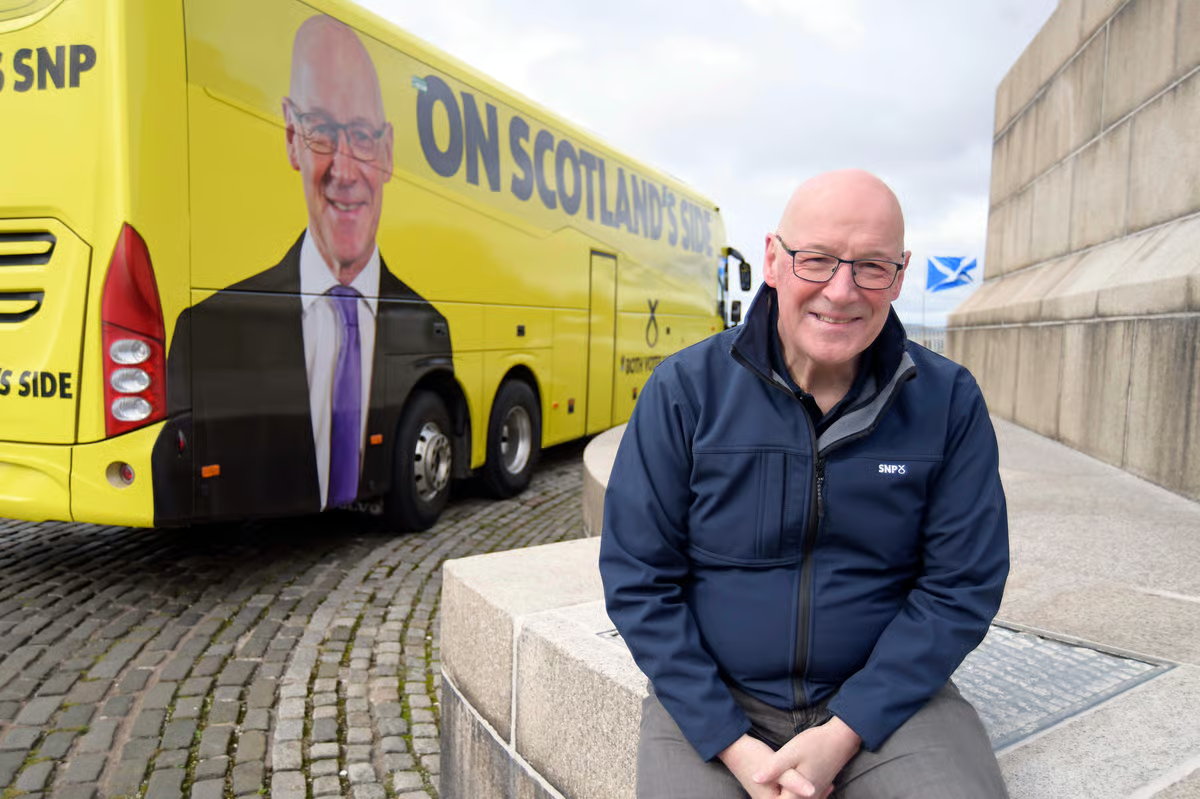
Swinney says he will win independence vote in 2028 and run for election in 2031

Published

on

Swinney says he will win independence vote in 2028 and run for election in 2031

This would be a “seismic change”, were it to happen, Mr Swinney says, adding that in Wales, where Labour have been in power since the start of devolution, it would be a “massive change in the fortunes and perspective of the Labour Party” which would then have “enormous implications for the United Kingdom”.

Source link

Continue Reading

NewsBeat

Birtley man ‘stalked’ woman from Newcastle to Ibiza

Published

on

Anarchy Brewery unveils Shearer can to mark Newcastle anniversary

Connor Casey, 22, of The Brambles, Birtley, appeared at Durham Crown Court via video link from Holme House Prison, where he is remanded in custody.

He is accused of stalking a woman between January 28 and March 16, causing her to fear violence would be committed against her.

The allegation states that he kept track of her movements, damaged and threatened to damage her property, followed her when socialising with friends in Newcastle and when she travelled abroad, to Ibiza.

Advertisement

Casey is also accused of assaulting her, causing actual bodily harm, in Thailand, between January 31 and March 3, this year, and intentional strangulation, at Chester-le-Street, between December 31 and February 1.

All three counts were put to Casey at the hearing and he denied them all.

A timetable prior to trial was agreed, with the prosecution to serve its file of evidence by May 8 and the signed defence statement to be submitted by June 5.

All parties agreed on a trial start date of Tuesday September 1.

Advertisement

Judge Nathan Adams told Casey, of The Brambles, Birtley, near Chester-le-Street: “You have pleaded not guilty and the case is now timetabled to trial.

“By June 5 you need to help in the preparation of your signed defence statement, setting out why you say you are not guilty.

“The trial will start on September 1, and you will remain in custody in the meantime.”

Advertisement

Source link

Continue Reading

NewsBeat

Passengers stranded in Asia as major airlines cancel 23 flights and delay 483 more

Published

on

Daily Mirror

Passengers were forced to miss connecting flights and faced hours of disruption – reports suggest there was overcrowded waiting areas and huge queues at major airports

Passengers have been left stranded after a huge number of flights were reportedly cancelled as four major airlines experienced delays.

Advertisement

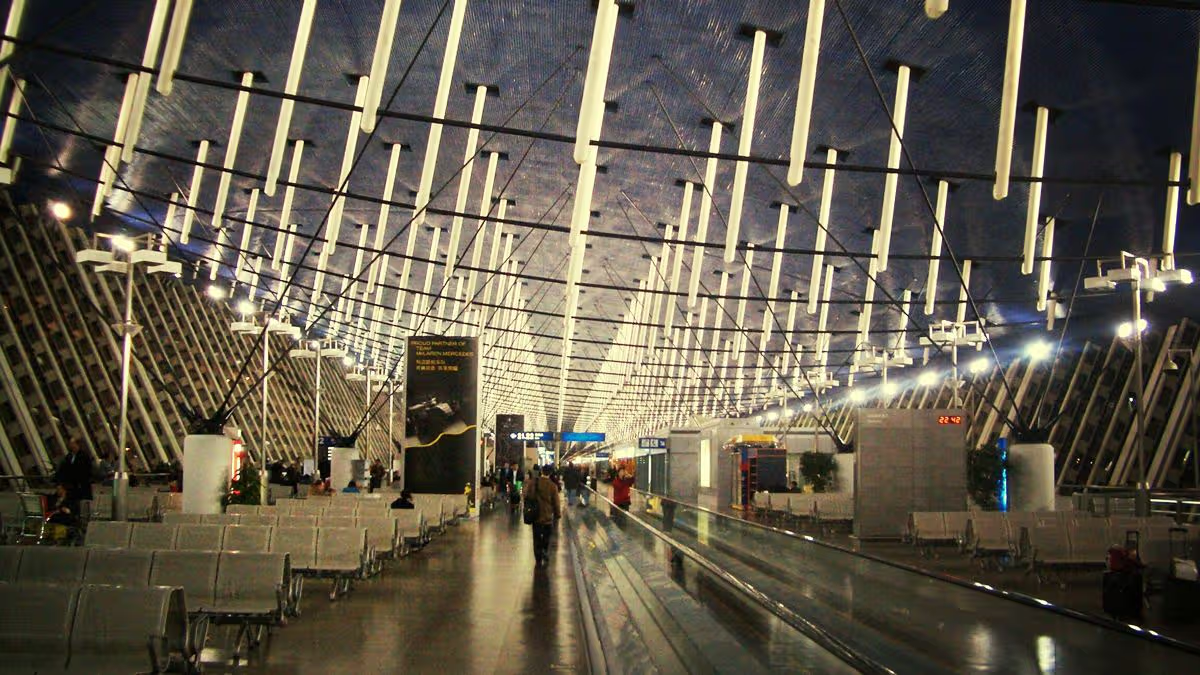
According to Travel and Tour World, nearly 500 flights were delayed as Capital Airlines, Garuda Indonesia, China Eastern Airlines and Pakistan International Airlines.

The airlines collectively cancelled 23 flights across a number of different airports in Asia, including Shanghai Pudong and Islamabad International Airport.

Reports suggest that these delays created a whole host of problems – with passengers missing connecting flights and facing hours of disruption. Travel and Tour World reports that there were overcrowded waiting areas and huge queues at Shanghai and Beijing.

It comes as Aer Lingus is expected to cancel around 500 flights due to “mandatory maintenance” on aircraft.

Advertisement

An Aer Lingus spokesperson told RSVP Live: “Aer Lingus has commenced operating its planned summer schedule. A number of recent cancellations have been required due to mandatory maintenance on aircraft, along with a limited number of schedule adjustments.

“Where schedule adjustments are being made, the vast majority of customers are being reaccommodated on same day services.”

Earlier this month, Ryanair chief Michael O’Leary cautioned that flights could be cancelled this summer owing to the soaring cost of jet fuel.

Advertisement

He told ITV News: “We’re all facing an unknown scenario. And we are certainly looking at maybe having to cancel 5 per cent, 10 per cent of flights through May, June and July.”

Should passengers find their flight cancelled, O’Leary suggested they should ‘blame Trump’ rather than the airline.

Air Canada is also set to suspend services to New York’s JFK International Airport over the summer as the war in Iran creates jet fuel shortages that have sent prices soaring.

Canada’s flag carrier said on Friday that flights from Toronto and Montreal to JFK will cease on June 1 and resume on October 25.

Advertisement

Services to the New York metropolitan area’s two other airports — LaGuardia and Newark — will continue.

Air Canada said it will reach out to customers who are affected by the suspension with alternative travel options.

“As jet fuel prices have doubled since the start of the Iran conflict and some lower profitability routes and flights are no longer economic, we are making schedule adjustments accordingly,” a spokesman for the Montreal-based carrier said.

Source link

Advertisement
Continue Reading

NewsBeat

Sweden warns Russia could launch land grab to seize Baltic Sea island

Published

on

Daily Mirror

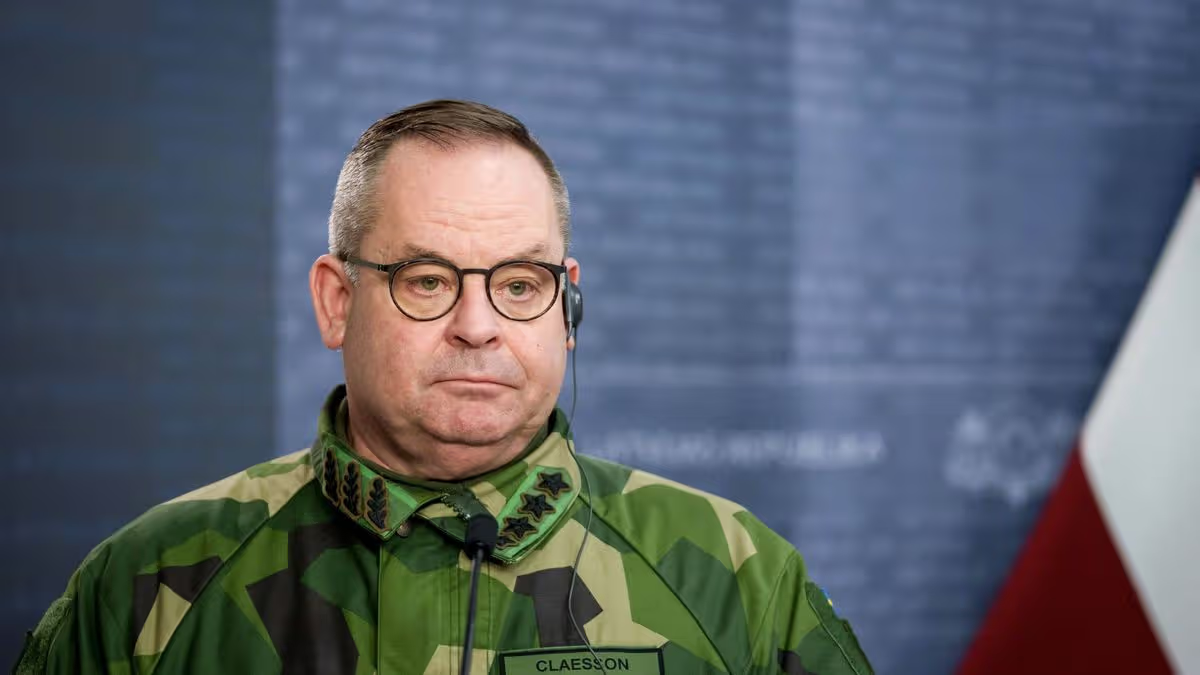
Swedish Chief of Defence warns Moscow could carry out Baltic Sea ‘land grab’ at any time to test NATO’s resolve as military intelligence says Russia capable of war expansion

Sweden is bracing itself for a potential Russian operation to seize the island of Gotland, according to the country’s military chief.

Advertisement

Swedish Chief of Defence Michael Claesson warned that Moscow could execute a land grab “at any time” in order to put NATO’s determination to the test.

“It doesn’t have to be particularly extensive at all, but more to make a point and wait to see what might happen politically,” Claesson said.

NATO military exercises have traditionally centred on a potential Russian land assault along the alliance’s eastern flank, however focus is now turning towards the Baltic Sea.

War games have simulated possible Russian landings on strategically vital islands such as Gotland in Sweden, Bornholm in Denmark, and Hiiumaa and Saaremaa in Estonia.

Advertisement

Swedish military intelligence has cautioned that Russia is capable of broadening its conflict in the years ahead.

They further warn that any resolution to the Russian war could enable Putin to redeploy troops closer to NATO territory.

It follows US President Donald Trump repeatedly rounding on NATO allies over what he regards as insufficient backing for the Iran war. Most recently, at a Turning Point event in Arizona on Friday, 17 April, Trump delivered a keynote speech in which he declared that his country must depend on itself.

Trump said: “If NATO teaches us any one thing, and I hope you all watched because they weren’t there for us, if it teaches us any one thing: we have to rely on ourselves.

Advertisement

“We can’t rely on outside countries and outside sources.”

Meanwhile, Ukraine’s President Volodymyr Zelensky has condemned a US decision to extend the period during which Russia is allowed to sell oil despite Western sanctions.

The move means countries can purchase Russian oil and petroleum products already loaded on vessels at sea until 16 May.

The US argues that the waiver is meant to ease the energy supply crunch sparked by the US-Israel war with Iran.

Advertisement

But in his remarks on Sunday, Zelensky said “every dollar paid for Russian oil is money for the war” in Ukraine. Widespread sanctions have been in place against Russia since President Vladimir Putin launched his full-scale invasion of its neighbour in February 2022.

Source link

Continue Reading

NewsBeat

Children born near army base learn truth about UK soldier dads

Published

on

Children born near army base learn truth about UK soldier dads

“Edward”, a nine-year old Kenyan boy, has always been aware his father worked for the British military. The boy’s skin colour, lighter than his peers, has provoked years of bullying. His father disappeared before Edward [not his real name] was born, leaving his mum living in extreme poverty, ostracised by some of her family.

Source link

Continue Reading

Trending

Copyright © 2025