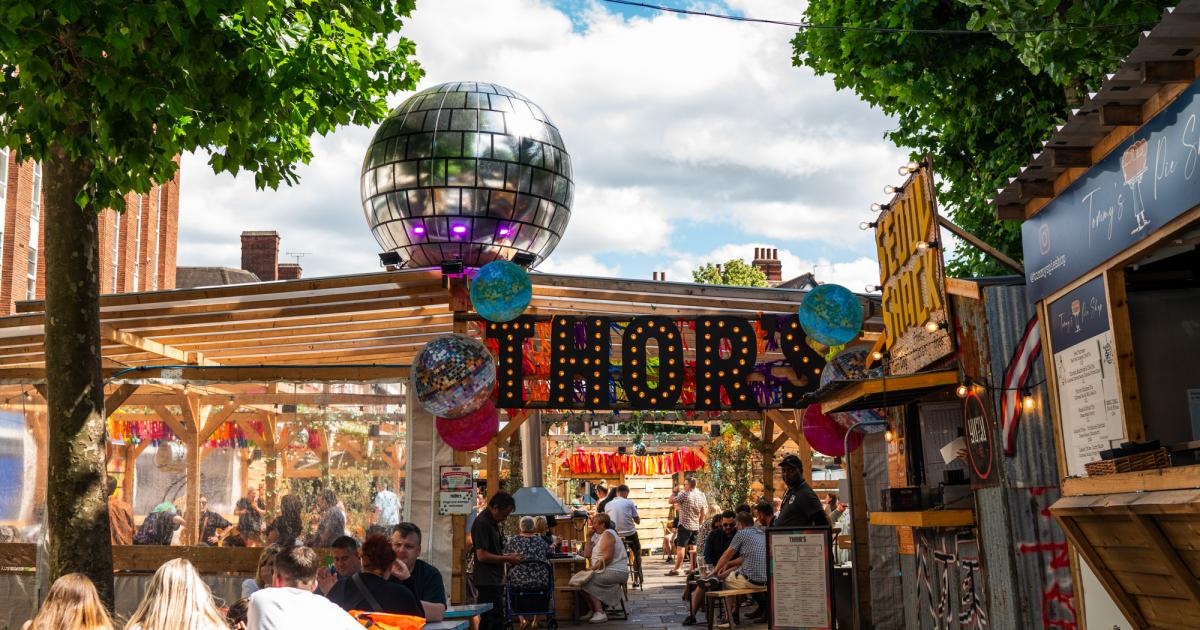



Thor’s application to get planning permission for its Parliament Street pitch for another five years has been approved by City of York Council.
Fabler, the company behind the venue, said they hoped the family-friendly venue would continue to help increase footfall in the city centre and give the space a sense of purpose.
Two public comments lodged about the plans claimed it would be visually intrusive and would affect street performers and nearby church services on Sundays.
Council planning officers stated it would not have any unacceptable effect on the surrounding area and listed buildings, with the space already used for a number of events.
Advertisement
RECOMMENDED READING:
It comes ahead of Thor’s opening for this summer on Saturday, May 22.
Plans for the venue this year includes a Nordic-style tipi along with a bar, street food truck and a new family pop-up park provided by York’s Business Improvement District (BID).
It is also set to feature fire pits and a performance space for live music and other acts.
Advertisement
Thor’s is set to run in Parliament Street until Sunday, September 6.
It is set to open from 11am to 7.30pm Monday to Wednesday, until 9.30pm from Thursday to Saturday and until 8pm on Sundays.
Fabler, which also runs Dusk and House of Trembling Madness, is run by York-based couple Amanda and Richard Monaghan.
The firm’s plans stated they applied for permission for the pitch for 16 weeks between May and September until 2030 to save time and money by not lodging multiple applications.
Advertisement
An impression showing how Thor’s in Parliament Street, York, could look in 2026 (Image: Fabler)
Concerns raised in public comments on the plans include claims it would stop others from using the space for a significant portion of the year.
They also claimed an increase in footfall in an already busy pedestrian area could cause safety issues.
Thor’s plans stated their welcoming, fully-accessible venue aimed to draw in locals, visitors and families.
They added noise was not expected to affect any neighbouring homes or businesses, with its small speakers positioned to face away from them.
Advertisement
Plans stated: “Thor’s is more than just a bar, we’re community creators.
“The tipi has been developed in order to create a welcoming space.
“It will be a welcome break for families and shoppers- a green space for everyone to enjoy.”
Thor’s venues have been in York since 2015 when it first appeared as a pop-up bar during York Christmas Market.
Advertisement
Its Parliament Street venue first opened in 2021 and has become a yearly fixture since.
It is one of three in York along with Thor’s tipis in the grounds of The Milner hotel and a winter venue in Museum Gardens.
A beach in East Sussex could reopen to the public almost 20 years after safety concerns shut access to the shore.
Newhaven West Beach was closed by French owner Newhaven Port and Properties in 2008 due to the “dangerous condition” of its cliffs.
James MacCleary, the Liberal Democrat MP for Lewes, presented a bill to parliament in an attempt to secure legal public access to the “beautiful sandy beach” on 28 April.
MacCleary said: “17 years ago, this beach was closed to the people of Newhaven. For generations, the West Beach was where children learned to swim, families spent their summer and memories were made. It was not just a stretch of sand; it was a part of life.”
Advertisement
He called on the government to “take this bill, adopt it, make it law and give Newhaven its beach back.”
In June 2016, former mayor of Newhaven Steve Saunders said: “I am disappointed at NPP’s decision not to reopen the beach at this time and not being able to give the good news that everyone was hoping for. The people of the town are naturally angry and frustrated at its continued closure, and I completely sympathise and share in these understandable views.
“I have tried hard with officers and colleagues at Newhaven Town Council to reach a compromise solution with the Port Authority, which would see this well-loved facility available for everyone to enjoy again.”
Sveti Stefan, an island on the Budva Riviera, is set to welcome back guests from July following a settlement between the Montenegro government and island leaseholders.
The popular island was forced to close in 2021 amid a decade-long legal battle over beach access for locals.
Greggs is popular among countless people but for workers, it’s sometimes a different story. A Greggs employee has shared a “new pet peeve” unlocked by demanding customers – and fellow staff members agree
Certain customers have a tendency to be discourteous and demanding, others relish the chance to demean people simply carrying out their duties, and some can be unpredictable and eager to lodge complaints. One Greggs employee has revealed the customer behaviours they find most draining.
Greggs is a firm fixture on Britain’s high streets, beloved by people across all age groups thanks to a wide-ranging menu featuring classic favourites such as the enduring sausage roll, steak bake, and cheese and onion pasty; alongside its sweet offerings including biscuits and donuts, plus the popular vegan sausage roll, salads, sandwiches, pasta and more.
The bakery enjoys a dedicated following and it’s estimated that approximately 2.5 million sausage rolls are sold across the UK every week, totalling roughly 140 million a year.
Taking to Reddit, one employee was eager to reveal the reality of working behind the counter rather than queuing in front of it.
Advertisement
In a post titled “New pet peeve unlocked; customers telling me how to do my job”, they sarcastically wrote: “‘Did you use the correct tongs to pick up my vegan roll? You used the yellow ones but I’m pretty sure they are for vegetables.’”
They went on: “Also; I’m trying to put together a customer’s large order that’s like 10 steak bakes and 40 sausage rolls and they’re constantly asking me why I haven’t prepared their cup of tea yet.
“Also also; tell them the total price of their sausage roll and latte; ‘£3.40? Is that including the latte?’ Oh no sorry I forgot to charge you for the latte because as we all know a single sausage roll costs £3.40.”
In the comments section, other Greggs staff members were eager to share their own experiences and thoughts. One said: “Welcome to customer service! These people will never stop… just smile and wave.”
Advertisement
Another said: “My favourite one is when they’ve got a reward on the app they don’t want to use but they don’t let you know ahead of time so you can advise them to switch it off so it doesn’t redeem so they get the free one. I had someone ask today if I could add the free one back onto their app and they’d pay for it instead.”
A third commented: “I hate customers who blatantly know they didn’t order something and then demand you get it for them. Half the time they expect the item for free and it’s like ‘well no?’”
A fourth added: “When they say ‘I want this baguette with a latte and this sandwich with this coke’ as if we control what items the system pairs up in a deal.
“Like, it automatically puts everything into the best value, I don’t choose which combination of deals you have.”
Advertisement
Greggs was established in Newcastle over 80 years ago by John Gregg. His ambition was to supply fresh egg and yeast to households across the northern city, carrying out deliveries by pushbike.
10 years on, he launched Greggs of Gosforth – minus the bicycle – where he produced fresh bread and baked goods. The high street continues to feature a Greggs outlet to this day, although it has evolved considerably over the decades.
According to the Greggs website: “With over 2,000 Greggs in the UK, the important stuff still matters to us. We’re hard-working, but above all else we’re family; and it doesn’t matter who you are, where you are from or what your favourite bake is, when you come into our shops, you’re part of the family too.”
Data from aviation analytics firm Cirium shows 296 departures from UK airports were cancelled this month as of Tuesday, representing 0.75 per cent of the total scheduled flights. This marks a significant increase from just 120 cancellations reported six days prior.
However, the outlook for the peak summer travel period appears more stable. Week-on-week schedule reductions for June remain limited at 48 fewer outbound flights, following the cancellation of 0.2 per cent of services. July has seen a reduction of 31 flights week-on-week, while August shows a minimal decrease of just four flights.
Around 13,000 flights were cancelled globally in May, resulting in two million fewer available seats, analyst Cirium previously revealed.
Advertisement
While this figure might appear significant, it constitutes a mere 1.5 per cent reduction in total worldwide aviation capacity, saysThe Independent’sSimon Calder. These cancellations are primarily driven by the high price of jet fuel, rather than any supply shortages.
United Airlines cut its full-year outlook to $7–$11 per share from $12–$14 earlier in the year before the U.S. and Israel attacked Iran. (Getty)
German carrier Lufthansa and Turkish Airlines account for a substantial proportion of these grounded services, with both airlines opting to cancel flights as a cost-saving measure. In the UK, some Lufthansa operations have been affected, though this often means passengers are re-routed, for instance, those planning to fly from Glasgow to Frankfurt may now depart from Edinburgh.
Heathrow Airport has recorded just over 100 cancellations. However, these are not new disruptions but rather extensions of previously planned operations to airports in the Gulf region, where resumption dates have been further delayed.
Below is a list of how airlines are responding, in alphabetical order:
Advertisement
Aegean Airlines
The Greek airline expects suspended Middle East flights and a spike in fuel prices to have a “notable impact” on its first-quarter results.
AirAsia X
The Malaysian airline’s executives said the company had cut 10% of flights across the group, with a surcharge of about 20% on fuel in general.
Advertisement
Air France-KLM
The airline group said it planned to increase long-haul ticket prices to address surging fuel costs, with cabin fares set to rise by 50 euros ($58) per round trip.
The Dutch airline will not operate 80 return flights out of Amsterdam’s Schiphol airport over the next month.
Advertisement
The flights are “currently no longer financially viable to operate” due to rising kerosene costs, said KLM.
Air Canada
Canada’s largest carrier plans to trim four of its 38 daily flights to New York due to higher fuel prices. The four flights to JFK International Airport will be cut from 1 June to 25 October 2026.
Jet Fuel Canada’s largest carrier plans to trim four of its 38 daily flights to New York. (AP)
Air India
The Indian carrier said it would revise its fuel surcharge from a flat domestic surcharge to a distance-based grid. It said surcharges on international routes did not compensate for the exponential rise in fuel prices.
A government document, seen by Reuters, indicates that the Nigerian Midstream and Downstream Petroleum Regulatory Authority (NMDPRA) has set price limits for aviation fuel.
Nigerian airlines temporarily suspended a planned nationwide shutdown of flight operations, which was set to begin on April 20, after the government intervened amid crippling fuel prices. The Airline Operators of Nigeria (AON), an industry body representing a dozen primarily domestic carriers, had warned they would halt services from April 20, citing that surging jet fuel costs had rendered operations unsustainable.
Advertisement
Air New Zealand
The airline said on 7 April it would slash flights through May and June and hike fares, having been one of the first to announce broad increases to ticket prices when the conflict broke out. It also suspended its full-year earnings forecast due to fuel market volatility.
Easyjet said European consumers should expect higher ticket prices. (Reuters)
Air Transat
The Canadian airline said it would reduce planned capacity by 6% from May until October this year, with cuts expected on routes to Europe and the Caribbean and its service to Cuba remaining suspended until October.
Akasa Air
Advertisement
India’s Akasa Air said it was introducing a fuel surcharge ranging between 199 and 1,300 Indian rupees ($2 to $14) on domestic and international flights.
Alaska Air
The U.S. airline said it would increase fees for the first checked bag by $5 and by $10 for the second on its North American flights, as well as for its Hawaiian Airlines unit. It hiked prices for a third checked bag from $50 to $200.
The carrier withdrew its full-year profit forecast as the sharp rise in jet fuel prices put pressure on margins.
Advertisement
American Airlines
The U.S. carrier said it would hike checked baggage fees by $10 each for the first and second checked bags and by $150 for the third checked bag on domestic and short-haul international flights. It also trimmed certain benefits for economy passengers.
It had earlier said it expected a $400m increase in first-quarter expenses due to fuel prices.
Asiana Airlines
Advertisement
The South Korean airline will slash 22 flights between April and July due to the fuel cost increase, Newsis reported.
British Airways
IAG – which owns British Airways, Aer Lingus and Iberia of Spain – is talking of “pricing adjustments to reflect these higher fuel costs”. A spokesperson said: “We are not seeing jet fuel supply interruptions, but fuel prices have risen sharply and, despite our hedging strategy, which gives some shorter-term mitigation, we are not immune to the impact.”
“BA will not come after you for more cash, and the airlines can charge only what the market will bear. And judging from some of the prices on offer, that isn’t a lot,” he said.
IAG company also warned its profits will be hit as it expects to spend about €2bn (£1.72bn) more than planned on fuel this year. But Chief executive Luis Gallego said IAG does not believe there will be “any interruption for the summer” in terms of jet fuel supplies.
Cathay Pacific
The Hong Kong airline said it would cut some flight from mid-May until the end of June, cancelling about 2% of its scheduled passenger flights, while its budget airline HK Express was cutting around 6% of flights.
Advertisement
The carrier previously said it would hike its fuel surcharge by 34% across routes from April 1 and review them every two weeks.
The airline raised HK$2.08 billion ($265.58 million) from three-year fixed-rate notes at a yield of 3.78%, according to a term sheet seen by Reuters on Wednesday.
Cebu Air
The Philippines-based airline said the sharp rise in fuel prices was a key concern and it would continue to review its pricing and network strategies to mitigate the impact.
Advertisement
China Eastern Airlines
The airline said it would raise fuel surcharges for domestic flights from 5 April, with flights of 800km and below hit with a 60 yuan ($9) surcharge and a 120 yuan surcharge for flights over 800km.
Delta Air Lines
Delta said it would cut capacity by around 3.5 percentage points from its original plan and raise fees for checked bags in an attempt to offset soaring jet fuel costs, with an increase of $10 on first and second checked bags and a $50 increase on the third.
Advertisement
The U.S. airline pulled all planned capacity growth for the current quarter and forecast profit below Wall Street expectations. Delta CEO said it would hold off on updating the full-year outlook given uncertainty over how long the fuel price spike would last.
Lufthansa said it would ground 27 planes servicing its short-haul CityLine subsidiary. (AP)
Easyjet
EasyJet Holidays told customers they can be confident their holidays will “go ahead as planned” without extra surcharges.
CEO Garry Wilson said on Saturday, 25 April: “We know that holidaymakers may have questions about what recent global events might mean for their travel plans this summer, so we are giving our customers absolute peace of mind that no surcharges will be added to their flights or package holidays.”
EasyJet had previously warned of a bigger half-year pre-tax loss of between £540m and £560m ($731m and $758m), including £25m in extra fuel costs in March.
Advertisement
CEO Kenton Jarvis previously said European consumers should expect higher ticket prices towards the end of summer, when existing fuel hedges come to an end.
Frontier Airlines
The U.S. airline is reviewing its full-year forecast as fuel prices have increased significantly since it issued the outlook.
Greater Bay Airlines
Advertisement
The Hong Kong-based company said it would raise fuel surcharges on most routes from 1 April, while keeping them unchanged on mainland China and Japan routes.
Its surcharge for flights between Hong Kong and the Philippines will more than double, the carrier said.
Hong Kong Airlines
The airline said it would raise fuel surcharges by up to 35% from 12 March, with the sharpest increase on flights between Hong Kong and the Maldives, Bangladesh and Nepal, where charges would rise to HK$384 ($49) from HK$284.
Advertisement
Indigo
India’s biggest airline said it would introduce fuel charges on domestic and international flights from 14 March, including a charge of 900 rupees for flights to the Middle East and a charge of 2,300 rupees for flights to Europe. The company is also lobbying the Indian government to cut fuel taxes, sources told Reuters.
Speaking on Friday, chief executive Steve Heapy said: “Holidaymakers should have every right to book their hard-earned break in the sun, without worrying about being hit with additional costs, and they can have that complete assurance when they book a flight or holiday with Jet2. Customers booking with Jet2 know that they are locking in their price without additional cost surprises later.”
Jetblue Airways
The U.S.-based low-cost carrier said it was increasing fees for optional services such as checked baggage as it experiences “rising operating costs”. Baggage prices will rise by either $4 or $9, it said.
Joanna Geraghty, CEO of the U.S.-based low-cost carrier, told employees in a memo seen by Reuters that the carrier would not consider bankruptcy this year, even as rising jet fuel costs threaten its financial recovery. The company entered a $500 million debt financing agreement, according to an SEC filing.
Advertisement
Korean Air
The South Korean carrier will enter emergency management mode from April, as rising oil prices weigh on costs, a source with knowledge of the matter told Reuters. The airline plans to implement phased response measures based on oil price levels, and step up company-wide cost efficiency to offset surging fuel costs.
It said it has axed “unprofitable” short-haul flights operated by its regional subsidiary Lufthansa CityLine, reducing the entire group’s capacity by one per cent in available seat kilometres this summer.
Lufthansa CityLine has hubs in Frankfurt and Munich. The first 120 daily flight cancellations took effect on Monday and will continue through the end of May. The airline said affected passengers have been notified.
The group has also permanently removed the 27 Lufthansa CityLine aircraft from operation. Some routes have also been cancelled in their entirety, including from Frankfurt to Bydgoszcz and Rzeszów in Poland, as well as Stavanger in Norway, meaning they have been temporarily removed from the flight schedule.
Norse Atlantic
Advertisement
Low-cost Norwegian airline Norse Atlantic has cancelled its flight route between London Gatwick and Los Angeles due to the rise in fuel prices.
Pakistan International Airlines
The carrier said it would raise domestic flight fares by $20 and international fares by up to $100, citing higher fuel surcharges.
Qantas Airways
Advertisement
KLM said on April 16 it would cancel 160 flights in Europe in the coming month. (Reuters)
Australia’s Qantas said it had delayed a planned A$150m ($106m) buyback and was raising its estimated fuel bill for the second half of 2026 to A$3.1bn-A$3.3bn, from a previous A$2.5bn forecast.
Ryanair
Ryanair’s chief executive, Michael O’Leary, has warned that several European airlines could face significant financial difficulties and potential failures if jet fuel prices remain high throughout the summer season.
Despite the volatile market, O’Leary affirmed that Ryanair is ‘the best insulated, most hedged airline in Europe’ and committed to not imposing price increases or fuel surcharges on its customers.
SAS
Advertisement
The Scandinavian airline said it would cancel 1,000 flights in April because of high oil and jet fuel prices, after cancelling a “couple hundred” flights in March.
SAS, which had already increased flight prices, said that even if it tried to absorb the rising fuel costs, the price surge would still be a blow to the aviation industry.
While customers with flights booked can expect refunds, Spirit is not providing any help in booking alternative travel plans. Several of Spirit’s competitors have offered capped ticket prices “specifically for Spirit customers who now need to rebook cancelled flights,” Transportation Secretary Sean Duffy said.
Duffy claimed during a Saturday press conference that Trump officials had made “a significant effort” to keep the airline afloat.
“There was a number of ideas being floated on how the government could step in and be helpful to Spirit Airlines,” Duffy said. “The president was like a dog on a bone trying to figure out a way to keep Spirit afloat.”
President Donald Trump had discussed a potential bailout of the airline after it found itself in bankruptcy proceedings for the second time in less than two years — and as the price of jet fuel skyrockets amidst the war in Iran.
Advertisement
Spring Airlines
The budget Chinese airline said it would raise fuel surcharges on domestic flights from 5 April, with details to be announced later.
Southwest Airlines
The American carrier forecast second-quarter profit below estimates as margins were dented by high fuel prices. It previously said it would hike checked baggage fees by $10 for the first and second bags, raising costs to $45 for the first bag and $55 for the second.
Advertisement
TAP
The Portuguese airline said its price hikes would partially mitigate the impact of fuel price changes on its revenue.
Thai Airways
The Thailand-based carrier said it would raise fares by 10% to 15% to address rising fuel costs.
Advertisement
TUI
Europe’s largest tour operator TUI has reassured customers who have already booked their holidays that the price is fixed “with no fuel surcharges added.”
Neil Swanson, managing director of TUI UK & Ireland, said: “We understand that customers want both confidence and clarity when booking a holiday.
“Our teams are here to support people who are thinking about booking, and those who have already booked with Tui can be reassured that their holiday price is fixed, with no fuel surcharges added.”
Advertisement
TUI had previously cut its underlying operating profit forecast and suspended its revenue guidance, citing uncertainty caused by the Iran war, prompting its shares to fall by 2.6%.
Turkish Airlines
Turkish Airlines has been the most severely impacted carrier, with over 3,000 flights cancelled, according to Cirium data.
This widespread disruption affects 23 routes, including Hurghada, Billund, and Leipzig, alongside various African and Middle Eastern destinations, according to The Sun.
Advertisement
SunExpress, a joint venture between Turkish Airlines and Lufthansa, said it would impose a temporary fuel surcharge of 10 euros per passenger from 1 May on routes between Turkey and Europe. The surcharge will apply to bookings made on or after 1 April for departures on or after 1 May.
T’Way Air
The South Korean low-cost carrier said it planned to furlough some of its cabin crew without pay in May and June as part of measures to address the impact of the war.
British Airways-owner IAG said in March it did not plan to increase ticket prices immediately. (Getty)
United Airlines
The U.S. airline’s CEO Scott Kirby said ticket prices may need to rise by as much as 15 to 20 per cent to offset a surge in jet fuel costs. The company already instated five fare increases late in the first quarter, along with higher baggage fees, which it said have started to offset rising fuel costs.
Advertisement
The carrier also forecast second-quarter and full-year profits below Wall Street estimates and said it expected to recover only 40-50% of the increase in fuel prices through fares and other revenue measures in the second quarter, `improving to 70-80% in the third and to as much as 85-100% by the fourth.
The U.S. airline previously said it would cut unprofitable flights over the next two quarters as it prepares for oil prices to remain above $100 until the end of 2027, CEO Scott Kirby said.
It is also increasing first and second checked bag fees by $10 for customers travelling in the U.S., Mexico and Canada and Latin America, it said in an e-mailed statement to Reuters.
Vietjet
Advertisement
The Vietnamese budget airline said it had adjusted flight frequency on selected routes due to potential fuel shortages.
Vietnam Airlines
The carrier plans to cancel 23 flights per week across domestic routes from April, Vietnam’s aviation authority said, after the airline requested government assistance to remove an environmental tax on jet fuel.
Virgin Atlantic
Advertisement
The airline is adding fuel surcharges to fares but will still struggle to return to profitability this year, its CEO Corneel Koster told the Financial Times.
Virgin Australia
Virgin Australia said it expected an increase in jet fuel cost of around A$30m-A$40m for the second half of this fiscal year, and a 1% reduction in capacity in the fourth quarter.
The airline previously said it was adjusting fares to reflect rising cost pressures.
Advertisement
Volotea
The Spanish low-cost airline introduced a new pricing policy linking ticket prices to fuel costs, which could potentially add a post-purchase surcharge of up to 14 euros ($16.50) per passenger, per flight.
Westjet
The Canadian airline has cut seat capacity for June as costs soar, the Globe and Mail reported. The carrier will add a C$60 ($43) fuel surcharge to some bookings and combine flights as costs soar, the Canadian Press previously reported.
Ionela Filip, 34, is accused of conspiring to traffic young women into the UK, alongside her husband George Filip, and of conspiring to control prostitution for gain
15:23, 12 May 2026
Advertisement
A woman and her husband trafficked young women from Romania into the UK before directing them into prostitution, a court has heard. The couple are alleged to have made “tens and thousands of pounds” from the operation, which saw them employing 16 women as part of a prostitution ring.
Ionela Filip, 34, is accused of conspiring to traffic young women into the UK, alongside her husband George Filip, and of conspiring to control prostitution for gain. She is also accused of directing the women, setting up “provocative” advertisements and online accounts on websites, and of depositing thousands of pounds into her bank account.
A trial at Cardiff Crown Court on Tuesday heard Ionela Filip played an “important and leading role” in the operation, which is alleged to have taken place between 2015 and 2022. Make sure you never miss Wales’ biggest updates by getting our daily newsletter.
Opening the case to the jury, prosecutor Matthew Cobbe said: “You will hear, on the prosecution’s case, that (Ionela and George Filip) worked closely together to put young women, typically Romanian young women, to work as sex workers throughout the UK.”
Advertisement
The court heard some of the locations where these women were based included Cwmbran, Aberdeen and Wolverhampton, with the operation based at addresses in Newport.
Mr Cobbe continued: “They generated tens of thousands of pounds in the process.”
The jury was told Ionela Filip was involved in creating some of the online profiles used to advertise sex workers and she dealt with messages from customers of those sex workers.
It is also alleged she directed others involved in the conspiracy, including her brother Alexandru Moco and friend Leonard Banica, as well as using her bank accounts for payments of expenses and to receive large amounts of cash.
Advertisement
Mr Cobbe said it was not the prosecution’s case that any of the women trafficked to the UK were “under duress” to work in the sex industry.
The prosecutor added: “Nevertheless, the unlawful work undertaken was on a very significant scale and the examination of their bank accounts demonstrate (the defendant) and her co-conspirators were generating a huge amount of cash.
The court heard George Filip, Moco and Banica have pleaded guilty to conspiring to traffic and control prostitution for gain.
In January 2025, arrest warrants were executed at properties in Bishpool View, Newport, and Conway Croft, Newport, and a number of arrests were carried out.
Advertisement
Ionela Filip was not arrested but she was detained in October upon arriving back in the UK.
She answered “no comment” to all questions, but provided a prepared statement in which she made a “flat out denial” of her involvement in the operation.
Mr Cobbe said: “The fact that others have entered acceptable pleas does not mean itself Ionela Filip is guilty but those pleas show this control of prostitution and trafficking was taking place.
“This case is squarely about where you can be sure Ionela Filip played her part.”
Advertisement
Filip, now of Friary Road, Birmingham, has pleaded not guilty to three counts of conspiracy to control prostitution for gain, four counts of conspiracy to traffic, two counts of transferring criminal property, and one count of removing criminal property.
The trial continues.
Get daily breaking news updates on your phone by joining our WhatsApp community here. We occasionally treat members to special offers, promotions and ads from us and our partners. See our Privacy Notice.

Ukrainian and Russian intelligence have shown that Vladimir Putin diverted huge numbers of next-generation FPV drones away from the Ukrainian front and into rear depots since late 2025.
Trump has the bejeezus scared out of him at White House
The Kremlin may already have amassed up to 130,000 fibre-optic drones, a stockpile that could rise to 200,000 by the end of summer.
Advertisement
FPV drones are especially dangerous because they use hair-thin fibre-optic cables rather than radio signals, making them far harder to jam electronically by NATO defences.
Putin is massively expanding Alabuga Special Economic Zone in Tatarstan now effectively a giant drone city (Picture: TV Zvezda/east2west news)
Asked at the White House event if the ceasefire in Iran was still in place, Trump said it is ‘unbelievably weak’ and on ‘life support’ before talking about the recent peace proposal from Iran.
‘I would call it the weakest right now after reading that piece of garbage they sent us,’ Trump added.
‘I didn’t even finish reading it.’
It came as the cost of Trump’s Operation Epic Fury spiralled to ‘closer to $29 billion’, Congress heard because of ‘updated repair and replacement of equipment and general operational costs’.
Advertisement
Democratic Senator Mark Kelly said on the weekend that it’s ‘shocking how deep we have gone into these magazines.’
War Secretary Pete Hegseth fired back on social media saying Kelly was ‘blabbing on TV (falsely & dumbly) about a *CLASSIFIED* Pentagon briefing he received.’
‘The munitions issue has been foolishly and unhelpfully overstated,’ Hegseth claimed at Congress before adding ‘we know exactly what we have, we have plenty of what we need.’
As AI agents rapidly evolve from experimental tools into productivity systems, AnySearch, a next-generation AI search product purpose-built for AI agents and enterprise AI systems, has officially launched, offering AI agents unified access to high-quality information.
Jose Mourinho is in final negotiations to become Real Madrid’s next head coach, 13 years after his first spell at the Bernabeu.
The 63-year-old is the clear favourite – and currently the only candidate Real are in talks with over the role.
He would replace current head coach Alvaro Arbeloa, who only took charge in January following Xabi Alonso’s departure.
Real Madrid president Florentino Perez first considered the possibility of Mourinho’s return two days after Xabi Alonso left the club, during initial conversations with the Portuguese coach’s representatives.
Advertisement
Mourinho has been manager of Benfica, in his native Portugal, since joining on a two-year contract last September, and only yesterday told media he did not want to talk about his future just yet.
“There’s a match against Estoril, and from Monday onwards I’ll be able to answer questions about my future as a coach and Benfica’s future,” he said.
Saturday’s game against Estoril Praia is Benfica’s last of the season.
He was in charge at Real between 2010 and 2013, winning La Liga, the Copa del Rey and the Spanish Super Cup.
The sex offender had previous convictions for offences involving children
A registered sex offender, who has had previous convictions for offences involving children, has breached a strict court order. Police visited Vincent Flemons, 53, after the team in charge of managing sex offenders discovered he was breaching orders in place around him.
Advertisement
Flemons was given a Sexual Harm Prevention Order (SHPO) in July 2025 which stated he must not install, download, or use any instant messaging service which does not save internet history without obtaining prior written consent.
Officers received a notification in February that he had downloaded a social media app which does not record chat history, and without receiving prior consent. The SHPO further stated that any device Flemons used must retain all internet history, and that he must notify police of any change of home address within three days.
A search of Flemons’ device revealed that he had also deleted several apps, including Instagram and Twitter, from his phone. He had also been staying at a property in Waterbeach without alerting police, both further breaching the conditions of his SHPO.
On Thursday, May 7, Flemons, of no known address, was jailed for one year for two counts of breaching a SHPO and one count of failing to comply with Sex Offenders Register notifications. He admitted the offences at Huntingdon Law Courts.
Advertisement
DC Sonia Kauser, who investigated, said: “Flemons was well aware of the conditions of his SHPO, but decided to breach them anyway. I’m pleased that he has now faced justice, and I hope this case shows how committed we are to managing sexual offenders and ensuring they comply with court orders.”
I want to start by first saying that we have worked closely together on Violence Against Women and Girls for many years and I have no doubt you have genuine knowledge and desire to rectify this dreadful social ill. We have started to make steps towards change whilst in government and I have been grateful for your support.
However, it would be remiss of me not to say that real change and direction in this area usually came from threats made by me in light of catastrophic mistakes. The Mandelson saga whenever it bubbled up made Number 10 kick into gear on the subject in order to prove our credentials. I will never waste a crisis to make advancements for women and girls and so demands were made and some were met.
Advertisement
I think you are a good man fundamentally, who cares about the right things however I have seen first-hand how that is not enough. The desire not to have an argument means we rarely make an argument, leaving opportunities for progress stalled and delayed.
Over a year ago presented solutions, long worked on by brilliant civil servants that would end the ability for children in the UK to take naked images of themselves. 91% of online child sex abuse is self-generated by children groomed, tricked and exploited in to abuse. The technology exists to stop children being able to take naked images of themselves. We could make this possible on every phone and device in the country. We could stop this abuse. It has taken me a year to get you to agree to even threaten to legislate in this space. Not legislate, just threaten. This is the definition of incremental change. Nothing bold about it. The announcement was meant to be in March, I’m still on a promise this will happen in June, I’ve given up believing it. How many children were left without a safety net in the time we dilly dallied and worried about tech bosses?

This is just one example.
Labour governments come around rarely is the constant refrain at the moment. It’s true they are precious. Every Labour government in my and my family’s lifetime has forged progress that changed our country and the world for the better. I know you care deeply, but deeds, not words are what matter. I’m not sure we are grasping this rare opportunity with the gusto that’s needed and I cannot keep waiting around for a crisis to push for faster progress.
Advertisement
Decency is vital, calm curiosity is also needed, but so too are fight and drive required. Have a row, push back, make arguments, bring people along. Standing up and being counted can’t always be workshopped. Politics is as much about feelings as policy, especially at the moment.
I want a Labour government to work and I will strive as I always have for its success and popularity, but I’m not seeing the change I think I, and the country expect, and so cannot continue to serve as a minister under the current leadership.
For the UK’s young carers, life is a cycle of adult responsibilities and social isolation. But for one weekend a year, the Young Carers Festival helps them swap domestic stress for the simple joy of being a child
For most UK festival fans, the last weekend of June is important for one reason: Glastonbury. But for the country’s young carers, there’s another let-your-hair-down jamboree held that weekend that leaves lasting memories.
The Young Carers Festival in Hampshire is an annual residential weekend held exclusively for children aged 11 to 17 with caring responsibilities.
Advertisement
Run by the YMCA Fairthorne Group, in partnership with The Children’s Society, for attendees “it’s the only weekend that they getaway from their caring responsibilities”, organiser Karina Barnett tells Positive News.
Estimates for how many young carers (described as someone aged five to 18 who helps care for a loved one) there are in the UK vary wildly. The 2021 census put the figure at around 120,000, but other surveys estimate hundreds of thousands more.
Advertisement
However, despite there being so many young carers in the UK, the group remains largely forgotten, unseen by society.
“They don’t get paid for what they do. They don’t get asked to do what they do. It’s almost like they’re just [brushed] under the carpet,” says Annie Jones, a former festival attendee. “They put their life on hold to do this.”
That’s where the Young Carers Festival comes in. Over three days, hundreds of young carers descend upon YMCA Fairthorne Manor, an outdoor activity centre in the Hampshire countryside, and unpause the childhood that many of them have not been able to prioritise.
Advertisement
There, the air is thick with the chatter of new friendships being formed and the yells of kids, often adorned with glitter or face paint, racing from activity to activity. Do I want to kayak or climb? What about the dance classes? This is a festival, so I should stop by the hair braiding or silent disco… but we can’t miss the farm animals, can we? For these children, the YCF (as the attendees excitedly call it) is a rare thing: not only somewhere that they can be kids, but somewhere that they can do so surrounded by other young carers.
Jones cared for her mother growing up and went to the festival for the first time when she was 16. “It feels like these people that you’re with at this festival you’ve known forever, because they just get it and understand,” she says. “It’s like you can relate to them and you’ve known them a long time. If you’re feeling a bit wobbly, they just get it straight away.”
Advertisement
Over the years, the numbers of children attending the YCF has fluctuated dramatically. When the festival was first created, there were more than 1,500 young carers present. Due to a lack of funding, only roughly half that came along in 2025. Still, it remains the world’s biggest gathering of young carers.
They don’t get paid for what they do. They don’t get asked to do what they do. It’s almost like they’re just brushed under the carpet
Angel Brown, who cares for her mother, attended the festival between the ages of 11 and 16, and only then began to grapple with how many young carers like her there were in the UK.
“You don’t realise how many people are in the same boat as you,” she says. “I didn’t realise how much of a big deal it actually was.”
This summer, the Young Carers Festival returns with the theme ‘celebrating you’, and more activities than ever. The kids will arrive on Friday to live music, fun fair rides and a firework display, then spend the Saturday doing whatever their hearts desire: painting, playing on inflatables, yoga. Beyond meal times, there is no itinerary for them to follow. For young people so used to living their lives for their loved ones, such freedom can be life-changing.
Advertisement
Still, the barriers preventing people from attending have grown in recent years. Ticket costs are kept as low as possible (a spot including a tent costs £140), and while local groups pay rather than attendees themselves, budget cuts and the closure or merging of young carers groups by councils means that many organisations have had to cut the number of kids they can send.
Travel costs are also high for those coming from further afield. While The Children’s Society offers grants to assist, the need far outstrips supply.
Advertisement
The Young Carers Festival leaves its mark on those who do attend. Keren Ben-Dor is a group leader with the Romsey Young Carers, and says that older children return with stories from the festival, leaving their younger counterparts itching to go.
“There’s almost a bit of a legacy to the whole event… so [the] young people build up and wait for the opportunity when they get to be invited,”she says.
While some kids seek adventure at the festival, there are options for those wanting to take part in mental health workshops, speak to organisations who help young carers, or simply switch off in the chill-out zone.
You don’t realise how many people are in the same boat as you
“Being a teenager, being a young carer, going through exams, everything can sometimes be a bit overwhelming, and some kids do get a little when they’re in that situation,” says Jones.
Advertisement
Having benefitted from the Young Carers Festival as an attendee, Jones now volunteers at the event. Brown does the same. Whether it’s volunteering, donating or sponsoring a child to attend through the YMCA Fairthorne Group or The Children’s Society, any action that can help more children experience the YCF comes hugely appreciated, Jones says.
“It’s hard to describe the atmosphere, but if you came down you’d feel it,” she says. “It’s so full of love.”
That, ultimately, is what Barnett wants for the kids: for them “to have that weight off their shoulders for a weekend to just enjoy themselves”.
“I hear that every festival, and then I know that they’ve had a good time, and I’ve done a good job,” she says.
Advertisement
Images: YMCA
Be part of the solution
At Positive News, we’re not chasing clicks or profits for media moguls – we’re here to serve you and have a positive social impact. We can’t do this unless enough people like you choose to support our journalism.
Give once from just £1, or join 1,800+ others who contribute an average of £3 or more per month. Together, we can build a healthier form of media – one that focuses on solutions, progress and possibilities, and empowers people to create positive change.
You must be logged in to post a comment Login