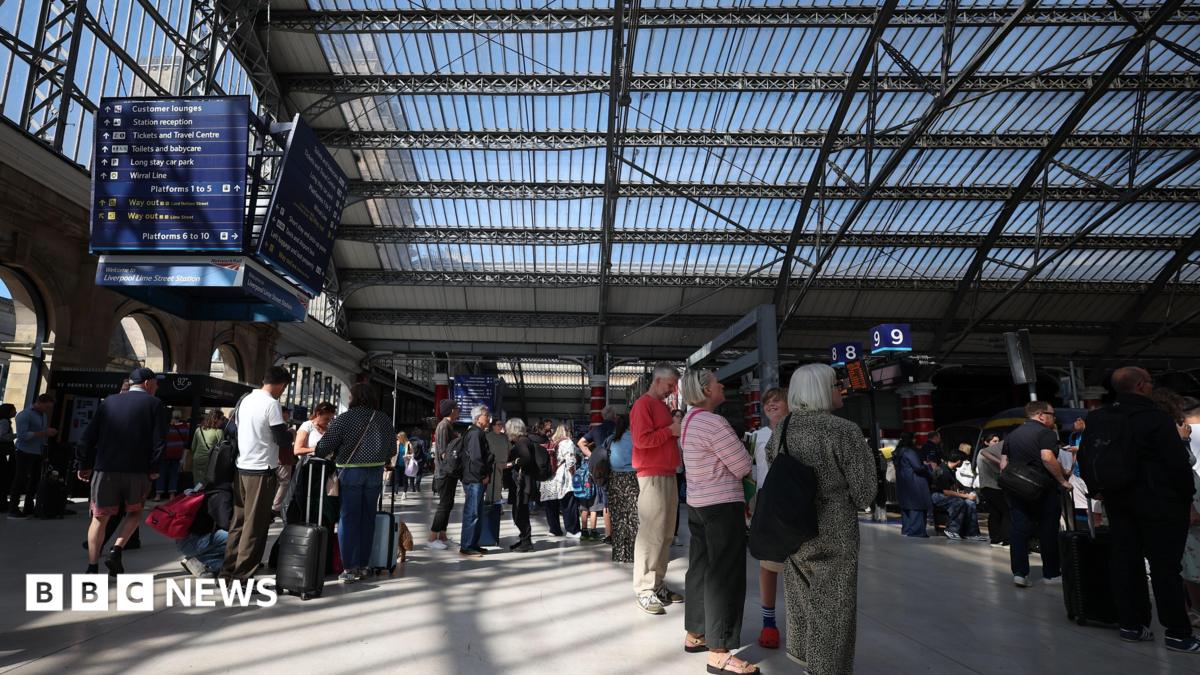
Sarah Nelson, who was unable to get to work in Manchester, was one of a number of affected passengers who told BBC Your Voice about their disruption.
She said she faced a “nightmare” five-hour round trip to just get back to her home in Blackpool.
The remedial massage therapist’s train was stuck at Horwich Parkway for more than 90 minutes.
Chris, a technology consultant, travelled to Manchester from Scotland on Wednesday on business.
Advertisement
He said he would likely book a hotel for the night, despite the expense and inconvenience, describing the delay as “costly, inconvenient… frustrating”.
“We’re still being told there is no power to any of the trains, no electricity – and they don’t expect anything to run today until the end of the day,” he said.
“I will have to get a hotel here and see if I can get home tomorrow.”
A couple returning from a trip to Gibraltar were planning to get a train home to Clitheroe, Lancashire, after landing at Manchester Airport.
Advertisement
But Matt and Sarah had to book an Uber to take them home instead, adding it was “costing a fortune”.
Stacey was among passengers who were evacuated from a train that stopped prematurely in Manchester when signalling failed.
The 38-year-old office worker, who was travelling from Deansgate to Leyland, Lancashire, paid £60 for a taxi home.
“The train stopped when the signals went,” she said, praising the “phenomenal” staff for their “calm and professional” efforts organising a controlled evacuation from the viaduct.
The Migration Policy Institute, a nonpartisan research group, has said that the most expansive census-based estimate accounts for about 22,000 to 26,000 babies born in the US from birth tourism every year. Government data, according to the institute, showed that there were 9,600 births to mothers with foreign addresses in 2024.
“The idea (is) that people come here pretending to be a tourist, pretending to be a visitor,” Stephen Miller, homeland security advisor and White House deputy chief of staff for policy, said while standing beside the president on Thursday.
“But the real reason they’re here is to have a child, to make that child an automatic citizen, (to) leave our country and then have a US citizen child,” he said, adding that thoe children then gain access to welfare benefits, the voting booth, and “all the other rights and privileges that belong solely to Americans”.
Miller said the president has the authority to ban birth tourism under a section of the Immigration and Nationality Act, which grants the president the power to set exceptions and limitations on who can enter into the country.
Advertisement
On one of his first back days in office in 2025, Trump signed an executive order that tried to end birthright citizenship as guaranteed in the 14th Amendment to the US Constitution.
A legal battle brought the case to the Supreme Court, which in June ruled that Trump’s 2025 policies could not stand and birthright citizenship remained the law.
The decision was a major blow to Trump’s ongoing efforts to limit who can live, work, and become citizens in the US.
The high court made “a bad decision, very unfair decision”, Trump said from the Oval Office on Thursday while announcing the executive orders. “Our country suffers because of it, and we’re ending in a different way.”
Advertisement
Gabriel Chin, a professor at the University of California Davis’ School of Law, told the BBC that while parts of the order might hold up, other aspects “raise some serious constitutional questions”.
Chin said the president does have some power to restrict people coming into the US specifically for the purposes of having a child.
“But once it does happen, once a child is born in the United States, I don’t think the president has any power to decide that that child is not a citizen,” he said, adding that the issue was settled in the Trump administration’s recent loss in the Supreme Court.
He called birth tourism a “drop in the bucket” against the millions of births in the US.
The roadworks may be delayed by up to four weeks following the discovery
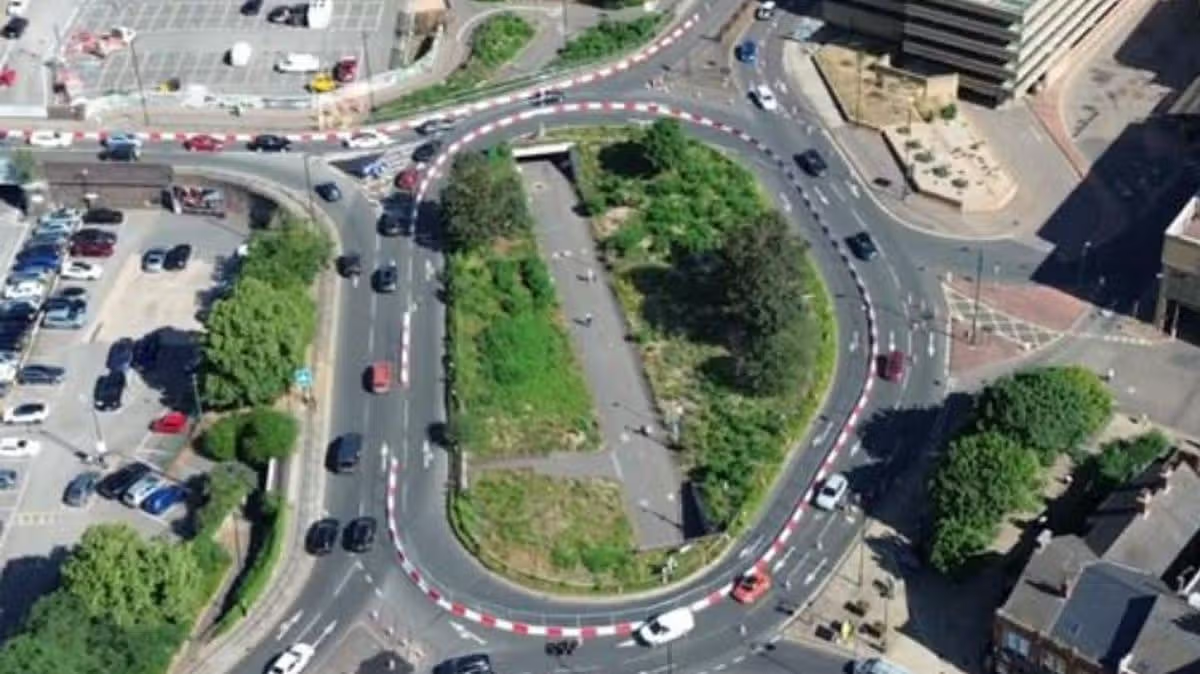
More skeletons have been discovered at the site of major roadworks in a Cambridgeshire city centre. Roadworks are currently ongoing on the Queensgate roundabout in Peterborough as part of the City Link project.
Advertisement
The multi-million pound project aims to improve the city’s train station and connections across the city. While carrying out the works at the end of July, seven human skeletons were discovered.
With works paused and archaeologists called in, more skeletons have been found. A Peterborough City Council spokesperson said: “Following an initial discovery of one human skeleton, as standard practice, the police were initially called to establish if this was a crime scene.
“When they were satisfied it was not, a burial licence was applied for and obtained from the Ministry of Justice and then an archaeologist attended the site. A total of 11 skeletons have been discovered so far on land within the Queensgate roundabout. Since the discovery, the contractors have increased site security.”
The site of the roundabout used to be a Victorian cemetery and was closed to burials in 1858. Records show that the remains from the cemetery were cleared when the subways were built at the roundabout during the 1970s. Due to the discovery, the roadworks could be delayed up to four weeks.
Advertisement
The council spokesperson added: “The speed at which we were digging has had to slow down, so we don’t damage any remains. We are looking at options to reduce these delays in later phases of the project and will announce any timetable updates in due course.”
The Blues were beaten by Juventus in Hong Kong earlier this week, and are looking to avoid a third straight pre-season defeat having also lost to Tottenham.
There were some reasons to be positive from the defeat to the Old Lady, but Xabi Alonso will want to see far more against another Italian opposition.
A familar face will be sitting in the opposition dugout, with ex-Manchester United manager Ruben Amorim now in charge of the the Rossoneri.
Date, kick-off time and venue
Advertisement
Chelsea vs AC Milan is scheduled for a 1pm BST kick-off on Saturday, August 8, 2026.
The match will take place at Gelora Bung Karno (GBK) Stadium in Jakarta.
Where to watch Chelsea vs AC Milan
TV channel: In the UK, the game will be televised live on CFC, Chelsea’s in-house video streaming service. Kick-off is at 12.30pm BST.
Advertisement
Live stream: All of Chelsea’s pre-season fixtures will be broadcast via CFC+, which requires a membership.
An annual subscription costs £15, while pay-per-view passes worth £9.99 are also available for each match.
Live blog: You can follow all the action on matchday via Standard Sport’s live blog.
Mykhailo Mudryk coming on against Juventus
Getty
Advertisement
Chelsea vs AC Milan team news
Mykhailo Mudryk was given eight minutes off the bench on Wednesday, marking his first appearance since his doping ban was lifted, and will hope for more exposure in Jakarta.
Summer signing Danny Welbeck started the game, and went close to scoring early on, and should get another chance to impress.
Both Cole Palmer and Levi Colwill will be assessed ahead of the game after sitting out the loss to Juventus with minor knocks.
Advertisement
Chelsea vs AC Milan prediction
There has not been too much for Chelsea fans to get excited about so far this summer, on the pitch at least, and there will be some pushing for Xabi Alonso to show them something more after two underwhelming defeats, and one barmy 10-goal thriller.
AC Milan have played out draws with Celtic and Inter Milan so far this summer, and another draw feels like a fair prediction.
Head to head (h2h) history and results
Advertisement
Chelsea vs AC Milan match odds
We aim to offer every online gambler and reader of The Standard a safe and fair platform through unbiased reviews and offers from the UK’s best online gambling companies.
Gambling can be addictive, always play responsibly and only bet what you can afford to lose. Gambling sites have a number of tools to assist you to stay in control, including deposit limits and time outs. If you think you have a problem, advice and support is available for you now from BeGambleAware or Gamcare.
Any offers or odds listed in this article are correct at the time of publication but are subject to change. Terms & Conditions apply to all offers.
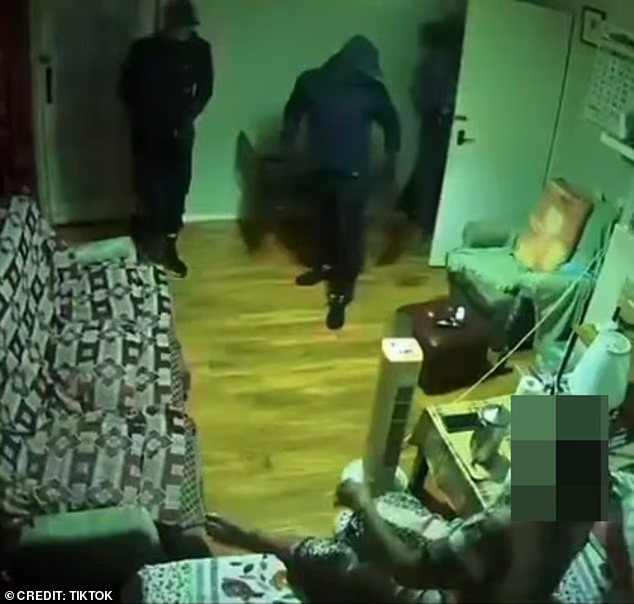
This is the moment masked thieves broke into an elderly woman’s house and ransacked it as she watched on helplessly.
In footage captured on a Ring camera, an 83-year-old can be seen sleeping in her bed at her home in Hayes, west London, when four balaclava-clad men burst in.
The startled pensioner then gets out of bed as one of the men, carrying what appears to be a weapon, approaches the woman – ordering her to be quiet.
The robbers can then be seen rummaging through her belongings as she is sat shaking on her bed.
Advertisement
After just two minutes, they flee – leaving her personal possessions strewn across the room and the visibly distraught woman is left alone in her room.
Now, the Metropolitan Police have launched an investigation into the robbery with enquiries still ongoing.
The force said that several items of jewellery, as well as around £500 in cash was stolen from the property.
While one suspect was captured on CCTV carrying a weapon, no injuries were reported, it added.
Advertisement
In Ring camera footage, an 83-year-old woman can be seen sleeping in her bed at her home in Hayes, west London, when four balaclava-clad men burst in
The startled pensioner then gets out of bed as one of the men, carrying what appears to be a weapon, approaches the woman ordering her to be quiet
Although crime across London has dropped by 15 per cent in the last year, data from the Daily Mail revealed that in the decade since Sadiq Khan became Mayor of London crime has soared across the capital.
Advertisement
The data shows that a range of crimes, including theft from the person, sex offences, drugs and violent crime, have dramatically increased from when Sir Sadiq first came to power in 2016.
Theft from the person has increased by 140 per cent from 35,570 in 2016-17 to 85,465 in 2025-26. In 2024-25, the year Sir Sadiq was re-elected, it had even skyrocketed to 101,053.
Elsewhere, sexual offences have risen by 55 per cent from 17,491 in 2016-17 to 27,074 in 2025-26.
Drug offences have risen by 34 per cent from 40,652 in 2016-17 to 54,291 in 2025-26.
Advertisement
And violence against the person has soared by 51,086 incidents 27 per cent from 191,691 in 2016-17 to 242,777 in 2025-26.
The figures, based only on crimes reported to the Metropolitan Police, do not factor in how London’s population has grown over the same time. Official estimates suggest the capital’s headcount has risen from 8.7m in 2016, the year Sir Sadiq was elected, to just shy of 9.1m in 2024 – the most recent year.
A Met spokesman said: ‘We are aware of a video circulating online showing a burglary in Hayes. We understand the concern that incidents like this can cause for those affected and the wider community.
‘Detectives are conducting a thorough investigation and are pursuing all lines of enquiry.
‘On Monday, 29 June at 21:57hrs police were called to reports of a burglary on Judge Heath Lane, Hayes.
‘Officers attended but the suspects had fled the scene. They spoke with the victim, an 83-year-old woman. One suspect was captured on CCTV carrying a weapon, but no injuries were reported.
Advertisement
‘It is believed that several items of jewellery, as well as around £500 in cash was stolen from the property.
‘No arrests have been made at this stage. Enquiries continue and anyone with information that may assist police is asked to call 101 quoting CAD 9067/29July.
‘Information can also be provided anonymously to independent charity Crimestoppers on 0800 555 111.’

Fingal County councillors Cathal Boland and Eoghan Dockrell spoke to DublinLive at the scene of the fire.
Cllr Boland said: “When I was in Ballyboughal this afternoon, I came out of Giddy Up, the coffee cart, and I looked up to find this enormous blooming black smoke.
“I immediately tried to contact people I knew along the way, but I tracked down here and realised that there was a traffic problem.
“Traffic was back down the rural lane that the fire was on, so I immediately began to direct traffic.
Advertisement
“There’s been great cooperation from the public.”
Cllr Dockrell added: “I know that there were some people in nearby houses who were asked to move away.
“As far as I’m aware, nobody is injured and everyone is safe presently.
“This has been one of the largest fires to take place in north Dublin, and certainly Ballyboughal, in years and years.
Advertisement
“We have to say thank you to Gardai and the firemen for all the work they’ve been doing the past few hours.”
Flames and smoke pictured at a car scrap yard in Wimbletown(Image: Dublin Fire Brigade)
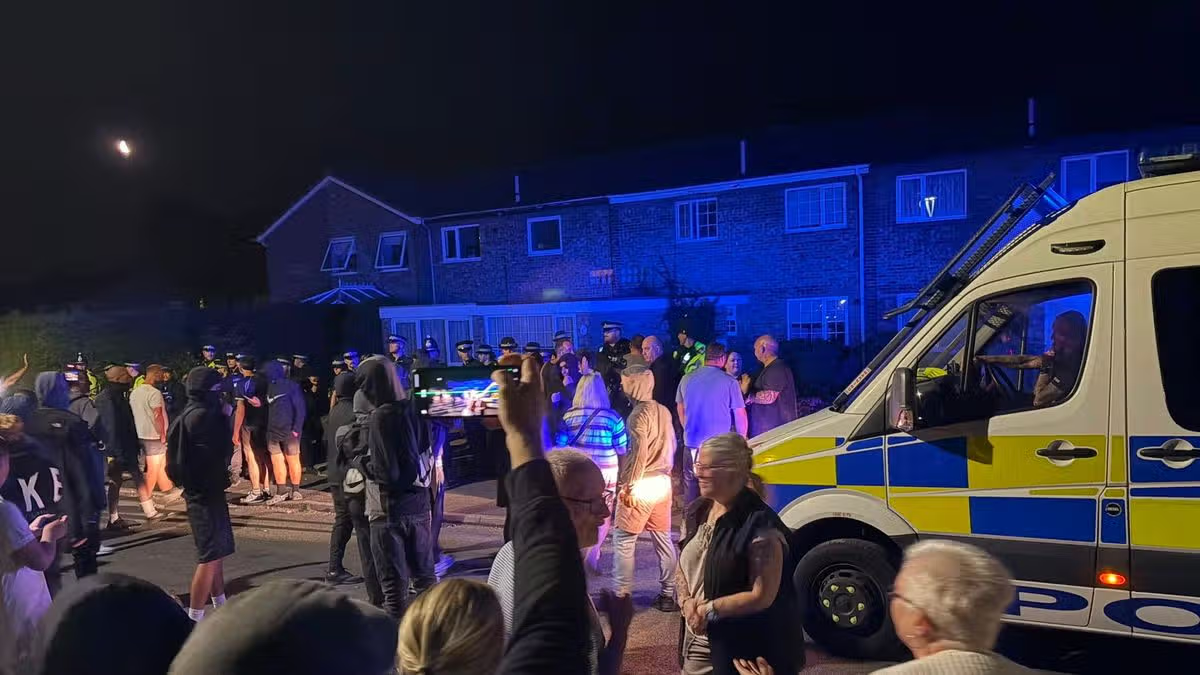
Two men were arrested on Thursday following two nights of disorder in Thetford, Norfolk, after people attempted to storm homes linked to asylum seekers and police officers were assaulted
Further arrests have been made in Thetford after crowds attempted to storm homes linked to asylum seekers and police officers were attacked.
Advertisement
Two men were arrested on Thursday, Norfolk Police confirmed, following two consecutive nights of unrest in the market town. One was arrested on suspicion of inciting racial hatred in connection with events on Wednesday. The other was held on suspicion of being drunk and disorderly and failing to provide his details to officers when requested.
Police powers were stepped up on Thursday evening in the aftermath of the earlier disorder. This followed officers being “subjected to significant aggression” on Wednesday, with one struck by a rock, one bitten and another spat at
Two officers were taken to hospital after responding to the scene at Clover Way that evening, which police described as “fast-moving and volatile” with tensions mounting as a crowd advanced towards a residential property.
Advertisement
On Tuesday night, windows were smashed, fences broken and attempts were made to force entry into a residential property, police said.
The protesters’ attempts to break into homes were fuelled by fears that the properties were being used to house asylum seekers.
Video footage circulating on social media appeared to show police escorting a number of asylum seekers away from properties in the area.
Eyewitnesses and social media users had condemned the police response, with reports suggesting that a woman in a mobility scooter was pepper-sprayed on Wednesday. The force defended their actions as proportionate and appropriate, including the deployment of Pava spray.
They stated that Pava, a handheld incapacitating substance similar to pepper spray, was deployed in response to an individual’s behaviour within the crowd.
A police spokeswoman added: “We understand that concerns have been raised about a woman using a mobility scooter who was affected during the incident.
“It was not the intention for any bystander to be impacted; however, where people remain within an area of active disorder and do not follow police instructions to move away, there is a risk they may be affected by tactics deployed to protect public safety.”
Advertisement
A resident of Clover Way, who wished to remain anonymous, revealed that at around 9.30pm on Wednesday “lots of young boys… came up on bikes and chucked eggs at the house”. The largely seated demonstration began “peaceful” until additional officers arrived and formed a line, she said.
Subsequently, “it started to get a little bit rowdy” and “people took a step forward towards the police”.
Nobody attempted to enter the property, she said, noting that police “started pepper-spraying people”, including “a lady in a wheelchair”.
There were “a few young idiots picking up stones, lobbing them at a police car”.
“They brought a riot van down and blocked the front of the house,” she said, adding that officers brandished batons, made arrests and instructed people to disperse. Norfolk Police confirmed that two arrests were made on Wednesday night on charges including public order offences, harassment and possession of an offensive weapon.
One man in his 40s remains in police custody.
Brian Thompson, 68, of Fairfields, Thetford, has been charged with possession of an offensive weapon, namely a wooden bat. He has been released on bail and is due to appear before Norwich Magistrates’ Court on August 25.
Advertisement
A man in his 30s, who was arrested on Wednesday in connection with Tuesday’s incidents on suspicion of a public order offence, has since been released and issued with a conditional caution.
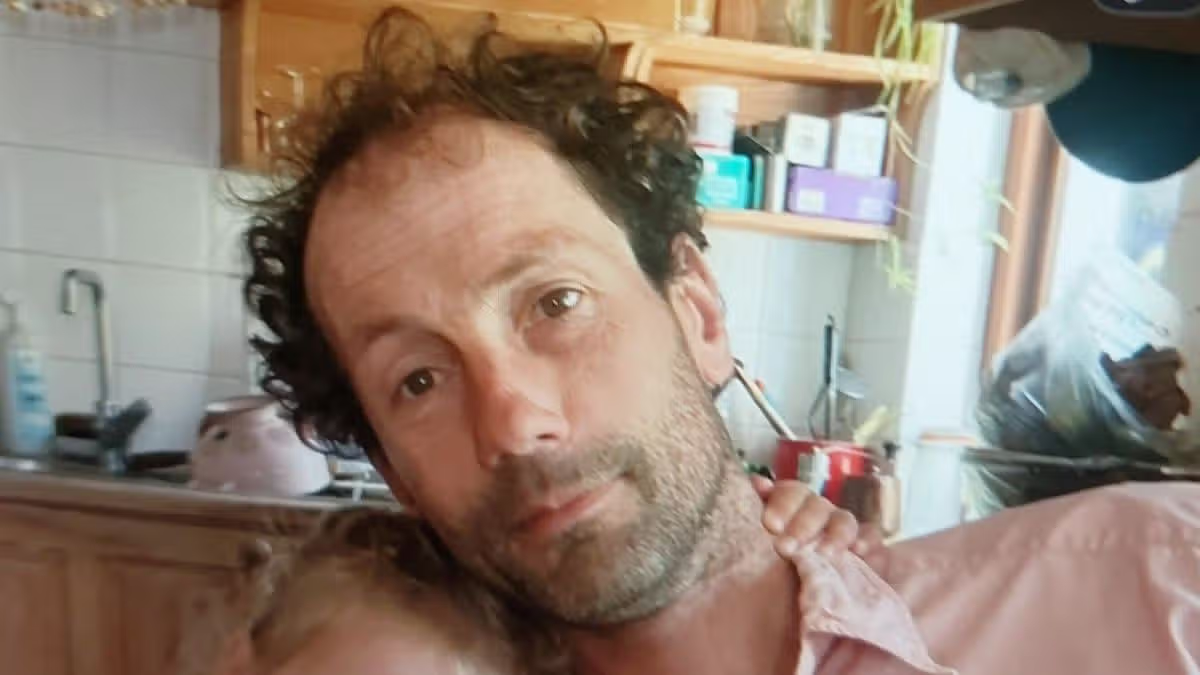
He was believed to have been intending to go rock climbing before he was reported missing on Wednesday, August 5
Abbie Wightwick Education Editor and Rachel Vickers-Price UK and World News Reporter
00:52, 07 Aug 2026
A body has been discovered during the search for a missing rock climber.
Ben, from St Davids in Pembrokeshire, is believed to have been planning to go rock climbing before he was reported missing on Wednesday, August 5.
Advertisement
Dyfed Powys Police confirmed that on Thursday, a body was found in the coastal area of Caer Bwdy, Pembrokeshire.
In a statement released on Thursday evening, the force said: “Formal identification has not yet taken place, and while the family have been informed of this development, we are not in a position to confirm the identity of the deceased at this time. They are being supported by specially trained officers.
“We ask that the family’s privacy is respected while enquiries continue.”
Ben, 47, is thought to have been heading out for a rock climbing trip when he left his St Davids home on Wednesday, August 5 at around midday, reports Wales Online.
Advertisement
It is understood he had planned to travel to either the Carreg y Barcud area, near Trelerw, or Caer Bwdy Bay, on the outskirts of St Davids in Pembrokeshire.
After hours passed without any contact, Ben’s family raised the alarm and emergency services were alerted.
Both a Coastguard vessel and helicopter have been deployed as part of the search operation.
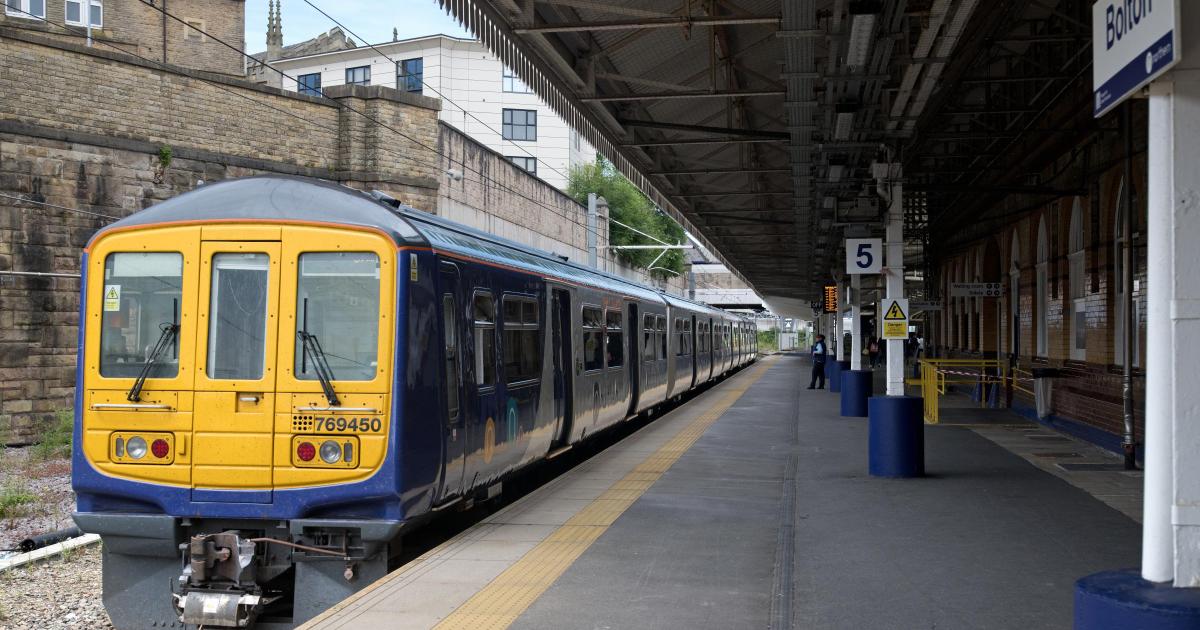
Several trains to and from Bolton have been delayed, with some services running more than 30 minutes behind schedule as passengers face delays during the afternoon.
According to National Rail, the problem has been caused by a failure of the electricity supply at a rail communications centre, affecting signalling and operational systems across parts of Greater Manchester, the Midlands and the North West.
The disruption is impacting several train operators, including Northern, Avanti West Coast, East Midlands Railway, London Northwestern Railway, Merseyrail, TransPennine Express and Transport for Wales.
Advertisement
Responding to passengers on social media platform X, Northern warned that services were likely to be delayed because of the power outage.
In one reply, the operator said: “It is likely to be delayed due to the power outage. I am sorry for the disruption this will cause.”
Northern also apologised to affected passengers, adding: “We are really sorry for the disruption to your journey.
The train operator said the power failure had also affected its control building, making it difficult to arrange alternative travel for passengers.
A spokesperson added: “The power issue is affecting all lines and our control building so we are unsure when any alternatives would be able to be booked at this time.
“We are working to get this fixed as soon as we can.”
National Rail said the incident was first reported shortly after 2pm and warned that trains could continue to be cancelled, delayed or revised while engineers work to restore power.
Advertisement
Disruption is currently expected to continue until around 4pm, although this could change.
Passengers travelling to or from Bolton are being urged to allow extra time for their journeys and check the latest travel information before setting off.
Those delayed may also be entitled to claim compensation through their train operator’s Delay Repay scheme.
Prime Minister Andy Burnham has argued that parliament should wait before returning to assisted dying until palliative and social care are properly funded. His intervention comes before MPs are due to debate a new assisted-dying bill for England and Wales on September 11.
Public debate often centres on people with terminal illnesses who are experiencing unbearable suffering and want greater control over how they die. Burnham’s argument raises a wider question: can a choice be fully voluntary when access to palliative care, social care, suitable housing or practical support restricts the alternatives someone believes are available?
Supporters argue that failures in care should be addressed without indefinitely denying terminally ill adults an autonomous choice. Our comparative analysis of parliamentary debates in Canada and England and Wales nevertheless shows why the language surrounding that choice deserves attention.
Advertisement
Politicians sometimes present choosing when and how to die as an expression of independence, courage or dignity. Others suggest that avoiding dependence on relatives or public services can be part of behaving responsibly in later life. A 2025 ethical analysis argues that framing assisted death as both an autonomous choice and a social responsibility could create pressure on older people who need care.
This does not establish that requests are generally caused by poverty, pressure or inadequate services. But it does raise questions about how circumstances can shape a decision without amounting to direct coercion.
Different systems
Canada’s medical assistance in dying law, known as Maid, allows practitioner-administered and self-administered deaths, although every recorded Canadian Maid provision in 2024 was practitioner-administered.
The terminally ill adults (end of life) bill would create a narrower system in England and Wales. It would apply to adults with decision-making capacity who have an inevitably progressive illness or disease and are reasonably expected to die within six months. They would have to take the final action that causes their death themselves.
Advertisement
Suffering is not a separate eligibility requirement. The bill instead requires a clear, settled and informed wish, made voluntarily and without coercion or pressure from another person.
MP Lauren Edwards reintroduced the bill in June 2026 after the previous version passed the Commons but fell because it did not complete its Lords stages before the parliamentary session ended. Its second reading is scheduled for September 11.
Canada’s law also changed after its introduction. Following the Supreme Court decision in Carter v Canada, parliament legalised Maid in 2016 for adults with a grievous and irremediable condition, advanced irreversible decline, enduring intolerable suffering and a reasonably foreseeable natural death.
In 2021, parliament removed foreseeable death as an eligibility requirement. Canada now distinguishes between Track 1 cases, in which natural death is reasonably foreseeable, and Track 2 cases, in which it is not. England and Wales would not inevitably follow the same course, but Canada shows that eligibility rules and safeguards can be substantially revised after legalisation.
The distribution across neighbourhood income groups was broadly similar to that of all people who died from natural causes. Track 2 recipients were slightly more likely than this comparison group to live in the lowest-income neighbourhoods. Compared with Track 1 recipients, they were also slightly younger and more likely to be women or live alone. More lived in neighbourhoods with high residential instability.
These area-level measures do not reveal an individual’s income, housing conditions or reasons for requesting Maid. They cannot establish whether disadvantage contributed to a particular decision.
An Ontario chief coroner’s committee examined three deliberately selected Track 2 deaths involving possible social or structural vulnerability, including isolation, unsuitable housing and inadequate support. The committee stressed that the cases were not representative. They show the questions unmet needs can arise during an assessment without indicating how often these circumstances occur.
Advertisement
Practitioners reported that 74.1% of all recipients had received palliative care, compared with 23.2% of Track 2 recipients. The groups had different illnesses and proximity to death, and the figures do not establish whether available care was appropriate or adequate.
Small qualitative studies show that bereavement experiences vary. Interviews with nine people found that knowing the date of death could allow farewells and family rituals while creating an emotionally intense countdown. A separate study of 12 people who had experienced disagreement around Maid, documented unacknowledged pain and disenfranchised grief. Neither study shows how common these experiences are.
Choice and social circumstances
Our analysis suggests that praising assisted death as inherently brave or dignified risks creating an implicit contrast with people who continue to need care. Treating avoidance of dependence as socially responsible may reinforce fears of becoming a burden.
Advertisement
The England and Wales bill requires two doctors and a review panel to assess eligibility. Doctors must examine relevant records, make inquiries of health and social care professionals where appropriate, and discuss available treatment, palliative care, hospice care, symptom management and psychological support.
These are substantial safeguards. The bill does not, however, list an applicant’s reasons or unmet social needs as separate eligibility tests. Nor does it expressly require assessors to decide whether inadequate care or housing has narrowed the alternatives the applicant believes are available. A person may feel like a burden even when nobody has pressured them directly.
Reliable monitoring would therefore need information about applicants’ circumstances, access to care and reasons for requesting assistance. Canada’s data shows how difficult it is to assess inequality when official records rely heavily on neighbourhood measures and contain limited information about unmet needs.
Personal choice remains central to the case for assisted dying. Parliament should also consider how care shortages, isolation and fear of dependence may shape that choice before changing the law.
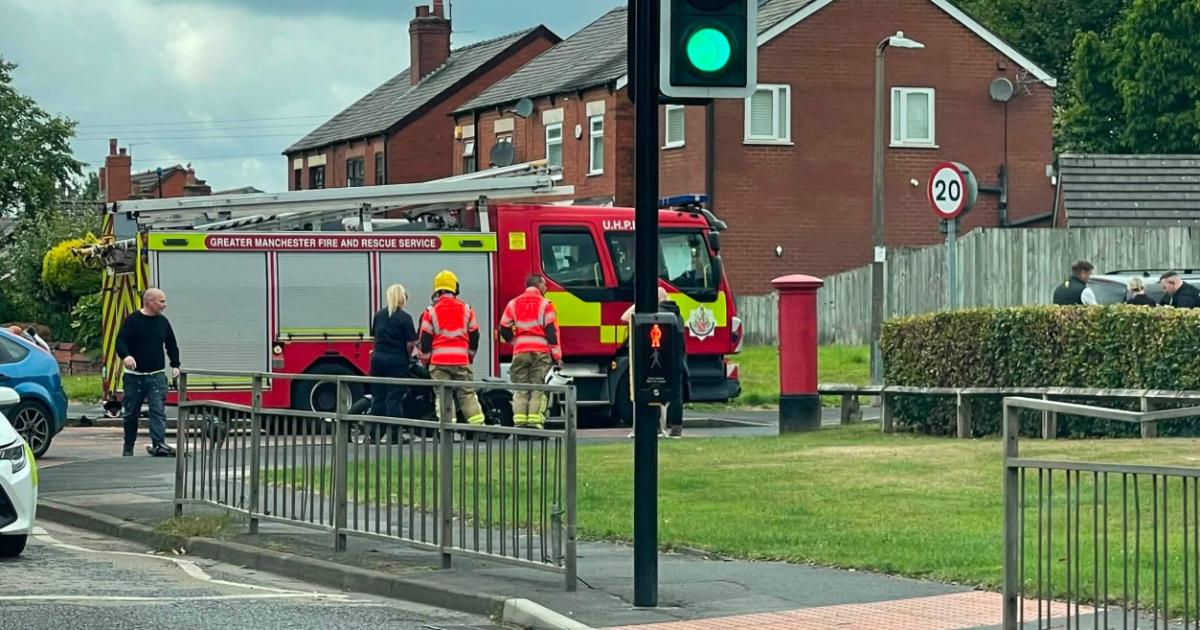
The incident began at around 12.55pm this afternoon (Thursday, August 6), when fire services were called to the scene due to a collision between the motorcyclist and a van.
One fire engine was called to the scene, taking around 35 minutes to ensure the area was safe before leaving.
(Image: David Wilkinson)
A spokesperson for Greater Manchester Fire and Rescue: “At 12.55pm on Thursday, August 6, one fire engine from Bolton Central was called to a road traffic incident between a motorbike and van on Park Road, Westhoughton.
“Crews arrived quickly and made the area safe and were on the scene for approximately 35 minutes.”
Advertisement
Greater Manchester Police also stated: “It was a minor road traffic collision involving a motorbike and a van. No injuries reported, no arrests made.”
The incident took place at the junction between Park Road and Captain Lees Road, near the Unsworth Group Practice.
Westhoughton Cllr David Chadwick said: “It’s a difficult one. As we get more and more development in the area it increases the likelihood of these things happening.
“Park Road has become an arterial route.”
Advertisement
Park Road is a particularly busy road, and is frequently the site of crashes.
You must be logged in to post a comment Login