A man, a woman and a teenage girl have died after getting into difficulty in the sea near Shoreham-by-Sea, while a younger girl from the same family remains in a critical condition in hospital
Carrington Walker and Anahita Hossein-Pour and Stanley Murphy-Johns Press Association
21:57, 18 Aug 2026Updated 22:04, 18 Aug 2026
Advertisement
A couple and their teenage daughter have tragically lost their lives after encountering difficulties in the water off the Sussex coast.
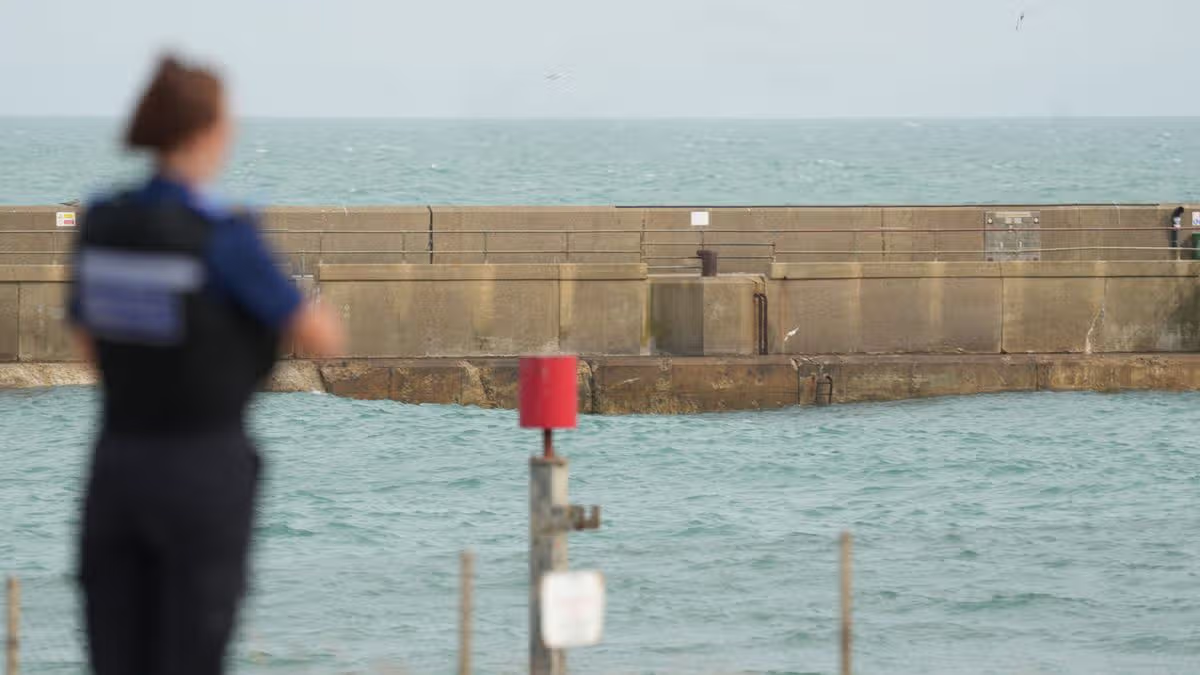
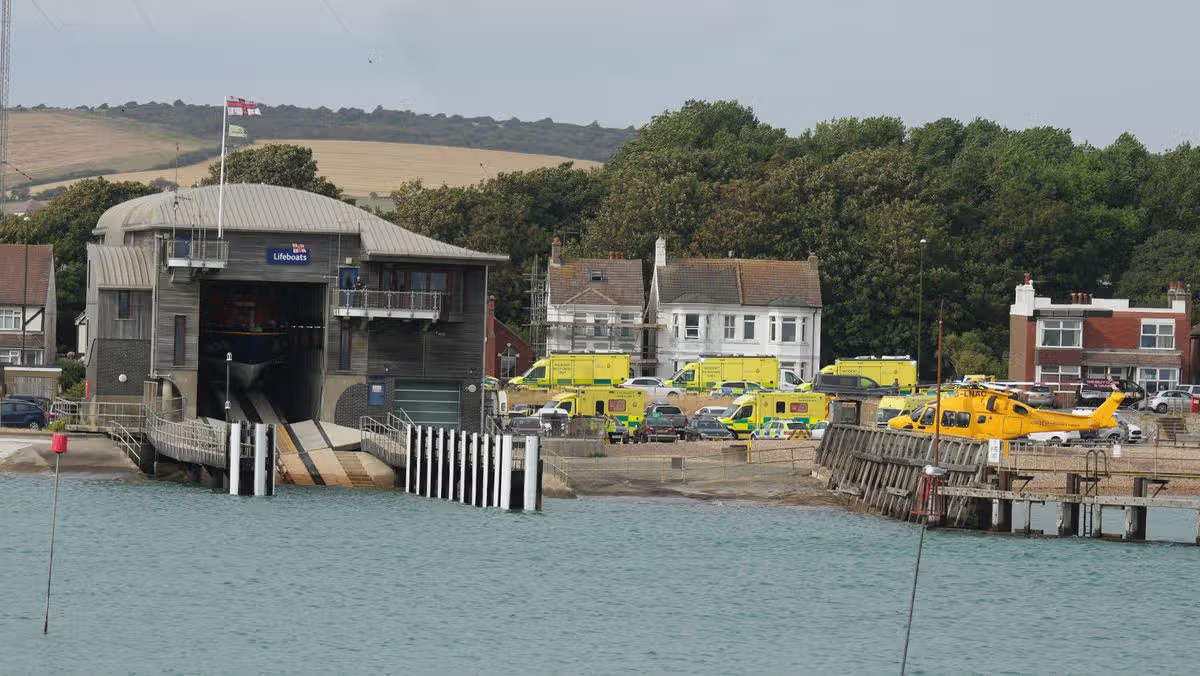
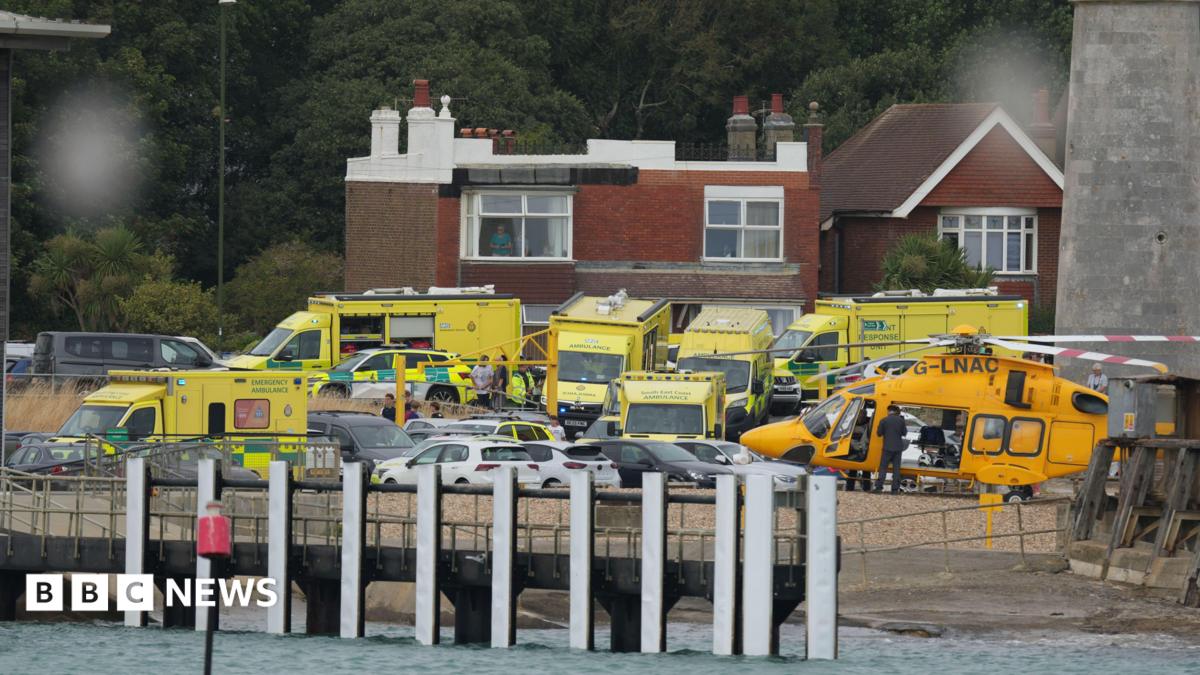
Numerous ambulances and two air ambulances were spotted in Shoreham-by-Sea, West Sussex, close to the RNLI station on Tuesday afternoon. Sussex Police confirmed that emergency services responded to reports of four individuals in distress in the water near Shoreham Fort.
The force believe the family entered the water from land for a swim.
Addressing journalists this evening, Chief Superintendent James Collis revealed that a man, a woman and a teenage girl died, while a younger girl from the same family remains in a critical condition in hospital.
Advertisement
He said: “Around 2,40 pm this afternoon, emergency services were called to reports of four people in difficulty in the water close to Shoreham Fort.
“Sussex Police supported His Majesty’s Coast Guard and the RNLI as all four people were brought to shore.
“Tragically, despite the best efforts of paramedics, three people – a man, a woman, and a teenage girl – were sadly confirmed deceased.
“A younger girl has been taken to hospital and is in critical condition. We can confirm all four people were from the same family, and their next of kin have been informed.”
Advertisement
Anyone with information or video footage about the incident has been asked to contact Sussex Police online or via 101, quoting Operation North.
Ensure our latest stories always appear at the top of your Google Search by making us a Preferred Source. Click here to activate or add us as your Preferred Source in your Google search settings.
Emergency services are responding to reports that four people are in difficulty in the water off the Sussex coast.
Multiple ambulances and two air ambulances could be seen in Shoreham-by-Sea, West Sussex, near the RNLI station on Tuesday afternoon.
A Sussex Police spokesperson said: “Emergency services are currently responding to reports of four people in difficulty in the water close to Shoreham Fort.
“A section of the A259 in Shoreham has been closed as the incident remains ongoing, and we’re urging the public to stay clear of the area in the meantime
Advertisement
“We will provide more information as soon as we are able to.”
The A259 Brighton Road was blocked in both directions from New Road to Kingston Lane because of the incident.
An RNLI spokesman said: “Shoreham RNLI were tasked by HM Coastguard at approximately 3pm on Tuesday 18 August.”
At the scene an ambulance could be seen leaving under a police escort with blue lights flashing.
MUNICH (AP) — Bayern Munich midfielder Jamal Musiala said he’s dealing with a neurological issue but doing well despite collapsing during a preseason game Tuesday at Heidenheim, three days after a similar incident against Leipzig.
The 23-year-old Germany international went down shortly after entering the friendly as a substitute in the second half. He received medical treatment and was helped as he walked off the pitch.
Musiala had collapsed Saturday during a friendly against Leipzig. German news agency DPA reported that he left the field on his own but still appeared dazed.
Bayern, in its report on Tuesday’s game, only said of the incident: “There was a setback when Jamal Musiala had to be subbed off with a knock minutes after coming on.”
Advertisement
After the game, Musiala posted a message on his Instagram account, explaining that he has suffered “treatable absence seizures” because of a neurological problem.
Musiala said he’s optimistic and receiving excellent medical treatment.
A spokesperson for Air Ambulance Charity Kent Surrey Sussex said both of its helicopters and critical care team had been sent to the scene as part of the response, and Shoreham RNLI said its lifeboat had beencalled out at 15:00 BST.
South East Coast Ambulance Service (Secamb) said it had been called to “reports of four people in need of medical attention”.
A section of the A259 – a main commuter road which runs through Brighton, Shoreham and Worthing – was closed.
This year’s A-level results show a significant increase in the number of students choosing to study politics. In fact, politics saw the largest year-on-year increase of all A-level subjects in the UK, with entries up 11.9% this year compared with 2025.
This is an additional 2,639 students – up from 22,185 to 24,824. Politics still accounts for only 3% of all A-levels studied across the UK in 2026. This increase comes on the back of increases in demand for over a decade. Politics is one of the fastest-growing A-levels – up 81% in the UK since 2010.
Who studies politics?
There is an interesting phenomenon going on in terms of who is choosing to study politics. In 2022, the subject marked an important watershed when, for the first time, more women than men studied politics across the UK. A significant change for a historically male-majority subject.
The trend of a small female majority has continued year on year. In 2026, though, the gender split is almost 50-50.
Advertisement
This change in gender demographics over time is quite distinct from the trajectory of many other social science subjects. Psychology has remained strongly female-majority, while economics and business studies are male-majority subjects.
For young women, there may be several distinct factors at play. First, increased interest may be linked to recent changes to the A-level syllabus. A study found that young women placed greater importance than young men on topics such as human rights, elections and voting, climate change and inequality. These are all topics that feature in the revised 2017 politics syllabus, which covers a wider range of political ideas and global issues than previously.
In addition – while somewhat harder to assess – it seems that social media is playing a role in enabling greater engagement and awareness of political issues and debates among young women. This may be because online debates about issues that resonate with young women, including women’s rights, may be encouraging interest in politics.
Advertisement
This would chime with research showing that traditional classroom discussions are less effective in developing “political self-efficacy” (how much a person believes in their ability to understand and make change through politics) among girls than boys aged 11-16. This suggests that factors outside the classroom, such as social media, may be fuelling increased interest.
Why are teens choosing politics?
According to the British Academy, students taking A-level politics in England tend to come from wealthier families compared with the norm for A-level students. Historically, A-level politics has been a popular, and widely offered, subject at private schools.
Yet recent data shows that the number of state-funded schools in England offering A-level politics has risen. More state-funded sixth forms and secondary schools offering the subject suggest that greater accessibility may be a factor in the rise in uptake.
There are most likely multiple reasons for the rise in demand for the politics A-level over the last 15 years. Factors such as ongoing global conflicts, climate change and the increased volatility of national politics, such as the UK’s six prime ministers in the last decade, have increased interest in and the desire to understand how we are governed and what triggers global political change. The proposed lowering of the voting age to 16 may also have prompted increased interest in the subject among teenagers.
Advertisement
Research suggests that young people care deeply about social and political issues and that they are increasingly keen to understand the systems that affect their lives.
The growing popularity of politics A-level may reflect a generation that recognises that political literacy is no longer simply an advantage, but an essential part of active citizenship. But there is still more work to do to ensure that this growing demand is met. A recent report by the Electoral Commission found that 72% of young people believe schools and colleges should do more to teach politics, democracy and voting.
The challenge for politicians is to turn young people’s growing interest in politics into meaningful political participation. In the last general election only 40% of 18–24-year-olds voted, and just 20% of those were from lower socioeconomic groups. Parties that engage young people on issues they care about and involve them between elections are likely to be rewarded. Ultimately, politicians must move from speaking to young people to working with them.
Young people are not disengaged from politics but increasingly interested in understanding it. The challenge is to build on this interest, to create opportunities for young people from all backgrounds to pursue political studies education at school and university. It also means finding more diverse ways to support all young people to engage with and participate in politics.
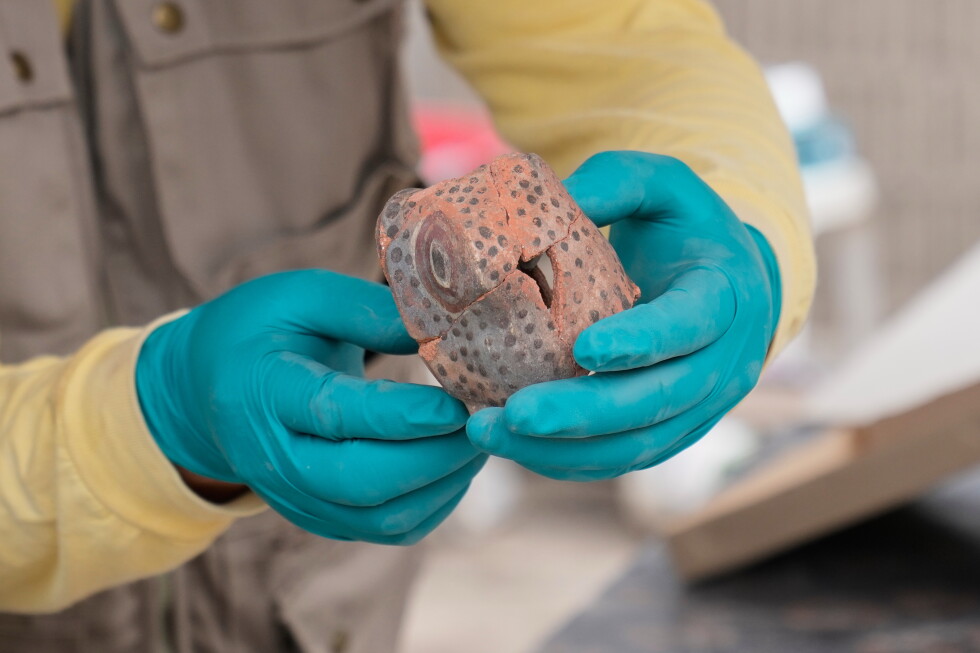
LIMA, Peru (AP) — Archaeologists in Peru on Tuesday unveiled the skeletal remains of an adult they believe was buried as an offering near the base of Huaca Pucllana, an ancient adobe pyramid in Lima, the nation’s capital.
The remains are believed to be those of a man who may have been sacrificed during a ritual in which a canal linked to a ceremonial pool was closed.
Gladys Paz, the archaeologist who led the excavation, said the bones will help researchers better understand “the rituals of the Lima culture” and reconstruct ceremonies performed hundreds of years ago.
Paz said that the body was buried inside a canal, resting on its left flank, with the skull facing the pyramid and the Pacific Ocean.
Advertisement
The Lima culture flourished between the 1st and 7th centuries along Peru’s arid central coast, about 700 years before the rise of the Inca Empire.
Huaca Pucllana was one of the most important ceremonial and administrative centers of the Lima culture, which disappeared centuries before a group of Spanish conquistadors founded Lima in 1535.
Today, the pyramid is surrounded by parks, leafy streets and upscale apartment buildings in the districts of Miraflores and San Isidro.
Huaca Pucllana is open to tourists, with a restaurant serving Peruvian specialties like ceviche, stir-fried beef and roasted alpaca meat.
Advertisement
According to Peru’s government, there are more than 400 archaeological sites across metropolitan Lima. Pieter Van Dalen, an archaeology professor at the National University of San Marcos who was not involved in the excavation, said that it’s common to find tombs, mummified remains and other burial-related items along Peru’s coast. Such discoveries have also been made while construction workers dig canals to install gas pipes.
The introduction of hydration breaks to World Cup matches this summer sent shockwaves through football, and they may soon feature in Premier League matches.
The breaks also allowed broadcasters an extra pair of advertising opportunities, leading to a massive increase in TV revenue from the tournament.
The hydration break was widely criticised for its effects on match momentum and contribution to the tournament’s commercialisation.
But the return of the club game in recent weeks has seen the hydration break remain prominent, not only in pre-season friendlies but also in the early rounds of the Carabao Cup.
Advertisement
When the curtain raises on the new Premier League season this Friday, with newly promoted Coventry visiting Arsenal, it is not yet clear whether hydration breaks will feature.
Will there be hydration breaks in the Premier League this season?
Premier League matches may feature hydration breaks this season, but only when they are needed.
Whether any given match requires a hydration break is down to the referee’s discretion and is generally agreed between teams before a match gets underway.
Advertisement
Guidance issued in May said match officials should consider a drinks break if the temperature is at or above 30C come kick-off.
As such, certain Carabao Cup first-round matches staged a drinks break in either half in the first week of August, with the UK in the grips of its latest heatwave.
Drinks breaks, then, may feature in the Premier League this season should matches be played in sufficiently warm conditions, but they will not be a regular fixture.
Welsh presenter Jason Mohammad is among the line up for the latest series of the BBC show
Celebrity MasterChef hopeful Jason Mohammad suffered a blow as his efforts in one challenge were called a “disaster”.
Advertisement
The Welsh TV and radio presenter is one of the stars taking part in the 21st series of the show, and in the first episode he faced off against actor and author Joe Pasquale, Jay McGuinness from The Wanted, weightlifter and Olympic medallist Emily Campbell and Love Island star Shakira Khan.
After they had whipped up their signature dishes, the contestants were tasked with preparing a gnocchi dish alongside judge Giorgio Locatelli in the Cookalong Challenge.
They were told the one that most resembled the chef’s would win the MasterChef pin – and a time advantage.
Jason got to work fast, but his meal failed to win over Giorgio and his fellow judge, food critic Grace Dent.
As he carried it up to the judges, Giorgio laughed: “When I look at the shape of those carrots, I wonder what have you learned from me?”
While the chef conceded that Jason’s gnocchi was “tasty”, Grace said: “These are the biggest gnocchi I’ve ever seen in my life.”
“The sauce, you really put a lot of pepper in it, but I really like that,” said Giorgio. “Obviously, the vegetable inside needs to be a little bit more refinely cut. But the disaster in this one is the gnocchi.”
Advertisement
Grace suggested they were “weighty”, adding: “In fact, after two or three, you need to have a lie down with your ankles raised.”
“Too much flour went in there,” said Giorgio, while Grace added: “This is not a perfect plate of gnocchi, but it’s definitely dinner.”
Speaking afterwards, Jason admitted it was a “kick up the backside” for him.
“Probably what I needed,” he confessed. “You know, this isn’t like food that’s being chucked on a kitchen table and you’re tucking into it. This is MasterChef.”
The next instalment of the competition will see Gladiators star Emily Steel – also known as Dynamite – up against actress Donna Preston, former Royal Ballet Dancer Eric Underwood, EastEnders ‘ Nitin Ganatra and YouTuber Tom Simons, aka TommyInnit. In the third heat, Saturdays star Una Healy, Loose Women’s Sue Cleaver and former I’m a Celebrity camper Melvin Odoom will be cooking alongside comedian Max Fosh and paralympic athlete Lauren Steadman.
In a statement, a spokesperson for asset management firm Blackstone, where Mr Cromie worked as a vice-president in private wealth solutions, said: “We are shocked by the tragic passing of three people, including our colleague Alex Cromie and his wife Marie Ebert, who were celebrating their honeymoon.
On August 14, the hottest day of an exceptionally hot summer, a train derailed near Lewes in East Sussex, England. Three carriages tipped over and two people were seriously injured. The following day, another train derailed in Essex.
We don’t yet know what caused either derailment, and the UK’s Rail Accident Investigation Branch is still gathering evidence. Network Rail – the public body that owns and manages most of Britain’s railway network – said in response that this summer’s repeated heatwaves have “presented exceptional challenges to the railway”. We do know that heat poses particular problems for railways, and that heat-related failure is an increasing risk in the UK as temperatures rise.
Xueyu Geng is a Professor in Ground Engineering at the University of Warwick, and an expert in railway track design and embankment stability. The Conversation asked her about the key challenges for a rail network in heatwaves, and how trains can stay safe and efficient in ever more extreme heat.
What happens to railways in extreme heat?
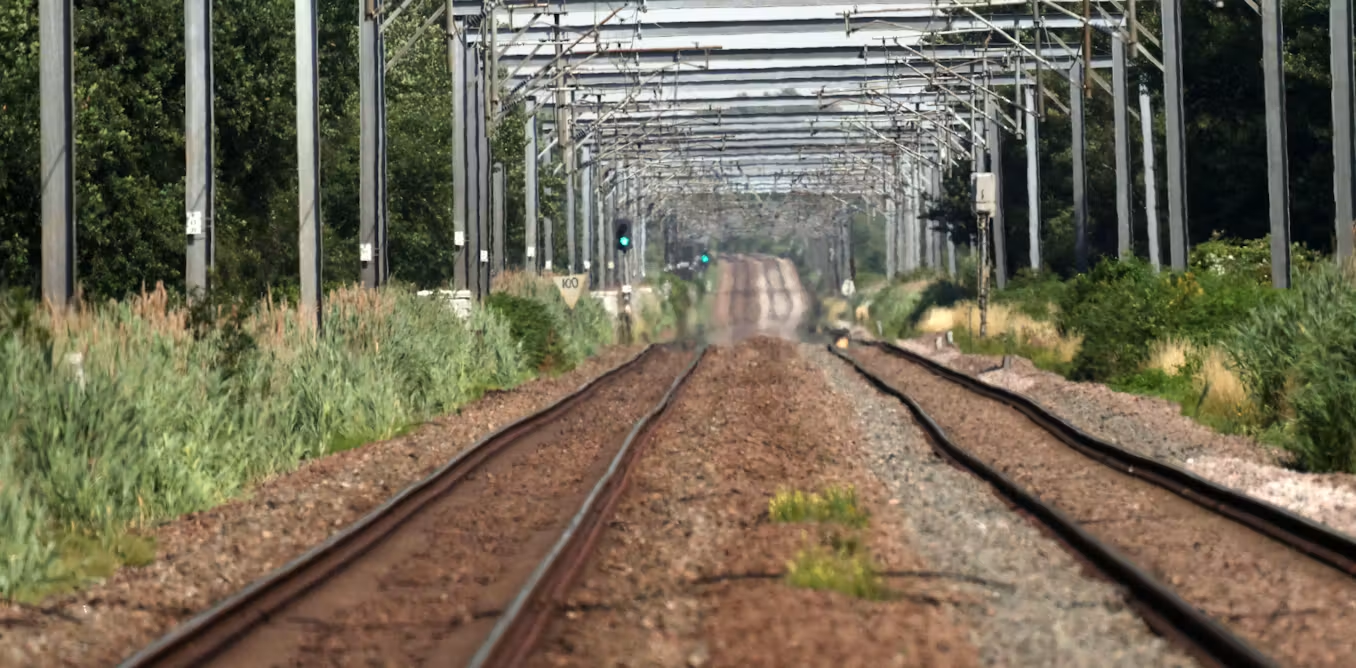
Steel expands when heated. Most of the network uses continuously welded rail: long lengths that are effectively restrained by the sleepers, fastenings and ballast, rather than jointed sections that can expand freely. When the rail heats up it wants to get longer but can’t, so it builds up substantial compressive stress instead.
Advertisement
If that stress exceeds the track’s resistance to sideways movement, the track can shift sideways, causing a thermal buckle. That’s why extreme heat is a genuine safety issue, not just a comfort-and-delays problem.
Rail temperature and air temperature are also two different things. Direct sunshine matters a lot: a stretch of track in full sun can run considerably hotter than a shaded section experiencing the same air temperature.
Temperature is only half the story, though. Ballast – the layer of crushed stones beneath the tracks – along with sleepers, fastenings and the condition of the track and ground all affect how much sideways movement it can withstand.
So there’s an important distinction between a “hot rail” and an “unstable track”. A railway can run a high rail temperature safely if the track system as a whole has enough resistance in reserve.
Advertisement
Is this a particular problem for Britain? Do hotter countries manage it better?
I wouldn’t say British infrastructure was simply designed for the “wrong” temperature; British engineers have always had to design for thermal expansion and contraction. The more fundamental issue is that the climate is shifting during the working life of the infrastructure.
Historically, the extreme temperatures built into design and operational planning reflected a climate where very high temperatures were rare. We’re now seeing heatwaves that are more frequent and that push into a temperature range many existing assets simply didn’t experience for most of their service life.
There are already examples of heat causing derailments. For instance, in 2015 a freight train derailed near Langton, Lincolnshire, on the hottest day of the year to that point. An investigation found the track had buckled in the heat.
The risk is now being managed at increasingly high temperatures. On July 19 2022, the UK’s first day over 40°C and still its hottest ever day, operators shut down one of the main lines linking London to northern England and Scotland. The closure was a precaution: rather than risk trains encountering buckled track, operators stopped services during the hottest part of the day.
Advertisement
Extreme heat is especially awkward for a railway specifically, because the infrastructure is so tightly constrained, you can’t let a track drift sideways even slightly, since wheel-rail interaction depends on very tight tolerances. Two adjacent stretches of track exposed to identical weather can have very different resistance to buckling, depending on their stressing history, ballast condition, fastenings, geometry and the ground underneath.
Trains and their tracks must be perfectly aligned. omegamezle / unsplash, CC BY-SA
There’s no single “heat-proof” railway technology to copy from hotter countries. What they have is the advantage of treating high heat as a normal design condition rather than an exceptional one, with track designed, maintained and operated accordingly.
Our design assumptions and maintenance strategies need to reflect the climate the railway will actually experience going forward, not the climate it was built for.
Advertisement
How have railways adapted, and what would a truly climate-proof railway involve?
The biggest shift needed is from a “reactive” to a “predictive” approach. At the moment, when extreme heat is forecast, operators step up inspections, monitor rail temperature, and impose speed restrictions where needed. Useful, but it’s responding to immediate risk rather than anticipating it.
The next generation of railway management should bring together weather and solar radiation forecasts, actual rail temperature, track geometry, rail stressing history, ballast and fastening condition, drainage, ground and embankment condition, and train speed and traffic loading. Put those together and you can identify which specific sections of track are vulnerable, rather than treating an entire route as uniformly at risk.
This is where new technologies have a strong role to play. Remote sensors, “digital twins” (computer models of a train system that can be updated with real-world data) and modern data science can all help spot a section approaching a critical condition before it becomes unsafe.
A truly climate-resilient railway isn’t just “stronger rails in the ground”. Prolonged hot, dry weather can change ground moisture and affect earthworks at the same time as thermal stress is building in the rail itself. That’s why resilience has to cover everything from train tracks and drainage to signalling and power systems, all together, not rail steel in isolation.
Advertisement
Should we design new tracks, or retrofit old track, for the heatwaves of the future?
Railway assets have very long lives: a track, bridge or embankment built or substantially renewed today could still be in service in 50 or 100 years. That creates a fundamental mismatch between the current design life and a climate that keeps changing within that lifetime.
The right question isn’t “can this new track cope with today’s hottest day?” It’s “what climate will this asset have to withstand across its whole life?”
This hits railways harder than most other transport modes, for a specific reason: the track has to stay precisely aligned. Roads suffer in heat too – asphalt softens, concrete expansion joints get stressed – but a road vehicle has rubber tyres and steering, giving it some lateral tolerance for minor surface movement. A railway wheel and its raised inner lip – the flange – don’t have that margin. Continuously welded rail has to stay within millimetre-scale geometric tolerance over very long, continuous lengths, with compressive stress building as temperatures rise.
For new infrastructure, climate projections for the middle and later parts of this century should be part of engineering decisions now, because that infrastructure will still be in service then. But I wouldn’t design every component to withstand an extreme 2100 temperature outright: that risks enormous, unnecessary cost for conditions that may not materialise for decades.
Advertisement
The better approach is risk-based adaptation: build appropriate resilience into new infrastructure from the outset, and for the existing network, identify the specific sections where future climate creates unacceptable risk and progressively retrofit those. That might mean improving ballast resistance, drainage, embankment stability, monitoring or thermal management, depending on what the local vulnerability actually is.







































You must be logged in to post a comment Login