Connect with us

NewsBeat

Three men appear in court in connection with mosque model on Moygashel bonfire

Published

on

Belfast Live

The trio appeared side by side in the dock at Dungannon Magistrates’ Court during a brief mention of that case on Wednesday

Three men have appeared in court in Dungannon charged in connection with a model of a mosque being placed on a Loyalist bonfire in Co Tyrone in July.

Advertisement

Tyler Somerville, 28, of Jacksonville Road in Moygashel, Simon Dilworth, 58, of a different address on Jacksonville Road and John Black, 38, of Prince Andrew Crescent in Moygashel all faced one charge in terms of offensive material.

The charge is that on July 8 2026 they displayed written material which was threatening, abusive or insulting, intending to stir up hatred or arouse fear contrary to Article 9(1) of the Public Order (Northern Ireland) Order 1987.

It came after a model of a mosque was on a bonfire in Moygashel, Co Tyrone in July as loyalist bonfires were being built across Northern Ireland to mark the anniversary of the Battle of the Boyne.

The trio appeared side by side in the dock at Dungannon Magistrates’ Court during a brief mention of that case on Wednesday morning.

Advertisement

All indicated they understood the charge.

A detective constable told the court he believed he could connect the accused to the charge.

No issues were raised during the first appearance of the three men with connection.

While all three had previously been out on police bail, they left under £250 court bail.

Advertisement

A fourth co-accused is set to appear on September 23, with all four to “travel together” going forward.

Meanwhile, Mr Somerville has been permitted to travel on a one-week holiday which had been booked before his arrest for the alleged offence.

For all the latest news, visit the Belfast Live homepage here and sign up to our daily newsletter here.

Source link

Advertisement
Continue Reading
Click to comment

You must be logged in to post a comment Login

Leave a Reply

NewsBeat

WTA Finals to move to Charlotte in United States from 2027 on three-year deal

Published

on

Elena Rybakina holds up the 2025 WTA Finals trophy

The American city of Charlotte in North Carolina has been chosen as the new home of the season-ending WTA Finals.

The WTA says it wants to create the “Super Bowl of women’s sports” and is hoping the three-year deal will bring more stability to an event that has had six hosts in seven years.

A planned 10-year stay in Shenzhen ended after just one year, with Guadalajara, Fort Worth, Cancun and Riyadh all taking turns since. Crowds have often been disappointing.

“The WTA has always owned the WTA Finals, but now we are going to operate it, too,” said WTA chair Valerie Camillo.

Advertisement

“We are not going to do everything ourselves, but we are taking control of this event, of the creation of the revenue and the controlling of the expenses. And that allows us to control our own destiny.”

This year’s Finals will be held in Indian Wells, California, before the tournament moves to Charlotte from 2027.

Prize money is yet to be announced, but the pot for this year’s Finals will be $10m (£7.4m) – which is $5.5m (£4.1m) less than the sum put up by Saudi Arabia last year.

“2026 is a year of transition for the WTA,” Camillo said.

Advertisement

“We are doing the normal belt tightening you would expect of any business while also absorbing the unexpected cost of relocating the WTA Finals to Indian Wells.

“What is most important to know is that we have a clear path to deliver consistent, sustainable financial performance in 2027 and beyond, supported by strong revenue and audience growth.”

Riyadh had been due to stage the Finals for a third time in November, but the arrangement finished one year early.

This was partly because of the instability caused by the conflict between the United States and Iran, but also reflected the waning interest of Saudi Arabia’s Public Investment Fund (PIF).

Advertisement

The country’s sovereign wealth fund has recently stopped bankrolling LIV Golf, while the Saudi Arabia Snooker Masters was another casualty earlier this year.

The Finals, which involve the best eight singles players and doubles teams of the year, will be staged at the Spectrum Centre where the Charlotte Hornets play their home NBA games.

The basketball season will be in full swing next November and, because of the frequency of home games, the Finals will be reduced from eight days to five, which is likely to affect revenue.

Camillo says the WTA has already started exploring alternative formats with the players, but if the round-robin element of the tournament survives, the finalists would need to play every day.

Advertisement

The WTA will also move its global headquarters from St Petersburg in Florida to Charlotte as part of the agreement.

Source link

Continue Reading

NewsBeat

how environmental progress can become unstoppable

Published

on

how environmental progress can become unstoppable

It must be tough being a judge on the world’s most prestigious environmental prize: imagine having to choose between an ingenious machine that removes microplastics from a river in Europe, or a company in East Africa that sells clean cookstoves through affordable weekly instalments.

Over the last six months, we have been working with colleagues at Green Futures Solutions at the University of Exeter to make that job a little easier. We have found a way to distinguish between solutions that carry on working as long as people keep putting money into them, and those with “tipping potential” that get better, cheaper and easier to adopt the more successful they are. Our new report applies the science of positive tipping points to the five Earthshot categories – nature, air, oceans, waste and climate – for the first time.

After a northern summer of record-breaking heat, wildfires, floods and a deadly glacier collapse in the Nepal-Tibet border region, it would be easy to conclude the planet is only headed towards collapse. But tipping points science says otherwise. The same dynamic principle that leaves coral reefs and rainforests vulnerable to a relatively abrupt breakdown can also work in our favour – if we know the right levers to pull.

What is a positive tipping point?

Most environmental interventions assume change is incremental and proportionate: bigger problems require bigger budgets and lead to slower progress. But many complex systems we rely on (technologies, markets, societal norms, ecosystems) can shift abruptly once a critical threshold is crossed.

Advertisement

Solar power is a great example. Its cost fell around 90% in a decade because every panel sold stimulated innovation that made the next one cheaper. This attracted more investment, which cut costs again and improved performance. The tipping point happened when self-propelling feedback took over. Clean electricity, our report finds, is now a “master cascade”: as solar and wind have tipped in many markets, clean power can accelerate further progress in electric mobility, residential heating, industrial emissions and air quality.

Our report identifies the potential for such self-propelling feedback across 51 solution areas. Specifically, we identify whether the innovative solution is, or could quickly become, more affordable, accessible, and attractive than the polluting incumbent system it seeks to replace. We have also assigned measurable 2030 targets to each solution area, so progress can be tracked.

Three that could soon tip

Around 2.1 billion people still cook on wood, charcoal or dung and the smoke kills nearly 3 million people a year, including more than 300,000 children under five. Pay-as-you-go finance (borrowed from off-grid solar), turns an unaffordable stove into a small weekly payment. Clean cooking is now close to tipping in several African markets. People switch primarily because it saves them time and money.

Advertisement

Founder and CEO, Charlot Magayi, launched Mukuru (one of the 2025 Earthshot winners) as an alternative to traditional cookstoves, which emit harmful chemicals and lack safeguards.
@TheEarthshotPrize

Methane is responsible for about 30% of global heating so far, but lasts only around 12 years in the atmosphere. Cutting methane emissions therefore helps cool climate within a decade, rather than a century. A new generation of satellites can now pinpoint methane leaks from individual oil and gas facilities from space, and they are cheap to fix. The gas saved is worth more than the repair.

Inside a well-enforced marine-protected area, where commercial fishing is banned, fish biomass typically reaches four to seven times that of the surrounding waters within five to ten years. Fish spill out across the boundary, nearby fish catches rise, and the fishers who initially opposed the marine-protected area become the constituency demanding more of them. Only around 3% of the ocean is fully protected, but the landmark high seas treaty (itself an Earthshot prizewinner) entered into force this year and aims to protect 30% of the world’s oceans by 2030. Satellites can now monitor some industrial fishing fleets, so enforcement of marine-protected areas is getting easier. The science, the technology and the politics are coming together.

woman on boat, looks through binoculars at sea

The high seas treaty, one of the 2025 Earthshot prizewinners, is led by Rebecca Hubbard, director of the High Seas Alliance.
The Earthshot Prize

Not everything is about to tip. The biggest brake is investment: Africa receives only 3% of clean energy finance despite holding 60% of the world’s best solar resources. Our report shows where innovative financing could create the conditions to address these barriers, and highlights how the current investment gaps in adaptation financing can be closed.

By using our research to shape how the prize searches for, selects and supports solutions, Earthshot can help trigger positive tipping points to accelerate out of trouble.

Advertisement

Source link

Continue Reading

NewsBeat

Perthshire councillors approve return of “vital” filling station to village

Published

on

Daily Record

The restoration of the filling station in Bridge of Earn was described as a “vital necessity” in the documents for the change-of-use planning permission.

Councillors have granted permission for Oilfast to reinstate a filling station on Bridge of Earn’s Main Street, on a site previously used as a vehicle sales forecourt.

Advertisement

Motherwell-based Oilfast sought change-of-use planning permission to reintroduce a petrol station in the Perthshire village, arguing it was “a vital necessity”.

Perth and Kinross Council’s Planning and Placemaking Committee was told by a senior planning officer that the application was part-retrospective, as the applicant had carried out the “majority of the works without the benefit of planning permission”.

Presenting the application to the committee on Wednesday, September 9, Development Management team leader Paul Williamson said the application had been brought forward as a result of enforcement negotiations. It was recommended by council officers for conditional approval.

According to the Design and Planning Statement – submitted by JMS Planning and Development on behalf of Oilfast – the site had operated as a filling station until around 2008.

Advertisement

They argued there was “a national need for additional and enhanced petrol filling station facilities” and “a significant absence of petrol filling station facilities within the local area, particularly between Perth and Kinross”.

Presenting the application for the automated, unmanned facility, JMS Planning and Development’s statement described filling stations as “vital community facilities” that “often function as a community hub”.

The agent’s statement read: “Petrol filling stations are a vital necessity and can often function as a community hub, but are facing significant threats in a harsh economic climate. Petrol stations have been likened to post offices and local shops as vital community facilities which are rapidly disappearing.”

The number of UK filling stations is reported to have fallen by 75 per cent between 1967 and 2023.

Advertisement

There were five objections from members of the public alongside a further objection from Earn Community Council.

Addressing councillors, objector Sarah Stewart stressed her concern about the cumulative impact of lighting, noise, traffic and contamination on neighbouring homes.

Mrs Stewart said: “Our concern is not one element in isolation; it’s the cumulative effect of all these activities operating together.”

Neighbouring objector Iain Bethune felt there were “material gaps” in the information provided by the applicant regarding traffic, lighting, and contamination.

Advertisement

Highlighting issues with parking and visibility, he said: “We request stronger action, such as double yellow lines.

“This would be an obvious solution.”

Oilfast chief executive Stephen Anderson told councillors that the company already operates two 24-hour petrol stations in Perthshire—in Guildtown and Balbeggie—“without issue”.

The pumps in Bridge of Earn will not operate 24 hours a day, but will be available from 6am to 11pm.

Advertisement

The use of jet washes and air, water and vacuum units will be limited to between the hours of 7am and 8pm.

Mr Anderson said: “We pride ourselves on being considerate operators and, quite frankly, it’s in our best interest to be good neighbours.”

He added that Oilfast had commissioned a mail drop to 600 neighbouring households: “Eighty-four per cent of respondents were in favour of reopening the Cargill’s site for fuel sales, with 74 per cent voting ‘strongly in favour’.”

The current site owner, Cargill’s, has entered into a lease agreement with Oilfast for the forecourt area only.

Advertisement

Cargill’s Autos will continue operating car sales and general vehicle maintenance and repairs in the area behind the forecourt.

Conservative councillor Ian James moved the plans for approval, seconded by SNP councillor Mike Williamson.

Local Conservative councillor David Illingworth (Almond and Earn ward) sought to restrict fuel sales to between 7am and 10pm for the benefit of nearby residents.

However, he was legally advised by council officers that there would need to be “a clear justification as to why there’s a need to reduce the hours”.

Advertisement

He subsequently withdrew his amendment.

Planning permission was unanimously granted—subject to conditions—allowing the site to be used for fuel sales from 6am to 11pm.

Source link

Advertisement
Continue Reading

NewsBeat

Sir Bradley Wiggins backing son, Ben, to achieve something that he never could

Published

on

Manchester Evening News

Ben Wiggins heads to London after success at the Tour of Britain and his father is looking forward to see him shine in London

Bradley Wiggins has used his own relationship with his father to shape his bond with son Ben – and hopes the newest Wiggins on the cycling scene can achieve something he never managed.

Advertisement

Now 21, Ben Wiggins has started to establish himself as a rising force on two wheels, both on the road and the track. The latter is where Bradley Wiggins first made his name, winning four of his five Olympic gold medals in the velodrome but victory at London Six Day always eluded him.

The competition has now been slimmed down to London 3 Day, and after finishing third and second in each of the last two years, Ben Wiggins is aiming to go one better than his dad’s best result. This is London 3 Day’s third year, and it continues to grow – bringing world-class track racing and a brilliant live atmosphere back to London.

Bradley Wiggins said: “In the last two years he’s finished third, second. So he’s got a chance to do something I didn’t do. We, me and Cav (Mark Cavendish), got second. So definitely, it would be a great thing if it happens.”

Wiggins’ father, Gary, was an Australian professional cyclist who competed regularly on the Six Day circuit. Wiggins senior was not part of Bradley’s life growing up, and he has spoken previously about wanting to prove himself to his father and how that drove him on.

Advertisement

They did reunite later in Gary’s life before he died following a fight at a house party in 2008. Given the dynamics of that relationship, Bradley Wiggins was keen to ensure that his own father-son connection with Ben was very different.

He explained: “The only thing I decided a long time ago was, and it was probably informed by my own relationship with my dad, first and foremost, I wanted to be his dad.

“He always looked at me as his hero, and it was in an unhealthy way, I thought. I think establishing our relationship as father and son – win or lose for him, I’m still his dad and still there for him – has served us well over time.

Advertisement

“If he wins, I’m his biggest supporter. If he loses, like any dad, I stick my arm around him. I never wanted to be the one saying, “Right then, you didn’t do this right, you didn’t do that right.”

“My level of expectation, I never wanted to put that on him. In doing that, he’s always got a supportive dad who, win or lose, is going to be there for the rest of his life.

“He’s found his own way through the sport, navigating it, and he’s had success as well. I think he’s become his own person. It’s not about repeating what I did or trying to emulate what I did. I think that’s important.”

Given Bradley Wiggins’ success on the bike – Britain’s first-ever Tour de France champion and a five-time Olympic champion – he still has plenty of advice to offer if Ben ever requires it.

Advertisement

And while he is always conscious of not overstepping the mark and interfering with coach’s plans, he is happy to share his mental approach to elite cycling with Ben.

He added: “He tends to come and ask me for things that other people probably can’t give him. His coach has all the conditioning stuff.

“There are things that he asks me, particularly about the mental side of it, the preparation and what you should be thinking going into it. So that’s quite nice, that I’m able to give him that from my own experience.

“Although the sport’s changed quite a lot, and maybe the preparation might change, the fuelling strategies and all that, the mental mindset going into something where you’ve got to arrive and be as fast as possible, that’s remained the same since the start of time.”

Advertisement

London 3 Day returns to Lee Valley VeloPark from 13-15 November 2026, bringing together the world’s fastest riders, Olympic champions and cycling’s next superstars. Tickets and information: www.london3day.com | Instagram @LND3DAY

Source link

Continue Reading

NewsBeat

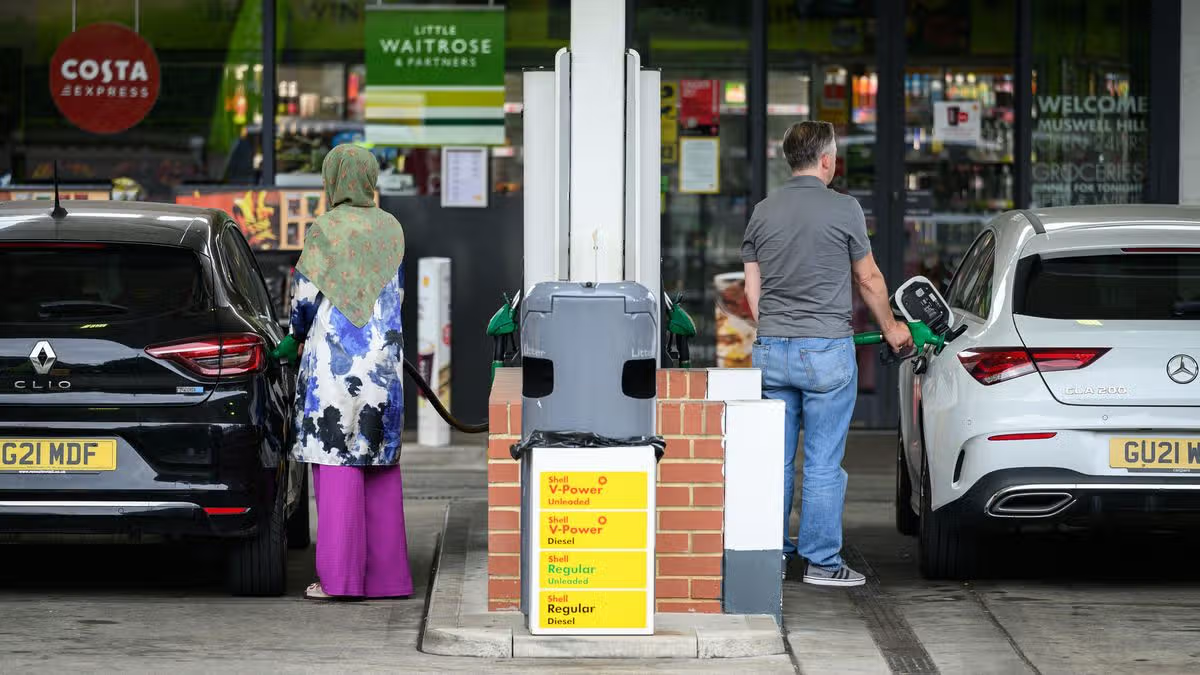
The most expensive place to fill up in Cambridgeshire as fuel prices soar

Published

on

Cambridgeshire Live

Average pump prices are jumping by a penny a day in some cases

Soaring petrol prices have now reached their highest level since the start of the Iran war with the cost of filling up a family car with unleaded fuel edging towards £100.

Advertisement

The average price of a litre of petrol has now gone through the 170p barrier which means it would cost around £94 to fill up a standard 55-litre tank car, and in many areas prices are much higher.

Motorists face a postcode lottery at the pumps with even the cheapest prices charged by supermarkets varying widely across the country. Maidstone in Kent has the highest average price for unleaded petrol this week at 175.2 per litre. That is 20p a litre more than motorists are paying in parts of Northern Ireland, and 15p a litre more than the average price in Watford.

In Cambridge, motorists are currently paying 173.2p per litre for unleaded petrol, making it one of the most expensive places in the country to fill up.

You can find the cheapest petrol and diesel on sale in your neighbourhood by searching our postcode checker.

Advertisement

Owners of diesel cars are paying an average of just over 190p and dozens of forecourts around the country have seen the price of standard diesel go over the £2-a-litre mark in the last week.

The price of diesel has reached 215p per litre at BP motorway services, while a service station on the M61 motorway near Bolton is charging 195.9 per litre of standard unleaded, one of the highest prices in the country.

According to the latest data from Fuel Finder, at least 200 garages are charging 181p or more per litre of standard E10 unleaded, which would push the cost of filling up a standard family car on their forecourts over the £100 mark.

RAC head of policy Simon Williams said: “Since the start of this month, the cost of filling a family car has already risen by almost £5, to £94 for petrol and £106 for diesel. Average pump prices have jumped by yet another penny in just a day. Petrol has now broken through the £1.70-a-litre barrier and stands at 170.54p – its highest since 23 August 2022. Unfortunately for hard-pressed drivers, prices look set to keep on rising”.

Advertisement

Average price for unleaded petrol:

20 most expensive areas

  • Maidstone – 175.2p
  • Brentwood – 174p
  • Dumfries and Galloway – 173.7p
  • Broxbourne – 173.5p
  • East Staffordshire – 173.2p
  • Cambridge – 173.2p
  • South Oxfordshire – 172.9p
  • North East Derbyshire – 172.9p
  • East Hertfordshire – 172.8p
  • Westminster – 172.7p
  • Cheshire East – 172.7p
  • Tandridge – 172.6p
  • Colchester – 172.6p
  • Chichester – 172.5p
  • Ashford – 172.4p
  • Breckland – 172.4p
  • Denbighshire – 172.2p
  • North Hertfordshire – 172.2p
  • Bournemouth, Christchurch and Poole – 172.1p
  • Lambeth – 172.1p

20 areas with the cheapest average prices

  • South Ayrshire – 163.9p
  • Basingstoke and Deane – 163.8p
  • Hartlepool – 163.8p
  • Erewash – 163.7p
  • West Suffolk – 163.5p
  • Ashfield – 163.2p
  • Tamworth – 162.7p
  • York – 162.2p
  • South Tyneside – 162.2p
  • Ipswich – 161.7p
  • Antrim and Newtownabbey – 160.6p
  • Watford – 160.2p
  • Fermanagh and Omagh – 160p
  • Derry City and Strabane – 159.2p
  • Causeway Coast and Glens – 159.2p
  • Armagh City, Banbridge and Craigavon – 157.2p
  • Mid Ulster – 156.2p
  • Mid and East Antrim – 156.1p
  • Ards and North Down – 154.2p
  • Scottish Borders – 149.3p

Source link

Continue Reading

NewsBeat

Proposed curriculum in Northern Ireland would restrict children’s language learning

Published

on

Proposed curriculum in Northern Ireland would restrict children’s language learning

Northern Ireland is in the process of establishing a new curriculum for primary and secondary education. The proposed Northern Ireland Curriculum Framework 2028, TransformED – currently under consultation – sets out a new, knowledge-rich curriculum.

Knowledge-rich means a strong understanding of subject-specific content, rather than, for instance, more general skills. There are many similarities with the 2013 educational reforms in England spearheaded by then education secretary Michael Gove, such as the influence of cognitive science and the belief that secure knowledge underpins higher-order thinking.

Some of the most far-reaching proposed changes in Northern Ireland are in language teaching.

Over the past 20 years, modern languages taught in schools in Northern Ireland have included French, German, Irish and Spanish.

Advertisement

When the curriculum was last reformed in the early 2000s, there was a missed opportunity to include statutory languages in the primary school curriculum. This effectively rendered Northern Ireland as having European Union’s shortest compulsory period of language learning.

Nevertheless, many of Northern Ireland’s post-primary schools teach [two or three languages]. The current curriculum requires the study of at least one language of the European Union but it provides ample flexibility to study more.

The new proposals still do not include modern languages in primary school. They shift to focus attention on “a single core modern language”, only required at secondary school in the 11-14 age range. Teaching practice would be focused on the three pillars of phonics, vocabulary and grammar. This includes concentrating on teaching pupils a high-frequency list of 800 words.

In Northern Ireland schools where teaching is in English, Irish is considered a modern language with the same status as French, German and Spanish. In Northern Ireland’s two Irish-medium post-primary schools, pupils learn through Irish and study English and either French or Spanish.

Advertisement

This differs from other Celtic jurisdictions, where language provision has been expanded, not reduced. Since 2013, Scotland has offered all pupils the chance to learn at least two modern languages. The Republic of Ireland and Wales have bilingual plus one policies, meaning that all pupils learn Irish or Welsh, plus an additional foreign modern language.

In fact, the explicit focus on only one core language from ages 11 to 14 in Northern Ireland is a significant policy shift not seen elsewhere in the British Isles. In England, language study is compulsory from ages seven to 14 and can include ancient languages in the primary phase.

Depth of knowledge

The argument from the Northern Ireland devolved government is that research evidence supports spending learning time concentrating on “developing depth of knowledge”. Yes, depth of knowledge of languages and linguistics is essential, but there is no peer-reviewed international research which says young people should only learn one language at school or that this should be confined to the 11-14 age range.

The proposals prioritise depth of knowledge.
Javier Bermudez Zayas/Shutterstock

Informed by international research, EU policy sets a goal of all pupils acquiring, before the end of upper secondary, proficiency in the language of schooling and knowledge of two additional languages. It also calls for particular attention to be paid to language awareness in multilingual classrooms.

Advertisement

In the UK, this approach has been widely embraced in recent changes to the curriculum in Wales.

The word list of 800 high-frequency words, which differ across each of French, German, Irish and Spanish, is an approach that has also been used in England, where, at GCSE level, pupils have defined word lists. But as applied linguist Gianfranco Conti notes, a high-frequency word list tells us how often a lexical item occurs in a corpus a word is used but it does not tell us how useful that word will be to an 11-year-old.

The word for “pencil case” may not be in the top 800 words, but it’s still important to a young person in a classroom and worth knowing, not least because it helps to explain gender in languages.

The arguments for multilingualism are well rehearsed – and this is a time when Northern Ireland’s schools educate over 21,350 newcomer pupils and are home to speakers of more than 90 languages.. The decisions made now will shape language learning for a generation.

Advertisement

Source link

Continue Reading

NewsBeat

Wales breaking news plus weather and traffic updates (Wednesday, September 16)

Published

on

Wales Online

Plaid Cymru leader and first minister Rhun ap Iorwerth will speak at a march for independence later this month, it has been announced. Thousands of people are expected to descend on Aberystwyth on Saturday, September 26, for a YesCymru Welsh independence rally.

It is the first YesCymru march to be held in mid Wales and follows the 10 marches held since 2019, including in Cardiff, Wrexham, Swansea and Carmarthen, which have seen tens of thousands of people from every corner of Wales attend. Campaign organisers confirmed Mr ap Iorwerth will be among the speakers at the rally following the march.

It comes after what YesCymru described as an “historic week” in the independence movement. Full details here.

Advertisement

Source link

Continue Reading

NewsBeat

Putney Pusher suspect is found dead: Millionaire HSBC banker, 44, an ex-Army captain with links to royalty was under investigation in hunt for jogger who shoved woman into bus

Published

on

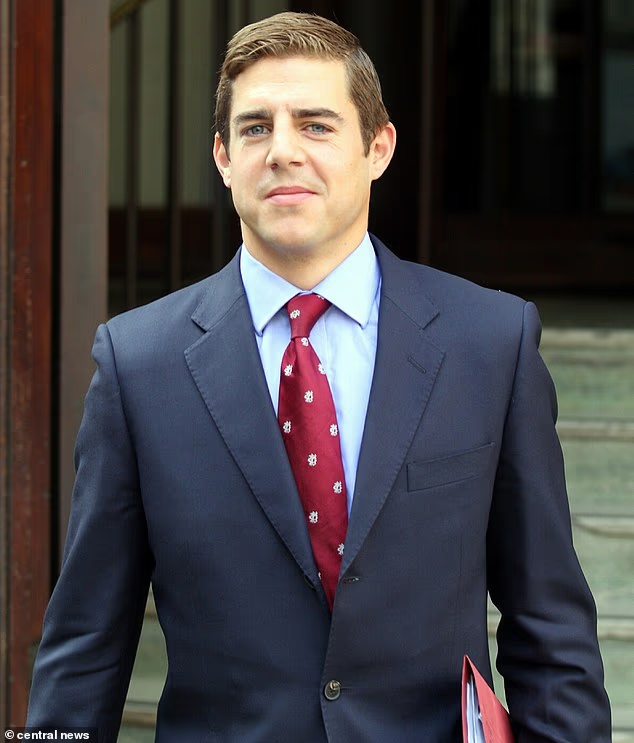
Nicholas Brandram - who was arrested by police on suspicion of being the Putney Pusher - has been found dead. He is pictured 2013

A 44-year-old private banker arrested by police on suspicion of being the Putney Pusher has been found dead. 

Nicholas Brandram was detained on June 15 at his home in Chiswick, West London, for attempted grievous bodily harm.

It was in relation to a notorious incident on May 5, 2017 when a jogger shoved a female pedestrian into the path of a double-decker bus on Putney Bridge – which only avoided her thanks to the lightening quick reactions of the driver. 

Police searched Mr Brandram’s £1.4million house and subsequently rearrested him for possession of Class A and Class B drugs – believed to be cocaine and cannabis. 

Advertisement

A Metropolitan Police spokesman said today: ‘At 7.15pm on Tuesday, September 15 officers and the London Ambulance Service attended an address in Chiswick, Hounslow after a man was found unresponsive inside a property. 

‘Sadly, a 44-year-old man was pronounced dead at the scene. His next-of-kin have been informed. At this time his death is being treated as unexpected, but is not believed to be suspicious. A file will be prepared for the coroner in due course.’

Mr Brandram – a grandson of Princess Katherine of Greece and Denmark, Queen Victoria’s last female descendant – was a director at HSBC’s private bank before being suspended after his arrest. 

His name was not released at the time of his arrest for legal reasons, but his identity was the subject of intense online speculation. He can now be named following his death. 

Advertisement

Mr Brandram was a decorated former British Army captain who served with the Scots Guards in Iraq, Bosnia and Afghanistan. In 2012, the Newcastle University philosophy and psychology graduate was awarded a Queen Elizabeth II Diamond Jubilee Medal in recognition of his military service.

A year later, he appeared at City of London Magistrates’ Court after colliding with a female cyclist on Hyde Park Corner on March 6 of that year. 

Nicholas Brandram – who was arrested by police on suspicion of being the Putney Pusher – has been found dead. He is pictured 2013 

Advertisement

Mr Brandram crashed his 1948 Harley-Davidson into the woman and then drove off without leaving his details or checking if she was hurt, the court heard. 

Representing himself, he told magistrates: ‘I ride a bicycle myself and realise the risks.

‘I’m an upstanding member of society and have recently resigned as a member of the British Army and have served in Iraq and Afghanistan.

‘I have a very loud bike so it’s not impossible I collided with her without me realising it. At the same time with such a big bike I don’t know how I didn’t feel the collision.’

Advertisement

He pleaded guilty to a count each of driving without due care and attention and of failing to stop after a road accident. 

He received five penalty points, a £200 fine and was told to pay £105 compensation. Mr Brandram thanked magistrates and said he would pay the fine immediately. 

The Putney Pusher incident took place during rush hour on May 5, 2017 at about 7.40am.

A woman was walking southwards on Putney Bridge when the jogger approached her from the opposite direction.

Advertisement

There was plenty of room on the footpath for him to run around her safely, but instead he shoved her onto the road – directly in the path of an incoming 430 bus going at 12mph.

Thanks to the rapid reactions of the driver, Oliver Salbris, the bus missed the 33-year-old victim’s head by inches, and she survived largely physically unscathed. 

The jogger continued his run across Putney Bridge without so much as a backward glance.

After the vehicle stopped, passers-by rushed to help the shaken woman – who has never been publicly identified.

Advertisement

The jogger returned in the opposite direction about 15 minutes later, passing the victim again while she was still being assisted on the bridge. He ignored her calls to stop. 

Nine years ago, police released dramatic CCTV footage of the moment this jogger appeared to push a woman into the path of an incoming bus on Putney Bridge

Nine years ago, police released dramatic CCTV footage of the moment this jogger appeared to push a woman into the path of an incoming bus on Putney Bridge 

The jogger was seen appearing to push the victim into the path of the incoming vehicle. The driver swerved and missed the woman's head by inches

The jogger was seen appearing to push the victim into the path of the incoming vehicle. The driver swerved and missed the woman’s head by inches

In April, Mr Salbris told the Mail that he would never forget what he saw.

Advertisement

‘I always think about the case and I still drive over Putney Bridge several times a day,’ he said.

‘Whenever I’m on the bridge, I look very carefully at the pedestrians on the pavement, I just can’t help it. I wouldn’t say it haunts me, but it’s not something I can easily forget.

‘I’m glad my reactions were quick on that day, or it would have ended very differently, both for me and the woman who was pushed. Her head was only a few centimetres from the bus and the wheel, even after I swerved to avoid her.’

At the time of the original appeal, the suspect was described as a white man in his early to mid-30s, with a stocky build and short brown hair. He was wearing a grey T-shirt and dark blue shorts.

Advertisement

Metropolitan Police detectives interviewed 50 men and arrested three suspects, including an American investment banker – who was able to prove ‘irrefutably’ that he was in the US at the time.

No suspect was ever charged, and the investigation was closed in 2018 before new information led to Mr Brandram’s arrest. 

Earlier this month, he was released under investigation to give police time to complete outstanding enquiries. 

The Met said at the time: ‘On Monday, June 15, a 44-year-old man was arrested on suspicion of attempted grievous bodily harm. 

Advertisement

‘The arrest relates to an incident on May 5, 2017, where a woman was pushed into the path of a bus on Putney Bridge in Putney.

‘Once in police custody, he was also arrested on suspicion of possession of Class A and Class B drugs.

‘He has since been released under investigation while enquiries continue.’

Mr Brandram - a grandson of Princess Katherine of Greece and Denmark, Victoria's last female descendant - was a director at HSBC's private bank before being suspended after his arrest

Mr Brandram – a grandson of Princess Katherine of Greece and Denmark, Victoria’s last female descendant – was a director at HSBC’s private bank before being suspended after his arrest

Advertisement

Mr Brandram’s late father, City executive Paul Brandram, was the only child of Princess Katherine of Greece and Denmark and Major Richard Campbell Andrew Brandram, who served with the British Army during the Second World War.

Princess Katherine was Queen Victoria‘s great-granddaughter, a first cousin of Prince Philip, and the daughter of King Constantine I, who ruled Greece between 1913 and 1922.

Queen Sofia of Spain, Paul Brandram’s cousin, told of her ‘great sadness’ after his death in 2020 at the age of 72. 

Like his father, Nicholas has had a successful career in the City, working at leading stockbrokers Killik & Co and Israeli lender Bank Leumi before moving to HSBC, where he managed the assets of wealthy individuals.

Advertisement

He was nominated Private Banker of the Year for 2026. 

Source link

Continue Reading

NewsBeat

Final call: 100 more walkers needed to light up Portsmouth at Rowans Hospice’s Shining Stars Walk

Published

on

Final call: 100 more walkers needed to light up Portsmouth at Rowans Hospice’s Shining Stars Walk

With less than two weeks to go until Rowans Hospice’s Shining Stars Walk returns to Portsmouth, the Hospice is making a final call for 100 more walkers to join a spectacular evening of remembrance, community and fundraising – helping to ensure local families can continue to receive compassionate hospice care when they need it most.

Source link

Continue Reading

NewsBeat

How I lost a stone – and found my mojo again – at 64: SUSANNAH CONSTANTINE reveals the everyday store cupboard staple that kickstarted her weight-loss journey – and the simple diet change that transformed her waistline

Published

on

Susannah Constantine posted a photo of herself in a swimming costume on Instagram in July

Source link

Advertisement
Continue Reading

Trending

Copyright © 2025