Connect with us

NewsBeat

Three things we learned from Arsenal FC win as Mikel Arteta puts title rivals on red alert

Published

on

Three things we learned from Arsenal FC win as Mikel Arteta puts title rivals on red alert

For Arsenal, this was about continuity after their first league title in 22 years. For Manchester City, it was about starting afresh with the continuity candidate, Enzo Maresca, in the dugout.

Source link

Continue Reading
Click to comment

You must be logged in to post a comment Login

Leave a Reply

NewsBeat

The small Cambridgeshire village where an ancient Roman burial ground once stood

Published

on

Cambridgeshire Live

The village pub is named after the ancient Roman burial ground

The Romans once had a stronghold over Cambridgeshire, as they did in many places across Britain. Over the years, there have been Roman artefacts uncovered across the county.

Advertisement

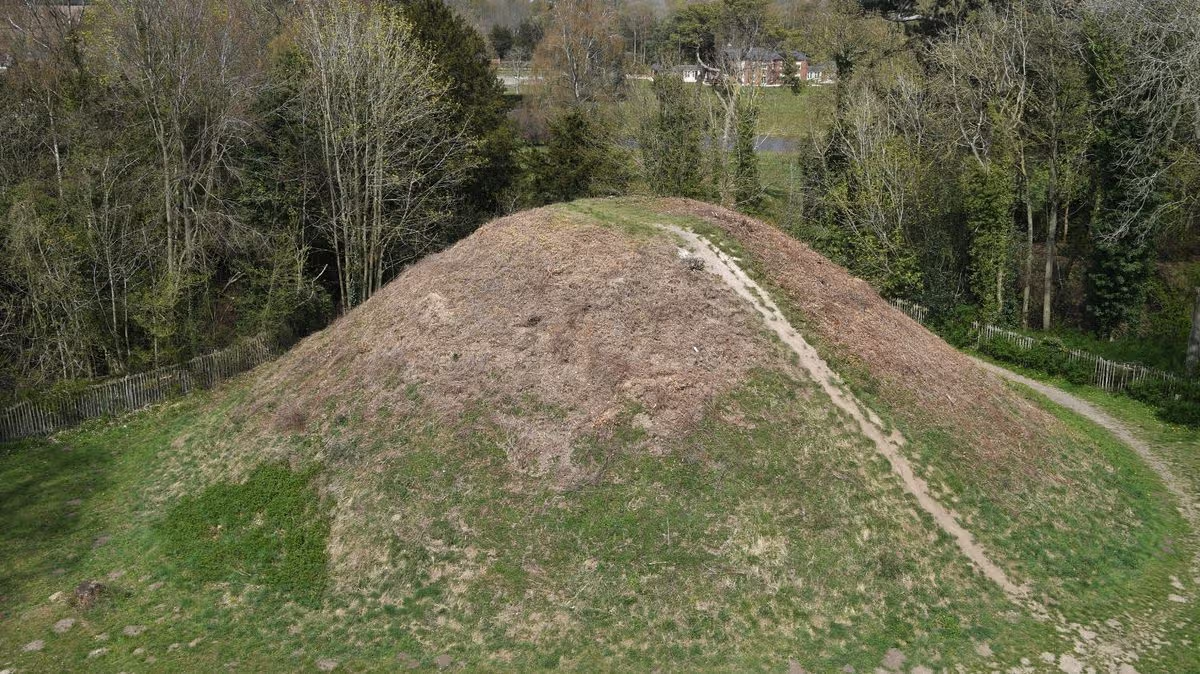
In the small village of Bartlow, there are the remains of one of Cambridgeshire’s most important Roman finds. The village is home to Bartlow Hills, a rare Roman cemetery. Dating back to the 1st and 2nd centuries AD, the cemetery features ancient burial grounds known as ‘tumuli’.

It’s considered the largest surviving mound standing at 50ft, and the highest Roman barrow north of the Alps. Four of the original seven burial grounds can still be seen today. The public are able to see the largest three, while the other remaining one, which is the smallest, is based on private property. The remnants of two others are visible, but these are lower mounds.

During the 19th century, excavations took place at the site. Through this, walled graves containing human cremains with glassed items were found stored in large wooden chests. The glassed items found were made of bronze, enamel and pottery. An iron folding chair was also found.

A small 4th century Roman villa was also located on the site of Bartlow Hills. Excavations of this site took place in 1852. A geophysical survey was conducted in 2006 and further excavations took place in 2007, however this work still couldn’t establish the location of the villa.

Advertisement

As well as its significant Roman history, Bartlow stands as a tiny Cambridgeshire village today. It is home to only around 110 people and features around 40 houses. The average prices of houses in the village range between £580,000 to £800,000. A main attraction in the village is the local pub. The Three Hills, which opened in 1847, is also a hotel. It’s named after the ancient burial grounds.

On the pub website, it says: “This delightful 17th century Grade II listed building is located in the heart of Bartlow, and is the only remaining pub and community facility in a small village of only 110 residents.”

The dog-friendly pub offers a large patio to enjoy drinks on hot summer days, or when it gets a bit colder, the snug is the “perfect haven for hiding out on a cold winter’s evening”.

Source link

Advertisement
Continue Reading

NewsBeat

Meet the man uncovering Saddleworth’s giants and boggarts

Published

on

Meet the man uncovering Saddleworth's giants and boggarts

Local content creator Richard Glover researches these ancient myths, teaching new audiences about the lore of the land and, more importantly, why we should still care about them.

By day he works in digital marketing, but in his free time he pores over 200-year-old maps, digs through local bookstores and library resources, using his photography and filmmaking skills to bring his findings to life.

His interest began as a child on holidays around the UK, when his dad would tell him about the knights and castles of the various locations.

Now, aged 36, he’s doing the same – but for tens of thousands of interested followers.

Advertisement

Recently, he posted a simple video of the Trinnacle, asking anyone with an interest in local folklore to follow his page.

The public heeded his call. Over a couple of days, the video exploded, attracting more than two million views and boosting his subscriber count substantially.

We spoke to him about his work and why he thinks more and more people are looking to the past to help understand the world around us today.

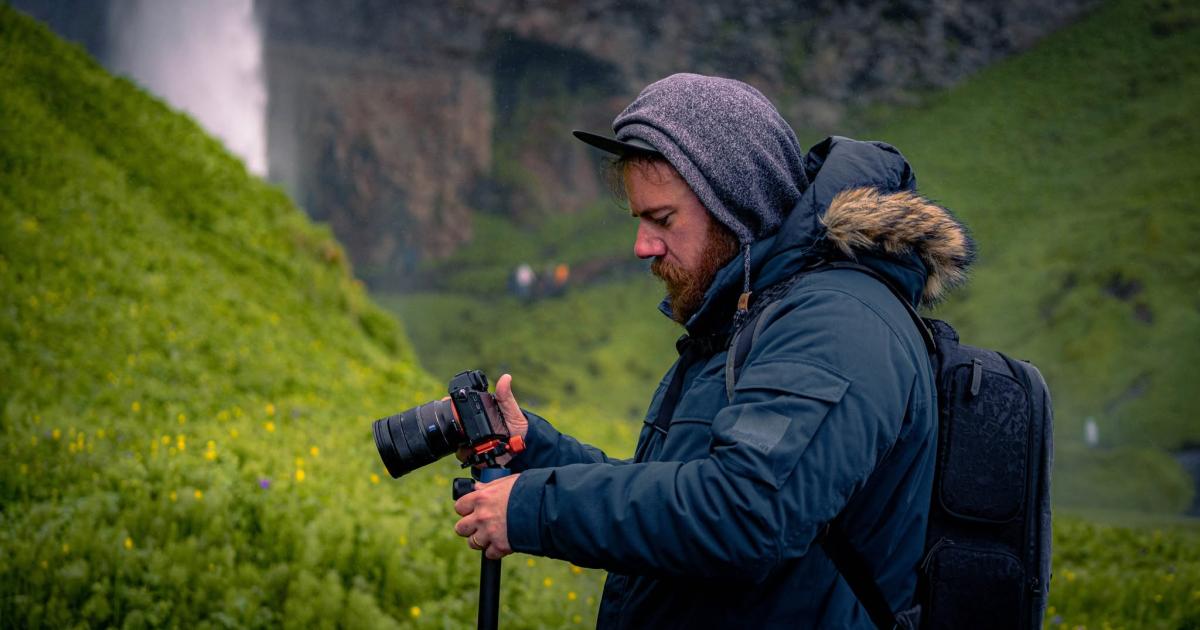
Richard Glover at Alderman Hill (Image: Richard Glover)

‘A connection to the land’

When it comes to Saddleworth, Mr Glover said there is one myth that always seems to crop up – the Dovestone Giants.

Advertisement

According to the legend, two giants fought to their death for the affections of a beautiful water nymph, forming the unique landscape in the process.

Mr Glover said: “Across the Saddleworth hills, you see scatterings of really large boulders and rocks and the story says those rocks are the remnants of the battle because the giants were hurling them at each other.

“For me, it’s less about what the story is and more about why it exists and what it tells us.

“People looked at the hills, saw these strange clusters of rocks, and were trying to make sense of that.”

Advertisement

Another example is the boggart legends of the 1800s. Mr Glover has found newspaper articles of families moving out of their homes due to boggart hauntings and priests who would patrol the streets at night to ward off malevolent spirits.

In reality, he theorised, this was probably their way of accounting for disappearances and accidents in the dangerous moorland environment.

Richard uses old maps and books to research Saddleworth’s myths and legends. (Image: Richard Glover)

This, in essence, is what his content is all about.

He explained: “Folklore and myth – we tend to dismiss them today as fiction, fairy tales, or children’s stories, but they go a lot deeper than that.

Advertisement

“They were a way that people looked at the world and tried to make sense of it, and the stories often served as a lesson or had some meaning behind them.

“They had a connection to the land because of it.”

‘The emotional history of the place’

The desire to reconnect with the land and nature, Mr Glover believes, is one of the reasons behind this resurgence in folklore interest.

Over the last few weeks, the Saddleworth Moors have been ravaged by a series of wildfires, resulting in serious damage to the precious landscape, as well as sparking widespread calls to repair and protect what remains.

Advertisement

Mr Glover said: “I don’t think suddenly looking at folklore will change everything, because there are other reasons, but I think it is one part of it.

“There are important discussions around climate change, the actions we take and green spaces being built on when they shouldn’t be.

“But if we don’t have a connection to something, it’s easy to devalue it. Once it’s devalued, it’s easy to change and destroy.

“The relationship with the hills and mountains isn’t there any more for many people.

Advertisement

“They go there because it’s a nice spot for a social-media video or photo, or because it’s a nice view, but it rarely goes deeper.

“The stories and histories are as much a part of the land as the soil, because they’re the emotional history of the place.”

Mr Glover said that the Industrial Revolution era saw a similar resurgence in folklore in response to the “chaos” and rapid pace of change.

He added: “I think it would be interesting to see whether there is a parallel with human behaviour now: the more the world changes, the more people want to go back and revert.

Advertisement

“People kind of want to return to something that is almost like comfort.

“We’re connected to everyone around the world, and now we’ve got AI that’s really developed over the last year or two as well.

“It’s almost like people want to reject that, which is why they’re returning to these stories.”

Richard Glover, 36, has gone viral with his videos about Saddleworth folklore (Image: Richard Glover)

‘Not made up from nothing’

Mr Glover said that his recent viral success has felt very “bizarre”, but ultimately he’s glad that people are taking an interest.

Advertisement

In particular, he’s been touched by the response from followers who, like him, are born and raised in the area.

He said: “These stories aren’t being made up from nothing. They’ve existed for hundreds and hundreds of years.

“A lot of people commenting have family lines going back generations around this area, so it’s very likely the stories I’m posting about could easily have been told by their ancestors.

“There’s an emotional connection to the stories as well.”

Advertisement

Mr Glover encourages other budding folklorists to follow in his footsteps and continue the ancient tradition of passing stories from person to person, generation to generation.

As well as watching his videos, viewers can contact him for more information. He also recommends local libraries, historical groups, and bookshops like the Towpath in Uppermill.

More can be found on the Richard Glover Explores, YouTube, Instagram, and Facebook pages.

Have you got any favourite local folktales and myths?

Advertisement

Let us know in the comment section below.

Source link

Advertisement
Continue Reading

NewsBeat

Sir Tom Jones issues four-word response to ‘game-changing’ Voice UK twist

Published

on

Wales Online

The Voice UK is returning to screens very soon, with a brand-new twist being introduced

The Voice UK is set to debut an exciting twist in the new series.

Advertisement

The singing competition will be back for its 14th season later this month, with Destiny’s Child icon Kelly Rowland joining the panel as a coach.

Kelly’s arrival was previously teased in a trailer, which sees a mysterious coach arrive for a blind audition in front of coaches Tom Jones, will.i.am, and Tom Fletcher and Danny Jones.

The American pop icon has replaced country singer LeAnn Rimes, who has departed after one season.

Kelly’s arrival isn’t the only change this season, as the ITV competition is also set to debut a very exciting new feature at the auditions.

Advertisement

In upcoming episodes, the coaches will wrestle with the choice to use a new rewind button, which gives them the opportunity to reconsider their decision regarding a performer who has left the stage without securing a single chair turn.

Speaking about the new format, host Emma Willis said: “I think it’s always a good idea to bring in fresh elements to keep a format like ours evolving. Having sat in those chairs myself, I know the pressure the coaches can feel.

“There are times when you finish a round and regret not spinning. This acts as a nice little safety net for them.”

Advertisement

Issuing a four-word response to the rewind button, Tom Jones said: “It’s a good addition,” before adding: “To have the power to offer a second chance is a great thing.”

McFly favourites Danny Jones and Tom Fletcher echoed the sentiment. “The rewind button is a total game-changer! It’s brilliant because it gives us that extra bit of power to right a wrong,” Danny shared.

Tom commented: “We’ve all had those moments where we’ve watched a performance back and thought, ‘What were we doing?!’ So, it’s a great safety net and is guaranteed to make things more interesting.”

Advertisement

The button will definitely bring a new dynamic to the competition, which fans will likely enjoy after previously being left screaming at the TV when a budding hopeful gets no coaches to turn for them.

“That button is dangerous!” newcomer Kelly admitted. “Because as a coach, you’re constantly thinking about the artists you didn’t turn for and wondering, ‘Did I get that one wrong?’ Everyone loves a second chance and I do too.”

The Voice UK returns to ITV1 and ITVX on Saturday, August 22

Source link

Advertisement
Continue Reading

NewsBeat

Single dose malaria drug could simplify treatment worldwide in medical breakthrough

Published

on

Single dose malaria drug could simplify treatment worldwide in medical breakthrough

Researchers have welcomed a new antimalarial compound as “an exciting step forward” in the global fight against the disease.

Discovered by a team at the University of Dundee, the molecule has the potential to streamline dosing schedules for both prevention and treatment.

Malaria is a severe mosquito-borne illness that mostly affects people living in tropical countries.

Global statistics from 2024 show an estimated 282 million malaria cases and 610,000 deaths, with numbers escalating partly due to increasing resistance to current drugs.

Advertisement
The compound was discovered by researchers at the University of Dundee, who said it has the potential to simplify dosing regimens for the treatment and prevention of the illness
The compound was discovered by researchers at the University of Dundee, who said it has the potential to simplify dosing regimens for the treatment and prevention of the illness (Jason Baxter/Alamy/PA)

The compound, called cabamiquine, is described as a “novel drug-like molecule” that can be administered in a single dose.

Early-stage trial results showed that when combined with the existing drug pyronaridine, the treatment proved effective and demonstrated a favourable safety profile in adults and teenagers.

The findings support further testing of the combined therapy in larger trials and among paediatric patients.

Dr Beatriz Baragana, a member of the Dundee University team that discovered cabamiquine, said: “This is an exciting step forward for a compound which has great potential to simplify dosing regimens for malaria, a disease which causes hundreds of thousands of deaths every year.

“All of the initial work that ultimately resulted in the discovery of cabamiquine was performed here in Dundee, with support and funding from Medicines for Malaria Venture (MMV).

Advertisement

“We are delighted to see how the compound, when administered with pyronaridine, is progressing into a potential malaria medicine, giving hope to the millions of people affected by malaria every year.”

Professor Ian Gilbert is head of the University of Dundee’s drug discovery unit, which spearheaded the breakthrough.

The division collaborates with scientific partners to turn biological research into candidate drugs addressing unmet medical needs.

Prof Gilbert said: “The benefits of this compound are not only that it looks to be effective, with a good benefit/risk profile, but it can also be delivered in a single dose, which is an important factor when you are treating a disease that occurs commonly in areas where consistent delivery of healthcare can be challenging.”

Advertisement

Following scientific and financial support from MMV, the organisation now plans to progress cabamiquine-pyronaridine into further development.

Paul Willis, vice president of drug discovery and preclinical safety at MMV, said: “Novel treatment and prevention regimens are urgently needed with simplified dosing to enable effective case management and to support long-term malaria control and elimination goals.”

The study’s findings were published in The Lancet Infectious Diseases.

Conducted by pharmaceutical firm Merck as part of the PAMAfrica consortium, the trial was co-funded by the EDCTP2 Programme, with support from the European Union and the Swedish International Development Co-operation Agency.

Advertisement

Source link

Continue Reading

NewsBeat

Now this ‘professional’ pickpocket who targeted the elderly is spared jail as prisons are too full

Published

on

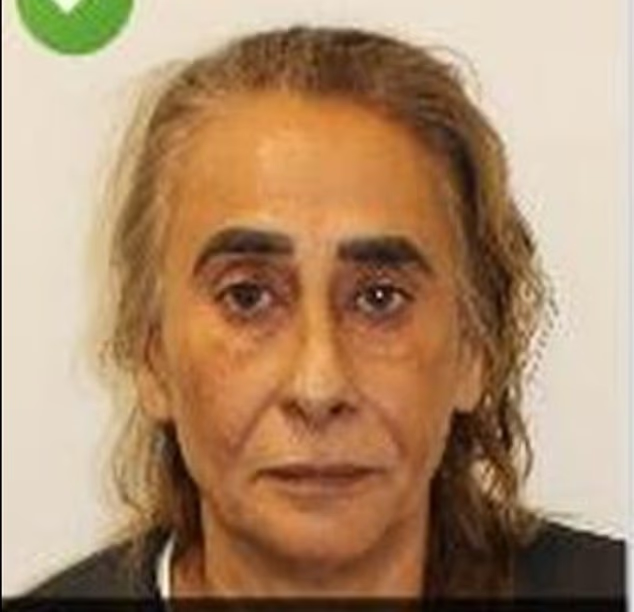
Stefka Gishanova, 55, who targeted elderly people on buses has been spared jail under the same legal changes that may see PC Andrew Harper¿s killers let out early

Advertisement

A pickpocket who targeted elderly people on buses has been spared jail under the same legal changes that may see PC Andrew Harper’s killers let out early.

In one offence, Stefka Gishanova took £1,900 cash a pensioner had withdrawn to spend on family Christmas presents.

The 55-year-old Bulgarian, who was arrested at Stansted Airport as she was about to board a Ryanair flight to Cologne, also stole mobile phones and a pensioner’s bus pass.

Sentencing her at Harrow Crown Court, Judge John Lodge told her: ‘You are a professional thief. Your occupation is as a pickpocket. You target the vulnerable.’

Advertisement

However, he said that, because of changes that came into force on March 22 with Labour’s Sentencing Act, her 12-month custodial sentence would be suspended, as all prison terms of such length now are.

He added that, under the current Sentencing Guidelines, he had also been obliged to reduce a potential two-year sentence for six thefts and attempted thefts to 12 months.

Six months was taken off because of her ill-health and no previous convictions, and another six for her guilty plea. Gishanova has been in custody since her arrest on July 22.

When she shuffled into the dock with a walking stick, the judge told her that if she had pleaded not guilty and forced a trial and cross-examination of her elderly victims, her sentence, if she had been found guilty, ‘would have been considerably higher’.

Advertisement

Stefka Gishanova, 55, who targeted elderly people on buses has been spared jail under the same legal changes that may see PC Andrew Harper’s killers let out early

Gishanova, from Edmonton in north London, who had the court proceedings translated for her by an interpreter, was told by the judge that she was ‘deliberately targeting vulnerable people’.

The victim who lost £1,900 in cash – which had just been withdrawn from her pension savings account and was taken in November 2023 – said in an impact statement that the theft had ‘changed my life’.

Advertisement

The pensioner said that she now goes out only once a week and will never get on a busy bus.

Prosecuting barrister Dominic Bell told the court that in August 2025, Gishanova had also stolen a £1,400 mobile phone from a disabled Muslim pensioner on a bus going to evening prayers.

‘The impact on the elderly of losing these sums of money or of losing a mobile phone is huge,’ the judge said.

He told Gishanova: ‘I understand you plan to return to Bulgaria. I very much hope you do. If you do not, and appear before this court in the next two years, you will go straight into custody for 12 months.’

Advertisement

All the offences for which she was convicted took place on London buses. In December 2022 she stole £50 in cash and a Freedom Pass, which enables those 60 and over to travel for no charge on public transport.

She walked free from court under the new Sentencing Act rules that are set to allow two men convicted of the manslaughter of PC Andrew Harper to be released after serving only half their 13-year sentences.

The law changes are meant to free up space in densely crowded jails, but last night it was reported Britain’s newest prison, HMP Millsike, near York, still has hundreds of empty cells 18 months after it opened.

The £400million Category C resettlement jail has a near 1,500 capacity but is currently restricted to around 1,100 due to a lack of prison officers, which is common across the system.

Advertisement

A source said: ‘Millsike has been struggling to staff the prison. They have reached the point where they have got all the staff they can recruit to safely operate at a reduced number of spaces but they are struggling to get above that.’

Advertisement

Source link

Advertisement
Continue Reading

NewsBeat

Darcy Lever biker has bike seized soon after buying it

Published

on

Darcy Lever biker has bike seized soon after buying it

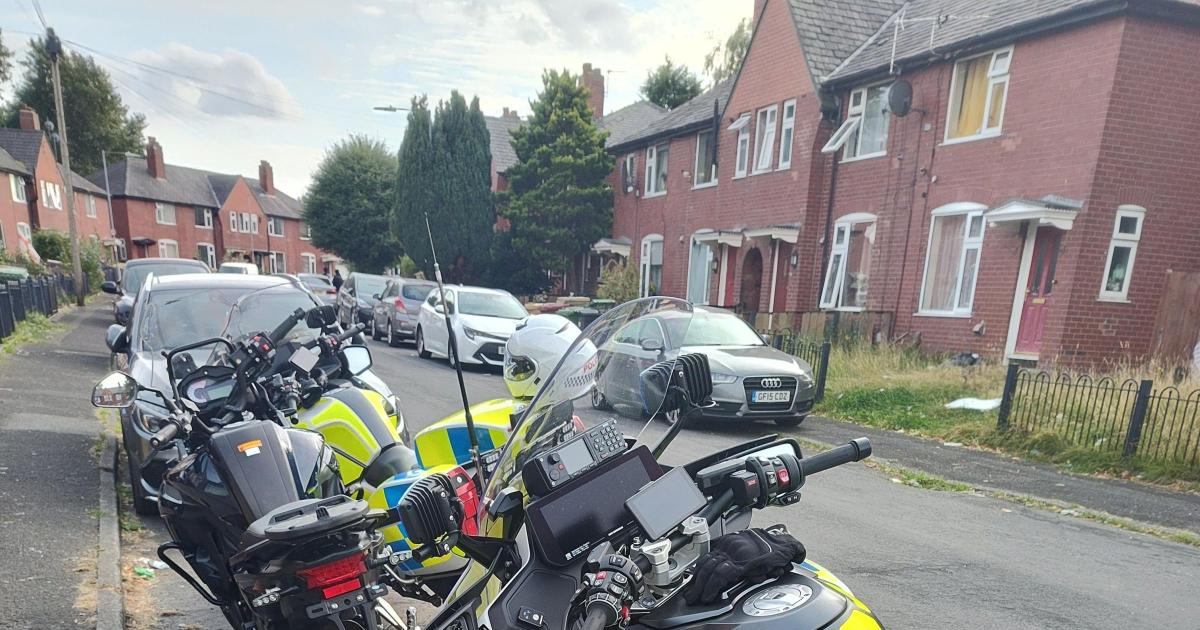
Officers from Greater Manchester Police’s Motorcycle Unit were called to Darcy Lever after receiving complaints about bikes being ridden in an antisocial manner.

When officers tracked down one of the riders, the situation quickly went from bad to worse for the bike owner.

Checks revealed the newly purchased motorbike was being ridden without insurance and without a registration plate on display, leaving officers with little choice but to seize it at the roadside.

Advertisement

The rider was reported for the offences, while the bike was taken away and could now end up back at auction.

A spokesman for GMP Traffic said: “GMP Motorcycle Unit left Stretford a report of bikes causing a nuisance in Bolton brought them to Darcy Lever.
“This rider was gently persuaded off his bike which was uninsured and no plate displayed.
“Just purchased, now seized. So back to auction.”

Source link

Advertisement
Continue Reading

NewsBeat

Amy Hunt surpasses expectations after claiming fourth European Championship gold

Published

on

Amy Hunt surpasses expectations after claiming fourth European Championship gold

British sprinter Amy Hunt was delighted to have succeeded beyond her wildest dreams after becoming the first athlete to win four gold medals at a single European Championships.

The 24-year-old world silver 200m medallist sealed her unprecedented quadruple in the inaugural mixed 4x100m relay final in front of a sold-out crowd at the Alexander Stadium to conclude a six-medal super Sunday in Birmingham.

Dina Asher-Smith also moved to the outright top of the European Athletics Championships all-time list with her 11th medal, and silver for Matt Hudson-Smith in the men’s 4x400m relay, bringing the hometown hero to nine, made him the outright most-decorated man in the history of the European Championships, and there was also gold for Georgia Hunter Bell in the 1500m final.

Jeremiah Azu (left), Dina Asher-Smith, Zharnel Hughes, (2nd left) Amy Hunt (right) with their gold medals (Mike Egerton/PA)
Jeremiah Azu (left), Dina Asher-Smith, Zharnel Hughes, (2nd left) Amy Hunt (right) with their gold medals (Mike Egerton/PA) (PA Wire)

“Oh my gosh, (I feel) just sensational!” said Hunt. “I think it surpassed my expectations for myself at this champs, not in terms of just the golds, but how I’ve handled myself, how I’ve handled all the pressure, the attention, the recovery, the discipline of it all.

“Not getting too caught up in the highs and staying kind of true to myself, keeping humble and keeping my foot on the gas the whole way through the week. Seven races in seven days is no easy feat.”

Advertisement

Jeremiah Azu, Asher-Smith, Zharnel Hughes and Hunt beat Germany and Spain in 39.97s.

Asher-Smith joined Polish sprinter Irena Szewinska on 10 European medals with women’s 4×100 relay triumph on Saturday after also collecting 200m bronze earlier in the week, although she already had two more golds to her name.

Dina Asher-Smith (right) celebrates her 11th European Championship medal (Martin Rickett/PA)
Dina Asher-Smith (right) celebrates her 11th European Championship medal (Martin Rickett/PA) (PA Wire)

With Sunday’s addition, the British record-holder is now up to eight European golds, and is the lone athlete with 11 medals overall.

“It hasn’t sunk in at all,” she said, when asked about her achievement. “At this point in my career, I’m just having fun. I’m just seeing what can be maxed out because I’m fortunate enough to stand on the line, and I don’t really have much to prove. I’d like an Olympic gold, but that’s kind of the only thing that’s on my bucket list.

“Being able to kind of come here and just kind of have fun and do some more events is a privilege. It’s definitely a privilege.”

Advertisement

The mixed 4×100 relay made its European Championships debut in Birmingham, opening the possibility for the ambitious Hunt to set her sights on four titles on home soil after clinching a sprint double, then women’s 4x100m gold.

Abbie Donnelly won marathon bronze (Mike Egerton/PA)
Abbie Donnelly won marathon bronze (Mike Egerton/PA) (PA Wire)

Hunt and Asher-Smith confirmed that they were not unduly affected by security measures at the venue on Saturday night, when it was previously understood that all of the teams in that evening session’s two relays were unable to leave on time due to security measures as a result of a police incident.

The women’s 4x400m relay quartet of Yemi Mary-John, Lina Nielsen, Nicole Yeargin and Emily Newnham struck silver, while their men’s counterparts, Hudson-Smith, Toby Harries, Ben Jeffries and Dobson finished three one hundredths of a second behind Italy in the competition’s closing race.

Jazmin Sawyers also snatched silver in the long jump, and Abbie Donnelly became the first British woman to win a marathon medal at the European Championships, with bronze.

Source link

Advertisement
Continue Reading

NewsBeat

Melsonby – North Yorkshire village in 28 Years Later film

Published

on

Melsonby - North Yorkshire village in 28 Years Later film

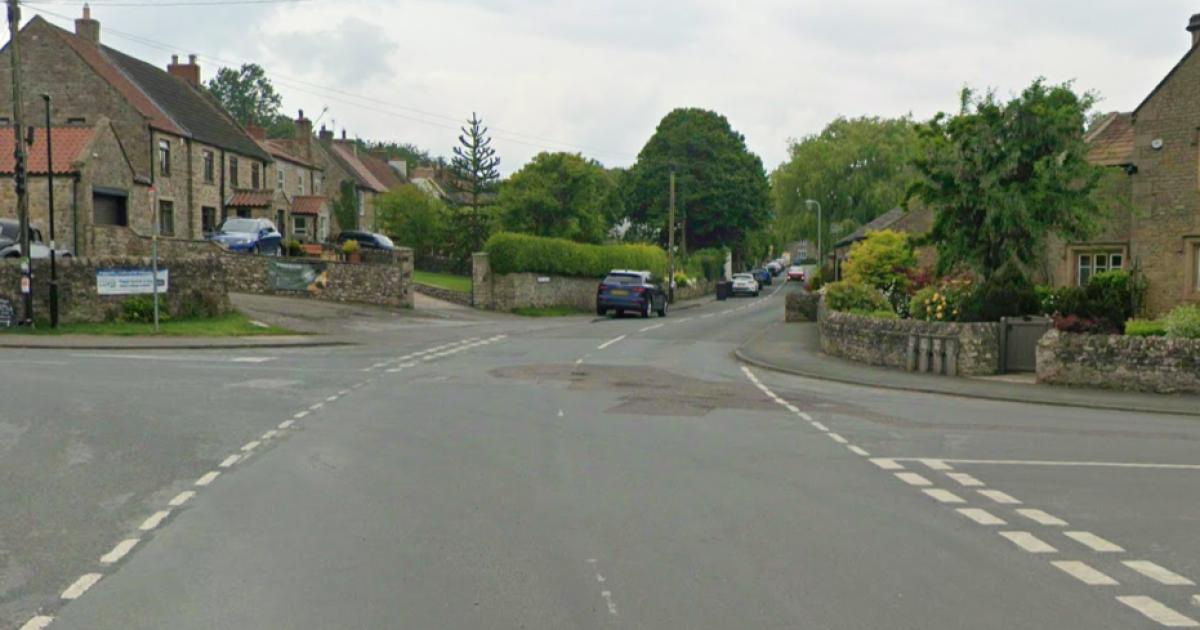
Melsonby, near Richmond, sits around a mile from the A1(M) and A66, and is a small rural village surrounded by North Yorkshire countryside.

But its combination of quiet lanes, historic buildings, and open landscape has helped put Melsonby on the map for reasons stretching from Hollywood filmmaking to an extraordinary Iron Age discovery.

The village was among the locations used during the production of 28 Years Later in 2024.

Melsonby in North Yorkshire (Image: GOOGLE)

Directed by Danny Boyle, the film made extensive use of real landscapes across northern England to create a Britain transformed after decades of infection and abandonment.

Advertisement

Locations across the North East and northern countryside were selected to provide the isolated and overgrown landscapes needed for the film.

Yet the village’s real history is arguably every bit as remarkable as its appearance on screen.

Melsonby is a compact community close to Richmond, with traditional homes, surrounding farmland, and St James’ Church at its heart.

The church is a Grade II*-listed building and forms one of the most prominent historic landmarks in the village.

Advertisement

But the discovery which transformed Melsonby’s archaeological importance came much more recently.

In 2021, metal detectorist Peter Heads discovered a collection of ancient objects buried in a field near the village.

Realising the potential importance of the find, experts were brought in and Durham University archaeologists excavated the site in 2022 with support from Historic England and advice from the British Museum.

What emerged became known as the Melsonby Hoard.

Advertisement

More than 800 objects dating back roughly 2,000 years were discovered, making it one of the largest and most significant Iron Age finds unearthed in Britain.

The collection includes parts of wagons and chariots, elaborate horse harnesses, bridle bits, ceremonial spears, and the remains of a large cauldron.

Twenty-eight iron tyres provide evidence that both two-wheeled chariots and four-wheeled wagons were being used.

Some of the horse equipment was decorated with coloured glass and Mediterranean coral, suggesting the people who owned the objects were connected to networks stretching well beyond northern Britain.

Researchers believe the extraordinary collection belonged to people of considerable wealth and status.

Advertisement

Many of the objects appear to have been deliberately burnt or broken before being buried.

Archaeologists believe that destruction may itself have been a powerful symbolic act, demonstrating the wealth and position of those involved.

The discovery has challenged older assumptions that Iron Age elites in northern Britain were less wealthy or influential than those living farther south.


It also places Melsonby close to the heart of a landscape once associated with the Brigantes, the powerful Iron Age people who controlled much of northern England around the time of the Roman conquest.

Advertisement

Today, objects from the hoard have gone on display at the Yorkshire Museum, bringing national attention to a village that many motorists may otherwise pass without noticing.

For residents, however, Melsonby remains a small and close-knit North Yorkshire community.

Melsonby lies little more than a mile from the A1(M) and close to the A66, placing two of the North’s major roads almost on its doorstep.

That means thousands of motorists pass nearby while travelling between Darlington, Scotch Corner, Richmond, and North Yorkshire.

Advertisement

Yet leave the main roads and Melsonby quickly feels removed from them.

The result is a village with two very different claims to fame.

Its countryside became part of the world of one of Britain’s best-known modern horror franchises, while beneath nearby fields lay evidence of extraordinary wealth and power more than 2,000 years earlier.

Advertisement

Source link

Continue Reading

NewsBeat

Farm Gate Farm Shop near the A1(M) in North Yorkshire

Published

on

Farm Gate Farm Shop near the A1(M) in North Yorkshire

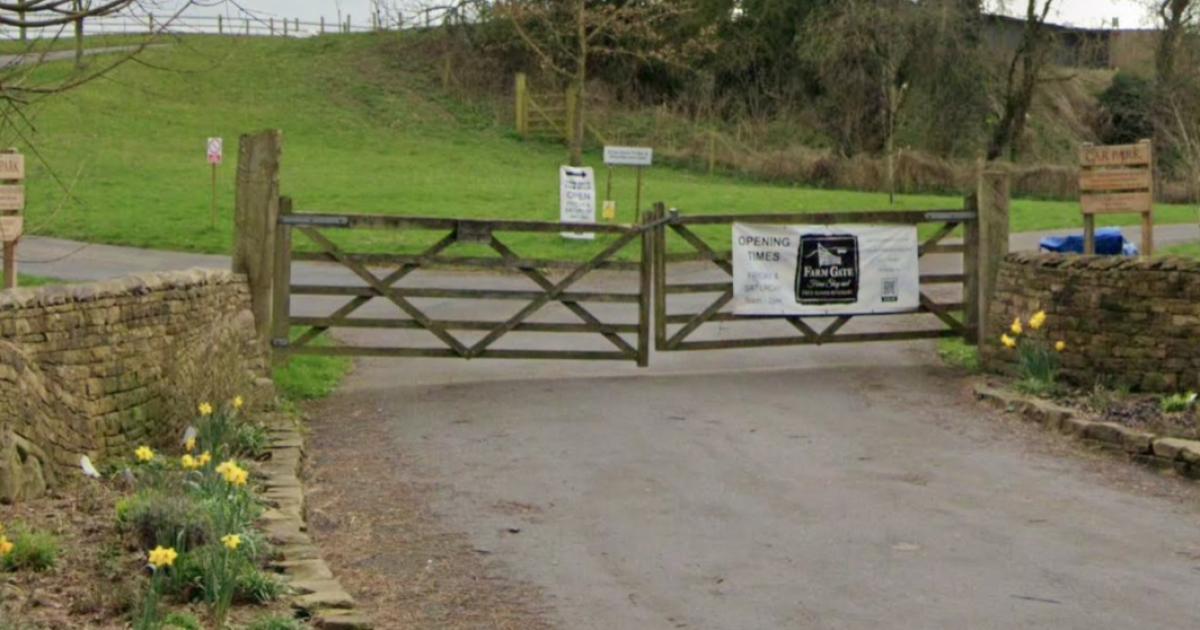
Farm Gate Farm Shop and Free Range Butchery, near the A1(M) and A19, holds a 4.9-star rating on Google from dozens of reviews.

Visitors regularly praise the shop for its selection of locally sourced produce, including free-range meat, British cheeses, bread, milk, and other Yorkshire products.

One recent customer described the farm shop as “superb” and said its range included cheeses that could be difficult to find elsewhere.

They said: “The meat is free range and you know what you get is quality.

Advertisement

“A wide selection of different cheeses, some of which are difficult to find elsewhere.

“Steve and all the team are so welcoming and accommodating to our requests.

“Well worth a detour if you are visiting the area.”

Farm Gate Farm Shop and Free Range Butchery (Image: GOOGLE)

Another visitor praised the knowledgeable staff after picking up cheese and steaks, describing it as a “great little farm shop”.

Advertisement

The business has also won fans for its focus on local and organic food.

One customer said: “Fresh, organic and tasty food.

“And they have the nicest staff!

“Locally sourced produce.”

Advertisement

Another called Farm Gate an “absolutely fantastic local artisan and organic shop”, praising its selection of organic flour, British cheeses, free-range meat, and locally produced drinks.

They added that the staff were friendly, knowledgeable, and clearly cared about the products they sold.

The welcoming atmosphere is another recurring feature in reviews.

One customer who visited with her sister and young son said staff even showed the youngster the lambs during their trip.

Advertisement

She wrote: “Well, what can I say other than ‘amazing’.

“The staff were exceptionally welcoming and helpful.”

For some customers, an unexpected first visit has turned the shop into a regular destination.

One reviewer said: “What a find this little place was.

Advertisement

“Having happened upon it by chance a few months ago, it is now one of our go-to places to find the very best authentic locally produced food.”

Another customer said they had been shopping there for more than a year and praised its granola, coffee, cheese, bread, flour, and meat, as well as a Christmas chicken they described as “gorgeous”.

Its approach to animal welfare and sustainability has also been highlighted by visitors.

One reviewer described the farm shop as a “gem” and said a lamb joint bought there at Easter had been “unsurpassed in flavour and tenderness”.

Advertisement

Long-standing customers have also praised the family-run business.

One reviewer said they had been using Farm Gate Farm Shop for more than ten years, while another said they had received weekly milk and butter deliveries for eight years without being let down.

The latter wrote: “Reliable, consistent, and genuinely helpful whenever you get in touch.

“The kind of local business that does everything right.”

Advertisement

Other products mentioned by visitors include locally produced milk, bacon and pancetta cured by the business, seasonal venison, and a selection of Yorkshire goods.


One reviewer said they had followed signs from the Malton road to reach the shop and found the journey worthwhile.

Another customer, who discovered it while on holiday, said they planned to return despite living around 50 minutes away.

They said they had been particularly impressed by the farm shop’s own meat and its extensive cheese selection.

Advertisement

Source link

Continue Reading

NewsBeat

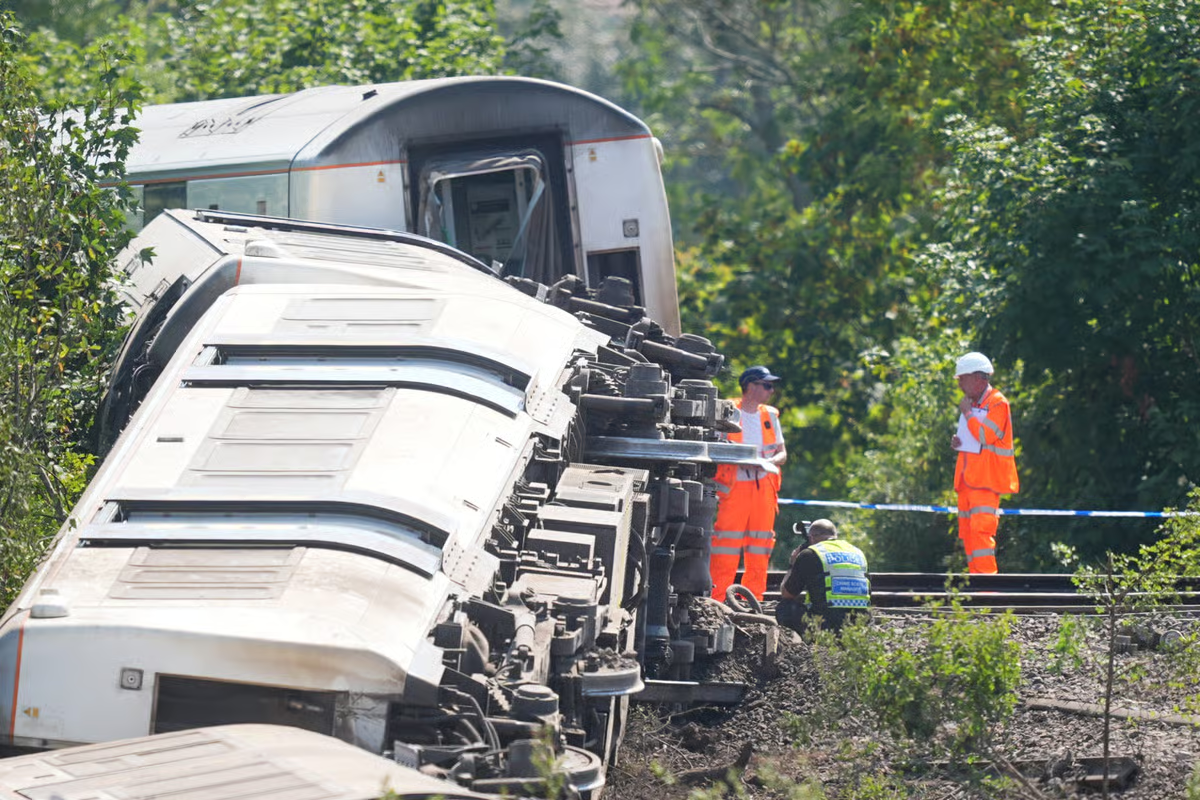
Line where train derailed to remain closed ‘for at least another 10 days’ as recovery operation begins

Published

on

Line where train derailed to remain closed ‘for at least another 10 days’ as recovery operation begins

John Whitehurst, Chief Executive Officer of Greater Thameslink Railway (GTR), which operates Southern Railway, said: “It has been an incredibly difficult time for our customers and colleagues, and our thoughts remain with everyone affected by this, particularly the family and friends of those who have been injured.

Source link

Continue Reading

Trending

Copyright © 2025