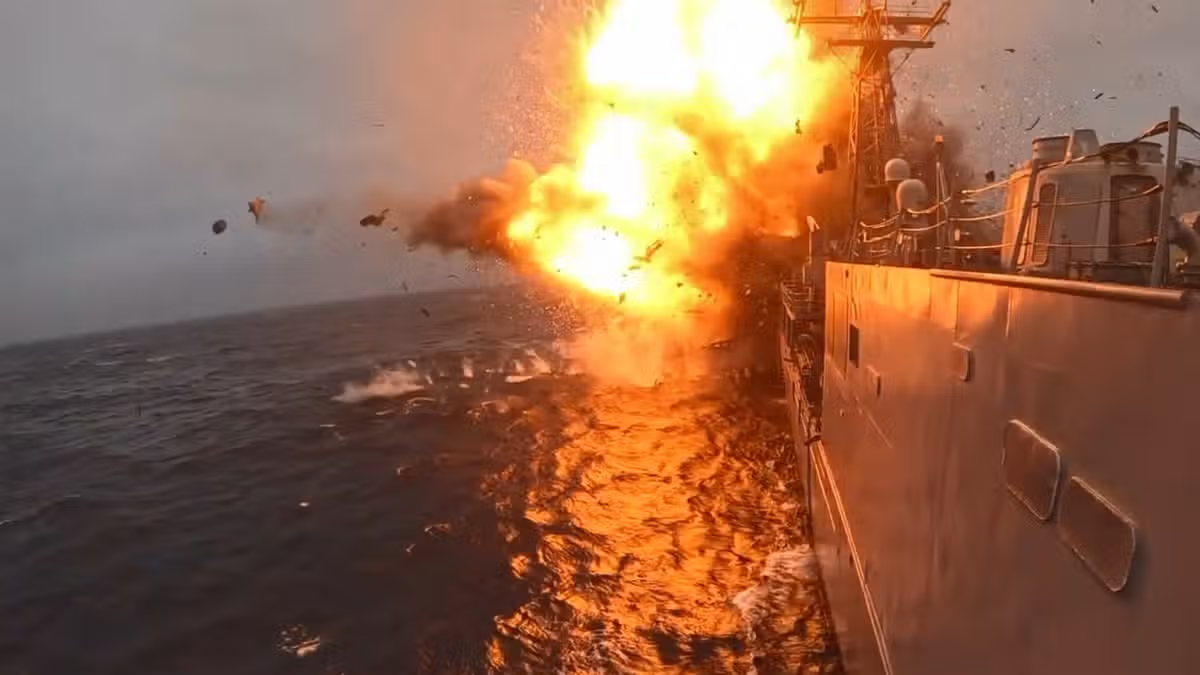
The USS Klakring was struck by a missile and sank in the North Atlantic during the operation at the MOD’s Hebrides Range.
Moment UK-US forces sink warship off Scottish coast
A US Navy warship has been sunk in Scottish waters as part of a joint military operation. The USS Klakring was struck by a missile from the USS Paul Ignatius with Royal Navy vessels and aircraft also involved in the operation at the MOD’s Hebrides Range.
UK and US forces have been undertaking live-fire exercises in the North Atlantic off the coast of the Western Isles this month. Known as Atlantic Thunder 2026, the operation included a joint-exercise targeting the USS Klakring, a decommissioned warship.
Dramatic footage published by the US Navy’s Sixth Fleet shows the moment the frigate was hit by a missile during the exercise. After launching a missile from the USS Paul Ignatius, explosions can be seen onboard the USS Klakring as smoke and flames erupt from the vessel while it is destroyed.
The operation was originally planned to take place in May, with the sinking of USS Klakring by co-ordination between British and American forces the centrepiece, but it was delayed by four months.
Launched in 1982, the USS Klakring was an Oliver Hazard Perry-class frigate named for after World War II Rear Admiral Thomas B. Klakring. It was decommissioned in 2013 after three decades in active service and had been stored at the Philadelphia Naval Inactive Ship Maintenance Facility in Pennsylvania before it was brought to Campbeltown ahead of the exercise.
All hazardous materials had been removed from the vessel before being sent to the bottom of the ocean.
Advertisement
It is not the first time a former US warship has been sunk as part of training exercises between UK and US forces off the coast of Scotland. A previous Atlantic Thunder operation took place in September 2022 in which HMS Westminster, a Wildcat helicopter and three RAF Typhoons sank the decommissioned frigate USS Boone alongside the US Navy and the US Air Force.
Get more Daily Record exclusives by signing up for free to Google’s preferred sources. Click HERE.
There’s no era of English history that gets people as interested as the Tudors. King Henry VIII’s reign has literally gone down in history – and we have a key part of Tudor history immortalised in the county
Advertisement
Two Tudor queens and another famous name from the Tudor era are buried in one of the county’s most iconic buildings. Katherine of Aragon and Mary Queen of Scots both found aresting place in Peterborough.
Peterborough Cathedral is one of the city’s most historically significant landmarks. The Norman building, which first opened to the public nearly 800 years ago, is the final resting place of a famous Tudor Queen and the original burial ground of another.
Both women’s lives and deaths were swamped in controversy and tragedy and tributes to them can still be seen at the site today. A third Tudor figure is also buried at the cathedral and while he is less well known, his life and legacy are no less intriguing.
Thousands of people visit the cathedral every year, attracted by its stunning and unique architecture, as well as its fascinating history. Below, you will find more information about the three Tudor figures connected to Peterborough Cathedral. While one is no longer buried there, a tribute inside the building means that her presence is felt nonetheless.
Advertisement
Katherine of Aragon
Katherine of Aragon, the first wife of Henry VIII, was buried at Peterborough Cathedral after her death in 1536. She had become Queen Consort in 1509, but after more than two decades on the throne, her husband divorced her and instead married his second wife of six – Anne Boleyn.
This certainly wasn’t an easy feat as Pope Clement VII refused to dissolve their marriage, meaning Henry had to take the radical step of splitting from Rome and establishing the Church of England to get what he wanted.
Katherine was eventually dismissed from court in 1533 but never personally recognised the divorce. She died just three years later at Kimbolton Castle in Cambridgeshire amid rumours she was poisoned.
Advertisement
Henry wanted to avoid a funeral in London, which could have been politically embarrassing, and Peterborough Abbey was nearby and important enough for her status. She was only granted the title of Dowager Princess of Wales but still ordered her servants to address her as Queen.
Henry did not attend the funeral of his wife of more than 20 years and forbade their daughter, Mary, from attending. After her funeral, Katherine was buried at Peterborough Cathedral where commemorative services for her are held to this day.
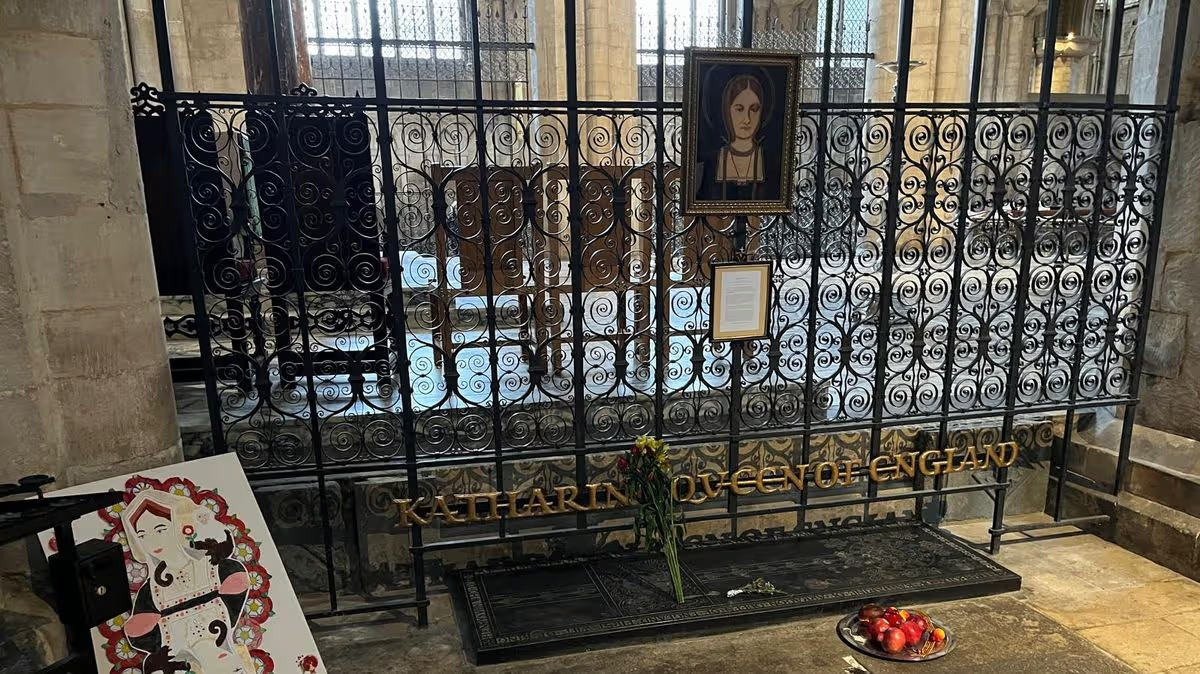
Flowers and pomegranates, her heraldic symbol, are frequently left by her tomb, which is also marked with her portrait and the words ‘Katherine Queen of England’.
Mary, Queen of Scots
Mary, Queen of Scots was also buried in the cathedral after her death in nearby Fotheringhay Castle – but this time, it was death by execution. Mary, a Catholic, was held in captivity for 19 years in Protestant England, until she was implicated in the Babington Plot – a conspiracy to murder Queen Elizabeth I. She was tried for treason, found guilty and executed in 1587.
Advertisement
She was eventually buried in the South Choir Aisle of Peterborough Cathedral after having been laid in a lead coffin within Fotheringhay Castle for nearly six months.
Her son, James I of England, later moved her remains to Westminster Abbey. The site of the original tomb can still be seen in the Cathedral.
Robert Scarlett (‘Old Scarlett’)
Robert Scarlett, or ‘Old Scarlett’, the cathedral’s sexton was something of a local celebrity in the Tudor era. The Peterborough gravedigger lived to the age of 98, with his life spanning the reigns of Henry VII, Henry VIII, Edward VI, Mary I and Elizabeth I.
Old Scarlett was said to have buried two people from every family in Peterborough – which may not been an exaggeration, given that the city was ravaged by the plague in the 1570s. He was also involved in the burials of both Katherine and Mary and legend suggests that he may have been the inspiration for the gravedigger in Shakespeare’s Hamlet.
Advertisement
In 1594, Old Scarlett finally got a grave on his own. He was buried just inside the cathedral – an unusual honour for common folk. His painting above the west doors looks down upon the cathedral visitors.
He is portrayed holding his spade and keys, and a skull lying at his feet. A commemorative rhyme reads:
“You see old Scarlitt’s picture stand on hie, But at your feete here doth his body lye. His gravestone doth his age and Death time show, His office by thes tokens you may know. Second to none for strength and sturdye limm, A Scarebabe mighty voice with visage grim. Hee had interd two Queenes within this place And this townes Householders in his lives space Twice over: But at length his own time came; What for others did for him the same Was done: No doubt his soule doth live for aye In heaven: Tho here his body clad in clay”.
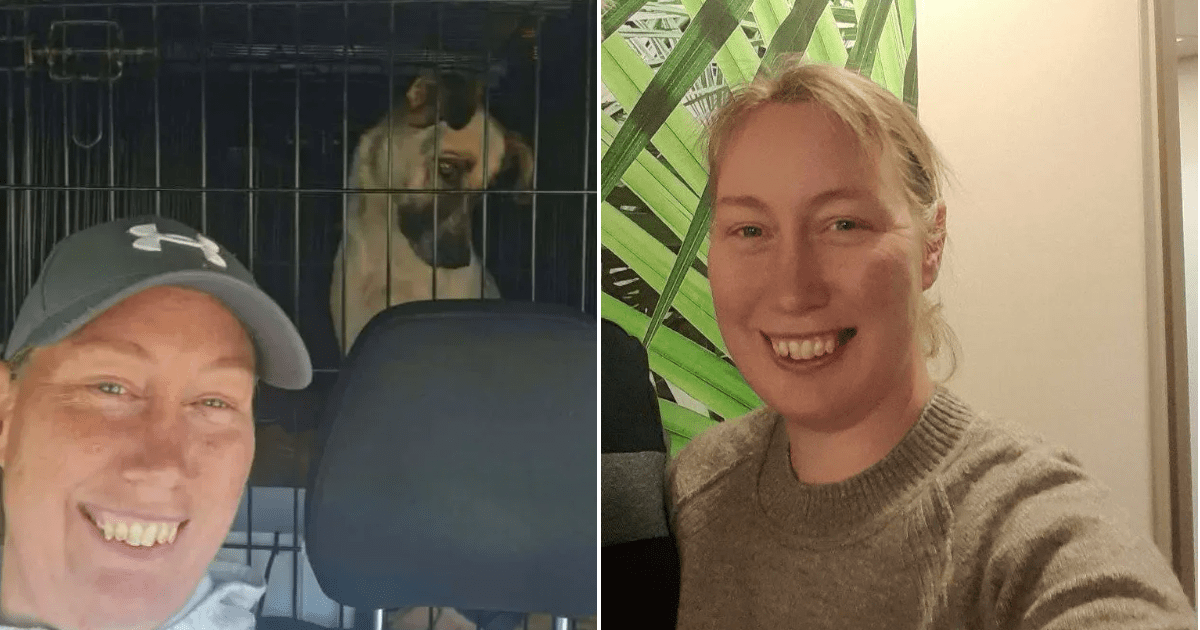
Rachael Harvey-Purkiss (pictured) and Allison Condon were ‘rare diamonds’
Two women on a mission to rescue 10 dogs died after a minibus, two trucks and a van collided in Romania.
Allison Condon, 61, and Rachael Harvey-Purkiss, 41, were in a minibus driving along the DN6, near the village of Vălișoara, Thursday morning.
The vehicle went on the wrong side of the road and crashed head-on into a lorry, injuring the 60-year-old driver, according to Romanian news outlet Informat.ro.
The lorry hit another HGV, trapping the minibus, before another van crashed into the pile-up.
Advertisement
Rachael, from Essex, and Allison, from Northamptonshire, died at the scene just after 11am. Eight of the 10 dogs also died.
Sign up for all of the latest stories
Start your day informed with Metro’s News Updates newsletter or get Breaking Newsalerts the moment it happens.
Rachael had a heart ‘full of nothing but love and care for animals’
The women were in western Romania to take the dogs to France for the UK-based Homeward Bound, which helps street dogs in Turkey.
Allison’s daughter, Sammie Condon, said on Facebook that she has received an ‘incredible outpouring of support’ from well-wishers.
‘This wasn’t supposed to happen…I’m still trying to come to terms with the fact it did and we still don’t know why or how just yet,’ she wrote.
Advertisement
‘This was supposed to be a beautiful adventure that brought dogs to the life they dreamed of. Then we were going to go home, carry on with our lives and try to build a better one
‘And all of it is gone.’
Sammie added that at least one dog survived the crash and is with a Romanian rescue shelter.
‘We cannot take away their grief’
Claire Dalton, the founder of Homeward Bound, said on social media that she is ‘heartbroken’.
Advertisement
An admin of the organisation’s Facebook group said Allison and Rachael’s hearts were ‘full of nothing but love and care for animals’.
‘Today we’re grieving in a way I can’t explain to you,’ they said, describing them as ‘two beautiful rare diamonds’.
More than £23,000 has been raised for Allison and Rachael’s families to cover the costs of flights, vet bills and supporting the remaining dogs.
‘We cannot take away their grief. But together, we can help ease the financial burden that has fallen on them so suddenly,’ the fundraiser says.
Advertisement
The Foreign Office is aware of the incident and in touch with the local authorities.
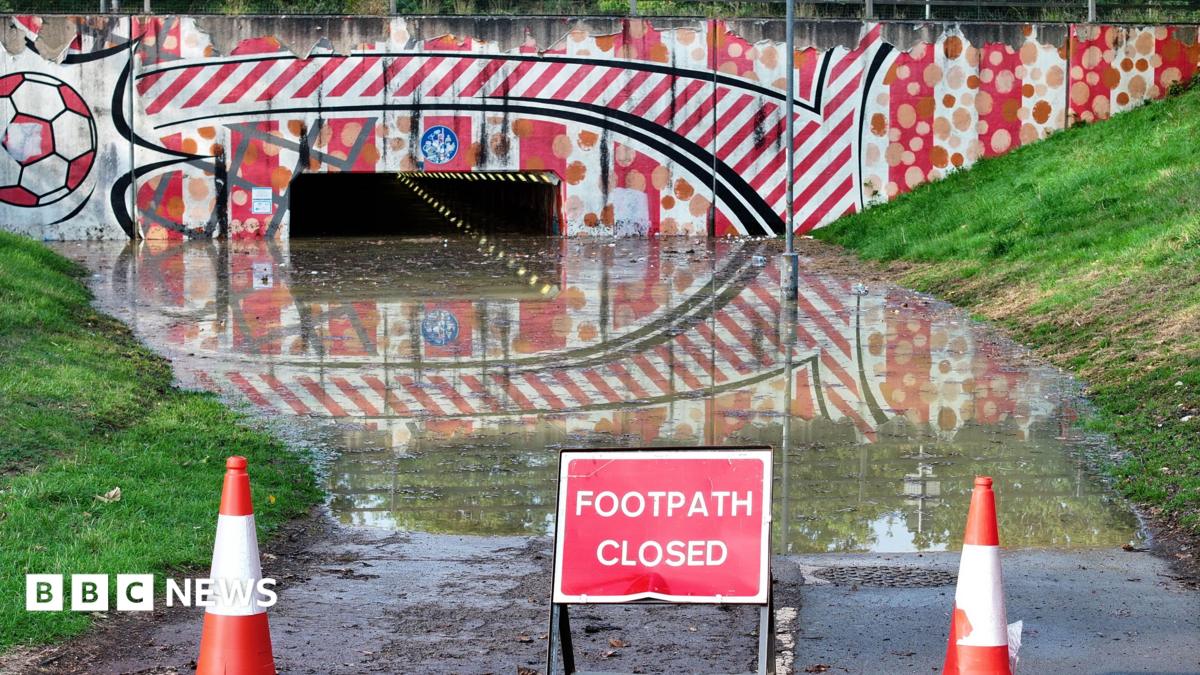
Thousands of homes in parts of West Sussex have water supply issues and a number of roads have flooded after what police are describing as a “significant” leak.
Roads around the Southgate Roundabout in Crawley have been closed on Sunday morning due to the burst water pipe, Sussex Police said.
Southern Water said around 9,000 customers were impacted and it was setting up bottled water stations.
A company spokesperson said: “Our teams are on site and working as quickly and safely as possible to repair the burst and restore supplies.”
Advertisement
The company said customers were experiencing a loss of water supply or low pressure in the following areas – Woolborough Road, Holmcroft, Southgate, Tilgate and Furnace Green.
It reported at 12:00 BST that supplies had returned to some homes.
At about 18:00, Crawley Borough councillor Duncan Crow said about 4,000 properties had seen their supplies returned.
The Southern Water spokesperson added: “Restoring water to customers as quickly as possible remains our highest priority.”
Advertisement
John Boulton, who is 82, and his partner are without water.
He said: “It’s pretty disgusting, really – we pay so much for the water supply.”
Boulton said he had just paid £22 for bottled water in a shop.
Two lifeguards spotted the 58-year-old floating in the water on Wednesday morning and brought his body ashore before they began performing CPR.
Paramedics arrived shortly after and took over efforts to resuscitate him, but the man was pronounced dead at the scene.
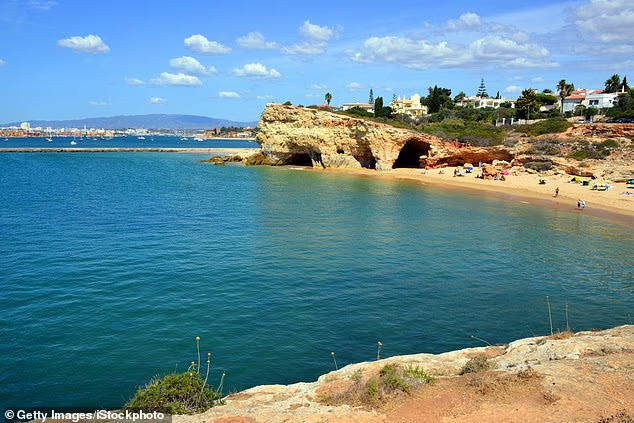
The incident took place at Pintadinho Beach, a tranquil Blue Flag beach nearest the fishing village of Ferragudo which is framed by clay-coloured cliffs.
Advertisement
It was unclear on Sunday morning whether the British man was a holidaymaker or lived in the area.
Whether he was alone when he got into difficulty, or with family or friends, is also unknown.
The alarm was raised at around 9.20am on Wednesday and although news of the incident started emerging on the day, police only confirmed his nationality on Sunday morning.
Trained psychologists have been mobilised to provide support to the victim’s family.
Advertisement
Pintadinho Beach, located on a cove the left bank of the Arade River mouth, where the British man was found on Wednesday
‘Following an alert received at 9:19am on Wednesday from a member of the public reporting a body floating in the water, personnel from the Local Maritime Police Command of Portimao were activated, along with teams from the INEM National Medical Emergency Institute, the Lagoa Volunteer Firefighters and the Judicial Police.
Advertisement
‘Upon arrival at the scene, it was found that the victim, a 58-year-old English national man, had already been removed from the water by two lifeguards who began resuscitation efforts until the arrival of the emergency response teams.
‘As it was not possible to reverse the situation, the man’s death was certified by the INEM doctor and his body was transported to the Barlavento Algarve Forensic Medicine Institute by the firefighters following work at the scene by police.
‘The Maritime Police Psychology Office was activated and is providing support to the victim’s family.’
There is no suggestion at this stage that the man’s death is being treated as a crime.
Advertisement
The post-mortem examination will determine whether the unnamed British man died from drowning or suffered some other kind of contributory health problem.
The Foreign Office has been approached for further comment.
On Saturday morning in a separate incident, a 64-year-old Irish holidaymaker died after getting into difficulty after the alarm was raised just after 10.30am yesterday.
The incident occurred in the sea at Prainha Beach in Alvor which is also close to Portimao – just a 20-minute drive west of Pintadinho Beach heading towards Lagos.
Founder Chloe Taylor, from Crook, said the group will welcome women of all abilities and running speeds.
Announcing the venture on social media, Chloe said creating the club was outside her comfort zone but was driven by a desire to bring local women together through fitness and friendship.
Chloe Taylor. (Image: CHLOE TAYLOR)
Chloe, 33, said: “I want to build a community for us girls to feel safe running together, especially through the darker months.
“This is about getting out, running together, meeting new people and doing something for ourselves.”
Advertisement
The club will hold weekly runs and weekend social events, including post-run coffee meet-ups.
Qualified run leader Chloe Taylor is also planning extra support for women new to running before they join group sessions.
The club’s first event will take place on Saturday, October 10.
A village green is a prized part of any village, acting as a meeting point and a place for children to play. But in one Cambridgeshire village, their green is rather something to behold, as it is one of the longest in Europe.
Advertisement
It’s far from being just a long stretch of grass, as Barrington’s green has a zip wire, a BMX trail, a climbing zone, playground swings, a climbing net, a slide and a rocking horse. It’s also a designated conservation area, proving its importance both locally and for visitors.
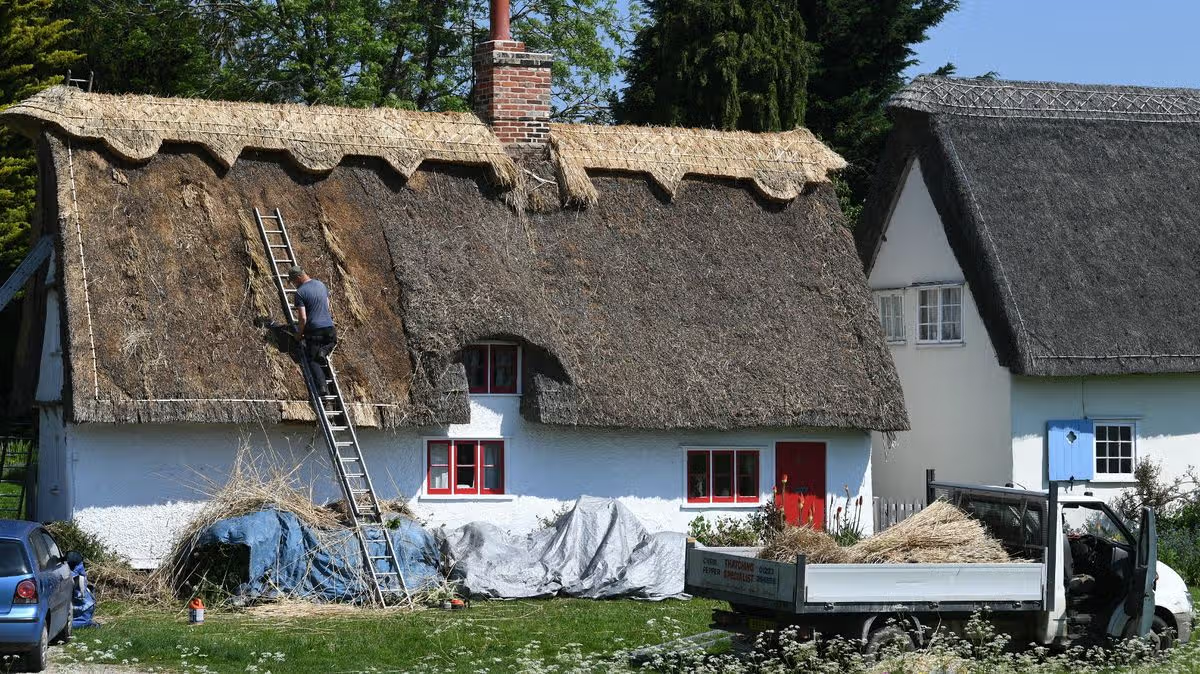
Barrington’s pretty streets are dotted with charming thatched cottages, giving it that chocolate box feeling. One of those thatched buildings is the local primary school, which is one of two remaining thatched schools in England. Barrington Church of England Primary School opened in 1838.
The school’s website states that “history and tradition are a large part of what makes our school special”. The school had previously maintained an Ofsted rating of ‘good’, since 2012, with the report describing pupils as “confident, kind and happy”. But their most recent report carried out in June 2026 rated the school as ‘needing attention’ five out of seven areas. However, the report did say that “pupils recall their learning with great confidence”.
Barrington has only one pub, which overlooks the village green. And according to the parish council, it’s the last standing out of seven pubs that used to be here during the Victorian era. It is easy to see why this one has stayed so popular over the years. It has an average of 4.5 / 5 from 706 Google reviews.
A recent Google reviewer said: “Outstanding Sunday roast. Probably the best roast out I have ever had. Nice wine, great service and a yummy pudding. I would 100% come back here again.”
You can get from Cambridge to Barrington in around 25 minutes by car, making it an ideal rural escape from the busier city. It has everything you need for a family day out, including plenty of options on the village green to keep children entertained. For those taking public transport, the 75 bus takes you from outside Downing College in Cambridge to Slid Lane, Barrington, in just 32 minutes.
“I think that Joe McNamara and Lioness is all that I can handle at this time,” 48-year-old Saldaña told People in an interview published Sunday, referring to her character in the show.
“I’m number one on the call sheet,” she explained. “I am first one in, last one out. I am prepping months before anybody ever is able to prep. So it’s already a lot of work for me.”
Zoe Saldaña says she is not ready to work on another show with ‘Yellowstone’ creator Taylor Sheridan (Getty Images)
Saldaña added: “I can’t imagine me taking on more of a Taylor Sheridan world.”
She went on to say that her work with Sheridan has proved to him that she is “reliable, just like Joe is.”
“I have my views, and I come with all heart, all brains, all muscle at all times,” she told the outlet. “So, no, I think I’m good here at Lioness.”
Saldaña stars in the series as a CIA operative who leads a top-secret group of female special operatives recruited from various branches of the military and tasked with infiltrating terrorist organizations by befriending their wives and daughters. The cast also includes Nicole Kidman and Morgan Freeman.
Advertisement
Zoe Saldana stars as CIA operative Joe McNamara in ‘Lioness’ (Paramount)
The Oscar winner told People at the time: “He’s very curious about government affairs, and he seeks out information and education based on that curiosity, and then he writes these incredibly elaborate shows that end up really educating us as well.”’
Watch Apple TV free for 7 day
New subscribers only. £9.99/mo. after free trial. Plan auto-renews until cancelled.
ADVERTISEMENT. If you sign up to this service we will earn commission. This revenue helps to fund journalism across The Independent.
Advertisement
“Working with him is a challenge in the sense that he does raise the bar, and you have one of two choices. You either accept the challenge and make sure that you don’t f*** up… or you quit,” she said. “And I like being challenged. I really do.”
Saldaña’s remarks come as her co-star Michael Kelly was recently announced to be joining Sheridan in another show in his television universe. Kelly is set to join the cast of Landman season three, which began filming earlier this month.
Harry Redknapp is another former Premier League boss feeling impacted by Manchester City’s guilty verdict.
He wrote in a column for The Sun: “There are so many who will feel they have a claim to have some wrongs righted should City fail in their appeal and I am one of them.
“During the period City’s charges cover, I was in charge of Spurs and locking horns with them for the Champions League spots over a long run. In back-to-back seasons, 2010/11 and 2011/12, we finished one place off qualification.
Advertisement
“The second time around, when City won the title with that Sergio Aguero goal on the final day, we finished fourth but STILL missed out as Chelsea won the Champions League to take our spot.
“In May 2011, a 1-0 loss to Roberto Mancini’s side saw them qualify for Europe’s biggest competition for the first time and ended our dream of getting in there ourselves.
“Who knows what would have happened if those at the Etihad had been playing by the rules like everyone else? No one can say for sure but Tottenham fans will not be alone in feeling that they were, in some way, cheated across those seasons.
“Champions League football over those two years could have changed so much for Spurs but I have no interest in the Premier League going back and deducting points from those seasons or deducting titles from City.”
When Egyptian archaeologists announced the discovery of a “lost golden city” near Luxor, Egypt, in 2021, headlines erupted around the world: Treasure. Revelation. A once-in-a-century find.
For archaeologists, however, the most notable feature was not the gold that had yet to materialise, but how quickly the story became framed as adventure. Years of survey, stratigraphic mapping and ceramic analysis barely registered.
Archaeology is one of the rare disciplines where popular culture does not simply reflect public understanding, but actively produces it. Many people encounter archaeology not through excavation reports or museum catalogues, but through a man in a fedora cracking a whip in a torchlit tomb.
In my discussions on archaeology and popular culture at the University of Tübingen, this becomes immediately clear. Students rarely arrive with expectations shaped by site reports or specialist literature – they arrive with Indiana Jones.
Advertisement
Archaeology as adventure
The idea of archaeology as adventure predates the discipline itself. It grew from 19th-century colonial exploration, when the past was treated less as knowledge than as loot. Ancient sites were framed as reservoirs of exotic objects to be extracted and displayed. Even earlier, in the 17th century, travellers like Cornelis de Bruyn returned from the Levant as minor celebrities.
Victorian adventure literature – most influentially H. Rider Haggard’s King Solomon’s Mines (1885) – presented distant landscapes as backdrops for hidden wealth and lost civilisations. Even as archaeology became an academic discipline, it remained entangled in this narrative. Museums displayed artefacts as spectacular fragments of vanished worlds, frequently detached from their archaeological context.
Indiana Jones teaching an archaeology class.
Popular writing extended this logic. C.W. Ceram’s Gods, Graves and Scholars (1949) translated archaeological research into a sequence of dramatic discoveries. He invited readers to experience excavation as a series of moments of revelation. In doing so, he helped stabilise a particular narrative form: archaeology as heroic encounter with the past, driven by exceptional individuals and spectacular finds.
Cinema has amplified and standardised this. From The Mummy (1932) to Raiders of the Lost Ark (1981) and later Tomb Raider (1996) and Assassin’s Creed (2007), archaeology became a recognisable genre defined by hidden chambers, booby traps and solitary heroism.
Advertisement
The persistence of the adventure narrative is not difficult to explain. Archaeology deals in inherently compelling material: objects, ruins, human remains. Popular media selects its most cinematic moments – the uncovered tomb, the deciphered inscription, the glittering artefact – and presents them as the story itself.
In the Indiana Jones films, knowledge arrives through revelation. A hidden chamber opens. A mystery resolves. The past appears to have been waiting to be discovered. But real archaeology works almost in reverse.
Beyond Hollywood
Years spent documenting crumbling walls, fragile ceramic shards and faint traces of settlement rarely produce moments of spectacle. Fieldwork often takes place under difficult conditions, in heat, dust or mud and proceeds through measurement, recording and interpretation. Knowledge constructed, not discovered, and then argued over, revised and sometimes abandoned. The adventure narrative erases this process.
The so-called “lost golden city” of Aten illustrates this tension. Announced as one of the most significant discoveries in Egypt in decades, it generated global headlines before substantial analysis had been published. The “golden” label itself remained unexplained. The revelation circulated widely; the knowledge production that followed remained slow and ongoing.
Advertisement
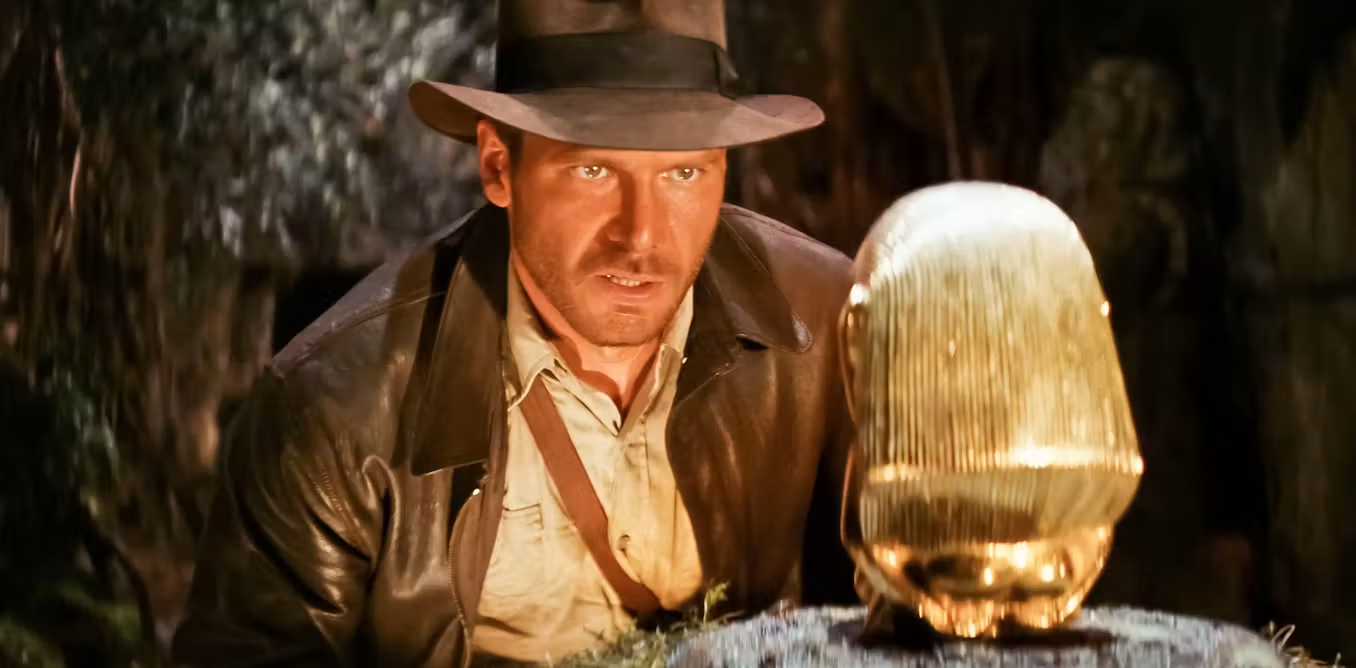
One of the memorable ‘discovery’ scenes from Indiana Jones: Raiders of the Lost Ark.
The adventure model also carries ethical implications. Questions of ownership, restitution and Indigenous heritage sit uneasily within a framework that treats artefacts as objects to be found rather than evidence embedded in living cultural and political contexts. The figure of the lone western excavator recovering lost pasts has a colonial genealogy that contemporary archaeology continues to confront.
Digital platforms intensify these dynamics further. Instagram and TikTok privilege visual immediacy and reward moments of uncovering over long-term interpretive labour. Algorithmic visibility tends to favour spectacle, not process.
And yet the adventure myth is not simply an error to be corrected. To dismiss it entirely would be to misunderstand its cultural function.
Advertisement
Archaeology and the public imagination
Without Indiana Jones, many people would rarely think about the deep human past at all. Museum attendance, research funding and student interest are all, in part, sustained by a cultural imagination in which archaeology matters enough to be exciting.
In teaching, this dynamic is familiar. Students often arrive drawn by cinematic archaeology, but many leave engaged by something else entirely: the realisation that the most unassuming fragment of a broken pot or worn object can reshape historical understanding.
There is also a reflexive dimension to this story. Archaeologists themselves participate in constructing the narratives that circulate about their work. Press releases announcing “lost cities” or “once-in-a-century discoveries” are not authored by Hollywood. The tension between public communication and scholarly precision is internal to the discipline.
Most people will never read an excavation report. Their understanding of archaeology is shaped through stories, not technical documentation.
Advertisement
Indiana Jones would struggle to obtain a modern excavation permit. Most archaeological breakthroughs occur far from collapsing temples – in comparative analysis, in computational reevaluation of legacy datasets, in the slow refinement of scholarly consensus. But accuracy alone does not determine cultural influence.
The adventure myth compresses a complex, distributed and often invisible process into a narrative that can be recognised at a glance. It obscures much of what archaeology is, but it also sustains its place in public imagination.
The more difficult question is what archaeology chooses to do with the attention it generates – and what kinds of stories it tells once the door has been opened.
























































You must be logged in to post a comment Login