Connect with us

NewsBeat

Travellers urged to one thing as deadly Victorian-era disease rises in UK and Europe

Published

on

Daily Record

Health authorities have sounded the alarm over the disease makes your body ‘forget’ how to fight infection

Travellers have been urged to take one vital precaution before heading abroad as cases of a highly contagious Victorian-era illness surge across the UK and Europe. Health authorities have sounded the alarm over measles, with outbreaks recorded in numerous European countries, including some parts of Britain.

Officials said there have been “ongoing cases and recent outbreaks of measles in Europe and the UK”, urging travellers to familiarise themselves with symptoms and check they have received the MMR (measles, mumps and rubella) vaccine.

It comes as Ireland’s Health Service Executive (HSE) has issued a travel advisory ahead of the Easter Holidays after reporting a spike among young people.

Advertisement

A spokesperson for the HSE said: “Measles is a viral infection which can result in serious complications. It is highly infectious and can spread easily. Latest data show MMR uptake among children aged 24 months is 87.6%, which remains below the World Health Organization target of 95% needed to prevent outbreaks.”

Thousands are now being asked to ensure they are fully vaccinated against the disease before embarking on any trips. The majority of UK cases have been among children aged 10 and under, with London making up two-thirds of infections.

Public Health Scotland have confirmed the current situation in Scotland after rising cases of the disease in England and Ireland.

In a statement, they wrote: “In response to an increase of measles cases across the UK and Europe since the pandemic, PHS continues to work with NHS health boards to closely monitor the number of cases in Scotland.

Advertisement

“As of 25 February, there have been five laboratory-confirmed measles cases in Scotland in 2026. There were 28 laboratory-confirmed measles cases in Scotland in 2025, and 24 in 2024.”

These figures indicate that there isn’t a current rise in Scotland and case numbers are in line with previous years. However, experts have stressed the important of being vaccinated as the disease is highly contagious and can spread easily.

An outbreak in North London has caused much of the rising English statistics, with the highest cases recorded in Enfield, Birmingham and Haringey, the Express reports.

Advertisement

No measles-related deaths have been reported in England this year but experts warn that this is possible as the disease can lead to serious complications, particularly in young children and vulnerable adults.

Measles was once rife in Britain before vaccination programmes drastically cut cases. However, declining vaccination rates in recent years have enabled the virus to re-emerge.

The HSE cautioned that measles is “one of the most infectious diseases”, which means outbreaks can spread swiftly when vaccination coverage falls below protective thresholds.

Measles symptoms to know

Symptoms typically emerge around 10 days after infection and initially mirror a severe cold.

Early signs include:

  • aches and pains
  • runny nose, sneezing and cough
  • sore, red eyes sensitive to light
  • fever of 38°C or above
  • tiredness and loss of appetite
  • small grey-white spots inside the mouth

A characteristic rash usually develops two to four days later, starting on the face or neck before spreading throughout the body.

Health officials advise that anyone uncertain about their vaccination status should contact their GP, as the MMR vaccine remains the most effective defence against measles.

The HSE also urged families to stay home and contact a doctor if they suspect infection, emphasising that infected individuals should avoid contact with others unless they are fully vaccinated.

Advertisement

With Easter travel on the horizon and millions preparing to fly abroad, health authorities are urging the public to ensure their vaccinations are up to date to stop the disease from spreading further across Europe.


Source link

Continue Reading
Click to comment

Leave a Reply

Your email address will not be published. Required fields are marked *

NewsBeat

What Americans think of the war in Iran

Published

on

What Americans think of the war in Iran

The American people are bitterly divided over the conflict in Iran. The US president, Donald Trump, won office in 2024 after campaigning on a message of “no new wars”. So the conflict that began with airstrikes conducted with the Israeli military in the early hours of February 28, and which has quickly spread into the rest of the region, has polarised opinion across the country.

An Economist/YouGov poll completed on March 2 provides early information about what Americans think of the war so far. The poll asked the following question: “Would you support or oppose the US using military force to overthrow the government of Iran?”

There is a great deal of confusion about what the objectives of the war are, since the messaging from Trump, and his senior officials, has veered from preventing Iran from developing nuclear weapons, to destroying the country’s ballistic missile capability, to regime change.

But, from the point of view of polling, this is as good a question as any for finding out what Americans think. Altogether 32% of them support the war and 45% oppose it.

Advertisement

A divided society

The responses to this question analysed by gender, race, age and education appear in the graph. Those who were uncertain are not included in the totals.
The graph shows that large variations exist among the different groups in relation to their attitudes to the war.

The relationship between attitudes to the war and the
social backgrounds of respondents


YouGov/Economist, Author provided (no reuse)

The largest differences are in relation to race. Some 37% of white respondents support the war and 44% oppose it. In contrast 7% of black people support it and 60% oppose. Hispanics were in between these two, but rather closer to whites than to blacks.

Advertisement

The was a large gender difference in the responses as well with 37% of men in support but only 26% of women. A marked age difference existed too with only 21% of 18-to-29 year olds supporting and 50% opposed. At the same time some 40% of those over the age of 65 supported the war with 49% opposed. Finally, 34% of those without a college degree were in support compared with 27% with a college degree. Overall, young black women with a college degree were most likely to oppose the war, whereas older white men without a college degree were most in support.

A question of politics

The social backgrounds and attitudes to the war of respondents are interesting, but they are overshadowed by the polarisation of opinion among supporters of the political parties and ideological factions. These appear in the second chart.

The relationship between attitudes to the war and the
political affiliations of respondents

Advertisement
Graph showing support for the war by political affiliation


YouGov/Economist, Author provided (no reuse)

The striking feature of this chart is the difference between respondents who identify with the Democrats and those who identify with the Republicans. Only 8% of Democrats support the war compared with 64% of Republicans. The highest level of support comes from respondents who are Maga (Make American Great Again) supporters. No less that 75% of them support the war and only 10% oppose it.

There is similar polarisation among liberals, which refers to anyone on the left of the ideological spectrum in the US, and conservatives. Only 8% of liberals support the war compared with 66% of conservatives. Moderates are in between the two with 25% of them supporting and 50% opposing the war.

What it could mean for November’s mid-term elections

One theory of elections argues that individuals have a set of well-defined preferences over policies and so they support the party which is closest to them in relation to these policies. In this analysis, policy preferences are summarised by the left-right ideological dimension, or alternatively by the liberal-conservative dimension in politics.

In fact, it appears that in reality the reverse is true with voters choosing a party or leader and then changing their views to fit in with those of their newly adopted party. The 47th US president is an extreme case of this, because he constantly changes his mind. Before he was elected, he promised that the US would not get involved in any more wars in the middle east. It appears that most Republicans and nearly all the Maga supporters are quite willing to go along with the U-turn and agree with anything he does.

This is a big advantage for a president who is so polarising, since it means that he can rely on a body of loyal supporters even when they don’t know the latest policy changes. However, it is a weakness when it comes to elections because the Democrats and Independents together easily outnumber the Republicans and Maga supporters in the electorate.

Advertisement

The Cooperative Election Study, a large-scale survey conducted at the time of the presidential election in 2024 showed that 32% of respondents in their national survey identified with the Democrats, 27% with the Independents and 30% with the Republicans. In short, the Republicans are up against a coalition of Democrats and Independents who make up just under 60% of the voters. Add the factor that many Americans are outraged by the president’s behaviour and you have a winning coalition for the opposition in the mid-term elections.

Whatever happens in the war, Trump is unlikely to recover his popularity for the Republicans not to lose control of the House of Representatives – and possibly the Senate – in the mid-term elections in November.

Source link

Advertisement
Continue Reading

NewsBeat

As Trump unleashes chaos, China has a message it wants the world to hear | World News

Published

on

Pic: Reuters

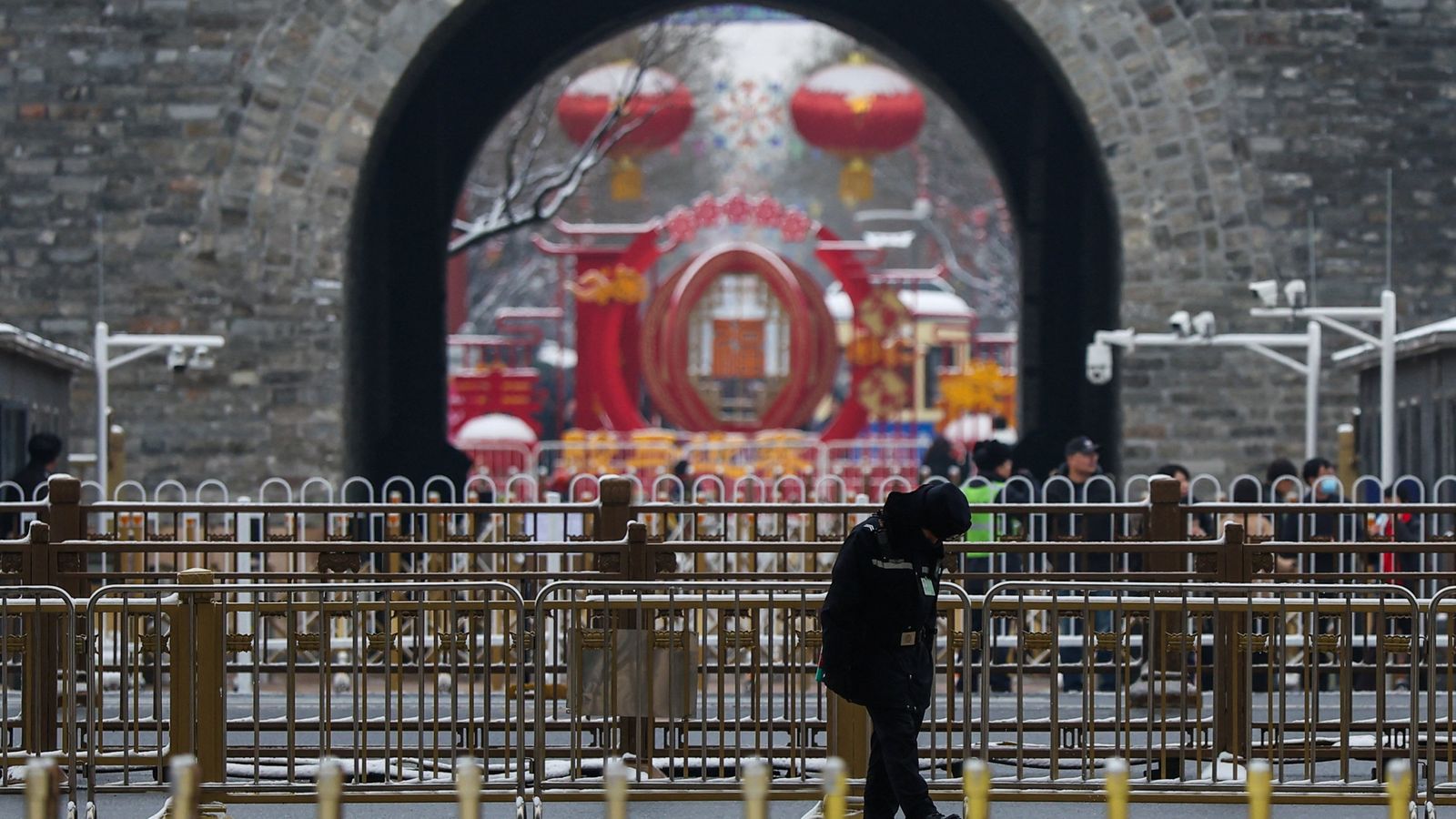
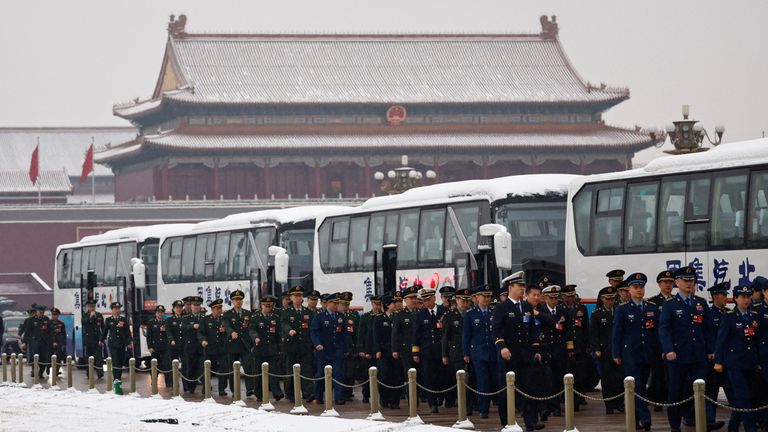
It’s been a snowy and bitterly cold morning in Beijing’s Tiananmen Square.

It’s a place where journalists and their cameras are usually not allowed; its brutal history makes it a highly sensitive location.

But this morning it was shut down to the usual tourist hordes, and we were invited in and allowed to film freely; a mark of a special occasion.

The occasion this time is an annual political event known as Lianghui or the Two Sessions.

Advertisement
Image:
Pic: Reuters

It’s China’s equivalent of the State opening of Parliament, a moment of pomp and ceremony, a moment where the curtain rises just a touch on what China’s leaders think, and what they want.

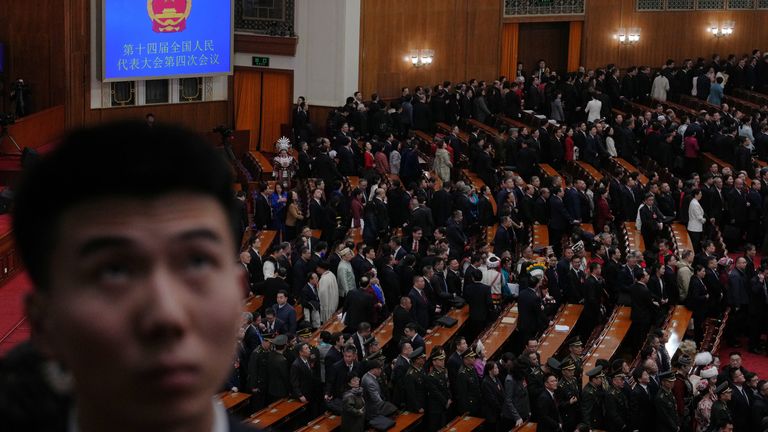
Nearly 3000 delegates are here from across the country, all members of China’s legislative body.

Pics: Reuters
Image:
Pics: Reuters

Many were wearing the traditional dress of China’s many ethnic minorities; a show of diversity deemed highly important.

In theory, they are here to discuss policy and vote on new laws and constitutional changes; in reality, they rubber-stamp decisions already made behind closed doors.

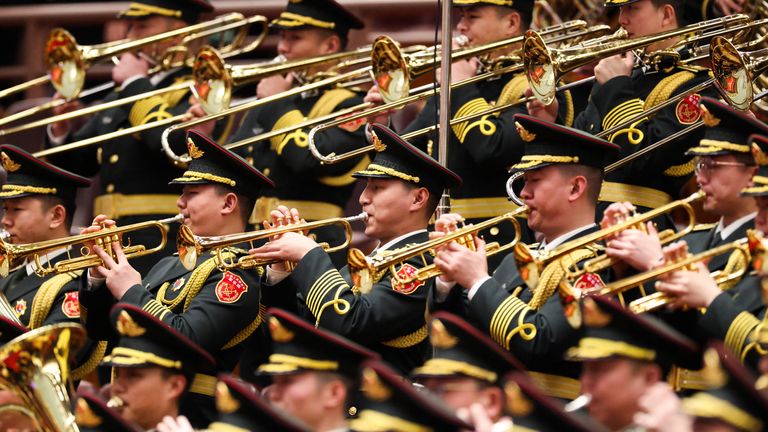
But there is no denying that the spectacle of it all is impressive.

Advertisement

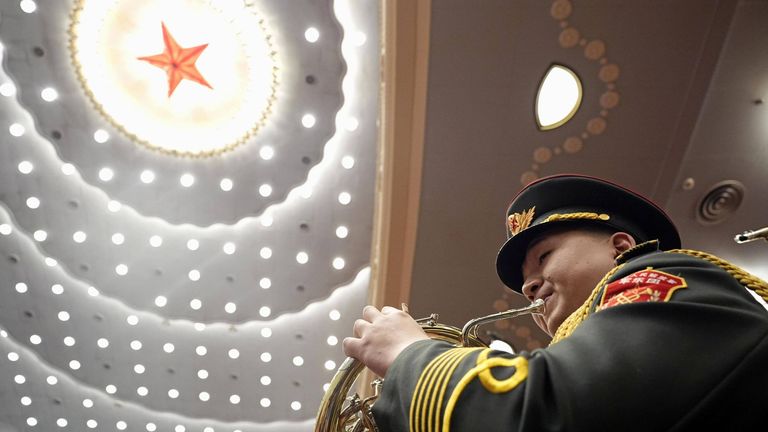
In the cavernous Great Hall Of The People, everything was pitch perfect; the band, the staging, even the tea cups were refilled in perfect choreographed unity.

Pic: AP
Image:
Pic: AP

Trying to decipher where China is headed is always a little bit of a game of reading between the lines, and so it was today.

The economy, for instance, is clearly still sluggish. The published growth target of 4.5 to 5% is the lowest goal China has set itself for over 30 years.

But this year, there is a little more insight about what China’s ambitions might be, and that’s because this year sees the publication of China’s latest ‘Five Year Plan’, a blueprint of sorts on what China’s strategy should be between now and 2030.

Pic: AP
Image:
Pic: AP

It might sound a bit lofty, but in the past these plans have been highly indicative; in the 1980s, for example, it was a Five Year Plan that heralded China’s infamous Reform and Opening Up — the policy that ultimately made it rich.

This year’s plan focuses on how China can really grow and win through leadership in the high-tech race; it seeks technological self-reliance, national security, and state guidance of the economy.

Advertisement

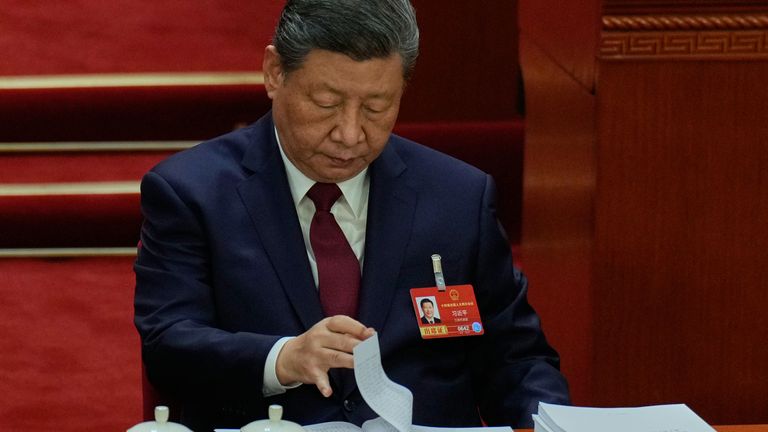
While Xi Jinping didn’t speak himself today, there is absolutely no doubt that everything laid out was a reflection of his leadership and his vision for an ascendant China.

Pic: AP
Image:
Pic: AP

He comes into this annual political moment in arguably one of his strongest positions for years; hot off a year of outmanoeuvring Donald Trump in the US-China trade war, purging swathes of his military’s leadership and further consolidating his absolute power.

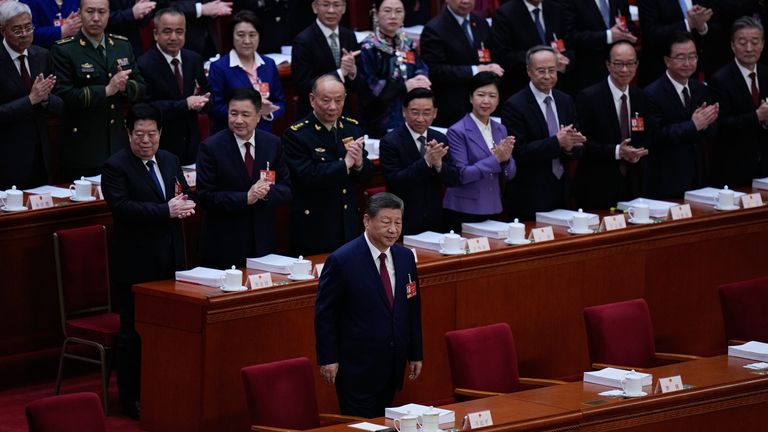
You can see it in everything from the staging to the deferential body language; his power is all but unchallengeable.

Advertisement

And it’s absolutely designed to send a message to the world.

Read more:
Spain’s PM not mincing his words over Trump’s war on Iran
Jimmy Lai’s fraud conviction quashed but he remains in jail

Pic: AP
Image:
Pic: AP

While Lianghui is primarily focused on domestic policy, it is not happening in a vacuum and events in the Middle East are the unavoidable backdrop.

The reality is that China won’t mind the contrast between the show they staged today, with all its displays of unity, order and might, with the chaos they see being unleashed by President Donald Trump.

It’s a contrast that suits their narrative – China is the superpower worth betting on.

Advertisement

Source link

Continue Reading

NewsBeat

Sir Keir Starmer confirms four more UK jets to be sent to Middle East

Published

on

Manchester Evening News

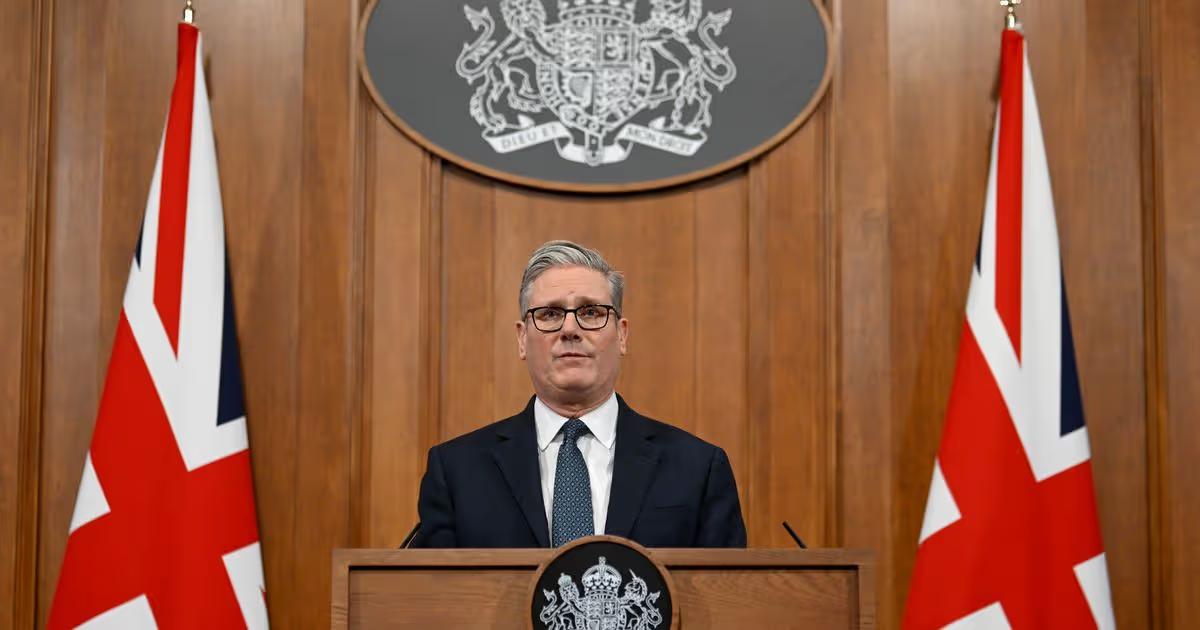
The prime minister confirmed the move in a Downing Street press conference

Sir Keir Starmer has announced that the UK will send four more jets to the Middle East “to strengthen our defensive operations”.

Advertisement

The prime minister confirmed the news in a press conference this afternoon. The Typhoon jets will join operations in Qatar amid the ongoing conflict, he said.

Sir Keir told the briefing he was focused on “providing calm, level-headed leadership in the national interest”. It comes as defence secretary John Healey met his counterpart in Cyprus to ease tensions about Britain’s response to drone attacks on the island.

Read our ongoing coverage of the latest situation here: Iran war LIVE as Doha and Azerbaijan hit by attacks

Foreign Office minister Hamish Falconer said earlier on Thursday that F35s have also been deployed to defend allies in the Middle East, and air defence destroyer HMS Dragon has been deployed to Cyprus, setting sail next week. Wildcat helicopters with anti-drone capabilities have also been dispatched to the island.

Advertisement

Speaking at the press conference in Downing Street, the Prime Minister said he had chaired a Cobra meeting on Thursday morning. He said he wanted to reassure people “worried sick about their family and friends” and “the potential for even greater escalation”.

He said: “I want to reassure the British public about the action that we are taking while the region has been plunged into chaos. My focus is providing calm, level-headed leadership in the national interest.

“That means deploying our military and diplomatic strength to protect our people, and it means having the strength to stand firm by our values and our principles, no matter the pressure to do otherwise.”

In Cyprus, Mr Healey met with Vasilis Palmas where he defended the UK’s deployment of military assets in the Middle East after RAF Akrotiri in Cyprus was hit by a drone. Cyprus’s high commissioner to the UK said a British military presence to defend the island was “the least we expect” in a criticism of the UK’s approach to managing the conflict.

Advertisement

Overnight on Monday, a hangar at RAF Akrotiri was hit by an Iranian-made Shahed drone, which was launched from Beirut in Lebanon, according to Cypriot officials. Two further drones detected on Monday were shot down by British warplanes, which took off from Akrotiri.

Asked if he thought the UK had acted with sufficient urgency to protect people living in and around the bases, high commissioner Kyriacos Kouros told Sky News: “Already we have the presence of Greek forces on the island. Two frigates arrived, four aircraft arrived, all of them with abilities to combat drones.

“The French are coming. So… the least we expect is the Britons to also be present since, as I said, we are not only defending Cypriots on the island.”

Sir Keir insisted the UK had been preparing for the possibility of conflict “long before” it began with Israeli and US strikes. He said Britain “started pre-deploying to the region in January and February, particularly to Cyprus and Qatar”.

Advertisement

This included fighter jets, air defence missiles, and anti-drone systems and was done over around eight weeks in conjunction with the US and other allies, he said. He added: “I’m satisfied that we can keep our people safe and we’re working very hard to make sure that wherever people have registered their presence, we can help them with the information that they need and the support they need, and get them back to the United Kingdom as quickly and as safely as possible.”

Source link

Continue Reading

NewsBeat

Female writers and readers have been challenging the patriarchy for more than 200 years

Published

on

Female writers and readers have been challenging the patriarchy for more than 200 years

Emerald Fennell’s film adaptation of Wuthering Heights has been pulling in the crowds recently, which is quite a feat in troubled times for cinema. Published in 1847, Emily Brontë’s tale of psycho-sexual power dynamics is just one of many enduring female-authored 19th century novels exploring female sexuality and desire for autonomy. These characters existed within a system that allowed women few education or career opportunities.

The ever-popular work of canonical British female writers such as Jane Austen, the (other) Brontë sisters and George Eliot were very different in style and tone. But they also draw attention to various forms of gender inequality.

Their novels focused on issues such as inheritance and property laws, the pressure on young women to marry for financial security, the sexual double standard and the lack of career prospects for women. In doing so, they gave voice to the frustrations of an expanding female readership in the 19th century.

The work of these and lesser-known female authors was crucial in shaping and fuelling public debates on what was referred to in the mid-Victorian period as “the woman question” (women’s right to vote). It later became the first-wave feminist movement in the late 19th and early 20th century.

Advertisement

The emergence of two inventive new literary forms in the early 20th century were key. One was modernism and the other the new printed paperback; both were intertwined with the expansion of women’s concerns and desires in the social and cultural sphere.

Modernism saw the burgeoning of experimental female writers such as Virginia Woolf and Jean Rhys in the 1920s. Then came popular genres such as mass market romance and what is now described as “cosy” crime fiction in the 1930s. Women writers and readers were creating spaces in high art and mass culture that centred female experience and domestic and personal life from the beginning of the 20th century.

The second wave

Given the importance of novels and reading to the history of feminist struggle, it is not surprising that second-wave feminism drew heavily on women’s literary heritage. This saw the publication of landmark academic studies of women’s writing such as Elaine Showalter’s A Literature of Their Own (1977), and Sandra Gilbert and Susan Guber’s The Madwoman in the Attic (1979). And with them came the proliferation of university courses on women’s writing.

Advertisement

The 1960s and 1970s also witnessed the birth of polemical feminist bestsellers. This included Germaine Greer’s The Female Eunuch (1970) and “consciousness raising” popular novels, such as The Woman’s Room (1977) by Marilyn French.

In the 1970s and 1980s, a more diverse group of feminist writers came on the scene. Writers like Margaret Atwood, Angela Carter, Alice Walker, Audre Lorde, Toni Morrison, Octavia Butler and Rita Mae Brown, continued to shape and expand the political and cultural scope and influence of women’s writing into queer, black and postmodernist forms.

Bookgroups, BookTok and the feminist novel

In our own era, while men are reading fewer and fewer novels, female writers and readers are keeping the world of fiction alive. Aside from being the major purchasers of fiction, women are far more likely to enhance and socialise their literary interests. Local book groups and online review and recommendation communities such as Booktok are popular spaces for exploring new literature.

Advertisement

They are also the driving force in the creation and consumption of successful new literary cycles. For example, one of the publishing success stories of the last ten years in English language fiction was the female-centred psychological thriller/domestic noir crime novel. This included the likes of Gone Girl (2014), The Girl on the Train (2016), Big Little Lies (2017) and The Housemaid.

As feminist literary critics have pointed out, not only are these novels predominantly written and narrated by women. Through widespread circulation and screen adaptations, they have also continued to bring to light key gender and power issues such as coercive control, domestic violence and the murder of women. At the lighter end of the spectrum, the recent explosion of “romantasy” fiction (a romance-fantasy hybrid) focuses on female desire and pleasure.

The boundary between literary and genre fiction is becoming increasingly blurred. But contemporary female writers such as Rachel Cusk, Bernadine Evaristo, Anna Burns and Eimear McBride continue to produce innovations in style and form. And younger female writers of “rage” and “sad girl” novels like Ottessa Moshfegh, Oyinkan Braithwaite, Rachel Yoder, Raven Leilani and Aria Aber are not afraid to explore edgy and unsettling accounts of women’s experience.

In life-writing, creative non-fiction and autofiction, women’s stories have also proliferated. Post #MeToo bestsellers such as Acts of Desperation (2022) by Meghan Nolan, and Three Women (2020) by Lisa Taddeo, tearing down comfortable myths of equality and exposing the persisting inequalities in women’s personal relationships.

Advertisement

For more than two centuries, women’s writing has not only reflected the constraints of patriarchy but actively challenged and reshaped them. As long as women continue to write, read and reimagine the world through fiction, novel reading will remain a vital site of feminist resistance and possibility.

This article features references to books that have been included for editorial reasons, and may contain links to bookshop.org; if you click on one of the links and go on to buy something, The Conversation UK may earn a commission.

Source link

Advertisement
Continue Reading

NewsBeat

Serial rapist Clifford Church given second life sentence

Published

on

Serial rapist Clifford Church given second life sentence

Clifford Ian Church, 63, lured a 25-year-old woman to his flat and forced her to submit to his sexual demands by hitting her to the floor and telling her “you are going to be hit every time you refuse”, Catherine Silverton told York Crown Court.

He also told her she needed teaching a lesson and locked them into the flat together.

She managed to escape naked into the Harrogate block of flats’ communal area.

Also naked but for a pair of socks, he pursued her and chased her up two flights of stairs, grabbed her as she desperately clung to a door frame and tried to drag her back to his flat until a resident, alerted by her screams, opened the door.

Advertisement

She had believed he was, in her words, a “nice old man”, said Ms Silverton.

Serial rapist Clifford Ian Church being interviewed by police (Image: North Yorkshire Police)

Police revealed after the case that Church dressed himself and left the flat hurriedly after the rape. He had thrown the woman’s clothes into the communal area for her to collect.

Church was on parole from a life sentence for raping, attempting to rape and sexually assaulting a 37-year-old woman on the seafront in Redcar, in an incident that Judge Simon Hickey said was very similar to the 2025 rape.

He was also jailed for eight years in 1997 for rape, attempted rape and attempted indecent assault of a 16-year-old girl. In total he has eight offences of rape and attempted rape.

Advertisement

Church, formerly of Harrogate and now recalled to prison to continue serving his first life sentence, pleaded guilty to raping the 25-year-old woman and assaulting her.

Giving him a second life sentence and ordering him to serve a minimum of 12 years before he can be considered for parole, the judge said: “It was a prolonged, determined and sustained incident that must have left the 25-year-old victim terrified.”

Church is already on the sex offenders’ register for life.

After the rape on August 9, 2025, police launched a major hunt for Church, putting out urgent public appeals across York, North Yorkshire as well as Cleveland and West Yorkshire. 

Advertisement

RECOMMENDED READING


Ms Silverton said Church had met the latest victim, a homeless drug addict, in Leeds and after a couple of meetings persuaded her to come by bus with him to Harrogate on the excuse that she would be paid £100 and some drugs for bagging heroin and crack cocaine. 

He gave her £100 on the bus and never mentioned anything sexual until they were in the flat.  Then he locked the door and told her to get her clothes off. She refused and he hit her to the ground.

On September 19, police found Church, who had been drinking, at Bradford Interchange and arrested him. He had been released from the first life sentence on November 1, 2017.

Advertisement

For Church, Rebecca Randall said his best mitigation was his guilty plea which had spared the 25-year-old the ordeal of giving evidence.

He had become somewhat institutionalised and behind bars had become a laundry orderly. He also helped new prisoners by advising them on how to avoid self-harming.

He had long-term alcohol and drug addictions which he had tried to overcome after his release in 2017 but had not been able to access the help he needed.

Advertisement

Source link

Continue Reading

NewsBeat

PSNI chief vows to ‘relentlessly pursue’ officers who sexually exploit women

Published

on

Belfast Live

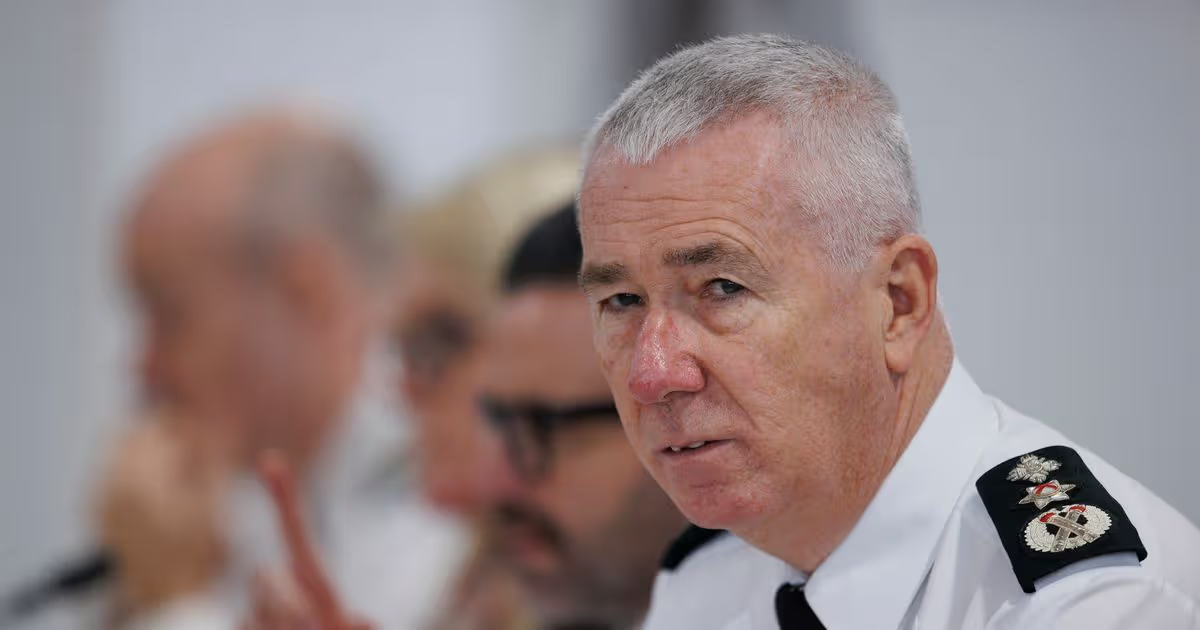
The Chief Constable of the PSNI has vowed to “relentlessly pursue” officers abusing their position for sexual purposes after a report found evidence of predatory behaviour in the police.

Jon Boutcher told the policing board that such incidents make him and the senior team “so angry” and serve to “undermine everything we’re trying to achieve”.

A report published this week analysed allegations involving officers (all male and aged between 30 and 50) between 2018 and 2024 and found predatory behaviour features in 30% of the most serious cases investigated by the Police Ombudsman for Northern Ireland.

Advertisement

The report also highlighted the vulnerabilities of the 36 victims (all female) identified in the cases, from being a victim of crime, to mental health issues, domestic abuse, suicidal ideation or addiction.

There was evidence of targeted exploitation of women, with police officers in those cases often making inappropriate use of police systems to identify women for sexual exploitation or acquire further information in relation to potential victims.

In his opening remarks to the board on Thursday, Mr Boutcher said “any abuse of position for sexual purposes is not simply wholly unacceptable, it’s abhorrent”.

He said: “It represents the most egregious breach of trust and a violation of the standards we expect of police officers and staff.”

Advertisement

He added: “I want to reassure this board and everyone watching that we will relentlessly pursue and deal with these people.

“Our collective commitment as a senior team and as an organisation is for zero tolerance for this type of activity.

“While the ombudsman’s report identifies serious individual misconduct, importantly, very importantly, it very much recognises the positive strategic direction we have taken and the significant work done to strengthen professional standards, enhance vetting and misconduct reporting processes and for learning from past failures.”

The Chief Constable said the organisation “will do everything necessary to deal with such issues” but that “the numbers of these officers are numerically incredibly small”.

Advertisement

“Albeit any such officer, even one, is unacceptable,” he said.

“The vast majority of our people are amazing and are more disgusted at this behaviour than anyone, because it undermines who we are and what we’re here to do – to protect society and look after vulnerable people, not exploit them.”

Mr Boutcher added: “There is no place for these people in the PSNI, we will find them and we will sack them.”

Political representatives on the board, Alliance MLA Nuala McAllister and Sinn Fein MLA Linda Dillon, both raised concerns on the findings of the ombudsman’s report.

Advertisement

Mr Boutcher replied: “When I arrived here I was concerned about the levels of misogyny in society here, and I don’t know if that’s simply because it’s more prevalent here, or simply because I’ve not noticed that prevalence increase generally in society, because of the online harms that we see and the way mainly young men are being shown things that nobody should look at through the internet, and being developed into people who become bad adults, as opposed to good, positive members of the community.”

He outlined that he had met with female officers and one of a number of initiatives to spur on cultural change was having officers “commit to a statement of intent with regards to our values and our behaviours”.

He said: “I can absolutely assure you that this type of behaviour, it makes me so angry, the members of this senior team so angry, because I know, because of the work that the rank and file do, some of which I described in my opening remarks, this undermines everything we’re trying to achieve.

“It goes to recruitment, it goes to trust in cops, goes to reporting, so we will work incredibly closely with the ombudsman to make sure that, and there will be, I think, almost certainly, quite considerably historical cases that will emerge from this work.

Advertisement

“And I would encourage anyone with any negative experience or any information about any such wrongdoing to please come forward and report it to either ourselves or the ombudsman so that we can clear house with regards to these behaviours.”

For all the latest news, visit the Belfast Live homepage here and sign up to our daily newsletter here.

Source link

Advertisement
Continue Reading

NewsBeat

FIFA to allow in-game adverts during World Cup as ITV given headache after backlash

Published

on

Daily Mirror

It was confirmed in December that all 104 matches at the World Cup will have two hydration breaks, prompting talks between broadcasters and FIFA about showing adverts during them

FIFA will allow broadcasters to show adverts during their live coverage of World Cup matches. ITV will be among the channels able to cut away during the mandatory hydration breaks at this summer’s tournament in the United States, Canada and Mexico.

Advertisement

Amid concerns over player welfare, FIFA confirmed in December that there’ll be one three-minute-long break in each half. The decision opened up the opportunity for broadcasters to show adverts while play is stopped for the first time.

Previously, adverts have only been permitted at half-time of matches. The Athletic report that after holding talks with broadcast executives, FIFA will allow in-game adverts.

Fans of basketball and American football will be used to the kind of commercial breaks which happen during timeouts in those sports. Broadcasters have, however, been told to stick to FIFA’s guidelines for in-game adverts.

JOIN US ON FACEBOOK! Latest news, analysis and much more on Mirror Football’s Facebook page

Advertisement

READ MORE: World Cup star caught up in war forced to flee Iran after bomb exploded ‘next to him’READ MORE: Brazil and Real Madrid star to miss World Cup after heartbreaking ACL injury blow

Football’s global governing body has told broadcasters that the breaks shouldn’t start within 20 seconds of the referee pausing play. The guidelines also say that they must return to the match feed more than 30 seconds before play resumes.

Broadcasters will therefore have a two-minute and 10-second window. ITV, who unlike BBC are permitted to show adverts, are yet to confirm their plans regarding adverts.

ITV could opt for split-screen commercials, keeping one eye on the action – like has been seen in this year’s rugby Six Nations. Since implementing the change, ITV have suffered backlash from viewers who feel that the adverts are a distraction.

Advertisement

Should adverts be allowed during matches? Have your say in the comments section.

Broadcasters could also switch back to their studio panel for in-game analysis or show highlights during the hydration breaks. The breaks have been made mandatory after multiple players and coaches complained about the intense heat during the Club World Cup which was held in the USA last summer.

“For every game, no matter where the games are played, no matter if there’s a roof, [or] temperature-wise, there will be a three-minute hydration break. It will be three minutes from whistle to whistle in both halves,” World Cup chief tournament officer Manolo Zubiria said.

Advertisement

“Obviously, if there’s an injury [stoppage] at the moment of the 20th or 21st minute and it’s ongoing, this will be addressed on the spot with the referee.”

Join our new WhatsApp community and receive your daily dose of Mirror Football content. We also treat our community members to special offers, promotions, and adverts from us – and our partners. If you don’t like our community, you can check out any time you like. If you’re curious, you can read our Privacy Notice.

Content cannot be displayed without consent

Source link

Advertisement
Continue Reading

NewsBeat

Labour considering suspending MP whose husband is suspected of spying

Published

on

Wales Online

David Taylor has been bailed along with two other men arrested in Pontyclun and Powys on Wednesday. His wife Joani Reid read a statement in the Commons on Wednesday in which she said she denied any wrongdoing

The leader of Scottish Labour has said the party has “judgements to make” on an MP whose husband is suspected of spying for China.

The Scottish Labour leader Anas Sarwar said on Thursday Labour has “judgements” to make on MP Joani Reid, who is an MP for East Kilbride and Strathaven and whose husband David Taylor, from Ruthin, was arrested on Wednesday as part of an ongoing investigation into alleged spying.

Advertisement

Mr Sarwar made the remarks amid speculation the UK Labour Party could suspend Ms Reid. On Wednesday the Metropolitan Police said three men – aged 39, 43 and 68 – were arrested by counter-terrorism officers in London and Wales on suspicion of assisting a foreign intelligence service.

The men were detained under the Police and Criminal Evidence Act, according to Commander Helen Flanagan, head of counter terrorism policing London.

Taylor has been bailed along with two other men arrested in Pontyclun and Powys on Wednesday. Ms Reid read a statement in the Commons on Wednesday in which she said she denied any wrongdoing.

On Thursday Mr Sarwar said of Ms Reid: “We are considering all these matters because they are serious questions that you are putting to me. As you know, we have an independent Governance and Legal Unit that’s considering many of these matters and we will have judgements to make today.”

Advertisement

Asked if Ms Reid should be suspended, Mr Sarwar said: “This is rightly an independent Governance and Legal Unit process. We are looking at all the questions that arise from this and we will be making judgements on this.”

Mr Sarwar said he last came into contact with Taylor “probably at some point last year”. “He is not someone who is well known to me,” he said.

A Labour source said suspension and an internal investigation would allow Reid to show she has done nothing wrong, the Daily Record reports.

Advertisement

In a statement on Wednesday Ms Reid strongly rejected any claims of wrongdoing. She said: “I have never been to China. I have never spoken on China or China-related matters in the Commons. I have never asked a question on China-related matters.

“As far as I am aware, I have never met any Chinese businesses whilst I have been an MP, any Chinese diplomats or government employees, nor raised any concern with ministers or anyone else on behalf of, even coincidentally, Chinese interests.”

Taylor was special adviser to Peter Hain when he was Welsh secretary and also previously worked for Senedd member Leighton Andrews when he was a backbencher. He was also selected as Labour’s candidate as police and crime commissioner in north Wales in 2016.

He is listed on the MP’s register of interests as a director of Earthcott Limited, a lobbying firm. He previously founded a cyber security company and his LinkedIn profile states he is director of policy and programmes for an organisation named Asia House.

Advertisement

His profile states: “At Asia House I lead our policy and research teams in delivering programmes and projects for clients across Asia, the Middle East, and Europe. I oversee the development and execution of strategic initiatives that connect senior government officials, business leaders, and thought leaders on critical regional and global issues.”

Source link

Continue Reading

NewsBeat

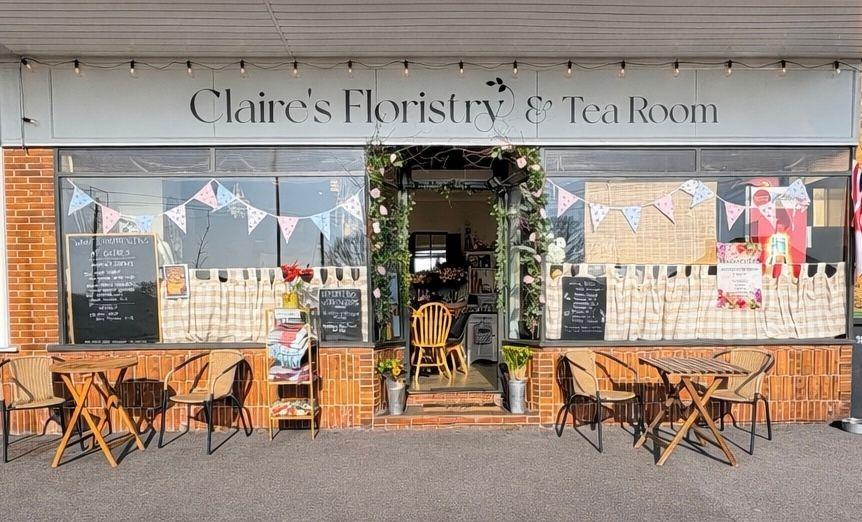
Community Rallies Around Claire’s Floristry & Tea Room as Business Celebrates Two Years

Published

on

Community Rallies Around Claire’s Floristry & Tea Room as Business Celebrates Two Years

On any given day, the scent of fresh flowers mixes with the sound of conversation, laughter and coffee cups in a small shop that has quietly become one of the area’s most welcoming community spaces. What started as a personal dream for local florist Claire has grown into something far bigger — a place where people come together.

Source link

Continue Reading

NewsBeat

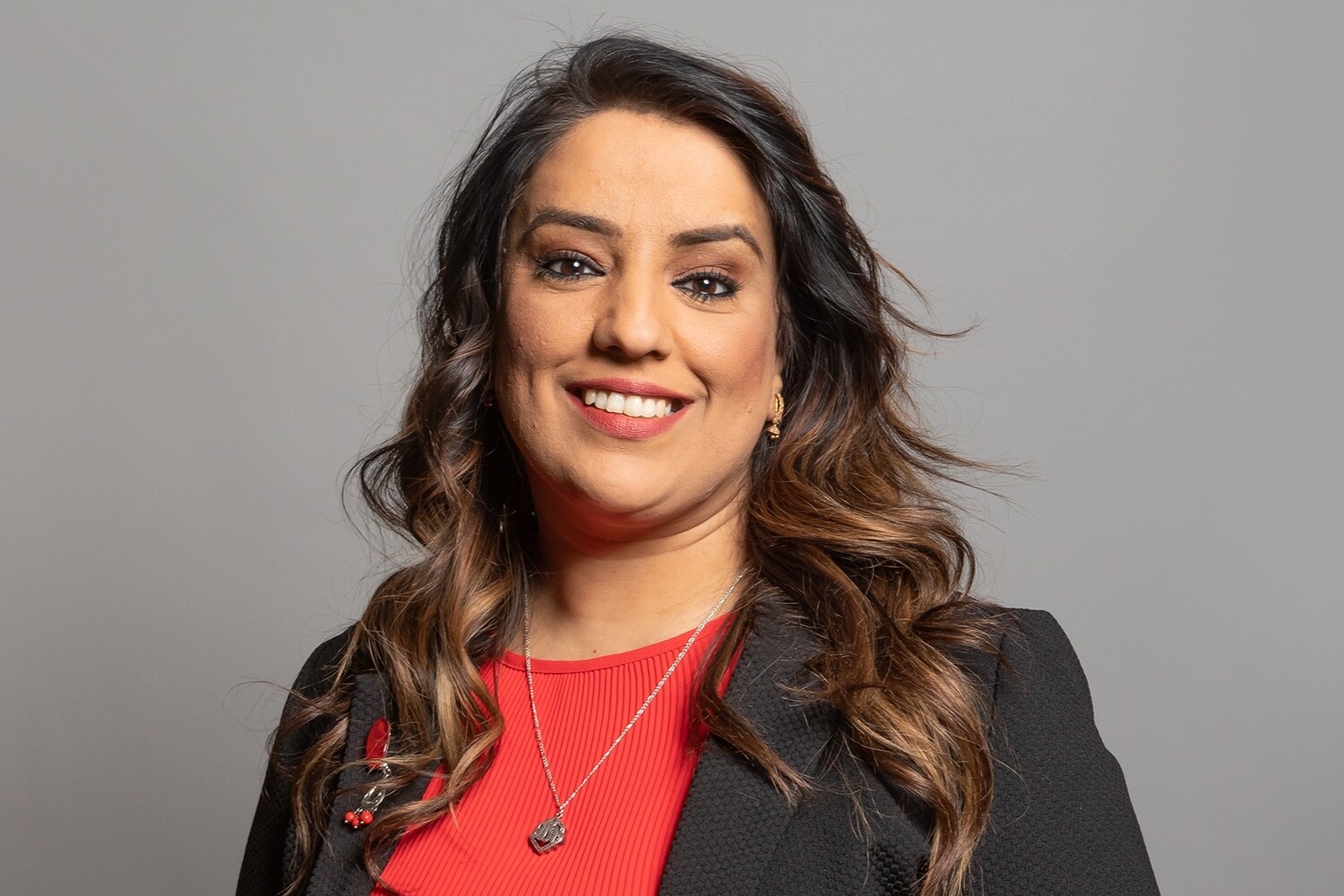
Life lessons: Naz Shah on what life so far has taught her

Published

on

Life lessons: Naz Shah on what life so far has taught her

The British politician on being optimistic, what she learned from her incarcerated mother, and her enduring faith in community

My morning ritual is …

I get up and take my thyroid medication. You can’t mix it with any caffeine, as it makes it obsolete, so half an hour later I have a ginger tea. That’s the thing that gets me up and about. No two days are the same with my job, but I often start work with early meetings.

Advertisement

I feel optimistic about …

Getting healthier. I’ve had some major surgeries this year. I feel optimistic about the future and hopefully getting more of a work-life balance because I don’t have that currently. I always feel optimistic about learning new things too.

What makes me angry …

People who try to divide people. The kind of people who try to fan the flames of division make me really angry.

Advertisement
Solutions every Saturday
Uplift your inbox with our weekly newsletter. Positive News editors select the week’s top stories of progress, bringing you the essential briefing about what’s going right.
Sign up

If I wasn’t a politician, I’d have liked to become …

A barrister. If I could go back to an education, that would definitely have been what I had my dreams set on. When you come from where I’ve come from and the life I’ve had, you don’t want anybody else to go through that. My life has been all about not having that fairness, not having equality or having justice – that is the thing that frames me and context that I view the world through. It’s all about justice and equality. I’d have liked to have become a barrister, a Michael Mansfield sort of character. Representing people and giving them a voice, you have an opportunity to change things.

The habit that has served me best in life …

Advertisement

Optimism. It’s about continuously seeking the light, even when it’s dark and I can’t see. It’s about resilience and making sure I carry on.

The habit I’ve successfully kicked …

Eating too many biscuits. It’s a bad habit that I have: Custard Creams, Chocolate Hobnobs, Bourbons… I’ve reduced my biscuit intake these days. But I still have more to kick.

If you’re true to your faith, your humanity and your values, you will make the world a better place

My sources of joy are …

Advertisement

My children, and music. I love good, old school R&B, dance and house classics from the 1980s and 1990s. I’m talking about Blackstreet, Jagged Edge, Destiny’s Child, Mary J Blige… Some floor fillers just get you going. I love dancing but I don’t get time for it anymore.

When things get tough I …

Turn to God. I always turn to my faith, Islam, when things get difficult. That’s where I find my sanctuary, my solace and my calm.

The book I wish everyone would read …

Advertisement

One of my all-time favourite books is The Seven Habits Of Highly Effective People by Stephen Covey. It really impacted my thinking, shaped my understanding and gave me a framework for leadership in my early days and the start of my career.

‘People have the answers but they don’t have the means to get to those answers,’ says Nav Shah. Image: Mauro Mora

Advertisement

The big thing I’ve changed my mind about in life …

Is that being busy isn’t the same as being productive, and that work-life balance isn’t a ‘luxury’ – it’s essential for long-term performance.

What keeps me awake at night …

Is my job. My brain overthinks things. I’m a solution-focused person – I’m thinking about solutions for society’s problems. What makes me angry also keeps me up at night.

Advertisement

The thing that motivates me most of all …

My faith. If you’re true to your faith, you’re true to humanity and to your values. If you’re true to all that you will live to make the world a better place. The bottom line is equality, fairness and justice. Reducing inequality is my main driver. I’m driven to help people that are in a less fortunate position. I’m very strong in my belief that God has given me a gift, and that the power and status and power I have has to be spent in helping humanity and improving society.

My mother spent 14 years in prison and taught me how to hold on to the light

My parents taught me …

My dad taught me how not to behave. He taught me how not to take responsibility, for children and for life. He abdicated his responsibility for his children. He didn’t step up. I’m the complete opposite – I take responsibility. My dad also taught me how to dance – I got my love of dancing from him at an early age.

Advertisement

My mother taught me patience and resilience. She spent 14 years in prison [When Naz was 18, her mother killed a man after enduring more than a decade of abuse from him] and she still taught me how to hold on to the light. She gave me the foundation for my strength. She taught me how to never give up.

I have this theory that …

Communities have their own solutions. People have the answers but they don’t have the means to get to those answers. For me, there is zero poverty of aspiration among communities. But there is a poverty of infrastructure to allow people to fulfil those aspirations.

I’d like to tell my younger self …

Advertisement

To read more books and to learn more languages. I’ve just started reading very recently. I left school at 12 and I should have read more. I’m thirsty for knowledge. I’ve always done a lot of experiential learning from work and things like that. But I’ve just recently started finding the joy in books.

Honoured: Survival, Strength And My Path to Politics by Naz Shah (W&N, £22) is out now.

Main image: House of Commons

Advertisement

Be part of the solution

At Positive News, we’re not chasing clicks or profits for media moguls – we’re here to serve you and have a positive social impact. We can’t do this unless enough people like you choose to support our journalism.

Give once from just £1, or join 1,800+ others who contribute an average of £3 or more per month. Together, we can build a healthier form of media – one that focuses on solutions, progress and possibilities, and empowers people to create positive change.

Support Positive News

Advertisement

Source link

Continue Reading

Trending

Copyright © 2025