
Connect with us
DAPA Banner

NewsBeat

Trump claims King Charles ‘would probably have helped us with Iran’

Published

on

Trump claims King Charles ‘would probably have helped us with Iran’

Donald Trump has claimed that King Charles “probably would have helped us” in Iran in another attack on Sir Keir Starmer and Nato.

Speaking during the King’s state visit, the US president said the monarch was a “phenomenal representative for his country” and suggested he would have differed in his approach to the conflict from the prime minister.

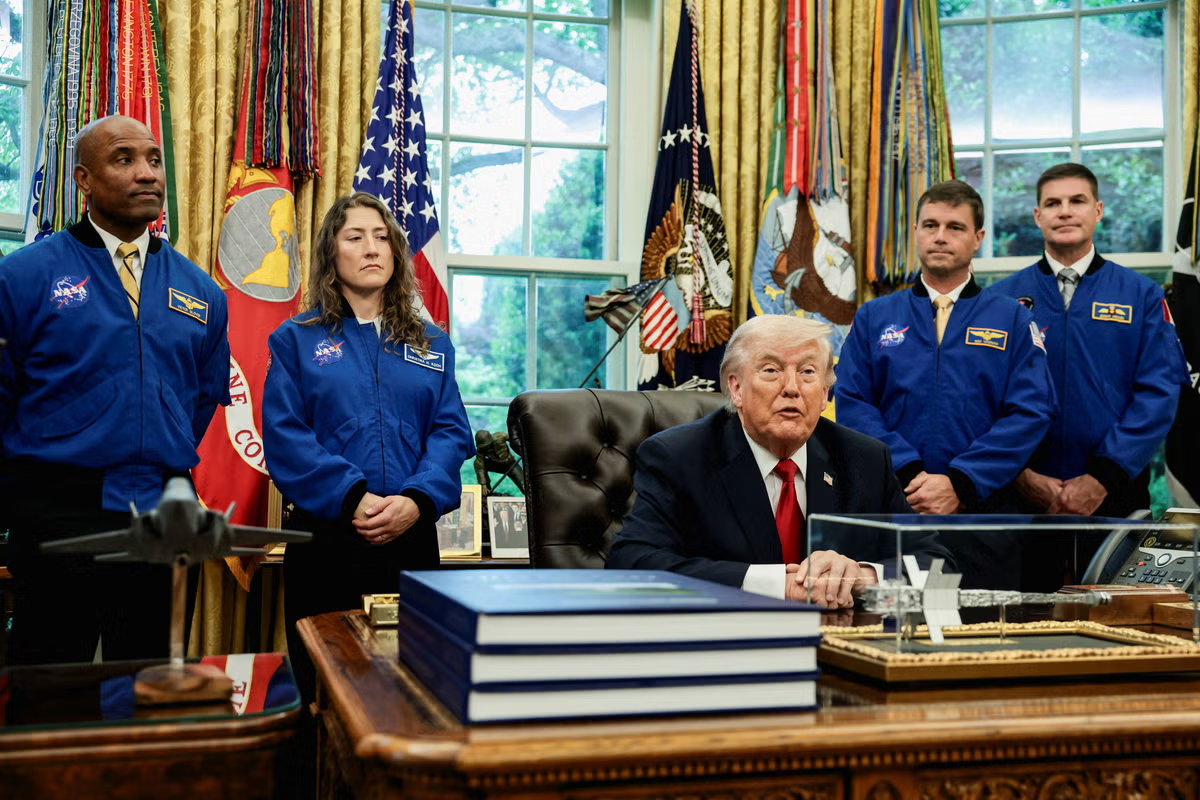
Donald Trump meets Artemis II astronauts in the Oval Office
Donald Trump meets Artemis II astronauts in the Oval Office (Reuters)

He said: “The King loves his country, and he’s a great king, and he’s a great friend of mine. And I think if that it were up to him, he would have probably helped us with Iran.”

Asked by reporters whether the King’s speech that referred to the need for a strong Nato alliance had changed his mind, Trump said he was very disappointed in Nato after the US “asked them to do some things about Ukraine and Iran”.

Praising the King as “fantastic”, he added: “He would have done– he would have followed the suggestions we made with respect to Ukraine, because, you know, we have some disagreements on Ukraine and not having to do with Nato so much as European countries.”

Advertisement

Trump said the King would see him before he left for home. “And, you know, but I think he’s a phenomenal representative for his country,” he said.

“I think the people in the United Kingdom should be proud.

“I love this speech yesterday. I watched it. I loved the speech last night. I don’t know about my speech. I thought my speech was okay, too, but I thought he was I think he’s an unbelievable King, and, by the way, an unbelievable queen. They are a great couple.”

The US president has repeatedly condemned Nato for what he sees as relying too much on the US for funding and has attacked other allies, including the UK, for not supporting the US-Israeli war on Iran.

Advertisement

He has more than once threatened to pull America out of the defensive alliance.

But he has been unwavering in his flattery of Britain’s royal family.

More to follow…

Source link

Advertisement
Continue Reading
Click to comment

You must be logged in to post a comment Login

Leave a Reply

NewsBeat

Were enormous octopuses apex predators in ancient oceans?

Published

on

Were enormous octopuses apex predators in ancient oceans?

At the time of the dinosaurs, the oceans were teeming with life. Below the waves, giant marine reptiles, such as the fearsome 4m (13ft) long mosasaurs, were the undisputed apex predators.

In artistic reconstructions of these ancient oceans, cephalopods – the animal group that includes squid, cuttlefish, octopuses, and their ancestors – are almost always portrayed as prey, often seen desperately swimming away from the jaws of a marine reptile to avoid becoming lunch.

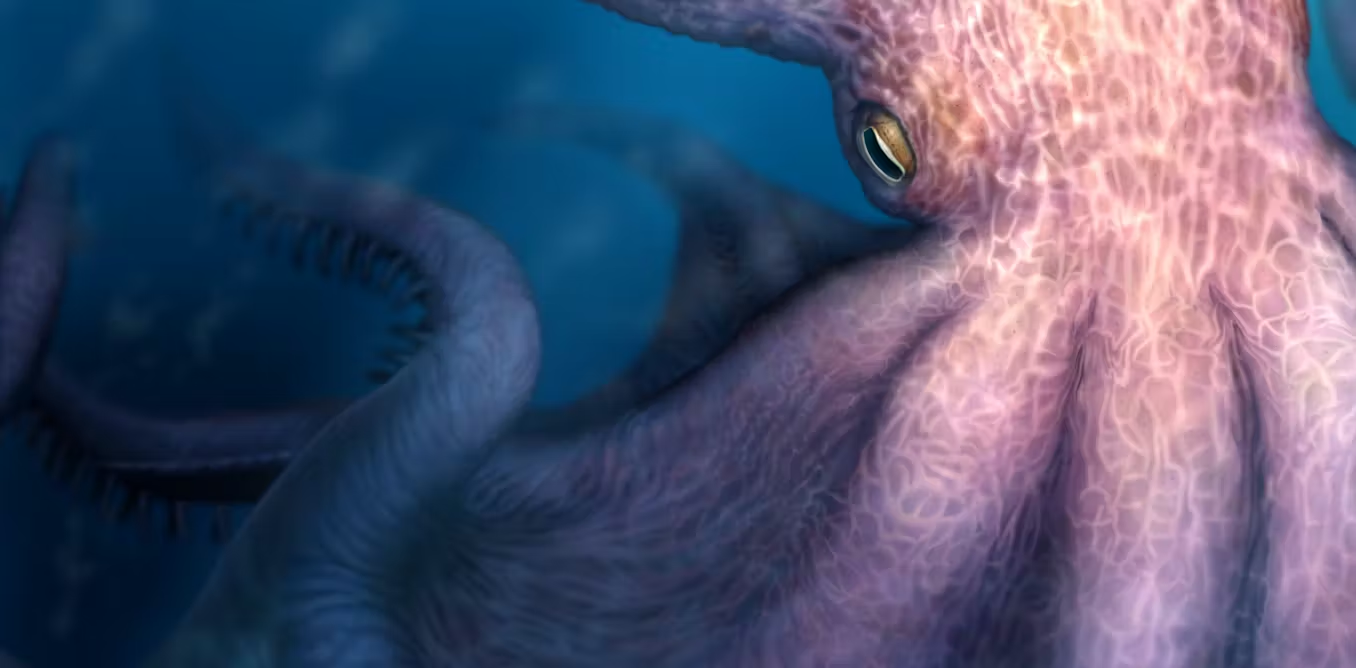
However, a remarkable new fossil suggests our view of the ancient oceans is incomplete, and that giant octopuses, perhaps reaching as long as 19m (62ft), may have been the ones doing the hunting.

The fossil in question is a giant octopus jaw, belonging to a new species called Nanaimoteuthis haggarti. It is found in Late Cretaceous rocks of Japan, making it between 100 million and 72 million years old.

Advertisement

Like other cephalopods, octopuses have a hard beak that looks like a parrot’s bill, used to bite and tear prey, and this fossil example is enormous – larger than that of the famous giant squid Architeuthis.

Based on the shape and size of the beak, Shin Ikegami, from Hokkaido University, Japan, and colleagues, identify it as belonging to the Cirrata, a group of finned octopuses still found today in the deepest oceans. They estimate that the animal may have reached between seven and 19 metres in length. Details have been published in the journal Science.


Shin Ikegami et al./Science, Author provided (no reuse)

If that upper estimate is even close to correct, Nanaimoteuthis, would represent the largest invertebrate yet described from the fossil record — an animal rivalling the largest marine reptiles in scale.

The authors also use the wear and damage on the octopus beak as indicators of ancient behaviour. Scratches and pits on the surface point to an animal hunting and crushing prey with bones or shells, not scavenging or feeding on soft-bodied organisms.

Advertisement

Additionally, the wear pattern is asymmetric, interpreted by the authors as evidence of a preference for chewing on one side over the other, a trait associated with higher cognitive function.

Far from being food, Nanaimoteuthis may have been one of the most formidable predators in its ecosystem, in an era we have long assumed was defined by vertebrate dominance.

That such a claim can be made at all is remarkable, because cephalopods almost never leave any trace in the fossil record. Unlike fish, marine reptiles, or even ammonites, most cephalopods have no hard parts like bones.

Octopuses, in particular, are almost entirely “skin bags” filled with water. When they die, they rot quickly, and even the few hard parts, such as the beak, are seldom preserved.

Advertisement

This creates a systematic bias that skews our understanding of ancient ecosystems: animals that preserve well dominate our reconstructions, and the animals that don’t, even if they were common among certain ancient ecosystems, are largely invisible to us.

Every fossil cephalopod, therefore, represents a vital piece of palaeontological information, giving us a fleeting glimpse into a lost world of squishy invertebrates.
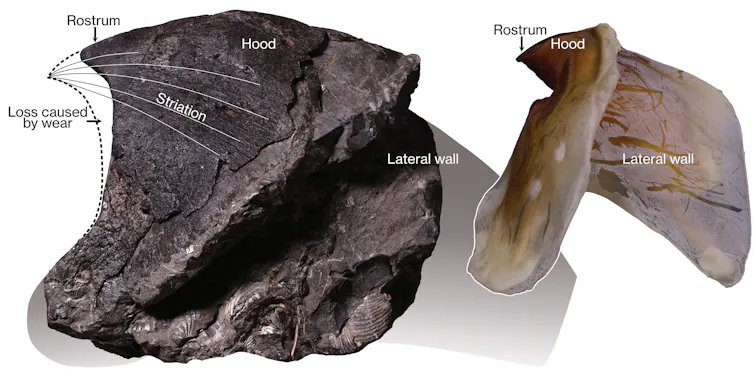
Left: the fossil jaw from Nanaimoteuthis haggarti. Right: a jaw from the giant squid, Architeuthis, for comparison.
Science, Author provided (no reuse)

But not all cephalopodologists are convinced by the size estimate, with the potential length of 19m in particular drawing scrutiny on social media.

Scaling cephalopod body sizes from beaks is not straightforward. The relationship between jaw dimensions and total body size varies considerably across cephalopod species, a problem compounded by the patchy data available for rarely caught deep-water cirrate octopuses.

Other researchers have also questioned the behavioural inferences drawn from the wear patterns, arguing that bite asymmetry can be caused by many factors, and that drawing conclusions about animal intelligence from a single specimen is premature.

Advertisement

It is also important to put this finding into context of the living relatives of Nanaimoteuthis. Modern cirrate octopuses are not known to swim after prey, typically hunting small invertebrates on the seafloor, raising questions about whether their giant ancient cousins would ever have encountered, let alone challenged, the formidable marine reptiles.

But step back from the debate over metres and scaling equations, and something fundamental comes into view. Our reconstructions of ancient ecosystems are shaped by what preserves (bones, shells, teeth) and often systematically blind to what doesn’t.

While future investigations may test the size estimate or refine behavioural interpretations, this remarkable fossil shows that there may have been giants lurking in the vast, deep, and dark waters of the ancient oceans. We just couldn’t see them until now.
Advertisement

Source link

Continue Reading

NewsBeat

Betrayal fans need to watch this dark crime thriller added to Netflix

Published

on

Wales Online

Netflix fans have been treated to a “superb” crime thriller that’s perfect for Betrayal fans.

Teaser trailer for ITV’s Betrayal

Netflix has released a “breathtaking” period drama film that’s been labelled as a “little gem”.

Advertisement

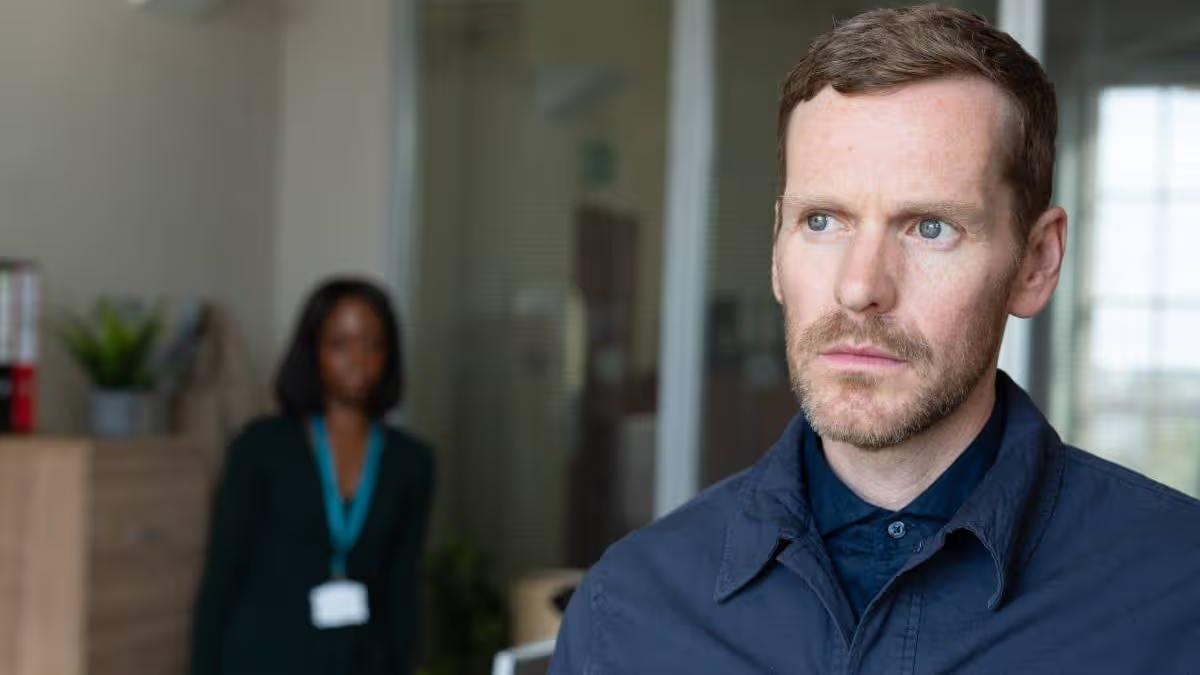
British espionage thriller Betrayal made its ITV debut earlier this year with the cast headed up by Endeavour legend Shaun Evans.

He is joined by stars such as Beyond Paradise‘s Zahra Ahmadi and Vigil actress Romola Garai who stars in 2023 crime thriller The Critic, which is now available to stream on Netflix.

While Garai plays a character called Cora Wyley, James Bond legend Gemma Arterton portrays young actress Nina Land, who becomes entangled in a blackmail plot orchestrated by “vicious feared” theatre critic Jimmy Erskine (played by Ian McKellen).

Set during the 1930s, The Critic is billed as a “story of blackmail, murder and high-stakes manipulation in the theatre world”.

Advertisement

Before the film’s premiere three years ago, The Critic had already attracted a devoted following, given its adaptation from Anthony Quinn’s 2015 novel Curtain Call.

It’s unsurprising, then, that audiences have been effusive in their praise for the period drama.

Advertisement

“This movie hits harder than it had any right to! How can these little gems sneak under the radar?”, questioned one viewer.

A second posted on IMdB: “A most colourful, but also dark and foggy production about success, secrets and death, it delivers far more than I’d expected.”

Another described it as a “breathtaking piece of filmmaking”, while someone else praised its “superb casting and a devilish plot”.

Advertisement

A fellow fan remarked: “It is a beautifully crafted film, full of nuances and subtleties that combine with a good script and technical finesse to offer a quietly compelling film.

“Suspend your expectations of what a film should be, sit back and relish one of the finest films of recent years. It is joy. Be entertained.”

Playing opposite Artherton in the role of critic Jimmy Erskine is the legendary Ian McKellen, renowned for his performances in X-Men, Lord of the Rings, Richard III, and The Da Vinci Code, amongst others.

The cast also features Harry Potter and Netflix’s Run Away star Alfred Enoch, Shadow and Bone’s Ben Barnes and The Crown actress Lesley Manville.

Advertisement

The Critic is available to watch on Netflix.

Source link

Continue Reading

NewsBeat

‘Put safety first’ this bank holiday plea after ‘catastrophic’ weekend of road deaths

Published

on

Belfast Live

“I am appealing to everyone to help ensure everyone makes it home safely to their families.”

Drivers and road users have been urged to put safety first this bank holiday weekend following a “catastrophic” few days on Northern Ireland’s roads.

Advertisement

The PSNI and Stormont‘s Infrastructure Minister made the joint safety appeal after five people lost their lives on the roads at the weekend.

A 16-year-old, named locally as Callum Hutchinson from Co Tipperary, is the youngest victim from the weekend following a collision on Sunday, April 26 on the Belfast Road at Nutts Corner.

READ MORE: Employer leads tribute to much loved friend killed in car crashREAD MORE: The five lives lost on NI roads in just 24 hours as charity makes plea

Two men, Malek Kerbache, 41, and Mateusz Prokopiuk, 31, both from Portadown, died following a two-vehicle collision on Glenavy Road in the Upper Ballinderry area on Saturday, April 25.

Advertisement

On the same evening, Emmet Potter from Carrickmore died after a crash involving a van in the Derrycourtney Road area of Caledon in Co Tyrone.

Patrick Deery from the Dungannon area died following a collision involving a motorcycle in the Omagh area at around 11am on Sunday, April 26.

Their deaths brought the toll for the year so far to 29. This is more than double the number of road deaths for the same period last year in Northern Ireland when there were 14 road deaths.

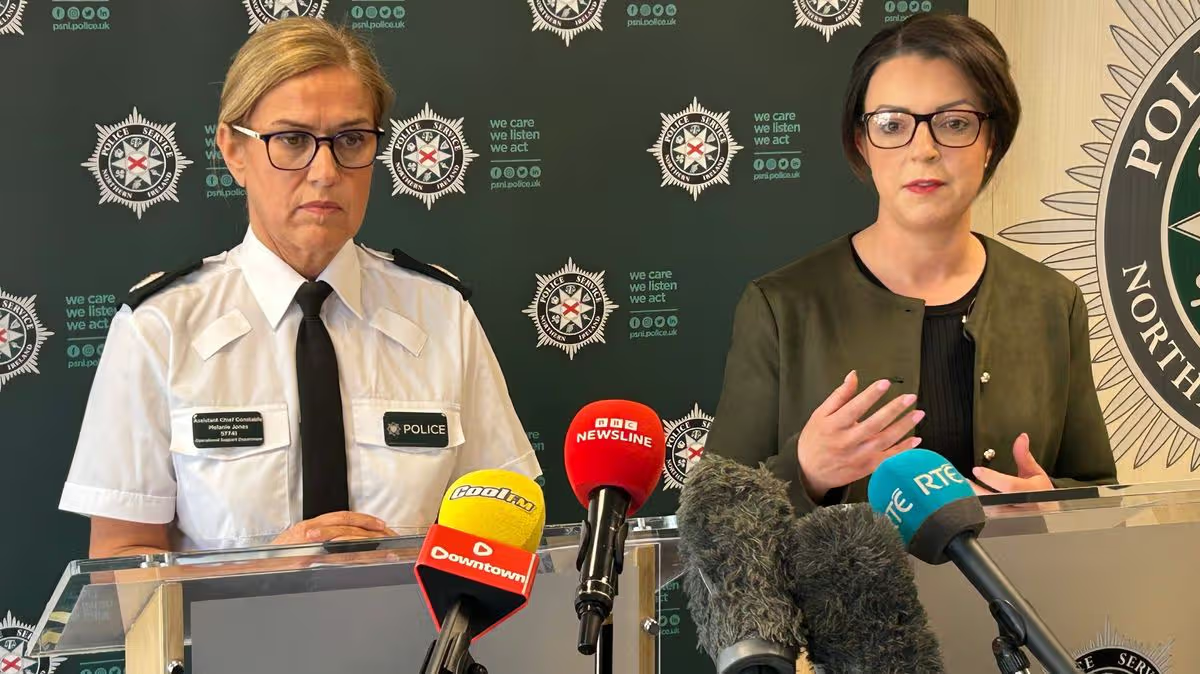
Speaking ahead of the bank holiday weekend, Infrastructure Minister Liz Kimmins and Assistant Chief Constable Melanie Jones issued the joint safety appeal “in the wake of what has been a horrendous weekend on our roads”.

Advertisement

ACC Jones said: “The past weekend has been catastrophic on our roads. Within 24 hours, between Saturday 25 April and Sunday 26 April, five people lost their lives as a result of road traffic collisions. “The thoughts and sympathies of the Police Service of Northern Ireland are with the families and the loved ones of those who have died, and those who were injured.” She added: “These deaths are a stark and cruel reminder of the very real dangers that exist on our roads. Twenty nine people have lost their lives on roads in Northern Ireland so far this year – what we might think of traditionally as the size of a school class. “This is 29 families whose lives have been changed in an instant and forever – friends and communities left devastated.” Minister Kimmins said: “We are just four months into 2026 and so far, 29 people have died on our roads. That means, on average, a life has been lost every four days. They set off on what was to be an everyday journey, but it turned out to be their last day.

“The loss occurs in an instant, but the devastation it causes lasts a lifetime for those left behind and I send my heartfelt condolences to everyone who is grieving today. “As we head into the bank holiday weekend, my appeal is for everyone using the roads to take extra care. Control your speed, put your phone away, never drink or drug drive, don’t get distracted and always wear your seatbelt. “We all want to get out and about to enjoy the good weather with our friends and family. We’ve all got plans, places to be. Let’s make sure we all get there – and get home – safely.”

ACC Jones noted that we’re heading into another busy period on our roads with the first of the May bank holidays and the North West 200 in Portrush next week.

She said: “Lots of people will be socialising, travelling to meet family and friends and our appeal is please be careful on our roads. The Police Service will have a visible enforcement presence on the roads across Northern Ireland, working to prevent and detect Fatal Five offences, including drink/drug driving and excess speed.

Advertisement

“Remember the Fatal Five – control your speed, put down your phone, never drink or drug drive, don’t get distracted and always wear your seatbelt. I do not want to have our officers knocking on anyone’s door to hear the life-shattering news their loved one has been injured, or has died as a result of a collision. “I am appealing to everyone to help ensure everyone makes it home safely to their families.”

For all the latest news, visit the Belfast Live homepage here and sign up to our daily newsletter here.

Source link

Advertisement
Continue Reading

NewsBeat

The Iran war has depleted supplies of tungsten, a critical mineral for the world’s militaries

Published

on

The Iran war has depleted supplies of tungsten, a critical mineral for the world’s militaries

The US and Israel’s conflict with Iran has drained munitions at an astonishing rate. This is placing pressure on the supply of a crucial metal: tungsten.

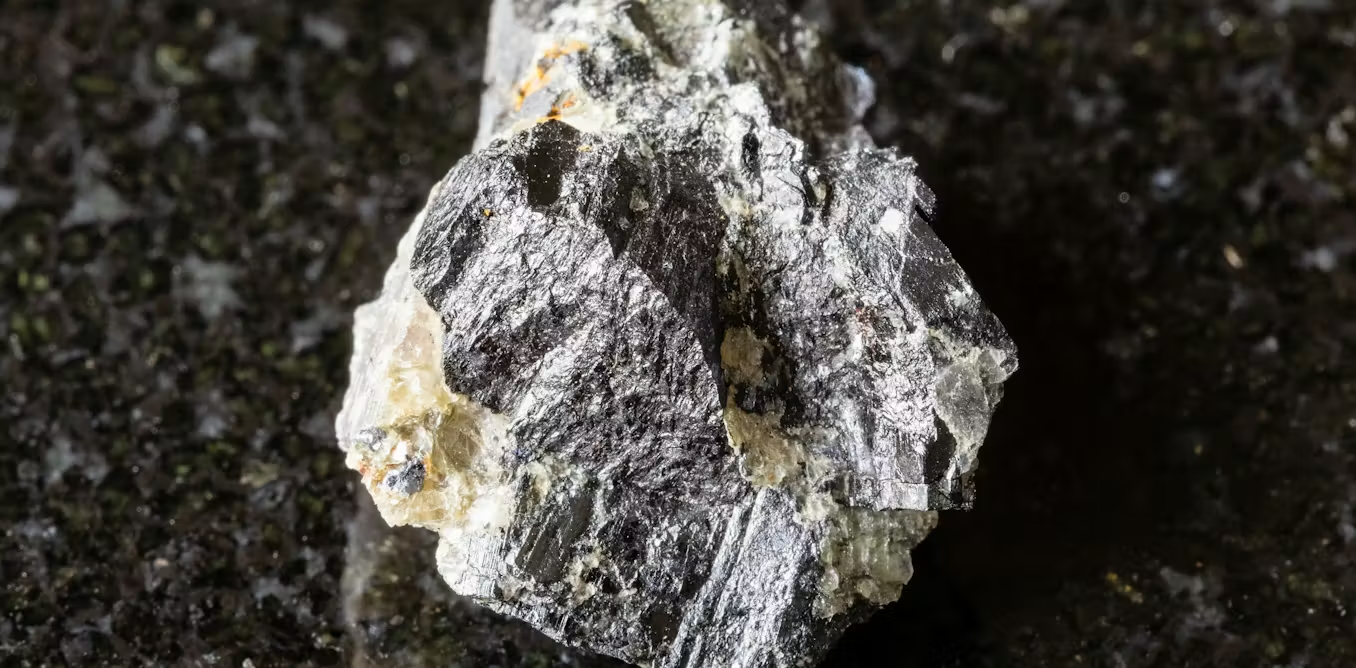
Tungsten is used in armour piercing munitions, in components that need to withstand high levels of heat and is an important additive in steel. Militaries around the world would grind to a halt without this strategically important element.

Yet, despite the current demand, the amount of tungsten mined each year is dwarfed by other metal ores, such as iron and aluminium (bauxite).

In addition, most of the world’s tungsten comes from China, which has recently placed restrictions on supplies. For some countries, including the UK, the push to secure new tungsten resources has never been more vital.

Advertisement

The English name for tungsten, comes from the Swedish “tung sten”, meaning heavy stone. Tungsten’s extreme hardness and resistance to thermal shock are what make it sought after for military technology.

In armour piercing munitions, dense tungsten alloy rods use the sheer velocity of their impact to tear through the armour on fighting vehicles and other hardened targets.

Tungsten’s properties mean it is widely used in munitions.
US Navy

When purified, tungsten has the highest melting point of all metals: 3,422°C (6,192°F). Unsurprisingly, it is used in components that need to withstand high temperatures, such as those inside aircraft engines.

Tungsten, along with other metals such as molybdenum, is added to steel to improve its “hot hardness”. Where normal steel would deform at high temperatures, adding the other metals improve steel’s resistance to deformation at high temperatures.

Advertisement

They form carbides with the carbon in steel, making it more resistant to wear, and resisting “creep”, where steel deforms in response to constant stress at high temperatures. Because the tungsten and molybdenum atoms are significantly larger than iron atoms, they improve the “yield strength” of steel, preventing defects in the metal lattice from spreading. Steel is used to make lots of military hardware so tungsten is vitally important.

Limited availability

Having said all that, the global tungsten market is small, tungsten is what is known as a “minor metal”, because it isn’t traded openly on exchanges like the London Metal Exchange. This makes pricing data opaque. While mining operations around the world produce around 2.6 billion tonnes of iron ore every year they only produce around 84,000 tonnes of tungsten.

Tungsten is also considered (alongside tin, tantalum and gold – a group often known as 3TG metals) as a conflict mineral. A significant quantity is mined in regions plagued by violence, forced labour and human rights abuses.

China produces around 80% of global tungsten – and does it so cheaply that it is hard for western firms to compete. In the US, commercial tungsten mining ceased in 2015.

Advertisement

Beijing is leveraging its dominant position to control tungsten supply through a sophisticated state trading and licensing regime. Exports of critical derivatives are restricted to a “whitelist” of authorised state owned firms.

This funnels a huge supply of the metal through a government monitored pipeline. In February 2026, China imposed export controls and reduced mining quotas, limiting tungsten availability. Beijing’s actions have introduced significant friction into western supply chains for military and aerospace applications of tungsten.

Draining stockpiles

Amid the geopolitical turmoil that is unfolding in the Middle East, there is a newfound gargantuan appetite for tungsten, with every bomb, missile and kinetic interceptor further draining stockpiles.

This presents an intractable problem for the defence industry. There has been a 12% increase in the use of military tungsten this year alone – in helicopters, fighter jets and munitions. This is hard to accommodate in a market with no availability.

Advertisement

Global logistics are further complicated by the challenges to global shipping created by the war. This puts a strain on the movement of mining equipment and supplies for processing by the handful of mines outside of China.

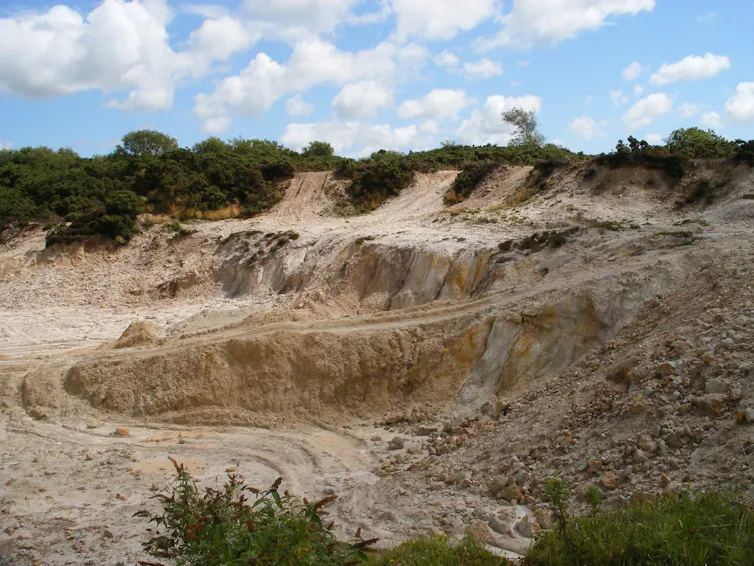
The Hemerdon Mine in Devon hosts the fourth-largest tin-tungsten deposit in the world
The Hemerdon Mine in Devon hosts the fourth-largest tin-tungsten deposit in the world.
Southwesterner / Wikimedia

Today, there is an economic and strategic opportunity for the UK. The Hemerdon mine in Devon hosts the fourth-largest tin-tungsten deposit in the world, and is a “shovel ready” project being revived by Tungsten West, a mining development company.

Further south, Cornwall Resources’ Redmoor site has revealed high-grade tungsten, tin and copper deposits. This could give the UK a competitive edge in mining and primary extraction, given the current market conditions.

Tungsten also has a recycling rate of 42%, which is higher than for many other critical materials. The recycling rate is the proportion of end-of-life tungsten that is diverted from landfill and made available for reuse. Around 30-35% of the global tungsten supply is derived from scrap (which is to say the proportion of new material made from recycled content).

In western markets, this figure is approximately double – around 70%, because of China’s dominance of the tungsten market. This scrap comes from both manufacturing waste and end-of-life products.

Advertisement

How the British military dealt with a molybdenum shortage in second world war.

However, supply shortages can often be a catalyst for innovation. In the second world war, metallurgists faced a critical shortage of molybdenum. German U-boat attacks on shipping convoys stymied supplies of this material. This forced metallurgists at UK engineering company Vickers to innovate, and recycle molybdenum from mining drill bits.

In the past, war has forced innovation to ensure the flow of critical materials – We can learn lessons from Britain’s response to molybdenum shortage in the second world war.

The limited global tungsten supply continues to present significant challenges for many countries. One factor that limits stocks is deteriorating ore grades from primary supply (which is to say the concentration of valuable metal inside mined rock is dropping over time). Another is the restrictive export licensing from China.

Advertisement

The current situation has pushed prices to historic highs and challenges the just-in-time nature of many supply chains.

Source link

Advertisement
Continue Reading

NewsBeat

Why the world needs the UN to keep an eye on AI

Published

on

Why the world needs the UN to keep an eye on AI

AI doesn’t have a boss. It doesn’t really care about rules. And most of us don’t have any say over what it will do next.

Yet the technology is all around us, firmly established in workplaces, financial systems, healthcare and defence. So maybe it needs someone to keep an eye on its progress and set some boundaries.

The UN certainly thinks so, and recently decided to set up an independent panel to monitor AI’s future development. It seems like a sensible move, but this attempt to create a successful forum for “rigorous, independent scientific insight” also highlights the inherent difficulties of governing technology on a global scale.

For a start, the US, which dominates AI development, doesn’t want anything to do with the panel. It voted against the UN’s idea (so did Paraguay), calling it “significant overreach”.

Advertisement

But the UN argues that AI affects everyone, and requires some global coordination. UN secretary-general António Guterres has described the new panel as the first “fully independent scientific body dedicated to helping close the AI knowledge gap and assess the real impacts of AI”.

As with some of the UN’s other forums, like the Intergovernmental Panel on Climate Change or the International Atomic Energy Agency, the AI panel would not write the laws, but would help establish common ground rules and standards that everyone can agree on.

AI is a different beast though. Unlike climate policy or nuclear materials, which are the responsibility of national governments, AI’s progress is largely driven by private – and very wealthy – firms.

International coordination is much more difficult, and already the US, the EU and China are taking different approaches to governance.

Advertisement

The EU takes a fairly cautious line, with strict rules on high-risk applications in areas like recruitment or law enforcement. The US favours voluntary standards within the industry. Meanwhile, China treats AI development and control as a matter of state.

When different parts of the world approach things so differently, there is a risk that any attempt at global cooperation will simply not work. Big firms could simply move their headquarters to whichever part of the world they consider to be the least restrictive. Technical rules can then become geopolitical tools rather than shared protections.

But the biggest challenge goes beyond technical coordination, because AI is fundamentally a technology of power which involves control over information, opportunity and surveillance.


À lire aussi :
Could revisiting Asimov’s laws help us avoid AI’s ‘Chernobyl moment’?

Advertisement

There have already been cases of AI being used in predictive policing models that disproportionately target communities. It has been part of automated welfare systems that exclude the vulnerable and decide on access to credit or housing.

Digital accountability

This is not the first time that a powerful digital force has surged ahead while oversight lags behind.

I witnessed this firsthand with research I carried out with colleagues about Bitcoin.

When we published our findings about Bitcoin’s massive energy footprint in 2021, the reaction was immediate and global. It triggered a debate that shook the industry, and demonstrated that digital systems can cause to the world.

Advertisement

AI is now on the same path, but the stakes are exponentially higher, affecting not just energy grids, but society itself.

AI-generated political statements, religious sermons and news footage circulate on screens everywhere. And when people cannot reliably distinguish authentic authority from artificial output, social trust is eroded.

AI could make online incitement easier, cheaper, more personalised and more widespread. Some civil leaders have claimed that digital radicalisation, the process by which people adopt extremist views through online content, could be intensified by these tools.

Societies everywhere are already grappling with AI’s wider social consequences.

Advertisement

The head of the Muslim World League, an international non-governmental Islamic organisation, Mohammad bin Abdulkarim Al-Issa, has warned that AI may “manipulate the ideologies and beliefs that connect and influence billions” with extremist messaging.

Having seen how groups like Islamic State exploited social platforms for recruitment and division, he also argues that the danger lies not only in what is said, but in the loss of identifiable authority behind it. Elsewhere, the Pope has warned that AI must never diminish human dignity or reduce people to data points.


À lire aussi :
AI laws overlook environmental damage – here’s what needs to change


These kinds of worry reflect legitimate concerns about how technological platforms can fracture societies when ethical guardrails fall behind. And this is precisely where the UN may have an important role to play.

Advertisement
UN v AI?
Aditya E.S. Wicaksono/Shutterstock

Historically, its strength has never depended on enforcement power so much as on symbolic authority and its ability to articulate widely shared goals designed to improve people’s lives.

The UN’s 1948 Universal Declaration of Human Rights became the foundation of modern human rights law, by reshaping what governments could plausibly justify. Likewise, the global eradication of smallpox showed how a shared UN-backed objective could enable cooperation even across geopolitical divides.

Perhaps the real question, then, is not whether the UN should try to regulate AI directly. It is whether the world can afford a fragmented AI order defined solely by markets, geopolitics and billionaires, with no common ground.

Because while the promise of AI is staggering, serious and dangerous failings could yet emerge from the unfilled gaps in governance. The UN could help to avoid them.

Advertisement

Source link

Continue Reading

NewsBeat

Live A470 updates as fire blocks road near Bannau Brycheiniog

Published

on

Wales Online

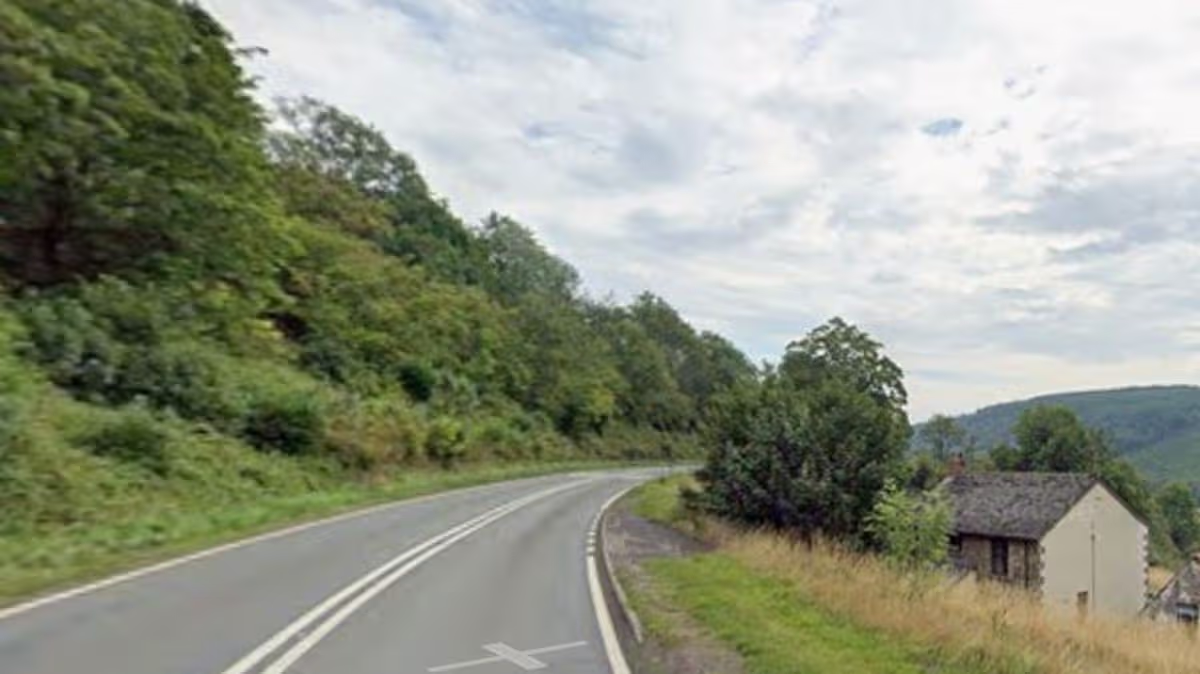
Part of the A470 in Powys is blocked in both directions due to a fire. According to traffic service Inrix the incident has been ongoing since 8.14pm from the A4059 to Llwyn Onn Guest House, Merthyr Tydfil.

A social media report suggests affects a mountainside of Bannau Brycheiniog (Brecon Beacons National Park). Stay informed on everything Merthyr Tydfil by signing up to our newsletter here

The post states: “The smoke was pretty intense on the A470 as I had been coming through… Especially on me passing the junction for Garwnant.” According to Inrix the fire is “serious”.

Advertisement

The incident comes as a separate fire continues to cause disruption in Port Talbot.

Get daily breaking news updates on your phone by joining our WhatsApp community here.

We occasionally treat members to special offers, promotions and ads from us and our partners. See our Privacy Notice

Source link

Advertisement
Continue Reading

NewsBeat

Coronation Street star Pauline McLynn reveals ‘plans to kill Maggie off’ amid Murder Week

Published

on

Daily Mirror

One star of Coronation Street has revealed that bosses told her that there were initially plans for her to kill her off when she signed on to appear in the soap last year

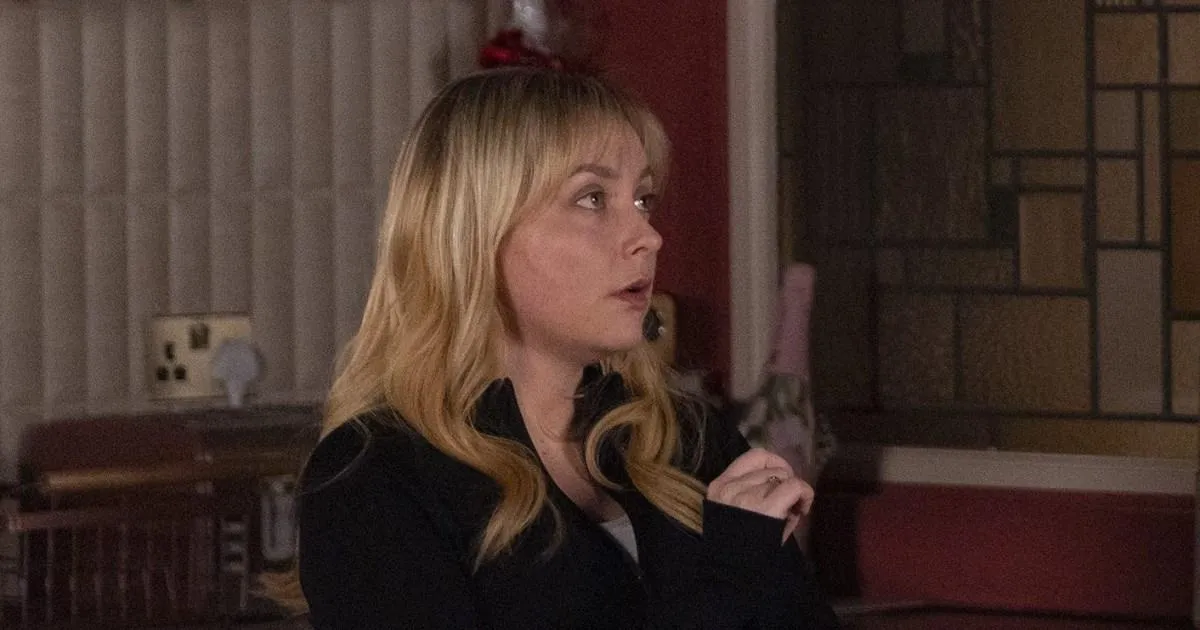
Pauline McLynn was told by Coronation Street bosses that there were plans for her to be killed off when she first joined the soap.

The actress, 69, who is best known her her role as Mrs Doyle on classic sitcom Father Ted, arrived on the world’s longest-running TV soap towards the end of last year as the Irish matriarch who had bought the Rovers Return Inn.

It was established early on that Maggie had a dark past and a flashback set in Ireland revealed she had been responsible for the death of her husband Alan, pushing him down the stairs in an argument all those decades ago, witnessed by their son Finlay.

Advertisement

READ MORE: Coronation Street Jodie’s fate ‘sealed’ as actress warns fans will be ‘shocked’ by deathREAD MORE: Coronation Street star Sally Dynevor: I’d play breast cancer storyline ‘differently’

In a radical format change, bosses decided to air a flashforward earlier this year that confirmed that either Maggie, or one of her fellow villains – Carl Webster (Jonathan Howard), Theo Silverton (James Cartwright), Megan Walsh (Beth Nixon), Jodie Ramsey (Olivia Frances Brown) would be killed off in scenes that are playing out this week, with each episode detailing the same day’s events but from each character’s point of view.

Asked how she feels about playing one of the soap’s many antagonists, Pauline said: “It’s nearly the biggest compliment I’ve been paid for a long time! I’m not interested in nice people. I far prefer to be a villain.” The star then revealed that she was told early on that Maggie would not be leaving the soap alive.

Advertisement

She added: “I will say this, when I joined the show, I was told that the plan for the character was to kill her. So we shall see! I think you’ll find when you watch all of the five stories that it’s very possible more than one person is dead, that’s another thing I will say.

“And the third thing, is that the wonderful [producer] Kate Brooks said to me once, you’re going to get a set of scripts and it looks like you’re dead – and you might be. I just wanted to warn you! We don’t know.”

Pauline then teased that it could indeed seem like Maggie is the victim in question by the end of the week, but warned fans to not be so sure.

Advertisement

She added: “I do seem very dead at the end of the week. Assume nothing. You might be being fed one thing which is true, but it could be more than one. It’s also brilliantly clear that any one of the five could be a killer, whether or not they’ve killed the person you believe to be dead or not. It’s brilliantly seeded in. There is a justice in Coronation Street, if you do a crime, you have to pay the price.”

Coronation Street boss Kate Brooks said of the big week: “It was a very complicated storylining process! I did lose a bit of sleep and my hair went a little bit greyer. Usually in a murder week you’ve got one victim, then the suspects – we had five potential suspects had to make sure all the stories aligned, made sense and they were all getting to the right place and coming together.

In the build-up it’s gearing up and the momentum is really strong, it could be any of them. Stars aligned to get to this juicy week. The flipside is going forward, there’s so many consequences for each individual character.

Then we’ve also got the who did it, that big story as well going forward as well as unpacking what’s going on with all those other characters. Very complex, but satisfying and enjoyable as well.”

Advertisement

Coronation Street airs weeknights at 8:30pm on ITV1 and ITV X.

* Follow Mirror Celebs and TV on TikTok , Snapchat , Instagram , Twitter , Facebook , YouTube and Threads .

Source link

Advertisement
Continue Reading

NewsBeat

DNA trace on discarded chicken bone snared hungry thief for student flat burglary

Published

on

Wales Online

Police found Shane Sweeney’s DNA on a bone left in the property he’d just burgled, event though he claimed it couldn’t have been his as he ‘didn’t like chicken’

Advertisement

A thief who broke into a student’s house and stole items including car keys and a laptop was caught after his DNA was discovered on a chicken bone left at the scene. He disputed being responsible following his arrest, claiming he “didn’t like chicken”.

Shane Sweeney, 28, carried out a burglary in Cardiff between January 24 and 25 while his victim was out working in the early hours of the morning. Upon her return, she discovered a number of items had been taken including a 65-inch television, two laptops, jewellery, a gold bar, bank cards and car keys.

A sentencing hearing at Cardiff Crown Court on Wednesday heard the victim’s Vauxhall Corsa was taken, but this was not connected to the defendant. Make sure you never miss Wales’ biggest updates by getting our daily newsletter.

The vehicle was later abandoned and discovered in Trowbridge.

Advertisement

The back door of the property, in Cathays, had been left open, the window was left ajar and a safety cable had been snapped.

A chicken bone was found on the kitchen table and when analysed, it was found to contain a DNA profile matched with Sweeney.

He was arrested and told police he was not responsible for the burglary, claiming he “didn’t like chicken”.

The victim said the burglary had affected her “physically, psychologically and financially” and she had been forced to pause her studies due to the stolen laptops containing her diploma assessment.

Advertisement

She added: “I can’t believe someone could do this to me.”

Prosecutor Hannah Head said the defendant was also to be dealt with for seven cases of shoplifting, committed between November last year and March.

The thefts took place at stores including Spar, in Abergale Road, Trowbridge, Sainsbury’s, in Newport Road, One Stop Shop, in Llanrumney, and the Co-Op in Pontcanna.

Among the items taken by Sweeney were cans of Coke, washing pods, alcohol, cleaning products, chocolate, meat, and Lindt easter eggs.

Advertisement

The total value of these items was £686.

Sweeney, of no fixed abode, later pleaded guilty to burglary and seven counts of theft from shops.

The court heard he had previous convictions, including 23 offences of theft and offences of non-dwelling burglary and shoplifting.

In mitigation, Hannah Friedman said her client was remorseful for his offending and wished to apologise to the victim of the burglary, having stated he was “not a burglar but a shoplifter”.

Advertisement

The defence barrister said the defendant did not carry out the offences alone, and was “misled” by a group of friends.

He moved to Wales from Ireland at the age of 18 and suffered a fractured vertebrae in a bike accident which left him addicted to opiates as pain relief.

This caused the defendant’s life to “spiral” but he wished to rebuild his life and establish a relationship with his three children.

Recorder Andrew Hammond sentenced Sweeney to a total of 24 months imprisonment.

Advertisement

Get daily breaking news updates on your phone by joining our WhatsApp community here. We occasionally treat members to special offers, promotions and ads from us and our partners. See our Privacy Notice.

Source link

Continue Reading

NewsBeat

Coronation Street star confirms comeuppance for Megan | Soaps

Published

on

Coronation Street star confirms comeuppance for Megan | Soaps
Sooner or later, justice always comes to Corrie. (Picture: Shutterstock/getty/ Metro)

Some villains are just too evil to change their ways. Coronation Street’s child groomer Megan Walsh is a prime example. Now Megan’s dirty secret is out, actress Beth Nixon reveals that the predatory teacher will receive justice – one way or another.

The monster is revealed. Now that everyone on the Street knows that doe-eyed, butter-wouldn’t melt athletics coach Megan Walsh has been grooming underage Will Driscoll (Lucas Hodgson-Wale) into a perverse ‘relationship’, she’s personal non-grata on the Cobbles.

Although Megan plays the victim and maintains she’s the victim of a schoolboy crush gone wrong, nobody believes her. The Driscolls are baying for her blood, and the Barlows want her to pay for her torment of Sam Blakeman (Jude Riordan) who she tried to bully into keep quiet about her predatory ways.

Now that Corrie’s murder Whodunnit story upon us, Megan is one of five potential victims who could be for the chop. With the end possibly in sight, actress Beth Nixon reflects on her time portraying the villain.

Advertisement

‘I mean, I love playing Megan because she’s so horrible. They’re my favourite types of characters to play. But I’ve loved it. It’s such a, like, there’s so much room to play with her because she just tells lies like they’re nothing. So there’s so many layers to the character.’

Megan talks to Will on the street
Megan has Will wrapped around her little finger.

‘I’ve loved playing Megan. And then the public reaction, I think obviously people hate her and, she’s a cow. But then it’s quite interesting because I think there’s people who are trying to understand her because we’ve never gone into why she’s doing the things that she’s doing.’

‘Like, why is she grooming young boys? There’s no justification because it’s unjustifiable, isn’t it, really? But I think that’s really nice from the storytelling point of view that there’s no point in justifying it, we don’t know why she’s doing it and it doesn’t matter.  So I think that’s great because it’s great for me because I can kind of just justify it as Megan, however she would.’

Beth raises a good point. The only thing missing from Megan’s story is motive.

Quite rightly, the story has been largely focused on Will’s experience and the perspective of his dad Ben Driscoll (Aaron McCusker) and his stepmother Eva Price (Catherine Tyldesley). There’s been little exploration of Megan’s past, or why she chooses to target the young and vulnerable.

Advertisement
Eva, Maggie and Ben stood outside the Rovers
The Driscoll family have been torn apart by Megan’s abuse of Will. (Picture: ITV)

‘I think that she doesn’t think that she’s doing anything wrong because she’s just so delusional.’ Beth explains.

‘But it’s been interesting to see the public try and figure out like, I wonder why she’s doing this? Why is she doing that? Like, it makes no sense, why would she do that? But it does make no sense because why would you be attracted to a child? ‘

‘Exactly like with Carl (Jonathan Howard), he’s a tortured soul. He’s had all of these things happen to him through his life. So you can kind of go, ‘oh yeah’. Whereas with Megan, which is great because you can go so far with her. She’s unredeemable. So you can just like go for it.’

Don’t miss a Soaps scoop! Add us as a Preferred Source

As a loyal Metro Soaps reader, we want to make sure you never miss our articles when searching for stories. We have all the latest soaps news, spoilers, videos, and interviews, with a vibrant community of highly engaged readers.

Click the button below and tick Metro.co.uk to ensure you see stories from us first in Google Search.

Advertisement

Add us as a Preferred Source

Soaps authors collage Fact box image only Picture: Metro
Now you can ensure you never miss a story from the Soaps team

Irredeemable is right. Even now her sickening crimes have come to light, the police have not been able to charge Megan because she was careful enough not to leave a shred of evidence – aside from the baby she was carrying.

While she told everyone that Daniel Osbourne (Rob Mallard) was the biological father, her relationship with the unfortunate Headmaster of Weatherfield High was only ever a cover for her grooming. Will was the father, and when his grandmother Maggie Driscoll (Pauline McLynn) attacked her in a fury, Megan had the perfect opportunity to have a termination in a secret and pretend she lost the baby due to the assault.

Advertisement
Maggie Driscoll holding Megan Walsh up against the wall during a confrontation in Coronation Street.
Megan used Maggie’s loss of temper do her advantage. (Picture: ITV)

‘I think she believes that she can talk herself out of anything. I think she just thinks that she can play everybody into the palm of her hand. She’s obviously a master manipulator and she turns the waterworks on and she victimises herself a lot. And if that doesn’t work, then she changes tact.’

‘So I think as it progresses, she does have moments of worry. But I think that she almost goes: “Right, my image that I’m building, get back into that, put the victim front on.” I think that she thinks she can worm her way out of it. And obviously, Will is key to that because if he starts admitting what’s been happening then it’s over pretty much because they don’t have any evidence, of course, at the moment. ‘

Will just might be the least of Megan’s problems.

Right now, Eva has teamed up with Leanne (Jane Danson) and Toyah Battersby to form a terrifying trio hellbent on getting a confession from the peadophile by any means necessary.

Unfortunately, all they did was manage to plant a tracker in Megan’s bag. Megan reported Eva to the police for assault, and rubbed salt in the wound by gloating to her face about sleeping with Will.

Advertisement
Leanne and Toyah Battersby and Eva Price physically attacking Megan Walsh in Coronation Street
The girls’ first attempt to get Megan’s confession did not go well. (Picture: ITV)

Now more determined to prove Megan’s guilt than ever, the three women confront the abuser in tomorrow’s episode. But when things go south, Toyah loses her temper and makes things worse by punching the abuser in the nose!

Up until now, Megan’s underestimate the trio. Beth Nixon explains why.

‘They’re not natural kidnappers. They don’t know what they’re doing. They’re like: “oh, I don’t know”. Don’t get blood on me. Obviously, Eva’s like in her pink and in her heels, like dragging me down the street, like clippy clopping her heels. She just thinks, what are you going to do, seriously? And then obviously when Toyah hits her, she goes, right, I’ve got you now.’

Megan Walsh bending over a table, surrounded by Eva Price and Toyah and Leanne Battersby in Coronation Street
Toya lashes out at Megan, (Picture: ITV)

‘You’ve assaulted me. I haven’t touched you, because she’s clever. She doesn’t attack anyone. Like, she just lets them do it to her. She winds them up and winds them up because then she can use that as ammunition.’

But there’s someone Megan underestimates at her peril. Maggie.

The acid-tongued landlady of the Rovers’ Return is prepared to go to drastic lengths to protect her family. She already killed her husband for threatening to expose the fact that Ben was secretly Jim McDonald’s love child.

Advertisement

That makes her a dangerous enemy indeed, which Megan will discover for herself in tomorrow’s episode. After escaping the wrath of Toyah, Leanne and Eva, she finds herself face to face will the killer granny.

Beth admits that Megan isn’t taking any chances.

‘Out of all the characters, I think Maggie is probably the one that Megan would be most scared of. She’s got a few secrets of Maggie’s. Like, she knows what she’s capable of. So I think, yeah, in a way she does get to her a little bit.’

Maggie confronts Megan.
We wouldn’t like to be in Megan’s shoes right now. (Picture: ITV)

‘But [Megan], again has got such a high opinion of herself that I think that she just thinks that she can outsmart her. And I think, if anything, if she goes head-to-head with her, then that makes Maggie look bad as well. Just using that again as ammunition. But yeah, I think she probably is a little bit scared. Quaking in her boots a little bit.’

So she should be. Megan is one of five cobbles villains who could be killed off in Corrie’s much anticipated murder week. There’s certainly no shortage of suspects. Is it curtains for Megan? Beth looks back on her time in the show.

Advertisement

‘It’s crazy. It’s crazy. This is my first TV job, so this is all, like, completely new to me. So, yeah, it’s just exciting. Like, when I watched the promo, then I was like, it looks like I’m in a movie. Yeah, it’s just amazing, I’ve had so much fun with it. And then especially doing Murder Week, like, it’s just honestly, like, one of the most amazing experiences I’ve ever had. So, yeah, I’m excited for you all to see it properly.’

So are we, Beth. So are we.

If you’ve got a soap or TV story, video or pictures get in touch by emailing us soaps@metro.co.uk – we’d love to hear from you.

Join the community by leaving a comment below and stay updated on all things soaps on our homepage.

Advertisement

Source link

Advertisement
Continue Reading

NewsBeat

Atletico Madrid vs Arsenal LIVE: Score and updates for Champions League semi-final

Published

on

Atletico Madrid vs Arsenal LIVE: Score and updates for Champions League semi-final

Atletico 0-1 Arsenal

45+1’ – Lookman fires harmlessly wide. Watching the penalty back, Oblak may be disappointed not to get a hand on it. He went the right way but it was so powerful that it flew between his hands.

Alan Smith29 April 2026 20:48

Advertisement

Atletico 0-1 Arsenal

45’ – There will be two added minutes.

Alan Smith29 April 2026 20:47

Advertisement

GOAL! Atletico 0-1 Arsenal (Gyokeres, pen)

44’ – He who wins it, takes it. Gyokeres drives ferociously into the bottom left corner and that goes a little way to repaying the transfer fee.

Alan Smith29 April 2026 20:46

PENALTY ARSENAL! Atletico 0-0 Arsenal

43’ – VAR is checking but Gyokeres, fed by Zubimendi two yards inside the box, goes down following a clear shove on the back from Hancko.

Advertisement

Alan Smith29 April 2026 20:45

Atletico 0-0 Arsenal

42’ – Atleti break swiftly down the right with a move that finally ends with Alvarez looking well placed to shoot inside the box… until Rice recovers brilliantly to intercept.

Alan Smith29 April 2026 20:44

Advertisement

Atletico 0-0 Arsenal

40’ – Martinelli, quiet until now, shuffles in from the left and has a low-odds shot blocked.

Alan Smith29 April 2026 20:42

Advertisement

Atletico 0-0 Arsenal

39’ – Hincapie has been excellent. Not content with keeping Simeone quiet, he’s now made a solid block to stop Koke’s delivery.

Alan Smith29 April 2026 20:41

Atletico 0-0 Arsenal

35’ – Arteta will be delighted with this so far. Alvarez is now beginning to drop a little deeper to get involved a bit more but Arsenal’s back four are moving as a unit and the midfield is working tirelessly in front of them. No one was anticipating thrill a minute and so it has proved but there is something to admire about how methodically Arsenal are going about their business so far.

Advertisement

Alan Smith29 April 2026 20:39

Atletico 0-0 Arsenal

30’ – Chance! Rice does well to beat Lookman to the ball. Odegaard then feeds Madueke, who drives forwards and shoots a yard or so wide with Oblak at full stretch.

Alan Smith29 April 2026 20:32

Advertisement

Atletico 0-0 Arsenal

29’ – Half-chance. Alvarez creeps in front of Gabriel but cannot direct a cross from the left on target.

Alan Smith29 April 2026 20:31

Source link

Advertisement
Continue Reading

Trending

Copyright © 2025