
The inaugural meeting of Donald Trump’s board of peace in Washington on February 19 caps a busy week for US diplomacy – though, not necessarily for the country’s professional diplomats. These people have been largely sidelined in the close-knit circle of the US president’s personal envoys, his former real-estate business partner Steve Witkoff and son-in-law Jared Kushner.
Earlier in the week, Witkoff and Kushner attended two separate sets of negotiations in the Swiss city of Geneva. They first sat down for indirect talks with Iran before then leading negotiations between Russia and Ukraine. They then dashed back to Washington to attend the board of peace meeting.
At best, Witkoff and Kushner have a mixed track record of diplomatic success. Kushner was a key mediator in the Abraham accords during Trump’s first term in office. Designed to normalise relations between Israel and other states across the Middle East, the accords have failed to create sustainable momentum for regional peace and stability.
So far, only the United Arab Emirates, Bahrain, Morocco and Sudan have established full diplomatic relations with Israel. Saudi Arabia, an influential player in the Middle East, has not followed suit.
Witkoff has been credited with playing a key role in mediating the January 2025 ceasefire between Israel and Hamas and the Gaza peace plan later that year. This latter plan, with endorsement from the UN security council, gave rise to Trump’s board of peace.
Both men have also been at the centre of efforts to end Russia’s war against Ukraine. Witkoff has been involved from the start of Trump’s second term, with Kushner joining more recently at the end of 2025.
Yet, neither Kushner’s addition or a greater focus on a parallel track of negotiations between Washington and Moscow focused on the mutual economic opportunities that peace between Russia and Ukraine would create have brought the warring sides closer to a deal.
Taken together, the outsized roles that Witkoff and Kushner are playing in US diplomacy despite their limited success expose a fundamental misunderstanding of peacemaking at the heart of Trump’s approach to international affairs.
Abedin Taherkenareh / EPA
Peace deals are generally complex. To get one across the line usually requires mediators and support teams that are deeply knowledgeable of the conflict in which they are mediating and have broad knowledge of how a plethora of issues can be resolved in a technical sense.
Above all, they need to understand what has driven the parties to conflict and what might induce them to cooperate. While material incentives such as the promise of economic development in exchange for peace are important, warring parties often also have symbolic and psychological needs. These also need to be addressed to ensure the parties sign on the dotted line.
Having just two people with little prior experience of diplomacy and almost no expertise on either of the two conflicts they are currently mediating simultaneously is a recipe for failure. It is likely to lead to a deal being pushed that is simply unattainable in the short term because at least one party will not sign.
And if a deal is, against the odds, agreed because of high pressure on one or both sides, it is likely to be unsustainable in the long term as at least one of the parties will probably defect and violence will resume. This is particularly likely if a deal lacks sufficient guarantees, which lowers the threshold for defection for parties who are not negotiating in good faith.
Ukraine peace negotiations
It is easy to see how such calculations apply in the context of the war against Ukraine. The Ukrainian president, Volodymyr Zelensky, has repeatedly made it clear that the Kremlin’s demands – especially Ukrainian withdrawal from the territory in the east it has successfully defended against Russia’s aggression – are not something he will agree to.
Even if he did, such a deal would almost certainly be rejected in a referendum. It will be psychologically close to impossible for Ukraine and Ukrainians to accept the humiliation of giving up something they have not lost, to reward Putin’s aggression and to be sold down the river by Trump in his pursuit of an economic side-deal with his Russian counterpart.
Similarly, it is easy to see that Russia is not negotiating in good faith. Moscow is presenting Kyiv with an ultimatum while destroying as much as possible of the country, both to weaken Ukraine’s will to resist and to undermine its future recovery. Add to that Russian resistance to credible security guarantees and the true intent of Russia’s negotiation strategy is not to achieve sustainable peace but to prepare for the next war.
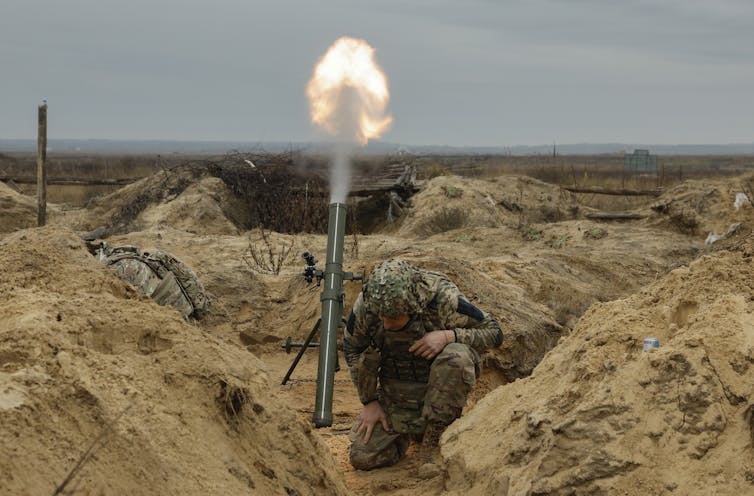
Sergey Dolzhenko / EPA

If and when negotiations on Iran or Ukraine break down or the agreements they might achieve collapse, there will also need to be supporting frameworks in place that can manage the consequences. Trump’s board of peace, which looks like a privatised version of the UN, is unsuitable for such a task.
Not only does it lack the legitimacy the UN has. There is also no indication that its members – be they the countries attending the inaugural meeting or the people serving at Trump’s pleasure in its executive structures – have the intent or capacity to take any actual peace-making role.
The board’s membership is, numerically at least, far below Trump’s aspirations. Only 24 of the 60 or so invitations sent out have been accepted, with traditional US allies in Europe and the G7 absent from the group. Among the attendees at the Washington meeting are the likes of Azerbaijan, Pakistan, Egypt and even Belarus, a country sanctioned by the US and Europe for its support of Russia’s campaign in Ukraine.
Trump’s board of peace may be able to establish a free economic zone here or there and generate some real-estate development. But much of that will be done to benefit its members’ wallets or egos – or both.