Police confirmed they have ‘limited information’ as officers in Thailand investigate why two boys are in the country
Kelly Williams Content Editor and Matt Jackson Live News Network Reporter
18:22, 27 Jun 2026
Two British teenagers have been detained in Thailand, triggering a police investigation into the “circumstances” surrounding their trip. South Wales Police confirmed on Friday evening that it has “limited information” about the arrests of the 17-year-olds, who are both from Cardiff, reports the Daily Star.
The Foreign, Commonwealth and Development Office is working alongside Thai authorities while police officers are “gathering as much information as possible”.
South Wales Police stated: “We are investigating the circumstances which led to the boys travelling to Thailand. We understand this is a very concerning time for the families and wider community.”
Advertisement
A spokesperson for the FCDO said: “We are supporting two British nationals detained in Thailand and are in contact with the local authorities”.
Anyone with information pertaining to the case has been urged to contact South Wales Police, quoting reference number 2600200125, or to reach out to Crimestoppers anonymously
Ensure our latest stories always appear at the top of your Google Search by making us a Preferred Source. Click here to activate or add us as your Preferred Source in your Google search settings.
Andy Burnham will need a “Moscow test” for his policies if he becomes prime minister, the former Chief of the Defence Staff Admiral Sir Tony Radakin has said.
Burnham, the favourite to succeed Sir Keir Starmer as prime minister, has previously said that new legislation must pass a “Makerfield test”, the constituency he was elected to this month.
Speaking to the BBC’s Sunday with Laura Kuenssberg programme, the ex-military chief said the UK’s next leader would need to operate “almost like a wartime prime minister” in light of global threats.
Sir Tony’s intervention came as the government prepared to publish its long-awaited defence spending plan.
Advertisement
He said that whoever becomes prime minister must fulfil the pledge to increase defence spending to 3.5% of GDP by 2035, describing military capabilities as “too bare”.
Negotiations in Whitehall have continued this week over how the Defence Investment Plan (DIP) will be funded, while the government has committed to releasing it before the Nato summit in Turkey on 7 July.
Defence Secretary John Healey and Armed Forces Minister Al Carns – who has not ruled out challenging Burnham to be Labour leader and prime minister – both resigned from the government earlier this month over what they said was insufficient investment for the plan.
Speaking to the BBC, Sir Tony said: “As well as having the Makerfield test, I would say it’s the Moscow test.
Advertisement
“What do we look like to Moscow? Do we look like a strong member of the Nato alliance? Do we look like a strong nuclear power? Do we look like a strong ally of America?
“Because those are the elements that keep us safe.”
Asked what his message to Burnham would be should be become prime minister, Sir Tony said: “It is keep our country safe, acknowledge that you have this extraordinary responsibility – so you’re almost like a wartime prime minister at the moment.
“And that means you need to invest in what really keeps us safe.”
Advertisement
Sir Tony said the UK’s level of defence spending at present risked falling “short on those commitments, and then that creates a whole load of hurt with our Nato allies and especially our relationship with America”.
Speaking about military capabilities, he said: “We’ve been very clear in saying that we need to strengthen our armed forces. It means additional money for day to day operations.
“That is stores. That is maintenance. That’s how you get those ships out. That’s how your aircraft are available for operations. That’s how your tanks and armored fighting vehicles are available.
“All of that at the moment is too bare.”
Advertisement
Under Sir Keir’s leadership, defence spending has increased and the government has pledged, along with most other Nato allies, to increasing spending up to an eventual ambition of 3.5% of GDP by 2035.
But in his resignation statement, Healey said the planned increase set out in the draft DIP fell well short of what was required, and claimed it would in fact lead to operational cutbacks.
There have been reports the Ministry of Defence (MoD) has asked for an extra £28bn between now and the end of the decade, but had only been offered an additional £10bn.
All government departments have been asked to cut budgets in order to fund the increase.
Advertisement
On Saturday, the (MoD) said £500m would be allocated to equip the UK’s elite Commando Force with new boats in the DIP.
The department said the plan had been “refreshed” over the last fortnight since Healey’s resignation, while his successor Dan Jarvis said it would “prioritise getting the latest kit” into the hands of front-line forces, including “new lethal strike drones”.
Prior to that announcement, Jarvis told BBC South that Burnham “understands the nature and complexity of the world we’re operating in, and national security will be, I know, the first priority of any Labour prime minister”.
He continued: “I am very confident though there will be a transition in prime minister, the basic policies will remain the same, which is ensuring everything we possibly can to keep the country safe…”.
Advertisement
Jarvis also repeated the government’s commitment to publishing the DIP before the Nato summit in July.
Watch Sunday with Laura Kuenssberg at 09:00 BST on Sunday on BBC One and iPlayer.
Bidders from Europe, the USA and South America joined others from across the UK bidding for lots of the 29 horse-drawn vehicle collection put on the market by its owner.
Together they paid more than £200,000 to own carriages that once bowled around some of the country’s great aristocratic estates through to others that have starred in films and television series.
Duggleby Stephenson Managing Director Will Duggleby: “It was absolutely epic, one of the best single-owner auctions we’ve ever seen at our York saleroom.”
Auctioneer Coralie Thomson with a Victorian private omnibus (Image: Duggleby Stephenson)
“It was a very special collection, brought together over a period of about a quarter of a century. Just how much national and international interest the team had managed to generate through the news media and their contact with specialist social media groups became clear earlier this week when we had people from literally all over the country . . . Devon, the South Coast, the North West . . . travelling to York to attend the viewing sessions.
Advertisement
“In addition to that we had people registering to bid from people in the Netherlands, France, Germany, Spain, the United States and, of course, South America.”
Among carriages that went for far more than expected was a horse-drawn Victorian trade cart built in 1895 by J. Herring of Hartlepool. It was expected to make about £3,500 but eventually went for £21,000 to a Yorkshire collector.
The Hartlepool cart that went for five times its expected price (Image: Duggleby Stephenson)
The top price went to a “roof seat brake” by Shanks of London, a high quality coaches maker. It attracted international attention and went for £33,000 to a Kentish buyer who outbid a rival from Santiago in Chile.
The roof seat break – favoured transport of the ultra wealthy race-goer (Image: Duggleby Stephenson)
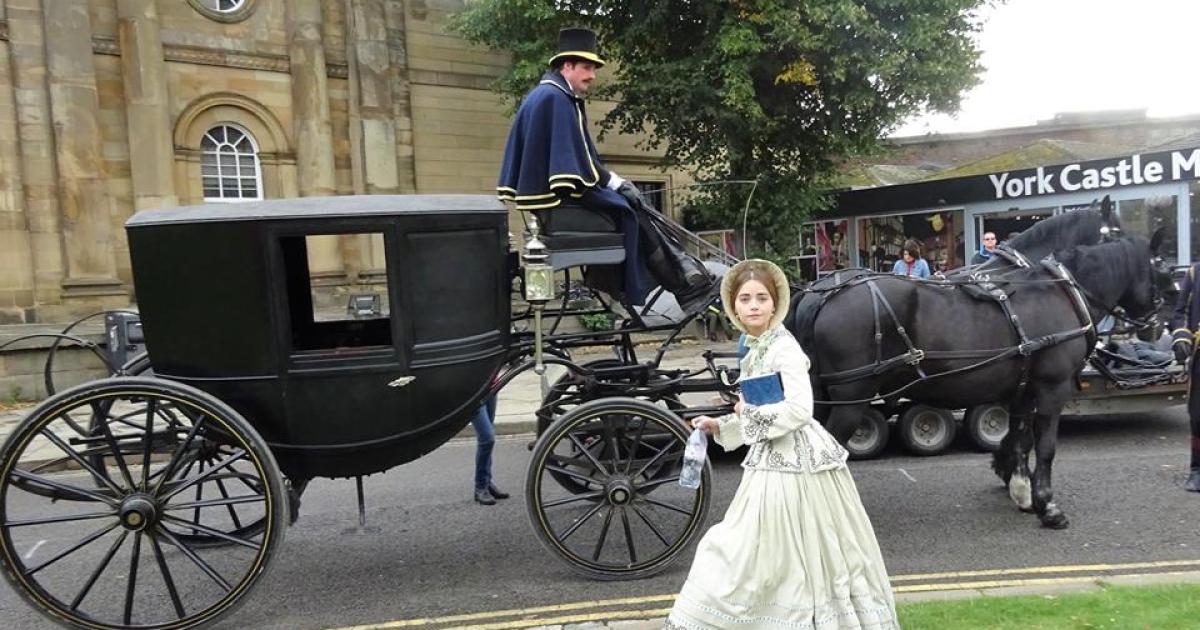
The most famous coach in the sale – a town coach, made by the Victorian carriage maker John Marston that was used in the ITV series ‘Victoria’ staring Jenna Coleman – -made £6,400.
Advertisement
A wild west chuck waggon went for £4,300, more than double the most optimistic predictions, a horse-drawn Victorian London fire engine that had a top pre-sale estimate of £1,200 actually made £5,400, bought by a Newcastle bidder, and a mail phaeton predicted to go for up to £5,000 went for £9,600, snapped up by a Devon enthusiast.
A Victorian London hearse went for £7,800, four times expectations, to an Essex buyer.
The Victorian London hearse (Image: Duggleby Stephenson)
In addition to the carriages and carts the 179 lots in the auction included an extensive range of equestrian and coaching equipment and memorabilia and that provided many more surprises. Half a dozen Victorian top hats made a thousand pounds, yew coaching whips made over a thousand pounds apiece, coaching horns went for as much as two thousand pounds and a four-team set of black leather and brass harness went for £7,800.
Andy Burnham will unveil plans for a ‘No 10 in the North’ in what could be the biggest devolution of power and resources from Westminster in decades.
In his first major policy speech since launching his bid to become Labour leader, the MP for Makerfield will promise to ‘break with business as usual’ by shifting decision-making out of Whitehall, giving regional leaders unprecedented control over housing, welfare and skills.
Burnham will deliver the speech in Manchester on Monday, as he seeks to build on momentum behind his Labour leadership campaign and following his decisive victory in the Makerfield by-election.
The Manchester Evening News understands the proposals include creating a northern headquarters for Number Ten. Any new building wouldn’t be completed until 2028 and an interim base would be used until then.
One option could be the new ‘Manchester Digital Campus’ at the home of the former Toys ‘R’ Us retail store in Ancoats.
The future of the former Central Retail Park had been fiercely debated for years after it was purchased by Manchester council in 2017 and knocked down two years later.
But in March, Chancellor Rachel Reeves gave the green light for the ‘Manchester Digital Campus’, which will see 8,800 civil servants be based at the site, which has been dubbed the ‘Whitehall of the North’.
Advertisement
An estimated 4,900 jobs will be created during construction of the ‘Digital Campus’. Those inside will work for various government departments with a focus on digital work.
Last year, the government announced a major shake-up of the civil service which includes moving jobs out of London. Ministers have already announced plans to close 11 office buildings in Whitehall over the next four years, saving £94million a year.
Burnham is also expected to argue that regional leaders should take on greater responsibility for welfare, post-16 education, and other areas controlled by Whitehall.
The MP for Makerfield will argue that his plans will make the whole country better off. He believes that richer parts of the country have been subsidising poorer areas without addressing the underlying causes of inequality.
People in London pay an average of £24,400 in tax but get back £19,500 in spending on public services – according to the Office for National Statistics.
In the North West, taxpayers on average contribute £12,700 but receive £17,300 in public spending.
Advertisement
Burnham’s agenda is in keeping with the vision set out in his book ‘Head North’, which he co-authored with his friend Steve Rotherham, metro mayor of the Liverpool city region.
“Regional and local leaders are constantly required to bid for funding and go on bended knee to the Palace of Westminster,” he writes. “Everyone is kept in their place.
“If we had a more balanced approach, where councils and mayors were dealt some cards too, we would have a much more functional, mature country where no one has to carry round a begging bowl.”
Lord O’Neill of Gatley, who has been advising Burnham on his economic plans, described the proposals as a ‘quiet political revolution’.
Advertisement
“In many ways what we have had the past 13, 14 years is sort of a tiptoe with little drip feeding bits of [devolution] – if you’re good you can have a little bit more,” he told LBC Radio.
“I’m a little bit surprised that there is not more focus on that at the moment. There is all this standard stuff – focus on fiscal rules etc, which of course are very important, but doing these things should open up a belief that there is a proper change in the game going on.”
Henri Murison, Chief Executive of the Northern Powerhouse Partnership told the Manchester Evening News: “We have long argued that that this powerhouse of North can be the key to solving the UKs perilous public finances which are bad today, but over coming decades could get a lot worse. By raising northern productivity, and with it the wages our businesses can afford to pay their workers, we can contribute more to UK plc than we do today. Higher wages and profits means automatically more tax paid.”
Advertisement
“Having worked with Andy for many years I have confidence that with a strong group of economic advisors and wider No 10 operation in part based in Manchester, that he can through devolution and the deployment of public and private investment deliver ongoing reductions in the cost of out of work benefits and ill health linked to poverty. This will reduce the annual revenue subsidy needed from those in London and the Greater South East to pay for the costs of historic underinvestment in the North.”
“Allowing Greater Manchester, wider northern cities and key regions like the Humber to keep more of the additional taxes generated when they attract development or wider investment will be game changing. It would give the North greater financial freedom based on tax revenues which would never have even been generated without this future success.
“It is smart economics, and in the end of benefit to the whole country, if we can collectively continue to afford world class schools, colleges and universities alongside health care free at the point of use alongside a new National Care Service. These national universal entitlements are only sustainable fiscally if the North is given the backing to generate more taxes for its own needs, and the country, going forward.”
Advertisement
Nominations for the Labour leadership close on July 16. If Andy Burnham is the only candidate he will be formally declared the Labour leader the following day, and Prime Minister on July 20.
The DWP has issued a statement after reports suggested the Treasury was drawing up plans to automatically deduct income tax from state pension payments at source
The DWP has issued a statement concerning a potential major shift in the way the state pension is taxed. State pension payments increase every April due to the triple lock mechanism, which resulted in a 4.8 per cent uplift to payments this past April.
Advertisement
Under current arrangements, state pension payments arrive in your bank account without any deductions, although they are classified as taxable income, similar to other earnings such as salaries or any private pension income you may receive. If you are liable to pay tax on your payments, HMRC can collect this through various methods.
These include modifying your tax code if you have a private pension or are in employment, through self assessment if you submit one, or via simple assessment.
A report by City AM indicated the Treasury was exploring this change, and was “drawing up plans” to automatically deduct income tax from state pension payments before they are distributed. The report claimed that the Treasury was working with the DWP on proposals to deduct tax at source, in the same way that employers deduct work-related taxes from staff salaries before transferring them into employee bank accounts,
The DWP was asked what work is being carried out on such a proposal. A Government spokesperson said: “There has been no change to the tax treatment of the state pension. The Government routinely undertakes research to better understand pensioners’ experiences with the tax system.”
However, tax officials are pushing forward with a major overhaul to state pension taxation, which is due to come into force imminently.
Chancellor Rachel Reeves announced at the Autumn Budget 2025 that a new measure would be implemented, guaranteeing that individuals whose only income is the state pension without any additional top-ups would not be liable for income tax. This tax relief initiative is required as the full new state pension is drawing increasingly close to the point at which income tax becomes due.
The full new rate presently sits at £241.30 per week, or approximately £12,550 per year, falling marginally below the £12,570 personal allowance – the standard maximum sum you can earn each tax year before income tax applies.
Advertisement
State pension payments increase every April, in line with the triple lock mechanism, which raises payments by whichever is greatest out of 2.5 per cent, the inflation rate, or the rise in average earnings. This means the full new state pension will certainly attract a tax liability next year under existing regulations.
Treasury statement The Government was recently asked to provide an update on the introduction of this new measure. An HM Treasury spokesperson said: “Anyone whose only income is the full new or basic state pension without any increments will not pay income tax, and we are committed to that over this Parliament.
“By keeping the triple lock, 12 million pensioners will see their income rise by up to £470 this year, and they continue to benefit from the highest personal allowance in the G7.”
HMRC officials previously indicated that fresh legislation would be required to bring the change into effect. They informed the Treasury Committee in January that this could possibly be incorporated into the 2026 autumn finance bill.
England’s winning run at the T20 World Cup continued with a rampant nine-wicket victory over New Zealand in their final group game at The Oval.
Already assured of top spot in Group 2, and with it a place in next week’s semi-finals, England built on the momentum of their four previous wins by cruising a chase of 164 with 16 balls to spare.
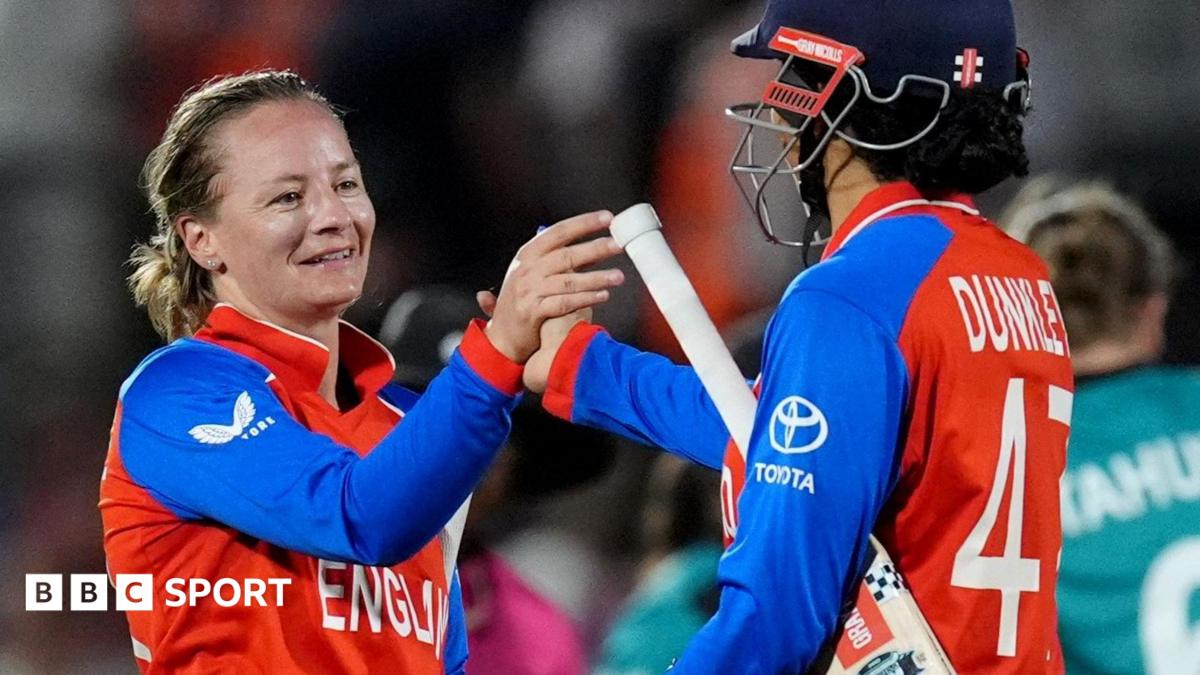
Danni Wyatt-Hodge, now the tournament’s leading run-scorer, kept up her superb form by crashing 89 not out. She was supported by Sophia Dunkley, who made 49 not out in their unbroken partnership of 128.
Advertisement
Defending champions New Zealand, who are now eliminated, are a shadow of the side that won this title in 2024 but the dominant nature of England’s win only added to the sense of momentum around this side.
After limiting New Zealand early on, they took three wickets in four balls without conceding a run in limiting the White Ferns to 163-6.
Sophie Devine hit three sixes in a 14-ball 30 on her final international appearance but otherwise England were always in control.
Their semi-final opponents will be confirmed on Sunday, with India or South Africa appearing the most likely.
Advertisement
That match will take place on Tuesday afternoon or Thursday evening back at The Oval, where England’s women’s side have never lost any of their 11 matches.
Win that and they will return to Lord’s for the final on Sunday for a chance to win their first World Cup title since 2017.
Traffic and crowds can sometimes hinder the search operations. Soldiers and Mexican volunteers have repeatedly called for silence, so they can listen for signs of life under the debris.
People are helping however they can. Those who have drones are using them to search for survivors or the deceased in hard-to-reach places.
Families huddle around drone video feeds searching for anything familiar. A piece of clothing, a strand of hair, a belonging. Anything that might bring news of a loved one.
As time passes, the unofficial death toll rises – and so do the consequences.
Advertisement
“There’s a smell… the dead are already being felt. That’s going to make us and the children sick,” says Glendys Delgado.
Two buildings near where Delgado lives are collapsed, but there has been no official help, she says. “No one from the government has come here, but I thank God that people from Caracas have come to support us with food.”
Deiyer Gabril, 27, says every area has been affected, “Macuto, Caribe… everything over there is bad. And we can all feel the odour.”
Authorities reported on Friday that 861 volunteers from Mexico, the US, El Salvador, Switzerland, Colombia, and other countries were in Venezuela, with more arriving.
Advertisement
Interim President Rodríguez said she spoke with US President Donald Trump and US Secretary of State Marco Rubio on Friday, and that they reaffirmed their commitment to send rescue teams and aid supplies.
The BBC have reportedly found Giant’s replacement on Gladiators, months after his girlfriend’s racy job led to his own axing from Bradley and Barney Walsh’s Saturday night series
22:08, 27 Jun 2026Updated 22:08, 27 Jun 2026
The BBC have reportedly found Giant’s replacement on Gladiators. Earlier this year, Giant, 40, whose real name is Jamie Bigg, departed the hit BBC show amid much controversy when he went public with then-girlfriend Taylor Ryan, 28, and it emerged that she worked as a model on OnlyFans.
Execs were quick to air their disapproval, and the athlete said that he was “shocked and disappointed” by the move, which he directly linked to his partner’s racy work. Now, it’s been revealed that body builder and fitness instructor Ahmad Rabus, 37, has now been cast on the Bradley and Barney Walsh’s hit programme, with just weeks to go until cameras roll at the Utilita Arena in Sheffield.
A source told The Sun: “Gladiators bosses loved Ahmad’s energy and positivity, they think he will be a great addition to the team. There are also rumours there could be a few other newbies joining the gang.” A BBC spokesperson declined to comment.
Advertisement
According to the outlet, Ahmad is a dad of one and previously went into detail about his fitness journey on his social media.
He wrote on Instagram: “My passion with fitness started at a young age. I started training at the age of 17 and have undergone my own transformation and dedicated myself to training for 17 years.
Advertisement
It comes after Jamie hinted that he and Taylor had decided to call time on their relationship. Writing on Instagram, he said: “Lately, I’ve spent a lot of time reflecting. Not on what I’ve achieved, but on who I want to become. Right now, I’m doing what I find the hardest… I’m taking the time I need to work on myself.”
At the time, insiders claimed to the Daily Mail, he had taken himself off to Spain for some space. “They haven’t ruled out getting back together in the future but Jamie knows he needs to work on himself right now,” a source told the publication.
Jamie’s Instagram post continued: “I’m spending time in my own busy brain trying to unpack and make sense of all the thoughts. I’m rebuilding routines, strengthening my mindset, improving my health, and gaining clarity on the man I want to be.
Advertisement
“One thing I know for certain is that I have a genuine passion for helping others. And if being honest, raw, real and transparent about my own journey helps even one person find their direction, purpose, or confidence again, then it’s worth sharing. “Growth isn’t always pretty. Self-reflection isn’t always comfortable. But both are necessary if you truly want to become the best version of yourself. The work continues.”
Giant, who has two children with ex-wife Katie, was furious at being axed for Gladiators and made his feelings very clear as it all unfolded.
He said in April: “After three incredible seasons on Gladiators, I was shocked and disappointed to learn that I wouldn’t be returning to the show for season four. This news followed shortly after I had shared plans to go public with my relationship.
“My partner, Taylor, is someone I’m incredibly proud of. While she is known for her work on OnlyFans, that is just one part of what she does, a business-minded entrepreneur, someone who dedicates her time to fostering dogs and genuinely one of the kindest people I’ve ever met. Her values align closely with my own.
Advertisement
“During conversations with the BBC, ‘child safeguarding’ was raised, something I take extremely seriously, especially as a father and role model. I want to be clear that I have always upheld the standards expected of me, both professionally and personally. Being a positive role model has always been central to who I am, on and off screen. I stand by my values, and I stand by the people I love.”
A Gladiators spokesperson had previously said: “After three formidable series, Giant is leaving Gladiators. We’d like to thank him for everything he has contributed to the show and wish him well for the future.”
WASHINGTON (AP) — Holiday gatherings and major life events have come with an empty seat. Certain dates on the calendar meant time at a cemetery, standing before granite stones.
They are a relatively small group of people, scattered across different states, but they share a common bond that stretches back decades: Each had a family member die violently in the struggle for voting and civil rights, victims on a long and difficult path marked by blood that ended when the country seemed to mature into the nation of its creed.
But 61 years later, and as the country approaches its 250th anniversary, those sacrifices are in question. In a series of decisions over the past dozen years, including one in April, the Supreme Court has effectively dismantled the law that their family members died to see enacted, the Voting Rights Act of 1965.
“My mother’s blood is on that bill. We were always proud of that, and now it’s gone,” said Anthony Liuzzo, whose mother, Viola Liuzzo, died on an Alabama highway between Selma and Montgomery while driving marchers in 1965.
Advertisement
Critics of the law argue that times have changed, a point Chief Justice John Roberts made in a 2013 decision that was the first major step in rolling back the law.
Survivors of lost loved ones disagree, pointing to the speed with which Republican-led state legislatureseliminated majority-Black congressional districts after the court’s April ruling, which severely weakened a section of the law that had protected voting rights for minority communities. They feel anger and sadness that a milestone political victory decades ago has been reversed, but they are committed to keep fighting.
A church bombing and a chunk of concrete
Lisa McNair was born Sept. 19, 1964. Her older sister, Denise, died in the Sept 15, 1963, bombing of the 16th Street Baptist Church in Birmingham, Alabama. The church had been a central organizing point for civil rights protest.
Advertisement
Lisa McNair poses for a photo inside 16th Street Baptist Church, the site of the Sept. 15, 1963 terrorist bombing of the church, Monday, June 1, 2026, in Birmingham, Ala. (AP Photo/Mike Stewart)
Advertisement
Lisa McNair poses for a photo inside 16th Street Baptist Church, the site of the Sept. 15, 1963 terrorist bombing of the church, Monday, June 1, 2026, in Birmingham, Ala. (AP Photo/Mike Stewart)
Advertisement
Advertisement
Advertisement
The explosion killed Denise McNair, 11, Addie Mae Collins, 14, Carole Robertson, 14, and Cynthia Morris Wesley, 14. Nearly two dozen others were injured. Three Klansmen were convicted years later.
Advertisement
One of Lisa McNair’s early memories of her sister was of the box that their grandmother kept from the funeral home. It included Denise McNair’s shoes, a purse and a rock-sized piece of concrete that had been embedded in her skull.
The crime brought the civil rights struggle onto the national stage and outraged Democratic President John F. Kennedy.
The times were tumultuous, McNair said, but it seemed the nation was heading in the right direction. Most of her life, “I’ve seen advances” on television, in commercials, with interracial marriages, civil rights and voting rights, “a plethora of rights that we got over the greater part of my lifetime.” But that has changed, she said.
McNair, 61, said she is “physically sick” about the Supreme Court decision and subsequent actions by lower courts and legislatures.
Advertisement
“I am constantly working to pray my way through it, so I can get up and go to work in the morning and do what I need to do. But I just want to ask every white person I see, What more do you want?” she said. “Why do you hate us so?”
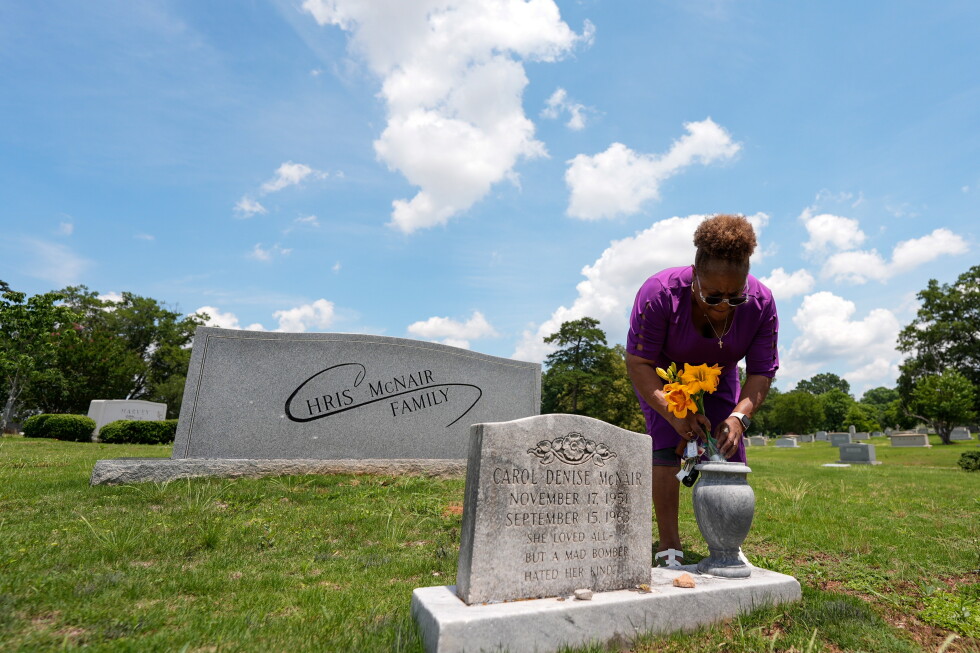
Lisa McNair arranges flowers on the grave of her late sister, Carol Denise McNair, Monday, June 1, 2026, in Birmingham, Ala. (AP Photo/Mike Stewart)
Advertisement
Lisa McNair arranges flowers on the grave of her late sister, Carol Denise McNair, Monday, June 1, 2026, in Birmingham, Ala. (AP Photo/Mike Stewart)
Advertisement
Advertisement
Advertisement
Advertisement
They left for Freedom Summer and never came home
Michael Schwerner, known as Mickey, came from a family in which human rights activism and challenging social norms were expected. He was in Mississippi in 1964 as part of Freedom Summer when he, Andrew Goodman and James Chaney vanished one day in June while investigating a bombing at a Black church.
In this file photo civil rights leader Dr. Martin Luther King displays pictures of three civil rights workers, who were slain in Mississippi the summer before, from left Michael Schwerner, James Chaney, and Andrew Goodman, at a news conference in New York, Dec. 4, 1964, where he commended the FBI for its arrests in Mississippi in connection with the slayings. (AP Photo/JL, File)
Advertisement
In this file photo civil rights leader Dr. Martin Luther King displays pictures of three civil rights workers, who were slain in Mississippi the summer before, from left Michael Schwerner, James Chaney, and Andrew Goodman, at a news conference in New York, Dec. 4, 1964, where he commended the FBI for its arrests in Mississippi in connection with the slayings. (AP Photo/JL, File)
Advertisement
Advertisement
Advertisement
Advertisement
Their bodies were found weeks later, buried in an earthen dam in a rural area of Neshoba County. Schwerner, 24, and Goodman, 20, were white; Chaney, 21, was Black.
Stephen Schwerner, who died earlier this year and was a social activist in his own right, told The Associated Press in a 2023 interview that as soon as the family heard his younger brother and the other men were missing, they knew they were dead.
“Our family was very out front in the media that the only reason there was international attention was two of the young men were white,” said Stephen’s daughter, Cassie Schwerner. “Had all three of those young men been Black, they would have ended up absent from our history and our narrative.”
The executive director of Morningside Center for Teaching Social Responsibility, Cassie Schwerner, said her family has followed voting rights through their ups and downs. That includes the 2013 Supreme Court decision that allowed states and counties with a history of discriminatory voting rules to make changes without prior approval from the Department of Justice.
Advertisement
The court’s April decision, she said, brought rage “and a good deal of sadness — not for me and my family, but for this country.” There is, she said, work to be done on multiple fronts.
Rights paid for in blood turned out to be fragile
Tamara Orange said among her many thoughts when she heard of the Supreme Court decision in this year’s Voting Rights Act case, there was relief — “relief that my dad is not here to see that; that Jimmie Lee Jackson is not here to see it; that Viola Liuzzo is not here to see it,” she said. “I’m relieved for them because to me, it’s as though the sacrifices that were made were done in vain.”
Her father, James Orange, was working with the Southern Christian Leadership Conference to organize voting rights protests in Marion and Perry County, Alabama, in 1965. When juveniles joined the effort, he was arrested for contributing to the delinquency of minors. Concern arose that Orange was going to be taken out of the jail and lynched.
Advertisement
The Rev. James Orange, right, and Obang Metho pray after helping to lay a wreath at the tombs of the Rev. Martin Luther King Jr. and his wife Coretta Scott King at the King Center for non-violent Social Change in Atlanta, Jan. 12, 2007. (AP Photo/John Bazemore, File)
Advertisement
The Rev. James Orange, right, and Obang Metho pray after helping to lay a wreath at the tombs of the Rev. Martin Luther King Jr. and his wife Coretta Scott King at the King Center for non-violent Social Change in Atlanta, Jan. 12, 2007. (AP Photo/John Bazemore, File)
Advertisement
Advertisement
A protest to intervene ended with Jackson, a 26-year-old Black church deacon, being shot in the stomach by a state trooper while Jackson tried to shield his mother and grandfather.
His death was the catalyst for what became the Selma to Montgomery march and “Bloody Sunday.”
Advertisement
Orange stayed in the movement all his life and died in 2008, Tamara Orange said. But even after the Voting Rights Act passed, “He would say, be careful or we’re going to lose it.”
‘We got bad news for you’
Anthony Liuzzo had just turned 10 when his mother, 39, left their middle-class neighborhood in Michigan and headed for Selma, Alabama. She had cried as she watched scenes from “Bloody Sunday” on television.
Viola Liuzzo participated in a portion of the second march and then helped drive other civil rights protesters around the Black Belt region of the state. On March 25, 1965, she was driving one protester between Selma and Montgomery when a vehicle pulled alongside and fired into the car.
Advertisement
This combination image shows an undated file photo of white civil rights activist from Detroit, Viola Liuzzo, left, who was helping to shuttle black demonstrators between Selma and Montgomery, Ala., and at right, a March 26, 1965, file photo of an Alabama state trooper’s car, parked near Liuzzo’s car, after she was shot to death in it near Lownsboro, Miss., on route to Montgomery. (AP Photo/Jack Thornell, File)
Advertisement
This combination image shows an undated file photo of white civil rights activist from Detroit, Viola Liuzzo, left, who was helping to shuttle black demonstrators between Selma and Montgomery, Ala., and at right, a March 26, 1965, file photo of an Alabama state trooper’s car, parked near Liuzzo’s car, after she was shot to death in it near Lownsboro, Miss., on route to Montgomery. (AP Photo/Jack Thornell, File)
Advertisement
Advertisement
The phone call came around midnight. Anthony Liuzzo remembers the caller asking his dad, “Is your wife Viola? We got bad news for you. She’s been shot.” When his father asked whether she was all right, the caller said “No, she’s dead,” and then hung up.
An informant for the FBI quickly identified members of the Ku Klux Klan as her killers. The three men charged would escape conviction on state charges but be convicted in federal court.
Advertisement
An iron fence surrounds the memorial to civil rights activist Viola Liuzzo on Friday, July 7, 2000, near Lowndesboro, Ala., on U.S. 80. (AP Photo/Dave Martin, File)
Advertisement
An iron fence surrounds the memorial to civil rights activist Viola Liuzzo on Friday, July 7, 2000, near Lowndesboro, Ala., on U.S. 80. (AP Photo/Dave Martin, File)
Advertisement
Advertisement
Advertisement
Anthony Liuzzo and his siblings lived with the lost birthdays and other missed milestones. His comfort was that the voting rights she had died for had become a reality. But the April ruling by the Supreme Court and the subsequent rush by Republican-led legislatures in several Southern states to eliminate congressional districts represented by Black lawmakers left him angry and distraught.
Advertisement
Even so, he said he is still proud his mother had the courage to go to Selma “when others sat in their pretty little houses.”
One morning, the Klan returned
The inscription at the bottom of Vernon Dahmer Sr.’s tombstone reads simply: “If you don’t vote, you don’t count.”
It is a message that embodies his life’s work and the story behind his death.
Even after Democratic President Lyndon Johnson signed the Voting Rights Act, not every state was eager to implement the new law. In Mississippi, it came with a “poll tax.” The amount was $2, but in a world where a farmworker’s wages might only be $5 a day, that was substantial, said Dahmer’s son, Dennis Dahmer Sr.
Advertisement
Dennis Dahmer stands next to a statue of his father, Vernon Dahmer, Sr. who was killed when the Ku Klux Klan firebombed the family home 1966, outside the Forrest County Courthouse in Hattiesburg, Miss., Wednesday, June 3, 2026. (AP Photo/Gerald Herbert)
Advertisement
Dennis Dahmer stands next to a statue of his father, Vernon Dahmer, Sr. who was killed when the Ku Klux Klan firebombed the family home 1966, outside the Forrest County Courthouse in Hattiesburg, Miss., Wednesday, June 3, 2026. (AP Photo/Gerald Herbert)
Advertisement
Advertisement
Advertisement
The elder Dahmer, 57 at the time of his death, was a successful businessman who owned a store, sawmill and farm near Hattiesburg. He also was a civil rights leader and NAACP president in Ford County. He offered to pay the $2 for Black residents who wanted to register to vote.
Advertisement
He had already been under scrutiny by the local Ku Klux Klan. There was harassment and there were threatening phone calls. The windows were shot out of his store, but no one challenged him directly because his sons were always present and armed.
That seemed to trail off after Johnson signed the law.
“The Klan quit calling,” Dennis Dahmer said. “They quit shooting out the windows, so my family thought that all of this was behind us.”
Advertisement
Dennis Dahmer, whose father Vernon Dahmer, Sr. was killed when the Ku Klux Klan firebombed the family home 1966, holds a photo of his brothers as they overlook the destroyed home after, after retiring home from military service, in Hattiesburg, Miss., Wednesday, June 3, 2026. (AP Photo/Gerald Herbert)
Dennis Dahmer, whose father Vernon Dahmer, Sr. was killed when the Ku Klux Klan firebombed the family home 1966, holds a photo of his brothers as they overlook the destroyed home after, after retiring home from military service, in Hattiesburg, Miss., Wednesday, June 3, 2026. (AP Photo/Gerald Herbert)
Advertisement
Advertisement
Advertisement
A copy of a poll tax receipt sits in the old schoolhouse meeting place, as part of the legacy of Vernon Dahmer, Sr., who was killed when the Ku Klux Klan firebombed the family home 1966, in Hattiesburg, Miss., Wednesday, June 3, 2026. (AP Photo/Gerald Herbert)
A copy of a poll tax receipt sits in the old schoolhouse meeting place, as part of the legacy of Vernon Dahmer, Sr., who was killed when the Ku Klux Klan firebombed the family home 1966, in Hattiesburg, Miss., Wednesday, June 3, 2026. (AP Photo/Gerald Herbert)
Advertisement
Advertisement
Advertisement
That changed in the early hours of Jan. 10, 1966, when two carloads of Klansmen showed up. They firebombed the house and adjacent grocery store and began shooting at the house. The elder Dahmer shot back, using his ample arsenal to fight off the attack.
His wife and the three children who were home survived, but he suffered severe injuries from inhaling the smoke and fumes from the flames. He died later that day.
Dennis Dahmer was 12 as he stood next to his dad’s hospital bed. He wondered why some people wanted his father dead just for trying to help Black people vote.
Advertisement
Dennis Dahmer, whose father Vernon Dahmer, Sr. was killed when the Ku Klux Klan firebombed the family home 1966, speaks about seeing his father dying in the hospital, in Hattiesburg, Miss., Wednesday, June 3, 2026. (AP Photo/Gerald Herbert)
Advertisement
Dennis Dahmer, whose father Vernon Dahmer, Sr. was killed when the Ku Klux Klan firebombed the family home 1966, speaks about seeing his father dying in the hospital, in Hattiesburg, Miss., Wednesday, June 3, 2026. (AP Photo/Gerald Herbert)
Advertisement
Advertisement
Advertisement
A former Imperial Wizard of the Ku Klux Klan, Sam Bowers, was convicted in 1998 for the attack and sentenced to life.
Advertisement
Like the families of other survivors, Dennis Dahmer’s family has witnessed the methodical dismantling of the Voting Rights Act.
“Finally, they basically turned it into a relic,” he said.
His plan now is activism, to speak out and promote the need for a massive voter turnout. He also wants to remind people of the price that certain families paid for everyone to have the right to vote and be represented by someone of their choosing.
“We’re living in a time when America has a lot of the same characteristics of the 1960s that I grew up in,” he said. “People say, are we going back? Hell, we’re already there.”
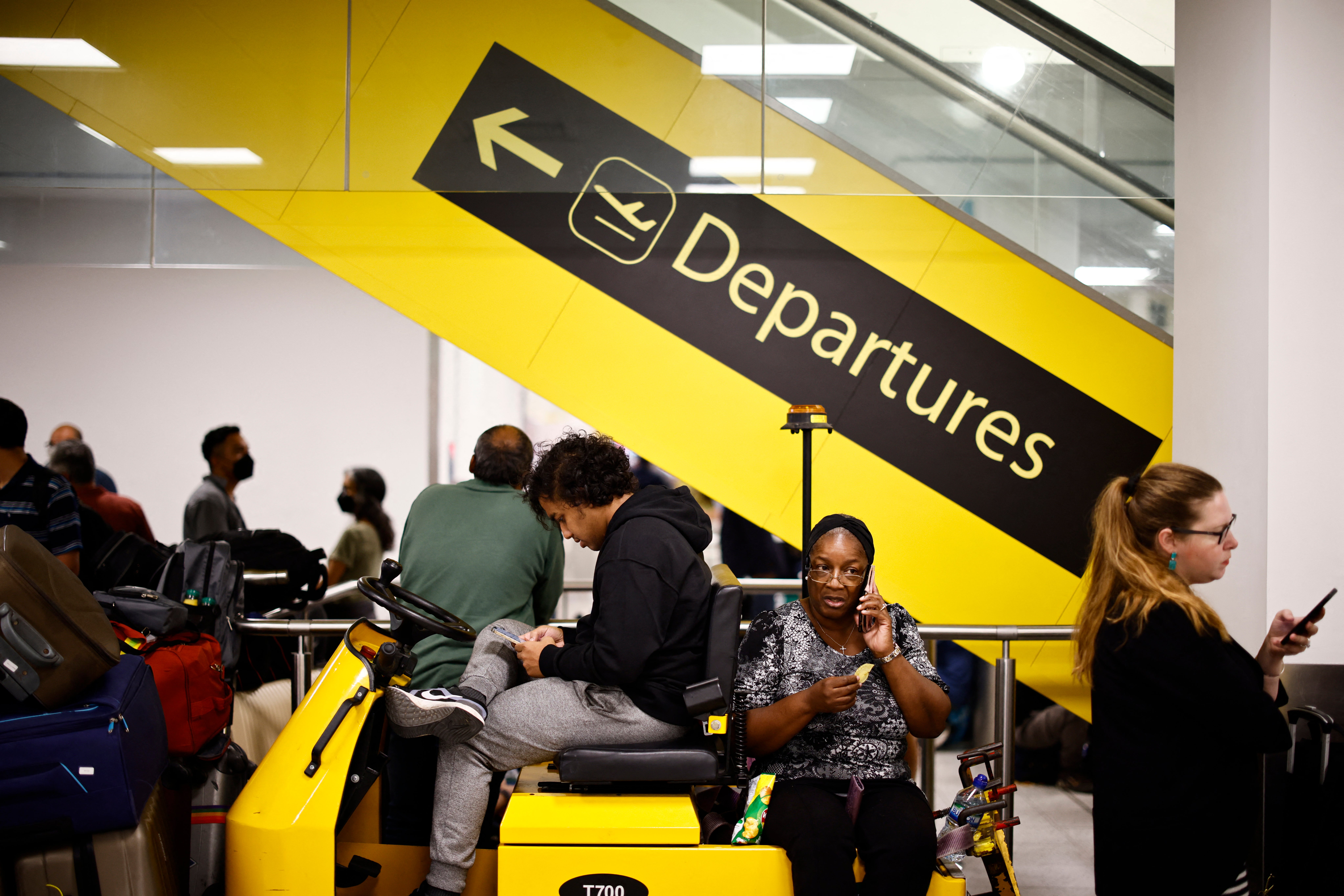
A total of 484 inbound and outbound flights were delayed across Gatwick and Heathrow airports by the evening, according to the FlightAware tracker.
Heathrow had 42 per cent of its flights delayed and Gatwick 50 per cent, it said.
NATS, the UK’s air traffic control service, said disruption could continue overnight into Sunday.
Advertisement
A NATS spokesperson told The Independent: “Severe thunderstorms across the South East of England and Europe continue to impact flights, and this is expected to continue for the remainder of today and overnight.
“To ensure the safety of the travelling public, aircraft need to avoid affected areas and be spaced further apart, which limits the number of flights that can operate safely.
Gatwick saw a number of flights delayed (AFP/Getty)
“We understand disruption is frustrating, but we’re working closely with airlines and airports to reduce disruption as much as possible. Passengers should continue to contact their airline for the latest information on their flight.”
Gatwick and Heathrow advised passengers to check the status of their flights with airlines before travelling, the BBC reported.
The warning covering the East and South East now runs until 9am on Sunday.
The UK broke the record for a June temperature for the third day in a row on Friday (AFP/Getty)
Friday was confirmed by the Met Office as the UK’s hottest June day on record, with a provisional temperature of 37.3C recorded in Santon Downham, Suffolk, surpassing the high of 36.7C recorded in Merryfield, Somerset, on Thursday.
These smashed the long-standing record for June heat, which dates back to the summer of 1976, by more than 1C, which is significant given such records were usually broken only by a fraction of a degree in the past.
Scientists warned that the heatwave would have been virtually impossible 50 years ago, with human-driven climate change fuelling more intense and frequent extreme heat events.
The Met Office said the third consecutive day of June’s record-breaking temperatures came as parts of the UK were transitioning to more of a westerly influence, bringing the risk of thunderstorms.
Advertisement
Thundery showers with gusty winds, lightning and hail are now forecast to move into the South East on Saturday evening.











































You must be logged in to post a comment Login