Erik and Lyle Menendez will have an opportunity to fight for parole earlier than expected.
The brothers, who were once sentenced to spend the rest of their lives behind bars for killing their parents, have been granted an early parole suitability hearing – tentatively scheduled for March 2027, TMZ reports.
They had previously only been able to apply for another hearing in August 2028, after the California Board of Parole denied their requests for early release last year.
But the parole board has since found they qualified for an earlier parole hearing under a provision to Proposition 9, a 2008 law that amended the California state Constitution and was meant to provide certain rights to crime victims, according to the Orange County Register.
Provisions to the law allow a person’s next parole hearing date to be moved up if there was a change in circumstances or new information indicating the person may be suitable for parole.
It remains unclear whether the parole board uncovered new information indicating the Menendez brothers may be suitable for parole, but their family members have argued that Lyle, 58, and Erik, 55, have been model prisoners.
‘For almost 40 years, Erik and Lyle have worked to take responsibility for their actions, confront and heal from the unimaginable abuse and trauma they endured, grow as individuals and dedicate themselves to serving others,’ a family spokesperson said in a statement.
‘Through efforts such as helping to establish a hospice program and creating Green Space, they have sought to build an environment that reminds people serving life sentences that their lives still have meaning and that, regardless of their circumstances, they can choose each day to grow, heal, accept accountability and contribute something of value to the world around them.
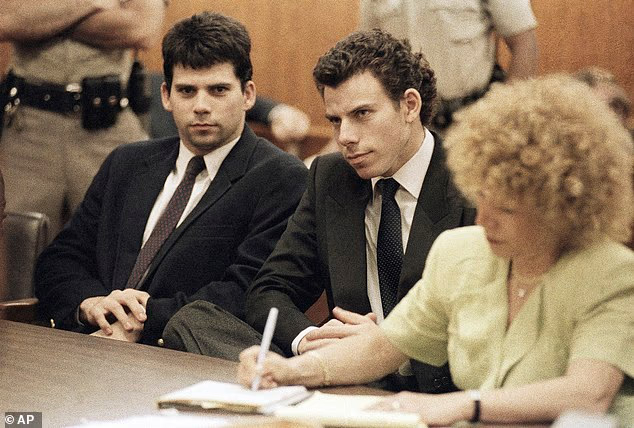
Erik and Lyle Menendez (pictured in court in 1990) will have another chance for parole early next year
The brothers were convicted in 1996 of murdering their parents, Jose and Kitty, inside their Beverly Hills mansion
‘Erik and Lyle were once sentenced to life without the possibility of parole,’ the family noted. ‘We will always be profoundly grateful that they have been resentenced and that our family can now imagine a future in which they are once again part of our everyday lives.’
The family then went on to say that the California Board of Parole’s decision to move up their hearing ‘is especially meaningful and brings us immeasurable joy as we move one step closer to a future with them that once seemed impossible.’
The brothers have been in jail ever since they were arrested for the shooting deaths of their parents, Kitty and Jose, as they watched a movie at their Beverly Hills mansion on August 20, 1989.
The duo were 18 and 21 at the time they killed their parents.
Their trial prompted worldwide headlines. Prosecutors said their motive was greed, as they stood to inherit $14 million from their parents and had spent large sums of cash following the murders.
Erik had purchased a Jeep and retained a private tennis instructor with hopes of becoming a professional, while his brother bought a Porsche and a restaurant. The two were also infamously seen sitting courtside at an NBA game in between the murders and their arrest.
The brothers insisted they acted against a father who sexually abused them for years and a mother who turned a blind eye to the abuse.
An initial trial ended with a hung jury. But at a second trial in 1996, where the judge refused to allow any evidence about the brothers being molested by their father, they were convicted and sentenced to life in prison with no possibility of parole.
The brothers had been sentenced to serve life in prison behind bars without the possibility of parole, but last year a judge decided to reduce the brothers’ sentences to 50 years to life, making them eligible for release
But nearly 30 years later, a judge decided to reduce the brothers’ sentences to 50 years to life, making them eligible for release.
Still, the California Board of Parole ruled last year that the brothers would be denied parole for three years, noting that they have both violated prison rules.
‘Contrary to your supporters’ beliefs, you have not been a model prisoner and frankly we find that a little disturbing,’ the board told Erik at his hearing, according to reporter Brian Entin.
That decision came after a full-day hearing during which commissioners on the board questioned Erik about why he committed the crime and why he violated prison rules.
He had claimed at the hearing that he bought firearms ‘to protect myself in case my father or my mother came at me to kill me, or my father came in the room to rape me.’
When he was then asked why he did not just run away or report the abuse to the police, Erik said he felt ‘leaving meant death’ and he had an ‘absolute belief that I could not get away.’
Erik was denied parole by the California Board of Parole at a hearing last August
Lyle was also denied parole at a separate hearing days later
Another commissioner then asked why he decided to also kill his mother. Evidence at the trial showed she had crawled on the floor, wounded, before the brothers reloaded the shotguns they had bought with someone else’s ID and fired a final shot.
‘When Mom told me… that she had known all of those years, it was the most devastating moment in my entire life,’ Erik said, becoming visibly emotional. ‘It changed everything for me. I had been protecting her by not telling her.’
‘On that night, I saw them as one person,’ he continued. ‘Had she not been in the room, maybe it would have been different.’
Erik also admitted at the hearing that his and his brother’s spending spree was an ‘incredibly callous act.
‘I was torn between hatred of myself over what I did and wishing that I could undo it and trying to live out my life, making teenager decisions,’ he explained.
Erik also used the hearing last year as a chance to apologize to his family.
‘I just want my family to understand that I am so unimaginably sorry for what I have put them through,’ he said.
‘I know they have been here for me and they’re here for me today, but I want them to know, that this should be about them. It’s about them, and if I ever get the chance at freedom, I want the healing to be about them.’
Then, at Lyle’s parole hearing days later, Parole Commissioner Julie Garland cited Lyle’s ‘deception, minimization and rule breaking’ despite his volunteer work and education while behind bars for the board’s decision to deny him parole.
Still, she told the elder brother that his denial ‘wasn’t the end,’ and added: ‘It’s a way for you to spend some time to demonstrate, to practice what you preach about who you are, who you want to be. Don’t be somebody different behind closed doors.’

























































You must be logged in to post a comment Login