

Connect with us

NewsBeat

Unique house that helped thwart French invasion of England

Published

on

Unique house that helped thwart French invasion of England

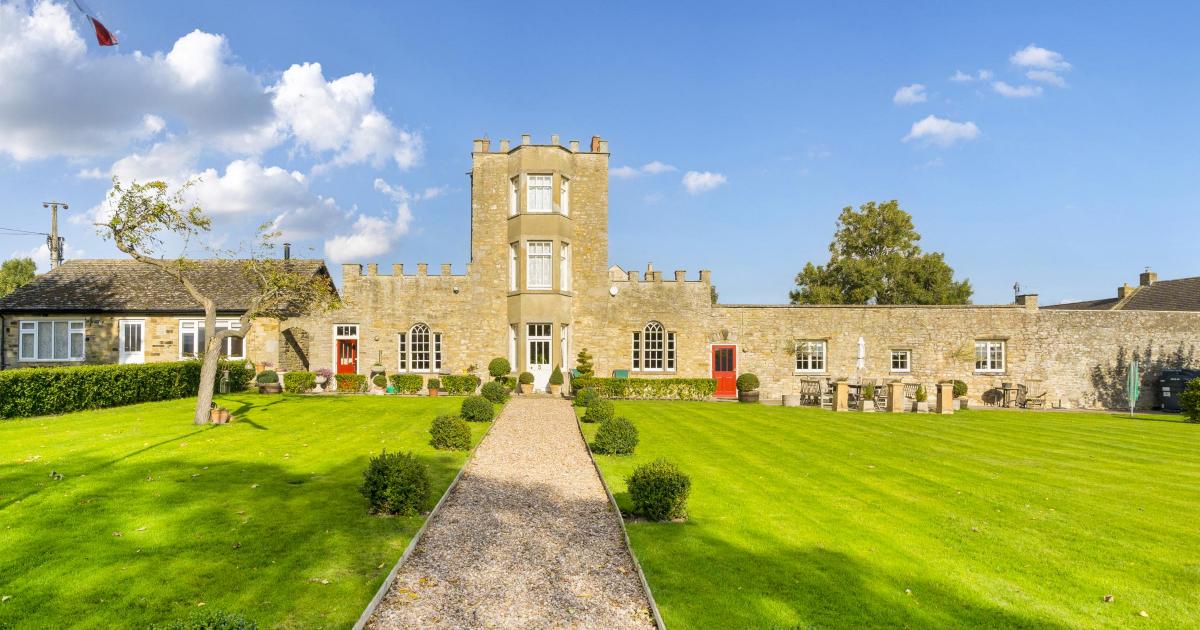
Built in 1803 by Captain Horn, who lived next door in The Old Hall, Forte Horn was to provide an early lookout in the Dales should Napoleon decide to attack England.

For the men who served in the Loyal Dales Infantry until the regiment was disbanded a year after Waterloo – in 1816 – it also served as a garrison.

Drawing room with open fireplace, bay window and garden door (Image: Giles Edwards Yorkshire Property)

And a very fine one at that.

As the threat of war faded and it became clear that Napoleon and his men would not be marching across the Dales, Forte Horn was turned into a family home and remains so today.

Advertisement

Forte Horn is approached via a private drive which ends in a parking area with ample room for several vehicles.

Dining area adjoining kitchen (Image: Giles Edwards Yorkshire Property)

Step inside the front door and you’ll find yourself in an entrance hall with a flagstone floor and feature wooden beams – perfect for doubling up as a dining room, should its new owners wish to.

Off this is a drawing room of elegant proportions, with a large open fireplace with a Jet master fire in-situ, a large feature window and a bay window with a door giving access to the garden.

A door links the drawing room to a second, less formal, sitting room.

Advertisement

Drawing room with open fireplace, bay window and garden door (Image: Giles Edwards Yorkshire Property)

From there an inner hall leads, in turn, to a double bedroom and bathroom.

This area could form a separate cottage with its own front door should the buyer wish to create a private living space – and subject to the usual planning/listed building permission.

This was granted a few years ago but has since lapsed.

Sitting room (Image: Giles Edwards Yorkshire Property)

Completing the ground floor is the spacious kitchen/breakfast room.

Advertisement

The kitchen area has wooden flooring, a range of oak units made by County Kitchens of Leyburn and an Everhot cooker with extractor fan over.

Up a couple of steps is the adjoining dining area, and off that a rear hall that serves as part utility room, part boot room and has a door out to the garden.

On the first floor – in the turret that no doubt offered the fort its best vantage point – is the spacious master bedroom with a large bay window that frames the view over the garden, plus a small original built-in cupboard.

A second double bedroom is currently used as a dressing room, with the accommodation completed by a bathroom.

Advertisement

Upstairs again is a large double bedroom with a large bay window offering spectacular views over the garden and beyond, plus a shower room and eves storage space.

Garden laid to lawn with hedges, borders and views to Jervaulx Moor (Image: Giles Edwards Yorkshire Property)

Situated to the side of the main house is Garden Cottage which comprises a large sitting room with a log burner, a kitchen breakfast room, two double bedrooms and a family bathroom.

This versatile dwelling would serve a number of purposes, including being perfect for multigenerational living.

Forte Horn’s garden is laid mainly to lawn and includes well-maintained hedges and borders containing a variety of shrubs, plants and soft fruit trees.

Advertisement

It is walled on two sides to provide privacy and has spectacular views at the front over the village and up to Jervaulx Moor.

There is a side gate onto the village green, a small courtyard garden at the rear of the cottage and a large garage.

Kitchen/breakfast room with oak units and Everhot cooker (Image: Giles Edwards Yorkshire Property)

Forte Horn is located in the middle of the village of Thornton Steward, around four miles from Middleham (which also has a fascinating history dating back to Richard III) and around six miles from Leyburn, Masham and Bedale.

It is on the market at £1.1m.

Advertisement

For more information or to arrange a viewing, please contact Giles Edwards Yorkshire Property on 01765 688353.

Source link

Advertisement
Continue Reading
Click to comment

Leave a Reply

Your email address will not be published. Required fields are marked *

NewsBeat

North Korea fires missiles in response to US military exercise | World News

Published

on

U.S. Army soldiers take part in a U.S.-South Korea joint river-crossing exercise this month. Pic: Reuters

North Korea has fired missiles into the sea in response to a United States military exercise.

Around 10 ballistic missiles were fired from near Pyongyang’s international airport on Saturday as a show of force after a joint military exercise between US and South Korea.

They flew around 220 miles before landing in the Sea of Japan, South Korea’s Joint Chiefs of Staff said.

It came just hours after South Korean Prime Minister Kim Min-seok met with President Donald Trump in Washington.

Advertisement
Image:
North Korea has long branded the exercises as invasion rehearsals. Pic: Reuters

South Korea has since ramped up its surveillance in response.

And experts fear Saturday’s launches could undermine the diplomatic efforts made by both sides.

The US and South Korea are currently participating in Freedom Shield, an 11-day shared military exercise held between both sides every March.

South Korean Army soldiers fire a machine gun mounted on a K1A2 tank during the exercise. Pic: Reuters
Image:
South Korean Army soldiers fire a machine gun mounted on a K1A2 tank during the exercise. Pic: Reuters

North Korea has long described them as invasion rehearsals – often citing them as a reason to dial up weapons testing.

Only last Tuesday leader Kim Jong Un’s sister criticised Washington and Seoul for proceeding with their drills during a period of such global uncertainty.

Advertisement

Read more from Sky News:
Why Iran’s Kharg Island is so important
Explosion damages Jewish school

Kim Yo Jong said they undermine regional stability at a time when the global security structure is “collapsing rapidly and wars break out in different parts of the world due to the reckless acts of outrageous international rogues.”

Advertisement

In recent months they have hardened their stance towards Seoul and are now urging Washington to drop denuclearisation demands as a precondition for talks.

And just this week Mr Kim was pictured alongside his teenage daughter as the country carried out missile tests from a naval destroyer.

Read more: Who is Kim Ju Ae?

A missile is fried from the North Korean Choe Hyon, a year-old naval destroyer, earlier this week. Pic: KCNA/AP
Image:
A missile is fried from the North Korean Choe Hyon, a year-old naval destroyer, earlier this week. Pic: KCNA/AP

It comes amid speculation that the US is planning to relocate some missile defences to the country as part of its intensifying war with Iran.

But South Korea has been quick to insist this would not affect its defence posture against its northern neighbours.

Advertisement

Source link

Continue Reading

NewsBeat

The infamous Cambridge pub with over 700 years of historic tales

Published

on

Cambridgeshire Live

The pub has a rich history, with everything from ghost stories the discovery of DNA

Very few pubs carry the deep historical legacy of The Eagle in Cambridge. Tucked along the narrow historic stretch of Bene’t Street, the second-oldest pub in the city has more than 700 years of stories etched into its beams, walls and ceilings.

Advertisement

Dating back to the 14th century, the building has witnessed centuries of Cambridge life. Medieval townsfolk one gathered here after market days centuries before wartime pilots filled its rooms with laughter and cigarette smoke and decades before brilliant scientists raised pints while discussing ideas that would reshape the world.

The Grade II-listed pub is a living archive, just steps away from other notable Cambridge landmarks, including King’s College and The Corpus Clock. The Eagle has never lost its charm, as every time you walk through the doors, you step into centuries of Cambridge history where every pint of ale comes with a story.

A Brief History of The Eagle

‘With beer for three gallons a penny’, the tavern was bought by Corpus Christi College in around 1458 and advertised as a property producing 20s per annum. Cambridge was growing at the time with many University colleges being founded, including Christ’s College, King’s College and Queen’s College.

The town was home to between 1500 and 5000 inhabitant and urban settlements surrounding the town began to lay their foundations.

Advertisement

The Inn was originally known as ‘The Eagle and Child’, with the child being the crest of the Earl of Derby and opened in 1667 as a coaching house for travellers commuting towards London for trade at the market.

A lease to Andrew Pylkynton, the innkeeper and his wife, in the archives of Corpus, mentions “their two tenements, a greater and a lesser nowe made an Inne called the Eagle and Child sett and built together in the parishe of St Benett in Cambridge.”

Inside the Eagle, there are a few places where old decorations are thought to still be standing from the time period. This includes wall paint and ‘broad green stripes’ above the second bar to conceal crooked timber planks.

Advertisement

The Inn was rebuilt in around 1800 with a slate roof and brick-infilled timber frames, and was used as the headquarters of the Cambridge Conservative party during elections in the 1820s.

Ghost Stories

The pub is said to be haunted following a fire in the 1700s. The story goes that a young child was trapped and burned to death because they were unable to open the window to escape.

Detailed in The Eagle’s history leaflet, it says: “The only thing keeping the pub from being plagued by spirits is a window, which must remain open at all times.”

They explain they have kept the window open ever since, as when it has been closed, it has mysteriously reopened and brought bad luck.

Advertisement

“The open window allows these young ghosts to leave the pub as they wish and it is reported that strange things have happened in the past when the window was shut.”

One account said: “That should anyone dare to try and close the window, everybody inside the pub will experience a powerful feeling of suffocation.”

On table 4, a ghostly gentleman sits and watches the punters drinking their pints. The Eagle staff warn people, “if he doesn’t like you, he will spill your drink!”

Tales of the locals

In 1826, two labourers named William Smith and Stephen Woodcock uncovered a haul of hidden coins from below 9 Bene’t Street. The treasure included nearly 200 gold pieces and over 3,500 silver pieces dating back to the reign of Charles I.

Advertisement

The sale of the hoard was £192 in which £162 went to the college, £20 went to the Master mason and £5 each to the labourers.

In 1907, a policeman described in a newspaper article that he could see who entered the yard and overhear conversations in the smoke-room about horse racing and telephonic messages being passed, naming horses and mentioning sums of money.

Police raided the inn and the landlord, Charles W. Hyde, was committed for trial the same day.

The Secret of Life

Just around the corner on Free School Lane stood the Cavendish Laboratory, where some of the University’s brightest minds carried out groundbreaking research. After long days in the lab, scientists and scholars would often drift into The Eagle for a well-earned pint.

Advertisement

It was here that one of the most famous moments in modern science unfolded. At lunchtime in 1953, Francis Crick burst into the pub and reportedly announced to those gathered that he and James Watson had “found the secret of life.”

The declaration referred to their discovery of the double-helix structure of DNA, a breakthrough that would become one of the most significant scientific achievements of the 20th century.

The discovery transformed the field of genetics, and in 1962, Watson and Crick, along with Maurice Wilkins, were awarded the Nobel Prize in Physiology or Medicine for their work.

Advertisement

Watson’s book ‘The Double Helix’ is commemorated on a blue plaque outside the pub alongside Rosalind Franklin and Maurice Wilkins’ contributions and two plaques in the middle room are hung by the table where Crick and Watson lunched regularly.

Today, the pub still celebrates that historic moment. Visitors can raise a glass of DNA Ale, brewed to commemorate the pivotal discovery first announced within The Eagle’s walls.

WWII and RAF Bar

This year marks the 90th anniversary of the first flight of the legendary Supermarine Spitfire, a reminder of the deep aviation history across Cambridgeshire and the surrounding counties that played a vital role during World War II.

At The Eagle, that wartime legacy still hangs overhead, quite literally. The pub is famous for its graffiti-covered ceiling, now known as the RAF Bar.

Advertisement

From the late 1930s through the mid-1940s, the pub became a popular gathering place for RAF and American airmen stationed at nearby air bases across the region. After flying missions, crews would head into Cambridge to share stories and raise a drink together.

Many left a lasting mark on the pub. Local historian Malcolm Osborn once recalled a story in which “a young airman stood precariously balanced on a chair atop a table in the back bar, then using a candle he burned his squadron’s number into the ceiling.”

That moment became part of a wider tradition. Over time, dozens of servicemen added their own marks, including names, squadron numbers, cartoons, signatures, and sketches.

Advertisement

One includes a drawing of a naked woman drawn in lipstick. This created a remarkable patchwork of wartime memories that still covers the ceiling today.

Decades later, the RAF Bar remains one of the pub’s most striking features, preserving the voices and presence of the young airmen who once filled The Eagle with laughter during some of the darkest years of the 20th century.

What’s going on today

In modern times, The Eagle continues to thrive while carefully preserving the character that made it famous.

The pub is now operated by Greene King, and many punters include university students catching pints between lectures and tourists who are drawn by its scientific legacy, wartime history or simply the promise of a good ale.

Advertisement

Source link

Continue Reading

NewsBeat

France vs England LIVE: Six Nations latest score, match stream and rugby updates

Published

on

France vs England LIVE: Six Nations latest score, match stream and rugby updates

Second-place France are now three points behind Ireland, who need a massive favour from old rivals England this evening. However, the chances of that happening appear remote if the form book is anything to go by, with Steve Borthwick’s struggling side having followed a 12-Test winning streak with three successive sobering losses to slump to fifth and on the brink of their worst-ever Six Nations campaign.

Source link

Continue Reading

NewsBeat

Recap: Man found dead in Bolton as police close woodland – live updates

Published

on

Recap: Man found dead in Bolton as police close woodland - live updates

As a subscriber, you are shown 80% less display advertising when reading our
articles.

Those ads you do see are predominantly from local businesses promoting local
services
.

These adverts enable local businesses to get in front of their target audience – the local
community
.

It is important that we continue to promote these adverts as our local businesses need
as much support as possible during these challenging times.

Advertisement

Source link

Advertisement
Continue Reading

NewsBeat

Max Dowman, 16, comes off bench to inspire Arsenal to crucial win

Published

on

Max Dowman, 16, comes off bench to inspire Arsenal to crucial win

Hello and welcome to coverage from the Emirates Stadium as Arsenal look to extend their lead at the top of the Premier League table with victory over Everton.

The league leaders will start the match seven points clear of Manchester City, who have a game in hand, and play West Ham at 8pm tonight.

With City 3-0 down to Real Madrid ahead of the second leg next week, their focus this evening could be elsewhere and should Arsenal move 10 points ahead, the pressure would be on to respond.

Advertisement

But in north London, Arsenal manager Mikel Arteta has dismissed suggestions they have adopted a siege mentality amid mounting pressure.

“You just have to go in that dressing room and feel the mood, the energy and the way we talk to each other and how much we value the position that we have right now,” Arteta said. 

“So our focus is on what ‌we have to ‌do, what we ⁠have to maintain and what we have to improve together.”

With no FA Cup fixture last week, Everton have not played since March 3, so they should start the match fresh but could be a little rusty.

Advertisement

However, since David Moyes returned to Merseyside for a second spell 14 months ago, Everton have won the most matches on the road of any Premier League side other than Arsenal.

Ahead of the match, Moyes came to Arteta’s defence, hitting back at suggestions that Arsenal’s physical approach and set-piece prowess present ​problems and saying ‌it would be boring if every team played the same way.

Arsenal have attracted criticism in recent weeks, especially for their corner-kick routines, as their go-to strategy to score, sparking debate about its tactical evolution.

“You are making it ⁠sound as if that’s a problem because they are good at set pieces and they are a strong, physical side,” Moyes said.

Advertisement

“I don’t see any problem with any of that. It’s part of the game.”

Source link

Continue Reading

NewsBeat

Fleeing tourists accuse Dubai Government of trying to ‘cover up’ impact of war on UAE

Published

on

Daily Record

One Brit who escaped said: “We watched the rockets in the skies and then saw the official accounts from the Government. They were simply not right and did not match reality. You realised it was part of the propaganda war.”

Tens of thousands of British workers and tourists have fled the UAE since Iran retaliated following Israel and the United States launching surprise attacks last month.

But the Dubai Government has been accused of trying to “cover up” the war’s impact on the city by putting strict rules in place in a bid to “protect its image”.

Tourists, influencers and social media commentators are not allowed to show any footage of Iranian rockets as it faces losing billions of pounds in tourism revenue.

Advertisement

The World Travel and Tourism Council predicted visitor spending in the UAE would reach £46bn in 2025. Dubai recorded almost 19.6 million visitors in the year leading up to February 2026, a five percent increase.

A 60-year-old from London was one of 21 people of various nationalities arrested for filming missiles in the sky.

The campaign group ‘Detained in Dubai’ is helping them.

Ben Keith, an international human rights barrister who has represented many of those arrested in Dubai, said: “They want to show that the UAE is safe for foreign tourists and workers.

“They do not want to show any images of the missiles getting through. They will do anything to protect the image of Dubai.”

One Brit who escaped over the desert with his family to Oman told the Mirror: “We watched the rockets in the skies and then saw the official accounts from the Government.

“They were simply not right and did not match reality. You realised it was part of the propaganda war.”

Advertisement

UAE’s defence systems stopped more than 90 percent of 1,700 Iranian projectiles. But military installations and the Fairmont Hotel, located on Dubai’s famous tree-shaped island, were dramatically hit.

The airport, one of the busiest aviation hubs in the world, had to close.

Attacks on two data centres briefly left Dubai residents unable to use their phones for digital payments. British financial giant Standard Chartered evacuated its entire staff from the prestigious Dubai International Financial Centre after an Iranian threat to target economic and banking interests linked to the US and Israel.

Tehran’s Revolutionary Guard listed the tech giants Google, Microsoft, Palantir, IBM, Nvidia and Oracle among targeted US companies, warning people to stay at least a kilometre away from banks. But any foreigner, including holidaymakers, who causes “reputational harm” to Dubai can face fines of up to £200,000, as well as a decade or even life in prison. And that includes any footage of Iranian attacks.

Advertisement

Campaign groups report that WhatsApp video and voice calls are banned because their encryption makes them harder for the regime to ‘spy on’.

The Gulf Cooperation Council has refused US offers to enter the conflict, as one Dubai businessman stated that ‘reckless American decisions plunged the region into war.’ And the crisis has not only impacted Dubai tourism. It has hit all of the Gulf states, including 2022 World Cup host Qatar, and Saudi Arabia, which will hold the 2034 tournament.

A mum and daughter from Falmouth, Cornwall, who did not want to give their full names before they were back home, enjoyed a holiday in Oman and elected to stay on even after the missiles hit. Speaking exclusively to the Mirror, Bella, 33, said: “We feel so sorry for the locals. Our guide kept taking calls from people who were cancelling trips. It is their livelihoods, and yet it has nothing to do with them.”

Mum Virginia, a retired scuba diving instructor, added: “One holidaymaker went to the airport, but returned when her flight to Australia was cancelled. It has been terrible for so many here.”

Jamie Mallon, 54, a financial advisor from Southampton, was convinced that the World Trade Centre of Abu Dhabi was a target for Iran because of the 9/11 attack on the World Trade Centre in New York. Jamie and his daughter, Izzy, 27, were caught in the terrifying spread of the war in the Middle East within minutes of arrival. One security alert on his phone told him 1,184 drones were fired at Abu Dhabi in one day along with eight cruise missiles.

Like thousands of UK nationals, they fled across the desert to fly home from Oman. Last week, 168,000 Brits had registered their presence across Bahrain, Israel, Kuwait, Lebanon, Palestine, Qatar and the United Arab Emirates.

More than 12,000 Brits were repatriated from the UAE on Government chartered aircraft and scheduled flights.

Source link

Advertisement
Continue Reading

NewsBeat

Why Pep Guardiola is not on the touchline for West Ham vs Man City Premier League clash

Published

on

Manchester Evening News

Manchester City No.2 Pep Lijnders will be the leading man in the dugout for the Blues at West Ham on Saturday night

Pep Guardiola was not allowed to be in the Manchester City dugout for the Premier League game with West Ham. The Blues boss must serve a second suspension of the season after picking up his sixth yellow card last week.

Advertisement

City’s manager picked up yellow cards in Premier League games with Arsenal, Forest, and Brighton earlier in the campaign to mean he had to sit out the FA Cup game with Exeter. And he has since picked up three more to mean he must now miss two games.

The rules cover both the Premier League and FA Cup but not the Carabao Cup or Champions League, meaning Guardiola will be allowed on the touchline for games next week against Real Madrid and Arsenal. However, for the West Ham game and the Liverpool FA Cup match next month he will only be able to communicate with his staff from the stands, with Pep Lijnders taking charge.

Get MEN Premium now for just £1 HERE – or get involved in our City WhatsApp group by clicking HERE. You can also join our City Facebook page by clicking HERE and don’t miss out on our brilliant selection of newsletters HERE.

Guardiola was fortunate not to get a red card at Newcastle last week, only picking up a yellow despite remonstrating on a number of occasions about the officiating both during the game and after it.

Advertisement

Asked about the incidents afterwards, he said: “When Jeremy Doku dribbles past (Kieran) Trippier and goes alone to the box and is being pulled form behind, I’m not asking for a yellow card but please – it’s a foul.

“I will defend my team. We have all the records in this country -all of them. Despite everything, we have all of them. And we have the record of the manager with the most yellow cards. I have always wanted this record and now I have it. Two game banned now and I will go on holidays.”

As the following question began, Guardiola pressed on: “Oh my God. Oh. My. God. There are things that still after 10 years I cannot understand. Review the action, review the action. Of course I’m going to defend Doku, and all my teams. They continue to do it.”

Source link

Advertisement
Continue Reading

NewsBeat

Three things we learned from Chelsea FC loss as Liam Rosenior trend gives cause for concern

Published

on

Three things we learned from Chelsea FC loss as Liam Rosenior trend gives cause for concern

Chelsea searched for an equaliser after the break, but Newcastle held on for a precious three points.

Liam Rosenior’s attack confounded

One of the key themes of Rosenior’s reign has been Chelsea’s ability to sustain and take advantage of attacking pressure.

For the first time tonight, though, Chelsea looked stifled in attack as they failed to score in the league for just the third time this season.

Advertisement

Despite having 67 per cent of the ball, Chelsea recorded fewer shots on target than Newcastle, who made the most of their rare forays forward.

This was a frustrating performance and a huge setback for Chelsea, who could take positives, even in defeat, from their display against Paris Saint-Germain.

Chelsea v Newcastle United - Premier League

Chelsea were well off the pace as Newcastle perfectly executed their game plan at Stamford Bridge

Chelsea FC via Getty Images

Away to the Champions League holders, Chelsea looked confident, unafraid to take risks in possession, and crucially, were sharp when presented with opportunities.

Advertisement

By contrast, they were toothless as Newcastle came to west London, soaked up pressure and came away with a rare three points.

This will be a hard lesson for Rosenior to take. Unlike in previous games, this was a performance utterly devoid of positives to build on.

Chelsea stumble in Champions League race

Chelsea were the first of the Champions League-chasing sides to play this weekend. Tonight was a great opportunity for the Blues to lay down a marker.

Advertisement

Source link

Advertisement
Continue Reading

NewsBeat

Meghan Markle’s former love interest worlds away from Suits

Published

on

Daily Mirror

Patrick J Adams has opened up about his new role in The Madison, a modern Western series created by Yellowstone mastermind Taylor Sheridan

Meghan Markle’s former co-star Patrick J Adams is a far cry from Suits in the new Paramount+ contemporary Western series, The Madison.

Advertisement

Conceived by Yellowstone genius Taylor Sheridan, the six-part series tracks the Clyburns, a wealthy New York family who are abruptly compelled to move to rural Montana following a tragic loss.

Michelle Pfeiffer heads up the series as matriarch Stacy Clyburn, who relocates to her husband Preston’s (played by Kurt Russell) picturesque ranch house by the Montana River with her two daughters, Paige (Elle Chapman) and Abigail (Beau Garrett).

Suits actor Adams takes on the role of Russell, the city-dwelling investment banker spouse of Paige, who grapples with adjusting to the rigours of life in the wilderness.

Speaking exclusively to Reach at The Madison’s London premiere, Adams reminisced: “My first impression was how cool it is that he’s there for this journey. Because, at first I was like, this seems like a guy who’d probably be like ‘I’m gonna stay home and work. You go do your thing in Montana’”, reports the Express.

Advertisement

“So I was just really impressed that he showed up no matter what, to be this uncomfortable in an unfamiliar environment.

“But never is there a doubt that he’s gonna do it, because he loves these people and he’s gonna show up for them. Whatever the seed of that was, I had a lot of respect for that.”

In the first three episodes, released today (Saturday, 14th March) on Paramount+, Russell and Paige strive to solidify their bond whilst courageously navigating the challenges of their new surroundings, often with comical outcomes.

Advertisement

This is a stark contrast from Adams’ portrayal of the suave, unlicensed solicitor Michael James Ross in the USA Network drama Suits, where he starred alongside Meghan Markle as Rachel Elizabeth Zane for seven series.

Reflecting on his time on the show, he revealed: “I shot a show for years in a studio on the outskirts of Toronto, so now, every day, to drive through the most beautiful state in the world and just be by this river all day, it’s unspeakably beautiful.”

He added: “And inspiring, it does so much of the work for you. If you ever feel uninspired or you’re not sure how you feel, you just look around and look at the sky and look at the mountains and watch the sun go down. That’s all you need, it’s a magical place.”

Advertisement

Paramount+ half price sale

This article contains affiliate links, we will receive a commission on any sales we generate from it. Learn more
Content Image

£7.99

£3.99

Paramount+

Advertisement

Get Paramount+ here

Paramount+ is offering 50% off its Standard and Premium subscriptions until July 10.

Numerous fans are poised to be captivated by Sheridan’s expansive new family drama, with another trio of episodes arriving in a week’s time.

Viewers also have reason to rejoice as The Madison has already been renewed and even filmed its second series, so anticipate the Clyburns’ saga to resume imminently.

The Madison continues next Saturday on Paramount+.

Advertisement

For the latest showbiz, TV, movie and streaming news, go to the new **Everything Gossip** website.

Source link

Continue Reading

NewsBeat

what a new study says about menopause treatment

Published

on

what a new study says about menopause treatment

Hormone therapy is widely used to treat menopausal symptoms such as hot flushes and night sweats. But scientists have long debated whether it affects dementia risk.

A new study adds another piece to this puzzle. It suggests that an Alzheimer’s biomarker may help identify which women are more vulnerable to dementia with certain hormone therapies.

Researchers analysed blood samples from 2,766 women recruited into a clinical trial in 1996 to 1999. They then followed participants until 2021 to examine whether levels of plasma p-tau217 at the start of the study were linked to people developing dementia, and whether this relationship differed depending on whether participants had used hormone therapy.

Plasma p-tau217 is a biomarker for Alzheimer’s disease, a measurable biological signal of the condition. Higher levels in the blood are linked to brain changes associated with Alzheimer’s.

Advertisement

Differences between a healthy and Alzheimer’s affected brain,
VisualMediaHub/Shutterstock

The study compared women who received a placebo or two types of hormone therapy. One was combined hormone therapy containing oestrogen and progesterone, usually prescribed for women who still have their womb. The other was oestrogen-only therapy, typically given after hysterectomy.

Women with higher levels of the Alzheimer’s biomarker had a substantially greater risk of developing dementia. In the study’s main analysis, higher baseline p-tau217 levels were associated with about three times the risk.

However, the relationship differed depending on the type of hormone therapy used. Among women assigned to combined hormone therapy, higher biomarker levels were linked to roughly four times the risk of dementia. This pattern was not seen among women using oestrogen-only therapy.

Advertisement

The association was strongest in certain groups, including women aged over 70, white women and those carrying the APOE4 genotype, a genetic variant that increases a person’s risk of developing Alzheimer’s disease.

Scientists think the difference between therapies may relate to how hormones interact with Alzheimer’s biology. Oestrogen may help protect brain cells and influence how the brain processes amyloid and tau proteins that accumulate in Alzheimer’s disease. Progesterone may modify these effects in ways that are not yet fully understood.

Colleagues and I earlier found that carriers of this genetic risk factor who used hormone therapy also had worse dementia-related biomarkers than those not using hormones or not carrying the genetic risk.

Earlier evidence

Data for the new analysis came from the Women’s Health Initiative studies, a large programme of clinical trials examining the long-term health effects of hormone therapy.

Advertisement

One component of this programme, the Women’s Health Initiative Memory Study, examined whether hormone therapy influenced dementia risk. The 2003 study found that combined hormone therapy roughly doubled the risk of dementia among women aged 65 and older. The wider hormone therapy trial was later stopped earlier than planned because overall risks, including breast cancer, stroke and blood clots, outweighed the benefits.

These findings applied to women who began hormone therapy after age 65. At the time, hormone therapy was often prescribed long-term to prevent conditions such as osteoporosis. Today it is usually started earlier, around menopause, which occurs at about age 50.

After these results were published, many women stopped taking hormone therapy, including those near menopause.

Later research suggested a more nuanced picture. Follow-up analyses of women who started hormone therapy between the ages of 50 and 54 found no evidence that treatment affected cognitive function when assessed six to seven years after the trial ended.

Advertisement
Woman standing by window with hand on heart, looking worried

The 2003 WHIMS study linked combined hormone therapy to dementia risk in women over 65. The findings led many women to stop HRT, even though most begin treatment around menopause.
SpeedKingz/Shutterstock

Similar findings have been reported in other clinical trials of relatively healthy women who began hormone therapy close to menopause. These studies suggest that up to ten years of combined hormone therapy appears generally safe but does not provide measurable cognitive benefits.

The picture looks different when hormone therapy is started later in life.

Different results in older women

Among women who began hormone therapy after age 65 in the Women’s Health Initiative studies, overall cognitive performance declined when tested around age 70. This decline was particularly noticeable in women who already had lower cognitive function at the start of the study.

Further evidence came from a 2010 analysis of the same group of women. Eight years after joining the study, MRI scans showed trends towards smaller volumes in the hippocampus and frontal lobes among older women using combined hormone therapy.

Advertisement

Shrinking in the hippocampus is commonly seen in Alzheimer’s disease and may indicate that combined hormone therapy could worsen existing brain vulnerability in some older women.

New findings

The new analysis adds further evidence and is consistent with meta-analyses by my colleagues and me of national registry data showing increased Alzheimer’s risk in older women using combination hormone therapy but not oestrogen alone. A smaller increase was also seen in women nearer menopause when treatment lasted more than five years.

Menopausal symptoms themselves may also play a role. Severe hot flushes and night sweats have been linked to a higher risk of dementia when they occur later in life. Women with these symptoms are also more likely to use hormone therapy, making the effects of symptoms harder to separate from treatment.

Symptom severity is also associated with other dementia risk factors, including smoking and obesity, poor sleep, and stress and alcohol use.

Advertisement

What does this mean for women?

Importantly, this study does not show that hormone therapy itself causes dementia. Instead, it suggests that biological risk markers may help identify women who could be more vulnerable when treatment begins later in life.

Overall, the relationship between hormone therapy and dementia risk appears to depend on when treatment starts, whether someone already has underlying risk factors, and how long therapy is used.

Starting combined hormone therapy later in life, particularly after age 65, may increase the risk of cognitive decline in some women. But studies have generally not found the same risks when treatment begins around menopause and is used for shorter periods.

Taking hormone therapy for five years or less when started around menopause has not been linked to increased cognitive decline or Alzheimer’s disease in clinical trials or in most national registry studies.

Advertisement

Because most women use hormone therapy for a limited time to manage menopausal symptoms, it is unlikely to increase dementia risk when started around menopause.

Source link

Advertisement
Continue Reading

Trending

Copyright © 2025