A viable pipe bomb was found following a security alert in Co Derry on Friday.
The Foreglen Road in Dungiven was closed shortly before midday on Friday, July 17, due to a security alert in the area with Ammunition Technical Officers attending the scene.
Following searches a suspected pipe bomb was found with a controlled explosion being carried out after it was deemed to be a viable device.
Advertisement
PSNI North Area Engagement Chief Inspector Mullan said: “A suspected pipe bomb was located earlier today, Friday 17 th July.
“Ammunition Technical Officers (ATO) attended the scene. They carried out a controlled explosion, and later deemed the device to be viable.
“The remnants of the item have now been taken away for forensic examination. “We would like to thank the public for their patience and cooperation as searches in the area were carried out overnight and into this morning. Closing roads causes disruption and inconvenience but, ultimately, public safety is our priority.
“Our enquiries remain ongoing and anyone with information which could assist with our investigation is asked to contact police on 101 quoting reference number 304 17/07/26.
Inside Sam Neill’s private family: Meet the late actor’s daughter who briefly followed in his footsteps before becoming a tattooist in Melbourne – and the son he reunited with after giving him up for adoption
Sam Neill was one of the world’s most recognisable actors, but away from the cameras his greatest pride was his family.
The Jurassic Park star was incredibly close to his children and grandchildren, becoming a devoted father-of-four and grandfather-of-eight after a life that took him from New Zealand to Hollywood.
Among his children was daughter Elena Neill, who briefly followed in her famous father’s footsteps before turning away from the spotlight and building a creative career of her own as a Melbourne tattoo artist.
Born in 1991, Elena is Sam’s only biological daughter with Japanese makeup artist Noriko Watanabe, whom he married in 1989.
Advertisement
Growing up with one of Australia’s most celebrated actors as her father, Elena initially explored a career in front of the camera.
She appeared in the 2004 Australian television film The Brush-Off, based on Shane Maloney’s crime novel, playing Sophie, the daughter of her father’s character Murray Whelan.
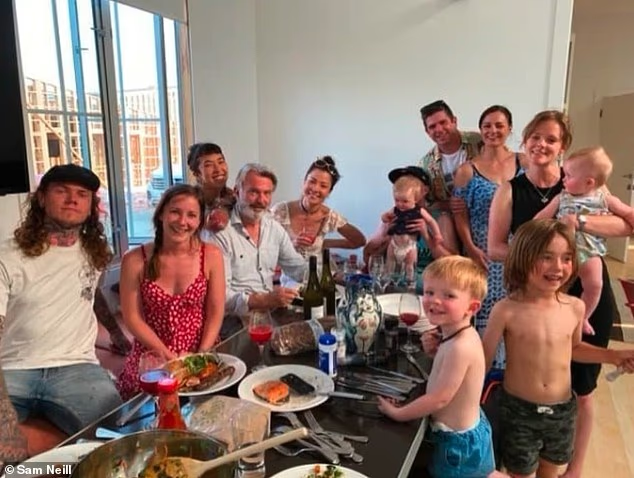
Sam Neill was one of the world’s most recognisable actors, but away from the cameras his greatest pride was his family (Sam is pictured with members of his family, including daughter Elena Neill and step daughter Maiko)
Advertisement
Among his children was daughter Elena Neill, who briefly followed in her famous father’s footsteps before turning away from the spotlight and building a creative career of her own as a Melbourne tattoo artist. (Elena is pictured in Top of the Lake)
She later appeared in Jane Campion’s acclaimed mystery drama Top of the Lake in 2013, where she played Stella, a young woman working as a tattoo artist.
The role proved to be an unusual glimpse into the future, as Elena eventually left acting behind and pursued tattoo artistry herself, becoming a Melbourne-based artist and creating a life away from her father’s fame.
Sam often spoke warmly about his daughter and included funny memories of fatherhood in his memoir Did I Ever Tell You This?
Advertisement
One story recalled a young Elena being asked what her father did for a living.
‘My daddy sits in caravans,’ she responded, referring to the long hours actors spend waiting between scenes on film sets.
Elena later became a mother to a daughter whose name has not been revealed publicly.
Sam’s eldest son is Andrew Neill, who he welcomed during his early twenties before making the difficult decision to place him for adoption in 1969. The pair later reuniting.
Advertisement
Speaking to The Times in 2014, Sam reflected on the experience.
Sam often spoke warmly about his daughter and included funny memories of fatherhood in his memoir Did I Ever Tell You This? (Sam is pictured with members of his family including his ex-wife Noriko Watanabe, daughter Elena and step-daughter Maiko)
‘No one has all the answers on how to be a good parent. I’ve got a slightly unusual family; it’s more extended than most,’ he said.
‘My first son, Andrew, was given up for adoption when he was very small. I was quite small, too – in my early twenties. I didn’t see him for 25 years and then we went looking for each other.’
Advertisement
Sam said their reunion was not the dramatic, emotional scene often portrayed in films.
‘These reunions are portrayed as sentimental and grisly, but there is nothing sentimental about it. No one sobs in anyone’s arms; it’s much more grown-up,’ he said.
‘If I could give my 20-year-old self any piece of advice, it would be that: you’re more capable than you think.’
By the time Sam and Andrew reconnected in 1994, the actor had already welcomed three more children.
Advertisement
His son Tim Neill-Harrow was born in 1983 during his relationship with New Zealand actress Lisa Harrow, whom he met while filming Omen III: The Final Conflict.
Unlike his father, Tim did not pursue acting and instead worked behind the scenes in film production, including roles in the camera and electrical departments on major productions such as The Matrix Reloaded and Guardians of the Galaxy.
One story recalled a young Elena being asked what her father did for a living. ‘My daddy sits in caravans,’ she responded, referring to the long hours actors spend waiting between scenes on film sets. (Sam is pictured in Jurassic Park)
His son Tim Neill-Harrow was born in 1983 during his relationship with New Zealand actress Lisa Harrow, whom he met while filming Omen III: The Final Conflict. (Sam and Lisa are pictured in 1981)
Advertisement
Tim later became a father himself, welcoming son Lachlan and twin daughters Molly and Poppy.
Sam’s fourth child was Maiko Spencer, the daughter of Noriko Watanabe from a previous relationship, whom Sam adopted during his marriage to Noriko.
Maiko largely stayed away from the public eye, but in 2021 she welcomed her first child, Nahlo – a moment Sam was so proud of that he made a rare exception and shared it publicly.
‘The Love. I don’t put family on media stuff. Except when they’re brand new,’ he wrote alongside a photo of his grandson.
Advertisement
‘This is my brand new grandson Nahlo, the bestest boy, two-weeks-old.
‘So chilled, no fuss. Just eats, sleeps and thinks about things. Parents blissed out, and everybody happy. Me particularly. The love.’
Despite his enormous success, Sam was candid about the difficulties of balancing fatherhood with a career that often took him around the world.
‘Probably a lot of my parenting has been marked by absence for one reason or another, not the least of them being that my job entails travel a lot,’ he told the ABC.
Advertisement
Sam’s fourth child was Maiko Spencer, the daughter of Noriko Watanabe from a previous relationship, whom Sam adopted during his marriage to Noriko. (Sam and Maiko are pictured in 2006)
Sam is pictured with ex-wife Noriko Watanabe in 1997
Maiko largely stayed away from the public eye, but in 2021 she welcomed her first child, Nahlo – a moment Sam was so proud of that he made a rare exception and shared it publicly
‘I don’t have any tips myself as far as parenting is concerned. At the same time, I’m not going to beat myself up about it.’
Advertisement
He also joked about the challenge of keeping up with his growing family.
‘Now I have eight grandchildren. This has to stop! I mean, I’ve only just got a handle on all their names anymore and I’ll be struggling. But they’re adorable,’ he said.
His son Tim was quick to defend his father, saying that despite the demands of acting, Sam had always been a loving parent.
‘There are worse things a dad can do than be off working. He is a good dad. He’s a very good dad. He’s grandad. Grad, as we call him.’
Advertisement
That deep love for his family was ultimately what inspired Sam to write what would become one of his most personal legacies.
After being diagnosed with stage-three blood cancer in 2022, the actor began writing his memoir, Did I Ever Tell You This?, at a time when he was confronting the possibility that he might not have much time left.
While the book became a bestselling memoir for fans, Sam always saw it as something far more personal – a record of his life that his children and grandchildren could return to long after he was gone.
Sam’s memoir Did I Ever Tell You This? is a record of his life that his children and grandchildren can return to long after he was gone
Advertisement
The actor said writing allowed him to leave behind his memories, stories, jokes and reflections for the people who mattered most to him.
Sam died at St. Vincent’s Private Hospital in Sydney on Monday after battling with pneumonia.
Family described his death as ‘sudden and unexpected’ in a statement published on his Instagram page.
The actor was previously diagnosed with a type of blood cancer.
Advertisement
‘It is with immense sadness that the whānau (family) of Sam Neill share the news of his passing on Monday 13 July, in Sydney, Australia. Sam was surrounded by family and passed with the dignity that has characterised his whole life,’ they said.
‘The loss was sudden and unexpected but blessed by the fact that Sam remained cancer-free. They would like to express their deepest gratitude to the staff at St Vincent’s Private Hospital for their incredible care.
‘More details will be shared later, but for now, on behalf of the family, we ask that you respect their privacy as they navigate this immeasurable loss.’
Police have launched a murder investigation after a pensioner was found dead at a property in Bolton.
10:49, 18 Jul 2026Updated 10:59, 18 Jul 2026
A woman has been arrested after the body of a 75-year-old man was found inside a house in Bolton.
Police were called to an address on Ormrod Street at around 8am on Friday, where officers discovered the man’s body. He was pronounced dead at the scene, the MEN reports.
The 49-year-old was arrested on suspicion of murder and remains in custody for questioning.
Advertisement
Greater Manchester Police’s Major Incident Team has launched a murder investigation and is continuing to pursue multiple lines of enquiry to establish the full circumstances surrounding the death.
Formal identification of the victim has yet to take place, but officers said his next of kin have been informed and are being supported by specialist officers.
Detective Inspector Louise Kelly said: “I would like to express my deepest condolences to the victim’s family and loved ones as they navigate through this loss. They will continue to be supported by our specialist officers during this difficult time.
“It is our priority to obtain some answers regarding the full circumstances of this tragic incident, and we are appealing for information from the public to help us progress our investigation.”
Advertisement
Anyone with information, CCTV or mobile phone footage is asked to contact Greater Manchester Police quoting log 744 of July 17, 2026, or contact Crimestoppers anonymously on 0800 555 111.
Toe-curling moment Sinn Fein politician complains she’s not allowed to speak in Gaelic in European Parliament – only to backtrack in English when she’s told she can
A Sinn Fein politician who accused the European Parliament of stopping her from speaking Gaelic made an embarrassing climbdown in English after officials pointed out that she was, in fact, allowed to do so.
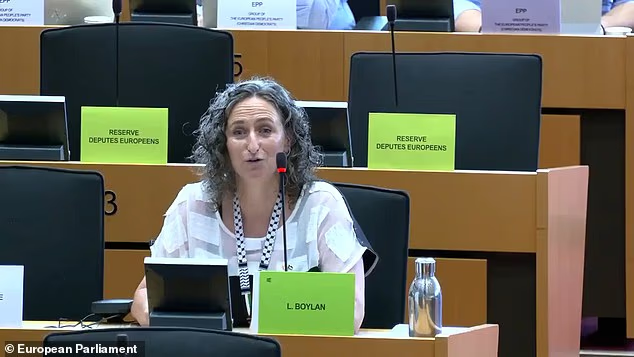
Dublin MEP Lynn Boylan was addressing a committee on EU Foreign Affairs when she found herself in a tangle over the use of the Irish language.
In a clip of the awkward moment, Ms Boylan prefaced her question with: ‘It is unfortunate that we can’t use our own language in this committee, but I will continue now in English.’
The committee’s vice-chair Hana Jalloul Muro quickly interrupted the Dublin-born politician, saying: ‘You can, you can.’
Advertisement
Caught off guard, the Sinn Fein MEP responded: ‘Ah, okay. We didn’t know. Sorry.
‘I will continue in English because I wasn’t prepared,’ the 49-year-old politician admitted before continuing her address.
The incident exposed both Ms Boylan and her party to criticism, with arguments that Sinn Fein appears to be more interested in ‘weaponising’ the Irish language for political points rather than genuinely promoting or using it.
The party has long positioned itself as a champion of the language, pushing for its use in official and everyday life in Ireland.
Advertisement
Dublin MEP Lynn Boylan was addressing a committee on EU Foreign Affairs when she found herself in a tangle over the use of the Irish language, saying how ‘unfortunate’ it was that it couldn’t be used
The committee vice-chair, Hana Jalloul Muro, quickly interrupted the Dublin-born politician, saying: ‘You can, you can’
Caught off guard, the Sinn Fein MEP responded: ‘Ah, okay. We didn’t know. Sorry’
Advertisement
Against this context, critics noted the irony of a Sinn Fein representative appearing unprepared to use Irish when the opportunity arose in an EU setting.
Ms Boylan has since faced questions about her own proficiency in Irish following the incident, as well as her ignorance of the ability to use Irish within an EU committee – with a translation being readily available.
However, supporters noted the difficulty in translating English to Irish on the fly, even for strong speakers.
The Traditional Unionist Voice (TUV), a conservative party in Northern Ireland, described the incident as ‘hypocrisy of Sinn Fein’.
Advertisement
In response, TUV Strangford Assembly candidate Jonathan Jackson said: ‘Unionists have long suspected that Sinn Fein are more interested in weaponising Irish and forcing it down the throat of communities who have no interest in it than genuinely promoting it because of love for the language.’
It is not the first time Sinn Fein’s use of the Irish language has come under scrutiny.
Earlier this month, the party appeared to vote against its own amendment to a government amendment in the Dail (Irish Parliament) during a cost of living debate.
Concluding the debate, Ceann Comhairle (speaker) Verona Murphy asked in Irish if they agreed to the amendment to which Sinn Fein’s TDs (MPs) did not agree.
Advertisement
Peadar Toibin, leader of the conservative party Aontu (Unity), jumped in and said ‘they’re backwards there’, pointing out that they had disagreed with their own amendment.
Padraig Mac Lochlainn, Sinn Fein TD for Donegal, then added he has ‘no fluent Irish’. Ms Murphy repeated the question in English.
‘We’ll do it in English as they say,’ she said, triggering laughter in the chamber.
The Sinn Fein TDs then agreed to the amendment.
Advertisement
Ms Boylan was elected as a Member of the European Parliament for the Dublin in July 2024. She is also the Chair of the EU Delegation for Relations with Palestine.
Gaelic has been a working language within the EU since January 1, 2022.
It is one of 24 official languages in the EU, which means speeches in the parliament and documents are translated to and from Irish.
The Irish language is recognised as the country’s first official language.
Defiant Thomas Tuchel refuses to bow to critics after World Cup semi-final agony – as England boss admits Three Lions still have ‘gap to close’ on Argentina, Spain and France
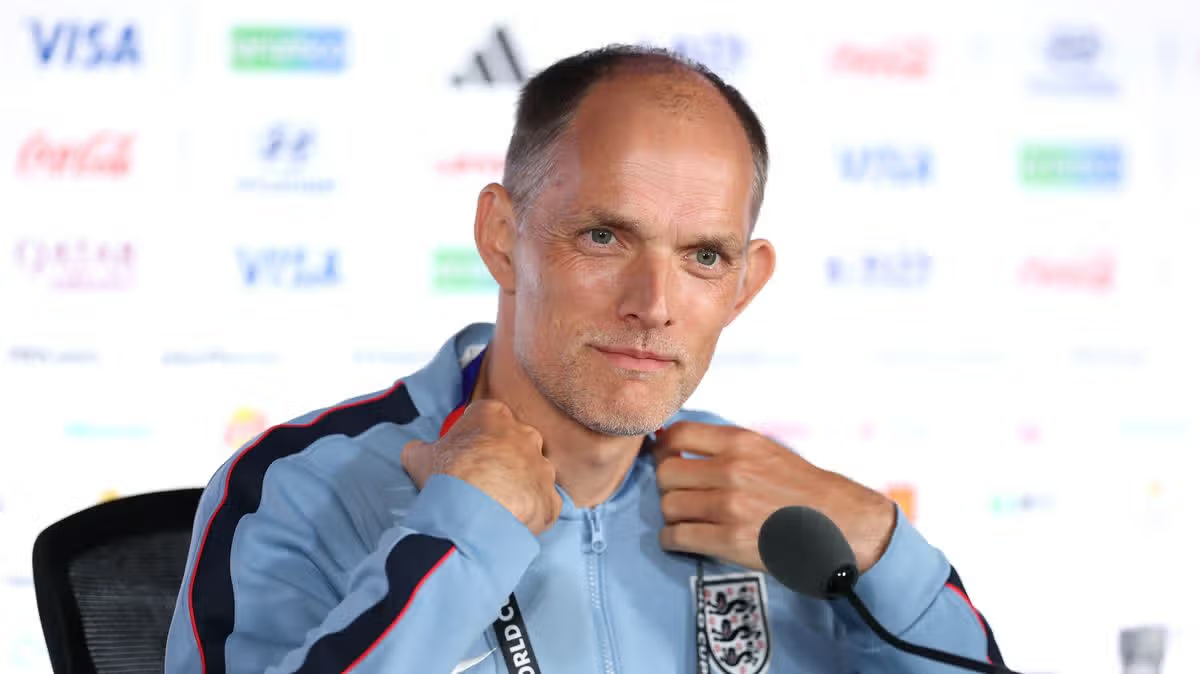
Thomas Tuchel admitted that there is still a visible gap between the world’s elite and England as he defiantly insisted that detractors of his reign will not change the decision to remain as manager.
The England boss has come in for a wave of criticism for the way in which he approached the final half an hour of Wednesday’s excruciating 2-1 World Cup semi-final defeat by Argentina.
There have been calls for the FA to part ways with the German, who insisted that his job ahead of the 2028 home European Championship is to find an extra level to compete with the very best in pressurised situations.
‘This is my pain, the players’ pain,’ Tuchel said before Saturday’s third-place play-off with France. ‘It is our scar that we carry. It’s a very painful defeat and we have to live with it. Not the critics, the experts, not our families.
Advertisement
‘We will overcome it, we will use it. We believe we could do it. We had genuine belief. I still believe three other nations, France, Spain and Argentina, expect to win. We are not there yet.
‘There is still a gap to close. This is what we will do, starting tomorrow. We have to play better football under pressure. We still have another level to reach. From there we go.
‘The gap is there because of the titles they have won as countries. What they built over many years.
‘We will not stop hunting and chasing. We have things to improve. There is not a lot of room for drama. If the blame game needs to be played then OK, you can do that, but I choose not to engage.’
Advertisement
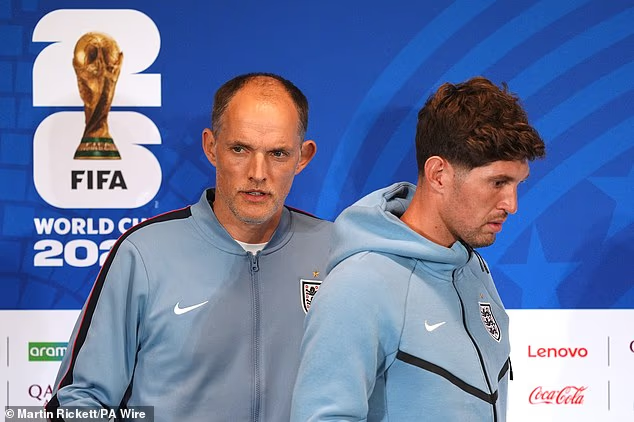
An emotional John Stones sat beside Tuchel, still appearing crestfallen, and claimed to have been unable to process the capitulation after what was likely his final World Cup appearance
Those comments effectively served to double down on his suggestion that the country’s DNA was not comparable to the likes of Spain and Argentina, who meet in Sunday’s final, and that England are not good enough on the ball.
Tuchel took exception to four different questions on his first public appearance since the dramatic defeat, querying the extent of fan criticism and dismissing Donald Trump’s assessment from a bizarre media appearance earlier in the day. The US President claimed England’s mistake against Argentina was moving Harry Kane into the back line, saying: ‘They took their best player and put him in defence.’
Advertisement
‘That’s what you do if you defend in a block,’ Tuchel replied.
An emotional John Stones sat beside Tuchel, still appearing crestfallen, and claimed to have been unable to process the capitulation after what was likely his final World Cup appearance.
Tuchel stayed defiant, however. When asked his thoughts on a sizeable number of supporters registering their anger, he replied: ‘I would like to make my own picture. It’s a strong opinion you give, to be an advocate for half the country being against me. Let’s wait for that.
‘I can never change my thinking of whether I’d like to carry on. You can see with John how painful it is. After a shock in the beginning it’s becoming more and more painful.’
Advertisement
The 52-year-old also claimed that the conditions in which England faced Mexico and Norway contributed to Wednesday’s performance.
‘Even if we don’t want to admit it because it feels like an excuse, the game with 10 men in Mexico, the altitude, losing the complete night of sleep and then Norway, it cost us more than we maybe thought,’ he added.
‘The togetherness built over these six weeks is not to be questioned. We could not get hold of the ball against Argentina. We couldn’t fight duels anymore.
‘If you ask me if I regret my decisions then no, I don’t. I felt we became too passive, I felt the momentum switched in the match and I tried to help and support.
Advertisement
‘I took several decisions trusting my instinct, intuition and experience. We didn’t get the result so I take responsibility. The decisions are made under stress. This is live, in-game coaching. I would regret it if I didn’t react.’
Share or comment on this article:
Defiant Thomas Tuchel refuses to bow to critics after World Cup semi-final agony – as England boss admits Three Lions still have ‘gap to close’ on Argentina, Spain and France
So-called ‘dodgy’ Fire Sticks and other modified streaming boxes offer users unauthorised access to premium content from providers such as Sky, Netflix, Disney+, and TNT Sports for free.
They are commonly marketed through websites, social media, messaging apps, and modified devices.
Law enforcement across the UK is cracking down on the use and distribution of these devices, which are considered a “serious crime” under the law.
People who access illegal TV streaming services are potentially liable to prosecution for criminal offences, including under Section 11 of the Fraud Act 2006.
Advertisement
Four arrested for supplying illegal streaming devices
Four men have been arrested in Merseyside following a two-day operation by police targeting the suspected supply of illegal streaming services to thousands of customers.
The arrests followed six search warrants.
On June 25, three men were arrested, including a 47-year-old from Birkenhead and two men, aged 41 and 56, from Prenton.
On June 26, a fourth man, aged 49 and also from Prenton, was arrested after further warrants were executed in Birkenhead and Prenton.
Advertisement
All those arrested are suspected of supplying unauthorised access to TV, films, and live sports to a large customer base.
Investigations manager at the Federation Against Copyright Theft (FACT), Nick Sumner, said: “These arrests demonstrate the value of FACT’s intelligence-led investigations and our close partnership with Merseyside Police.
“This sends a clear message that those involved in supplying illegal streaming services can be identified and held to account.”
The operation stemmed from intelligence-sharing between Merseyside Police and FACT, the UK’s leading anti-piracy body.
Advertisement
Police believe the alleged illegal activities caused harm to legitimate broadcasters, the wider creative sector, and the jobs it supports.
Illegal streaming devices offer users unauthorised access to premium content from providers such as Sky, Disney+, and TNT Sports for free. (Image: Getty Images)
Detective Constable Andrew Gibson, of the Cyber Dependent Crime Unit, said: “This coordinated operation follows detailed investigative work with FACT and has enabled us to take action against six individuals suspected of supplying illegal streaming services on a significant scale.
“Those selling illegal subscriptions should not assume that operating online will protect them from detection.
“We will continue to follow the evidence and pursue those believed to be profiting from this activity.”
Advertisement
The dangers of using illegal streaming devices
“Illegal streaming services are increasingly operated by sophisticated criminal networks, often involved in other types of crime,” BeStreamWise explained.
Meaning those who use illegal streaming devices run the risk of “letting criminals in”, resulting in:
Viruses and malware
ID theft, scams, and fraud
Inappropriate content
Around 39% of illegal streamers in the UK have suffered financial losses due to cybercrime linked to piracy, according to BeStreamWise.
The average amount stolen through illegal streaming is £1,680, while one in ten have lost more than £5,000.
What is the penalty if caught with a ‘dodgy’ Fire TV Stick?
Not only can the use of illegal streaming devices leave users open to ID theft, fraud, and viruses, but it can also result in fines and jail time.
Those caught using or selling a ‘dodgy’ fire stick/box and streaming premium content without paying are in breach of Section 11 of the Fraud Act 2006.
Advertisement
It says a person will be in breach if they obtain services “without any payment having been made for or in respect of them or without payment having been made in full”.
A person found guilty of this kind of offence could be fined or face a jail sentence of up to five years.
Have you ever used an illegal streaming device? Let us know in the poll above or in the comments below.
It was genuinely one of the most intense and tense press conferences I have seen in 27 years covering England.
And that is because the fall-out from Wednesday has been huge. But then – even by England’s standards – it’s hard to digest when you go from having so much hope to feeling so flat and deflated.
That is what football does to you. It is, as they say, the hope that kills you.
Even US president Donald Trump has questioned England’s tactics and use of Harry Kane. “What do I know about soccer?” Trump said. “They took the lead, and they took their best player, and they put him on defence.”
Advertisement
But it is the way it has played out which has also been so fascinating. England blew it. The frustration and disappointment quickly turned to anger and recriminations.
Tuchel was held up as public enemy No1. The Football Association quickly put out a statement from chief executive Mark Bullingham saluted the team. They also backed Tuchel.
But that only ended up turning Tuchel’s future into more of a debate. Why? He has got two years left on his contract.
Then came the blame game. The players were definitely surprised by Tuchel’s substitutions. One source close to the dressing room claimed the manager had “failed the players.”
Advertisement
Tuchel’s remarks also caused raised eyebrows among the players and those close to them. That was deflecting all of the blame onto the players, suggesting they had simply not followed his instructions.
It is not in the FA’s thinking to get rid of Tuchel. They remained convinced he is the right man for the job and, if England were to beat France, they would finish third and that would be their best-ever World Cup campaign on foreign soil and the best since they won it in 1966.
But Tuchel does have a habit of being combustable and his exits from Borussia Dortmund, Bayern Munich, Paris Saint Germain and Chelsea were pretty acrimonious.
So it would not be beyond the realms of imagination for him to quit. But it would need him to walk for there to be a change in manager.
The far bigger issue – and the biggest of all – is winning back the trust of the fans. And there has to be a question whether that is even possible. Few managers lose the fans – and get them back onside.
That is the battle facing Tuchel. Loyal England fans had been won over – then he lost them. They are genuinely angry and some want him gone. They see him as a busted flush.
Advertisement
Are we overreacting? Well, no. Even impartial observers think England have the best range and squad of players at this tournament. Mind you, they certainly do not have the experience and proven winners of Spain or Argentina.
Now, Tuchel has a big job on his hands to take England forward – and win back the fans.
Content cannot be displayed without consent
Right now, John is in North America, embedded with Thomas Tuchel’s England squad, giving Mirror readers every single nugget of detail as the team attempts to win a first men’s World Cup in 60 years.
By signing up to his new Mirror+ newsletter you’ll get access to his deep analysis of the game, strong opinion and unrivalled transfer news service throughout the summer.
Advertisement
John will be calling on his network of sources and contacts from 27 years covering football to bring Mirror+ subscribers the essential read every week – taking you under the skin of the game like no-one else can.
Each week, subscribers will get exclusive insight, gossip and the chance to submit questions.
The football agenda never stops – and neither do we. Whether it is World Cup glory or more heartache for England, John will be ready to do it all again next Premier League season, only with even better access for you, the readers.
It comes as the supermarket expands support for people across the country struggling to put food on the table
Neil Shaw Assistant Editor
10:10, 18 Jul 2026
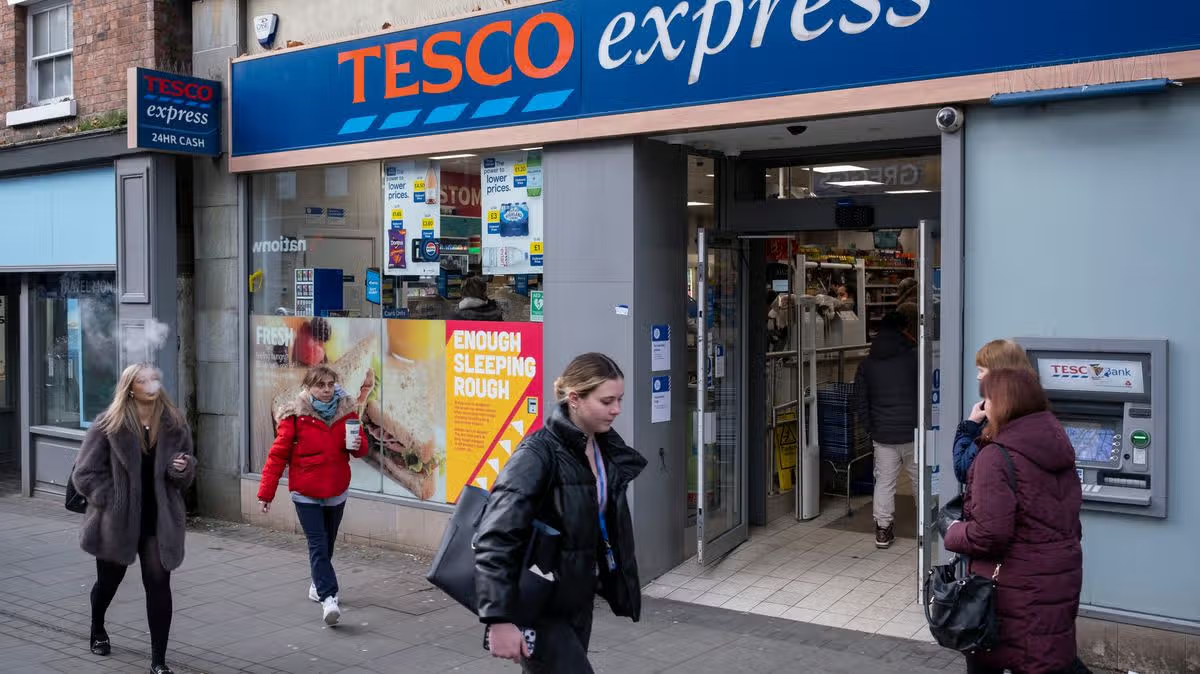
Tesco shoppers will be asked an important question when they reach the tills this summer. It comes as Tesco is providing extra help to support children and their families facing hunger.
Children who would normally receive free school meals during term time are at risk of missing meals during the holiday period. Trussell says food bank support for children remains 34% higher than before the pandemic, including a 24% increase in the number of emergency food parcels for children under-5.
Advertisement
A recent survey carried out by Felix, the new name for FareShare and The Felix Project, found that 41% of local charities receiving food via its nationwide food redistribution network have experienced an increase in demand in the last 12 months. For a further 13%, demand for food support had more than doubled in the last 12 months.
This summer, from July 6 to August 16 in Scotland and NI and July 20 to August 30 in England and Wales, Tesco will sell its pre-filled food donation bags in all large stores. The bags, which typically cost between £2 and £4, contain healthy and nutritious long-life food and essentials and can be picked up in store and paid for at the checkout. The donated items go directly to Felix and Trussell, who will distribute it to charities and food banks to help families who need it most across the UK.
And From Monday, August 3 to Sunday, August 9, customers will have the chance to round up their bill at the checkout to the nearest pound with the funds being split between Felix and Trussell to support their work over the summer. Online customers will also be able to make a monetary donation through an online giving link on Tesco’s grocery home shopping website as they check out.
For families shopping in store, the supermarket will also be running its Kids Eat Free scheme in its 317 cafés across the UK over the school summer holidays. This year’s it’s been expanded to run for longer across all regions of the UK and now includes weekends. The supermarket’s cafés will be offering one free Kids Hot Meal Deal, Kids Breakfast or Kids Pick ‘n’ Mix deal with each item bought by an adult from as little as 60p, when showing their Tesco Clubcard or Clubcard App at the till.
Advertisement
Tesco is also bringing back Free Fruit for Kids for the summer. From 20 July to 30 August, children will be able to pick up free apples at checkouts in more than 800 large Tesco stores and 77 of its large Express stores. Click & Collect customers will also be given free apples for their children at selected stores.
Christine Heffernan, Chief Communications and Sustainability Officer at Tesco, said: “We want to be able to support our charity partners to help those needing a little extra support this summer. Our partnerships with Felix and Trussell are central to this aim.
“When you’re out doing your weekly shop this summer, dropping a few tins into a food collection point, picking up a food donation bag in our stores or rounding up our grocery bill, can make a difference to the lives of thousands of children in communities across the UK.”
Matthew van Duyvenbode, co-chief executive officer at Trussell, said: “Our community of food banks distributed more than 900,000 parcels for children last year, demonstrating the unacceptable levels of hunger and hardship so many families are currently facing. This isn’t right. That’s why the support of our partner Tesco is so crucial, providing in-store summer pick-up bags, making it much easier for people to support their local food bank throughout the school holidays.
Advertisement
“No-one should need to turn to a charity for something as essential as food, and as we work towards achieving the long-term change needed, Tesco’s and the public’s support will make a real difference to families across the UK during this school holiday. We are so grateful to Tesco and to everyone who donates food this summer.”
Charlotte Hill, CEO at Felix said: “We know from speaking to charities receiving food via our network that demand for food support is growing as people across the UK face cost-of-living pressures. During the school holidays, families will be facing additional financial burdens as they juggle the cost of childcare and food. Many will be turning to their local community and charities for support.
“That’s why the donation bags in Tesco stores are vital. The food donated will be shared with charities and community groups that can offer not just meals, but spaces and activities for children to play and make friends during the summer holidays, relieving the pressure on parents.
“Any Tesco shoppers that can donate an item or two to Felix will be making a valuable contribution to helping to support children and their families across the UK this summer. Together we can make a real difference, thank you Tesco.”
It’s an intriguing plan. But once you factor in the whole life cycle, from water and rocket fuel used to launch these satellites into space, to keeping them cool and eventually disposing of old satellites, the environmental case becomes less clear.
Outer space, out of mind
Off-worlding polluting industries is not a new idea. In the 1970s, when the last Iranian oil crisis caused rocketing fuel prices, Nasa kicked off a plan to build huge solar plants in space. The idea flopped when the oil began to flow again.
Since data centres need so much energy, much of it for AI, such astronomical ideas are back on the table. Regular Earth-based data centres were responsible for around 5% of all electricity used in the US last year, for instance, mostly using fossil fuels. Their share of US power demand will likely triple by 2028.
The fragile frontier
That’s why the cold vacuum of space, with its endless supply of solar energy, is being pitched as a more sustainable alternative to big, noisy, hot data centres in our back yards.
Advertisement
Meanwhile, a recent petition from environmental law charity Earthjustice, is calling for a comprehensive review. They argue these proposals fail to acknowledge any environmental impact. “This is not just poor planning and a missed opportunity”, the petition states, “it violates federal law”.
Indeed, SpaceX’s planning applications come with assurances of no meaningful environmental impact. “It’s always sunny in space,” according to Musk, who says orbital data centres are “obviously the only way to scale”.
Yet data centres in space would be even more prone to overheating than those on earth. That’s because, like a Thermos flask, space keeps things hot. There’s no water or air to carry excess heat away. Instead, keeping powerful AI chips cool in orbit requires massive ammonia-filled radiators that let heat escape as infrared radiation. This isn’t very efficient and those radiators are much larger than the computers they cool. Lifting these huge structures to orbit would require a lot of rocket fuel.
SpaceX’s Starship takes off from its launch pad in Texas, May 2026. UPI / Alamy
Most plans for orbital data centres depend on the future success of SpaceX’s heavy-lift Starship. But every Starship launch burns over 1,000 tonnes of liquid methane, releasing around 80,000 tonnes of CO₂ (about the same as what 20,000 cars emit in a year). The warming associated with soot emissions in the upper atmosphere is 500 times more intense than the same emissions at ground level. We know soot from rockets reduces stratospheric ozone – the stuff shielding us from harmful UV rays. In the lower atmosphere, most soot falls back to Earth in weeks. In the stratosphere, soot stays there for up to four years, prolonging its damaging effects.
While it is always sunny in space, solar panels degrade much quicker there. Microchips are also easily damaged, falling prey to a phenomenon known as “bit flipping” – when high-energy particles rewrite memory hardware randomly changing data from 1 to 0. Retrieving busted hardware from space is not financially viable. SpaceX satellites have a five-year shelf life before being incinerated as they fall back to Earth. The environmental impacts of things burning up in the atmosphere are not well known.
Musk’s AI satellites would be connected by lasers. Should any one of the million or so satellites become untethered and collide with another, it would create further debris, creating more risk of collisions, more debris, and so on. Scientists call this the Kesler Syndrome and worry that orbital debris fields could hinder human activities in space for a very long time.
Orbital data centres would have a huge water footprint too. To catch toxic dust and protect their concrete launch pad from heat damage, a typical spaceport uses a deluge system releasing around 2 million litres of water with every launch. SpaceX has repeatedly broken environmental laws with its deluge system, allowing contaminated run-off from Starship launches to enter protected waters off the coast of Texas.
Some suggest these sci-fi schemes are designed to prop up SpaceX’s teetering stock price, rather than humanity’s computing needs. Others see orbital data centres as just one of many ambitious visions to tackle the environmental costs of AI. Either way, my research suggests this quest to off-world the industry’s headaches will have profound implications that are not well understood.
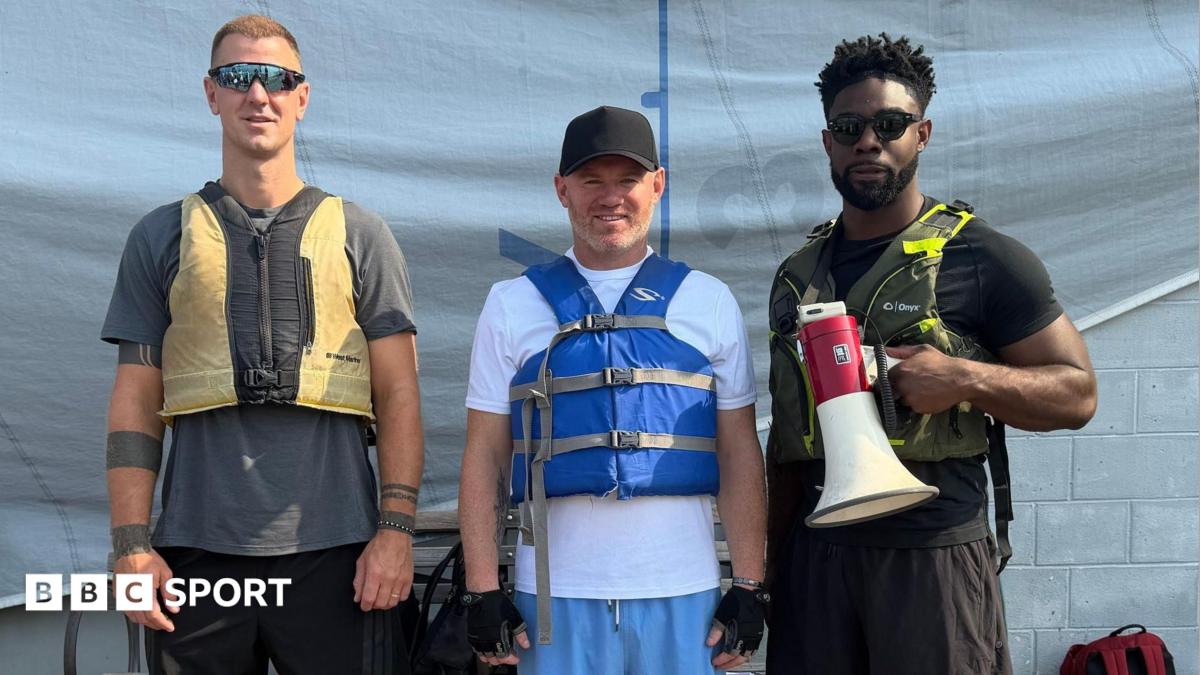
Turn the clock back to the last 16 of the World Cup, when the former England striker pledged to row down the River Mersey if Norway beat Brazil.
Norway did exactly that, beating the five-time champions 2-1, so BBC Sport pundit Rooney confirmed live on air that he would take on the challenge in the US.
He and fellow pundits Joe Hart and Micah Richards swapped their microphones for oars and took to the Hudson River in New York.
Advertisement
“I loved it,” Rooney said. “The fans were brilliant. So we’ve done it out of respect for the fans.”
Norway fans’ viking row became a sensation at the World Cup, and even Norway striker Erling Haaland was keen to see Rooney in action.
“Wayne, I expect you to go out on a rowing trip,” he said.
Norway were knocked out by England in the quarter-finals.
Advertisement
Rooney, Hart and Richards will be back on dry land alongside Gabby Logan for Sunday’s World Cup final (20:00 BST), which will be available to watch live on BBC One and BBC iPlayer.
England play France in the World Cup third-place match on Saturday at 22:00, also live on BBC One and BBC iPlayer.
Small boat crossings to the UK have almost halved while the irregular crossings to Europe are down almost 40 per cent so far this year, The Independent can reveal.
Analysis of Home Office data shows 12,214 people have arrived in the UK on small boats by 9 July this year – down 42 per cent from 2025, when 21,117 people had made the perilous journey across the English Channel in the same period.
While migration experts are clear that numbers are falling, it is hard to know definitively why this is.
EU border officials have pointed to partnerships in north Africa stemming the number of onward journeys, but experts caution that these pacts come with a deadly cost.
Advertisement
Nearly 1,300 people have lost their lives in the Mediterranean so far this year, according to the International Organisation for Migration (IOM).
Here, The Independent examines how many people are travelling on migration routes into Europe, and onwards to the UK, and why this might be.
How many people are arriving on small boats to the UK?
At the end of June this year, 11,884 migrants had arrived on dinghies – down 41 per cent on the same period in 2025 – a particularly high year for crossings, second only to a record-breaking 2022 – and down 12 per cent on 2024.
Advertisement
Labour has tried to bring the numbers down by paying more money to French police enforcement to stop migrants from leaving their shores and sending small boat migrants back to France in exchange for asylum seekers.
But the “one in, one out” scheme, which began in August 2025, has only removed a comparatively small number of migrants, with 1,087 people sent back to France as of the end of June. There have been reports that the French are looking to end the programme in October this year, to focus on a European-wide strategy of tackling irregular migration.
Why are the number of UK small boat migrants falling?
Advertisement
Dr Mihnea Cuibus, senior researcher at the University of Oxford’s Migration Observatory, said it was hard to identify any one policy change, or factor, as contributing to the fall in crossings.
He said: “Arrivals are down throughout Europe. They were also significantly down last year, which is significant because you would expect a bit of a lag as people travel through Europe to the UK. The decline we saw last year could finally be feeding through into arrivals in the UK.
“The other thing is change in policies, with the new deal with France, and the one in, one out scheme. The share of those who have been removed to France has remained very low, so we wouldn’t expect that to make a massive difference.
“It is likely that there seems to be a bit of an effect [from the different policy changes], but there are other factors such as arrivals into the EU.”
Advertisement
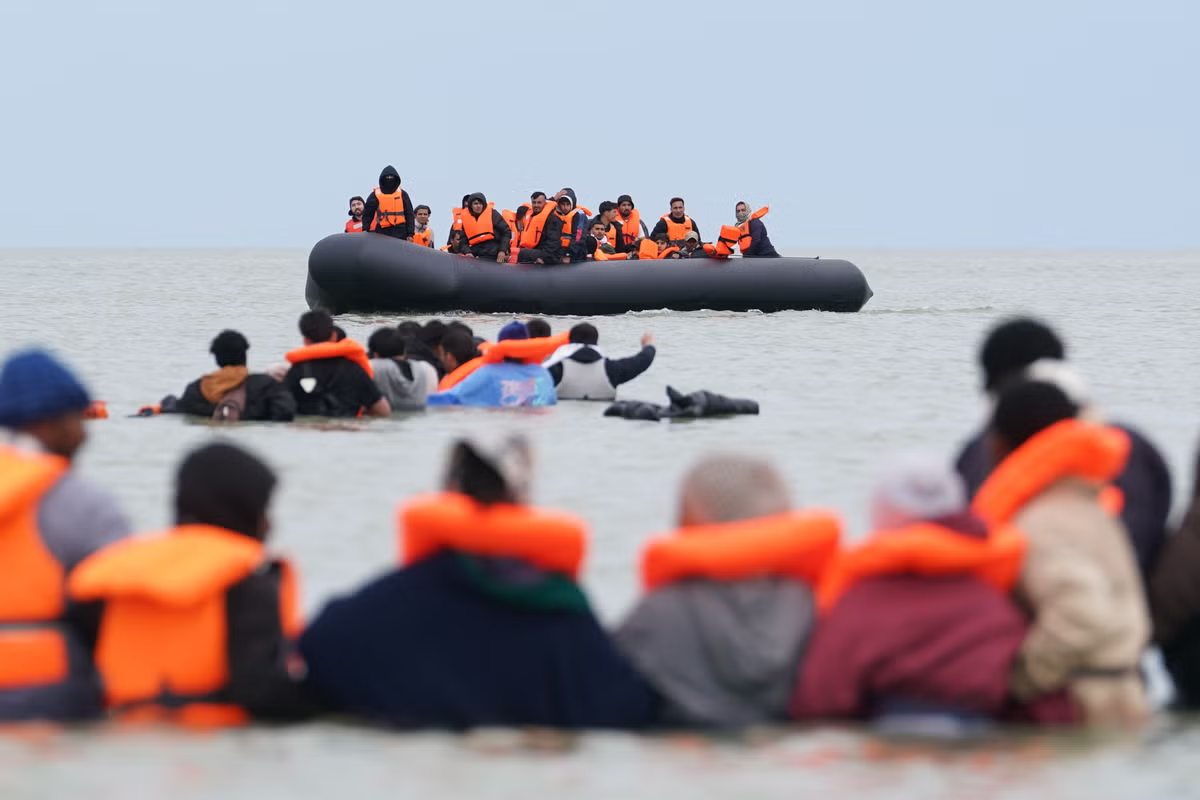
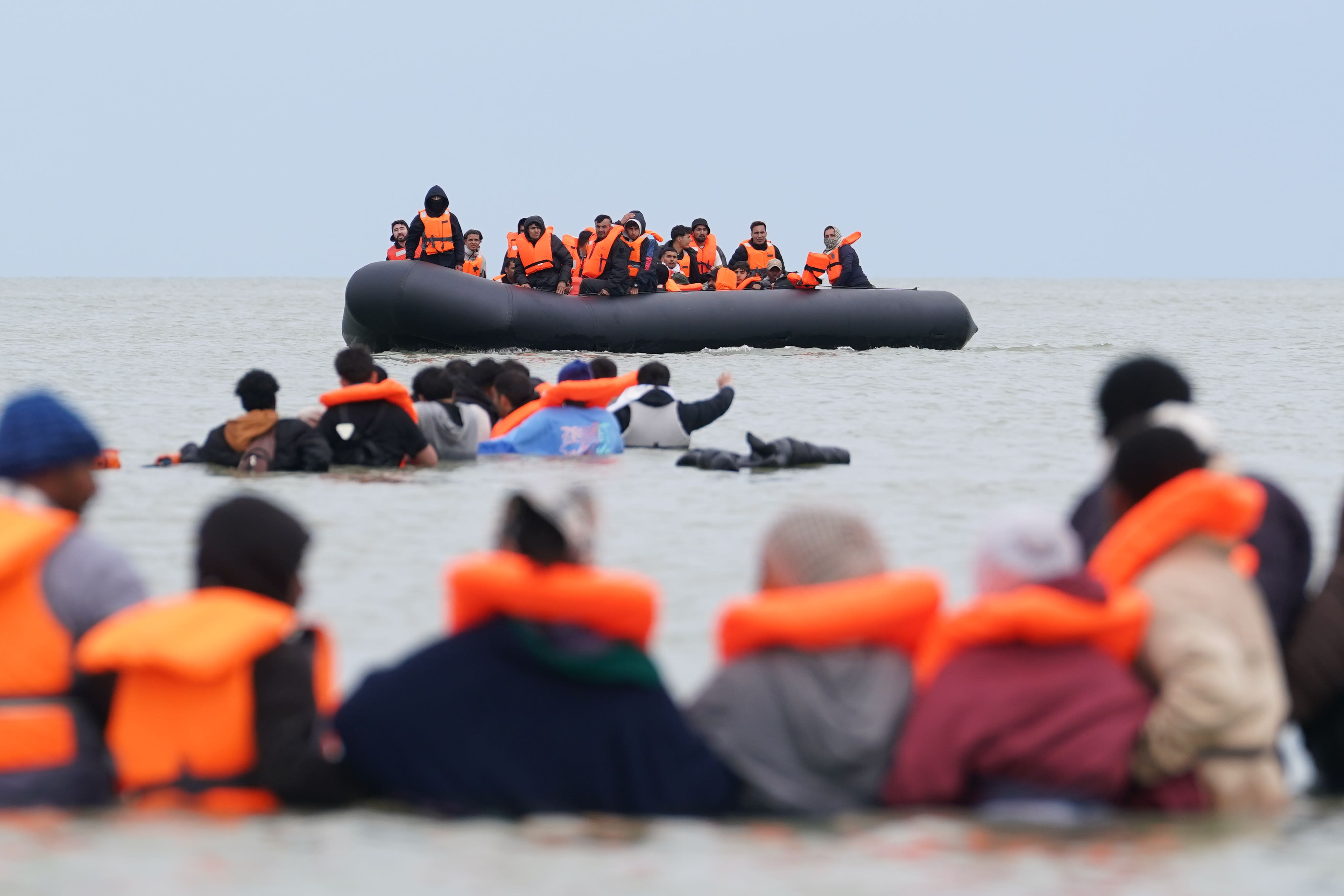
People thought to be migrants wade in the water as they attempt to board a small boat off the coast of Berck, France, during an attempt to cross the English Channel on June 15, 2026 (PA Wire)
In 2026 so far, 187 boats have arrived in the UK, compared to 362 boats in the same period last year. The size of dinghies has increased significantly as smugglers adapt to increased police activity on French beaches. Larger boats now ‘taxi’ around the coast of France and wait to pick up people offshore. In an indication of how big the small boats are now getting, a record 128 migrants arrived in one dinghy this week.
The previous record was 125 in September 2025. In total 41,472 people arrived in 672 boats last year, compared to 36,816 people in 695 boats in 2024.
However, the dip in arrivals in the first half of 2026 compared to 2025 may be due to when the bulk of people arrived last year. In 2025, arrivals were spread out throughout the year, starting with 4,568 people in March and continuing through the summer, with more than 5,000 people arriving in September. In 2024 and 2023 however, more people arrived later in the year, with 5,417 people crossing in October 2024.
This shows that while the arrivals are tracking down this year so far, more could still make the journey in the second half of 2026.
Advertisement
Dr Cuibus cautioned: “We do see these numbers move up and down, at times quite randomly over the past five or six years. We still don’t understand why 2025 was so big, just as we don’t understand quite why there was a surge in people in 2022 – particularly in Albanians.”
He added: “If this trend continues until the end of summer, that will be very interesting. We are in a bit of a waiting pattern until we’ve seen the summer through.”
Where are small boat migrants coming from?
Eritrea was the top country of origin for arrivals last year, with more than twice as many than in 2024. Many leave to escape national service, which is compulsory for all citizens aged 18 to 40 and there is a near-total suppression of civil or religious freedoms in the country.
Advertisement
The number of people coming from Afghanistan, which was the top country of origin in 2023 and 2024, declined to second in 2025 after a peak in 2022, the year after the Taliban takeover – with 8,319 people arriving via small boats.
Figures for the first three months of 2026 show that the Eritrean numbers are being sustained, with 743 citizens making the crossing compared to 735 Sudanese and 598 Afghans.
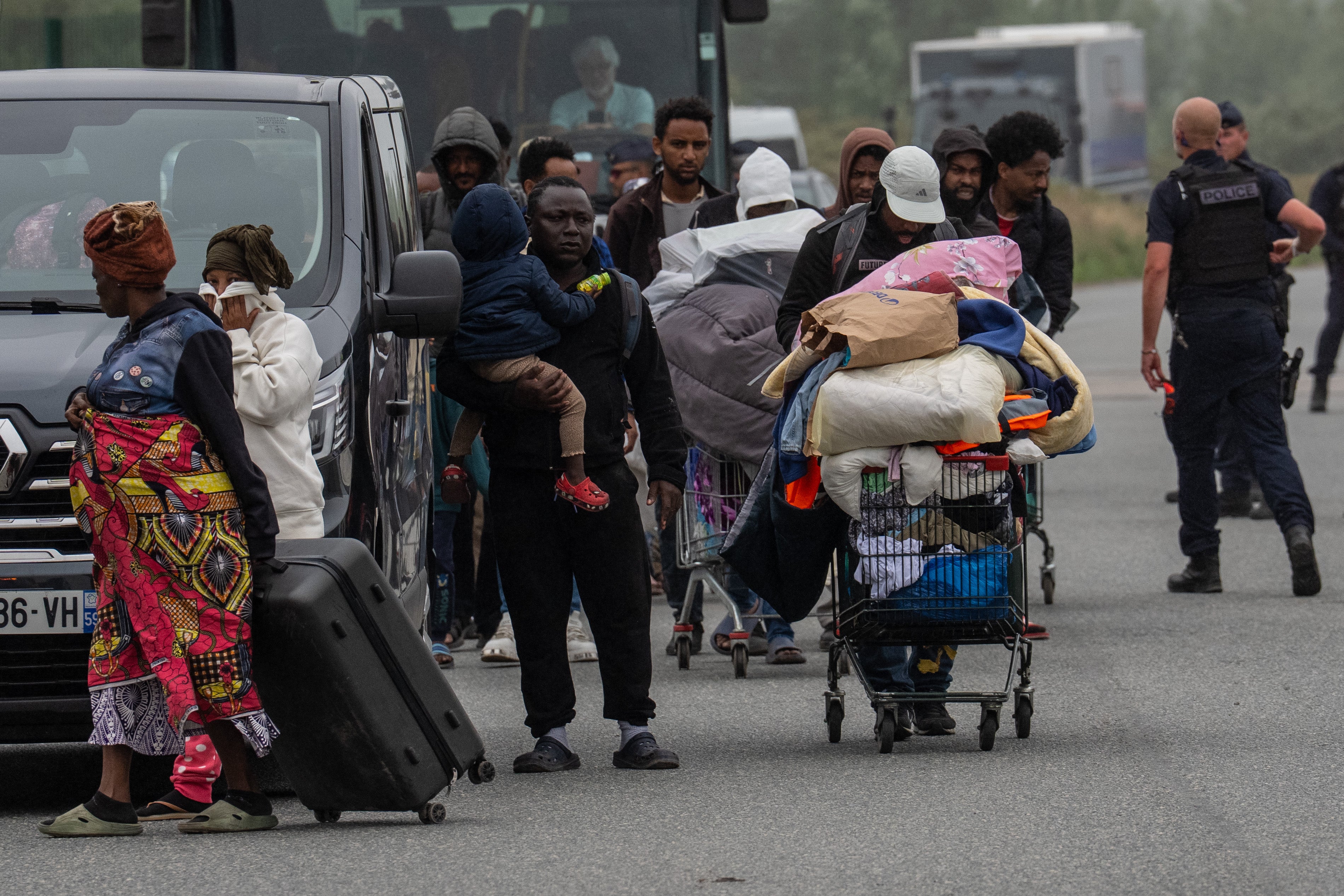
Migrants leave an area of their camp that was cleared by French authorities on July 2, 2026 in Loon-Plage, France. (Getty)
The number of Syrian, Iraqi and Vietnamese nationals also fell in 2025, while those from Sudan, Somalia and Ethiopia all increased.
The numbers of Somalians making the Channel crossing surged from 697 in 2024 to 3,783 in 2025. The steep rise comes after the jihadist group Al-Shabaab made major advances last year in its battle against the Somali government.
In Sudan, where the second highest number of small boat migrants now come from, the country has been experiencing a severe humanitarian crisis after three years of civil war. Over 14 million people have been displaced and two-thirds of the population – 33.7 million people – are in need of humanitarian support, according to the International Rescue Committee.
Advertisement
Judith Sunderland, from Human Rights Watch (HRW), said: “We’ve seen a massive outflow of people from Sudan, many who are stuck in Libya. We’ve already seen an increase in Sudanese on boats to Europe and there could be a really significant increase if various factors align.”
Explaining migration flows more broadly, she added: “There are a lot of people on the move because they are trying to improve their situation and the lives of their family. So long as there is bad governance and poverty, people will try to get someone where they think they can have a better chance.”
Dr Cuibus explained that Syrians and Afghans are now less likely to be granted asylum in Europe than they were in previous years and said this could be contributing to the reduced numbers arriving.
Advertisement
Irregular border crossings into Europe are also down
Irregular crossings into Europe are down almost 40 per cent in the first five months of 2026 compared to the year before, data from border agency Frontex shows.
Nearly 39,000 crossings were recorded in the months January to June – a decline attributed to co-operation between the EU and Africa to increase police enforcement at departure points. The Western African route saw the steepest decline, with detections down by 71 per cent on the year before.
The number of people arriving in Italy from north Africa across the central Mediterranean route, usually the busiest crossing, is also down 52 per cent year-on-year, with 14,340 people making the journey so far in 2026.
Advertisement
Why are small boat crossings to Europe falling?
Judith Sunderland, senior associate director at HRW, said the EU drive to stop people making the journey to Europe “carries with it enormous risks and suffering”. She explained “people are essentially trapped in various locations in their migration journeys”, such as migrants who get sent back to Libyan detention camps when they are picked up trying to cross the Mediterranean.
“Focusing on the numbers hides the suffering that is behind this. It is based on a lot of extremely dubious deals that the EU and individual member states have pursued and support for security forces in places like Libya, Tunisia, Mauritania and elsewhere,” she added.
Giorgia Meloni’s government in Italy, backed by the European Union, is funding, equipping and training both the Libyan and Tunisian coast guards to intercept people on their way to Europe.
Advertisement
Human rights organisations have this week called for the EU to stop funding Tunisia over its security forces “reckless and violent conduct” during interceptions at sea.
According to the charity Statewatch, the EU is also looking to team up with Libya’s eastern forces to stem the number of people launching boats from its shores.
Ms Sunderland explained that there are lots of factors that would influence the numbers getting on boats, such as the weather, smuggling dynamics, and the work of border forces.
Advertisement
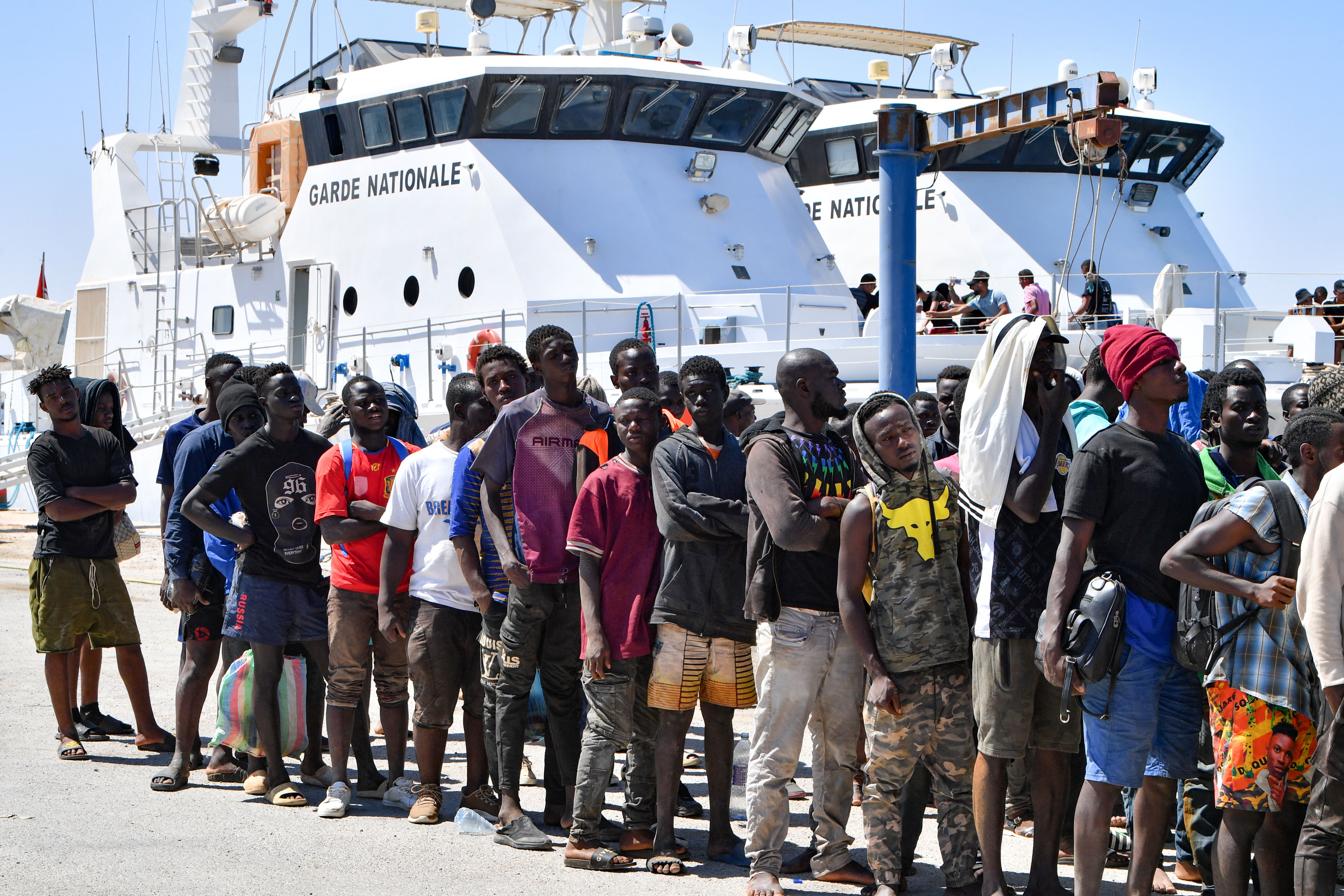
Migrants trying to flee to Europe, disembark in Sfax from a ship owned by the Tunisian coast guards, after being intercepted by them at sea on August 10, 2023. (AFP/Getty)
“The numbers have decreased recently compared to the past several years, but they are still higher than they were six or seven years ago,” she explained.
She said that, those who remain stuck in third-party countries such as in detention in Libya, will not give up their determination to move on. “They will keep trying. Very few turn back. And people smuggling networks adapt and change.”
Dr Cuibus added: “The view is that all of these deals, with Libya, Tunisia, more co-operation with Morocco, these things together do seem to have an effect, because at the end of the day it is about physical prevention. Experience kind of reveals that physical enforcement can stop the boats, if you stop people leaving countries from transit, or at least temporarily divert them to other routes. But there are also broader factors at play, like the changes in the home countries’ situation.”
A spokesperson for the IOM told The Independent: “While the number of irregular arrivals to Europe has declined in 2026, the situation continues to demand urgent attention because too many people are still risking – and losing – their lives on dangerous migration routes.
Advertisement
“The Central Mediterranean continues to be the world’s deadliest migration route… equally concerning is the growing number of migrants who disappear without trace, with increase evidence of so-called ‘invisible shipwrecks’ where vessels are lost and their fate remains unknown.”




















































You must be logged in to post a comment Login