



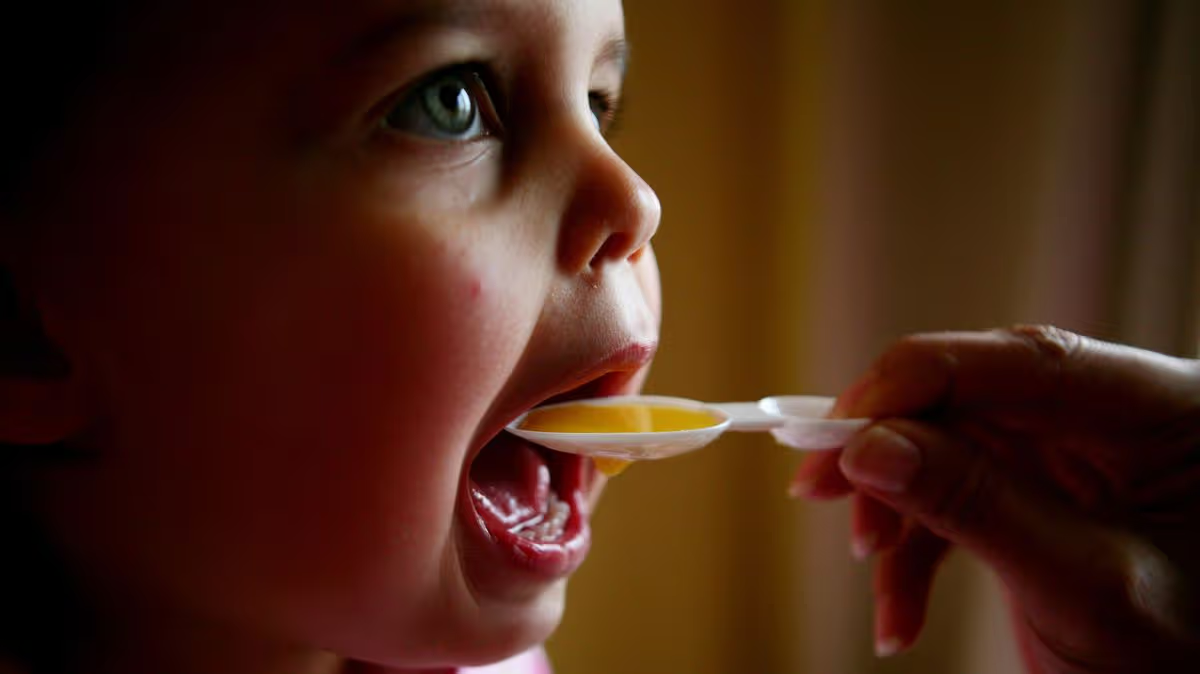
World-leading Great Ormond Street Hospital finds that children CAN take pills and often prefer them – and it could save the NHS millions
The NHS could start giving children tablets instead of liquid medicine and save millions of pounds, research suggests.
Pills cost a fraction of the cost and switching to them could save the health service sometimes tens of thousands of pounds a year just for one patient. A trial at Great Ormond Street Hospital (GOSH) in London found that patients as young as seven were successfully able to switch to pills, and in many cases preferred them to having to take unpleasant tasting liquid medicines.
The world-renowned children’s hospital is now planning to assess whether patients as young as four can successfully switch to cheaper tablets.
READ MORE: Marriage might lower your risk of developing cancer, new study findsREAD MORE: Doctor strike ‘deliberately timed to cause havoc’, NHS boss says
Project co-lead Dr Antonia Dastamani, consultant paediatrician at GOSH, said: “It is common practice to ask patients how they’re finding treatment, or how they feel when they have injections, but we never thought to ask patients about the taste of medicines and whether they like them.”
The initial trial looked at 19 children aged seven to 13 with a condition called congenital hyperinsulinism (CHI) which leads to high levels of insulin in the body. Sufferers have to take a medicine called diazoxide multiple times a day depending on their insulin and glucose levels to keep their blood sugar levels stable.
Until now children were given the medicine as a liquid – costing £15.50 per 50mg. In comparison diazoxide in tablet form costs just £1.15 per 50mg. Children were monitored to ensure their blood glucose levels remained stable and asked which form of medicine they preferred.
Researchers found that switching from liquid to tablets could save the NHS £40,000 per patient per year. CHI affects one in every 30,000-40,000 children.
Kate Morgan, Gosh clinical nurse specialist who co-led the project, said: “We knew the potential this trial had for savings, but the scale of the quality-of-life improvements for children and their families we are seeing is something we didn’t anticipate.”
What the kids thought
Jess Manktelow was one of the children who took part in the project and was switched to diazoxide tablets in April 2025. The 11-year-old from Kent explained: “It has made a big difference taking medicine that doesn’t taste horrible.
“There were times where I didn’t want to take it because of the taste. It makes things very easy for me now, I’m able to do it myself and it doesn’t take up as much time at school. When I’m doing things I like, like climbing, it doesn’t have as much impact and that makes me happy.”
Before the switch Jess’s school and family life had been organised around taking liquid diazoxide multiple times a day, which needs to be stored at room temperature in a glass bottle and drawn up with a syringe.
Jess added: “I would always get a lot of questions about the medication when I would go away camping or at airport for holidays. It would always be hard to explain why I need it so much, but it isn’t always an easy condition to explain.”
Mum Steph Manktelow added: “We were so excited when the team told us we could switch to the diazoxide tablets. We’d been hoping for some time, we knew it was a better solution and would allow Jess to have control over her condition and that is very important.”
There is emerging evidence to show that children are capable of swallowing tablets and capsules, particularly if they are taught how to do it from a young age. Previous research has looked at the possibility of establishing a ‘Pill School’ within the NHS to provide swallowing training sessions to children.
The new GOSH trial looking at tablets for kids as young as four could spark a change in the NHS as liquid medicines are more problematic as well as being more expensive. They generally have shorter expiry dates, require measuring the right volume to take and be more inconvenient to store and carry.
Project co-lead Dr Dastamani said: “This has shed a light on key questions we now want to ask children and young people about their care and treatment so they can be more involved and have more independence in their lives.”
Nurse Kate Morgan added: “Children are so much more than their diagnoses – they have full lives and families and their illnesses affect everyone, so it is very important we do all we can to make simple, positive changes that impact everyone for the better.”
The cost differences can be huge with common blood thinning drug warfarin costing £100 for a liquid bottle compared to £2 for 28 tablets.

















































You must be logged in to post a comment Login