The business had promoted its CastleCourt outlet as a “paradise for chocolate lovers”
A chocolate shop, which went viral for its luxury Dubai-inspired desserts, has closed its Belfast store less than a year after opening.
Advertisement
Shoppers visiting CastleCourt Shopping Centre this week were met with the shutters down at Taste of Belgium.
The closure comes exactly two years after the company opened its Belfast premises in July 2024, following the closure of its original Newry café in June of that year.
Taste of Belgium built up a loyal following on social media thanks to its extravagant desserts, including its £12 Dubai chocolate strawberries and £8 Dubai hot chocolate, as well as handmade Belgian chocolates and speciality coffees.
The business had promoted its CastleCourt outlet as a “paradise for chocolate lovers”, serving handcrafted Belgian chocolates alongside drinks, desserts and gift boxes.
Advertisement
The move to Belfast came after the owners shut their Newry premises, telling customers at the time they were relocating to a larger site in CastleCourt Shopping Centre.
However, customers arriving at the city centre shopping centre this week found the unit closed.
A spokesperson for CastleCourt Shopping Centre confirmed to Belfast Live that Taste of Belgium has permanently ceased trading at the shopping centre. No reason has been given for the closure.
The business had become one of several local retailers to capitalise on the viral Dubai chocolate trend, with its pistachio-filled chocolate strawberries and rich hot chocolates attracting queues and widespread attention online.
Advertisement
Its website continues to advertise Belgian chocolates and click-and-collect in Belfast, although it is unclear whether this will continue following the closure of the CastleCourt store
Following the announcement, customers said it is ‘such a shame’
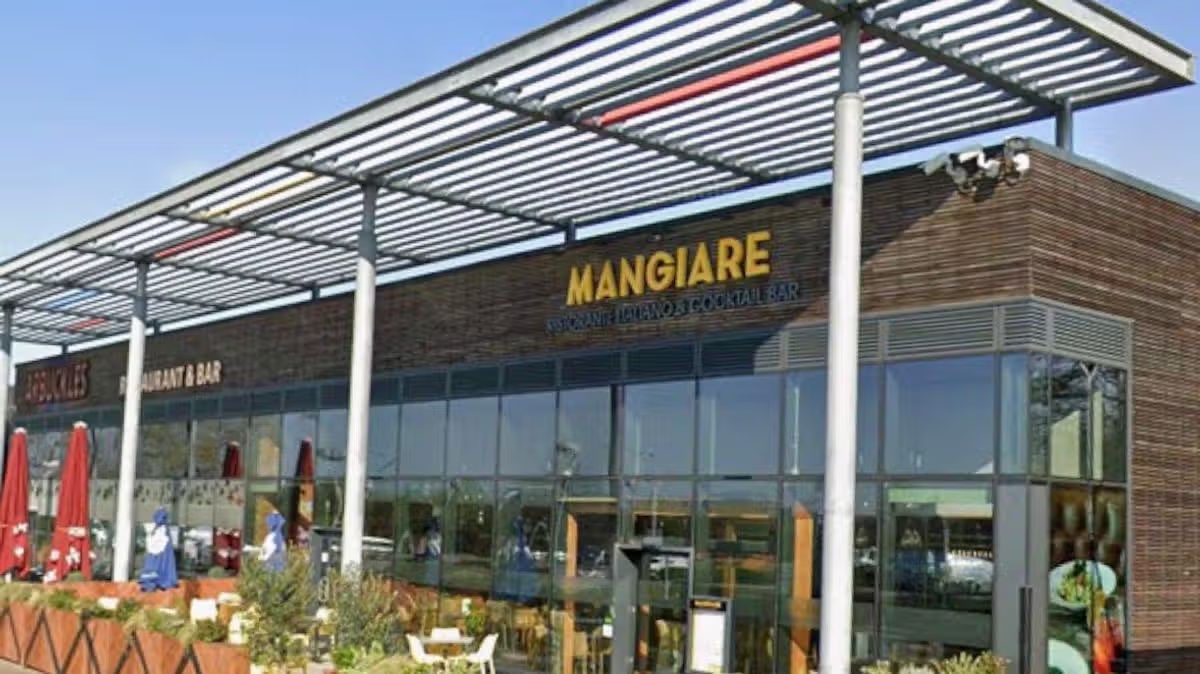
A popular Cambridgeshire Italian restaurant is set to close its doors permanently, citing they will “cherish the memories”. Mangiare on Downham Road in Ely is set to close for good on Sunday, August 2.
Advertisement
Its owners said that, “with a heavy heart” the restaurant will close. This isn’t the end of Mangiare though, as its other locations in Newmarket and Frinton-on-Sea remain in operation. The restaurant has thanked customers for all their support.
The Mangiare restaurant shared on Tuesday, July 15: “It is with a heavy heart that we announce Mangiare Ely will close on Sunday, 2nd August. A huge thank you to all our wonderful guests for your support over the years.
“It has been our pleasure to serve you, and we’ll always cherish the memories we’ve made together. And if you’re nearby, COME AND ENJOY the same delicious Italian food and friendly service at our MANGIARE NEWMARKET restaurant. Thank you for everything.”
In response to the news, diners commented that it is their “favourite restaurant” and that it is “such a shame” to hear. In a recent review on Tripadvisor, one customer wrote: “We visited Ely Mangiare today and I couldn’t fault any aspect of out meal or the service. The food was sensational.”
Advertisement
Another previous customer wrote: “This authentic Italian ristorante offers great flavours, crowd-pleasing dishes, and a relaxed, friendly vibe.”
The vision of the restaurant comprised of the “finest Italian taste coupled with a relaxed atmosphere for a memorable experience”, according to Mangiare’s website.
Cruelly, the journey was brought to an end in Atlanta by the defending champions.
Enzo Fernandez scored with five minutes to go, then Lautaro Martinez two minutes into stoppage time, both of them assisted by Lionel Messi, the greatest player of all time, whose genius showed no sign of having waned.
On to Sunday’s final to face Spain heads the 39-year-old and his team, an extraordinary group littered with Premier League pantomime villains who just seem to find a way. So did England, until this. Until now.
In the end, the fact England finished the match with six or seven minutes of constant possession as they hunted a leveller was like a sick joke. They had barely seen the ball for the previous 40 minutes, intent on closing out a victory before it ever truly looked like one.
Advertisement
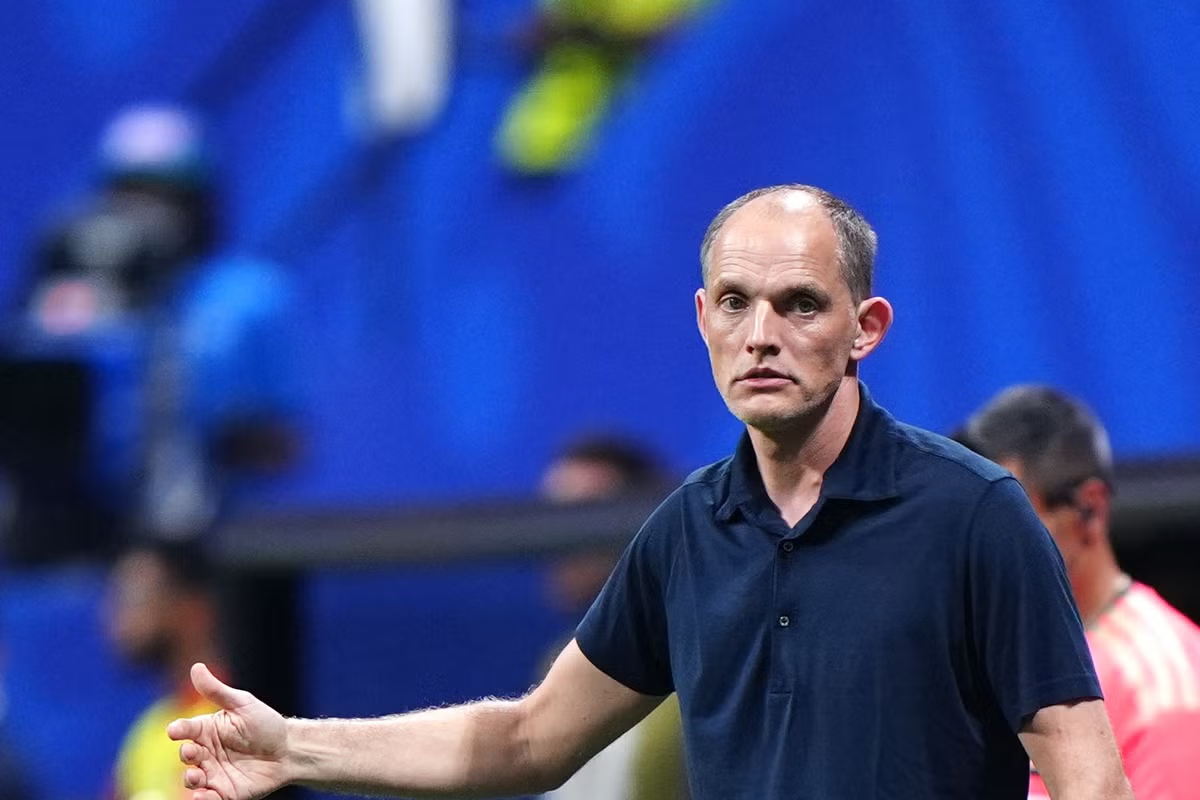
Thomas Tuchel could not get England over the line
Getty
England have enjoyed some superb moments at this World Cup. Jude Bellingham and Harry Kane have kept them in the tournament until the final week, with a stand-up supporting act elevating the stars ahead of them. But a journey to end 60 years of hurt? This one, like all the others, wasn’t to be.
This meeting of two chaotic and closely-matched teams was bound to produce a match that betrayed as much; the question was whether the chaos would rain goals or would shrink the pitch and produce a tight, tense deadlock.
Advertisement
It proved the latter. Look hard enough on one of these long England major tournament nights and you can see, preserved in amber, the moment that sets the tone for the drama to follow.
England vs Argentina was a cagey affair
Getty
In this case, a bullish foul on Elliot Anderson by Chelsea’s Enzo Fernandez. England swarmed the American referee Ismail Elfath, demanding a yellow card; Jude Bellingham and Cristian Romero went at each other.
Referee Ismail Elfath struggled to get a hold of the match initially, both sides well up for the battle and Argentina intent on making it a cynical affair. Fernandez struck just over the bar. It would take riskier football and better football to split these two.
Advertisement
Defending deserts England this time
When Declan Rice stole the ball, played in Morgan Rogers, and Rogers crossed for Gordon to stick the opener smartly in, England were caught in the jubilation of it all and fans began to dream of a return to the World Cup final after six long decades.
The speed with which England slumped into old habits, backed off and invited Argentina to come onto them was a nail-biting sight and a concerning one too.
On came Ezri Konsa and Dan Burn and Nico O’Reilly. And yet the clearances being made were by defenders already on — by John Stones and Marc Guehi, doing a fine job already without the need for the cavalry just yet.
Advertisement
England parked the bus but could not defend their narrow lead
AFP/Getty
Gordon’s goal was in the 55th minute, plenty of the game left. England sought to close it out too early. There was a time for Burn and co, the protection league who had hauled England across the line against Mexico and Norway. Just not yet.
Shattered bodies couldn’t get out fast enough to Fernandez’s strike from range, a goal so similar to those England conceded to Italy’s Claudio Marchisio at the 2014 World Cup and Aurélien Tchouaméni against France four years.
Messi lurked on the right, hooked in for Martinez to nod home. Argentina prepare for a final that might just have been England’s to contest, if they had been braver, had shown more of their teeth, in those crucial minutes after Gordon had raised belief for a nation now resigned to the same fate as usual. Not this time, again.
We often hear about how becoming a mum can impact identity – just this year, a major survey of 4,000 women by Peanut found nine in 10 mums (93%) said they’d experienced a “meaningful change” in identity after becoming a parent.
More than half (59%) said they felt like a completely different person after having a baby.
But compared with motherhood, fatherhood and identity seem to receive less research attention and much less public discussion.
Taking to Reddit more recently, a dad-of-three opened up about having the “realisation” that he doesn’t seem to have an identity outside of keeping his family running.
“Somewhere along the way I became the person who remembers everything. The grocery list. The camp forms. The appointments. The lunches. The laundry. The bills,” he said.
“None of those things are who I am. But together they’ve become what I do all day, every day.”
He added that he loves his family and loves being a dad, “but sometimes I wonder who I am when nobody needs anything from me”.
Advertisement
“I struggle with this too. It’s hard,” said one of many replies.
Another parent chimed in: “I went out for drinks while my family was away last week and I realised I forgot how to do that … I have my work life where I run that place, and my home life where I run that place, but outside of those two things, I have a hard time existing.”
One parent noted they “worry” who they will be in 20 years when their child is an adult and leaves home, while another recalled how even a simple “how are you?” prompts them to answer about their family’s wellbeing, rather than their own.
Why do we struggle with our identity after having kids?
Advertisement
It’s certainly not uncommon to feel like your identity shifts radically after having kids. Where once you only had yourself (and perhaps a romantic partner) to think about, now you’re also wholly responsible for another human – who relies on you for everything. They almost become an extension of you.
Dr Rebecca Lesser Allen, a clinical psychologist who works with families, said in her experience, identity loss begins when parents struggle to maintain space for their own perspective.
“In modern life, most parents begin organising their decisions around what the children need, what the household needs, what everyone else needs, and stop asking themselves: what do I enjoy? What feels meaningful to me? What kind of person am I becoming?” she said.
Rather than trying to return to the person you were before having children, the aim is to “continue growing and evolving while integrating parenthood into your larger sense of self”, she suggested.
Advertisement
“Healthy identity isn’t about clinging to your pre-parent self or disappearing into the role of ‘Mum’ or ‘Dad’. It’s about continuing to become a whole person.”
There is a lot of messaging in modern society that life needs to revolve around children, but Dr Lesser Allen wants to see a shift away from this idea that kids should be the organising principle of family life.
“We often receive the message that being a good parent means optimising every aspect of childhood – meals, sleep, enrichment activities, emotional development, schedules, weekends – and that a devoted parent should always put themselves last,” said the psychologist.
“That pressure is exhausting, and I don’t think it’s serving parents or children particularly well.”
Advertisement
How to regain a sense of identity after having children
Brook McKenzie, a chemical dependency counsellor and CEO for Burning Tree Programs, a long-term treatment centre for people struggling with addiction, said he often sees the long-term consequences “when a parent’s entire identity becomes wrapped up in their child”.
“Being a father is an enormously important part of a man’s identity, but it can’t be his entire identity,” he said.
“Children are supposed to need us differently as they grow. If Dad’s sense of purpose depends on remaining indispensable, he may unintentionally keep doing for his children what they need to learn to do for themselves.”
Advertisement
His advice to fathers in a similar position is to avoid asking, “Who am I when nobody needs me?” and instead ask, “Who am I choosing to become while my children are becoming who they are?”.
“Go back to the parts of yourself that existed before everyone needed something from you,” he advised parents. “Friendships. Marriage. Work. Faith. Fitness. Curiosity. Hobbies. Whatever was genuinely yours. And if some of those things no longer fit, build something new.
“The goal of fatherhood isn’t to remain necessary forever. It’s to raise children who can eventually stand without you – and to still have a life worth living when they do.”
Research suggests benefit from growing up in families where parents maintain a healthy sense of self and strong adult relationships, while remaining emotionally connected to their children, Dr Lesser Allen pointed out.
Advertisement
Instead of waiting until you have a free Saturday to reconnect with yourself (which could be a while, let’s face it), she urged parents to “invite your children into the life you already value”.
“If you love hiking, bring them hiking. If you enjoy gardening, you can let them help. Or give yourself permission to do it while they potter around and interrupt and bother you that they’re bored,” she said.
Kids might say they’re bored and wish they were doing something else – and that’s alright. They’ll be OK. She continued: “Give yourself permission to sit on the couch in the middle of a busy Saturday, read a book, and tell your kids ‘I’m not available right now.’
“Children don’t need every activity to be designed around them. They benefit from participating in meaningful family life.”
Advertisement
She also wants parents to get curious about the guilt they feel over doing things for themselves – this guilt “often reflects an internalised cultural message that a good parent is endlessly self-sacrificing”, she added.
“Again, the research indicates that this kind of self-sacrifice does not benefit children. Guilt isn’t always evidence that you’re doing something wrong. Sometimes it’s evidence that you’re challenging an unrealistic expectation.”
Like McKenzie, the expert said maintaining your identity isn’t just good for you, it’s good for your children, too.
“Kids benefit from seeing their parents have friendships, interests, meaningful work, and passions outside of parenting. It teaches them that adulthood isn’t about disappearing into caregiving or organising your entire existence around someone else,” she said.
Advertisement
“It teaches them that healthy relationships allow us to love deeply without losing ourselves.
“The healthiest families aren’t the ones where parents sacrifice their identities for their children. I work with adolescents and young adults in therapy every day who tell me that this is not helpful and often places an enormous burden on them.
“Healthy families are ones where children grow up surrounded by adults who remain whole people, and in doing so, model what a full and meaningful life can look like.”
McKenzie seconds this: “One of the healthiest gifts a parent can give a child is watching them see Mum or Dad continue to grow, pursue meaningful work, maintain friendships, nurture a marriage, and live a life that doesn’t depend on their child’s constant involvement.”
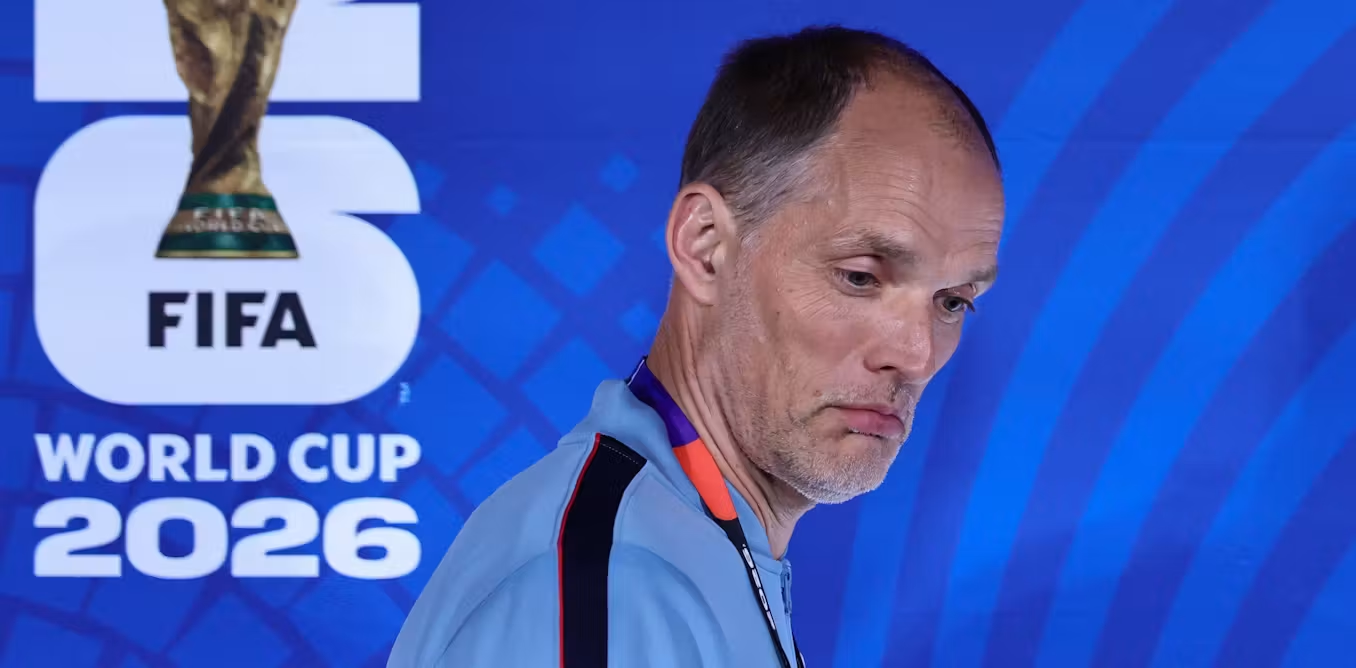
As a football coach, Thomas Tuchel has done things differently to many of his colleagues.
For example, it is extremely rare for lower league footballers to become the head coaches of top sides. But that’s what Tuchel did, playing as a defender in Germany’s bottom tiers, before going on to manage elite teams like Paris Saint-Germain and Chelsea.
It’s also unusual for youth team coaches to become coaches to senior sides, or to make the leap from coaching relatively small clubs to some of the bigger clubs in the world. Tuchel, England’s head coach, has made these switches too, and in doing so has demonstrated two particular managerial skills: awareness and adaptability.
The two qualities complement each other. A strong sense of awareness is required to effectively assess situations and players, and then recognise how and when a team might need to change its approach. It requires the ability to evolve and mature.
Advertisement
And a distinct aspiration for Tuchel is not to remain the same coach that he has been in the past. He has said: “[You] need to constantly adapt your style to what is needed, and to your group, and to change yourself, and to develop and to grow.”
He is also known for his perfectionism and dedication. And according to a former colleague, his total commitment to a cause can galvanise a group if it is harnessed correctly.
The colleague said: “Extraordinarily good coaches like him are very intense, that’s part of the deal. They live and breathe football, and that attitude transmits to the team.
“They want to do everything well, and that creates a strong feel for the collective. Everybody wants to give their all, every day, every game. That’s why teams immediately get better once he starts working with them.”
Advertisement
Tuchel retains very high expectations of performance. He does not mask his displeasure on the sidelines, and is not afraid to tell players when they are not playing well. But his methods involve much more than direct criticism.
For instance, after visiting a professor at Mainz University in Germany, Tuchel became an advocate of a technique known as “differential learning”, which emphasises variation rather than repetition of movement in football training. It also involves presenting players with a wide variety of obstacles that demand constant adjustment, while embracing the fact that players and opposing teams are all different.
So Tuchel began to tailor practice sessions to continually challenge and stretch his players. There would be extreme variation in pitch sizes for example, or particularly difficult drills.
Tuchel said of this more creative style of training: “That influenced me a lot, because it changed my role as a coach completely.
Advertisement
“With this [approach] there is no right and wrong. I’m just responsible for the ideas and principles of how we play. Within those they are free to find their own solutions.”
The overall idea for Tuchel is that training ends up being so testing and so demanding, that competitive matches seem comparatively easier to cope with.
Shape-shifter, trophy winner?
Tactical versatility has also been a defining feature of Tuchel’s method. He is well known for his in-game changes, where a side might switch formation six times during a match. He wanted his players to learn to constantly adapt to new roles, shapes and systems.
Advertisement
However, Tuchel has recently explained that if you switch formation too often, players can be conditioned to always look to the coach for a solution. Instead they should be concentrating on how they flexibly apply fundamental defensive and attacking principles, regardless of changes in tactics.
So again, Tuuchel is open to change. He wants to empower his team to make adjustments, without always looking to him for the answers.
To him, awareness and adaptability are crucial qualities required for effective management. This means having the confidence to follow a well-formulated course of action, but also the modesty to appreciate the limits of your capabilities and remain receptive to alternative solutions.
As Tuchel has commented: “I can do it my way, but I never want to say, ‘I know how it’s done.‘
Advertisement
“I know nothing. I just try my things, and every day is new. There are lots of people out there in business who say they know how it’s done. But there’s not just one way to do things. You have to adapt.”
Hello, and welcome to WalesOnline’s live blog for Thursday, July 16. We’ll be bringing you all of the latest news from across Wales – whether you’re on the move, at home or at work – as well as the latest traffic and travel.
We’ll also be keeping you informed of major news stories from the UK and overseas.
Contribute to the live blog by posting your comments below, or tweet us@WalesOnline to share the news that’s breaking in your area. Read the biggest stories in Wales first bysigning up to our daily newsletter here.
The 52-year-old former Chelsea boss was named Sir Gareth Southgate’s successor in November 2024 and led the back-to-back European Championship finalists to the last four in North America.
The German coach’s negative decision making has put him under intense scrutiny, but the Press Association understands he maintains the FA’s support.
Advertisement
Tuchel’s initial deal had only covered this World Cup but in February he signed an extension until 2028, when he fully intends to lead England into the home Euros.
Speaking after the Argentina loss, the head coach said: “I have a contract until the home Euros and I’m looking forward to that even like now it is difficult to look that far ahead.”
England flew back to their Kansas City base after Wednesday’s agonising loss in Georgia, where FA chief executive Mark Bullingham praised Tuchel.
“It is heartbreaking to be so close,” he said. “The players and Thomas gave it everything today and the squad, coaches and staff could not have worked harder during the tournament.
Advertisement
“I would like to thank them all – and also give my heartfelt thanks to our wonderful fans here in the USA and at home. We felt your support every step of the way and we are all so disappointed not to go further.”
England’s defensive substitutions have been questioned (Getty)
England cannot pack their bags for home just yet as the team must return to Miami a week on from winning their quarter-final against Norway at the Hard Rock Stadium.
A third-place play-off against France awaits and Saturday’s encounter will be a drag for all involved.
“A lot of lot of big, big, big football nations are eliminated before the semi-final, so, yeah, it is an achievement,” Tuchel said of making the final four.
“No-one wants to hear that at the moment. Me neither, because we demand the most of ourselves. That’s just the nature of being competitive.
Advertisement
“The nature of being so competitive (means) also puts the next game into perspective.
“Nobody of these (England) players, nobody of French players wants to play this match. They want to play in the final. We gave everything to be in the final.
“Everyone plays to win the World Cup, but it is what it is. We have for a day less and to recover, but we will do it professionally, of course.
“I didn’t say a lot (to the players afterwards). Nothing what you say in the dressing room can take away the pain or the disappointment, of course.
Advertisement
“We all know these moments, so I said let’s take it with respect, let’s digest it first. Accept that we gave everything. That is a big part in a defeat.
“Did we do everything to arrive in this semi-final? Did we give everything? 100 per cent we did, and I think the fans will realise that and do realise that.
“The second of all is to bounce back, to react. That’s what you have to do on highest level in sports. It’s what is demanded and what we will do.”
Sophie Fisher, 43, from York, has shared her battle after being diagnosed with coeliac disease after a series of unexplained medical issues that affected her life.
The mum of twins says that she spent years struggling with unexplained abdominal pain, exhaustion, and urgent diarrhoea – symptoms that began after the birth of her twin sons and a series of emergency surgeries.
RECOMMENDED READING:
Her health problems included a burst appendix, which perforated her bowel and led to emergency surgery; two years later, she was hospitalised again with an infected gallbladder, which was also removed.
Advertisement
Despite her ongoing digestive symptoms, Sophie said the issues were repeatedly attributed to scar tissue or post-surgical changes, with symptoms making day-to-day life unpredictable.
It was only after seeing a different GP – who asked why she had never been tested for coeliac disease – that she finally received a diagnosis for the autoimmune condition, which was confirmed by a blood test and endoscopy.
Sophie said: “When I got the diagnosis, I was absolutely gutted. Nobody wants to hear that they have to change everything they eat for the rest of their life. But at the same time, it was a relief to finally know I wasn’t imagining it.”
Coeliac disease affects around one in 100 people in the UK and causes the body’s immune system to attack the small intestine when gluten is consumed, leading to malabsorption of nutrients.
Advertisement
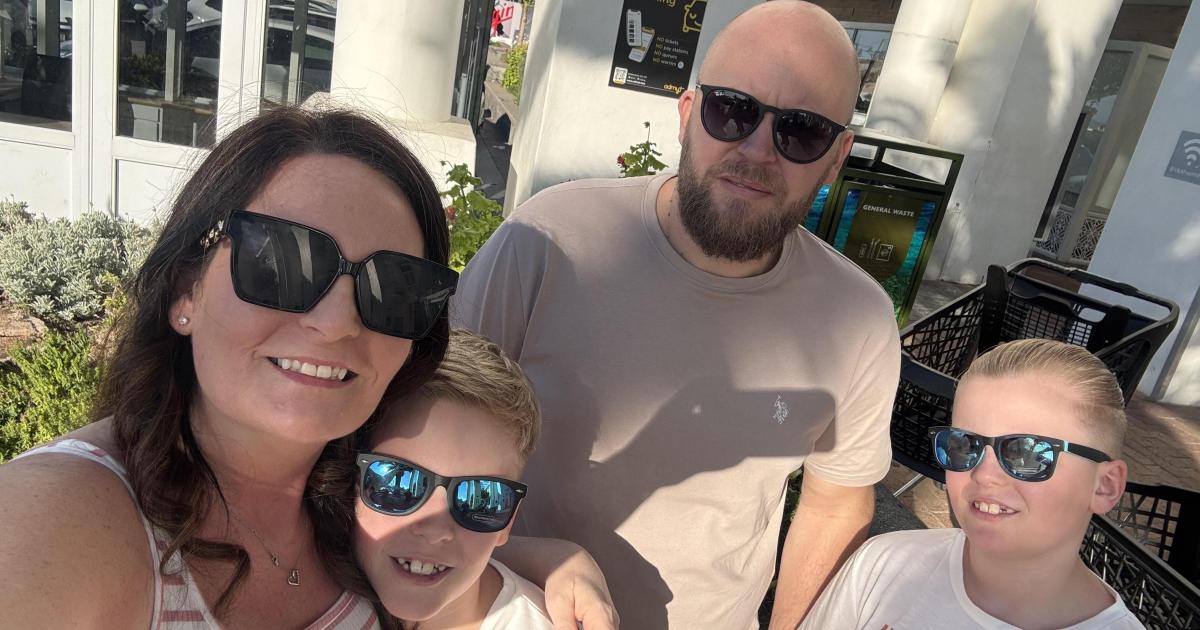
Sophie at Zip World with her family (Image: Guts UK)
The only treatment is a strict, lifelong gluten-free diet, with Sophie adding that adapting to a gluten-free diet has been challenging “both physically and emotionally”.
She said: “For years, being dismissed had made me feel like I was going mad. Managing coeliac disease day-to-day is hard work because it takes a lot of planning.
“I can’t just grab food when I’m hungry like other people can. Cross-contamination is a huge issue. I recently had blood tests showing gluten even though I hadn’t knowingly eaten any.”
She added that it had a significant emotional impact on her life, saying: “Emotionally, it can feel really isolating. I feel like ‘the awkward one’ all the time, even though it’s completely outside my control.
Advertisement
“Even simple days out can feel quite sad sometimes. The best way I can describe it is going to the coast and everyone wanting to just grab some chips and an ice cream, and I can’t.
Sophie and her family in matching pyjamas (Image: Guts UK)
“I’ve literally had to run across restaurants halfway through meals because of symptoms.”
Ms Fisher is sharing her story as part of Guts UK’s new campaign, Let’s Talk Guts, which aims to break the stigma around digestive symptoms and encourage people to seek medical advice.
She said: “I wish people understood that coeliac disease is an autoimmune disease. It’s not me being fussy or choosing not to eat gluten.
Advertisement
“I hope that if somebody else is feeling the way I felt before I was diagnosed, they might read my story and recognise something in it.
“If it helps someone push for answers or feel understood, then that’s really important to me.”
Running from July 13 – 19 , Guts UK has launched a campaign encourages people to have more open conversations about digestive conditions and symptoms, recognise when symptoms may need medical attention and feel confident talking about their guts with friends, family, colleagues and healthcare professionals.
The county’s force said it happened around 7.30pm on Thursday, July 2, on Walworth Avenue in Harrogate, between Walworth Avenue and a ginnel that runs towards Knaresborough Road.
Recommended reading:
Advertisement
The man, who uses a crutch, was approached by a woman who verbally abused him, specifically targeting his disability and causing significant distress, police said.
Officers are appealing for witnesses, particularly anyone who saw the incident or may have CCTV or video doorbell footage from the area.
The suspect is described as a woman in her late 40s or early 50s with blonde hair, wearing sunglasses, a short-sleeve white top, sand-coloured shorts, and carrying a shopping bag.
Anyone with information is asked to contact PC 724 Furnass at jodie.furnass@northyorkshire.police.uk, quoting reference 12260124395.
Katie Piper was left fighting for her life after her evil ex-boyfriend Daniel Lynch ordered for her to be doused in acid in a horrific attack – and he could soon walk free
Katie Piper has spoken out against online trolls who used Artificial Intelligence to ‘fix her face’ – nearly two decades on from suffering a sickening acid attack.
Advertisement
Daniel Lynch was jailed for life back in 2008, with a minimum of just 16 years, after ordering the attack on Katie, 24, which caused her to lose her eyesight in one eye and suffer horrific burns. “When the acid was thrown at me, it felt like I was burning in hell. It was an indescribable, unique, torturous pain,” Katie said.
After being rushed to hospital The Loose Women star, now 42, was put into an induced coma for 12 days. Since the horror attack she has endured hundreds of surgeries, and has talked openly about how she still fears for her life – prompting her to campaign for longer sentences for offenders who enact violence against women.
In her book, ‘Still Beautiful’, she describes the horrific ordeal she faced in hospital, writing: “What was left of my face after the acid had melted away my features was removed and unceremoniously dumped in a medical waste bin.”
Advertisement
Since then Katie has married Richard Sutton and they have two children. From hosting inspirational TV series, writing books, and helping open people’s eyes to what beauty really means, she has had a massive impact. But sadly there will always be online trolls making cruel comments.
Yesterday Katie took to Instagram to call out trolls for who requested X’s AI software Grok to alter a photo of her face to “make her beautiful”. Her post included both a red carpet photo, in addition to an altered AI version.
Her post caption reads: “So, today I found out what I’d look like if I was “normal”… according to AI and thousands of strangers on the internet. Someone uploaded a photo of me to Grok and asked it to “fix her face.” Since then I’ve been repeatedly tagged in a thread where people debate my appearance and share AI-generated versions of what I “should” look like.
Advertisement
“I’m okay. I’m not posting this because I need reassurance. I’m posting it because I’m wondering what happens when this isn’t aimed at someone who’s spent nearly two decades rebuilding their confidence. What happens when it’s a teenager? Someone newly injured? Someone living with a visible difference who’s still trying to find their feet? “We’re entering a world where AI doesn’t just generate images. It quietly reinforces ideas about what’s considered “normal”, “acceptable” or “beautiful” and millions of people consume those messages without even noticing. For what it’s worth, I don’t spend my life wondering what I would have looked like. Apparently the internet does enough of that for both of us.
Content cannot be displayed without consent
“I think this conversation is much bigger than me. It’s about AI, bias, beauty standards, anonymity, empathy, and where we draw the line. It feels like the start of a much bigger story, one I think we should investigate. What happens when AI decides what “normal” looks like? Who gets erased by those standards? Have you had an experiences?”
Dozens of celebrities took to the comments. Emily Attack wrote: “You are perfect as you are. Genuinely. The most beautiful woman ever.” Paloma Faith wrote: “You are wonderful as you are and I despair for the kids too x”. Tallia Storm wrote: “I am sending you so much love, you are beyond incredible Katie.”
Other users wrote: “This is awful, what is the world coming to,” and another said: “You are and have always been absolute perfection.”
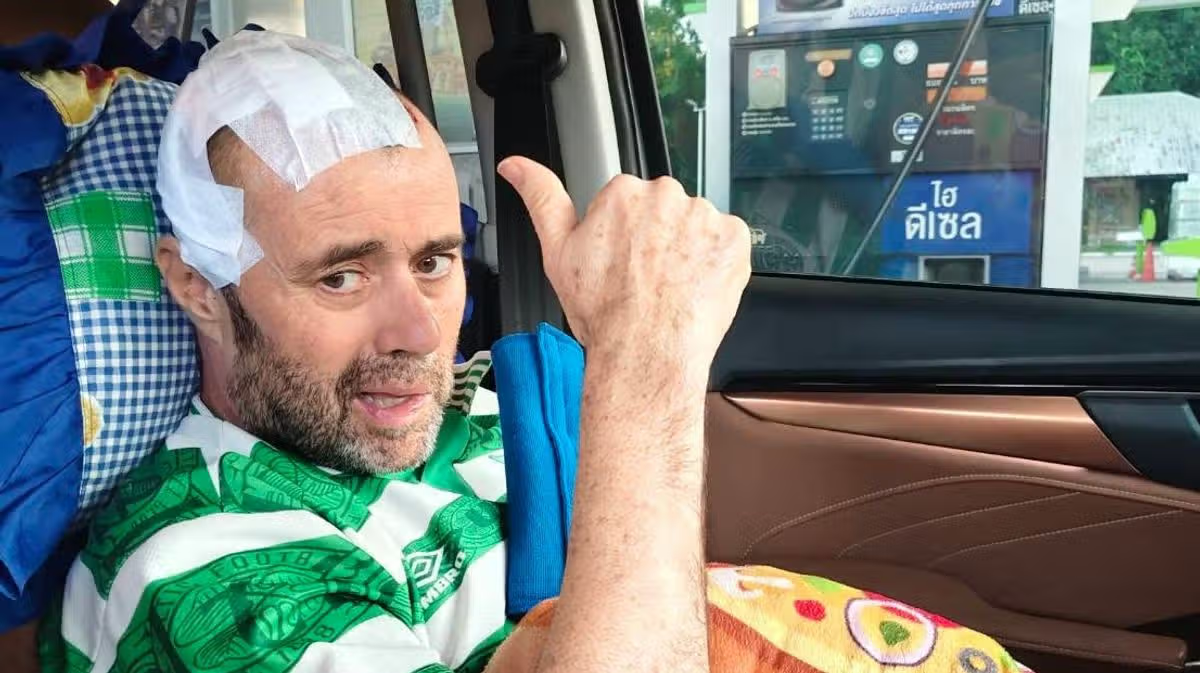
Paul Lennon, who founded the Thai Tims, has been diagnosed with Grade 4 Glioblastoma.
The Celtic fan founder of singing children’s group the ‘Thai Tims’ has been diagnosed with an incurable brain tumour.
Advertisement
Paul Lennon, 60, who started the Good Child Foundation in Thailand and used Celtic songs to teach English to children with Down’s syndrome, is receiving palliative care.
He was diagnosed with Grade 4 Glioblastoma (IDH-wildtype), an aggressive form of brain cancer, earlier this year. Glioblastoma patients are typically given a life expectancy of between 12 and 18 months.
He has since returned home to be cared for by his family after undergoing major brain surgery.
The heartbreaking update was shared on Paul’s Facebook page by his family, who revealed he is currently unable to communicate following his operation.
They said: “Paul Lennon is very ill with a Grade 4 Glioblastoma (IDH-wildtype) brain tumour. He underwent a craniotomy to alleviate his illness and suffering, and because of this, Paul is currently unable to use Facebook or communicate with others.
“Paul has now returned home and is receiving palliative care.
“We would like to thank everyone for all the moral support sent his way, and we are deeply grateful to the Huddleboard and Celtic fans for never abandoning Paul and for coming together to donate towards his medical expenses. We thank you from the bottom of our hearts.
Advertisement
“Throughout his life, Paul has always been dedicated to doing good deeds and helping others. May those good virtues return to watch over Paul during this incredibly difficult time.”
Just weeks before, Paul had shared the devastating news of his treatment with supporters.
On June 18, he wrote: “Today Is chemotherapy and radiation treatment on my brain tumour. Thoughts and prayers are very much appreciated at this terrible time.”
Advertisement
Later that day, he added: “I hope all our charity efforts will look after us in these dark times.”
For more than 20 years, Paul, has devoted his life to helping children with Down’s syndrome in rural Thailand with his wife Pun, through their Good Child Foundation after son, Berni, was born with the condition.
Determined that children who had been excluded from mainstream education would be given opportunities, Paul taught them English by using the songs that echo around Celtic Park.
Advertisement
The youngsters became affectionately known as the Thai Tims, with videos of them singing Hoops favourites attracting millions of views online and becoming a viral sensation.
The remarkable clips captured the imagination of supporters around the world and led to the children travelling to Scotland, where they performed at Celtic Park and appeared on Sky TV’s Soccer AM.
Paul also worked tirelessly to keep the memory of murdered Blantyre teenager Reamonn Gormley alive.
The Celtic-daft teen volunteered at the Good Child Foundation during a gap year in Thailand in 2010 and won the hearts of children there through his work and dedication.
Advertisement
The following year he was stabbed to death in an attempted street robbery while walking home from the Parkville Hotel in his hometown.
Paul formed a partnership with Blantyre Soccer Academy in his memory and organised a series of tributes involving the Thai Tims kids.
The children recorded a special charity version of Just Can’t Get Enough in his honour, helping raise money for the Good Child Foundation and knife crime charity Crimestoppers.
Advertisement
Paul also ensured the young Celtic fan’s legacy would live on by overseeing the construction of the Reamonn Gormley Memorial Hall at the charity’s school in Chanthaburi Province.
The pavilion, painted in Celtic’s famous green and white colours, was designed to provide a place where children can learn, perform music and take part in activities years after the Blantyre teen’s visit inspired so many.
His efforts have been supported by Blantyre Soccer Academy who donate thousands of pounds for the foundation, raised during their annual Reamonn Gormley Memorial Soccer Festival and Sportsman’s Dinner, held every May and June.
Get more Daily Record exclusives by signing up for free to Google’s preferred sources. Click HERE.














































You must be logged in to post a comment Login