
Connect with us

NewsBeat

War damages historical sites in Iran

Published

on

War damages historical sites in Iran

UNITED NATIONS (AP) — U.S. and Israeli strikes on Iran have damaged at least four cultural and historical sites, including palaces and an ancient mosque, raising alarms about the impact of the widening war on protected landmarks that are important to Iranian identity and world history.

The speed and extent of the damage have so concerned Iran and Lebanon that they sent a request to the United Nations’ cultural agency, UNESCO, this week to add more sites to its enhanced protection list.

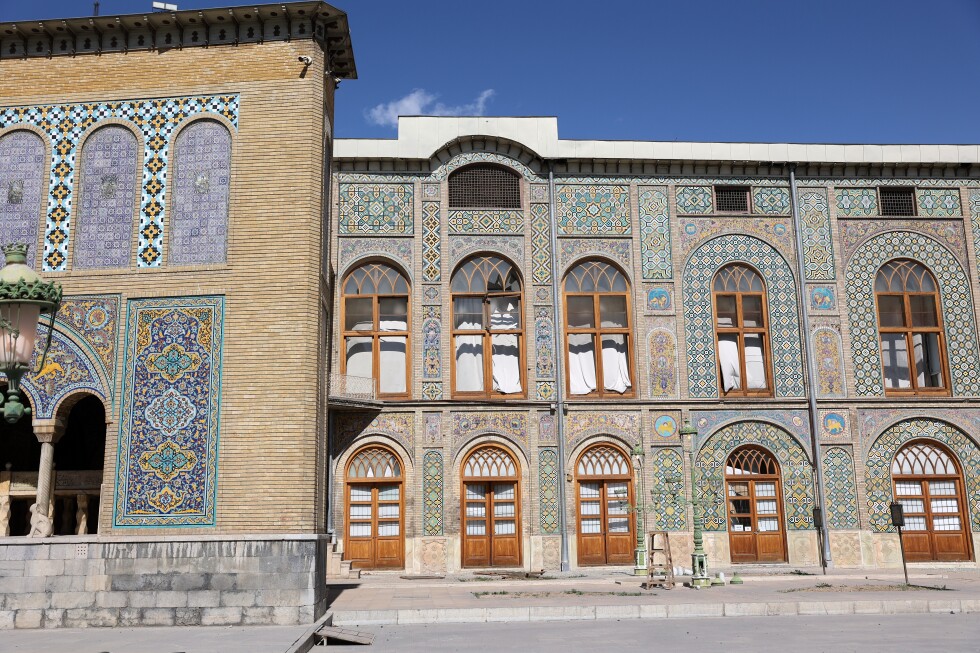
UNESCO confirmed that it has verified damage to the lavish Qajar-era Golestan Palace in Tehran as well as the 17th century Chehel Sotoun palace and the Masjed-e Jāme, the country’s oldest Friday mosque, both in Isfahan. There also was verified damage at buildings close to the Khorramabad Valley, which includes five prehistoric caves and one rock shelter providing evidence of human occupation dating to 63,000 B.C.

At Golestan Palace, shattered glass from the mirrored ceilings blanketed the floors alongside broken archways, blown-out windows and damaged molding scattered below its glass-mosaic walls, according to Associated Press video taken March 3.

Advertisement

UNESCO said it provided all parties to the conflict with the geographical coordinates of the heritage sites ahead of time, “to take all feasible precautions to avoid damage.”

The impact to cultural sites has not been isolated to Iran but has been felt across the Middle East and beyond, with UNESCO tracking damage to the White City in Israel, Tyre in Lebanon and elsewhere.

Collateral damage to such places has been part of the fabric of war for decades, including in conflicts between Russia and Ukraine as well as Israel and Hamas, in which dozens of sites have been damaged or destroyed.

“What is happening is clear to all: In these increasingly modern conflicts, it’s civilians who pay the price, it’s civilian infrastructure that pays the price, and we’ve all seen the destruction of priceless historical heritage,” U.N. spokesperson Stephane Dujarric said this week.

Advertisement

Damage to history

Human rights advocates are echoing that sentiment, warning that the Iran war not only has killed more than 1,000 people but upended the institutions and historical places that communities rely on.

“It causes harm to civilians because it damages or destroys a piece of their history that can be significant both to the world and also to a specific region or community,” said Bonnie Docherty, senior researcher in the arms division at Human Rights Watch. “It undermines the sort of shared identity of a local community, which can often be important for bringing people together.”

Arash Azizi, who grew up in Iran before moving to the U.S. as an adult, said that because his family couldn’t afford to travel abroad when he was a child, they visited historical sites across the country. This, he says, is how he learned about his cultural identity and history.

“At times where school kids are killed, when human life is at stake, when the stakes are very high, people might think, ‘What are a couple of broken tiles or broken glasses?’” the 38-year-old New York resident said.

Advertisement

“I think this is the wrong attitude,” he added. “We need a cultural context. We need to know who we are, and where we come from, and what does it all mean?”

Iranian American sees one damage site as deeply personal

For Shabnam Emdadi, a 35-year-old Iranian American also in New York, the damage to the Safavid-era Chehel Sotoun Palace in Isfahan is deeply personal. She traveled there with her dad a few years before he died.

“Those Iran trips with him were my most fond memories of him at his happiest, where he felt most at home and alive, and I’ll never forget them,” Emdadi said. “Which is why every day when I see the damage of these sites that are the core of my memories, I feel like I am also losing a piece of him.”

It was unclear if it was U.S. or Israeli strikes that caused the damage. The Pentagon did not provide comment. The Israeli Defense Forces said it was “unfamiliar” with claims of damage to UNESCO sites.

Advertisement

One nonprofit group pointed to U.S. Defense Secretary Pete Hegseth saying last week that America’s approach to the war would not include “stupid rules of engagement.”

“That’s an extremely important statement because it’s those rules of engagement that embody international humanitarian law, which is not just the protection of cultural heritage, but the protection of all civilian populations and structures, including your hospitals, your schools, etc.,” said Patty Gerstenblith, president of the U.S. Committee of the Blue Shield, an international organization dedicated to protecting heritage in conflict, disaster and crisis.

UNESCO’s protections

The affected sites are among the nearly 30 Iranian sites designated as under special protection as part of UNESCO’s World Heritage list.

Other notable landmarks on the list include the Great Wall of China, the Egyptian pyramids, the Taj Mahal and the Statue of Liberty.

Advertisement

The agency’s World Heritage Committee annually designates sites considered “of outstanding value to humanity” and intervenes when sites are in danger of destruction or damage. The program provides countries with technical assistance and professional training to preserve the sites.

The Trump administration announced last July that it would once again withdraw from UNESCO as it distances the U.S. from some international organizations.

The White House cited similar concerns as it did in 2018, saying it believes U.S. involvement is not in its national interest and accusing the agency of promoting anti-Israel speech. The decision won’t go into effect until December.

___

Advertisement

Associated Press writer Giovanna Dell’Orto in Minneapolis contributed to this report.

Source link

Advertisement
Continue Reading
Click to comment

Leave a Reply

Your email address will not be published. Required fields are marked *

NewsBeat

Why Friday the 13th was bad luck for the Knights Templar and their legacy

Published

on

Why Friday the 13th was bad luck for the Knights Templar and their legacy

In Ridley Scott’s 2005 epic Kingdom of Heaven, The Knights Templar are portrayed as violent extremists. The film is about a crusader, Balian of Ibelin, who is fighting to defend the Crusader Kingdom of Jerusalem from the first Sultan of Egypt and Syria, Saladin.

The Knights Templar were formed on Christmas Day 1119, as a revolutionary type of knighthood in which knights lived as monks, taking vows of poverty and piety. Their mission was to protect travellers on the dangerous roads of the Kingdom of Jerusalem. So it struck me as interesting that in Scott’s crusades film they would be portrayed as antagonists of the Crusader Kingdom.

Their singling out in Kingdom of Heaven was the spark that led to my book The Knights Templar: Crusade, Myth and Hollywood. What I found was that villainising the order was fairly common in films that include them. However, rather than being a modern trope, their vilification can be traced back to 700 years ago.

On Friday October 13 1307, the grandmaster Jacques de Molay was arrested by a debt-ridden pope along with every other Templar found in France. The sudden arrest caused widespread shock throughout Europe. Some of the confessions that would be extracted from them would have a mysterious occult edge and it would be these that would shape the order’s legacy from then on.

Advertisement

The Templars amassed vast riches, land, and political power for nearly 200 years. Their downfall began in 1291 with the loss of the Crusader states, or Outremer (modern Israel, Lebanon, Syria, and Turkey). After the Crusader capital of Acre fell to the Mamluk forces of Egypt and Syria, the Templars were left without a cause, making the order appear redundant and vulnerable to criticism.

The two figures central to their downfall were French Pope Clement V and French King Phillip IV, who was burdened with significant debt and had previously moved against groups within his power, such as Italian bankers in 1291 and the Jews in 1306, seizing their property and assets to ease his financial problems.

Friday 13th

On Friday October 13 1307, Jacques de Molay was in France negotiating another crusade. That military campaign would never happen and instead, he and every Templar in France (around 2000 of them) were suddenly arrested and imprisoned in the Paris Temple.

Jacques de Molay, the last grandmaster of the Knights Templar.
Wikimedia

Although the news shocked Christendom, Clement V had written to Phillip IV in 1305 detailing the rumours about the Templars and plans for an investigation. Phillip IV issued the Templars’ arrest order a month prior, charging them with blasphemy, sodomy and heresy.

Advertisement

The first charges related to the initiation into the order, where, according to the Order for Arrests, initiates must deny Christ and spit on an image of him three times. The document then details how the initiate is stripped naked and kisses the receiving Templar on “the lower part of the dorsal spine”, “the navel” and “on the mouth”.

Once in the King’s clutches, the Templars were deprived of sleep and shackled with irons. Templar Ponsard de Gizy described in detail how he was unable to move in a pit for three months, with his hands tied behind his back so tightly that blood ran down his fingernails.

Those who did not confess faced the rack and suffered the strappado – this is where the victim was strung up by the hands, which were bound behind their back. Under these horrific conditions, 134 of the of the 138 Templars questioned in Paris confessed to some or all of the charges. Under torture, even the grandmaster admitted to denying Christ, but instead of spitting on his image, he claimed to have spat on the floor instead.

It wasn’t the charge of blasphemy, however, that haunted the Templars’ legacy, it was the accusations of worshipping false idols.

Advertisement

Extracted under torture, Hugues de Pairaud describes worshipping a head with two feet under its face and two feet behind it. Very few Templars had any knowledge of the mysterious head idol, and only nine admitted to knowing about it. Those who did gave contradictory accounts: the head with feet was described as having a beard, of being painted on a beam and made of wood, silver, and gold leaf. Others claimed to worship an idol called Baphomet and a bearded head called Yalla.

The origin and identity of the idol Baphomet are mysterious. However, historian Sharan Newman suggests it’s most likely a corruption of the name Mohammed.

The Templar order was abolished in 1312 and Jacques de Molay was burned at the stake in 1314 as a relapsed heretic. The majority of the Templars caught in France were either executed or confined to prison indefinitely. However, it wasn’t until the 16th century that the Templars’ heresy entered popular imagination.

Advertisement

The German physician Heinrich Agrippa’s 1531 book De Occulta Philosophia, recontextualised the failed order alongside witchcraft. While French writer Guillaume Paradin detailed the Templars’ sordid heresy in his 1552 Chronicle of Savoy. In his history of Savoy, the Templars engage in orgies with women after initiates worshipped an image covered in human skin with glowing carbuncles for eyes.

The salacious occult imagery of the 16th century remained a widely held perception of the Templars into the 20th and 21st centuries. This lasting association is clear in cinema.

The 1972 Spanish/Portuguese horror film Tombs of the Blind Dead portrays undead Templars rise from their graves to prey on a group of teenagers. The undead Templar recently resurfaced again in the 2017 film The Mummy, where the titular villain raised Templars from their tombs to act as her minions.

There are Templars across cinema enacting evil and its interesting to think about how this all came to be because of a handful of confessions about worshipping false idols, which were obtained through torture.

Advertisement

This article features references to books that have been included for editorial reasons, and may contain links to bookshop.org. If you click on one of the links and go on to buy something from bookshop.org The Conversation UK may earn a commission.


Source link

Advertisement
Continue Reading

NewsBeat

Belfast cafe giving away free coffee all day

Published

on

Belfast Live

Coffee lovers can rejoice as a café in South Belfast will be providing free brews this Friday

A Belfast cafe is giving away free coffee all day on Friday as part of a special celebration.

Café Melrose, on the Lisburn Road, will be providing brews to customers free-of-charge on Friday, March 13, to celebrate their new coffee product.

Advertisement

The initiative will take place from 8.30am to 4pm and is in celebration of the premises’ new partnership with Newcastle coffee roaster Groupwork.

Owner Gabriel McCoy, 30, who took over the business two years ago said: “There has been a café here for about a decade, we have made significant investment into the site. We are super excited to elevate our coffee offering to be in line with everything else we are doing here.

READ MORE: EasyJet flight to Belfast diverted after passenger required “urgent medical attention”READ MORE: Man charged with murder of woman in Enniskillen

“We went to five different roasters but the husband and wife team there, Stephen and Hannah at Groupwork made it a no brainer. We decided to swap our coffee to Groupwork who are a company based in Newcastle. They ran through the whole process with us, and the fact that I am originally from Hilltown in Co Down means together we can bring the county’s hospitality to Belfast.

Advertisement

“To celebrate that partnership we are offering free coffee all day tomorrow from 8.30am to 4pm. People are fine to pop in for a free brew, you don’t need to sign up or anything, just come along.

“We specialise in top tier service, we are very reasonably priced for a BT9 café but Friday will give customers a chance to try our new coffee offering completely for free. For the last week we have had the coffee available and the feedback has been really positive. People are buying the coffee and taking it home with them, so that is a massive tick of approval. Lately, we have been going around all our local streets and handing out flyers.”

Gabriel said there was a wide array of food and drink available at the café.

He added: “We have our own delicatessen which provides a selection of sandwiches and wraps, it is a massive deli that caters to all dietary requirements. We have an extensive brunch menu and we also have the capability to do outside catering.”

For all the latest news, visit the Belfast Live homepage here and sign up to our daily newsletter here.

Source link

Advertisement
Continue Reading

NewsBeat

Popular sandwich shop to open new location on bustling Cambridge street

Published

on

Cambridgeshire Live

The brand will be offering a spaghetti and meatball sandwich as a nod to the old restaurant.

A popular sandwich shop in Cambridge is opening a second location on Mill Road just a few months since its first store was unveiled. Marvin’s, which is a sandwich shop found on Green Street and is the sister-brand to Stir Bakery, will be taking over the old site of Maurizio Dining & Co on Mill Road.

Advertisement

Martin Perkins of Marvin’s said: “We know Maurizio’s means a lot to people. Places like that become part of the rhythm of a street. We’re incredibly grateful to Maurizio for everything he’s built here and we’re proud to be taking up the mantle.”

The opening follows the “successful launch” of Marvin’s first location, which only opened a few months ago in September 2025 is is the next step for the “fast-growing independent brand”. The brand has said it is “honoured” to be continuing the “site’s tradition of feeding the neighbourhood”.

Mill Road is already known for being an area packed with independent businesses, restaurants, and cafés. Matt Harrison, the founder and owner of Stir and Marvin’s, said: “Mill Road has a unique energy. It’s where so much of Cambridge’s food culture lives. Independent businesses, family-run shops, incredible ingredients and cuisines from all over the world. To open Marvin’s here and become part of that fabric is something we’re hugely proud of.”

Similarly to its Green Street shop, the Marvin’s on Mill Road will serve its signature menu of “big, layered sandwiches built on bread baked fresh every day specifically for each style of sandwich”. The shop will be bringing “chewy bagels and fluffy focaccia” sandwiches as well as a special spaghetti and meatball sub, which will be served with a marinara dipping sauce as “a nod” to Maurizio Dining & Co.

Advertisement

Guests will also be able to find an ever-changing selection of “globally inspired” sandwiches. If you fancy something sweet, Marvin’s also stocks fresh pastries and a range of soft drinks that have been “designed to complement the food”.

The Mill Road locations wants to keep “Marvin’s relaxed, high-energy approach to hospitality that has quickly made the Green Street site a favourite among Cambridge sandwich fan”.

Source link

Advertisement
Continue Reading

NewsBeat

The best beard trimmers, tried and tested for precision and styling versatility

Published

on

The best beard trimmers, tried and tested for precision and styling versatility

It’s never been more important to find the best beard trimmer. Like a lot of men, I became alarmingly obsessed with the quest for the perfect beard styler during lockdown. Unable to go and ask a Turkish barber to trim my facial hair into a contoured thing of beauty, I was forced to try and do that myself in my bathroom. Initially, the results were mixed, to put it politely.

Not that there are any lack of products for the man who wants to trim his beard at home – the market has become flooded with choices. “I think a great deal of it is down to the vogue for beards that began around 10-15 years ago with the hipster/lumbersexual trend and has stayed that way ever since,” said Stephen Doig, Men’s Style Editor at The Telegraph. “And with it, a cottage industry devoted to making sure that men are appropriately kitted out for their beard maintenance.”

I’ve spent the last few months testing the latest trimmers from all the major manufacturers. You can read my findings in the reviews below, followed by some more advice from Stephen in the FAQs section. But if you’re in a rush, here’s a quick look at my top five:

Advertisement

The best beard trimmers: At a glance

JUMP TO REVIEWS


How to choose the best beard trimmer

Doig says you should think about safety and flexibility first when choosing grooming tools. “I think it’s important to get the basics right; a good grip on the handle because slip ups can cause cuts, a safe razor and the ability to switch between lengths,” he says.

He explains that once you’ve mastered the fundamentals, you can start exploring additional tools that suit your grooming goals. After that, it’s really a matter of how much you want to invest in precision equipment for shaping your beard, trimming edges, and maintaining hair on your head and body.

To understand how best to deploy trimmers and razors, Doig recommends learning from professionals who handle them daily. “Whenever I speak to barbers, the key thing is to shave and trim in the direction the hair grows, so avoid going against the grain and meeting resistance which will irritate the skin,” he said.

Advertisement

Paying attention to these small but essential techniques can help achieve a closer, safer, and more comfortable finish.


How we test beard trimmers

Source link

Continue Reading

NewsBeat

Faye Singleton working to provide accessible ECG screenings

Published

on

Faye Singleton working to provide accessible ECG screenings

Faye Singleton, originally from Cheshire, studied BioMedical Science at the University of York and has since built a career working for Thirsk-based company CardioLogic.

She has been using her expertise in the field to best support local football teams based in the North Riding FA, working closely with the FA to help provide cheaper ECG tests, a potentially-life saving initiative. With around 1 in 300 people that have an ECG test, finding a life-threatening abnormality.

A member of the York City Ladies squad, but currently recovering from an ACL injury, Faye was on the pitch when former teammate Summer Paley collapsed during a match in September 2024 due to an undetected heart condition.

Now Faye’s looking to get the message out that ECG heart screenings are easily accessible, having worked with the North Riding FA to provide over 150 tests so far.

Advertisement

Faye told the Press: “People aren’t aware of how common sudden cardiac death is. 12 young people a week die from sudden cardiac death in the UK alone.

“An ECG can prevent it, and this is around half the cost of a private ECG test, which is over £70.

“It’s potentially life-saving, so we’re hoping as many people reach out for it.

“Within North Riding FA we’ve done over 150 tests but it’s time for more sports clubs, schools, colleges, and universities to join the initiative.”

Advertisement

“We’re also working with British Athletics and other County FA’s now, we’ve got Birmingham, Cumberland and Liverpool on board with the device and the project.

Faye hopes to one day support the lower reaches of the women’s football game. Picture: Supplied

“It’s the device, which is an innovation in tech, that has enabled us to do this.

“Without this next step forward in the technology, we wouldn’t be able to offer an ECG at this price. ”

A typical ECG test requires medical professionals to position electrodes correctly. This new technology has those electrodes pre-positioned in one sticky patch. Faye explained that even players can apply it themselves.

Advertisement

All it takes is one sticky patch, stuck to the centre of someone’s chest, it records a 12-lead ECG through BlueTooth connectivity to a mobile phone. The tracings are sent off to UK Cardiologists who can analyse the ECG and create a report highliting if there is an underlying heart condition.

Therefore Faye, who has been working closely with Jasmine Morris – Deputy Designated Safeguarding Officer at the North Riding FA – has recently linked up with local side Fulford FC under-13’s girls team, to help provide them with ECG screenings.

Faye continued: “We worked with Fulford FC under-13’s girls recently, and they all stuck it on themselves no problem.

“They did the ECG, which takes 10 seconds, and their parents got a report a week later in a secure email, which said whether their child’s ECG is normal or abnormal.

Advertisement

“Jas is a huge part in this, she takes the device to the clubs.

Local team Fulford FC’s under-13’s girls recently underwent cardiac screenings in partnership with the North Riding FA. Picture: Supplied

“We try and contact the clubs to say this is on offer, do you have anyone interested?

“They come back and say ‘yes we’ve got ten players’ that want the test, so we then send the consent form out to each player or parent, if they are under 18, then Jas or myself will go to their training night and test each player which takes around five minutes.

Faye is currently helping to provide ECG testing to local teams throughout the North Riding FA, but in the long-term, she’d also like to make a change in the senior section of the women’s game and offer this to schools, colleges, and universities.

Advertisement

Summer’s collapse in 2024 was a scary moment for everyone there, and due to the level of football that York City Ladies play at, Faye confirmed that a free prior ECG test had been unavailable to the Minsterbelles squad.

That’s something she hopes to see change, looking to bridge the gap for the lower reaches of the women’s game.

“Since seeing Summer’s collapse in person, I was at the game when she collapsed, it was just so scary,” Faye said.

“I did a lot of research into what screening was available for us as a tier four club.

Advertisement

“If you’re a tier four team in the men’s game, you get a free ECG test, but if you’re a female, it’s only the top two tiers in the women’s side.

York City Ladies have benefitted from Faye’s support. Picture: Supplied

“I wanted to bridge that gap and even offer it to those lower than tier four, because there’s nothing stopping them from having the same cardiac arrests.”

Once a person has finished their simple ECG test, their information is forwarded on to our Head Cardiologist, Professor of Cardiology Aneil Malhotra.

Aneil, who is also an expert in sports cardiology, has been offering his full support to Faye in her battle for ECG testing, after he worked closely with some of the biggest names in sport: “He’s been brilliant, he does all the reporting.

Advertisement

“He reads the ECG, writes up if there are any abnormalities and then sends it back.

“He’s based in Manchester and screens all the Premier League teams in the North, plus other sports.

“He’s an expert in cardiology for the UK, so we’ve got the backing of him, which is fantastic.”

For more information, you can find Cardiologic’s new dedicated Facebook page at Cardiologic Diagnostics, which can be found HERE, or on Faye’s LinkedIn page HERE.

Advertisement

Alternatively, for any further information or if you’d like to get involved, you could reach Faye directly at faye@cardiologic.co.uk.

Source link

Advertisement
Continue Reading

NewsBeat

The run-in: How race for Championship survival shapes up for Portsmouth, West Brom, Leicester City & Co

Published

on

The run-in: How race for Championship survival shapes up for Portsmouth, West Brom, Leicester City & Co

The battle lines are drawn with 10 games remaining in which Pompey have to secure their place in the Championship. The mid-week results saw the Blues’ gap to the drop zone cut to just two points, with John Mousinho’s side collecting one point from 12 and picking up two wins from past eight league fixtures.

Source link

Continue Reading

NewsBeat

Putin’s ‘hidden hand’ likely helping Iran against Trump, UK defence secretary says | World News

Published

on

Russian President Vladimir Putin. Pic: Pelagiya Tikhonova/Sputnik, Kremlin Pool Photo via AP

Vladimir Putin’s “hidden hand” is likely helping Iran respond to Donald Trump’s war, the UK defence secretary has said, as it emerged that Iranian-linked drones hit a base in Iraq where some British troops are located.

They were not hurt.

John Healey said attacks by Iranian forces against targets across the Middle East “have the hallmarks” of how Russian troops operate in their war against Ukraine.

This included a change in how Iran uses its drones.

Advertisement

Tehran sold thousands of “Shahed” one-way attack drones to Russia in the early months of President Putin’s full-scale invasion of Ukraine.

Image:
Putin. Pic: AP

The Russians, with Iranian help, then developed their own version of the unmanned aerial vehicle and now the lessons they have learnt from fighting in Ukraine appear to be helping the Iranians in their response to waves of US and Israeli strikes against Iran.

“No one will be surprised to believe that Putin’s hidden hand is behind some of the Iranian tactics, potentially some of their capabilities as well,” Mr Healey said, speaking to reporters during a trip to the UK’s Permanent Joint Headquarters (PJHQ) at Northwood, the main base overseeing military operations overseas.

The defence secretary said this likely Russia link was “not least because the one world leader benefitting from the sky high oil prices at the moment is Putin”.

Advertisement
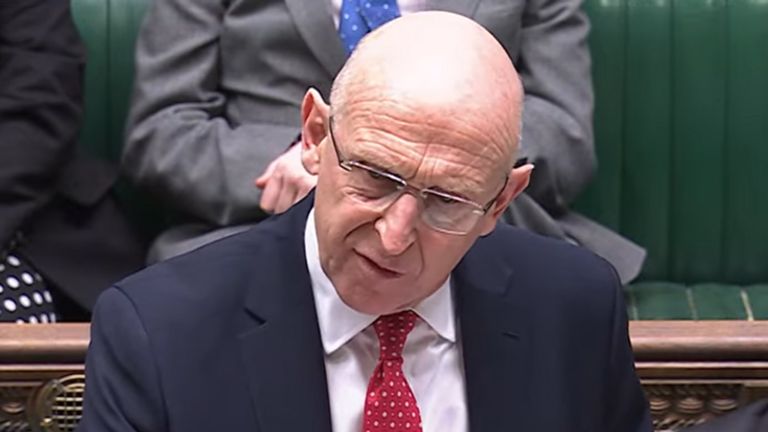
John Healey
Image:
John Healey

He was referring to a spike in the price of oil after Iran used its chokehold over the Strait of Hormuz off its coastline to block one of the world’s most vital shipping lanes.

The defence secretary said the Russian president “is clearly likely to welcome this war more than anyone else.”

Lieutenant General Nick Perry, the chief of joint operations who oversees all UK military operations around the world, said there was “definitively” a link between Russia and Iran, which have a long-standing military relationship.

“We have definitely seen the Iranian tactics of the use of their drones learnt from Russians – flying them much lower so they are more effective,” Lieutenant General Perry said, speaking to Mr Healey as they looked at a map of the Gulf in a room at the military headquarters.

“There is no doubt [the Iranian] tactics have changed,” Lieutenant General Perry said.

Advertisement

Advertisement

Iranian attack triggers huge blaze in Bahrain

He said drones were causing the most damage by the Iranian side across the region.

Read more:
What we know about the deadly Iran school strike
IEA announcement not enough to bring down oil price

This included an Iranian-linked drone – potentially fired from Lebanon or Iraq – that struck a Royal Air Force base in Cyprus on the second day of the war, landing near a hanger.

Advertisement

Mr Healey said the components of that device are being investigated to find out if they included Russian parts.

“We will update you on the findings from that,” he said.

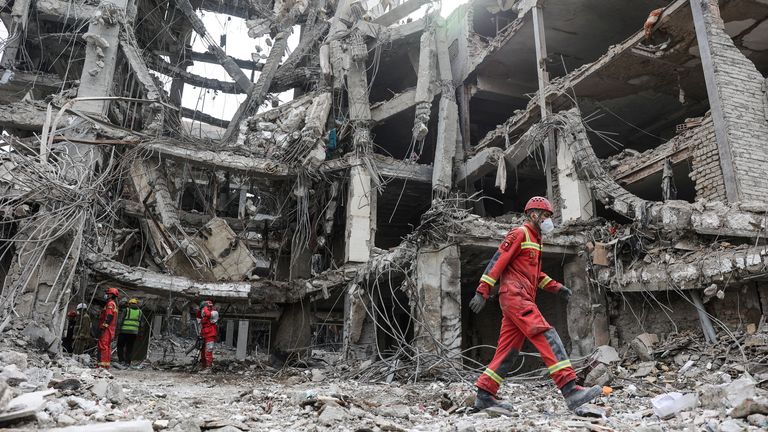
Emergency personnel work at the site of a strike, amid the U.S.-Israeli conflict with Iran, in Tehran, Iran, March 12, 2026. Majid Asgaripou
Image:
Emergency personnel work at the site of a strike, amid the U.S.-Israeli conflict with Iran, in Tehran, Iran, March 12, 2026. Majid Asgaripou

A second military commander said that British forces had shot down two drones fired towards a military base in Erbil, northern Iraq, overnight.

“A number did impact the camp,” the officer told Mr Healey.

Advertisement

He said there had not been any British casualties.

However, the defence secretary said there had been reports of a number of US casualties, though none had been seriously injured.

Advertisement

Source link

Continue Reading

NewsBeat

UK tourist, 60, could face two years in jail for ‘filming Iranian missiles’ on holiday in Dubai

Published

on

Manchester Evening News

21 people have been accused of breaking the UAE laws against filming or uploading social media posts of conflict

A British tourist is facing two years in prison for allegedly filming Iranian missiles flying over Dubai while on holiday. The 60-year-old man from London is one of 21 people accused of breaking the United Arab Emirates’ (UAE) strict laws against filming or uploading social media posts of conflict, according to legal advocacy group Detained in Dubai.

The man was arrested in Dubai on Monday, March 9. He is said to have deleted the footage from his phone immediately when asked by authorities, and claimed to have had no knowledge of committing any offence, The Mirror reports.

Radha Stirling, director of the London-based Detained in Dubai organisation, said: “Amongst those charged is a British man who says he deleted the video immediately when asked and meant no harm, but is still among those facing charges.

Advertisement

Get MEN Premium now for just £1 HERE – or get involved in our WhatsApp group by clicking HERE. And don’t miss out on our brilliant selection of newsletters HERE.

“The official allegation relates to: ‘broadcasting, publishing, republishing or circulating rumours or provocative propaganda that could disturb public security.’

“Under UAE cybercrime laws, one post can lead to many arrests. Anyone who shares, reposts or comments on the same content can face the same charges. and be named on the same charge sheet. The charges are vague and broad but serious nonetheless. Those charged could face lengthy prison sentences.

“Residents could also be detained under national security laws, held indefinitely, denied access to their embassy and be subjected to human rights abuses. In times of tension, extreme caution is advised.”

Advertisement

Prosecutors in the UAE had warned last week over the risks of sharing “rumours” about incidents in the UAE amid the ongoing Middle East conflict.

A social media post from UAE Public Prosecution said: “Any person who shares or reposts content from unknown sources shall be subject to legal accountability in accordance with the applicable legislation, even if they are not the original creator of such content. Be aware and informed… Information is a responsibility, and spreading rumours is a crime.”

Iranian drones have continued to hit Dubai over the past 24 hours despite Tehran ‘apologising’ to its Gulf neighbours last week for the impact of the war. Two drones launched from Iran fell near Dubai International Airport yesterday, leaving four people injured.

Advertisement

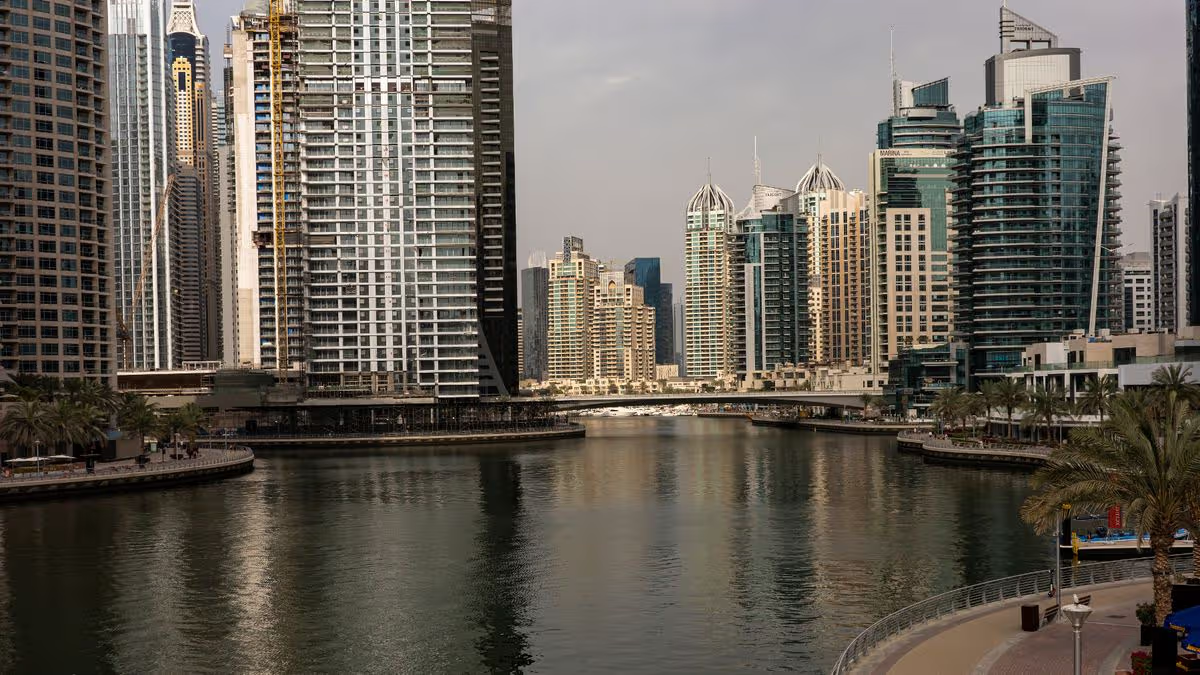
And authorities rushed Dubai Creek Harbour area late last night after another drone struck a high-rise building, sparking a fire on several floors. Photographs taken this morning showed windows blown out and smoke damage on a section of the building’s façade.

The Dubai Media Office said multiple emergency teams responded to the incident in the waterfront district, with residents evacuated as a precaution.

Source link

Advertisement
Continue Reading

NewsBeat

Van ‘blown over’ in Sneaton, near Whitby, as heavy winds hit

Published

on

Van ‘blown over’ in Sneaton, near Whitby, as heavy winds hit

The force said it received more than 40 reports of disruption on the roads on Thursday (March 12), which included a van being “blown over”.

A yellow weather warning for wind has been issued for York and North Yorkshire until 8pm on Thursday.

North Yorkshire Police said winds exceeding 50mph have been recorded at Fylingdales in the North York Moors.

Advertisement

Forecasters said coastal areas are set to experience the strongest gusts.

On the North Yorkshire coast, a van had been “blown over” in Sneaton, near Whitby, and collided with another vehicle on Thursday, a police spokesperson said.

Fallen branches were also been recorded across the A19 near Easingwold, they added.

The police spokesperson urged motorists travelling in North Yorkshire to take “extreme care”.

Advertisement

“Emergency services and other teams who maintain our infrastructure are working flat out to keep everyone safe. But please drive cautiously and expect the unexpected, especially on exposed rural roads,” they said.

“The Met Office is forecasting more heavy rain today followed by freezing temperatures in rural parts of the county overnight, so please anticipate localised flooding and ice if you’re travelling tomorrow morning.”

How to report incidents

Anyone who sees an incident that poses an immediate threat to life is urged to contact North Yorkshire Police on 999.

Incidents relating to items, such as trees, blocking a road should be reported to the North Yorkshire Council Highways Team on 0300 131 2131.

Advertisement

Fallen or damaged power lines should be reported to Northern Powergrid on 105, but if they are across a road, footpath or anywhere else that could pose a risk to life, people should immediately dial 999.

Debris on the motorways should be reported to National Highways on 0300 123 5000 or 999 if there is a risk to life.

Source link

Advertisement
Continue Reading

NewsBeat

Clean up at Callander oil spill under way as investigation continues into cause

Published

on

Daily Record

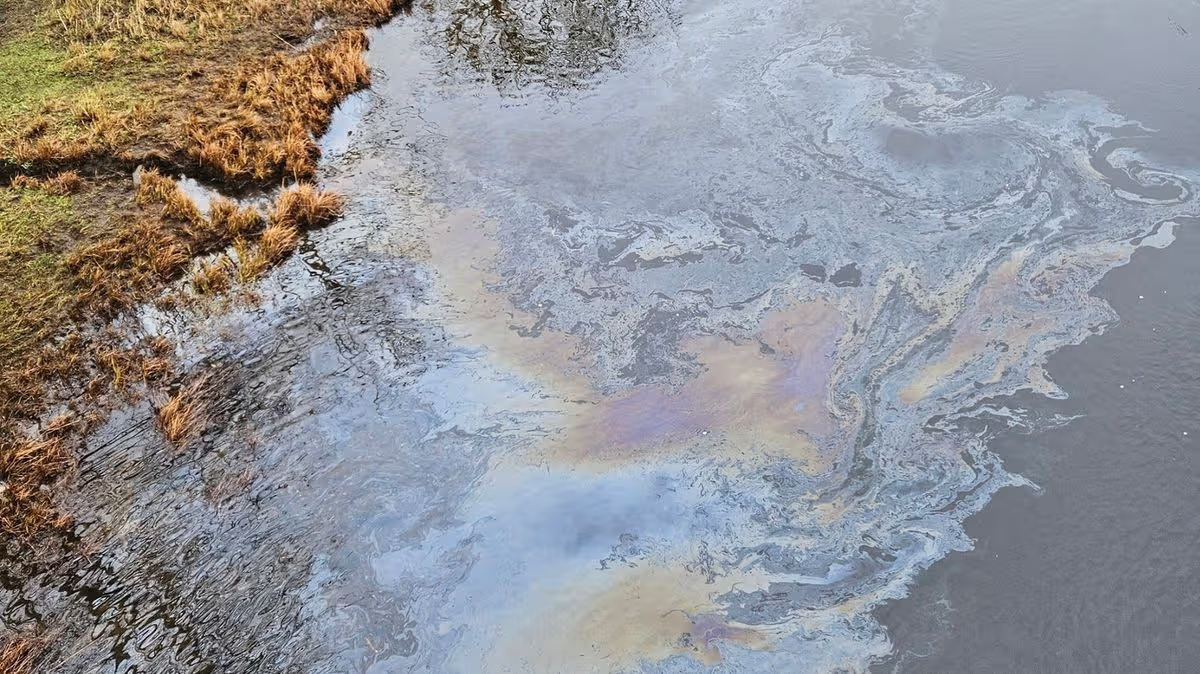
The spill was reported in the waters of the River Teith as concerned locals looked for answers.

A clean-up is underway after another fuel spill was reported in the waters around rural Stirling.

Advertisement

The presence of fuel in the water was reported and captured by images in the River Teith near Callander last week – leading to concerns over a link between the discovery and the major leak just up the water in Killin.

A connection between the two leaks was dismissed by initial investigations as officials from Scottish Water and SEPA got to work in sorting out the leak in the Teith and advising locals.

The first advice from Scottish Water insisted there was no risk to the drinking water as a result of the incident, while nearby Deanston Distillery was also notified as a precaution.

A later update from SEPA said the leak was due to a “localised issue” which was being washed from the road into the river through surface drains.

Advertisement

The SEPA statement to Stirling MSP Evelyn Tweed added that there may be the presence of “visible oil sheens” for the following days due to some of the residue being trapped in mud, but there was no risk to the local wildlife population.

In a response to the Observer, a SEPA spokesman said: “SEPA received reports on Thursday March 5 of pollution to the River Teith via a Scottish Water surface water outlet.

“We are continuing to investigate this incident and are liaising with Scottish Water and Stirling Council throughout this process.

“We would like to thank those who reported the incident to SEPA and encourage anyone who witnesses a pollution incident to contact us immediately on 0800 807060 or by submitting an online report with as much information as possible.”

Advertisement

The spokesman added that clean-up work was also being carried out on site by officials from Stirling Council as part of keeping the area safe.

A Stirling Council spokesman said: “We can confirm that we have been in contact with SEPA regarding the oil spill into the River Teith.

“Officers from our Roads Team attended the site to help clean residual oil which had spilled onto the road surface.”

The Callander leak comes on the back of the major fuel spill in the River Dochart in Killin.

Advertisement

Locals in the village were forced to use bottled water and make use of services elsewhere – including in Callander – for daily essentials as SEPA, Scottish Water and the council came together to find a solution to that spill.

The spill was initially linked to a botched robbery at a petrol station on the edge of the village, but the exact cause of the fuel leak remains under investigation for the precise circumstances.

Source link

Advertisement
Continue Reading

Trending

Copyright © 2025