

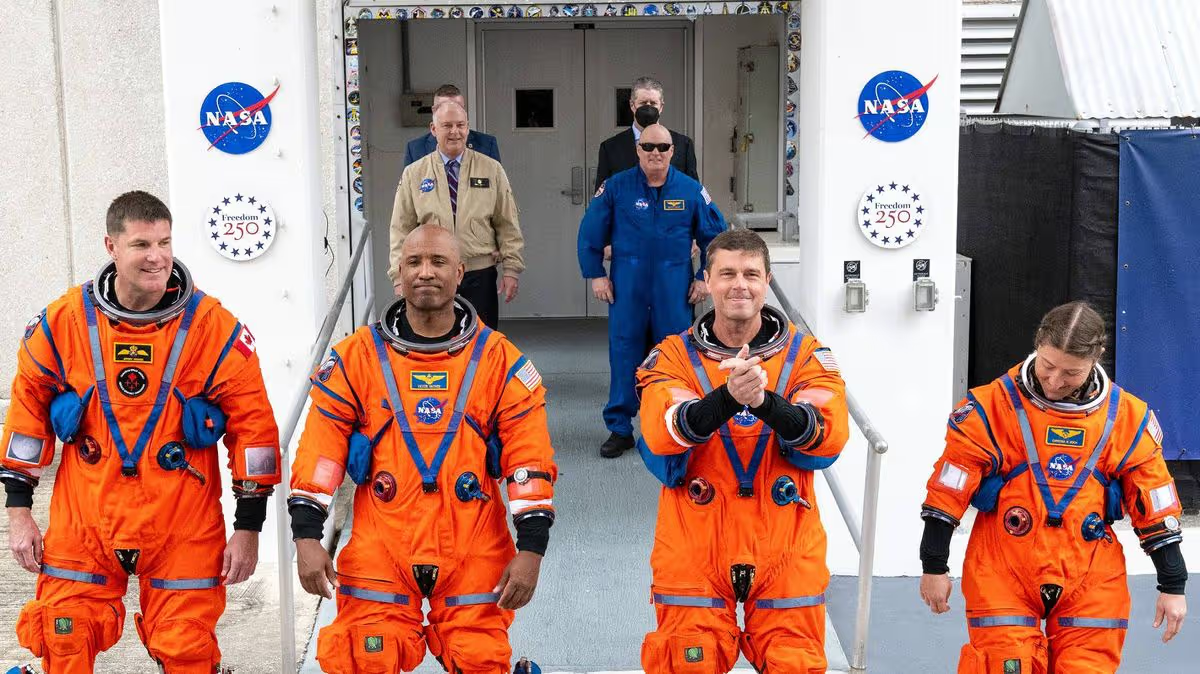
The history-making space mission to the far side of the moon from the US is well underway – here’s what life is like onboard the Orion spacecraft for the four crew members taking part in the historic Artemis mission
Freeze-dried food, a no privacy toilet and confined living quarters, this is what it’s like to live in a spaceship.
Defying gravity as they launch towards the moon for the first time in 53 years, four astronauts are on a history-making endeavour.
The Artemis II mission are on a planned lunar flyby by the United States, with four space explorers taking on a daring expedition to reach the far side of the moon in their Orion Capsule, launching over 252,000 miles away from the surface of the Earth.
Last night, Nasa said the astronauts have passed the halfway point between Earth and the moon, with the spacecraft more than 136,080 miles from Earth.
Commander Reid Wiseman, Victor Glover, the first person of colour to travel beyond low Earth orbit, Christina Koch, the first woman on a lunar mission, and Canadian Jeremy Hansen rocketed in to space on the evening of Wednesday April 1.
But this was no April fools – the goal? Stress test Humans, the ‘SLS’ (Space Launch System) rocket, and the life support systems which keep us alive in the daring, harsh reality of deep space.
READ MORE: NASA Artemis crew’s warning as they pass ‘point of no return’ on moon mission
While it may sound glamorous, the next two weeks will be a gruelling endurance test for the space seekers, sharing a living quarters no bigger than a minivan.
Cosy and compact, the foursome are settling into their new digs. Life inside the Orion Spacecraft, which they have named “Integrity” is a mix of high-tech living and “camping” in their very small floating room.
There are six windows in the Orion capsule, and currently, the astronauts will only be able to see Earth shrinking, while the moon grows towards them.
There are a few amenities for the crew. While there is no fridge or cooker, they have a food warmer and a water dispenser. NASA allows the astronauts a few home comforts, as they could choose some of their favourite meals such as mac and cheese and prawn cocktail.
Their food comes from freeze-dried pouches that they then rehydrate and cook. They also brought five different varieties of hot sauce as tastebuds can dull down in microgravity.
When it comes to the toilet, they have a rather compact but high-tech vacuum system built into the floor. The crew experienced some issues as the toilet broke on day two, but luckily got it back working.
In order to ‘flush’, the compact system uses airflow to ‘pull’ waste away since gravity isn’t on their side – but there is no privacy.
Being in zero gravity means it’s crucial for the astronauts to do physical exercise every day to prevent their muscles and bones from weakening. The human bones will shrink and become fragile as they don’t need to hold the weight of the human body. The crew will use a flywheel device – a cable-based machine that allows them to “row” and do squats against resistance, since weights are pretty useless in space.
While they are they hundreds of thousands of miles away, the Orion crew are still able to communicate with Earth. They aren’t completely isolated as they have direct communication with Mission Control in Houston. Today’s technology means fans of the mission all over the globe can follow along in real time.
However once they get behind the moon, they will experience a “blackout” where contact with the Earth will cut off for up to 50 minutes. As the crew are travelling through the “Van Allen” radiation belt in deep space, it means they could be susceptible to a solar flare. This is a colossal burst of energy and light from the sun.
If this was to happen, the crew have a designated radiation shelter where they will clear out storage lockers and crouch down together under the cabin floor for protection.
It’s a dangerous mission with exceptional risks, these four crew members are making history. The Artemis 2 mission is scheduled to end on Friday, April 10, 2026. It will splash down into the Pacific Ocean, just off the coast of San Diego around 8:05pm EDT.
The end of the mission is actually the most dangerous part as the crew will parachute out of the spacecraft after hitting the atmosphere at 25,000 miles. The friction creates a “superheated plasma” around the capsule which will block all radio signals for seven minutes.
However waiting for them in the ocean will be a US Navy ship ready to pull them out of the water and back to safety.

























































You must be logged in to post a comment Login