A new treatment has shown huge potential for treating spina bifida in the womb, after a trial showed that it improved children’s mobility and quality of life.
Spina bifida, a condition in which a baby’s spinal cord is not properly enclosed during gestation, can lead to a range of lifelong disabilities. However, scientists claimed this week to have a promising new treatment, which involves applying stem cells from the mother’s placenta to her baby’s spine while surgeons repair it in the womb.
Diana Farmer, chair of the University of California’s Davis Department of Surgery, which led the US trial, said the procedure “paves the way for new treatment options for children with birth defects”.
Advertisement
Six mothers took part in the phase one trial, the results of which were published in the Lancet health journal this week. Michelle Johnson was among them.
“Our family couldn’t feel more blessed,” said Johnson, whose son Tobi (pictured) was born in 2022. “Tobi’s physical and mental abilities are nothing short of a miracle.”
While further research is needed, Aijun Wang, co-inventor of the treatment, said it was a “major step toward a new kind of fetal therapy”. Shine, a UK-based spina bifida charity, described the results as “very exciting”.
Former Man United star Adnan Januzaj opted to take a pay cut to remain at Sevilla in the summer, after struggling with form and injuries
Former Manchester United star Adnan Januzaj has spoken about his struggles since leaving Old Trafford. The now 31-year-old has been with Sevilla since 2022 and took a pay cut last summer to remain with the club.
Advertisement
Januzaj came up through the youth teams at United after joining from Anderlecht as a youngster. He made 63 first-team appearances, scoring five goals, before completing a permanent move to Real Sociedad in 2017.
He impressed with the Spanish side, scoring 23 goals in 168 appearances, earning him a move to Sevilla in 2022. However, injuries and form issues saw him struggle to make an impact.
He spent time on loan with Istanbul Basaksehir and Las Palmas. Upon his return, he has made 13 appearances for the club this season, after agreeing the pay cut.
Advertisement
Speaking ahead of Sevilla’s La Liga clash with Barcelona this weekend, the Belgian explained why he took the decision to stay: “The pay cut? I wanted to play here giving my best for Sevilla, because I haven’t had the opportunity for the last three years,” he said.
“I’ve always felt affection at all the clubs and I try to repay it with my quality and by being able to contribute.”
Januzaj also spoke about how he has overcome outside pressure, adding: “If I listened to everyone’s opinion, I’d be dead, I’d quit football and stay home. Football can change a lot; today you’re the best and tomorrow you can be the worst.
“If you’re not mentally strong, you won’t get anywhere. I’ve always stayed calm, working as hard as possible. I have such natural technique that sometimes on the pitch I seem relaxed, because it’s been my style of play since I was little.
“But I’ve always been committed to wanting to play football.”
He added: “It’s never really been a problem with coaches, it was other kinds of problems. At the clubs I’ve been to, I’ve done well.
“This year I’m here to try to perform as well as possible and give Sevilla something I haven’t been able to give them in recent years…I feel very good now and in the last few matches I’ve started to give a little more.
Advertisement
“There are 11 matches left and I’ll give my best until the end of the season. The most important thing is to avoid relegation first and then give the best performance possible if I stay healthy.”
Sky Sports discounted Premier League and EFL package
This article contains affiliate links, we will receive a commission on any sales we generate from it. Learn more
Sky has slashed the price of its Essential TV and Sky Sports bundle for the 2025/26 season, saving £336 and offering more than 1,400 live matches across the Premier League, EFL and more.
Sky shows at least 215 live Premier League games each season, an increase of up to 100, plus Formula 1, darts, golf and more.
The fear of mines laid by submarines, kamikaze drone boats and GPS jamming have effectively closed the Strait of Hormuz.
Iran has long threatened to shut the narrow waterway through which 20% of the world’s oil supplies passes, knowing that doing so would cause market havoc and send prices soaring. This is effectively what has now happened.
At least 16 ships have been hit by Iran since the conflict began, with Tehran releasing a video (below) of what it claims is the moment an oil tanker was attacked off the coast of Iraq – with devastating consequences.
Now, 3,000 ships and around 20,000 crew are trapped or affected in the region, the International Maritime Organisation says.
Advertisement
So what tools and weapons is Iran employing in its blockade of the crucial trade route – and what is it holding back for later?
Datawrapper
This content is provided by Datawrapper, which may be using cookies and other technologies.
To show you this content, we need your permission to use cookies.
You can use the buttons below to amend your preferences to enable Datawrapper cookies or to allow those cookies just once.
You can change your settings at any time via the Privacy Options.
Unfortunately we have been unable to verify if you have consented to Datawrapper cookies.
To view this content you can use the button below to allow Datawrapper cookies for this session only.
Sea drones, sometimes called USVs (unmanned surface vehicles), are small, unmanned vessels that operate on or below the water’s surface, making them difficult to defend against, particularly at night.
In January last year, footage released by the Iran’s Islamic Revolutionary Guard Corps (below) purportedly shows such craft in an underground tunnel.
Naval drones laden with explosives have reportedly been used in at least two attacks on oil tankers in the region since the war began.
On 1 March, a crude oil tanker was hit 44 miles off the coast of Oman, killing one crew member.
Days later, the Bahamas-flagged crude oil tanker Sonangol Namibe was hit near an Iraq’s Khor al Zubair port.
Video posted online shows what resembles a naval drone slamming into the side of the ship, triggering an explosion that sent plumes of smoke into the sky.
Six ships are reported to have been struck since early Wednesday alone, the most intense period of naval strikes by Iran so far.
Advertisement
Iran has also suffered significant casualties at sea, with reports of 87 deaths after the US sunk an Iranian warship off the coast of Sri Lanka last week.
Meanwhile, Iranian UAVs (unmanned aerial vehicles), or flying drones, have also been seen. Dr Sidharth Kaushal from the RUSI thinktank told Sky News that they may pose a lower risk to the actual ships, but are a danger to their crews and have a psychological impact.
Watch: Iran’s tactical advantage in the Strait of Hormuz
Is Iran deploying mines in the Strait of Hormuz?
Advertisement
The possibility of Iran deploying anti-ship mines to the Strait of Hormuz has come increasingly into the spotlight as the war has continued.
Made infamous through their use in huge minefields in the Second World War, these weapons would pose a grave threat to ships passing through contested waters.
Iran has some “contact mines”, according to Dr Kaushal.
But a more sophisticated threat comes in the form of mines that can lie in wait for ships on the seabed. When a vessel passes above them it is detected by a sensor and then the mine releases a torpedo-like charge, Dr Kaushal says.
Advertisement
These mines could be laid by ships – though these would likely to be targeted by US-Israeli strikes – or by so-called “midget submarines”.
The submarines are based on a model from North Korea and can be used to clandestinely lay mines.
It’s unclear how many mines – if any – have been laid in the Strait of Hormuz.
Dr Kaushal cited reporting from American sources that suggests “a small number – dozens so far” had been deployed. Sources told the Reuters news agency that Iran had deployed about a dozen mines and that most of the locations were known.
Advertisement
Advertisement
‘Strait of Hormuz was always going to be Iran’s ace card’
Stocks of anti-ship missiles
“What the Iranians haven’t used much thus far is their arsenal of anti-ship missiles,” Dr Kaushal says.
These include the Iranian variant of the C802 Chinese ballistic missile or the home-produced Kheibar Shekan missile.
Advertisement
“They have kind of achieved their strategic aim for now,” Dr Kaushal says, referring to the fact that the Strait of Hormuz is effectively closed.
This might change if there was an attempt to have commercial vessels pass through the waters escorted by warships.
“If there is an effort to force the Strait with naval forces I think some of the capabilities might be more relevant.”
The US has refused near-daily requests from the shipping industry for military escorts through the Strait of Hormuz since the start of the war, saying the risk of attacks is too high for now, sources told Reuters.
Advertisement
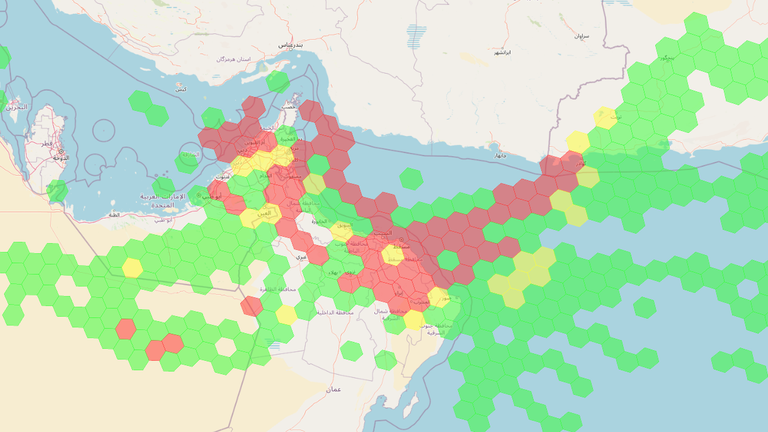
Image: High levels of GPS interference have been detected in the region. Credit: gpsjam.org
Not just Iran carrying out GPS jamming?
The issue of GPS – or, more correctly called GNSS (global navigation satellite systems), jamming – is increasingly an issue for airplanes and ships worldwide.
And the Strait of Hormuz has been a hotspot for electronic interference since before the conflict broke out.
While it can be used to antagonise adversaries, it’s often used as a defence measure against drones.
Dr Ramsey Faragher, director of the Royal Institute of Navigation, told Sky News that multiple countries may be using the technology in the Gulf.
Advertisement
“It’s probably a combination of Iran possibly turning up and turning on more of its own interference sources,” he said. “But also I suspect neighbouring countries have now turned on some of their own in order to try to defend against the drone strikes.”
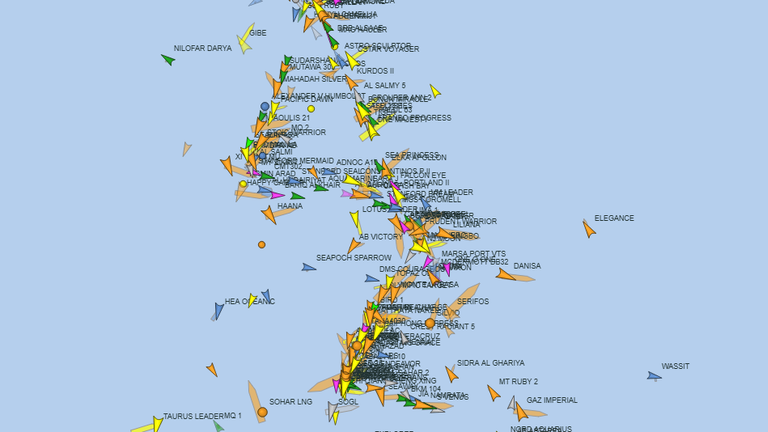
Image: Clusters of ships in specific geometric patterns show on tracking services – likely caused by GPS interference. Pic: VesselFinder
Disrupting navigation signals is one of the “cheapest and effective first lines of defence” against drone attacks, he says.
A look at a map of known GPS jamming in the region appears to show hotspots over Oman and the UAE, which are among the countries targeted by Iran since the conflict broke out.
On VesselFinder, which tracks ships worldwide based on their location transmissions, huge clusters of boats in oddly geometric shapes can be seen. This is likely to be a result of GPS interference and not indicative of their actual positions.
Dr Faragher added: “It’s definitely one of the most active spots in the world right now for electronic interference and that’s impacting, as we all know, not just maritime shipping and commercial shipping but it’s impacting all of the aircraft that fly nearby that region as well.”
“We were promised watering, and I’m not sure that has been done so I am a little annoyed about that. I know the forecast has not been kind, but few people complain about too much rain.
“The conditions suit some horses, but for the big favourites we would like it softer.”
Jon Pullin, clerk of the course at Cheltenham Racecourse, said they had watered the majority of the ground on Wednesday evening.
Pullin told BBC Sport: “After racing concluded on Wednesday, selective watering took place on the majority of the new course to maintain the going description of Good, Good to Soft in places.
Advertisement
“Our focus is on producing safe jumping ground for all our participants and that has been provided today.”
Two horses died on the opening two days of the 2026 Festival – Hansard on Tuesday, then HMS Seahorse on Wednesday – but all came home safe on Thursday.
Mullins is the most successful trainer in the history of Cheltenham, having saddled 118 winners. Regarded as the most prominent trainer in Ireland, he has also trained the last two winners of the Grand National.
Five Mullins-trained horses won on the opening two days of the Festival, but none on day three.
Advertisement
The 69-year-old said he had concerns about the ground from early on Thursday, with his fears confirmed as the day continued.
Mullins added: “I talked with JP [McManus, Fact To File’s owner], and said, these horses are too difficult to acquire.
“We waited all day for rain that was half-promised, so we made the decision not to run.”
Fact To File was the only horse Mullins withdrew on Thursday, with another 15 of his trainees running.
Advertisement
Shortly before Fact To File’s withdrawal, racing fans saw 40-1 shot White Noise win the Mares’ Novices’ Hurdle and the Stayers’ Hurdle was taken by Home By The Lee, another long-priced victor at 33-1.
Mullins himself directly suffered at the hands of an outsider in the final race of the day, as his Road To Home was beaten by a nose by 22-1 shot Ask Brewster in the Kim Muir Challenge Cup Handicap.
Heavy rain had been forecast at Cheltenham on Thursday morning, but while there was some wind and rain it was less than expected and the going was good for the Ryanair Chase.
It was eventually won by Heart Wood, which beat Jonbon – the new favourite following the absence of Fact Or File – by several lengths.
Ethan Ives-Griffiths was subjected to weeks of abuse at the hands of Michael Ives and his wife Kerry Ives before his death
Nina Massey, Press Association Law Correspondent
18:03, 12 Mar 2026
The Court of Appeal has rejected a bid to increase the sentences of a couple who were jailed for life for murdering their two-year-old grandson. Ethan Ives-Griffiths was subjected to weeks of abuse at the hands of Michael Ives, 48, and his wife Kerry Ives, 47.
The toddler was extremely dehydrated and severely underweight with visible marks and bruises when he collapsed with a catastrophic head injury at his grandparents’ home in Flintshire in August 2021.
Advertisement
In October last year the couple were jailed for life at Mold Crown Court. Michael Ives was sentenced to a minimum of 23 years imprisonment and Kerry Ives for a minimum of 17 years. Don’t miss a court report by signing upto our crime newsletter here
On Thursday Bill Emlyn Jones KC, for the Solicitor General, asked the Court of Appeal in London to increase the sentences, saying they were “unduly lenient”.
But Lord Justice Popplewell, Mr Justice Sweeting and Judge Penelope Moreland ruled that the sentences were appropriate and should not be increased.
Advertisement
Reading the judgment, Lord Justice Popplewell said Ethan was a “brave” and “resilient” boy with a “strong character” and that his grandparents “did not like him standing up for himself”.
Setting out some of the facts of the offending, he added that CCTV showed Michael Ives carrying his grandson by the top of his arm and appearing to punch him after putting him into a car seat.
Other footage showed the boy in the back garden “walking with a peculiar, wide stance and an uncertain gait”, which could be linked to the early effects of brain injuries caused by previous blows to his head, the judge said. To humiliate Ethan, Michael would make him stand with his hands on his head, he added.
Ethan had been placed on the child protection register, requiring him to be seen every 10 days, but when his mother last saw her social worker, on August 5, she spoke to him on the doorstep and told him Ethan was having a nap.
Lord Justice Popplewell continued: “On behalf of the Solicitor General, Mr Jones contends that for Michael and Kerry the minimum terms of 23 years and 17 years, respectively, were unduly lenient.
“He says that when sentencing for the murder the judge could not divorce the aggravating factors of the murder from the factors of what had gone before.”
The judge added: “In Michael’s case we are not persuaded that the sentence was unduly lenient.” He also said that it was clear that the sentencing judge, Mr Justice Griffiths, had the overall position “clearly” in mind.
Advertisement
The judge said that the panel was also “unpersuaded” in Kerry’s case that the minimum term was unduly lenient. “The judge was very well placed to assess her culpability and personal mitigation,” Lord Justice Popplewell said.
Ethan’s mother, Shannon Ives, 28, of Rhes-y-Cae, near Holywell, who had been staying with her son at her parents’ home, was found guilty of causing or allowing his death and of child cruelty, and sentenced to 12 years in prison.
Gordon Cole KC, for the mother, appealed against her sentence, telling the court the jail term was “too long” and that the judge had not fully taken into account her personal mitigation.
Advertisement
Lord Justice Popplewell said the judges had given careful consideration to his arguments but were unpersuaded that they justified “interfering with the sentence”.
Measles is an airborne virus (Picture: Getty Images)
A single London borough has had 80 cases of a ‘fast-spreading’ measles outbreak in less than three months.
Measles is a highly contagious disease that notoriously causes a red rash behind the ears or hairline that quickly spreads downward.
At least 235 cases of measles have been confirmed in the UK since January, according to UK Health Security Agency data released today.
Of them, 107 occurred in the past four weeks.
Advertisement
The agency says 80 laboratory-confirmed cases of the disease were in Enfield, north London, and 15 in the neighbouring borough of Harringey.
What to know about measles
The virus can’t be easily stopped in its tracks (Picture: Getty Images)
Measles spreads when infected people cough or sneeze, spewing viral droplets that float in the air for hours and wriggle on surfaces.
It’s six times more transmissible than Covid-19, making it difficult to contain.
The virus, also called rubeola, can be spread days before symptoms even begin.
Advertisement
Symptoms start around a week after someone gets in contact with the virus, such as a runny nose or a cough.
Within days, measles’s more infamous symptoms, like red or brown blotches and white spots in the mouth, called Koplik spots, emerge.
There’s no specific treatment for measles, other than remedies in hospital, like IV drips and painkillers, to make recovery easier. A vaccine remains the best way to prevent infection.
Seven schools in Enfield and Harringey have seen measles outbreaks, with some children requiring hospital treatment, the BBC reported last month.
Most were not immunised against the virus.
Advertisement
Latest London news
To get the latest news from the capital, visit Metro’s London news hub.
Advertisement
While measles outbreaks do happen, the speed of the infections has taken local healthcare workers aback.
Health experts say that 95% of people need to be vaccinated to curb the spread, with current vaccination rates well below that at 91.9%.
Protection is gained from the two-shot Measles, Mumps, Rubella, Varicella (MMRV) vaccine, given to children when they are 12 months old.
Together, the doses are about 97% effective at preventing an infection.
Advertisement
Enfield has the lowest uptake in the UK, which has alarmed people like Dr Jo Sauvage, the chief medical officer of the North Central London ICB, which organises healthcare for north London boroughs.
‘As the cases overall rise, it’s really distressing to see the numbers of children who are seriously ill also increase, with more children requiring hospital care,’ Dr Sauvage tells Metro.
Dr Yimmy Chow, UKHSA’s London region deputy director, says that children and adults who become infected with measles can suffer ‘needlessly’ in hospital.
Both Dr Sauvage and Dr Chow say there’s a simple thing people can do, however. Get vaccinated.
Advertisement
The measles, mumps and rubella vaccine is the best way to protect against the disease (Picture: AP)
‘Measles is one of the most infectious diseases known, and it will find those who are unvaccinated. Two doses of the MMR vaccine provide vital protection,’ Dr Chow says.
‘If your child has missed any vaccinations, or you are unsure whether they are up to date, please contact your GP surgery as soon as possible — it is never too late to catch up.’
The World Health Organisation declared the UK is no longer considered to have eliminated measles last month.
The man is facing two years in prison for allegedly taking the prohibited footage.
Benedict Tetzlaff-Deas News Reporter and Olivia Bridge
16:27, 12 Mar 2026
A traveller who allegedly filmed Iranian missiles in Dubai could face prison time for the footage.
The 60-year-old man, from London, stands as one of dozens of people accused of breaching strict laws in the United Arab Emirates against creating or uploading social media posts relating to conflict.
Advertisement
The legal advocacy group, Detained in Dubai, reports there are 21 people accused of the crime, reports The Mirror.
The Londoner was arrested in Dubai on Monday this week. It is reported he has deleted the footage from his phone immediately when asked by the authorities, and claimed to have had no knowledge of committing any offence.
Radha Stirling, director of the London-based Detained in Dubai organisation, said: “Amongst those charged is a British man who says he deleted the video immediately when asked and meant no harm, but is still among those facing charges.
“The official allegation relates to: ‘broadcasting, publishing, republishing or circulating rumours or provocative propaganda that could disturb public security.’
Advertisement
“Under UAE cybercrime laws, one post can lead to many arrests. Anyone who shares, reposts or comments on the same content can face the same charges. and be named on the same charge sheet.
“The charges are vague and broad but serious nonetheless. Those charged could face lengthy prison sentences.
“Residents could also be detained under national security laws, held indefinitely, denied access to their embassy and be subjected to human rights abuses. In times of tension, extreme caution is advised.”
Prosecutors in the UAE had warned last week over the risks of sharing “rumours” about incidents in the UAE amid the ongoing Middle East conflict.
Advertisement
A social media post from UAE Public Prosecution said: “Any person who shares or reposts content from unknown sources shall be subject to legal accountability in accordance with the applicable legislation, even if they are not the original creator of such content.
“Be aware and informed… Information is a responsibility, and spreading rumours is a crime.”
It comes as Iranian drones have continued to strike Dubai in the past 24 hours despite Tehran issuing an ‘apology’ to its Gulf neighbours for the war.
Two drones launched from Iran fell near Dubai International Airport yesterday, leaving four people injured. And authorities rushed Dubai Creek Harbour area late last night after another drone struck a high-rise building, sparking a fire on several floors. Photographs taken this morning showed windows blown out and smoke damage on a section of the building’s facade.
Advertisement
The Dubai Media Office said multiple emergency teams responded to the incident in the waterfront district, with residents evacuated as a precaution.
“No, I don’t talk about the Nobel Prize,” Trump said.
The comments would come as a surprise to the Donald Trump of a few months ago, who regularly spoke about how he deserved the high diplomatic honor.
Throughout 2025, the president claimed he had stopped at least eight wars since taking office, though an Independent fact-check underscored how many of these claims were inaccurate, exaggerated, or premature.
Advertisement
The U.S. is under heavy scrutiny for an apparent American strike on a girls primary school in Iran that killed scores of children (ISNA)
That didn’t stop nations and institutions seeking favor with Trump from playing into the president’s well-known interest in a Nobel Prize, which reportedly is fueled in part by his anger that President Barack Obama won one first.
In January, Venezuelan opposition leader María Corina Machado symbolically gave her Nobel Prize to Trump during a White House meeting, though the prize organizers say she remains the sole holder of that year’s honor.
The prior month, the international soccer organizing body FIFA gave Trump a newly created peace prize, which it announced weeks after Trump was snubbed for a Nobel and came as FIFA prepares to host the World Cup in North America in 2026.
Advertisement
Whatever Trump’s present interest in the Nobel is, there are few doubts that his administration has scrambled global relations with an oftentimes aggressive and unilateral approach.
The administration has tariffed enemies and allies, kidnapped the leader of Venezuela, launched a soft war on alleged drug boats in the Caribbean, assassinated the leader of Iran, and threatened the military takeover of Greenland, despite it being a NATO ally.
It has also failed to definitively end crises that the president confidently claimed he would solve, such as the Russia-Ukraine and Israel-Gaza wars.
A mobile repair expert from Vodafone has warned that poorly aligned wireless charging could be the culprit behind declining battery health, as uneven contact forces the device to work harder, generating heat and accelerating long-term battery degradation.
James Todd, national repairs manager at Fonehouse, said: “Modern phones have large camera bumps.
“When they sit unevenly on a wireless charger, the phone isn’t making optimal contact, so it has to work harder to charge.”
Advertisement
The risks of using illegal ‘dodgy’ Fire Sticks
Vodafone has teamed up with Fonehouse to offer same-day, in-store repairs in as little as two hours through its Fix & Go service, available in 18 Vodafone stores.
Mr Todd explained that although wireless charging is often seen as a convenient option, improper alignment between the phone and the charging coil can lead to excessive heat generation.
He said: “Wireless charging is often seen as a convenient hands-off option.
“But if the phone isn’t properly aligned, it can actually be worse for your battery than a cable.”
Advertisement
This misalignment causes the device to draw more power, creating heat that gradually reduces battery capacity.
Mr Todd said: “Over time, that heat reduces the battery’s capacity.
“It’s not something you notice straight away, but after a year or two, people wonder why their phone won’t last the day.”
The problem is especially common in vehicles, where phones are often left loosely on wireless charging pads while running navigation, music, and other apps.
Advertisement
To prevent battery damage, Mr Todd recommends using properly aligned wireless chargers, such as magnetic systems, or simply switching to a good-quality charging cable.
He said: “If you’re using wireless charging, alignment is everything.
“That’s why magnetic systems work so well, because they make sure the connection is optimal and reduce heat.”
Signs of battery deterioration include faster-than-normal battery drain, devices heating up during charging, sudden percentage drops, and unexpected shutdowns.
Advertisement
Should you charge your phone overnight?
Mr Todd said: “By the time people come into a repair shop, the damage has usually been building for months.”
He said that small adjustments to charging habits can significantly extend battery life and prevent unnecessary repair costs.
He said: “Take a second to make sure your phone is sitting flat and properly lined up.
Advertisement
“It’s one of the easiest ways to protect your battery and one of the mistakes we see most often.”
Beyond battery issues, another frequent problem is debris in the charging port.
Mr Todd said: “Every day you plug in your phone to charge, debris gets pushed further and further down into the port until the cable can’t properly connect.”
He said that a quick, professional cleaning can often resolve the issue without the need for expensive repairs.
Advertisement
The Fix & Go service covers a range of common smartphone problems, with repair prices starting at £49 for a camera fix, £39 for charging issues, £49 for battery replacements, £69 for rear cover repairs, and £79 for screen repairs.
The service is available for devices on any network, including those out of warranty, and supports Samsung, Apple, and Google handsets.
The police are appealing for information to help find a man who has been missing for a week. Christopher, 68, has been missing since Thursday, March 5.
Advertisement
Christopher was last seen in the area of Wellingborough at around 2pm. He has been described as around 6ft, bald, with a beard, and wearing glasses.
He was seen wearing a khaki green jacket, blue jeans, and a white hat with Forces PIN badges on. It is believed that Christopher may have left Wellingborough town. He has links to Peterborough.
If you have seen Christopher or have any information about where he might be, you can report it through the Northamptonshire Police website. You should quote the missing person reference number MPW1/741/26.
To get more news and top stories delivered directly to your phone, join our new WhatsApp community.Click this linkto receive your daily dose of CambridgeshireLive content.
Advertisement
We also treat our community members to special offers, promotions, and adverts from us and our partners. If you don’t like our community, you can check out any time you like. If you’re curious, you can read ourPrivacy Notice.
The court heard Noel Crowley’s wife of seven decades, Anne, slept each night with the hat he was wearing when he was knocked down
A much-loved family man and community stalwart was killed by a drug-driver as he walked to church, a court has heard.
Advertisement
Former Neath Port Talbot Council leader Noel Crowley was hit as he crossed the road by Zack Mason, an unaccompanied learner driver who was over the legal cannabis limit for driving. The 86-year-old was rushed to hospital but could not be saved.
A judge at Swansea Crown Court described Mr Crowley as a “much loved and much respected” man who was “know by many, and held in high esteem by all”.
Hannah George, prosecuting, told the court that the fatal incident happened in Port Talbot at around 5.30pm on December 7 last year.
She said Mason, who was aged 20 at the time and driving his mother’s Skoda Fabia car, pulled out of the car park of Blanco’s hotel and drove some 25 metres along Water Street before striking Mr Crowley as he was crossing the road.
Advertisement
Members of the public rushed to assist the injured man before he was rushed to University Hospital of Wales in Cardiff with severe head injuries. He died three days later.
In his police interview, Mason said a fellow motorist had “flashed” him out of the car park and that his attention had been drawn to the other driver as he thanked him. He told officers he had last consumed cannabis two days before the incident.
Advertisement
In a family statement read to the court, Mr Crowley was described as a man of “fairness and compassion” and great generosity, and as a champion of social equality.
Mr Crowley – who was awarded CBE, Deputy Lieutenant, Order of St John, Pro Ecclesia Et Pontifice, and Freeman of the Borough – was described as “the man who kept our world turning” who is “missed in every tiny detail of the day”.
The court heard Mr Crowley’s wife of seven decades, Anne, slept each night with the hat he was wearing when he was knocked down.
Zack Mason, now aged 22, of Lorraine Close, Sandfields, Port Talbot, had previously pleaded guilty to causing death by careless driving while over the legal limit of a specified drug, and to causing death while driving otherwise than in accordance with a licence when he appeared in the dock for sentencing.
Advertisement
The court heard he gained a provisional driving licence in April, 2021, but the following year it was revoked after he was caught driving without insurance.
David Singh, for Mason, said the defendant took full responsibility for his actions and acknowledged the devastation he had caused to Mr Crowley’s family.
He said his client had desisted from the use of cannabis since the day of the incident and that was a situation he would endeavour to maintain.
The barrister said it was not a case, for example, where the defendant had been speeding or been using his mobile phone, but said Mason had “clearly not been concentrating” resulting in “devastating consequences”.
Advertisement
Judge Huw Rees said the deceased was a “much loved loved and much respected” man who was “know by many, and held in high esteem by all”. He said no sentence a court could impose could mark the value of a life lost, and nor was it intended to.
With a one-third discount for his guilty pleas Mason was sentenced to four years in prison. He will serve up to half the sentence in custody before being released on licence to serve the remainder in the community.
The defendant was banned from driving for a total of seven years and must pass an extended test before he can get a licence.
Get daily breaking news updates on your phone by joining our WhatsApp community here. We occasionally treat members to special offers, promotions and ads from us and our partners. See our Privacy Notice