A new vision for urban living is taking shape, driven by an urgent need to make our cities more liveable, sustainable and resilient. Here’s what the metropolitan areas of tomorrow will look like
Wooden towers rise above the tree canopy, their facades alive with plants and shimmering solar cladding. The hum of traffic is gone. Instead, a quiet feet of autonomous robovans glides along dedicated lanes, linking neighbourhoods in smooth, predictable loops.
It’s a warm summer afternoon in 2037, and shoppers wander under covered walkways inspired by the porticoes of Bologna. Woodland weaves through housing districts, workplaces and civic squares. Streets smell of pine after rain. The skyline is timber and green rather than glass and glare.
Advertisement
Every building generates its own energy through integrated solar and micro wind systems, and collects and recycles water. Lighting, heating and ventilation respond automatically to occupancy and weather, guided by embedded IoT (Internet of Things) sensors. Temperature, humidity, air quality and movement are monitored constantly, optimising everything without residents lifting a finger.
Solutions every Saturday Uplift your inbox with our weekly newsletter. Positive News editors select the week’s top stories of progress, bringing you the essential briefing about what’s going right. Sign up
For the one million residents who have called Forest City 1 home since it opened in 2032, this is normal life. The young professionals priced out of the housing market and bored of identikit commuter estates found opportunities and something fresh in this trailblazing city. A Community Land Trust model ensured affordability, separating land ownership from property ownership, giving local residents control over how their community’s assets are managed. The 350,000 homes that have been built here softened prices nationally, pulling the average UK house price down by 4%.
New energy systems built around solar, small modular reactors and advanced district loops give households energy security. Waste, utilities and much of the transport infrastructure run below ground – all planned and buried before the first flagstone was laid. AI quietly manages water, traffic and energy flows, balancing them across this smart city.
Advertisement
This may sound like science fiction, but Forest City 1 is not a pipedream. It could be built in years not decades. The concept comes from Joe Reeve, founder of the non-partisan political movement Looking for Growth (LFG), and former journalist Shiv Malik. Their vision is anchored in a real site: avast plot on the Cambridgeshire-Suffolk border near Newmarket and Haverhill. The project is gathering support from investors, central government and even local residents.
Artist impression of what Forest City 1 might look like. Image: Forest City 1
Advertisement
Cambridge has the highest density of talent inEurope, and its proximity to London and to Stansted airport makes it an ideal location for the UK’s first new city in more than half a century. “We want a brand new city that is a place that people want to live in, not just commute to and from,” Reeve tells Positive News, from his home in London.
“Cambridge is criminally constrained from growing due to the green belt, and businesses are crying out for more lab space and places for workers to live. We chose this location because half the land is owned by three Lords and a Sheik.”
Private landowners without generational attachments, he explains, are more open to large-scale change. The population density is extremely low. Just 8,000 people live across the site’s 45,000 acres, much of it currently used as farmland.

Advertisement
The model sees new energy systems built around solar, small modular reactors and advanced district loops giving households energy security. Image: Forest City 1
Reeve describes the UK planning system as one that “sucks”. In his view, the current pattern produces ugly new build estates around beautiful villages, without the supporting infrastructure. “Trains and roads get busier but nothing gets upgraded,” he says.
That angers existing residents, disappoints new ones and harms wildlife and local ecology. Meanwhile, local businesses see little benefit because commuters continue to shop and socialise in London. And small-scale development does nothing meaningful for national affordability.
Advertisement
Forest City 1 allocates 12,000 acres – more than a quarter of its total site – to forest alone. Biodiversity would leap thanks to monocultural farmland being replaced with a natural environment that includes plans to create one of the largest redwood forests in the world. But above all, Reeve says, it would create a place where people genuinely want to live.
AI manages water, traffic and energy flows across the smart city
Momentum is real. Investors are circling, government interest is rising, and Reeve is bullish. “We want shovels in the ground before the end of this government,” he says.
But critics such as Jon Reeds, of the campaign group Smart Growth UK, argues that the location of it is wrong. “If they could find a large brownfield site close to major conurbations, so it had good public transport and could make use of existing infrastructure it could be a possibility,” he says. But building on agricultural land, when the UK only produces 60% of what it consumes domestically, is not the right answer, he suggests. Reeds explains that food and water security during times of climate change and global insecurity means we should be expanding our domestic food production land rather than building on it.
“It is fascinating that their proposal uses ‘green’ arguments for building on green land,” says Prof Tony Travers, an expert in local government at the London School of Economics. However, he says “the need for new homes is such that any idea is well worth considering”.

Advertisement
NEOM’s The Line has been put on hold indefinitely. Image: NEOM, The Line
New cities are seductive, but they bring their own complications. NEOM’s The Line in Saudi Arabia is the most extreme example: a 100-mile long, glass-fronted, car-free city initially intended to house 9m people sounded like something out of a sci-fi movie. Although construction began in 2021 promising a fully sustainable, fully digital, fully smart city, the project has been cancelled.
Advertisement
Building a hyper-dense megacity in one of the planet’s hottest, driest regions proved to be extraordinarily complex. Water must be brought in from the Red Sea through colossal desalination plants. Vertical farms must be powered to grow food where nothing grows naturally. The ventilation, cooling and waste systems required for millions of people pressed into a narrow corridor are vast. Now, with delays and budget overruns stacking up, the project has been shelved.
Smartly repurposing existing urban spaces
For most of the world, the future will not be built from scratch. It will emerge from transforming the cities we already inhabit. The shift is already underway.
On Rue de l’Arbalete in Paris, the first thing you notice is the quiet. Gone are the horns and fumes that once defined this narrow street. Now birdsong echoes between buildings, children cycle through planters and benches, and parents chat in dappled shade. A few years ago, this was a choked through-road. Today, it feels like a village square.
Advertisement
Paris has been a global leader in cleaning up and reclaiming its urban spaces. Not only has the Seine become swimmable again thanks to a major clean-up, but more than 300 ‘school streets’ have been pedestrianised and planted since 2020. The results – cleaner air, safer routes, more exercise for children – have landed well with residents. “School streets are a unique way to reclaim public space, and the health and environmental effects are well established,” Mathieu Chassignet, an engineer in sustainable mobility at the French environmental agency ADEME, tells Positive News.
School streets mean cleaner air, safer routes and more exercise for children
Voters agreed. In 2024 they backed the expansion of the model to another 500 streets. Other cities have taken note. “Paris shows how transformative it can be when cities prioritise youth,” says Sabina Sethi Unni, an urban planner at Open Plans, an advocacy group promoting the implementation of ‘school streets’ in New York.
Vienna now has around 140 parklets, low-cost communal areas turning parking bays into mini public squares. Stockholm doubled its summer pedestrian streets in 2018, opening space to cafes, public seating and art. Oslo and Copenhagen have pulled cars out of their centres too. Whilst initially business owners fear removing cars from city centres will dent profits the opposite proves to be true time and again. London, prompted by Covid, witnessed the transformation of nightlife area Soho into an open-air district. Although Soho didn’t remain pedestrianised it inspired many other parts of the capital to become low-traffic neighbourhoods– no longer prioritising cars – and the city’s famous Oxford Street will become fully pedestrianised after overwhelming public and business support.

Advertisement
More than 300 school streets have been created in Paris, removing cars, planting trees and reclaiming public spaces outside schools. Image: Joséphine Brueder/Ville de Paris
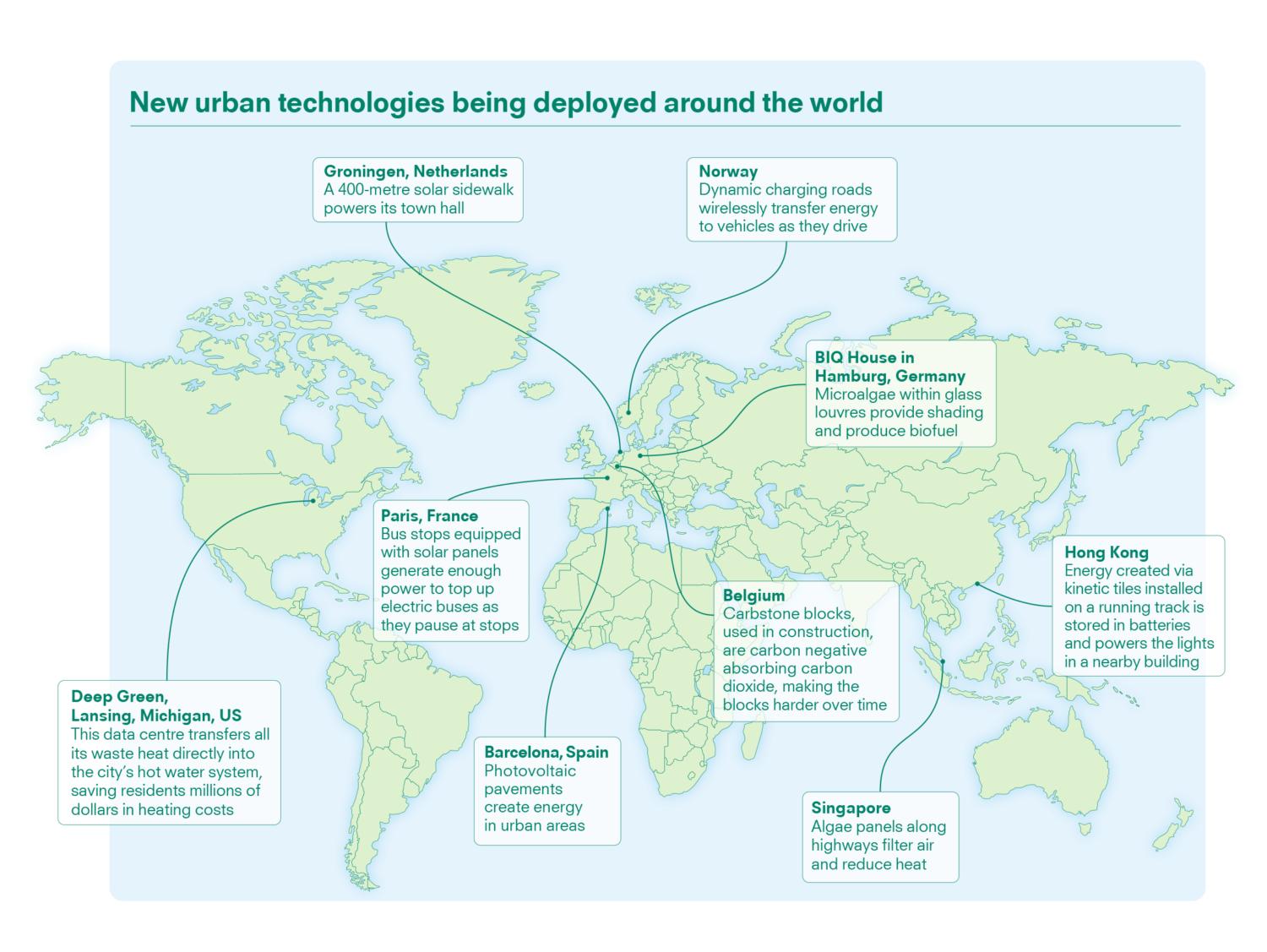
City evolution is not only about surface-level change. It is about the systems that keep everything running. Heat that once spewed wastefully from energy-hungry data centres is now captured and channelled into district heating. Public transport systems are electrifying at pace with dynamic charging roads, which wirelessly transfer energy to vehicles as they drive.
Solar-embedded infrastructure is moving from experiment to norm as the buildings of the future will not simply consume fewer resources they will generate and recycle them. Carbon-eating concrete and living-algae walls remove carbon from the air, while vertical forests and vertical farms clean air, regulate temperatures and, most importantly, produce much needed food.
Advertisement
Get spongy
None of this matters if cities cannot cope with water. By 2050, the number of properties in England exposed to fooding is projected to rise from 6.3m to 8m. Flash foods could increase by up to 66%. A climate-driven surge in short, violent rainstorms, combined with decades of paving over natural ground, has turned many cities into hard-shelled drainage machines. That model is failing. A new one is emerging in its place.
“Climate change brings us more extreme weather, and in this case, more extreme rain events within a very short period of time,” says Dutch architect Dirk van Peijpe of De Urbanisten. “We need to be ready for that kind of cloudburst that isn’t just increasing the capacity of our technical infrastructures, as so many cities have.”
Instead of pouring more money into deeper pipes and bigger sewers that will still be overwhelmed, van Peijpe argues for a shift in mindset. “Spend the same sums on creating a public space that can temporarily hold that rainwater,” he says. Because the water never mixes with sewage, it remains clean and usable.
Advertisement
It is combining water management in an urban environment with improving public spaces
“The rain water that we harvest from roofs and parking places and streets and squares around them… can be temporarily stored in this public space, and then, after 24 hours, the water square is emptied into the natural aquifers, in the soil infiltration, and you can actively use it again for other purposes,” he says.
Rotterdam has taken this thinking further than almost anywhere. The old port city, long accustomed to living with water rather than fighting it, has been getting spongier year by year. Across its neighbourhoods, hundreds of new water-absorbing parks, basins and nature-based defences have been completed or are underway. They look like everyday public spaces: skate bowls, sunken lawns, stepped amphitheatres, bright playgrounds. But they have a double life. In a cloudburst, they quietly swallow thousands of cubic metres of water. Some of the largest can hold around 1,700 cubic metres before slowly releasing it back into the ground, boosting groundwater rather than flushing it out to sea.
Van Peijpe has been central to this reimagining of the city. One of De Urbanisten’s flagship projects sits a short walk from the emerging Hofbogen park. “The water square is the first in the world that combined water storage with designing a fine public space,” he says. “It is combining water management in an urban environment with improving public spaces.”
In Rotterdam, the rain captured in the square is filtered, dropped into a closed aquifer system beneath the park, then used to feed vegetation and power fountains and streams. The city gets a public realm feature on dry days and a protective basin on wet ones.
Advertisement
That experimentation continues above street level. The disused Hofplein railway line is becoming an elevated linear park reminiscent of New York’s High Line. Here too, the water cycles through the network. Rain gathered on the roof level is cleaned and channelled back down into an aquifer to create a closed system for Hofbogen park. “The water system feeds the vegetation in the park with rainwater so we don’t need to waste drinking water for the plants,” van Peijpe says.
China – the pioneer in creating sponge cities– has rolled out projects nationwide, integrating wetlands, permeable pavements and green corridors. And New York is also taking note. The Department of Environmental Protection has begun installing seven miles of permeable pavement along curbs in the city’s Borough Park district, to allow water to seep rather than surge during storms.
Cities are evolving fast and are being forced to respond to the same pressures: climate, population, inequality, affordability and the need for healthier lives. It may well be that all new cities are built among forests with timber skylines and streets shaded by trees. Where food is grown vertically, and transport is silent and clean.
Advertisement
Whether it’s retrofitting the medieval cities of Europe with integrated smart tech or building a new city from the ground up, the future city is not a fantasy. It is already under construction. The only question is how quickly we choose to build it.
Additional reporting Alice Kantor and Gavin Haines
Illustration by Andrea Manzati
Advertisement
Be part of the solution
At Positive News, we’re not chasing clicks or profits for media moguls – we’re here to serve you and have a positive social impact. We can’t do this unless enough people like you choose to support our journalism.
Give once from just £1, or join 1,800+ others who contribute an average of £3 or more per month. Together, we can build a healthier form of media – one that focuses on solutions, progress and possibilities, and empowers people to create positive change.
Bill Gates has apologized to staff at his charitable foundation over his past friendship with Jeffrey Epstein, also admitting to two extramarital affairs, according to a report.
“To be clear, I never spent any time with victims, the women around him,” Gates said while apologizing to foundation executives for introducing them into Epstein’s orbit.
“It was a huge mistake to spend time with Epstein. I apologize to other people who are drawn into this because of the mistake that I made,” he said.
Advertisement
The tech entrepreneur turned philanthropist explained that he first met the pedophile in 2011, three years after Epstein had pleaded guilty to soliciting a minor for prostitution in Florida, but that he had not looked into the financier’s background and was only dimly aware of an “18-month thing” that limited his travel.
Bill Gates has expressed his regret at ever knowing Jeffrey Epstein and says he ended contact with him in 2014 (AP)
He acknowledged that his then-wife, Melinda Gates, had expressed concern about Epstein in 2013, but that he had ignored her caution and continued to see him socially.
“Knowing what I know now makes it, you know, a hundred times worse in terms of not only his crimes in the past, but now it’s clear there was ongoing bad behavior,” Gates said, according to the WSJ.
Advertisement
Alluding to his ex-wife, he added: “To give her credit, she was always kind of skeptical about the Epstein thing.”
Gates continued to map out the course of their relationship, saying he had met with Epstein in 2011, taken trips on his private jet and spent time with him in Germany, France, New York, and Washington, but “never stayed overnight” at his properties or visited Little St James, his now-notorious private Caribbean island.
He said he did not see Epstein again after 2014, although there were “ancillary issues” that Epstein continued to email him about, but Gates said he chose not to respond to them.
Advertisement
Epstein died in a New York City jail cell in August 2019 (New York State Division of Criminal Justice)
Gates also said the women pictured with him in the files were Epstein’s assistants, whom the billionaire had asked to pose with him.
He said he had been drawn to Epstein initially because he “talked about the kind of intimate relationship he had with a lot of billionaires, particularly Wall Street billionaires,” whom, he said, could help Gates with his fundraising goals, which “made it easier for me to feel like this was a normalized situation.”
“It definitely is the opposite of the values of the foundation and the goals of the foundation,” Gates admitted. “And our work is very reputation-sensitive. I mean, people can choose to work with us or not work with us.”
A Gates Foundation spokesperson told The Independent: “This was a scheduled town hall with employees, which Bill does twice a year. In the conversation, Bill answered questions submitted by foundation staff on a range of issues, including the release of the Epstein files, the foundation’s work in AI, and the future of global health.
Advertisement
“In the town hall, Bill spoke candidly, addressing several questions in detail, and took responsibility for his actions.”
Gates posing for a photograph with a woman whose identity has been redacted, as seen in the recent Department of Justice release of files pertaining to Epstein (DOJ)
During the town hall, the billionaire also admitted to two affairs.
“I did have affairs, one with a Russian bridge player who met me at bridge events, and one with a Russian nuclear physicist who I met through business activities,” he said.
Advertisement
Melinda Gates spoke to NPR’s Wild Card podcast earlier this month about the release of the Epstein files and told host Rachel Martin that the scandal “brings back memories of some very, very painful times” in her marriage.
The couple, who have three children, divorced in 2021 after 27 years together.
Martin asked her guest about one of the emails released by the DOJ that suggested her former husband had sought treatment for a sexually transmitted infection and planned to supply it to his ex-wife too without her knowledge, asking what her “dominant emotion” was when she first heard about it, to which she answered: “Just unbelievable sadness.”
Advertisement
Melinda Gates speaking to NPR’s ‘Wild Card’ podcast earlier this month about the Epstein scandal and the end of her 27-year marriage (NPR)
A spokesperson for Bill Gates has vehemently denied the allegations in question and previously told The Independent: “These claims are absolutely absurd and completely false.
“The only thing these documents demonstrate is Epstein’s frustration that he did not have an ongoing relationship with Gates and the lengths he would go to entrap and defame.”
Unlike other powerful men linked to Epstein, Gates has shown a commendable willingness to speak frankly about his past mistakes.
“Every minute I spent with him, I regret, and I apologise that I did that,” he recently told Australia’s 9News, adding that he was “foolish to spend time with him” and is “one of many people who regret ever knowing him.”
Advertisement
“The more that comes out, the more clear it will be that, although the time was a mistake, it has nothing to do with that kind of behaviour,” he added.
A federal judge reprimanded Donald Trump’s administration for claiming that an immigrant seeking his release from custody was convicted for marijuana possession in 2009 — when he was 4 years old.
To support arguments for the man’s ongoing detention and removal from the country, government lawyers attached a document from Immigration and Customs Enforcement that they “indicated” was related to his criminal history.
They submitted the document in court filings “despite the differences in birthdate, birthplace, parents’ names, and immigration status,” West Virginia District Judge Irene Berger noted in her order to release him on Tuesday.
“This sloppiness further validates the Court’s concerns about the procedures utilized by the Respondents depriving people present in the United States of their liberty,” she wrote.
ICE officials submitted a document purporting to show an immigrant seeking his release was convicted for marijuana possession — when he was 4 years old (Getty Images)
Judges within the last week have held at least two government attorneys in civil contempt for failing to follow orders in immigration cases, according to documents reviewed by The Independent.
Last week, Minnesota District Judge Laura M. Provinzino held a federal prosecutor in civil contempt for “flagrant disobedience of court orders” in the case of a noncitizen swept up in Trump’s surge of immigration officers in the state.
Advertisement
Provinzino ordered Special Assistant U.S. Attorney Matthew Isihara to pay $500 a day until the government returned a man’s identification documents after his release. The contempt was purged after his documents were returned.
This week, Trump appointee Judge Eric C. Tostrud of Minnesota found the administration in civil contempt for transferring an ICE detainee to Texas in violation of his order and then releasing him without his belongings.
The judge ordered the administration to refund him $568 for the cost of a plane ticket home.
Advertisement
Lawyers defending Kristi Noem’s DHS are battling an overwhelming number of immigration lawsuits and failing to keep up with court orders (REUTERS)
The administration’s attempts to arrest and deport tens of thousands of people from the country — without giving them much of a chance to fight their cases before they’re indefinitely jailed in immigration detention centers — have triggered an avalanche of lawsuits that are overwhelming courts and prosecutors.
Dozens of new habeas corpus petitions — the lawsuits immigrants have filed to challenge the constitutionality of their arrest and detention — are hitting court dockets every week. Government attorneys are overwhelmed or quitting in droves under pressure to fight them at an unsustainable pace.
Judges have argued that it’s a crisis of the administration’s own making.
Officials “have chosen to avail themselves of these exact circumstances of which they now complain,” wrote California District Judge Sunshine Sykes, whose order this month commanded the government to let detainees challenge their detentions.
Advertisement
In New Jersey, government lawyers recently admitted to violating roughly 50 orders stemming from more than 500 cases.
Julie Le, a lawyer for ICE who was drafted to help with the caseload in the U.S. Attorney’s Office in Minnesota, was removed from that detail days after her outburst in court.
The same month, Minnesota’s chief federal judge ripped into the administration after he found ICE violated nearly 100 court orders stemming from the recent surge of officers into the state, or “more court orders in January 2026 than some federal agencies have violated in their entire existence.”
Advertisement
“ICE has every right to challenge the orders of this court,” wrote Judge Patrick J. Schiltz. “But, like any litigant, ICE must follow those orders unless and until they are overturned or vacated.”
Officials at the Justice Department and DHS have labeled judges “activists” and “rogue” members of the judiciary in public statements criticizing the decisions but have rarely appealed them.
If you’re a nervous solo traveller, it could help ease your mind (Picture: Getty)
Cabin crew travel for a living, so we tend to trust their advice on making the most of our trips.
And this flight attendant’s top tip could be an invaluable one, especially if you’re travelling alone.
Esther Sturrus, who works for Dutch airline KLM and shares TikToks about her journeys, recommends always throwing a water bottle under the bed when you get into a hotel room.
Although unlikely, tourists can be targeted by thieves or intruders, with some travellers choosing to be vigilant in certain countries or in rooms on lower floors.
Advertisement
According to Esther, her hack lets you ‘check that no one is under the bed without looking’, easing your mind if you’re wary.
She advises rolling the bottle under the bed, adding in her video that it ‘has to come out on the other side’. If it doesn’t, you may want to exercise caution.
Best of Metro Deals
Get exclusive discounts with Metro Deals – save on getaways and spa days. Powered by Wowcher
Bannatyne Spa: Spa day for two with treatments, lunch & prosecco — save up to 57% off.
Bear in mind that an obstruction doesn’t necessarily mean there’s someone hiding underneath your bed.
Advertisement
It could just as easily be where spare sheets are stored, or you didn’t throw the bottle hard enough to get it right across to the other side.
That said, it doesn’t hurt to check, and you’ll sleep better knowing you’ve done your due diligence.
Esther’s followers praised the tip, including one person who called it ‘super useful’. Another said that a new fear had been ‘unlocked’ by the revelation, while a third called it a ‘crazy’ though.
The rest of the flight attendant’s hotel hacks were more lighthearted, though, from using a hairdryer to clear a steamed-up mirror to turning over a paper cup and poking a hole in the bottom to hygienically hold your toothbrush.
Advertisement
Metro previously asked cabin crew for their insider tips on having the best possible flight. This is what we found out.
How to get upgraded on a flight
‘As far as travel tips are concerned, my number one tip for those looking to get upgraded (and treated like royalty) on a flight is to be lovely to the cabin crew,’ Hannah Murphey, former flight attendant and director of Globe Fit Ltdtold Metro.
‘A smile and eye contact upon boarding goes a long way. Chat to the crew and ask them about their job. I used to love it when passengers showed an interest in me and were kind opposed to demanding.
‘I wanted to then go out of my way to ensure that they have the very best flight, so I would move their seats if there was a better one available – and I would give them extra drinks etc. purely because they had showed me kindness.
Advertisement
‘When passengers are rude and expectant it has the opposite effect.’
Essentially, a little kindness really does go a long way.
Choose the best seats
If you’re in a position to choose where you’re sitting on the plane – make sure you think about that decision.
‘Go for a seat just forward of the wing for a comfier flight and don’t sit near the toilets or galleys – because it can be smelly and noisy,’ suggests Daisy White, a former flight attendant.
Advertisement
Sit at the front of the plane for your choice of food
If you can choose your seats, opt for the front of the plane. Not only do you tend to feel turbulence less at the front compared to the tail of the plane, but there’s also a perk during mealtimes.
Kamila Jakubjakova, a flight attendant, told Metro: ‘The food service usually starts from the front of the airplane, so you’ll get to dine first if you sit in the very first rows of an aircraft. Sitting in the front rows also means you’re more likely to get your preferred choice of meal if two options are available.’
However, the cut is less than previously promised.
At the November budget, Chancellor of the Exchequer Rachel Reeves said: “I can tell you today that for every family we are keeping our promise to get energy bills down and cut the cost of living with £150 cut from the average household bill from April next year.”
Britain’s energy debts have been pushed to record levels, partially due to inflated gas market prices as gas by tanker is imported from the US and Middle East, and also because of the greater costs of the UK’s energy transition.
On the energy bill cut, Tim Jarvis, the director general of markets at Ofgem, said: “Today’s announcement will be welcome news for many households.

Advertisement
“Wholesale energy prices have fallen in recent months, and we’re investing in our network to safeguard the future energy system. The main driver of today’s reduction is the change to policy costs announced by the chancellor in the budget.”
Here’s everything you need to know about the reduction in energy bills:
What is Ofgem’s price cap?
The energy price cap sets a maximum price that suppliers can charge customers in England, Scotland and Wales for each unit of gas and electricity they use.
Advertisement
It also sets a maximum daily standing charge – the cost of having your home connected to the grid.
The headline price cap figure provided by Ofgem indicates what a household using gas and electricity and paying by direct debit can expect to pay if their energy consumption is typical.
However, the cap does not limit a home’s total bills because people still pay for the amount of energy they use, so if it’s above the average they will pay more, and if it is below they will pay less.
When will energy bills be reduced?
Advertisement
The reduction in energy bills will begin in April.
Ofgem’s quarterly cap will reduce by 7 percent a year for the three months from April, from £1,758 to £1,641 for the average combined gas and electricity bill in Great Britain.
All households will benefit from the savings no matter which tariff they are on, however, savings will differ depending on how much energy is used.
However, critics say the energy bill cut doesn’t go far enough. Clare Moriarty, the chief executive of Citizens Advice, said: “A fall in energy prices is welcome but for many people bills remain stubbornly high. For millions of households this has stopped being a temporary hardship and become an ongoing threat to their financial stability.
Advertisement
“The government has taken steps in the right direction to bring down bills. However, planned changes to how warm home discount costs are recovered mean those who need it most – households on low incomes with the highest energy needs – could keep as little as half the support in practice.”
All participants will get their hands on this medal
Belfast City Marathon medal 2026
With just under 10 weeks to go until the Phoenix Energy Belfast City Marathon and Team Relay, the Belfast City Marathon has revealed this year’s medal to build excitement ahead of the big day on May 3.
The event gets underway at Stormont Estate and travels through each corner of the city across the 26.2-mile route. Team Relay participants taking on Legs A, B, C or D can collect their medal at the end of their legs at Montgomery Road, Boucher Road, Falls Road and Duncairn Gardens. Marathon runners and Leg E relay participants will receive their medals at the finish line at Ormeau Park.
If you would like to make your medal even more memorable, you can add an iTAB. This small metal insert fits neatly onto the back of your medal and can be personalised with your name or team relay name, along with your finish time. Participants can pre-order an iTAB by visiting eventmaster.ie, logging into their account and heading to the ‘Manage My Booking’ section to add it to their order.
If you missed out on securing an entry this year, there are still opportunities to take part through our Charity Places. Visit www.belfastcitymarathon.com/charity-places to find out more.
The Phoenix Energy Belfast City Marathon is sponsored by Phoenix Energy, Translink, Kukri Sports, Belfast Live, Daily Mirror, Q Radio, Better, Runna, Marathon Photos Live, iTAB, Deep RiverRock, Charles Hurst, Mac in a Sac, Steigen, Applied Nutrition, Linwoods Health Foods and Belfast City Council. The Official Charity Platform is Give2You.
Want to see more of the stories you love from Belfast Live? Making us your preferred source on Googlemeans you’ll get more of our exclusives, top stories and must-read content straight away. To add Belfast Live as a preferred source, simply click here.
The opponent, date and venue for Taylor’s final fight have not been confirmed.
August would be a more likely date for a Croke Park bout as the iconic Dublin stadium is hosting the latter stages of the All-Ireland Hurling and Football Championships throughout July.
In September, Taylor was named ‘Champion in Recess’ by the World Boxing Council (WBC) after informing the sanctioning body of her plans to take some time away from the sport.
Last week, Briton Sandy Ryan claimed the vacant belt with victory over Mexico’s Karla Ramos Zamora in Nottingham.
Advertisement
Taylor has a 25-1 professional record with her only defeat coming against Britain’s Chantelle Cameron in Dublin in 2023.
After avenging that loss to become a two-weight undisputed champion later that year, Taylor recorded wins over Serrano in November 2024 and July 2025 having already overcome the Puerto Rican in April 2022.
“I’m not sure who the opponent is or what the date will be,” added Taylor, who won an Olympic lightweight gold medal in 2012 before turning pro in 2016.
“I just know I’ll fight this year during the summer time and all the other details will be laid out in the coming weeks and months.
Advertisement
“Either way I’m in the gym for whenever and whoever it will be. I’m staying sharp and ready.”
Mary Berry has shared a variety of dishes over the years, including this ‘wonderfully comforting’ chicken pasta bake which has more than 170 four-star ratings on BBC Food.
Sophie Harris Senior Lifestyle Reporter and Isobel Pankhurst Audience Writer
13:41, 25 Feb 2026
Mary Berry has revealed numerous recipes throughout the years, including speedy weeknight meals, which are ideal for the entire household. This includes her chicken pasta bake, which boasts over 170 four-star reviews on BBC Food.
It can be made in advance, and even stored in the freezer for as long as three months. The recipe description stated: “A wonderfully comforting chicken pasta bake, this will go down well with the family.”

Advertisement
It feeds six to eight individuals, and whilst Mary opts for penne pasta, she notes that any pasta variety will be suitable.
Ingredients:
Butter, for greasing
250g penne
One onion, roughly chopped
Three skinless, boneless chicken breasts, cut into thin strips
One tablespoon of paprika
Two tablespoons of olive oil
Salt and freshly ground black pepper
For the sauce:
50g butter
50g plain flour
750ml hot milk
One teaspoon of Dijon mustard
100g Parmesan cheese, coarsely grated
Two large tomatoes, deseeded and cut into small cubes
Method:
Preheat the oven to 220°C/200°C Fan, then butter a shallow 1.75 litre ovenproof dish.
Cook the penne with the onion in boiling, salted water, then drain and refresh in cold water. Leave to drain again in the colander.
Put the chicken strips in a resealable freezer bag with the paprika and a little salt and pepper, seal the bag and shake to coat. Warm one tablespoon of oil in a large frying pan and swiftly sear the chicken over a high heat for two minutes until just cooked through.
Advertisement
Using a slotted spoon, transfer the chicken to a plate and leave to one side.
To prepare the sauce, melt the butter in a large saucepan, then incorporate the flour and whisk until smooth to create a roux. Cook for one minute, then gradually pour in the hot milk, whisking over a high heat until the sauce is smooth and thickened, allowing it to boil for four minutes.
Fold in the mustard and half the cheese, seasoning with salt and pepper.
Add the pasta and onion to the pan with the sauce, stirring well to combine. Spoon half of this mixture into the dish, lay the chicken strips on top, then spoon the remaining pasta and sauce over the chicken.
Advertisement
Scatter the tomatoes across the top, then finish with the remaining cheese. Place in the oven and bake for 20 minutes until piping hot and golden brown on top.
Before using any IPL or epilator, carry out a patch test on a small clean, dry and hair-free section of skin. “Although home hair removal devices are less aggressive than in-clinic tools, it is important to perform a patch test and wait 24 hours to check for any redness, burns or irritation before proceeding with a full session,” says dermatology expert Selma van Asselt.
It is equally important to examine the device’s hair and skin compatibility chart before use. “Extremely light hair, as well as red and grey hair are not suitable for this kind of treatment because they cannot accumulate enough heat to destroy the hair’s growth centre,” says Selma. “Darker skin types will also accumulate too much heat, which could cause skin burns or hyperpigmentation.”
Selma also says people with eczema, open cuts, sunburn or those using active skincare ingredients should avoid IPL devices and epilators. She advises those who are pregnant, nursing, undergoing any medical procedures or aesthetic treatments to refrain from the treatment.
Advertisement
Aftercare is also key. Selma urges those to “avoid saunas, sun beds or swimming pools” 24 hours after a treatment. “While it may seem like a mild treatment, exposing the body to more heat after a session may cause irritation.”
Those with fair hair whether it’s grey, blonde or red, may find certain hair removal devices are not as effective as others. Fair hair makes it harder for tools like lasers and IPL devices to detect a contrast between the hair and skin. The solution? Epilators.
Marina Mevzos, marketer at beauty-tech brand Sensica, explains: “Fair, very light blonde and grey hair contain little melanin, which makes IPL and laser treatments generally less effective. Epilation can be a useful choice for temporary smoothness in these cases. However, devices like IPL may provide some benefit if there is enough contrast between hair and skin.”
Try our Best Buy epilator: Panasonic ES-EY90-A511 Wet and Dry
Bayer Leverkusen are through to the last 16 of the Champions League (Picture: Getty)
Bayer Leverkusen star Robert Andrich is adamant he would rather avoid Bayern Munich in the last 16 of the Champions League, even if it would put his side on collision course with Arsenal.
Kasper Hjulmand’s booked their place in the first knockout round following a goalless draw against Olympiacos last night which saw them protect their two-goal advantage from the first leg.
Leverkusen know they will face a daunting task however Friday’s draw pans out but Andrich insists it’s far too early to be contemplating an all-German tie.
He said: ‘We knew from the start that we would face a top club anyway. I stand by my opinion:
Advertisement
‘I would prefer not to face a German team, so that perhaps enough German teams can still stay in the competition.’
Those sentiments were echoed by Jonah Hoffman, who added: ‘I think it’s a bit too early for a German-German tie.
‘It doesn’t have this Champions League character somehow. So if I could have my wish, then Arsenal.
Your football fix
Metro‘s Head of Sport James Goldman delivers punchy analysis, transfer talk and his take on the week’s biggest stories direct to your inbox every week.
Arne Slot’s Liverpool await their Champions League fate (Picture: Getty Images)
Man City
Bodo/Glimt, Real Madrid or Benfica
Tottenham
Advertisement
Atletico Madrid, Galatasaray or Juventus
Newcastle
Chelsea or Barcelona
Advertisement
‘It would be a bit cooler to travel to London and for them to come here.’
Arsenal last faced Leverkusen in Europe’s most prestigious club competition back in 2002 during the second group stage.
The Gunners thrashed the eventual finalists that year 4-1 at Highbury and earned a creditable draw away from home, but it was their German opponents that ultimately qualified for the latter stages along with Deportivo Lacoruna.
Advertisement
Arsenal were among the favourites for the competition that year and are among the favourites again after they swept all before them in the league stage.
Who can the other teams play?
Barcelona
Newcastle, Monaco or PSG
Bayern Munich
Advertisement
Borussia Dortmund, Bayer Leverkusen
Sporting
Bodo/Glimt, Real Madrid or Benfica
Advertisement
With eight wins from eight games, including a convincing 3-1 victory over Bayern Munich, Arsenal would be firmly expected to progress were they to meet Leverkusen next but sporting director Simon Rolfes is up for the challenge.
He said: ‘Arsenal would be nice. I said the same thing when we could’ve faced Dortmund in the previous round.
‘Especially that we would be able to meet two of our former players in Kai Havertz and Piero Hincapie.
Advertisement
‘Nobody wants these ties between teams from the same country.’