NewsBeat
What will urban living look like in the future?

A new vision for urban living is taking shape, driven by an urgent need to make our cities more liveable, sustainable and resilient. Here’s what the metropolitan areas of tomorrow will look like
Wooden towers rise above the tree canopy, their facades alive with plants and shimmering solar cladding. The hum of traffic is gone. Instead, a quiet feet of autonomous robovans glides along dedicated lanes, linking neighbourhoods in smooth, predictable loops.
It’s a warm summer afternoon in 2037, and shoppers wander under covered walkways inspired by the porticoes of Bologna. Woodland weaves through housing districts, workplaces and civic squares. Streets smell of pine after rain. The skyline is timber and green rather than glass and glare.
Every building generates its own energy through integrated solar and micro wind systems, and collects and recycles water. Lighting, heating and ventilation respond automatically to occupancy and weather, guided by embedded IoT (Internet of Things) sensors. Temperature, humidity, air quality and movement are monitored constantly, optimising everything without residents lifting a finger.
For the one million residents who have called Forest City 1 home since it opened in 2032, this is normal life. The young professionals priced out of the housing market and bored of identikit commuter estates found opportunities and something fresh in this trailblazing city. A Community Land Trust model ensured affordability, separating land ownership from property ownership, giving local residents control over how their community’s assets are managed. The 350,000 homes that have been built here softened prices nationally, pulling the average UK house price down by 4%.
New energy systems built around solar, small modular reactors and advanced district loops give households energy security. Waste, utilities and much of the transport infrastructure run below ground – all planned and buried before the first flagstone was laid. AI quietly manages water, traffic and energy flows, balancing them across this smart city.
This may sound like science fiction, but Forest City 1 is not a pipedream. It could be built in years not decades. The concept comes from Joe Reeve, founder of the non-partisan political movement Looking for Growth (LFG), and former journalist Shiv Malik. Their vision is anchored in a real site: avast plot on the Cambridgeshire-Suffolk border near Newmarket and Haverhill. The project is gathering support from investors, central government and even local residents.
Artist impression of what Forest City 1 might look like. Image: Forest City 1
Cambridge has the highest density of talent inEurope, and its proximity to London and to Stansted airport makes it an ideal location for the UK’s first new city in more than half a century. “We want a brand new city that is a place that people want to live in, not just commute to and from,” Reeve tells Positive News, from his home in London.
“Cambridge is criminally constrained from growing due to the green belt, and businesses are crying out for more lab space and places for workers to live. We chose this location because half the land is owned by three Lords and a Sheik.”
Private landowners without generational attachments, he explains, are more open to large-scale change. The population density is extremely low. Just 8,000 people live across the site’s 45,000 acres, much of it currently used as farmland.
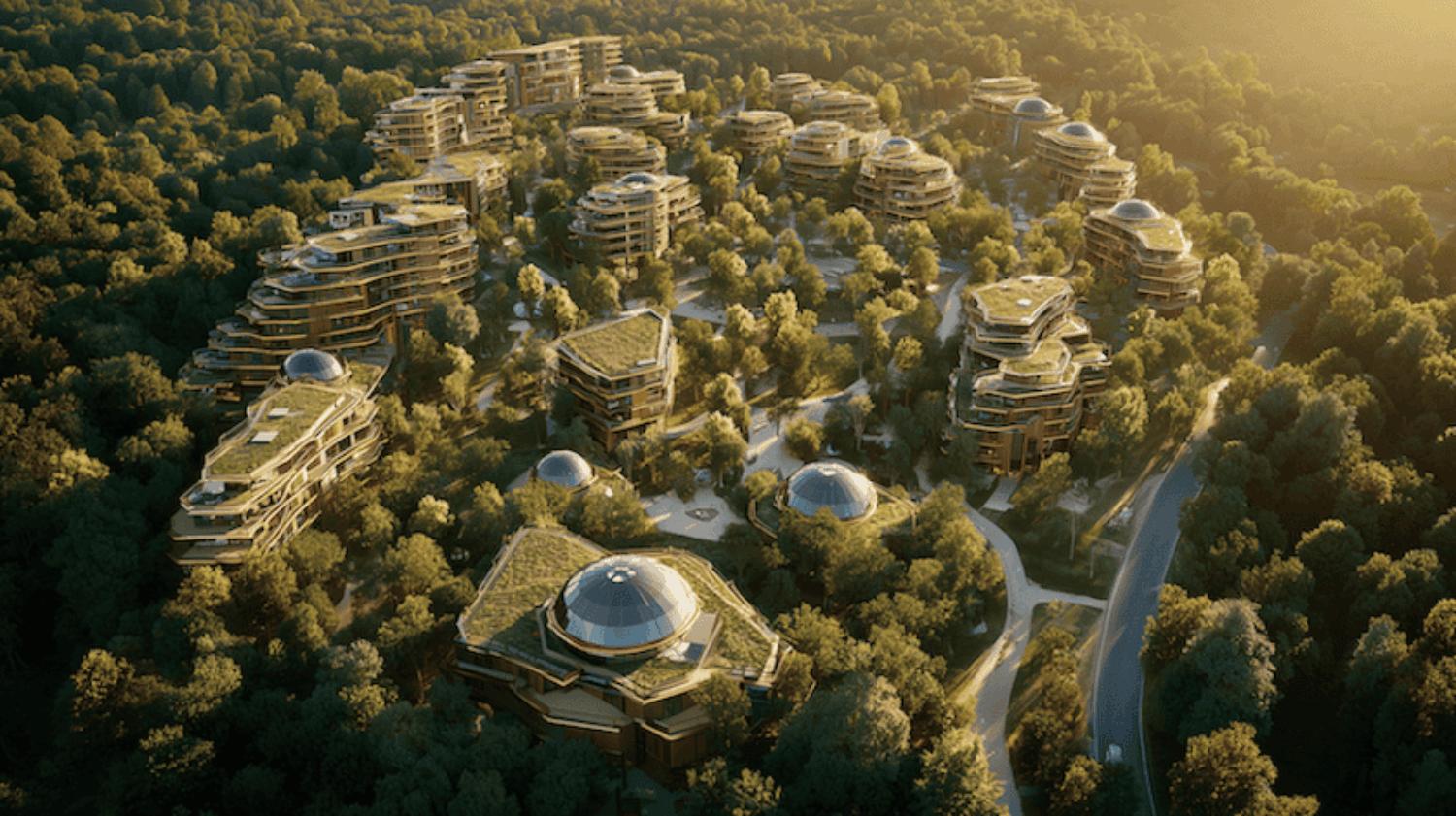

The model sees new energy systems built around solar, small modular reactors and advanced district loops giving households energy security. Image: Forest City 1
Reeve describes the UK planning system as one that “sucks”. In his view, the current pattern produces ugly new build estates around beautiful villages, without the supporting infrastructure. “Trains and roads get busier but nothing gets upgraded,” he says.
That angers existing residents, disappoints new ones and harms wildlife and local ecology. Meanwhile, local businesses see little benefit because commuters continue to shop and socialise in London. And small-scale development does nothing meaningful for national affordability.
Forest City 1 allocates 12,000 acres – more than a quarter of its total site – to forest alone. Biodiversity would leap thanks to monocultural farmland being replaced with a natural environment that includes plans to create one of the largest redwood forests in the world. But above all, Reeve says, it would create a place where people genuinely want to live.
AI manages water, traffic and energy flows across the smart city
Momentum is real. Investors are circling, government interest is rising, and Reeve is bullish. “We want shovels in the ground before the end of this government,” he says.
But critics such as Jon Reeds, of the campaign group Smart Growth UK, argues that the location of it is wrong. “If they could find a large brownfield site close to major conurbations, so it had good public transport and could make use of existing infrastructure it could be a possibility,” he says. But building on agricultural land, when the UK only produces 60% of what it consumes domestically, is not the right answer, he suggests. Reeds explains that food and water security during times of climate change and global insecurity means we should be expanding our domestic food production land rather than building on it.
“It is fascinating that their proposal uses ‘green’ arguments for building on green land,” says Prof Tony Travers, an expert in local government at the London School of Economics. However, he says “the need for new homes is such that any idea is well worth considering”.


NEOM’s The Line has been put on hold indefinitely. Image: NEOM, The Line
New cities are seductive, but they bring their own complications. NEOM’s The Line in Saudi Arabia is the most extreme example: a 100-mile long, glass-fronted, car-free city initially intended to house 9m people sounded like something out of a sci-fi movie. Although construction began in 2021 promising a fully sustainable, fully digital, fully smart city, the project has been cancelled.
Building a hyper-dense megacity in one of the planet’s hottest, driest regions proved to be extraordinarily complex. Water must be brought in from the Red Sea through colossal desalination plants. Vertical farms must be powered to grow food where nothing grows naturally. The ventilation, cooling and waste systems required for millions of people pressed into a narrow corridor are vast. Now, with delays and budget overruns stacking up, the project has been shelved.
Smartly repurposing existing urban spaces
For most of the world, the future will not be built from scratch. It will emerge from transforming the cities we already inhabit. The shift is already underway.
On Rue de l’Arbalete in Paris, the first thing you notice is the quiet. Gone are the horns and fumes that once defined this narrow street. Now birdsong echoes between buildings, children cycle through planters and benches, and parents chat in dappled shade. A few years ago, this was a choked through-road. Today, it feels like a village square.
Paris has been a global leader in cleaning up and reclaiming its urban spaces. Not only has the Seine become swimmable again thanks to a major clean-up, but more than 300 ‘school streets’ have been pedestrianised and planted since 2020. The results – cleaner air, safer routes, more exercise for children – have landed well with residents. “School streets are a unique way to reclaim public space, and the health and environmental effects are well established,” Mathieu Chassignet, an engineer in sustainable mobility at the French environmental agency ADEME, tells Positive News.
School streets mean cleaner air, safer routes and more exercise for children
Voters agreed. In 2024 they backed the expansion of the model to another 500 streets. Other cities have taken note. “Paris shows how transformative it can be when cities prioritise youth,” says Sabina Sethi Unni, an urban planner at Open Plans, an advocacy group promoting the implementation of ‘school streets’ in New York.
Vienna now has around 140 parklets, low-cost communal areas turning parking bays into mini public squares. Stockholm doubled its summer pedestrian streets in 2018, opening space to cafes, public seating and art. Oslo and Copenhagen have pulled cars out of their centres too. Whilst initially business owners fear removing cars from city centres will dent profits the opposite proves to be true time and again. London, prompted by Covid, witnessed the transformation of nightlife area Soho into an open-air district. Although Soho didn’t remain pedestrianised it inspired many other parts of the capital to become low-traffic neighbourhoods– no longer prioritising cars – and the city’s famous Oxford Street will become fully pedestrianised after overwhelming public and business support.
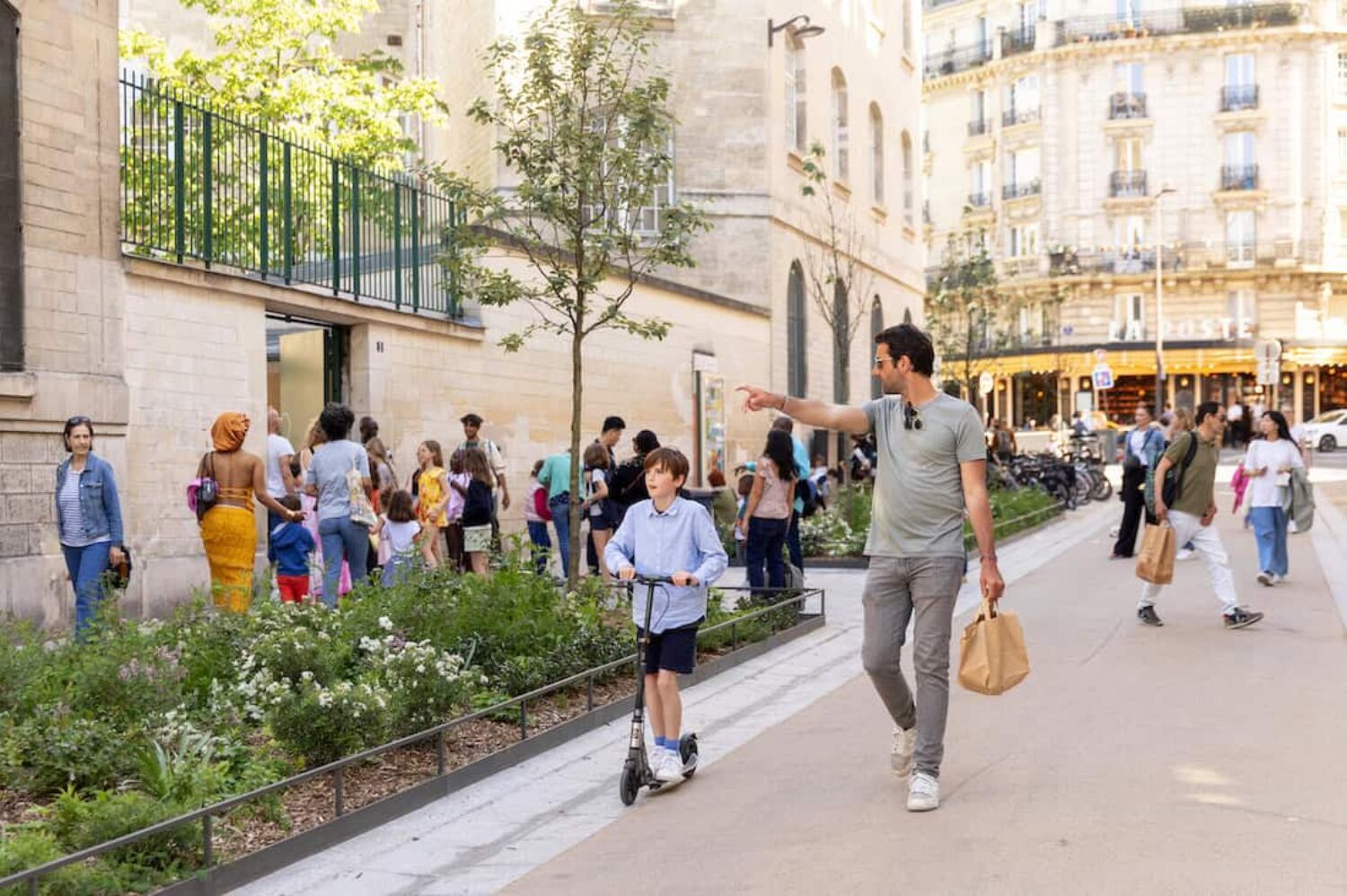

More than 300 school streets have been created in Paris, removing cars, planting trees and reclaiming public spaces outside schools. Image: Joséphine Brueder/Ville de Paris
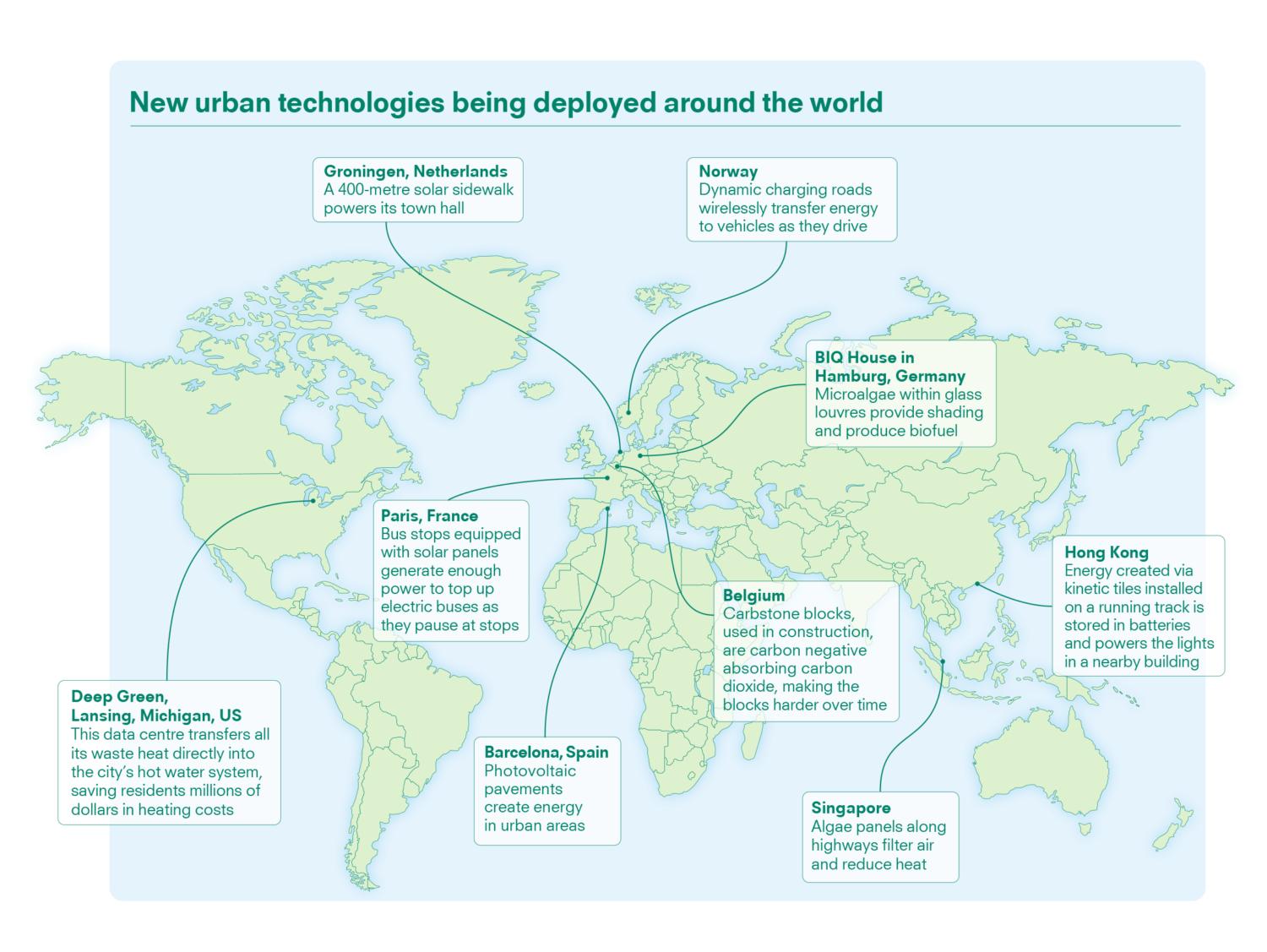
City evolution is not only about surface-level change. It is about the systems that keep everything running. Heat that once spewed wastefully from energy-hungry data centres is now captured and channelled into district heating. Public transport systems are electrifying at pace with dynamic charging roads, which wirelessly transfer energy to vehicles as they drive.
Solar-embedded infrastructure is moving from experiment to norm as the buildings of the future will not simply consume fewer resources they will generate and recycle them. Carbon-eating concrete and living-algae walls remove carbon from the air, while vertical forests and vertical farms clean air, regulate temperatures and, most importantly, produce much needed food.
Get spongy
None of this matters if cities cannot cope with water. By 2050, the number of properties in England exposed to fooding is projected to rise from 6.3m to 8m. Flash foods could increase by up to 66%. A climate-driven surge in short, violent rainstorms, combined with decades of paving over natural ground, has turned many cities into hard-shelled drainage machines. That model is failing. A new one is emerging in its place.
“Climate change brings us more extreme weather, and in this case, more extreme rain events within a very short period of time,” says Dutch architect Dirk van Peijpe of De Urbanisten. “We need to be ready for that kind of cloudburst that isn’t just increasing the capacity of our technical infrastructures, as so many cities have.”
Instead of pouring more money into deeper pipes and bigger sewers that will still be overwhelmed, van Peijpe argues for a shift in mindset. “Spend the same sums on creating a public space that can temporarily hold that rainwater,” he says. Because the water never mixes with sewage, it remains clean and usable.
It is combining water management in an urban environment with improving public spaces
“The rain water that we harvest from roofs and parking places and streets and squares around them… can be temporarily stored in this public space, and then, after 24 hours, the water square is emptied into the natural aquifers, in the soil infiltration, and you can actively use it again for other purposes,” he says.
Rotterdam has taken this thinking further than almost anywhere. The old port city, long accustomed to living with water rather than fighting it, has been getting spongier year by year. Across its neighbourhoods, hundreds of new water-absorbing parks, basins and nature-based defences have been completed or are underway. They look like everyday public spaces: skate bowls, sunken lawns, stepped amphitheatres, bright playgrounds. But they have a double life. In a cloudburst, they quietly swallow thousands of cubic metres of water. Some of the largest can hold around 1,700 cubic metres before slowly releasing it back into the ground, boosting groundwater rather than flushing it out to sea.
Van Peijpe has been central to this reimagining of the city. One of De Urbanisten’s flagship projects sits a short walk from the emerging Hofbogen park. “The water square is the first in the world that combined water storage with designing a fine public space,” he says. “It is combining water management in an urban environment with improving public spaces.”
In Rotterdam, the rain captured in the square is filtered, dropped into a closed aquifer system beneath the park, then used to feed vegetation and power fountains and streams. The city gets a public realm feature on dry days and a protective basin on wet ones.

That experimentation continues above street level. The disused Hofplein railway line is becoming an elevated linear park reminiscent of New York’s High Line. Here too, the water cycles through the network. Rain gathered on the roof level is cleaned and channelled back down into an aquifer to create a closed system for Hofbogen park. “The water system feeds the vegetation in the park with rainwater so we don’t need to waste drinking water for the plants,” van Peijpe says.
China – the pioneer in creating sponge cities– has rolled out projects nationwide, integrating wetlands, permeable pavements and green corridors. And New York is also taking note. The Department of Environmental Protection has begun installing seven miles of permeable pavement along curbs in the city’s Borough Park district, to allow water to seep rather than surge during storms.
Cities are evolving fast and are being forced to respond to the same pressures: climate, population, inequality, affordability and the need for healthier lives. It may well be that all new cities are built among forests with timber skylines and streets shaded by trees. Where food is grown vertically, and transport is silent and clean.
Whether it’s retrofitting the medieval cities of Europe with integrated smart tech or building a new city from the ground up, the future city is not a fantasy. It is already under construction. The only question is how quickly we choose to build it.
Additional reporting Alice Kantor and Gavin Haines
Illustration by Andrea Manzati
Be part of the solution
At Positive News, we’re not chasing clicks or profits for media moguls – we’re here to serve you and have a positive social impact. We can’t do this unless enough people like you choose to support our journalism.
Give once from just £1, or join 1,800+ others who contribute an average of £3 or more per month. Together, we can build a healthier form of media – one that focuses on solutions, progress and possibilities, and empowers people to create positive change.