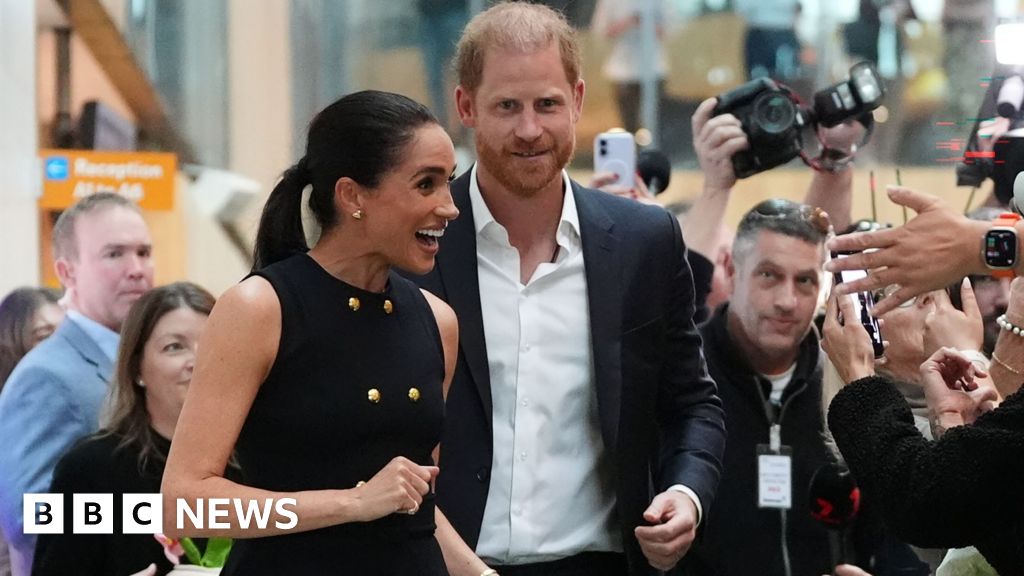


The Duke and Duchess of Sussex have arrived in Australia for a four-day tour that includes visits to charitable causes alongside private, money-making engagements.
After stepping down as working royals in January 2020 and giving up their His and Her Royal Highness (HRH) titles, the couple are visiting as private citizens and say that the trip is privately funded.
The visit includes meeting patients and medics at a children’s hospital, military veterans and their families, and survivors of family violence.
BBC News journalist Simon Atkinson explains how Harry and Meghan’s visit will be different compared to their last time in the country in 2018.
Former PM travels to frontline near Zaporizhzhia for ‘potentially life-threatening’ documentary
Former Prime Minister Boris Johnson has embarked upon a “potentially life-threatening” expedition for a new Channel 5 programme.
Advertisement
Boris Johnson: Into the ‘Kill Zone’ will show the 61-year-old undertaking “a deeply unofficial and secret assignment” as he journeys behind the frontline of the Russia/Ukraine conflict.
Revealing details about the documentary, the broadcaster stated Johnson visits shattered villages, a frontline chapel and a makeshift bomb factory and must take shelter during a missile attack, reports the Mirror.
A synopsis for the documentary from Soho Studios and Two Rivers Media states: “Quietly entering the country so as not to draw attention to himself, Boris travels beyond Kyiv in a 72-hour unprotected journey to the frontline ‘kill zone’ near Zaporizhzhia, where drones, artillery and the realities of modern warfare quickly replace diplomacy and political rhetoric.”
“Boris witnesses the realities of modern war at close range.”
It continues: “Embedded with Ukrainian soldiers, he visits shattered villages, a frontline chapel, secret drone bases and even a makeshift bomb factory hidden inside abandoned cottages, and shelters in an under-siege eighth story flat during a missile strike.”
The former PM also accompanies mobile gun teams and Kyiv’s volunteer air defenders for a “terrifying and freezing night shift protecting the capital from Russian drone attacks”.
Advertisement
He said: “The Ukrainians are fighting the same war, against the same drones, that are being sent against civilians by the same alliance of tyrannies. We have spent four years psalming platitudes and telling them that their fight is our fight.
“On the basis of what I have seen, we are risibly failing to live up to our pledges, and to give them the help they need.”
Guy Davies, consultant editor for commissioning at Channel 5, described how the politician “takes us on a traumatic and revelatory journey” throughout the programme.
Advertisement
“It is clearly a cause that is close to his heart and we see him in a new light – no longer looking at the war from the statesman’s perspective, away from the frontline, but in the trenches and more able to speak freely,” he added.
Soho Studios’ founder Ian Lamarra commented: “Seeing a recent British Prime Minister on the frontline of a conflict, with his life in genuine danger, is extremely powerful.”
Boris Johnson: Into the ‘Kill Zone’ is set to air on Channel 5.
Huntley died as a result of a blunt head injury, an inquest has heard.
The 52-year-old died in the Royal Victoria Infirmary in Newcastle on March 7 after he was attacked with a metal bar in a workshop at HMP Frankland in Durham on February 26, an inquest opening hearing was told.
The County Durham and Darlington Coroner Jeremy Chipperfield was sitting in Crook, County Durham, on Tuesday.
Advertisement
Listed under the name Ian Kevin Huntley, the inquest opening lasted less than five minutes.
Coroner’s officer Bradley King read a statement in which he said: “This 52-year-old male was born on January 31 in 1974 in Grimsby.
“His last employment status and occupation is recorded as being a prisoner.
“He resided at HMP Frankland.
Advertisement
“He died on March 7 2026 at the Royal Victoria Infirmary.
“I understand the circumstances to be that Mr Huntley was struck over the head multiple times by another prisoner with an object described as a metal bar.
“The assault left Mr Huntley with significant head injuries.”
Mr King said Home Office Pathologist Dr Jennifer Bolton conducted a post mortem on March 9 and gave the cause of death as “blunt head injury”.
Advertisement
Huntley’s body was formally identified on the day he died.
The inquest was told that a police investigation was under way and that Anthony Russell, 43, has been charged with murdering Huntley at the maximum security jail.
Mr Chipperfield adjourned the hearing until May 27 when there will have been an update in the criminal proceedings.
Russell will attend Newcastle Crown Court on April 24 for a pre-trial preparation hearing.
Advertisement
Huntley was serving a life sentence for the 2002 murders of 10-year-olds Holly Wells and Jessica Chapman.
The ex-school caretaker killed the best friends after they left a family barbecue to buy sweets in Soham, Cambridgeshire, on August 4 2002.
He dumped their bodies in a ditch 10 miles away.
They were not found for 13 days, despite a search involving hundreds of police.
Advertisement
At the time, Huntley lived with Maxine Carr, who was a teaching assistant at Holly and Jessica’s primary school.
He denied murdering the girls but was convicted after a trial at the Old Bailey in 2003. He was jailed for life with a recommended minimum term of 40 years.
Carr gave Huntley a false alibi and was jailed for 21 months for perverting the course of justice.
Medical comment provided by Dr Donald Grant, GP and Senior Clinical Advisor at The Independent Pharmacy.
It’s a tough feat, even for tough feet: the 42.2km course of a standard marathon is a challenge many runners aspire to beat.
More and more of us are reaching the impressive milestone. 2026′s Brighton Marathon, for instance, saw a record-breaking 14,000 finishers.
Generally, being able to complete the race is seen as a marker of amazing health. Certainly, exercise is great for us, and runners can be expected to live as many as 12 years longer than less active people.
Advertisement
But given that ultra-endurance running has been associated with GI issues, and that tendinopathy, stress fractures, and even a higher risk of kidney and heart issues can hit on race day, we asked GP Dr Donald Grant to share whether they’re overall good or bad for our health.
Is running a marathon good or bad for us?
Sure, the day itself can be tough – “The marathon itself places a significant amount of stress on the body, particularly on the heart, joints and muscles, and it’s not uncommon to see temporary inflammation, fatigue or minor injuries following the event”.
That’s especially true if you haven’t prepared well for the event. But the race is only one session in what is usually a multi-week programme.
Advertisement
“Many of the long-term health benefits actually stem from the training element, where continuous exercise helps improve cardiovascular well-being, strengthen muscles and support mental well-being,” said Dr Grant.
“For most people, these benefits will outweigh the short-term strain of the event itself, provided they train appropriately.
Sticking to a well-organised endurance training plan can “strengthen the heart and make it more efficient, reducing blood pressure.
“These adaptations are linked to a reduced risk of chronic conditions such as heart disease, stroke, and type 2 diabetes.”
Advertisement
So, while “The intense and repetitive strain placed on the body, particularly the joints, muscles, and connective tissues, can increase the likelihood of overuse injuries such as tendonitis and knee problems,” in general, “Running a marathon can be very good for your health when approached responsibly, but it can be harmful if undertaken without proper preparation and care.
“The difference lies in how well the demands of training and racing are balanced with recovery and overall lifestyle.”
When do the benefits of running max out?
Of course, you definitely don’t have to run a marathon to see health benefits.
Advertisement
Some research has suggested that the Goldilocks zone for maximum longevity is about two and a half hours of running per week (for reference, the average marathon finish time for UK women is about five hours, and obviously happens in one day).
“While running offers clear health benefits, these don’t necessarily continue to increase the longer or more intensely you train. Even moderate distance running is sufficient to improve cardiovascular fitness and overall well-being,” Dr Grant said.
“With extreme endurance events such as marathons, it could be said that benefits plateau and the risks of factors such as overuse injuries or fatigue may increase. It’s all about finding a balance that works for you.”
The cases include those of a man who punched and choked his former partner and a man who kicked, punched and struck his dog with the butt of his shotgun
14:25, 14 Apr 2026Updated 14:32, 14 Apr 2026
Advertisement
Three men who were due to appeal their prison sentences have had their cases adjourned due to the fuel protests.
The appeals were about to be called at the County Court in Antrim when defence counsel Neil Moore highlighted that if the appeals failed, the prison van could get stuck at Nutts Corner on its way to HMP Maghaberry.
“I am in no way prejudging your mindset,” he told Judge Sandra Crawford but added that “the roundabout at Nutts Corner, if not already closed, could be closed” by the time the cases are dealt with.
That meant if the appeals were unsuccessful, the prison staff and the defendants “would have the unenviable situation” of being stuck for an unknown length of time, the barrister told the court.
Advertisement
The three appeals against sentence included the case of a man who punched and choked his former partner, a man who kicked, punched and struck his dog with the butt of his shotgun and a third defendant who assaulted his partner and damaged her property.
Mr Moore said that having spoken to court staff and the prosecution, suggested dates had been identified for each of the cases to be slotted in.
Judge Crawford said, given that the situation over the fuel protests has “now crystallised,” she agreed with Mr Moore and adjourned the three cases.
Metropolitan Police raided a convenience store in Kilburn High Road, north London, last Tuesday as part of a week of action in Brent focusing on tackling theft, robbery and e-bike related crime.
Around 1,161 phones were seized as part of the raid, the force confirmed today, double the amount of phones initially suspected. The force had originally reported that hundreds were found in the store last week.
Four men, aged 22, 25, 34 and 63, were arrested on suspicion of handling stolen goods, possession of drugs and intent to supply.
Advertisement
More than a thousand phones were stacked on shelves (Metropolitan Police)
Bodycam footage of the raid showed a number of armed officers move through the shop towards the back of the store, where they used bolt cutters to unlock a door into a room where multiple shelves were stacked high with smartphones.
Police procured a warrant after intelligence led them to believe the venue was being used to supply Class B drugs.
Three of the suspects were released on bail, while one was released under investigation.

Inspector Yu Zhang, from the Met’s local policing team in Brent, said last Thursday that the force was not only targeting phone snatchers, but those who profit from the stolen devices.
The force is using new technology to tackle the crime wave (Metropolitan Police)
“We understand mobile phone theft remains a major concern for Londoners and that’s why we have worked hard to drive down offending,” Inspector Zhang said. “Seizures such as this show that we are not only targeting individual phone snatchers, but also those who handle and profit from stolen devices.
“Londoners deserve to feel safe and we are committed to relentlessly disrupting the organised criminal networks fuelling this crime”
Advertisement
The arrests come as fewer than one per cent of mobile phone thefts actually result in a charge, The Independent revealed in March via freedom of information request. Nearly nine in 10 cases were closed without a suspect being identified, with the Met Police closing 95 per cent of their investigations.
The force has said mobile phone theft offences dropped from 81,365 in 2024 to 71,391 last year across the capital as part of its focused crackdown on the crime.
Earlier this year, the force arrested 248 individuals and seized 770 stolen phones as part of four weeks’ worth of intensified activity to combat mobile phone theft across London.

Officers are using intelligence, drones and high-powered Sur-Ron electric bikes, to catch offenders and disrupt the stolen mobile phone market.
Some lovers try positions that they can’t handle – I’m referring to the bones of the wrist, of course. The phrase is a classic mnemonic used to remember the eight carpal (wrist) bones – scaphoid, lunate, triquetrum, pisiform, trapezium, trapezoid, capitate and hamate – whose initials form the memorable sentence.
One of the most curious features of anatomy education is that people often remember mnemonics for decades, long after the rest of their anatomical knowledge has faded. And it’s often the filthiest ones that work best.
These short phrases, rhymes or sentences – used to remember ordered lists of nerves, bones or arteries – have been a staple of anatomy teaching for generations. Some are harmlessly quirky. Others are decidedly less polite. What they share is an unusual staying power.
That persistence is not just a quirk of medical culture. It reveals something important about how learning works.
Advertisement
Anatomy requires understanding and applying the structure of the body. But it begins with something far less glamorous: learning a vast and specialised technical vocabulary. The online database Terminologia Anatomica lists around 7,500 standardised anatomical terms, a figure broadly similar to estimates of the active vocabulary used by fluent speakers in everyday language (often cited at 5,000-10,000 words).
Mnemonics emerged as a practical response to this challenge, helping students organise and retrieve unfamiliar terms while a deeper understanding of anatomical relationships develops. As generations of students have discovered, the more distinctive the phrase, the harder it is to forget.
Why the brain struggles with lists
Much of anatomy involves remembering sequences. The bones of the wrist, the branches of major arteries or the 12 cranial nerves must be recalled in a precise order. The problem is that the brain is not particularly well suited to remembering long lists of unfamiliar terms.
Working memory – the system that allows us to hold information temporarily in mind – has a limited capacity. When faced with a string of technical words, especially ones derived from Latin or Greek, it quickly becomes overloaded.
Advertisement
Mnemonics help solve this problem by converting a list into a structured phrase. Instead of remembering eight separate bones of the wrist, the learner remembers a single sentence whose first letters act as cues for each structure.
Chunking
This strategy is referred to as chunking – grouping several pieces of information into a single meaningful unit. Once the phrase itself has been learned, the brain can use it as a scaffold to reconstruct the original list.
It’s not new either. Renaissance students faced the same challenge of remembering large amounts of anatomical information, and they often relied on mnemonic techniques inherited from the classical ars memoriae, or “art of memory”.
Anatomical knowledge was sometimes taught through didactic Latin verse, making long lists easier to recall in an era when learning was largely oral. One example is the tradition of anatomia versificata, in which anatomical structures were described poetically so they could be memorised. Medical verses attributed to the 12th-13th century French physician Gilles de Corbeil circulated in universities for centuries.
Advertisement
Early printed medical works, such as physician Johannes de Ketham’s Fasciculus Medicinae (1491), also reflected this culture of structured memorisation, pairing text with striking anatomical illustrations to aid recall. Behind these approaches lay classical memory techniques described by writers such as Cicero and Quintilian, who encouraged learners to organise knowledge using vivid imagery and spatial mental maps – an approach that aligns remarkably well with the inherently spatial nature of anatomy itself.
But structure alone does not explain why certain mnemonics, particularly the slightly outrageous ones, tend to stay with us for years.
Why the rudest mnemonics are the most memorable
If mnemonics simply organised lists into manageable chunks, almost any tidy sentence would do. Yet the more outrageous or slightly inappropriate the mnemonic, the more firmly it tends to lodge in memory.
This phenomenon is known as the distinctiveness effect. Information that stands out from its surroundings is more likely to be remembered than material that blends into the background. In a lecture full of unfamiliar Latin terminology, an unexpected or risque phrase becomes instantly distinctive. It interrupts the steady flow of technical language and draws attention to itself.
Advertisement
Attention is the gateway to memory. Information that captures attention is processed more deeply by the brain and is therefore more likely to be stored.
The hip bones connected to the … something bone. Kues/Shutterstock.com
Humour adds another layer. When something makes us laugh, or even causes a moment of mild embarrassment, it activates emotional centres in the brain, including the amygdala, which plays a role in regulating how memories are consolidated. Emotionally marked information is often stored more strongly than neutral material.
There is also a social element. Mnemonics are often shared between students, repeated in revision sessions, and passed down through successive cohorts. The phrases become part of the informal folklore of medical education, remembered not just as words but as part of a shared experience.
Put these elements together – distinctiveness, humour, emotional reaction and social repetition – and it becomes clear why the slightly outrageous mnemonic tends to win out over its more respectable rivals.
Advertisement
Used well, these phrases act as scaffolding: temporary supports that help students organise unfamiliar vocabulary while a deeper three-dimensional understanding of the body gradually develops. In time, they become less necessary.
A critically acclaimed yet underappreciated crime-comedy gem from 2025 is now available to stream on Paramount+
Lucas Hill-Paul Content Editor
14:17, 14 Apr 2026
This truth-is-stranger-than-fiction crime-comedy has just landed on Paramount+ A critically lauded yet largely overlooked cinematic treasure from 2025 is now ready to stream.
Inspired by an extraordinary true story, the film was directed by Derek Cianfrance — the mastermind behind celebrated indie dramas such as Blue Valentine and The Place Beyond the Pines — with a major Hollywood name stepping into the lead role.
Advertisement
Channing Tatum (Magic Mike) plays Jeffrey Manchester, a struggling veteran and father who turns to a life of crime simply to keep his head above water.
Dubbed the ‘Roofman’ owing to his peculiar habit of breaking into fast food restaurants through the roof at night before robbing them in the morning, Jeffrey is apprehended at his daughter’s birthday party and handed a 45-year prison sentence, reports the Mirror.
He subsequently hatches an escape plan and successfully breaks into a Toys “R” Us store, where he manages to survive for some time on stolen M&Ms. Upon discovering that his ex-wife has cut off all contact, Jeffrey embarks on a tender yet deceitful relationship with one of the toy shop’s staff members, Leigh (portrayed by Kirsten Dunst).
Celebrated as one of the finest under-the-radar films of 2025, Roofman is now streaming on Paramount+ and is essential viewing for those who enjoy offbeat crime comedies and moving tragic romance.
One 10/10 IMDb review described it as “one of the biggest surprises of 2025”, stating: “This is a movie I went in with a good amount of expectations and the movie overdelivered in every way imaginable.
“I love how this movie takes real life events and put a comedic spin on the story and the filmmakers do it in a way that actually works. You also have a fantastic ensemble cast in the movie including Channing Tatum, Kirsten Dunst, Ben Mendelsohn, LaKeith Stanfield, Juno Temple, Melonie Diaz, Uzo Aduba, Lily Collias and Peter Dinklage who are all great.”
Another viewer hailed Roofman as an “unexpectedly pleasant experience”, confessing: “I was not interested in this movie but the reviews seemed decent so tried it out and I am glad that I made that decision. It is crazy that this movie is based on a true story. I am at a loss for words to describe all the emotional rollercoaster and ethical dilemma it caused throughout the movie.
“Crazy and suspenseful storyline aside, the acting by Channing Tatum and Kirsten Dunst was very well done and the chemistry between them made this movie even more credible and heart wrenching near the climax.
Get Paramount+ free for a week
Advertisement
This article contains affiliate links, we will receive a commission on any sales we generate from it. Learn more
Telly fans can get seven days of free access to Paramount+ shows like Tulsa King and Dexter: Original Sin by signing up for a free trial via Amazon Prime’s Paramount+ channel.
“This was unexpectedly an amazing movie and I really thank all the reviewers who helped me make my choice to go watch. What an experience. I am going to remember this one for a long time.”
Advertisement
A glowing write-up from a Rotten Tomatoes critic read: “Absolutely loved this movie. Channing Tatum was incredible, this movie kept me engaged from the jump! Also incredible that this is based off a true story! Very good!” A final enthusiast gushed: “Shocked by how much I liked this movie. I found it not just funnier but also more emotional than I was anticipating. Great film.”
The only thing more surprising than Bloodborne getting a movie is who one of the producers is (Sony)
A second FromSoftware movie adaptation is in the works, but it’s unclear how involved the developer actually is with its production.
It is shameful the way Bloodborne has been thoroughly ignored by Sony, since its 2015 launch on PlayStation 4. Despite calls for a PlayStation 5 remake, remaster, PC port, or just a simple update that bumps up the frame rate, Sony’s done nothing with Bloodborne in all that time.
Pitches for new Bloodborne projects, both internally and from other studios, were reportedly rejected, and it’s widely presumed this is because Sony doesn’t want to touch Bloodborne without developer FromSoftware’s approval.
So, it’s safe to say Bloodborne fans have been thrown for a loop now that Sony has casually announced it’s turning the game into a feature length movie.
Advertisement
The project was confirmed during Sony’s recent CinemaCon presentation, albeit with no trailer or promotional images. However, it will be an animated movie rather than live action and promises to be R-rated.
For context, an R-rating is one of the highest age ratings a movie can receive in the US and is reserved for movies with adult content that isn’t suited for anyone under the age of 17. So, the UK equivalent would be an age rating of 18.
Expert, exclusive gaming analysis
Sign up to the GameCentral newsletter for a unique take on the week in gaming, alongside the latest reviews and more. Delivered to your inbox every Saturday morning.
Advertisement
This is an early, positive sign considering anything less than that would mean Bloodborne’s gothic horror aesthetic, disturbing monster designs, and copious bloody violence would risk being watered down.
What’s far more surprising, though, is that Seán William McLoughlin, better known as Irish YouTuber Jacksepticeye, has been brought on as a producer.
Advertisement
Jacksepticeye has no special ties to FromSoftware, Sony, or Bloodborne itself, with his only real credential (besides being famous) being that he’s a big fan of the game.
However, his involvement is likely a response to the success of Iron Lung, another video game to movie adaptation, which was spearheaded by YouTuber Markiplier (in which Jacksepticeye makes a cameo).
Markiplier personally directed, wrote, and starred in Iron Lung whereas Jacksepticeye is only listed as a producer on the Bloodborne movie. Currently his only experience of moviemaking is a couple of short films.
Don’t miss Gaming news! Add us as a Preferred Source
As a loyal GameCentral reader, we want to make sure you never miss our articles when searching for gaming stories. We have all the latest video games news, reviews, previews, and interviews, with a vibrant community of highly engaged readers.
Advertisement
Click the button below and tick Metro.co.uk to ensure you see stories from us first in Google Search.
GameCentral has been delivering unique games news and reviews for over a decade
‘I am going to do everything in my power to make this the best Bloodborne adaptation possible. Not only is it my favourite game ever made but I know how truly passionate the fans of this game are and how much hunger they have for more of it,’ he wrote in a Reddit post.
Advertisement
The response from fans seems to be a mix of excitement and confusion, with plenty joking that it’s a late April Fools’ joke, as well as hope that this will be what finally leads to a remaster or remake.
We’d be far more interested to know how much involvement FromSoftware itself has with the movie as well as who is actually directing it, but nothing like that has been announced yet.
The live action Elden Ring movie is already looking promising based on the leaked set design, with director Alex Holland being a self-described fan of the original game. Although making a movie out of any From game, given their opaque storytelling, seems an inherently risky prospect.
And in any case, being authentic to the source material doesn’t guarantee a good film, as the The Super Mario Galaxy Movie ably proved.
Advertisement
Which movie are you most excited for? (Bandai Namco)
Some residents have said it now ‘doesn’t feel safe’ where they live
Locals have described the death of a 16-year-old boy as ‘chilling’. Floral tributes have been left at the scene where the teenager was reportedly attacked in Riseholme, Peterborough, at around 7pm on Sunday (April 12).
Advertisement
The 16-year-old boy was taken to hospital, where he later died. Cambridgeshire Police has said the stabbing is not believed to have been a “random attack”.
Tributes have been paid to the teenager, with flowers laid at the entrance to the Orton Shopping Centre. People who live opposite where the stabbing took place shared their reactions to the tragedy.
One woman, who wished to remain anonymous, first heard of the incident through one of her children’s friends. She said: “My teenager’s friend said something happened in Orton, but I didn’t know what.
“It’s so bad. I have teenagers and it’s not good. I feel it’s not safe [here] after what happened.” The woman said she was not allowed out of her home when a police cordon was in place on Monday (April 13). She added: “The police asked to look in my garden. I wasn’t allowed out – it felt like I was in jail.”
Advertisement
Nearby resident Jackie, who asked to use her first name only, said she heard “lots of sirens” on the night of the incident. She added: “I didn’t expect what happened to have happened.
”It’s so scary, especially being right on the doorstep. The poor boy that it happened to, I feel for his family. It feels less safe now that something like this has happened.”
One man, who asked to not be named, said the area is “getting worse”. He said: “There are always younger people hanging about near the centre and you don’t know what they are up to. Now something tragic has happened, something needs to be done about preventing something so bad happening again.”
Advertisement
Another woman, who wished to remain anonymous, said a “young life is lost just like that”. She added: “It’s so sad what happened. I have children near that age and now I don’t want to let them out. I don’t know what happened or how, but it’s a waste of a life. It’s chilling what happened.”
Officers arrested four people after Sunday’s incident. This involved a 15-year-old boy and 18-year-old man, both from Peterborough, on suspicion of murder. Police have asked for an extension to the custody limit for these two individuals so they can ask them more questions.
A 17-year-old girl from Peterborough was also arrested on suspicion of assisting an offender. She has been released on conditional bail until July 8.
A 16-year-old girl from March was also arrested on suspicion of assisting an offender and being in possession of a bladed article. She has been charged with possessing a knife/bladed article in a public place and is due to appear at Huntingdon Magistrates’ Court on May 13.
Advertisement
A post-mortem is due to take place for the 16-year-old boy who died at Peterborough City Hospital on Thursday (April 15). He has not yet been formally identified, according to the police.
Cambridgeshire Police is still appealing for information. Anyone with information should report it online or call 101 and quote Operation Whitby.
What is salmon DNA, and how is it delivered through skincare?
In skincare, “salmon DNA” refers to fragments of genetic material extracted from salmon — specifically a compound known as PDRN (polydeoxyribonucleotide), which has been researched for its skin-repairing and regenerative benefits.
Known for its ability to calm inflammation, support barrier repair and improve skin texture over time, PDRN is used in skin-rejuvenating treatments, from everything from injectables to serums and creams.
Advertisement
According to Dr Sonia Khorana, “From a clinical perspective, I think PDRN is an interesting and promising regenerative treatment. It can be a valuable option for patients looking to improve skin quality subtly.”
Is PDRN skincare safe?
Yes, both PDRN injections (polynucleotides) and skincare are safe. Even with the injections — because it’s highly purified and biocompatible, the risk of adverse reactions is low,” says Dr Khorana. “Although, as with any injectable treatment, there is always a small risk of bruising, swelling or infection.”
Are the treatments or skincare painful? Is there any downtime?
Advertisement
Downtime with PDRN (polydeoxyribonucleotide) depends on how it’s used — whether in at-home topical skincare or as part of an in-clinic treatment such as injections or microneedling.
When applied topically, there’s no downtime to consider. These formulas are designed for daily use, helping to boost hydration and support the skin barrier without triggering irritation. They’re often incorporated into routines to help skin recover after more intensive treatments.
Dr Khorana adds that downtime for treatments is also minimal: “A few days if you end up with a bruise”.
“You may see some small bumps, redness or slight swelling immediately after treatment, but this typically settles within 24-48 hours. Most people are able to return to normal activities the following day. As always, patient selection and practitioner experience are key to ensuring both safety and good results.”
Advertisement
But she advises that with less pain/downtime comes fewer results: “In skincare, PDRN works more superficially — so while it can help with hydration, smoothness and subtle radiance, it won’t deliver the same regenerative effects as in-clinic treatments.”
Are there any risks/things to be aware of?
Injectable PDRN can cause temporary side effects such as redness, swelling, bruising or small bumps at the injection sites. As is common with these types of treatments, there is also a small risk of infection or irritation if not performed in an appropriate clinical setting.
For topical skincare, risks are much more minimal — the potential for mild irritation or sensitivity, particularly in very reactive skin types.
Advertisement
Dr Khorana says that an important thing to flag would be people with fish allergies. “I’m not sure of the purification process for topical PDRN and whether the allergen protein is removed.
“When I do polynucleotide injections in clinic, I don’t worry about fish allergies because I know the protein causing the allergy has been removed when they purify it, and these injections are classed as medical devices as CE marked.”
She recommends proceeding with caution here, as “the topical PDRN versions are not medical devices, it will depend on the brand/labs whether they remove the protein.”
How quickly do you see results, and how long do they last?
Advertisement
One of the things to understand about PDRN is that results are gradual rather than instant.
Dr Khorana notes that injectable treatments require a course of three to four sessions, spaced at two to three weeks apart. Results are then usually seen around three months after starting the treatment plan, and typically last around six to 12 months after the full course has been administered.
For skincare, the effects are more subtle, with noticeable benefits including improved hydration and smoother skin in as little as a few weeks. However, Dr Khorana tells me that consistency is also key — and that this can vary depending on factors like age, skin quality and lifestyle
How does PDRN differ from Botox or filler?
Advertisement
Dr Khorana says: “PDRN works very differently from treatments like Botox or dermal fillers, and it’s important not to think of them as interchangeable.
Botox works by relaxing muscles to reduce the appearance of dynamic lines, while fillers aim to restore volume and structure. PDRN is a regenerative treatment that focuses on improving the quality of the skin by supporting repair, hydration and collagen production.”
She stresses that in practice, all these treatments work really well together, and it’s a common aesthetic plan.
You must be logged in to post a comment Login