

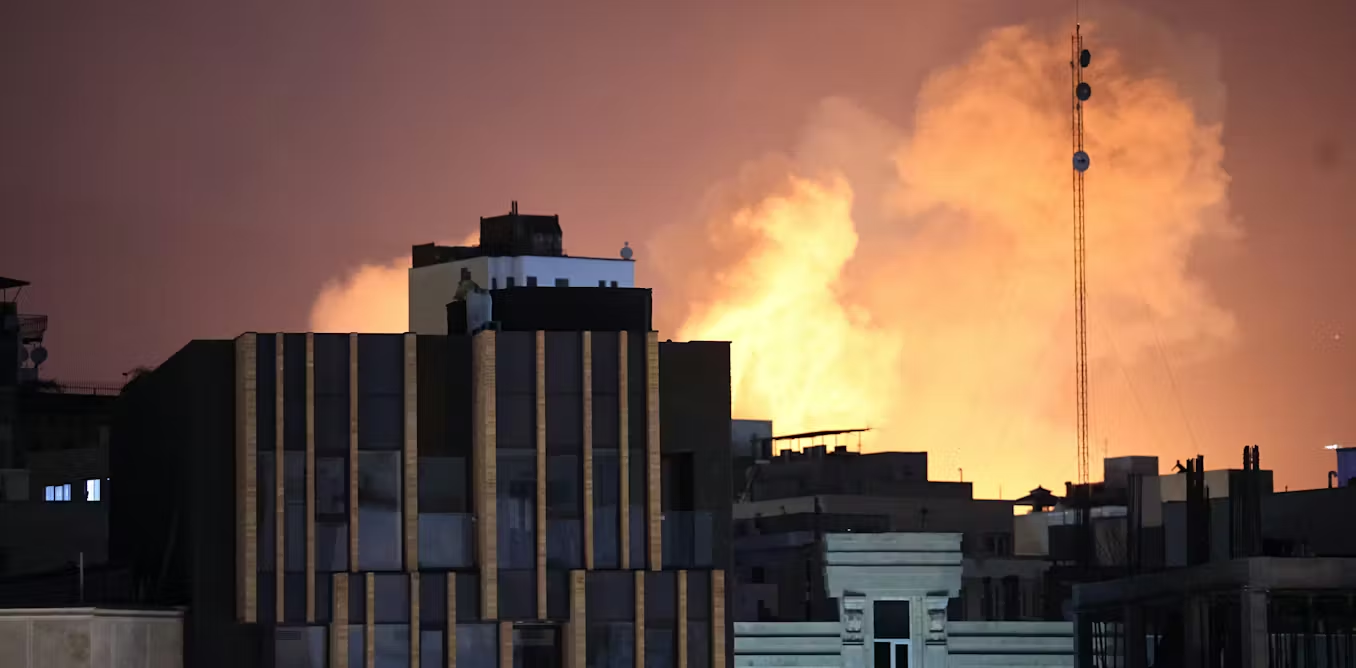
When US and Israeli forces launched airstrikes on Iran, the shock waves were felt far beyond the region. As the conflict escalates, understanding who benefits from this crisis might be as important as counting its costs.
The timing could hardly be worse for the UK economy. Official forecasts for GDP growth in 2026 had already been downgraded to 1.1% before a single missile was fired. Predictions that inflation might dip now look optimistic; and expectations of an interest rate cut on March 19 have fallen sharply.
The energy shock is immediate. Tanker traffic in the strait of Hormuz has fallen by around 90%. Qatar, the world’s second largest exporter of liquefied natural gas, halted production indefinitely. Although the UK sources little gas directly from the Gulf, energy markets are global so UK households could see more than £500 added to their annual bills.
Beyond energy, UK stocks have fallen, the pound has come under pressure and the UK government’s £23.6 billion fiscal headroom could erode rapidly.
For defence stocks, however, the picture is different. London-based BAE Systems surged around 6% on the first day of the conflict. And the American defence industry seems determined to quadruple production of some weapons.
Peace benefits ordinary citizens, small businesses, global supply chains and the planet’s climate trajectory. The beneficiaries of war are more concentrated.
One of the most uncomfortable truths about this conflict is that while it inflicts pain on some, it creates windfalls for others. In my co-authored research, we call this the “paradox of incentives”. Determining who benefits is essential to understanding why wars persist long after it may seem rational to stop.
Defence contractors and the arms economy
On Wall Street, defence firms including Lockheed Martin, Northrop Grumman and RTX rose between 4% and 6% on the first day of the strikes. The three firms’ combined shareholder gain on that one day was US$25–30 billion (£18.7-£22.5 billion).
In Israel, Elbit Systems briefly became the country’s most valuable listed company, with its shares up 45% since January. In Europe and the UK, defence stocks surged against a falling FTSE 100.
The rally ‘round the flag effect
Wars may also be good for incumbent politicians in the short term. Before the strikes began, the fallout from the release of the Epstein files was reverberating globally, and piling scrutiny on to many with connections to the White House. Within hours of the first strikes, web searches for the Epstein files collapsed.
But perhaps the most counterintuitive application of the paradox concerns Iran itself. The Islamic Revolutionary Guard Corps (IRGC) controls up to half of Iran’s oil exports. Its engineering arm, Khatam al-Anbiya, has become one of the largest contractors in the country, controlling construction, telecoms, agriculture and energy.
Economic sanctions designed to weaken Tehran have actually entrenched the power structures they were meant to erode. As foreign firms exited and domestic companies struggled, IRGC-linked entities used access to informal trade routes, currency controls and security networks to expand their dominance.
At the same time, according to the World Bank, close to 10 million ordinary Iranians fell into poverty between 2011 and 2020 as the sanctions tightened.
The energy windfall
The oil and gas price shock is already providing a windfall in unexpected places. The US could benefit as Europe’s reliance on American energy exports, accelerated by the Ukraine war, grows even more.
For the Gulf petrostates, the picture is nuanced. Saudi Arabia and the UAE together hold a huge share of the world’s spare production capacity. They face real costs from the conflict, but their exposure to the Hormuz closure is lower than neighbours Kuwait, Qatar and Iraq. Both countries built bypass pipelines specifically to export oil without transitting the Strait.
And for Russia, the war diverts price-sensitive buyers such as India and China away from competing suppliers in the Gulf.
The green transition
Higher oil and gas prices make new fossil fuel extraction more commercially attractive. The same crisis that bolsters the case for renewables also makes fossil fuels more profitable. This could slow the transition by redirecting attention back towards oil and gas.
Irene Miller/Shutterstock
In our research, we argue that breaking the paradox of incentives is possible. But it would require the financial interests of powerful actors like those mentioned above to become aligned with solutions. In the context of this conflict, that principle points towards four routes.
The first would be a windfall tax on companies benefiting exceptionally from wars. The UK already has a precedent: its energy profits levy hits oil and gas profits above a set threshold until 2030. Although this levy has come under fire recently, there is a strong case for extending its principles to defence contractors whose share prices and profits surge during conflicts.
For oil-producing nations, a release of emergency stocks coordinated by the International Energy Agency (IEA) could cap price spikes. This happened in 2022 when IEA member countries released 60 million barrels from strategic reserves. The G7 nations have now said they “stand ready” to do this.
On the political side, democratic accountability, independent economic institutions and a free press all narrow the window within which leaders can exploit wartime popularity. These things can’t always be changed from the outside however, and underline the need for robust domestic institutions.
The green transition paradox is perhaps the hardest to address in the short term, but it is also where the fix is clearest. It has been argued that the more dependent economies become on the profits of war through arms exports, fossil fuel revenues or defence procurement, the harder it becomes to divert funding and attention to climate issues.
The solution is not to stop countries defending themselves – but to ensure that the transition to a green and secure energy system proceeds, precisely because of crises like this one.
The costs of this war are already being counted in energy markets. Before long, they will show up in national and household budgets. What makes this crisis particularly hard to resolve is the paradox at its heart: the actors best placed to end it are among those with the most to gain from its continuation.




















































You must be logged in to post a comment Login