A week of attacks on Iran and the killing of its supreme leader and senior commanders have plunged Iran into crisis – who’s in charge now and who could take his place?
Which senior leaders have died?
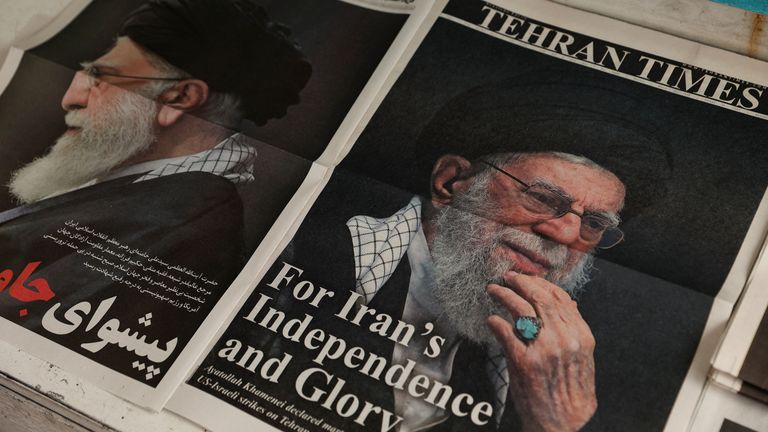
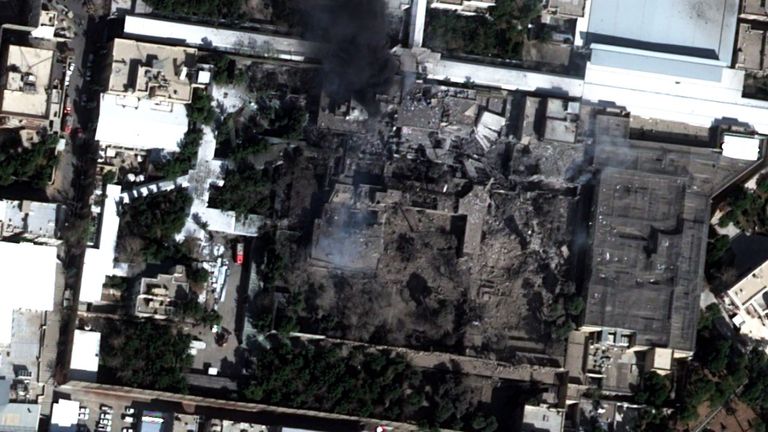
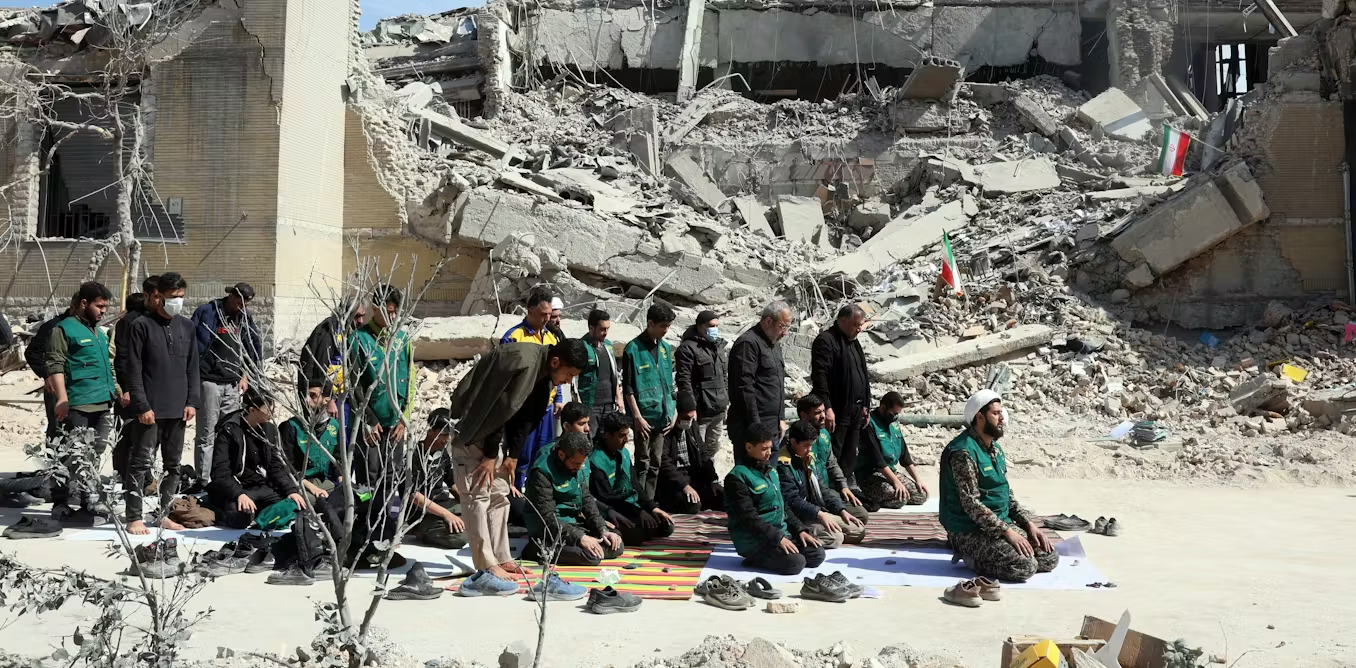
Ayatollah Ali Khamenei was the prize target and an Israeli strike on the first day of the war obliterated his Tehran compound, killing him and members of his family.
The 86-year-old had been in power for 37 years after taking over from the regime’s founder in 1989.
He had final say in all matters of state – above the country’s president – and led a system that brutally supressed public dissent and killed its own people.
Israel claimed 40 top military commanders were eliminated in the early airstrikes.
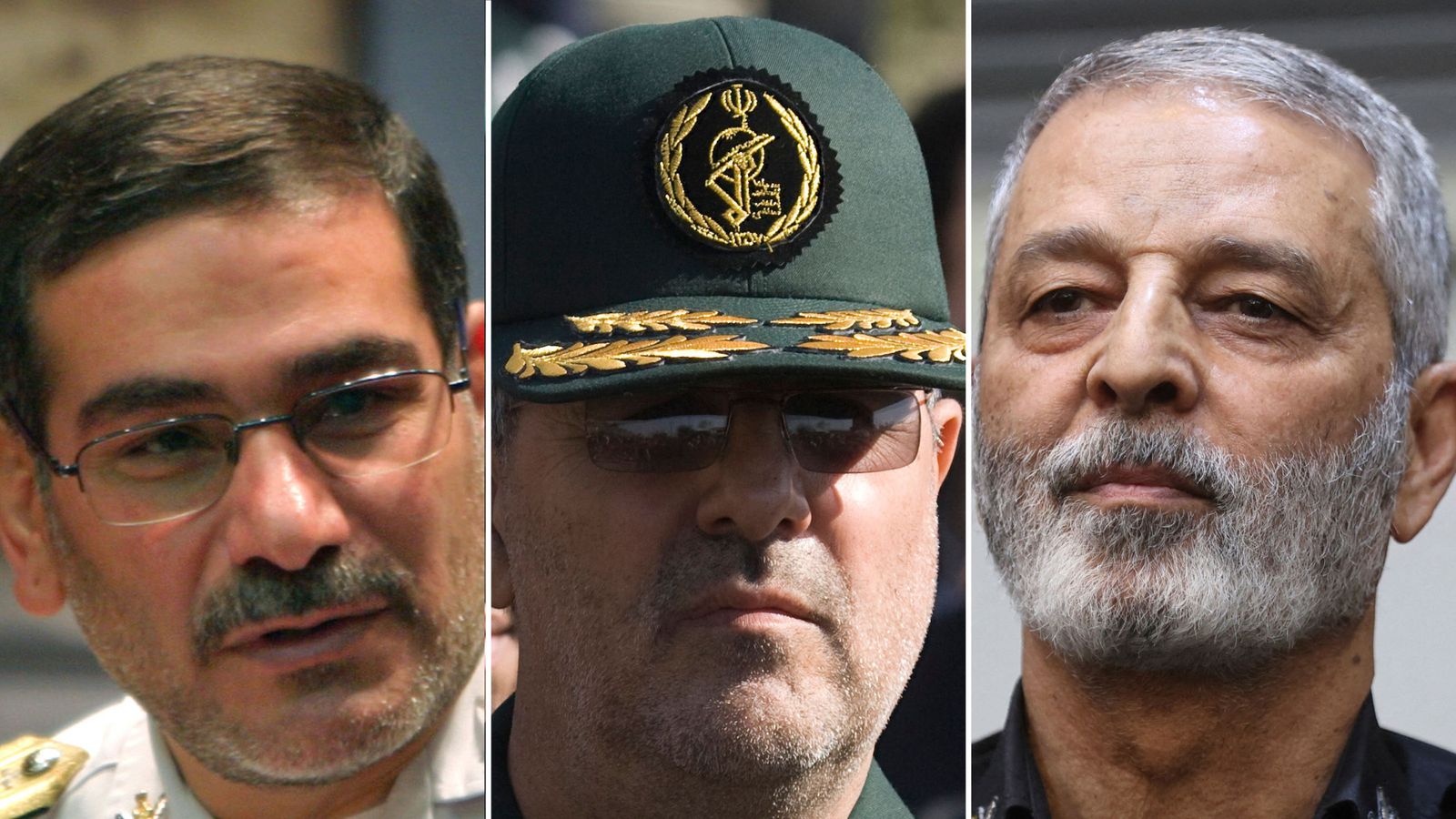
Image: Clockwise from top left: Mohammad Pakpour, Aziz Nasirzadeh, Abdolrahim Mousavi, Ali Shamkhani. Pics: Reuters
Among them are said to be armed forces chief of staff General Abdolrahim Mousavi and defence minister General Aziz Nasirzadeh.
Advertisement
Also reportedly killed was the head of the powerful Islamic Revolutionary Guard Corps (IRGC), Major General Mohammad Pakpour.
Image: Ayatollah Khamenei was killed when his compound was hit from the air (below)
Pakpour had only been in the job since June, when he replaced Hossein Salami after he was killed in the 12-day war between Israel and Iranin June 2025.
Ali Shamkhani, a top security adviser to Khamenei, also died in airstrikes, according to Israel. He had been overseeing the recent negotiations with the US over Iran’s nuclear and missile programme.
Who’s in charge now?
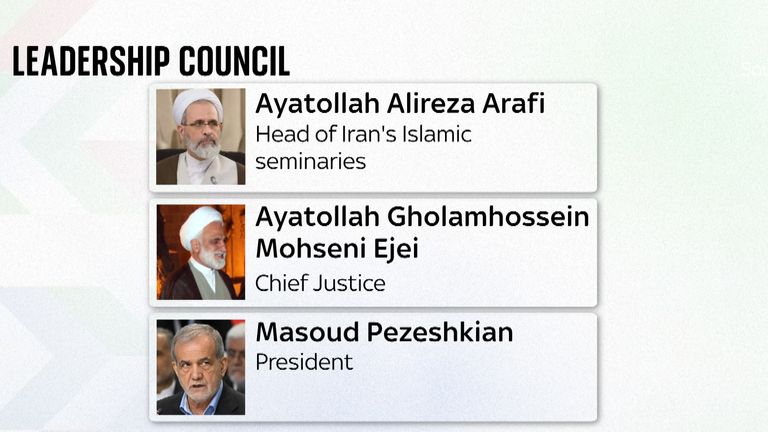
A three-person leadership council has temporarily assumed the duties of supreme leader, in line with Islamic Republic law.
Advertisement
It comprises Iranian President Masoud Pezeshkian, head of the judiciary and former intelligence minister Gholam-Hossein Mohseni-Ejei, and Ayatollah Alireza Arafi, head of Iran’s seminaries.
Ali Larijani, national security council secretary and top adviser to the slain supreme leader, is also likely to be playing a key role.
Following the US-Israeli airstrikes, he said on social media that Iran would not negotiate with US President Donald Trump and accused him of “delusional ambitions”.
Who chooses the new supreme leader?
An 88-member panel called the assembly of experts is deciding who will take over – although Mr Trump has said he also wants a say.
Advertisement
The panel is made up of Shia clerics whose candidacies are approved by Iran’s constitutional watchdog.
Advertisement
Iran ‘waiting’ for US ground invasion – foreign minister
One member, Ayatollah Ahmad Khatami, told state TV the candidates had been identified but did not publicly name them.
Under the country’s law, the selection process must happen as soon as possible – and a decision is believed to be imminent.
Advertisement
The announcement could be withheld until the assembly is assured the new supreme leader is as safe, as far as possible, from enemy attacks.
Israel has promised to hunt down whoever is chosen.
Mr Trump has said he now wants to select the new Iranian leader – in a similar way in which a president sympathetic to the US was recently installed in Venezuela.
“We’re going to have to choose that person along with Iran,” he told the Reuters news agency
Advertisement
Who’s favourite to take over?
The supreme leader must be a senior figure with political and religious authority.
Khamenei’s power was often wielded through close advisers but it is unclear how many survived, and he was never publicly recorded as naming a successor.
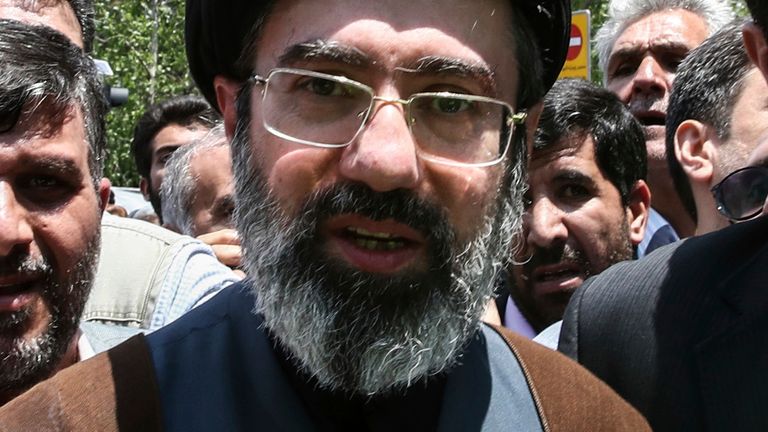
Image: Mojtaba Khamenei (pictured in 2019) could follow in his father’s footsteps. File pic: AP
His son, Mojtaba Khamenei, is strongly believed to be the frontrunner and has long been tipped as potential successor.
He fought for a battalion of the IRGC in the Iran-Iraq War in the 1980s and he’s still believed to have close links to it.
Advertisement
The 56-year-old has great influence within Iran internally, despite being only a mid-ranking cleric and having never held government office.
A US diplomatic document disclosed by WikiLeaks in 2008 described him as “principal gatekeeper” to his father and “the power behind the robes”.
Trump rates war ’15 out of 10′
Hassan Khomeini – the grandson of the first supreme leader and founder of the republic Ayatollah Khomeini – is also believed to be a candidate.
Advertisement
However, his support for the reformist faction that’s been sidelined in recent decades makes him a less likely pick.
Ayatollah Alireza Arafi, one of the three on the temporary ruling council, is also thought to be under consideration.
He called it the “single greatest chance for the Iranian people to take back their country”.
Mr Trump claimed many in the IRGC, military and police forces “no longer want to fight”.
Kurds preparing to fight in Iran
However, the feared IRGC still appears to have stayed loyal and there so far appears to be no signs of further popular uprisings on the streets.
Advertisement
Many experts say airstrikes alone cannot force a change and that a ground force would be needed.
Kurdish forces in neighbouring Iraq have told Sky News they are desperate to get involved but would need more support from the US to pave the way.
Before the Iranian revolution, Iran was ruled by a monarchy, with the king called the “shah”.
Reza Pahlavi, the US-based son of the shah who was deposed in the 1979 revolution, has said: “With [Khamenei’s] death, the Islamic Republic has in effect reached its end and will very soon be consigned to the dustbin of history.”
Chilling chimp kills it in lean, mean flick that, thankfully, opts for practical costume and effects.
Think Cujo with a chimpanzee instead of a St Bernard dog and a pool in place of a car and you get Primate.
Advertisement
The latest horror from English director Johannes Roberts (The Strangers: Prey at Night, Resident Evil: Welcome to Raccoon City) sees a group of friends’ tropical vacation turning into a terrifying fight for survival when adopted chimp Ben (Miguel Torres Umba) contracts rabies.
Primate is one of the best animal attack flicks to come along in quite some time.
It’s short and simple but shines with its taut tension and gnarly kills.
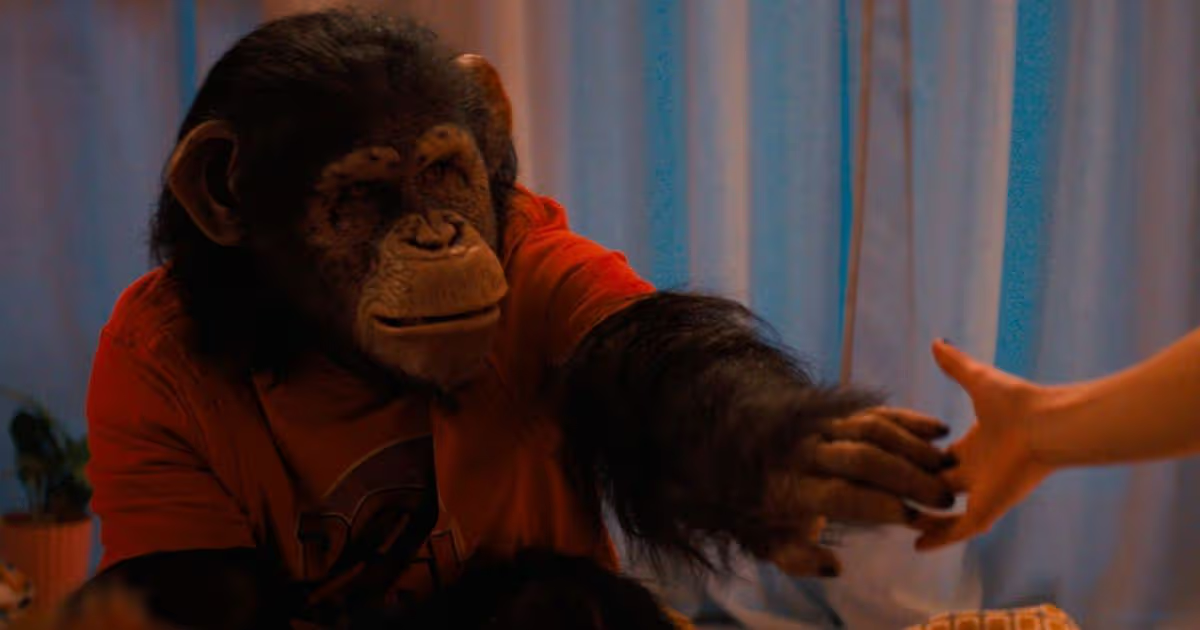
Roberts bathes his film in vibrant visuals, including several close-ups of an increasingly stricken Ben, peaking with a twisted bedroom scene that sees Ben surrounded by devilish red lighting.
Advertisement
Some of the characters are throwaway fodder – Jess Alexander’s vapid Hannah and Benjamin Cheng’s object of affection Nick – but a nice bond is established between sisters Lucy (Johnny Sequoyah) and Erin (Gia Hunter) and Ben.
Oscar winner Troy Kotsur also projects more with facial expressions and actions than many actors could with hundreds of lines of dialogue as Lucy and Erin’s deaf dad Adam.
The real revelation, though, is Umba who portrays Ben while wearing a practical suit; he’s every bit as convincing as a chimp than anything we’ve seen from motion-capture king Andy Serkis.
Practicality, thankfully, rules the day across the board, which leads to several memorable kills.
Ben shows no mercy as he punches, bites, scratches and tears his way through his stricken victims; bones break, flesh is ripped and blood spatters everywhere.
And rarely will an electronic soundboard evoke this much dread.
Yes, the lead group make a couple of dumb decisions, but they also show bursts of ingenuity amid a perfect pace that never misses a beat.
Advertisement
Primate is lean and mean with the most chilling chimp I’ve seen since the childhood nightmare fuel of 1991 TV mini-series Chimera (if you know, you know).
● Do you have a favourite animal attack horror flick?
Pop me an email at ian.bunting@reachplc.com and I will pass on your comments – and any movie or TV show recommendations you have – to your fellow readers.
● Primate is showing in cinemas now.
Advertisement
*Don’t miss the latest headlines from around Lanarkshire. Sign up to our newsletters here.
And did you know Lanarkshire Live had its own app? Download yours for free here.
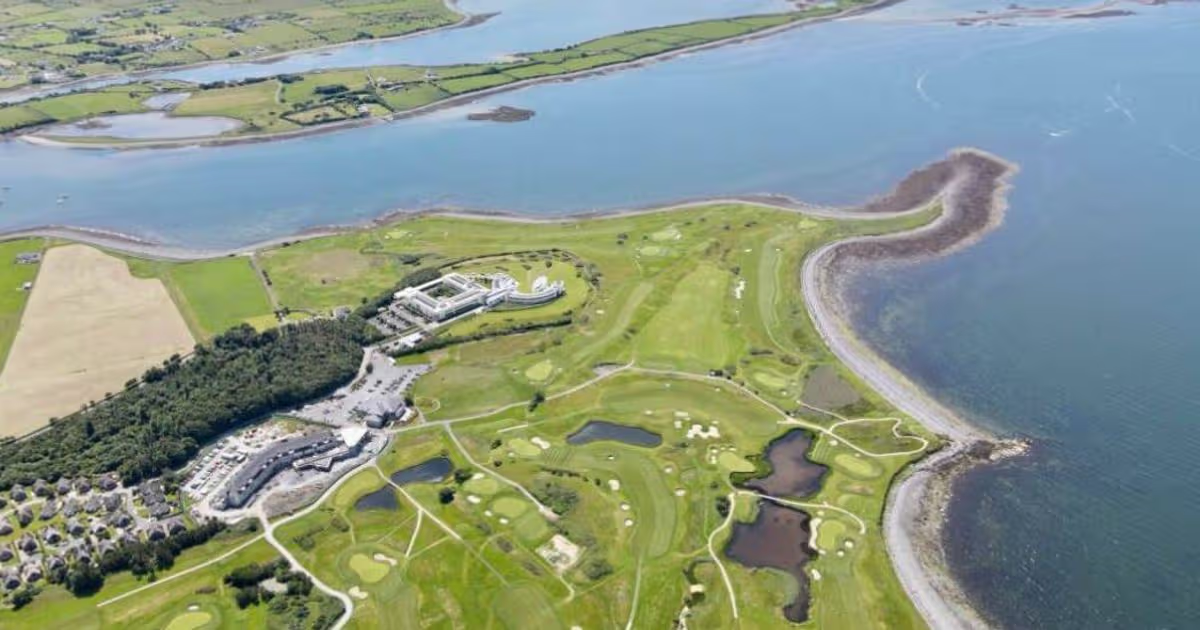
The Hawthorn, set on a Christy O’Connor Jnr course, features 114 rooms, signature restaurant The Skylark, and a full-service spa.
A luxurious new Irish 5-star golf hotel is scheduled to welcome guests in May 2026, spearheaded by the Connacht Hospitality Group as part of a broader €60 million development.
Advertisement
The Hawthorn by Galway Bay, situated within the grounds of the 18-hole Galway Bay Golf Course, features 114 rooms, a signature restaurant called The Skylark, and a comprehensive spa facility.
It marks the first five-star establishment to launch in Galway in over 20 years and aims to blend championship golf, holistic wellness and regional attractions.
With major events including the Open at Portrush and the Ryder Cup scheduled at Adare Manor in 2027, golf tourism across the island of Ireland serves as a significant economic contributor, generating over €700 million each year.
More than 220,000 international golfers arrive annually, with North American visitors, who typically spend three times more than standard tourists, representing the bulk of the market. The industry sustains 15,600 jobs, reports the Irish Mirror.
Advertisement
The May opening will realise a longstanding ambition of Irish Ryder Cup legend Christy O’Connor Jnr to establish the location as a world-class golf destination. The Galway-born former European Tour professional designed the original Galway Bay course that first welcomed players at the scenic site in 1993.
Targeting both domestic and international golfers, the golf hotel sits along the Wild Atlantic Way between north and south. The course has also received recent investment, including a complete bunker regeneration project.
Dean Montgomery, the venue’s director of golf, commented: “The golf course here has always had remarkable natural potential, and it is a privilege to be overseeing its next chapter. Our focus is on elevating the holistic golf experience whilst respecting Christy O’Connor Jnr’s original vision for the site.
Advertisement
“The course offers a compelling challenge for international visitors, and the opening of The Hawthorn will provide luxury-seekers with the perfect base to explore this wonderful destination.”
The Hawthorn also features The Oystercatcher Bar, serving Japanese cuisine alongside sweeping views across the championship course and Galway Bay.
Additional amenities include their own chocolatier at the Chocolate Nest, plus a Whiskey Room and Wine Cellar, tailored for curated tastings and private gatherings.
“As we approach our May opening, there is a real sense of excitement within the team as we prepare to welcome guests to this extraordinary destination,” said Hawthorn General Manager John Keating.
Advertisement
Prospective guests can reserve their stay now, with availability commencing from 15th May 2026.
Want to see more of the stories you love from Belfast Live?Making us your preferred source on Googlemeans you’ll get more of our exclusives, top stories and must-read content straight away. To add Belfast Live as a preferred source, simplyclick here.
From brutal crackdowns on nationwide protests in January, to Israel and the United States’ recent strikes, Iran has been in the international spotlight for weeks. Reporting on Iran is challenging, both from inside the country and from outside. During periods of unrest and political turmoil, it becomes even harder and more restrictive.
Iran’s media landscape is divided between outlets closely affiliated with the state and those considered reformist. State-aligned outlets include organisations such as Islamic Republic of Iran Broadcasting (IRIB), Tasnim, Fars News and Mehr News.
These conservative outlets often promote narratives that support Iran’s ruling clerical establishment. Their coverage frequently aligns with the views of hardline leaders such as the supreme leader Ali Khamenei, who was killed in the initial strikes on February 28. Other state-affiliated outlets, including Mizan, which is linked to Iran’s judiciary, similarly publish coverage that portrays the Islamic Republic as the victim of foreign aggression in the current conflict.
There is also a smaller group of reformist publications, such as Shargh Daily, Ham-Mihan and Donya-e-Eqtesad, which tend to offer more analytical and critical coverage of political and economic issues in the country.
Advertisement
But reformist papers operate under constant pressure. During the height of the protests in early January, Iranian authorities imposed a severe internet shutdown and communications blackout. Many domestic news outlets became inaccessible online. A small number of hardline outlets, such as Fars and Tasnim, continued to distribute information through Telegram channels.
For more than two weeks, much of the information emerging from Iran downplayed the scale of the government’s crackdown on protesters. Instead, official narratives emphasised alleged foreign interference, blaming the unrest on the US and Israel.
Reformist outlets that challenge this narrative often face retaliation. Journalists are frequently arrested and newspapers are suspended or closed. The authorities shut down Ham-Mihan in January 2026 after its editor-in-chief published an opinion piece reflecting on the current political unrest and the 1979 revolution that ended the monarchy.
These restrictions mean that state-aligned media outlets often dominate the narrative out of Iran, shaping how events inside the country are presented to the outside world.
Advertisement
Challenges for international media
International media organisations face a different but equally complex set of obstacles. Foreign journalists have a limited presence inside Iran, largely because of the risks involved.
Several reporters working for major outlets such as The Washington Post and The New York Times have been detained by Iranian authorities in the past, creating a climate of caution among international news organisations.
As a result, only a small number of outlets maintain reporters in the country. Organisations such as the Financial Times and Al Jazeera have limited representation on the ground, while many others operate regional bureaus in Turkey or the United Arab Emirates. Agencies such as Reuters, Bloomberg, CNN and CNBC often rely on these regional hubs, while others report on Iran from Europe or North America.
Even from outside, gathering reliable information remains difficult. Many sources inside Iran are afraid to speak with foreign media, as authorities routinely intimidate or arrest individuals who communicate with international journalists. Government officials are also reluctant to speak with foreign reporters.
Advertisement
Internet shutdowns during protests and wartime further complicate reporting. With communications frequently restricted, journalists must rely on information from human rights organisations, activist networks and official social media accounts.
A man looks at copies of Iranian daily newspapers reporting about talks between Iran and the US in February. Abedin Taherkenareh/EPA-EFE
Diaspora media organisations, which operate outside Iran but broadcast and publish in Persian, play a crucial role in filling some of the gaps in information. These outlets reach audiences both inside and outside the country. Examples include Iran International, BBC Persian, IranWire, Manoto and Voice of America. Though Voice of America was defunded and taken down by the Trump administration, its Persian-speaking news is still operating and providing news from the US to the public. However, it has been accused by some of its staffers of censoring coverage of Iran’s exiled crown prince, Reza Pahlavi, who has emerged as the leading opposition figure during the latest uprising.
Pahlavi frequently appears on other disapora outlets, which provide a platform for opposition voices that rarely appear in Iran’s domestic media unless to be discredited.
Because they maintain extensive networks of sources inside Iran, diaspora outlets are often among the first to receive videos, images and eyewitness accounts of protests or military activity. After verification, this material is frequently used by international media organisations such as The New York Times, CNN and BBC World.
Advertisement
They also report more on the nuances that may be less obvious to foreign journalists, such as how Iranians feel about the war or the death of the supreme leader. While international outlets focused on those mourning the death of Ayatollah Ali Khamenei, the reality is that many ordinary Iranians were celebrating.
Whether working for reformist newspapers inside Iran, international news organisations abroad or diaspora media outlets, journalists covering the country face extraordinary pressures. Many are subjected to hacking attempts, online harassment and, in some cases, physical threats. The work is emotionally demanding, particularly for Iranian journalists who are reporting on events impacting their own country, communities and families.
The cheapest spots for petrol and diesel in Northern Ireland have been revealed amid price rises exacerbated by conflict in the Middle East. The Consumer Council’s Fuel Price Checker, which is updated every Thursday, shows the latest impact this is having here.
It comes as Israel and the US launched attacks on the Iranian capital and other parts of the country last weekend, with Iran retaliating against US personnel across the Middle East.
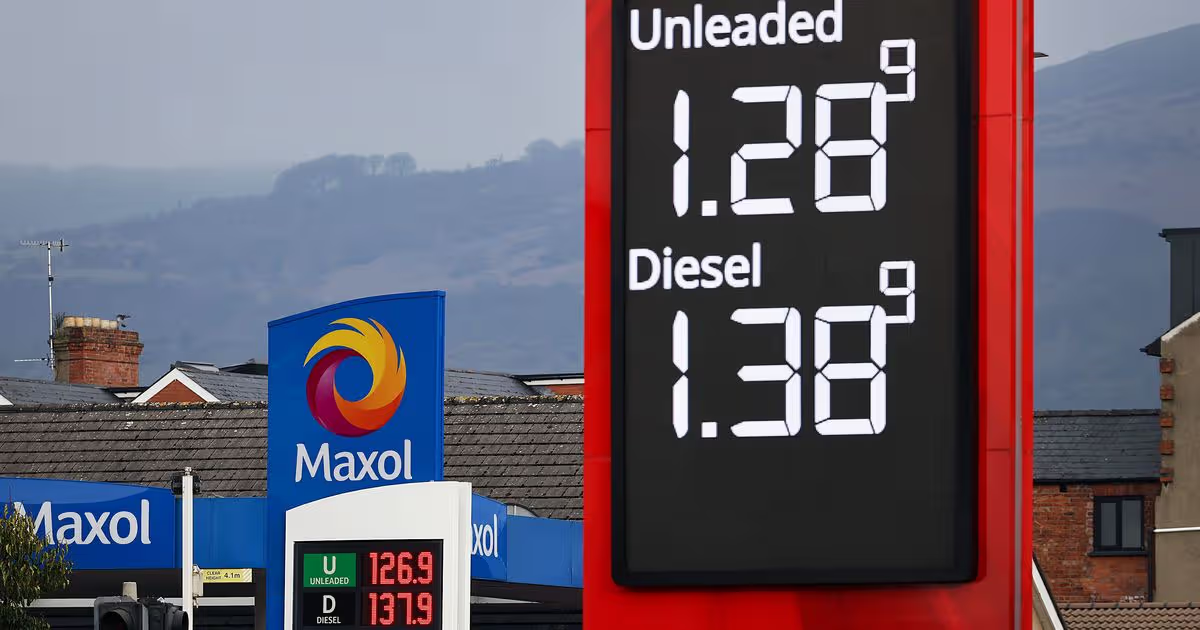
This week, the average price of petrol in Northern Ireland is 126.2p, up from 124.8p last week. For diesel, prices have increased from 132.6p last week to 133.8p this week.
However, prices vary depending on where you are across the region. Lisburn is currently the cheapest spot to fill up on petrol, with prices 2.9p below the regional price at 123.2p per litre.
Magherafelt is currently the most expensive place for petrol this week, with prices 3.4p above the Northern Ireland average at 129.6p.
For diesel, Dungannon is the cheapest area to fill up your tank this week, with prices 3.9p below the regional average at 129.9p per litre. The most expensive spot for diesel this week is Strabane, where prices are 6.6p above average at 140.4p per litre.
Advertisement
Motorists are being urged not to panic buy fuel amid price rises. Luke Bosdet, spokesman for the AA, said: Pump prices are heading up – wholesale costs had been increasing even before the weekend’s strikes on Iran.
“However, pump averages today are still below where they started the year and petrol is almost 6.5p a litre cheaper than this time last year. That makes a tank of petrol more than £3.50 cheaper than in early March 2025.
“The fuel trade has reported some increased demand, which was expected, but drivers in general are heeding advice to stick to their usual refuelling routines. There’s no point wasting time, fuel and money queuing when drivers don’t need to.”
RAC head of policy Simon Williams said the impact of oil price rises should not be felt for at least a week.
Advertisement
Mr Williams said: “We really shouldn’t see a shock jump in prices at the pumps as wholesale fuel costs had only been rising gradually in recent weeks.
“Even though the price of dated Brent crude rose by five dollars a barrel yesterday to 78 dollars, the impact of this shouldn’t be felt for over a week.”
He encouraged retailers not to increase the price of fuel which is already in forecourt tanks.
“Knowing the tendency for price increases to be passed on far more quickly than cuts, on behalf of drivers we urge retailers not to put up the price of fuel they’ve already got in forecourt tanks and reflect any increases in wholesale fuel fairly on the forecourt,” Mr Williams said.
Advertisement
Gordon Balmer, executive director of the Petrol Retailers Association, said pump prices will “have to go up” amid the ongoing conflict.
“The conflict in the Middle East has increased the wholesale cost of petrol and diesel, which will mean pump prices will have to go up,” he said.
“Rising fuel prices hurt the economy in the form of higher inflation, impacting already hard-pressed household budgets.”
Marie Collins, 84, from Narborough has received no state pension payments since November after health issues left her unable to fly home from Cyprus
An 84-year-old woman says she has been left “abandoned” and driven to depression after her state pension payments stopped without warning whilst she was recovering from surgery abroad. Marie Collins, who lives in Narborough, Leicestershire, has not received any pension payments since the beginning of November.
Advertisement
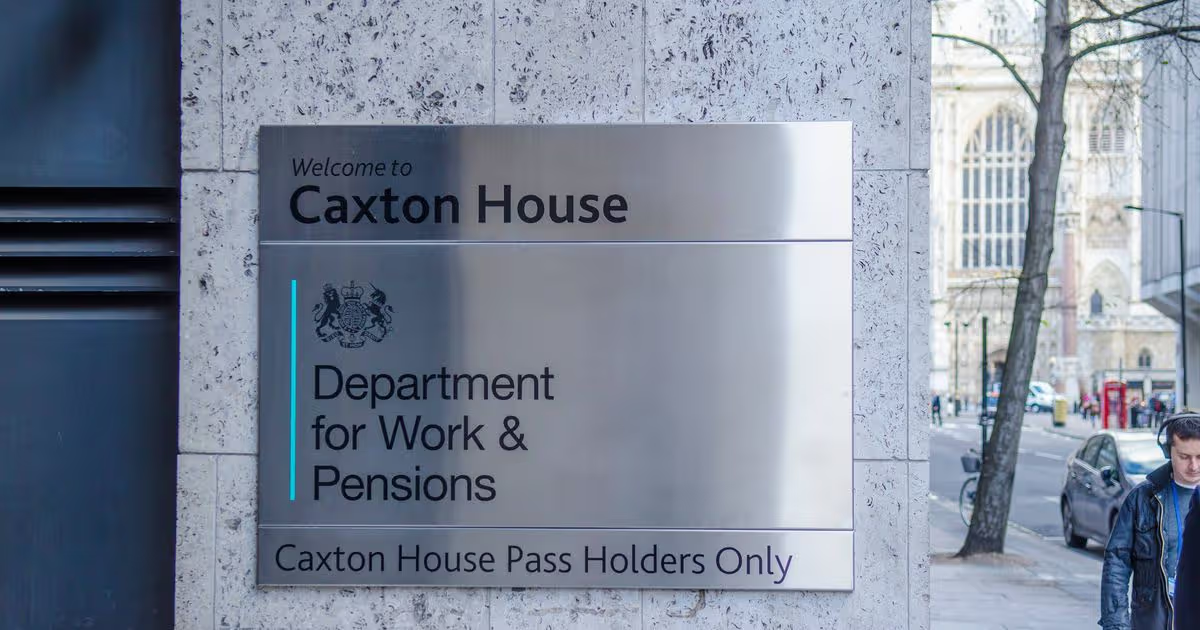
She is currently stranded in Cyprus after a fortnight’s holiday back in September turned into months overseas as health complications meant she was issued with a no-fly order by doctors. The Department for Work and Pensions (DWP) has been repeatedly contacted by Marie, her niece, and even the British Consulate in Cyprus, yet her payments remain suspended.
“I have not had a penny for nearly four and a half months,” she said. “I’ve got no savings. What am I supposed to live on?” Marie was admitted to hospital with a severe chest infection.
Subsequently, she had a fall and has since undergone physiotherapy, but still has limited use of her hand and “no pressure” in her fingers, leaving her unable to write properly.
Doctors provided letters confirming she was not fit to fly, and both local and specialist medical evidence was sent to the DWP, she said. Despite this, her pension payments stopped at the start of November, reports Leicestershire Live.
Advertisement
Marie says she spent “weeks and weeks” trying to contact its offices by phone, often waiting on hold for hours before being cut off. “Every time I got through to someone different, it felt like they hadn’t read any of the notes,” she said.
“They just kept sending me round in circles.”
With her health deteriorating, Marie asked her niece in Yorkshire to intervene on her behalf. She was told the department could not speak to her niece without power of attorney.
Marie arranged the paperwork for this to be done and sent it by recorded delivery in early January. Tracking confirmed it had arrived, but her niece was later told the department had no record of it and still could not discuss the case.
Advertisement
At one point, Marie said she was unable to make international calls after running out of mobile credit, leaving WhatsApp as her only means of communication. “I could not make calls, I could not receive calls, I could not send texts. I was completely stuck,” she said.
In mid-January, following intervention from the British Consulate in Cyprus, Marie was told she needed to complete a new 12-page state pension form. She was informed that once received, her payments would be reinstated.
Due to her hand injury, Marie struggled to fill in the paperwork and sign it. “I could not write. I had to get help to fill it in. I tried to hold the pen with two hands just to do a signature,” she said.
The completed form was sent on January 23 and tracked as delivered six days later. However, as of early March, no payments have resumed.
Advertisement
Marie says her financial worries have had an effect on her health. When she arrived in Cyprus in September, she weighed nine and a half stone.
She now weighs seven stone. “I am hardly eating. I am in a deep depression,” she said.
Friends in Cyprus have helped her with food and accommodation. Before travelling, Marie had put her home on the market following the death of her long-term companion, who was also elderly and “severely disabled”.
She explained the house was too large for her to manage on her own and she had planned to downsize. On the advice of her estate agent, the property was emptied to facilitate viewings, but it has not sold.
Advertisement
Marie now says she has nowhere permanent to return to in the UK.
Still under medical care and awaiting clearance to fly, Marie fears further delays could leave her stranded if travel becomes disrupted.
“I am not worried about Cyprus,” she said. “I am worried about when they (DWP) are going to start paying me. I am a UK national. I feel totally abandoned.”
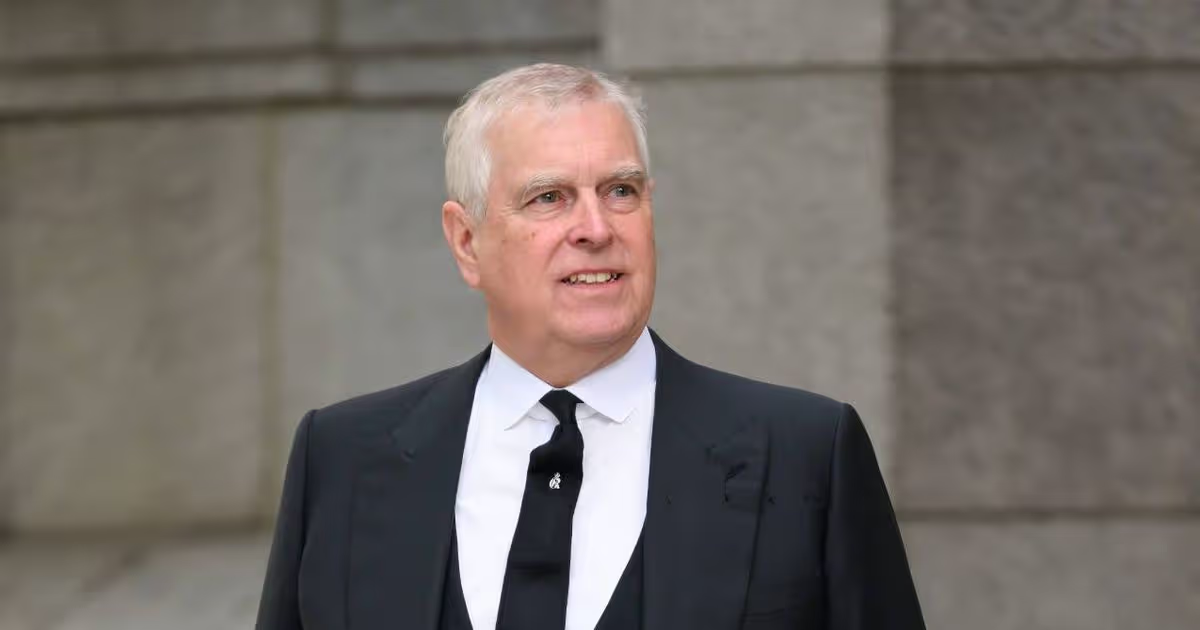
Andrew Mountbatten-Windsor was reportedly preparing to travel to Bahrain or Abu Dhabi when arrested in February following a tip-off to a senior courtier. He has been released under investigation and denies any wrongdoing.
Bradley Jolly Overnight News Editor and Peter Hennessy
02:56, 07 Mar 2026
Disgraced Andrew Mountbatten-Windsor was reportedly “getting his passport ready” to flee Britain for the Middle East when he was arrested, reports suggest.
The 66 year old has since been released under investigation but, with bombs and missiles raining down across the region daily, any remaining hopes of reinventing himself amongst the Arab elite appear scuppered. Now, Donald Trump is believed to be primed for his “big one” offensive on Iran as the conflict there escalates.
Ensure our latest stories always appear at the top of your Google Search by making us a Preferred Source. Click here to activate or add us as your Preferred Source in your Google search settings.
Andrew’s ex-wife Sarah Ferguson maintains her own connections in the Middle East and she, alongside Andrew, was evicted from the Royal Lodge last year. A source revealed: “There is no way any of them are going to go to the Gulf and Middle East region for a long time to come. It is far too dangerous for them, just as it is for everybody else.”
The development marks another setback for the father-of-two, who this week reportedly feels it is “deeply unfair that people have turned on him” following the Jeffrey Epstein files controversy. The ex-duke, a former helicopter pilot with the Royal Navy, categorically refutes all allegations of misconduct.
Advertisement
Speaking to the Daily Mail, a British diplomatic source with previous connections to the Yorks in the Gulf region observed: “It’s inconceivable that they’ll be visiting the region now, certainly not while the war is going on and it could, of course, be an indefinite war.”
Andrew had consistently identified the Middle East – home to billionaire sheikhs and emirs – as a potentially profitable avenue for generating income, both personally and for his wider network.
His relationship with Abu Dhabi’s ruling dynasty stretches back to his days at Gordonstoun, the prestigious Scottish boarding school, where he befriended Sheikh Mohamed bin Zayed Al Nahyan, currently the UAE president and referred to by Andrew as MBZ. His dynasty ranks amongst the wealthiest globally, commanding an estimated £225 billion fortune.
Advertisement
Their assets include substantial London real estate holdings and majority ownership of Manchester City Football Club.
These associations became especially advantageous in 2001 when, following his departure from the Royal Navy, he secured the position of UK Special Representative for International Trade and Investment – a post detractors suggest he subsequently exploited for personal financial gain. Andrew refutes any impropriety.
Officers are appealing for information following the attempted robbery in Cliffe, east of Selby, on Monday (March 2).
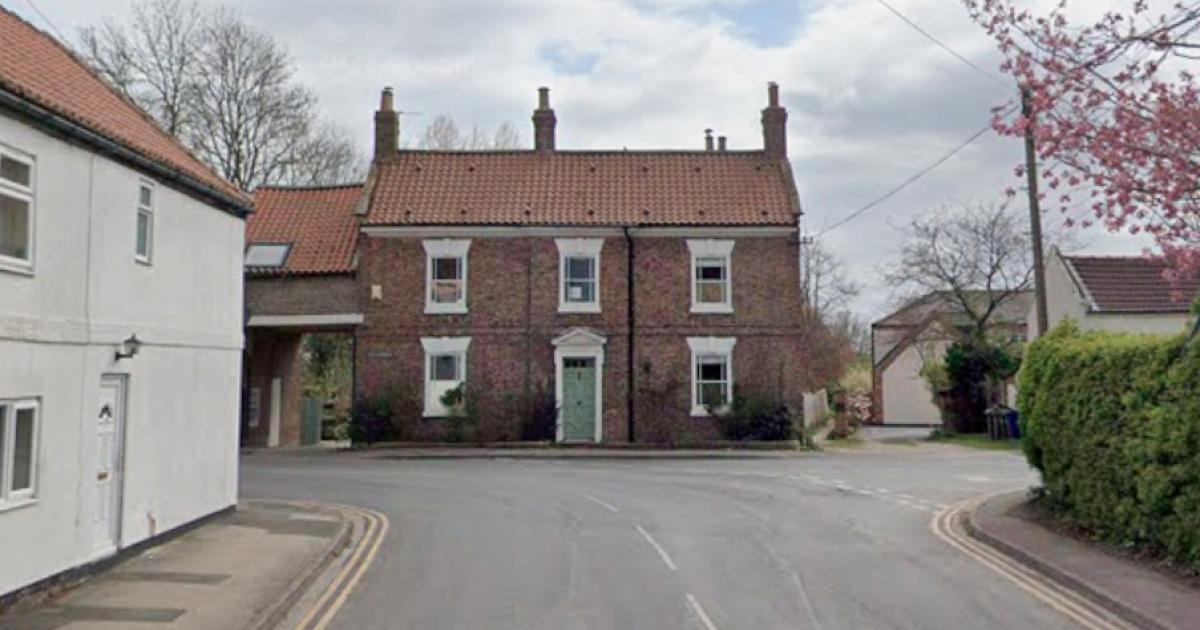
North Yorkshire Police said five men in two silver vehicles – a pick-up truck and a van – attempted to steal a Revvi e-bike from the children at about 6.15pm at the junction between Main Street, Hull Road and Turnham Lane.
“The victims were unharmed, but understandably very frightened,” a force spokesperson said.
Advertisement
North Yorkshire Police said its suspects are described as white men aged in their 20s to 30s.
The force said police are carrying out door-to-door and CCTV inquiries, urging anyone with information to report it.
“We’re particularly appealing for information about any person who may have seen the two vehicles, or witnessed the incident itself,” the police spokesperson said.
Latest cabin bag rules for airlines including Jet2, easyJet, TUI, and British Airways after Ryanair made a change to its policy earlier this year
This article contains affiliate links, we will receive a commission on any sales we generate from it. Learn more
Advertisement
Budget airlines are an excellent way to see the world for less, but one thing that can catch you out when boarding is cabin baggage allowances. At peak times, it’s common to see the dreaded bag sizer coming out as you board, and just a couple of extra centimetres can end up seeing you slapped with a hefty fee.
Annoyingly, cabin bag size allowances vary a lot between airlines and seemingly change all the time too, so even frequent fliers can get caught out. That’s why it’s important to check the airline’s official website before you fly to ensure you aren’t caught out at the boarding gate.
It’s much cheaper to buy extra baggage in advance when you’re booking your ticket, rather than paying for excess weight at the airport, so make sure you’re realistic about what you’ll be packing.
We take a look at airlines’ individual policies below…
Advertisement
Ryanair
Anyone flying on the budget airline should make sure they measure their luggage before they head to the airport.
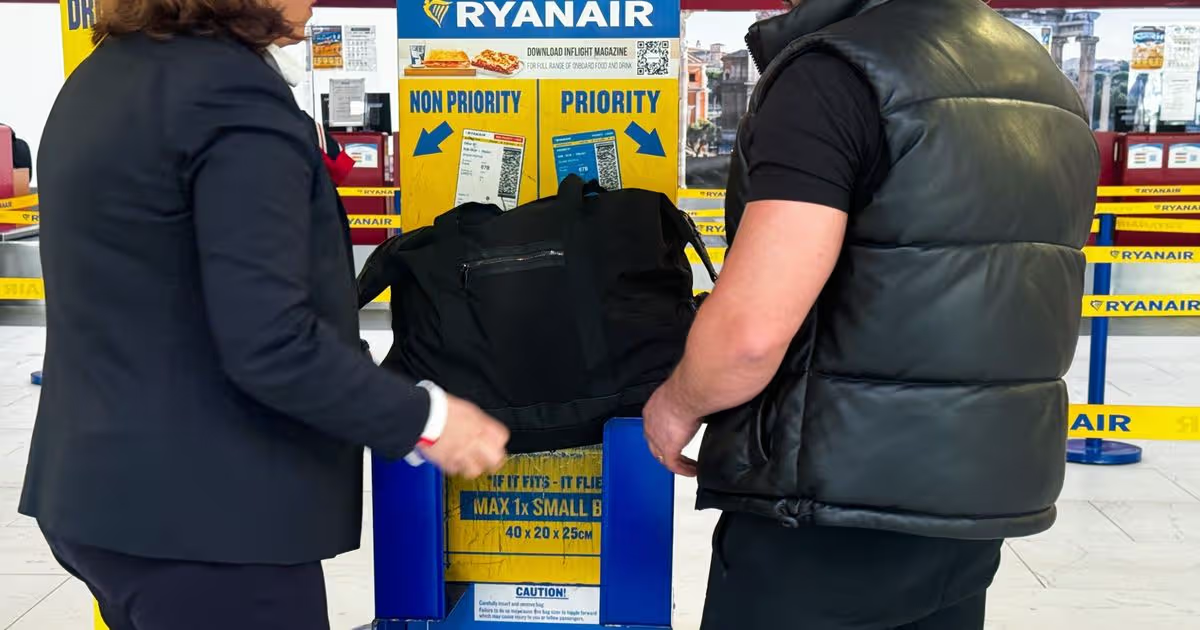
Recently, Ryanair offered some good news for passengers; the free underseat bag that is included in its most basic fare level is now allowed to be slightly larger. Previously, it had to be 40 x 25 x 20 cm, but since summer 2025 Ryanair now allows bags of up to 40 x 30 x 20 cm. This item can be a handbag, backpack, laptop bag, or other item as long as it fits within the dimensions as it goes under the seat in front of you.
While these small bags don’t technically have a weight limit, passengers will need to be able to carry and handle them, and excessively heavy items might be noticed by the flight crew.
For an additional fee, passengers can also bring a second cabin bag of up to 55 x 40 x 20cm onboard with them of up to 10KG in weight. This will need to be lifted into the overhead locker. Checked bags can also be added of 10, 20, or 23KG, with prices varying depending on route and availability. Checked baggage needs to be under 80 X 120 X 120cm in size per item.
Advertisement
EasyJet
EasyJet also tends to strictly monitor onboard bag sizes, and places orange bag sizers around the airport so you can check your luggage will fit. However, it’s still important to measure at home in case you need to repack. Ticket prices on easyJet include one small underseat cabin bag of up to 45 x 36 x 20 cm in size and 15KG in weight.
Customers can also add a second cabin bag of 56 x 45 x 25 cm maximum, including handles and wheels for a fee, although this cost does also include speedy boarding. Passengers can also pay for up to three checked bags of 15, 23, or 32KG, and these must have a maximum total size under 275cm when you add the length, width, and height. Some easyJet flights offer twilight drop-offs so you can check your luggage the night before an early flight.
Jet2
Jet2 offers the same cabin baggage allowance for package holiday and flight only customers: a small bag of 40 x 30 x 20cm, which must fit under the seat, and a 10KG piece of hand luggage of up to 56cm x 45cm x 25cm. Package holiday customers with Jet2 also get 22KG of checked baggage included in the flight, while flight-only customers can add this option for an additional fee. Passengers can buy up to three checked bags of up to 22KG if they don’t like to pack light.
Advertisement
British Airways
British Airways (BA) is a little more complicated as it has many different ticket types. You can use its baggage calculator to find your precise allowance. Those flying on a basic economy fare usually get a small bag and a cabin bag included in the price. The smaller bag can be up to 40 x 30 x 15cm and its guaranteed this will be allowed onboard with you. The cabin bag can be up to 56 x 45 x 25cm, but if overhead locker space runs out, it may need to go into the hold. Make sure your essentials for the flight and passport are in your smaller bag.
Checked bags also vary depending on route and class. Economy with checked bag fares include a 23KG piece of hold luggage up to 90 x 75 x 43cm, and business and first class passengers get much bigger allowances.
TUI
Flight-only passengers with TUI get a 10KG piece of hand luggage included in the price of up to 55 x 40 x 20 cm, plus a small personal item like a laptop bag or handbag of up to 40 x 30 x 20cm TUI emphasises that passengers must be able to lift their hand luggage into overhead storage compartments themselves.
Advertisement
Checked bags can be bought while booking the flight, and those booking package holidays with TUI that fly with its airline get 20KG of checked baggage included. TUI BLUE and cruise customers can get 25KG allowances, so its worth checking your booking confirmation to see if you get this perk.
Have a story you want to share? Email us at webtravel@reachplc.com
Couples often disagree about who does more housework. Part of that disagreement reflects real differences in behaviour. But part of it is perception: what each person notices, remembers and counts as “work”.
That same problem turns out to influence the research that feeds headlines about gender equality at home. Many household surveys ask just one person to report how much housework both partners do. My research shows that this seemingly minor design choice – whether the husband or the wife in a heterosexual couple answers – can fundamentally change what the data appears to say about money, gender and chores.
For decades, researchers have tried to understand how couples divide housework when both partners earn money. Two broad explanations dominate the debate.
One focuses on economics. Exchange and bargaining theories predict that the higher earner does less unpaid work at home, because their time has a higher opportunity cost and more negotiating power. From this perspective, as women’s earnings rise, their share of housework should fall, while men’s should rise.
Advertisement
The other explanation emphasises gender norms. Sociologists have argued that when couples depart from the traditional male-breadwinner model – especially when wives earn more than their husbands – they may “do gender” at home to compensate. In this view, women may end up doing more housework, and men less, to symbolically reassert traditional roles.
The evidence has been mixed. Some studies support bargaining. Others find patterns consistent with “doing gender”. One reason for this discrepancy may lie not in how couples behave, but in how their behaviour is measured.
To explore this, I analysed 24 years of data (1999-2023) from the US Panel Study of Income Dynamics – a nationally representative longitudinal survey of US families run by the University of Michigan and funded primarily by the National Science Foundation and the National Institutes of Health.
I focused on married, dual-earner heterosexual couples, the group most often studied in research on housework and income. The survey repeatedly interviews households and asks how many hours per week each spouse spends cooking, cleaning and doing other work around the house.
Advertisement
In each wave, one person answers on behalf of the household. Sometimes it is the wife, sometimes the husband. This creates a valuable opportunity. Because the survey follows the same couples for years, we can compare households to themselves and ask a simple question: what changes when the respondent changes?
Who answers changes the story
Previous research has long shown that husbands and wives report housework differently, and the same pattern appears in my research. When husbands answer surveys, they tend to report a more equal division of labour than wives do, crediting themselves with a larger share of household work and reporting slightly fewer hours for their partners. Even before income enters the picture, who answers the survey shapes what “sharing the load” appears to look like.
The more revealing differences emerge once income is taken into account. When wives are the respondents, the relationship between earnings and housework looks like economic bargaining: as wives’ share of household income rises, they report doing less housework and their husbands doing more, in a largely linear way.
When husbands are the respondents, the same households tell a different story. Their reports show a non-linear pattern: husbands report increasing their own housework as their wives’ earnings approach parity. They then report doing less once wives earn more than they do, while reporting higher housework hours for their wives. This pattern is consistent with what sociologists call gender deviance neutralisation, where departures from the male-breadwinner norm are symbolically offset at home.
Advertisement
The crucial point is not that one theory is right and the other wrong. It is that the same couples can appear to support competing explanations depending on who answers the survey.
Sharing the load. Drazen Zigic/Shutterstock
The results do not reveal the “true” number of hours someone spent cleaning in a given week. Instead, they reveal something more fundamental about the evidence base: reported housework is filtered through gendered perceptions and self-presentation, especially in situations that challenge traditional expectations, such as near equal or reversed earnings.
Housework is not just a set of tasks. It is a socially loaded activity tied to ideas about fairness, competence and identity. When people report on it, they are likely not just simply recalling time, they are also telling a story about how their household works.
Housework statistics are widely used to judge whether societies are becoming more equal, and to evaluate policies affecting dual-earner families. If researchers pool responses without treating respondent identity as central, they risk averaging away meaningful differences and drawing muted – or misleading – conclusions.
Advertisement
In the end, the question is not only who does the chores. It is also who gets to describe them – and how much our conclusions depend on that storyteller.
WASHINGTON (AP) — American employers unexpectedly cut 92,000 jobs last month, a sign that the labor market remains under strain. The unemployment rate blipped up to 4.4%.
Hiring deteriorated from January, when companies, nonprofits and government agencies added a healthy 126,000 jobs, the Labor Department reported Friday. Economists had expected 60,000 new jobs in February.
Revisions also cut 69,000 jobs from December and January payrolls.
The surprisingly weak employment picture in February adds to the economic uncertainty over the war with Iran, which has caused oil prices to surge and saddled business and consumers with unforeseen costs.
Advertisement
“The job market is struggling in the face of so many headwinds,” said Heather Long, chief economist at Navy Federal Credit Union. “Companies are going to be even more reluctant to hire this spring until the war ends and they can see consumers still spending. It’s a tense time for the U.S. economy.”
The job market had been expected to rebound this year from a lackluster 2025 when it was buffeted by President Donald Trump’s erratic tariff policies, his purge of the federal workforce and the lingering effects of high interest rates. In 2025, employers added just 15,000 jobs a month. Hopes for a 2026 rebound rose after January hiring came in above expectations.
“Just when it looked like the labor market was stabilizing, this report delivers a knock-down blow to that view,’’ said Olu Sonola, head of U.S. economics at Fitch Ratings. ”It’s bad news whichever way you look at it.’’
The job losses were widespread.
Advertisement
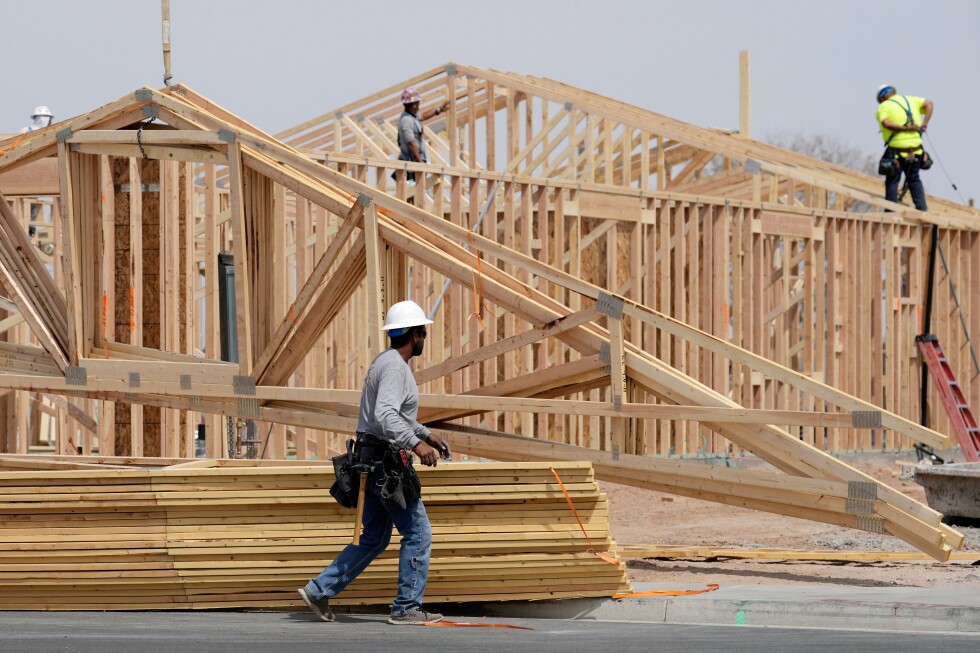
Construction companies cut 11,000 jobs last month, which likely reflects frigid weather. And healthcare firms shed 28,000 jobs after a four-week strike by more than 30,000 nurses and other front-line workers at Kaiser Permanente in California and Hawaii. Health care has been one of the job market’s strong points.
Factories cut 12,000 jobs and have now lost jobs for 14 of the last 15 months. Restaurants and bars lost nearly 30,000 jobs. Administrative and support services firms cut nearly 19,000 jobs and courier and messenger services almost 17,000.
Financial firms added 10,000 jobs, though job cuts continue to hit that sector as well this year.
Average hourly wages rose 0.4% from January and 3.8% from a year earlier.
Advertisement
The outlook for the job market – and the entire economy – is clouded by the war with Iran.
The combination of weak hiring and increasing inflationary pressures arising from the war creates a nightmare for the Federal Reserve, which must decide whether to cut interest rates to help the job market or hold off to help keep a lid on prices. “This is probably the worst scenario for monetary policy,″ said Eugenio Aleman, chief economist at Raymond James.
Employers were reluctant to hire last year because of uncertainty over Trump’s tariffs – and the unpredictable way he rolled them out.
The impact of Trump’s aggressive trade policies may recede in 2026. His import taxes became smaller and less erratic after he reached a trade truce last year with China and deals with leading U.S. trade partners such as Japan and the European Union. A lot of businesses have also learned how to offset the costs of the tariffs, often by passing them along to customers via higher prices.
Advertisement
Brian Bethune, an economist at Boston College, said that Trump’s 2025 tariffs were a shock to companies’ business plans. Now, just as they’ve adjusted to them, “Guess what! All of a sudden their 2026 business plans are upended by an increase in fuel costs’’ caused by the war with Iran.
Jay Foreman, CEO of the toy company Basic Fun, expects to get some relief from Trump’s tariffs after the Supreme Court last month struck down the biggest ones and potentially created a path for importers to get refunds for the levies they paid. The refunds would allow Foreman to invest more in his Boca Raton, Florida, company, which makes Lincoln Logs and Care Bears. He can also hand out more generous raises to employees and hire new people.
“We are expecting a record year,’’ he said.
Yet under new tariffs sought by Trump, Foreman estimates that Basic Fun’s tariff bill will more than double this year to $15 million. That is partly because the firm will be paying for a full year of Trump tariffs in 2026. Tariffs last year were not rolled out until spring or later.
Advertisement
_____
AP Economics Writer Christopher Rugaber contributed to this report.