Connect with us
DAPA Banner
DAPA Coin
DAPA
COIN PAYMENT ASSET
PRIVACY · BLOCKDAG · HOMOMORPHIC ENCRYPTION · RUST
ElGamal Encrypted MINE DAPA
🚫 GENESIS SOLD OUT
DAPAPAY COMING

NewsBeat

why are cruise ships so prone to disease outbreaks?

Published

on

why are cruise ships so prone to disease outbreaks?

Cruises are sold as floating holidays, but they are also useful for understanding public health. Cruise ships are carefully designed places where many people live, eat, relax and move through the same shared spaces for days at a time. They show how easily illness can spread when people are packed into a single interconnected environment.

Think of a cruise ship as a temporary city at sea. It has restaurants, theatres, lifts, cabins, kitchens, water systems and indoor gathering spaces. That is great for convenience, but it also means that once an infection gets on board, it can move through the ship in ways that are hard to stop.

The Diamond Princess outbreak is perhaps the best-known example. During the 2020 COVID outbreak, 619 passengers and crew tested positive for the disease. Researchers found that the ship conditions made the novel coronavirus spread more easily. Their modelling suggested that public health measures, such as isolation and quarantine, prevented many more cases, but it also showed that an earlier response would have further limited the outbreak.

Norovirus (the so-called vomiting bug) is the infection most closely linked to cruise ships. In a review of previously published studies, researchers found 127 reports of norovirus outbreaks on cruise ships, with many linked to contaminated food, contaminated surfaces and person-to-person spread. A more recent report from the US also showed that norovirus can spread very rapidly from person to person on a cruise ship.

Advertisement

This helps explain why ships such as Celebrity Mercury, Explorer of the Seas and Carnival Triumph have become familiar names in outbreak reports. These were not unusual in some special way; they were simply settings where shared dining, close contact and frequent movement through common areas allowed infection to spread fast.

Food service plays a big part in this risk. Buffet-style dining, shared utensils and many people touching the same surfaces can make it easier for stomach bugs to spread. If someone is infected but does not yet feel sick, they may still contaminate food or surfaces before they realise they are unwell.

Buffet dining can help stomach bugs spread.
Hapsari Ayu/Shutterstock.com

The ship’s design adds to the problem. People spend time together in dining rooms, bars, lifts, corridors, theatres and spa areas. Crew members also live and work in the same environment, often in shared accommodation, so illness can move through the ship from passenger to passenger or between passengers and crew.

Ventilation also plays a crucial role. Cruise ships are not closed boxes, but they do rely heavily on indoor spaces where people spend long periods together. Studies into cruise ship air quality have shown that illness can spread more easily in crowded, enclosed spaces, like cabins, restaurants and entertainment venues, if the ventilation system is not up to scratch. Things like adequate fresh air circulation, specialist filters and air-purifying technology all play a role in keeping passengers safe.

Advertisement

Legionnaires’ disease (a serious lung disease caused by bacteria) shows a different kind of risk. It is not usually spread directly from one person to another. Instead, people can get infected by breathing in tiny droplets from contaminated water systems, hot tubs or showers.

A well-known outbreak among cruise passengers was linked to a whirlpool spa, and recent reports from the US Centers for Disease Control and Prevention have described other cruise-associated legionnaires’ disease outbreaks linked to ship water systems.

Age also matters. Cruise holidays are especially popular with older adults, and many passengers have long-term health conditions that make infections more serious. A stomach bug on a cruise can lead to dehydration, and a respiratory infection can lead to pneumonia or hospital care.

Cruise ships do have medical facilities, but they are limited compared with land-based hospitals. They are built to give first aid, basic treatment and short-term care, not to manage a fast-moving outbreak on a large scale. That is why cruise health depends so much on early reporting, quick isolation and strong cleaning practices.

Advertisement

Other infections such as respiratory viruses, including influenza, can spread in the same crowded indoor settings, and stomach bugs can spread through food, hands and shared surfaces. COVID and flu exploit enclosed air and crowds. Norovirus loves buffets and surfaces. Legionnaires’ targets water systems, which ships can’t easily sterilise. Hantavirus (a severe respiratory illness spread by rodents) outbreaks on ships are rare. However, as recent news of the deaths on the MV Hondius attests, germs in close quarters find it much easier to spread.

How to limit your risk

As an epidemiologist, I have seen many outbreaks in hospitals, schools and even flights. For travellers, the best protection starts before boarding. It is sensible to check whether the cruise line has clear illness reporting, cleaning and isolation policies. Make sure your routine vaccines are up to date. And for older adults, pregnant women and anyone with health problems, consult your GP before travelling. Also, ensure your travel insurance covers illness-related disruptions.

Once on board, washing your hands with soap and water is the most useful step for preventing stomach bugs like norovirus. Hand sanitiser can help, but it does not replace soap and water. If you start to feel unwell, the safest move is to avoid buffets and crowded shared spaces and report symptoms early rather than trying to carry on as normal.

Cruise lines have improved their hygiene and outbreak response systems over time, and many voyages pass without incident. But the basic structure of cruise travel still creates the same challenge: many people sharing the same meals, the same air, the same water systems and the same common spaces. That is why outbreaks keep returning, and why cruise ships remain a useful reminder that public health is shaped as much by design as by germs.

Advertisement

Source link

Continue Reading
Click to comment

You must be logged in to post a comment Login

Leave a Reply

NewsBeat

Actress Zawe Ashton compares filming sex scenes to ‘prostitution’

Published

on

Daily Mirror

Actress Zawe Ashton has urged young female stars to speak up if they’re uncomfortable filming sex scenes for TV or movies, comparing it to a form of ‘prostitution’

Advertisement

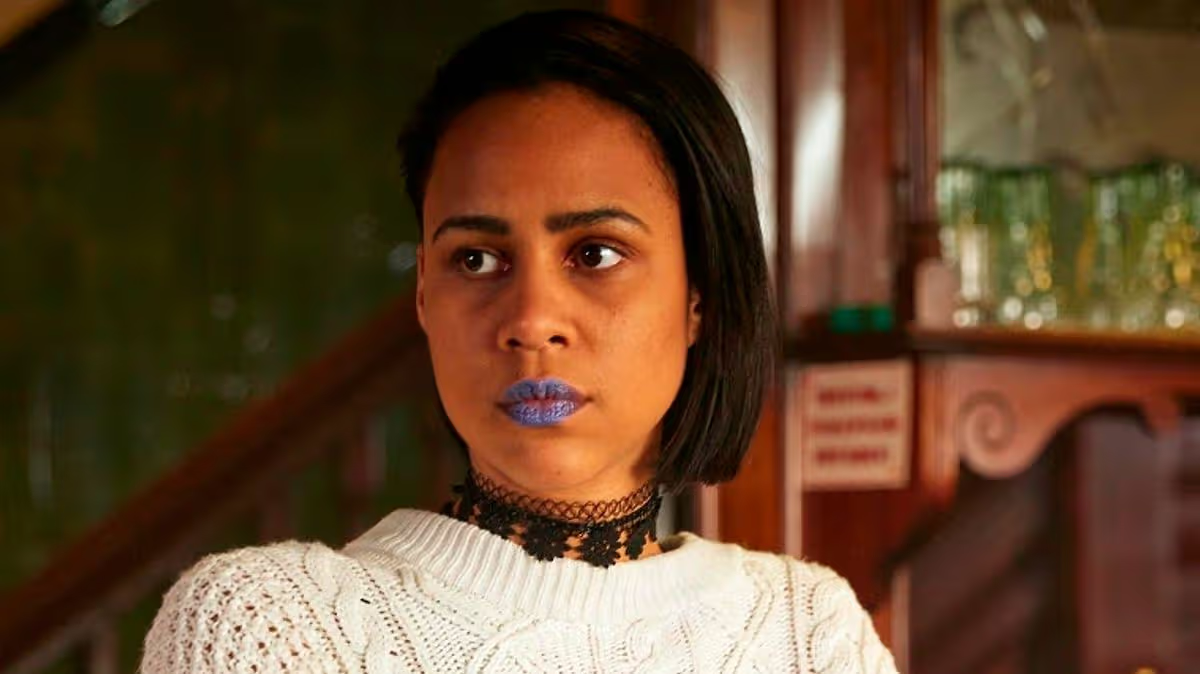
Fresh Meat star Zawe Ashton has said actresses can feel pressured into filming sex scenes or risk being labelled “prudish” in their bid to get ahead in the industry. The 41-year-old actress, who is engaged to Tom Hiddleston, compared some intimate on-screen scenes to a form of “prostitution” and urged younger actresses to say “no” if they feel uncomfortable.

In a candid discussion on a topic rarely spoken about publicly, Ashton also revealed she was once given alcohol for “Dutch courage” before filming an intimate scene. Reflecting on her experiences, she said: “I’ve been in not nice situations on sets with sexual scenes, where you go, ‘Do you know what, I feel like a strong person and I can get myself over the threshold of this behaviour.’ There’s an element of survival there.”

“But sometimes younger actresses are made to feel as though they have to do these things. You’re in contractual conversations where you’re made to feel that if you don’t do it, you’re prudish, you’re not open, you’re not going to become the actress or have the career you really want.

“If you’re not comfortable, just say no. In life and art, no scene is worth taking over your mental health.” Ashton, who is also known for her role in The Marvels film franchise, said actors are often forced to compromise their own comfort in order to make sex scenes appear realistic on screen, revealing she had worn stick-on prosthetics while filming.

Advertisement

She said: “If you’re asking me what it’s been like to make sex look real on screen, I will tell you it is a little bit like prostitution, not that I know what that’s like.

“You’d like to have a bonus for the scene. Often you’re covered in glycerin because it’s a sustainable way of creating sweat. Often you are at a pretty good level of nakedness. In my experience, I’ve had everything from a nude thong to a stick-on pair of jelly boobs, which is pretty exposing.”

The TV and film actress also recalled being so nervous before filming intimate scenes with Jake Gyllenhaal in the 2019 film Velvet Buzzsaw that she drank prosecco beforehand to calm her nerves.

Advertisement

Speaking on the Miss Me podcast with Miquita Oliver last month, she said: “I was so nervous before this scene and some very kindly people on the production gave me a couple of mini bottles of prosecco in my trailer.

“It was a night shoot and I was feeling quite tipsy. But the prosecco is not just about the Dutch courage, it’s to quiet the noise when you walk away from the scene -a bit like when you walk away from a hook-up and think, ‘What just happened there?’”

Ashton met Hiddleston while starring together in the West End production of Betrayal, which later transferred to Broadway. The pair became romantically linked soon afterwards.

In 2022, it was revealed the couple were engaged after Ashton was seen wearing a large diamond ring shortly after the birth of their first child in October that year. In January 2025, they welcomed their second child.

Advertisement

They recently appeared together on the red carpet at the Laurence Olivier Awards in London.

Source link

Continue Reading

NewsBeat

Man who took 10 hostages in hours-long ‘bomb’ standoff at Bakersfield bank is shot dead

Published

on

Daily Mirror

The FBI stormed a building in Bakersfield, California, to end a nearly 16-hour standoff during which the suspect had tied up hostages and claimed he strapped explosives to them and himself

A man has been shot dead after taking 10 school employees hostage and claiming he had strapped explosives to himself.

Authorities stormed the building in Bakersfield, California, overnight, ending a nearly 16-hour standoff during which the suspect tied up half the hostages and also said he had put explosives on them and himself, police said.

The hostages – employees of the Kern County Superintendent of Schools – were found unharmed inside the building that also houses a Chase bank, said Bakersfield Assistant Police Chief Jeremy Blakemore.

Advertisement

“Throughout the night, their families questioned whether or not they would be seen again but we are very grateful for the outcome,” Blakemore said during a news conference Wednesday.

Anthony Scott Searles-Harris, 41, was shot and killed around 4:20am, according to Sid Patel, special agent in charge in the FBI’s Sacramento office. Authorities said he was an Army veteran who was dishonourably discharged, had a history of trouble with law enforcement and was a registered sex offender.

Searles-Harris told police he had a bomb after barricading himself within the second floor of the building, Blakemore said. Authorities were testing the devices that Searles-Harris said were explosives, but Patel said they do not appear to be a concern.

One of the hostages was able to communicate with law enforcement using her phone until her battery died, Patel said. She was diabetic and didn’t have her medicine so officials knew she was at risk, he said.

Advertisement

“I’m sure there’ll be mental scars that they’re living with, and we’ll have our victim specialist to help them,” Patel said.

While authorities declined to discuss a motive in the standoff, Blakemore said some of the demands Searles-Harris made involved asking for materials from an earlier case.

“He had concerns related to how his previous case had been handled and what the aftermath of that was, the sentencing and those kinds of things,” Blakemore said, without specifying details.

California Department of Justice and court records show Searles-Harris was on the state’s sex offender registry due to convictions in 2014 for sex crimes related to a child under 14 years of age. Those records show he was released from prison in 2018.

Advertisement

FBI officials said Searles-Harris served about a year in the Army before being dishonourably discharged in 2007 for going AWOL.

Court records in Kern County, California, show Searles-Harris filed a petition to prevent domestic violence, and was involved in divorce proceedings that began in 2009 and note a young child, as well as a fight for guardianship years later in which he was listed as an objector.

During the news conference, Blakemore said he was aware of videos Searles-Harris had apparently posted criticising the sheriff’s office and claiming he was innocent of his previous sex crimes convictions. He said the videos were being reviewed but the department had no plans to investigate the claims of innocence.

It wasn’t clear why Searles-Harris targeted the school district office. “What unfolded was undoubtedly a terribly frightening and unsettling experience, and the composure our employees demonstrated throughout the 16-hour ordeal was extraordinary, John Mendiburu, the county schools superintendent, said in a statement.

Advertisement

The standoff began early Tuesday afternoon, when officers responded to a call of a bomb threat at the Chase Bank building, a four-story office building with dark-tinted glass windows in Bakersfield, a city of about 380,000 residents about 100 miles northeast of Los Angeles.

The police department’s crisis negotiation team talked with Searles-Harris by phone and he released two hostages Tuesday night. Buildings nearby, including City Hall and the police headquarters that are just a block away, were evacuated and some roads were closed during the hostage situation.

More than 100 FBI personnel assisted, including two SWAT teams, bomb technicians and crisis negotiation teams, Patel said. A hostage rescue team was deployed from its headquarters on the East Coast, he said.

Jacob Davidson, a livestreamer known as Dad’s Gone Live, was a block from the building when he started receiving calls about the bomb threat. He watched police enter the back of the building, and his livestream captured through a window a woman rocking back and forth before crouching below the window. Later, two hands could be seen waving.

Advertisement

Source link

Continue Reading

NewsBeat

Britain’s reading revival may be failing to reach those most disconnected from books

Published

on

Britain’s reading revival may be failing to reach those most disconnected from books

Plenty of adults think of themselves as readers. They remember the books they loved as children, the novels they stayed up late to finish, and the periods of life when reading felt natural and routine. Yet many have not finished a book in months, or even years.

The National Year of Reading 2026 has placed reading firmly back in the public conversation. Across the UK, libraries, literacy organisations, publishers and cultural institutions are working to encourage reading for pleasure and rebuild reading habits.

This renewed focus matters. At a time when concerns about declining reading are widespread, celebrating reading as joy, immersion and connection remains important.

Yet these conversations often make me think less about books themselves than about the type of reader they focus on. Much discussion around reading for pleasure begins with people who already possess a relationship with books: their favourite novels, formative reading experiences and longstanding habits. This presumes they already have the confidence to see themselves as readers.

Advertisement

Less visible are those for whom reading stopped feeling natural much earlier. This matters because much of the current conversation around reading decline still treats the problem primarily as one of enthusiasm: how to persuade people that books are pleasurable, enriching or culturally valuable. But for some adults, the problem is rebuilding a relationship with reading that stalled years earlier.

Research suggests many adults are not resisting reading because they dislike books. They are struggling because reading no longer feels manageable within the conditions of their lives.

Reading in prisons

My colleague Josephine Metcalf and I research adult reading re-engagement through a digitally delivered book club for readers and writers across more than 90 prisons in England and Wales.

While prisons may seem an unusual place to explore reading habits, they offer important insights into the factors that encourage or discourage reading engagement, including confidence, autonomy and previous experiences of education.

Advertisement

One finding appears repeatedly: struggling to engage with reading often precedes finding pleasure in reading. Before enjoyment comes interrupted concentration, prolonged effort, embarrassment, and memories of reading associated with judgment or failure.

Research from prison-based reading groups similarly suggests that disengagement is frequently linked not to disinterest in books themselves, but to earlier experiences of reading as performance, exposure or inadequacy.

This may help explain why reading initiatives often reach people who already possess some relationship with books, while adults whose reading habits fractured years earlier remain harder to engage. The barriers are frequently more practical and behavioural than ideological.

Advertisement

Recent census data published by The Bookseller reinforces this point. While attitudes towards reading remain broadly positive, many adults who identify as readers rarely read regularly. The obstacles are familiar: distraction, exhaustion, reduced concentration and competition from digital entertainment.

Creating the conditions for reading

Our own work suggests that adults return to reading under very particular conditions: privacy, autonomy, short forms, strong narrative momentum, self-paced engagement and the removal of performative pressure. Reading habits are often rebuilt gradually through repetition, accessibility and emotional safety before reading confidence fully returns.

This has implications far beyond prisons. If the National Year of Reading aims to produce lasting change, the challenge may not simply be encouraging people to value books more highly. It may involve paying greater attention to the conditions that allow reading habits to recover after long periods of disruption.

Reading campaigns, book recommendations and public celebrations of reading remain important, but they are unlikely to reach everyone equally. Re-engagement often depends upon quieter forms of infrastructure: accessible pathways back into reading, opportunities for private participation, and environments where reading can develop without judgement.

Advertisement

Prisons make this visible in concentrated form. When autonomy, privacy and appropriate structure are present, adults who disengaged from reading long ago often begin reading again.

The shift rarely happens because literature’s cultural importance has suddenly become persuasive. More often, it happens because the surrounding conditions have changed sufficiently for reading to feel possible.

Research into prison reading groups has shown that reading can support confidence, reflection and discussion. More recent work has highlighted the value of combining reading with creative writing activities that encourage readers to engage actively with texts.

Advertisement

Many adults who no longer read regularly do not need to be convinced that books matter. They already know that. The larger challenge is ensuring that conversations about reading also reach those who no longer feel reading belongs to them.

If we want to understand the future of reading, we may need to spend less time asking why people have stopped reading, and more time creating the conditions that help them start again.

Source link

Advertisement
Continue Reading

NewsBeat

Lanarkshire MSPs speak out as Scotland’s private health admissions hit record levels

Published

on

Daily Record

Statistics released by the Private Healthcare Information Network (Phin) show about 54,000 admissions to private settings in 2025, an increase of six per cent.

Two Lanarkshire MSPs have spoken out following new stats revealed the number of private healthcare admissions in Scotland hit record levels.

Advertisement

Statistics released by the Private Healthcare Information Network (Phin) show about 54,000 admissions to private settings in 2025, an increase of six per cent.

Some 29,470 people were admitted using their private medical insurance, an increase of five per cent.

The number of people paying to go private increased by seven per cent.

Scotland saw the sharpest increase in private healthcare use in the UK, with Wales increasing by 1.8%, England by 0.6% and Northern Ireland reducing by 4.8% between 2024 and 2025.

Advertisement

Cataract surgery was the most popular procedure for those going private, with more than 9,000 people seeking treatment last year, 7,335 of those self-funding their procedures.

Hip replacements, endoscopies, colonoscopies and knee arthroscopy made up the top five procedures.

Central Scotland Conservative MSP Meghan Gallacher said: “A record number of Scots are now turning to private healthcare, paying out of their own pockets for routine treatment because of the SNP’s mismanagement of our NHS.

“A multi-million pound delayed discharge backlog is leaving patients who are fit to go home stranded in hospital beds, preventing others from accessing the care they need.

Advertisement

“GP services remain under immense pressure, while the walk-in clinic election gimmick is more focused on winning votes than improving patient outcomes.

“Our NHS should be modern, efficient and local, delivering timely care for everyone, not forcing more people to go private just to receive the treatment they need.”

Fellow Central Scotland MSP, and co-leader of the Scottish Greens, Gillian Mackay added: “Behind the statistics are thousands of personal stories and people forced to make difficult choices.

“Nobody should be forced into costly private sector operations because of waiting lists.

Advertisement

“Our NHS workers are doing a fantastic job every day, but if we are to meaningfully cut waiting lists and ensure people can get appointments when they need them then we need to back them and invest in medical staff.

“In the longer term there is a lot we need to do on prevention and early intervention to support people to live well and do what we can do to reduce future lists.”

Richard Wells, the director of technology and insights at Phin, said: “Private hospital admissions in Scotland continue to increase year-on-year.

“This shows the importance some patients place on the choice offered by the private sector.

Advertisement

“The total number of admissions still represents less than 1% of the population in Scotland, with the majority of people still being treated by the NHS.

“Both private medical insurance and self-pay admissions were at record levels. Our data shows though that there are distinct differences between the type of procedures people have, depending on how it is being funded.”

A Scottish Government spokesperson said: “Scotland continues to have a substantially lower rate of take up of private healthcare compared to England.

“It is also important to note that the number of private admissions represents a very small proportion of acute hospital activity carried out by the NHS.

Advertisement

“We are expanding access to the NHS in Scotland – exceeding the target to deliver 150,000 extra appointments and procedures and reducing long waits for new outpatients by 76.5 per cent and inpatient/ day case waits down by 47.4 per cent since July 2025.”

*Don’t miss the latest headlines from around Lanarkshire. Sign up to our newsletters here.

And did you know Lanarkshire Live had its own app? Download yours for free here.

Source link

Advertisement
Continue Reading

NewsBeat

Full list of traders in Bishop Auckland Street Food Carousel

Published

on

Full list of traders in Bishop Auckland Street Food Carousel

Street Food Carousel will take place in Bishop Auckland Market Place on Friday (June 5) from 4pm to 9pm.

As well as a fantastic selection of street traders, the event will also include live music and games including live bingo and play your cards right.

Piggy Blinders are one of the confirmed traders (Image: PIGGY BLINDERS)

(Image: Piggy Blinders)

Bishop Auckland Town Council said: “We look forward to welcoming residents and visitors into the town centre for another great evening.”

Visitors to the event can expect everything from loaded burgers and crispy chicken to cakes and desserts, with organisers promising there will be “plenty to enjoy”.

Advertisement

Unlocking Treasures, Darlington (Image: SARAH CALDECOTT)

As well as food, there will also be jewellery traders and pet stands.

Which traders will be there?

  • Piggy Blinders
  • Kolamba 
  • C&C Loaded Chips
  • Chicken Ting 
  • Fire & Stone
  • Brasa Brazilian Street Food
  • The Greekster 
  • Chilli Padi 
  • Dipping Donuts 
  • The Auckland Cupcake Company
  • Cassie’s Kitchen 
  • The Hedgehog Bakery
  • Sarah’s Treats
  • Just A Littlemore 
  • Doughvine Desserts
  • Unlocking Treasures 
  • Pevs Prints 
  • Molly’s Pet Pantry

Source link

Continue Reading

NewsBeat

French Open 2026: Aryna Sabalenka sees another Grand Slam chance disappear after Diana Shnaider defeat in Paris

Published

on

Aryna Sabalenka closes her eyes in disgust during a frustrating French Open quarter-final defeat by Diana Shnaider

Clay is not Sabalenka’s strongest surface even though she has won three times in Madrid, where the high altitude makes the conditions similar to a hard court.

Nor did she have a good build-up to Roland Garros. Six match points were squandered in a quarter-final defeat by Hailey Baptiste in Madrid in April, before she let a set and a break lead slip against Romanian veteran Sorana Cirstea in Rome.

But, given her quality and pedigree compared to the other Paris quarter-finalists, it is hard not to think another golden opportunity has slipped through Sabalenka’s fingers.

Sabalenka’s four Grand Slam singles titles – two Australian Open and two US Open triumphs, all on hard courts – are more than most people can dream of.

Advertisement

But she has also lost four finals and six major semi-finals, despite a consistency on the biggest stages that is unrivalled among her peers.

Sabalenka has the proud record of not losing before the quarter-finals of a Grand Slam since the start of the 2023 season.

However, she has not always dealt well with the pressure of the latter stages – particularly during the period where she has clearly been the best player in the world.

Sabalenka was the heavy favourite to beat underdog Madison Keys in the 2024 Australian Open final, but came unstuck. Twelve months later, she reached another Melbourne final – and a flurry of mistakes saw her squander a break lead in the deciding set against Elena Rybakina.

Advertisement

At last year’s French Open Sabalenka played what she described as the “worst final” of her life, hitting 70 unforced errors in windy conditions as she lost from a set up.

Against Shnaider, Sabalenka looked in control at 6-3 4-1 up before losing 12 of the final 13 games.

“I just think that there is something in specific moments during the match [where] I lose control,” said Sabalenka, whose 57 unforced errors outweighed her 46 winners.

Source link

Advertisement
Continue Reading

NewsBeat

Tata Steel apologises to Port Talbot residents who say homes ‘shook’ during demolition

Published

on

Wales Online

A rolling road block was put in place by South Wales Police on the M4 while the demolition took place

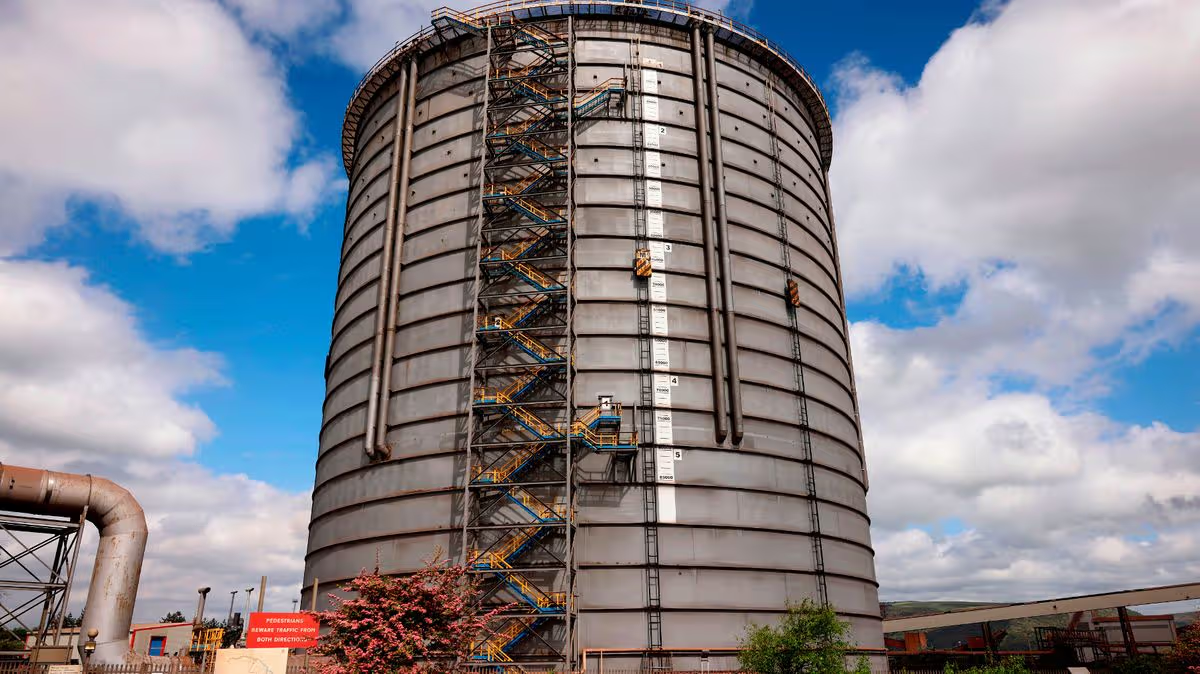
Residents said their homes “shook” after a loud bang was heard in Port Talbot on Wednesday evening. It came from the Tata Steel site where a demolition was carried out on one of its now redundant coke ovens gas holder.

Advertisement

It ceased operation together with the site’s heavy-end in September 2024. A rolling road block was put in place by South Wales Police on the M4 between junctions 37 Pyle and 38 Margam at 6.30pm as the demolition took place.

But some in the local area claimed they had no idea it was going to happen. Stay informed on everything Neath Port Talbot by signing up to our newsletter here.

One woman wrote online: “Would have been nice if residents had been informed, my whole house shook.”

A second added: “You could of warned us, my patio door shook and my animals were scared as well as myself.”

Advertisement

And a third wrote: “A day’s notice would have been nice. My daughter is terrified now.”

A statement from Tata Steel reads: “People working and living in the Port Talbot area may have just heard a loud noise emanating from the Port Talbot steelworks.

“This was the result of the planned demolition of the empty, redundant coke ovens gas holder, which has been completed safely as part of the ongoing engineering works on the site.

“The gas holder ceased operation with the closure of the site’s heavy-end in September 2024.

Advertisement

“This demolition was required to make space for future raw materials handling areas for the new three million tonne per year capacity electric arc furnace.

“Our thanks goes to the whole team involved from Tata Steel and our contractor partners Thompson of Prudhoe and PDC, in what was a complex programme of work. We apologise for any inconvenience caused.”

Get daily breaking news updates on your phone by joining our WhatsApp community here. We occasionally treat members to special offers, promotions and ads from us and our partners. See our Privacy Notice.

Source link

Advertisement
Continue Reading

NewsBeat

Israeli strikes kill nine in Lebanon as Hezbollah fires rockets over border

Published

on

Israeli strikes kill nine in Lebanon as Hezbollah fires rockets over border

The ministry also said that two paramedics were killed and a third was seriously wounded when Israeli forces “directly targeted an ambulance” in the Chehour area, which is about 14km (9 miles) to the east. The ambulance belonged to the Risala Scouts Association, which is affiliated with the Amal movement, an ally of Hezbollah.

Source link

Continue Reading

NewsBeat

Adoptive dad in Preston Davey trial says he ‘misplaced’ trust in partner

Published

on

Manchester Evening News

John McGowan-Fazakerley says he never questioned Jamie Varley’s devotion Preston Davey

A man accused of allowing the death of his 13-month old adopted son told a jury his trust in his murder accused partner was ‘misplaced’. John McGowan-Fazakerley, 32, said he never considered Preston Davey was at risk of physical or sexual abuse from 38-year-old Jamie Varley.

Mr Varley is also on trial, and is accused of murdering the young child. On July 27, 2023, Preston was carried into Blackpool Victoria Hospital in cardiac and respiratory arrest. He died at 7.20pm.

A post mortem concluded Preston died from upper airways obstruction with experts stating he had been physically, psychologically and sexually abused in the four months he lived with the couple in Staining Road, Blackpool, the court heard.

Advertisement

Click here to hear the latest from Manchester’s courts in our newsletter

Peter Wright KC, prosecuting, said the risk to Preston was ‘foreseeable and indeed foreseen’ by the defendant four days earlier when it is alleged both men sexually abused the toddler in his cot, LancsLive reported.

A series of photos recovered from Mr Varley’s phone showed Preston ‘suspended’ over his cot bars. His lips were turning gradually blue in what the prosecution say was the aftermath of a serious sexual assault, the court was told.

Mr McGowan-Fazakerley denied any form of sexual involvement with Preston and said he only saw the baby ‘fleetingly’ when he was called upstairs to see the ‘funny position’ Preston was in.

He said he told his partner to lie Preston down before returning downstairs to cook Sunday dinner. He only saw the photos when he was questioned by the police two years later, he said.

On his second day in the witness box, McGowan-Fazakerley said he ‘never questioned Mr Varley’s devotion to their adoptive son’. Mr Wright KC, prosecuting, showed a series of photos and videos which he suggested showed Mr Varley treating the tot as ‘a plaything.’

Mr McGowan-Fazakerley said: “I feel as if there’s information, messages, videos, pictures, that I wasn’t aware of. I feel at times that he’s prevented me from protecting him and doing something about it.”

Advertisement

When asked about a video recorded hours before Preston’s death, which showed the baby seriously unwell, he said: “Preston’s life was like an iceberg and there are things under the water that I didn’t know about.

“I feel… I feel that on the 27th July, that when Jamie took the video of him being poorly, I feel like if that was me and I saw that I would have acted, I would have took him to hospital….”

He said Mr Varley was his ‘best friend’ and he always felt they were honest with their thoughts and feelings. He said he did not see any signs of depression and was not aware of any ‘dark thoughts’ of drowning or suffocating the baby, as reported by a work colleague of Mr Varley’s earlier in the trial.

Mr Wright KC said: “I’m going to suggest what happened to that little boy was both foreseeable by you and indeed foreseen. That’s the truth, isn’t it? Mr McGowan-Fazakerley replied: “No it isn’t. If I could have foreseen that happening and foresaw that happening it wouldn’t have happened. I would have took that little boy out.”

Asked by his own barrister, Anne Whyte KC whether he felt his trust in his partner of eight years was misplaced, the defendant replied: “Yes, I do feel like my trust in Jamie has been misplaced.”

Mr Varley, 38, is accused of murder; manslaughter; sexual assault of a child under 13; inflicting grievous bodily harm; five counts of child cruelty; and further counts of making, taking and distributing indecent images.

Mr McGowan-Fazakerley is accused of causing or allowing the death of a child; two counts of child cruelty; and sexual assault of a child under 13. Both men deny all the charges against them.

Advertisement

The trial continues

Source link

Continue Reading

NewsBeat

Molly-Mae Hague celebrates welcoming second child with Tommy Fury in sweet post

Published

on

Molly-Mae Hague celebrates welcoming second child with Tommy Fury in sweet post
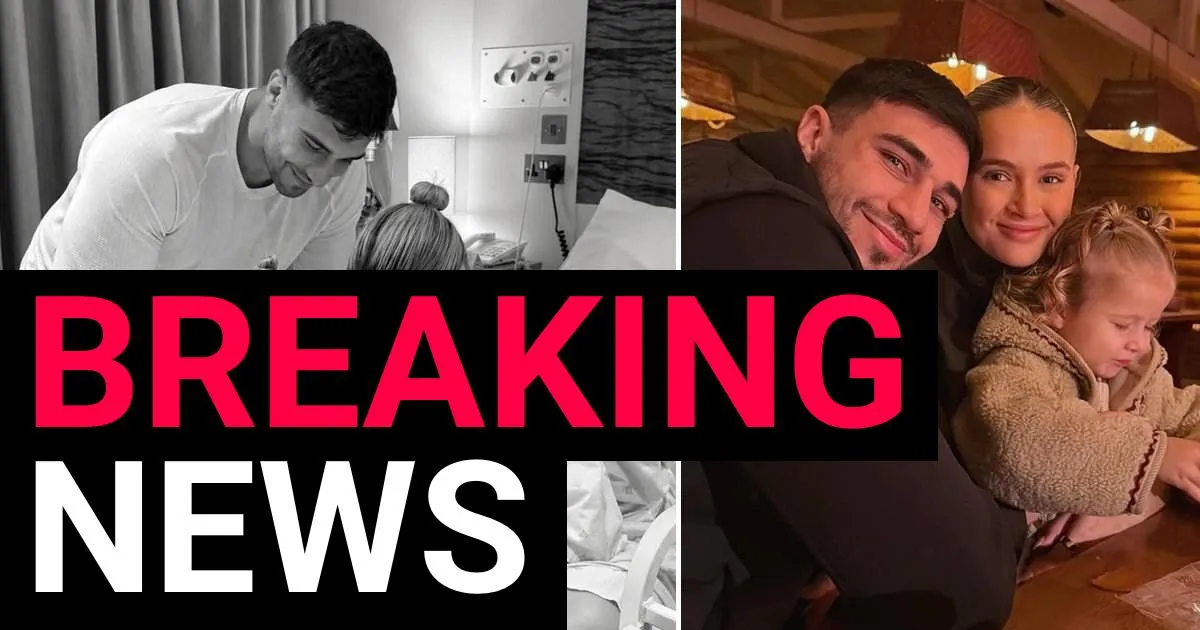
Molly-Mae Hague captioned the post: ‘….and then there were 4’ (Picture: mollymae/Instagram)

Molly-Mae Hague has given birth to her second child with Tommy Fury.

The former Love Island star confirmed the happy news in an Instagram post with the newborn on Tuesday night.

The 27-year-old shared a photo of her hospital bed, with partner Fury and their daughter Bambi looking down on the newborn.

In the snap, Hague was still wearing a hospital gown with a huge smile beaming down at the baby.

Advertisement

Hague has not yet shared the gender of the baby or their choice of name.

The beauty mogul captioned the post: ‘….and then there were 4,’ with a white loveheart.

Molly-Mae gives birth picture: mollymae
The couple welcomed their daughter Bambi in 2023 (Picture: mollymae/Instagram)
Molly-Mae gives birth picture: mollymae
The former Love Island stars haven’t shared the gender of the baby or their choice of name yet (Picture: mollymae/Instagram)

It was clear Hague’s due date was imminent, as in her last Instagram post a week ago to celebrate her 27th birthday, she said she was ‘about to pop’.

The couple, who met on the ITV dating show in 2019, shared the news that they were expecting their second child in February.

Hague, who was by then six months along, shared a black and white montage of clips, including one of her daughter Bambi with a ‘big sister’ jumper on.

Advertisement

The couple welcomed Bambi in 2023 and got engaged later that year.

However, they shocked fans the following year with news of their split, amid rumours of infidelity.

Advertisement

Source link

Continue Reading

Trending

Copyright © 2025