



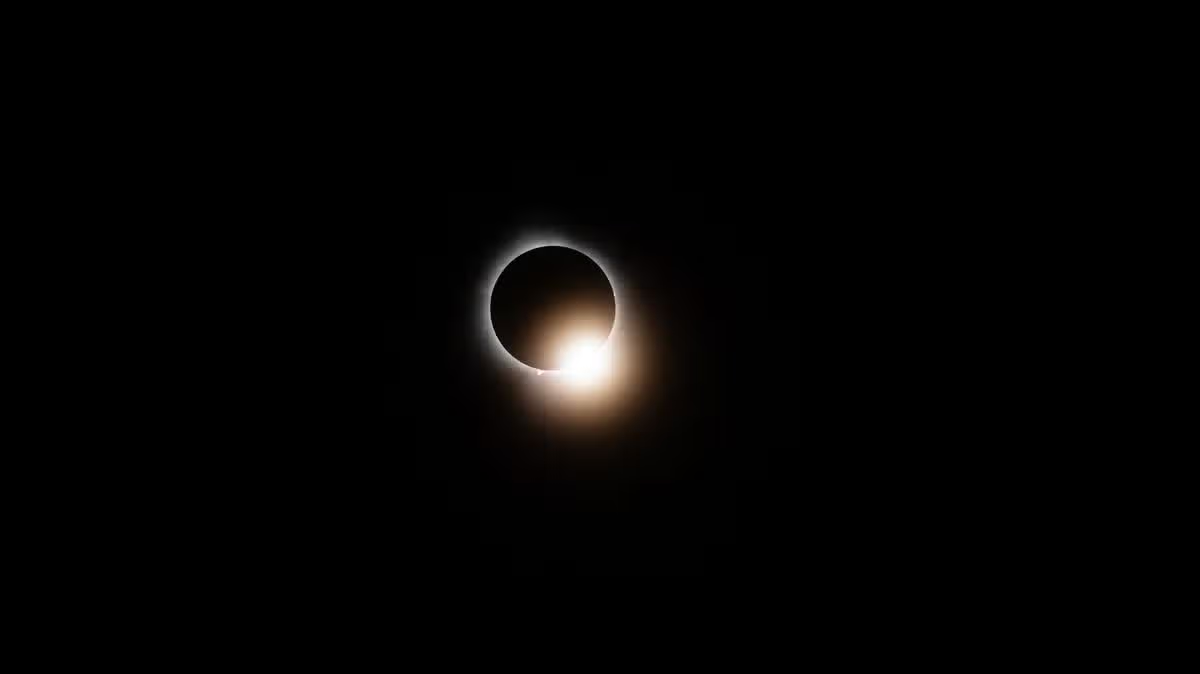
The sun will disappear for a period next week, as a rare astronomical phenomenon takes place
A solar eclipse will see millions of eyes fixed upwards as it sweeps across Europe next week.
The Sun will disappear for a short period in the daytime, as the Moon passes by it, casting Earth into shadow.
And for those unable to see the spectacular event for themselves, there is another way to experience it as it happens.
On Wednesday, August 12, the Moon will pass directly between the Earth and the Sun, blocking some or all of its light and casting its shadow across parts of Europe.
The eclipse’s narrow path of totality, where the Sun will be completely obscured by the Moon, will cross Greenland, Iceland and parts of Portugal and Spain.
Other parts of Europe will experience a partial eclipse, with the Moon appearing to take a bite out of the Sun and temporarily dimming daylight.
To mark the rare event, the European Space Agency (ESA) will be hosting a live broadcast, meaning space fans won’t need to gamble on the weather to see the spectacle as it happens.
The ESA livestream will run from the Observatorio Astrofísico de Javalambre in Teruel, Spain, starting at 5.30pm BST (7.30pm CEST).
It will be hosted by British space scientist and science communicator Dame Dr Maggie Aderin, and will be broadcast in English.
Featuring live interviews, explainers and spectacular imagery, viewers can learn about the mysteries of the Sun and its corona, how one famous eclipse changed our understanding of gravity, and how the ESA is now creating artificial solar eclipses in space.
At 6.31pm BST (8.31pm CEST), the Moon will plunge Javalambre into complete darkness for one minute and 21 seconds.
Anyone with questions about the eclipse can ask them using #AskESA on Bluesky or X, with a selection answered live during the broadcast
The Observatorio Astrofísico de Javalambre is a world-class astronomical observatory located within the path of totality. It mainly consists of two professional telescopes designed to carry out large-sky astronomical surveys that help astronomers study galaxies, dark energy and the structure of the cosmos.
Importantly, viewing conditions at the observatory are excellent, with cloud cover rare and light pollution low. The location offers a very clear view to the western horizon, where the Sun will be beginning to set as it is eclipsed by the Moon.
Additional small telescopes will be taken up to the observatory to observe the eclipse. A live feed from these telescopes at the observatory will provide continuous views as the Moon passes in front of the Sun, offering close-up observations of the different phases of the eclipse.
READ MORE: Christian convert accused of Scot’s suitcase murder ‘turned his back on religion’ before her death
READ MORE: Police remain at Scots beauty spot where 11-year-old girl found dead for third day
When is the solar eclipse?
The solar eclipse will take place on Wednesday, August 12, 2026.
Those in Ireland will see a partial eclipse, while locations within the path of totality will experience a far more dramatic event as the Moon completely covers the Sun.
Anyone watching the eclipse must use properly certified solar viewing glasses and should never look directly at the Sun, even when it appears dimmed by the Moon.
Several videos about the eclipse have been posted on ESA’s YouTube, Instagram and TikTok channels.
See here for more information, or click here to watch the stream live.
Ensure our latest stories always appear at the top of your Google Search by making us a Preferred Source. Click here to activate or add us as your Preferred Source in your Google search settings.

















































You must be logged in to post a comment Login