Connect with us
DAPA Banner
DAPA Coin
DAPA
COIN PAYMENT ASSET
PRIVACY · BLOCKDAG · HOMOMORPHIC ENCRYPTION · RUST
ElGamal Encrypted MINE DAPA
🚫 GENESIS SOLD OUT
DAPAPAY COMING

NewsBeat

why useful social media content gets lost online

Published

on

why useful social media content gets lost online

When Amy posts a photograph of herself on Instagram, she knows what will attract attention. A picture of her in a bikini may receive thousands of views. A post explaining the realities of living with a stoma (an opening in her abdomen that directs waste to a bag attached to it) may reach far fewer people.

“I get caught up in the numbers game like anyone,” said Amy. She has around 5,000 followers on Instagram, which is a respectable following considering that she creates content about surviving bowel cancer. Amy, like many others we have spoken to, uses social media to share her experience, connect with others and raise awareness. But what happens when sharing health information becomes tied to the rules of social media attention?

Finding others facing similar situations can be life-changing for people with rare or rarely discussed conditions. Amy has Lynch syndrome, an inherited condition that substantially increases the risk of developing certain cancers, often at a younger age. About one in 400 people are affected by Lynch syndrome, yet only 5% are aware of having it. Amy’s posts provide something many people with Lynch syndrome struggle to find: accessible information and the experience of someone with the condition.

In our research into how hereditary cancers are discussed online, we spoke to dozens of people around the world who share their experiences of illness on social media. They all told us that their primary goal is to educate others and support their peers.

Advertisement

Some want to represent their communities, especially if they feel these communities are underserved by the healthcare system. Kiara (not her real name) told us: “If you are a black or brown person and you don’t see yourself represented, then the immediate thought is that, ‘Oh, this is not something that we do, this is just something that white women do’.”

Those who post about their experiences of illness often offer information that would be extremely useful in the public domain. Yet the way social media platforms operate can make it difficult for even the most useful health information to reach the people who need it.

Social media platforms are designed around engagement: posts that generate reactions, comments and shares are more likely to be shown to users. Users have increasingly less influence over what appears in their feeds as recommendation systems decide which posts are shown to users. This means that engagement-savvy posts are more likely than others to appear on feeds and searches and face less risk than in the past of being fact-checked and moderated.

Designed around engagement.
Tada Images/Shutterstock.com

Those who share content on social media and want their content to be seen are usually aware of how the platforms work and try to make the most of it. Amy told us: “I’m like, that post is so important and then my dumb post of me in a bikini gets so many more views. I get mad about it, but I think to myself – Hey, if that bikini picture makes them go, ‘What is that on her stomach?’, and brings them to my page, they’re going to see the information.”

Advertisement

Like Amy, the people we spoke to have learned what makes their posts more visible and use this knowledge to curate their content. Sometimes, they even use it to control its visibility and reduce the risk of receiving harmful comments, which can go unmoderated. But this also means that the posts reaching the largest audiences may not always provide the most balanced picture of a health condition. We found that highly visible content creates narrow representations of illness.

What good content looks like

The problem is amplified because social media companies reward content creators whose posts generate high levels of engagement. This does not mean that all users who receive financial rewards are “bad influencers” – but they operate in a profit-driven environment with limited fact-checking and inconsistent moderation. In other words, they deserve scrutiny.

Based on our research, we have put together a set of recommendations to promote helpful health information on social media. If you come across someone sharing their experience, ask yourself: in what capacity do they share information on social media? Do they collaborate with external organisations? What sources do they rely on? How is their personal experience relevant? Use knowledge from reputable sources (health professionals, advocacy organisations) to cross-check the information they share.

Don’t rely on social media alone. Pair information you find on social media with other trusted sources. Charity websites, for example, can host content that would be removed or suppressed from social media platforms. Also, remember that platform algorithms can throw content in unexpected ways – and this can be emotionally triggering. You can control your feed by muting words and turning off notifications as a way of engaging with content on your own terms.

Advertisement

People like Amy are filling gaps that many patients experience between diagnosis, treatment and everyday life. But it may be harder to see them because social media are designed to reward attention over anything else.

Source link

Advertisement
Continue Reading
Click to comment

You must be logged in to post a comment Login

Leave a Reply

NewsBeat

How the cruel TikTok craze for exotic pets is a danger to people AND animals: after Oyster the marmoset was left on a bus, JANE FRYER reveals how evil owners are flushing their pets down the TOILET

Published

on

Last Friday, there was a commotion on the 302 bus at Kensal Rise, north-west London

Oyster the marmoset caused quite a stir last week. It all started last Friday, when there was a commotion on the 302 bus at Kensal Rise, north-west London.

The aisle was blocked by a laundry bag sticking out from the luggage rack. Inside the bag was a cage. And inside the cage was a teeny monkey. Dehydrated, distressed, ‘chirping and jumping’ about, quivering in fear and clearly dumped there deliberately by her owner.

Most of us have heard now how the thoughtful driver took the monkey back to the Metroline Bus Depot at Willesden station and alerted the RSPCA. And how staff named her Oyster, after the travel card.

And how, by a happy twist of fate, while she didn’t quite make it back to her family and her natural habitat in the Brazilian rainforest, she did head off to a specialist sanctuary which, by chance, had been looking for a female companion for its own lone male marmoset. So it seemed like a happy ending to warm our hearts.

Advertisement

But it turns out that Oyster is just one of dozens of miniature marmosets being dumped by their owners over recent months. And, according to rescue experts, she was very much one of the lucky ones.

‘Some are driven out and left in the countryside, or thrown out of car windows. Others are just flushed down the toilet – yes they’re small enough to flush,’ says Lindsay McKenna, founder of Wildside Exotic Rescue in Herefordshire.

‘People don’t know how to keep them. They like the idea of having a pet monkey, they’ve seen them on TikTok or Instagram, but they don’t really have a clue, and now with all the recent changes…’

In April, much needed new legislation was brought in requiring primate owners to apply for a licence to keep their animal and, according to the authorities, the take up rate has been worryingly low.

Advertisement

Last Friday, there was a commotion on the 302 bus at Kensal Rise, north-west London

The aisle was blocked by a laundry bag sticking out from the luggage rack. Inside the bag was a cage. And inside the cage was a teeny monkey

The aisle was blocked by a laundry bag sticking out from the luggage rack. Inside the bag was a cage. And inside the cage was a teeny monkey

Oyster the marmoset headed off to a specialist sanctuary which, by chance, had been looking for a female companion for its own lone male marmoset

Oyster the marmoset headed off to a specialist sanctuary which, by chance, had been looking for a female companion for its own lone male marmoset

Advertisement

While tighter controls are clearly a good thing, Lindsay worries that there is no amnesty and no safety net. Owners who had not really thought through their pet monkey – its care, diet, environment, longevity (they can live up to 15 years) – are simply panicking about acquiring a specialist licence and offloading their pets.

‘If we’re not careful, a whole generation of exotic pets will be flushed down loos or thrown out of cars,’ she says.

And it’s not just primates who are unwanted. Over recent years – thanks partly to social media trends and easier access to wild animals on the internet – the UK has become awash with exotic ‘pets’ better suited to the wilds of Africa, the tropical rainforest of the Amazon basin or steppe grasslands than a terrace in Chesterfield or bungalow in Bristol.

Which is alarming for many reasons, not least animal welfare, disease and biosecurity. But also because a lot of them are downright dangerous.

Advertisement

According to research by international wildlife charity Born Free, more than 2,200 dangerous wild animals, ranging from venomous snakes to big cats, crocodiles and primates, are currently being kept legally across Britain under the 50-year-old Dangerous Wild Animals Act (DWAA).

Campaigners, including Born Free’s founder patron Dame Joanna Lumley, have been clamouring for a change in the law. They want to outlaw the keeping of cobras and rattlesnakes in our bedrooms, monkeys in our sitting rooms and, yes, in some cases, alligators in our garden ponds.

‘Wild animals should never ever be kept as pets, no matter how much we feel we could give them a wonderful home,’ said Lumley.

‘It is shocking that so many are still being legally kept in private hands, propping up a cruel and ghastly trade.’ While some of these animals are located in educational facilities and conservation sanctuaries, a worrying number are in domestic homes around the country – in bedrooms, sitting rooms and garden sheds.

Advertisement
Over recent years, the UK has become awash with exotic ¿pets¿ better suited to the wilds of Africa than a bungalow in Bristol (Chris Hector from Essex Jungle with Hector the monitor lizard)

Over recent years, the UK has become awash with exotic ‘pets’ better suited to the wilds of Africa than a bungalow in Bristol (Chris Hector from Essex Jungle with Hector the monitor lizard)

According to research by Born Free, more than 2,200 dangerous wild animals are currently being kept legally across Britain (pictured: Lindsay McKenna, founder of WildSide Exotic Rescue CIC; Kirsty Gallacher, Born Free patron; Chris Lewis, Born Free research manager)

According to research by Born Free, more than 2,200 dangerous wild animals are currently being kept legally across Britain (pictured: Lindsay McKenna, founder of WildSide Exotic Rescue CIC; Kirsty Gallacher, Born Free patron; Chris Lewis, Born Free research manager)

That includes the world’s deadliest snake, the saw-scaled viper, one of which is currently licensed to be kept in Greater London, for goodness’ sake.

All of which sparks countless questions. About animal cruelty and our safety. About why anyone would want to keep a crocodile or a giant lizard in their back garden in Kent. And why the DWAA – which traditionally was all about keeping humans safe from wild animals rather than focusing on the impact of incarceration on the animal – has not been updated for 50 years. Which seems utterly shameful in this day and age.

Advertisement

People like Lindsay and Paula Stewart, another exotic animal rescuer, and Simon Marsh of Wild Welfare pick up the pieces.

‘We call wild animals exotic pets, but they’re still wild animals with all the behavioural traits of wild animals, even if bred in captivity,’ says Lindsay, who left her corporate job 17 years ago to rescue these animals and currently, with her team, looks after 43 different species including mountain lions, lynx, bobcats, skunks, wallabies, silver foxes and a zebra.

Most came from domestic premises, including four of the mountain lions, which were living in back gardens and can be highly dangerous if they escape.

‘A domesticated wild animal is probably the most dangerous, because they are not afraid of humans,’ says Lindsay. ‘So yes, if they were hungry, they would attack.’ Many of the rescued animals are in a terrible state. Both psychological – pacing, spinning, head turning, self-mutilating – and physical, often suffering from metabolic bone disease and rickets thanks to appalling nutrition and lack of sunlight.

Advertisement

She tells of the poor marmoset who’d lived on marshmallows and dried bananas for the first year of her life and had no sunlight.

‘She looked different structurally to the others and had terrible bone issues,’ she says.

‘How can it be OK to keep a wild animal like that inside a centrally heated house in a hamster cage on its own?’

Lindsay found one young alpaca who was in such a state it had to be euthanised, and mountain lions who have been kept in tiny concrete enclosures.

Advertisement

Paula Stewart, who runs The Animal Talent Agency, started rescuing ten years ago after stumbling across a neglected raccoon – on the banned list in the UK as an invasive species – in a garage in Cardiff.

‘It was a Christmas present for the daughter, was no longer wanted and had become very aggressive and was kept in a crate in the dark,’ she says.

Paula’s corn snake, Candy, was rescued from a domestic house fire. And her beloved bearded dragon, George, was found in an empty flat in Cheshire after the tenants moved out.

‘There was no heating, lighting, food or water. He was just left in a tank abandoned.’

Advertisement

All of which drastically affected his health. He has metabolic bone disease from getting too cold. A crooked tail where it was broken. An underbite on his jaw where it wasn’t properly formed.

Both Lindsay and Paula have noticed a surge in numbers lately and blame social media influencers for encouraging the craze in exotic pets. ‘It’s showing off. It gives them more followers on social media,’ says Lindsay.

Across Instagram and Facebook, videos showing small marmosets sharing strawberry yogurts, sitting on their owners’ heads or being groomed with a toothbrush, garner thousands of comments.

Meanwhile, horrible TikTok videos of men throwing dead rabbits to their gigantic pythons in their sitting rooms gain millions of views. ‘It’s the shock factor that excites people. They’re using wild animals as entertainment. It’s not right and it’s fuelling the market’ says Paula.

Advertisement

Given the horrors they all mop up every week, the animal rescuers are surprisingly generous about the owners. ‘Many really love their pets, but they don’t understand their highly complex needs,’ says Simon Marsh of Wild Welfare. ‘It’s often ignorance as much as neglect.’

Lindsay agrees: ‘The majority never intended harm. They were just swept up in the fascination of it and misled by breeders.’

Many might not know that a marmoset like Oyster is a highly intelligent, sociable, sentient creature, which would naturally live in a linked family group in the wild where they eat fruit, vegetables and insects, rather than on its own in a hamster cage next to the TV.

‘Owners treat them like miniature babies or humans and expect far too much of them. They are wild animals,’ says Paula.

Advertisement

New cobra or ball python owners need to understand that keeping the intelligent snakes in a tank in your bedroom is not meeting their welfare needs.

And that bigger snakes eat entire rabbits and guinea pigs – skin, fur and all – that come frozen in packs of 20 (it is illegal to feed snakes live animals in the UK) and will clog up your freezer for decades.

Those purchasing a pet alligator will need a lot more than a garden pond and a couple of steaks a week; in fact the reptiles need a constantly monitored environment complete with UV lights, humidity controls and water temperature and quality checks.

A big part of the problem is that the new type of exotic pet suppliers are no longer experienced pet shop owners who have the opportunity to vet buyers, and advise and educate them. Now the market is flooded with dodgy breeders who advertise on the internet and sell to anyone happy to pay between £1,000-£4,000 for a baby marmoset, or £30-£300 for a ball python.

Advertisement

Which means that ownership comes with a lot of unwelcome surprises. For starters, how long all these animals live.

Forget the usual four years for a guinea pig, or three for a hamster – a snake can live for 30 years, a lizard between 15 and 20. And up to 80 years for a tortoise or parrot. Even a marmoset will live 14 or 15 years – a lot longer than any social media craze.

Animals, too, can escape.

Every week there are stories of missing exotic – and often dangerous – pets. Nine days ago Stella, a 3ft ball python, was found in a neighbour’s garden in Southborough, Kent, having given her owners the slip for a fortnight.

Advertisement

And for days recently, residents of the village of Bramerton, Norfolk, were on red alert after a large cat, likened to ‘a small leopard’ was spotted roaming the countryside and had been reported to the RSPCA.

Nine days ago Stella, a 3ft ball python, was found in a neighbour¿s garden in Southborough, Kent

Nine days ago Stella, a 3ft ball python, was found in a neighbour’s garden in Southborough, Kent

Blaze, a Savannah cat, was found sunning itself in a plant pot in a family's back garden

Blaze, a Savannah cat, was found sunning itself in a plant pot in a family’s back garden

It turned out to be Blaze, a Savannah cat – a crossbreed of an African wild serval and a domestic cat – which had escaped from a nearby enclosure. Savannahs are a hot favourite on social media.

Advertisement

‘It’s a trophy pet thing,’ says Rick Minter, a big cat specialist. ‘But they are tricky and can be highly aggressive and predatory, so it’s a big commitment.

‘These are not cuddly cats, they can be very fierce and have been known to attack small dogs.’

They are also brilliant escape artists. And many inexperienced owners are just so relieved to see them go that they don’t bother to alert the authorities.

And is not helped by the fact that the law, as it stands, seems mad.

Advertisement

As Chris Lewis, Born Free’s captivity research and policy manager put it last week: ‘The Dangerous Wild Animals Act 1976 was intended to make the keeping of wild animals categorised as “dangerous” a wholly exceptional circumstance.

‘Yet 50 years on, we find ourselves in a situation where nearly ten times more venomous snakes are kept in British homes than British zoos, servals continue to be unnecessarily and cruelly crossbred with domestic cats to produce “fashionable” hybrids, and primates continue to be confined despite the Government acknowledging they are unsuited to being kept as pets.’

And, as a result, they are in grave danger. And their inept and misguided owners are putting the public in danger, too.

Source link

Advertisement
Continue Reading

NewsBeat

Man Utd can solve two problems after approval to sign star Bryan Mbeumo hates playing

Published

on

Daily Mirror

Manchester United continue to bolster their squad during the summer transfer window

Manchester United continue to be linked with Fulham star Antonee Robinson in a move that could provide two benefits to the Red Devils. Not only is the American defender is one of the most experienced left-backs in the Premier League, he’s also the one Bryan Mbeumo hates coming up against the most.

Advertisement

Robinson has drawn widespread admiration across the top flight, but it is the verdict of the United striker that is likely to carry the most weight. Mbeumo named Robinson as the toughest defender he has ever faced while appearing on the Obi One podcast last year.

He said: “I used to play against him when he was at Wigan and (he) changed completely. When he arrived he was really athletic, quick, but with his feet he was like, not so good, you know?

“But throughout the years he improved a lot, and I think now he can do everything. He can attack, he can defend, he’s strong, he’s good with his feet now, and yeah, I think really, really hard to play against him.”

FOLLOW OUR MAN UTD FB PAGE! Latest United news and more on our dedicated Facebook page

Advertisement

Coming from a forward who tormented Premier League defences for years before his switch to United, that endorsement is far and above a huge compliment.

Michael Carrick is understood to be monitoring Robinson closely as he looks to provide competition at left-back. Luke Shaw remains the only recognised senior option in that position following Tyrell Malacia’s departure.

After Malacia’s contract expired, Harry Amass became backup to Shaw. However, the teenager is considered too raw to shoulder the burden alone after just seven first-team appearances.

Robinson has become one of the Premier League’s most consistent and dynamic full-backs, making 26 goal contributions across 215 appearances. He has also earned 58 caps for the United States national team, netting five times.

Advertisement

His age has been flagged as a potential obstacle, with The Guardian reporting that Robinson falls outside United’s preferred target profile. However, the quality of his performances continues to attract suitors regardless.

United can kill two birds with one stone in signing Robinson. He can provide cover – and competition – at left-back and allow Mbeumo to enjoy playing alongside him rather than coming up against him.

Robinson is believed to be available for approximately £25million – a fee that could represent outstanding value for any club willing to invest in a proven performer. For United in particular, securing Robinson alongside the returning Shaw would not only provide Carrick with dependable cover but also hand youngster Amass the breathing room to develop at a sensible pace.

Advertisement

Sky Sports, HBO Max, Netflix and Disney+ with Ultimate TV package

This article contains affiliate links, we will receive a commission on any sales we generate from it. Learn more
Content Image

Sky has upgraded its Ultimate TV and Sky Sports bundle to now include HBO Max, Netflix, Disney+, discovery+ and Hayu, as well as 135 channels and full Sky coverage of the Premier League and EFL.

Sky broadcasts more than 1,400 live matches across the Premier League, EFL and more with at least 215 live from the top flight alongside Formula 1, darts and golf.

Source link

Advertisement
Continue Reading

NewsBeat

Why Crichton Avenue Bridge was built in York in the 1930s

Published

on

Why Crichton Avenue Bridge was built in York in the 1930s

IN his recent article on the General Strike of 1926, Dr Duncan Marks of York Civic Trust mentioned the level crossing at Burton Lane.

What many residents will not know is that before 1929, as you travelled along Burton Stone Lane from the Clifton end, you would have had to take a sharp right turn at the row of terraced houses which was called Field View.

The cast iron sign for the row is still there today but 100 years ago it was just the name of the row of houses and indeed they had a view of the fields to the north of Burton Lane as you headed over the level crossing to Wigginton Road at Bootham Stray bridge over the Foss Islands goods railway, close to Rowntree’s factory.

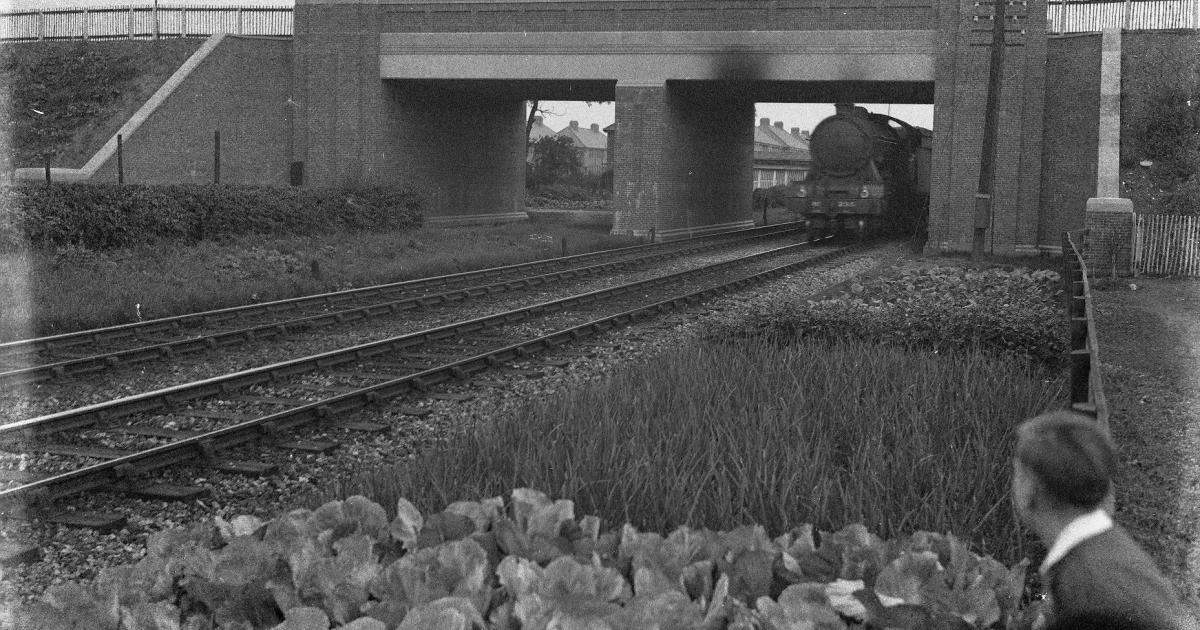
Burton Lane Level crossing in the 1920s. Photo from the Hanstock collection and supplied by YAYAS

In 1929, the Wall Street crash occurred and in Britain, unemployment hit hard; by 1931-2 male unemployment in York reached 20 per cent.

Advertisement

Rowntree’s factory had a difficult decade, with about 6,000 employees at the start of the decade and a fall in numbers of 1,500 by the end.

The company’s unemployment scheme paid on average £11,000 per year from 1923-7. David Sprunt Crichton’s influence on the Rowntree works after the First World War was considerable as a social worker and welfare officer for the company and his work alongside other fellow directors such as J B Morrell and Oscar Rowntree enhanced the factory’s reputation as a caring employer.

Nationally, there were schemes to create work for the increasing number of unemployed men and York was no exception.

The City Council acquired the land at the northern end of Burton (Stone) Lane in January 1929 with a view to building council houses using a loan of £23,578 to build the new roads and sewers.

Advertisement

Crichton Avenue Bridge under construction. Photo from the Hanstock collection and supplied by YAYAS

They also applied for a grant of £17,000 to build a new bridge over the York-Scarborough railway line so that the level crossing could be abolished.

In the November of 1929, a deputation went to London for a meeting with the Chancellor of the Duchy of Lancaster, none other than Sir Oswald Mosley.

At the same time, it was proposed to extend Burton Stone Lane north of its old turn at Field View to form a t-junction with another new road.


Recommended reading:

Advertisement

On January 1, 1930 it was announced that the new road would be named Crichton Avenue in memory of David Sprunt Crichton, the former welfare officer for Rowntree’s who had died in 1921; his widow became Lord Mayor in 1941, long after the new road was created.

This has led to a minor myth that Crichton Avenue was named after Edna Crichton. In an article in the Leeds Mercury of January 1, 1930 titled “Memory of York Man to be Honoured by City Council” it was stated that the new road would be named after David Sprunt Crichton “whose name is so highly honoured in that district”.

Crichton Avenue bridge in York. Picture:Google Maps

The new bridge was opened by the Lord Mayor, Alderman Vernon Wragge in June 1932 along with another small bridge over the Foss at another new road called Fossway. In an article in the Leeds Mercury of June 30, the Lord Mayor said that one of his chief delights was that the level crossing could now be dispensed with and he added that: “this bridge has been built largely with the idea, after the necessities of the neighbourhood have been taken into account, of benefitting the unemployed”.

In YAYAS’ photo archive there are several images by Thomas Hanstock of the new bridge over the railway being built and even one showing a train from Scarborough to York passing under it. Some have speculated that the boy watching the train is none other than Peter Hanstock, Thomas’s son, who donated his father’s collection to the society in the 1980s.

Advertisement

John is the chairman of Yorkshire Architectural and York Archaeological Society (YAYAS) and is a local historian.

YAYAS developed from its foundation in 1842. It publishes the York Historian and YAYAS Times, with articles and news items about York and its surrounds.

It is active with lectures and excursions and is always happy to welcome new members and suggestions for visits.

Its archives include photographic illustrations that can be used for research or reproduction with copyright acknowledgement.

Advertisement

Visit the website www.yayas.org.uk for more information about the organisation, its publications, how you can support it.

Source link

Advertisement
Continue Reading

NewsBeat

Berlin Pride attack latest: Police name 21-year-old suspect after one killed in attack on Berlin’s Pride event

Published

on

Berlin LGBTQ+ march shut down by police after a car drives into crowd
Germany: Hundreds of Thousands March Through Berlin for Pride

One person died and at least 17 others were injured after a car drove into a crowd during Berlin’s LGBTQ+ parade on Saturday evening.

Berlin fire brigade said that three of the victims were in life-threatening condition, while eight were in serious condition, per Sky News.

A suspect in the Berlin attack was identified in the early hours of Sunday morning as a member of the city’s “Islamist scene”, according to police. Police and prosecutors asked for help in finding the 21-year-old, whom they identified as Abdul B.

“We have now identified a suspected perpetrator. Measures against this suspected perpetrator, who has not yet been arrested, are underway. However, this suspected perpetrator is known to the police as a member of the Islamist scene here in Berlin,” said the spokesperson.

Advertisement

According to police, a car had driven into the Tiergarten park, near the route of the pride march, hitting several people.

Hundreds of thousands of people had come to Berlin on Saturday to celebrate at Berlin’s pride parade, known in Germany as Christopher Street Day. It’s one of Europe’s largest LGBTQ+ celebrations.

Police name 21-year-old suspect in Berlin Pride attack

German authorities on Sunday issued a wanted notice for a fugitive suspect in the van ramming near Berlin’s Pride festival that left one person dead and injured at least 16 others.

Advertisement

Police and prosecutors asked for help in finding the 21-year-old, whom they identified as Abdul B.

They said he is believed to have injured several people with a moving vehicle, and that one or more people apparently then left that vehicle. Several people were also apparently stabbed, they added.

Sunday’s notice warned the public to avoid “direct contact” with the suspect, saying that he may be armed and dangerous.

Police had said earlier that they had identified a suspect who has ties to Islamic groups in the German capital.“The suspect is known to police. He is known to us as a member of Islamic circles here in Berlin, and our search for this person is proceeding at full speed,” police spokesperson Florian Nath said.

Advertisement

Nath added that “we still have no information whatsoever regarding his specific motives, the exact sequence of events, or his role in the crime itself.”

Namita Singh26 July 2026 06:29

What is Christopher Street Day?

Berlin’s annual Pride celebration commemorates the 1969 Stonewall rebellion in New York, which began after police raided the Stonewall Inn, a gay bar on Christopher Street in Greenwich Village.

Advertisement

The Berlin LGBTQ+ event is one of Europe’s largest Pride celebrations. Hundreds of thousands of people join the parade, known in Germany as Christopher Street Day.

Namita Singh26 July 2026 04:56

Report says man seen emerging from car that crashed into Berlin crowd and fleeing on ‌foot

The Berlin police said the vehicle was white, describing it as possibly a car or minivan or minibus.

Advertisement

Tabloid newspaper Bild cited a witness as saying it was a van and that a man emerged from it and fled on ‌foot.

Among the injured, eight had serious injuries and of those, three were in life-threatening condition, a fire brigade spokesperson said.

“We have now identified a suspected perpetrator. Measures against this suspected perpetrator, who has not yet been arrested, are underway. However, this suspected perpetrator is known to the police as a member of the Islamist scene here in Berlin,” the police spokesperson told reporters.

Hundreds of thousands of people had gathered peacefully in the German capital for the annual Christopher Street Day celebrations, one of Europe’s largest LGBTQ events, before the apparent attack brought it to an abrupt end.

Advertisement

A large number of emergency service vehicles were at the scene.

“It’s one of the worst days for the queer community and a day I personally hoped I’d never have to experience… I’m shocked,” said Julian Miethig, who attended the event.

Christopher Street Day draws hundreds of thousands of people to the German capital each year. The event commemorates the 1969 Stonewall uprising in New York and combines a parade with political demands for equality, inclusion and protection against discrimination.

Namita Singh26 July 2026 04:46

Advertisement

Police say vehicle struck multiple people after charging into Tiergarten park

One person was killed and 17 others injured, with some in life-threatening condition, after a vehicle mowed down a crowd near Berlin’s Pride celebrations on Saturday evening, setting off a manhunt for ⁠those responsible, the police said.

Hours after the apparent attack many details remained unclear, but police said the vehicle struck multiple people after charging into the city’s central Tiergarten park close to the Brandenburg Gate.

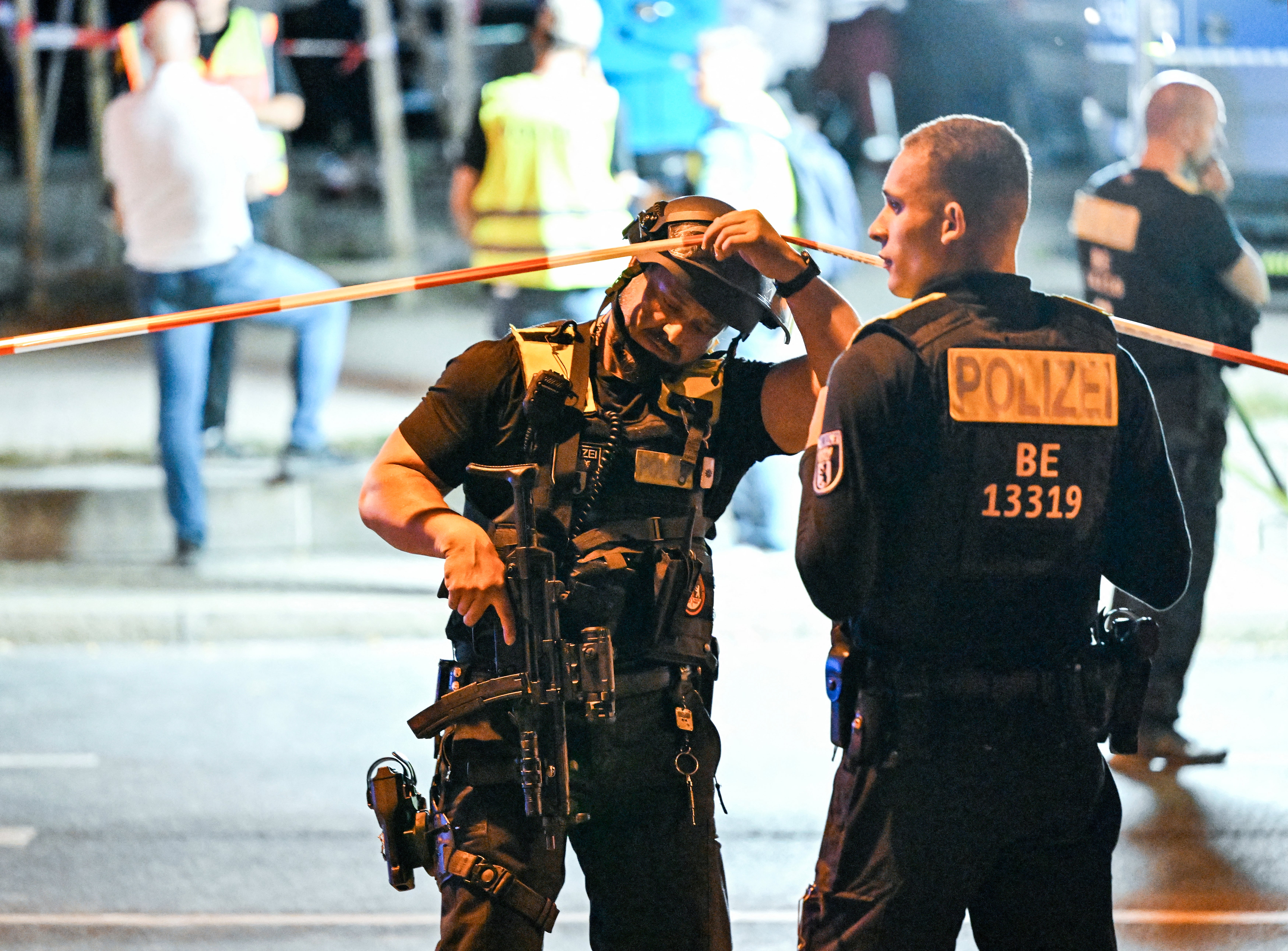
Armed police stand near the scene where one person was killed and around 16 injured after a car struck people on the outskirts of the Christopher Street Day (CSD) parade in Berlin, on 25 July 2026
Armed police stand near the scene where one person was killed and around 16 injured after a car struck people on the outskirts of the Christopher Street Day (CSD) parade in Berlin, on 25 July 2026 (AFP/Getty)

They later said they had identified an Islamist as a suspect and were seeking his arrest.

“According to our latest information, the vehicle drove … into the Tiergarten around 10pm (2000 GMT), injuring several people in the process, and then came to a standstill after hitting a ⁠tree here in the Tiergarten,” a police spokesperson at the scene said.”It was empty, which is why we are currently working intensively to track down the perpetrator or perpetrators.”

Advertisement

Namita Singh26 July 2026 04:39

Major vehicle-ramming incidents in Germany since 2016

Germany has seen a series of vehicle-ramming incidents since the 2016 attack onBerlin’s Breitscheidplatz Christmas market, prompting repeated security alerts around public gatherings, Christmas markets, carnival events and demonstrations.

Berlin, July 2026 Christopher Street Day: One person was killed and 17 others injured.

Advertisement
Emergency personnel and police gather in Berlin, early Sunday, 26 July 2026
Emergency personnel and police gather in Berlin, early Sunday, 26 July 2026 (AP)

Leipzig, May 2026 Central Pedestrian Zone: Two people were killed and three others seriously injured when a car drove into a central pedestrian zone in Leipzig.

Mannheim, March 2025 City Centre Crowd: Two ​people ⁠were killed and 11 others injured when a 40-year-old man drove a car into a group of pedestrians in Mannheim.

Munich, February 2025 Labour Union Demonstration: A 24-year-old ‌Afghan national allegedly drove a car into a labour union demonstration in Munich, killing a woman and her 2-year-old daughter and injuring dozens of others.

Magdeburg, December 2024, Christmas Market: Six people were killed and more than 200 injured when a car ploughed into a Christmas market in Magdeburg.

Berlin, June 2022 Shopping District: A 29-year-old German-Armenian man drove into a crowd in a busy Berlin shopping district, killing a teacher and injuring 14 of her students after mounting the pavement.

Advertisement

Trier, December 2020 Pedestrian Zone: Five people, including a 9-week-old baby, were killed and up to 15 injured when ‌a drunken 51-year-old German drove through a pedestrian area in the western city of ​Trier.

Volkmarsen, February 2020 Carnival Parade: A man drove his car into a carnival parade ‌in the western town of Volkmarsen, injuring dozens ⁠of people, including 20 children.

Berlin, December 2016, Breitscheidplatz Christmas Market: Anis Amri, a failed Tunisian asylum ‌seeker with Islamist links, hijacked a ​truck, killed its driver and then drove it into ‌a crowded Christmas market in Berlin, killing ​11 more people and injuring dozens. He was shot dead by police in Italy four days later.

Namita Singh26 July 2026 04:23

Advertisement

Police identify suspect in the vehicle ramming incident

Berlin police said they have identified a suspect who has not been arrested.

Police said he has ties to “Islamic circles” in the German capital.

“The suspect is known to police. He is known to us as a member of Islamic circles here in Berlin, and our search for this person is proceeding at full speed,” said police spokesman Florian Nath. He did not identify the suspect by name.

Advertisement

Nath added that “we still have no information whatsoever regarding his specific motives, the exact sequence of events, or his role in the crime itself.”

Namita Singh26 July 2026 03:53

Germany has recent history of vehicles being used in attacks

Germany has a recent history of vehicles being used in attacks, Reuters reports.

Advertisement

In December 2024, several people were killed in a car-ramming attack on a Christmas market in the eastern city of Magdeburg. The suspected perpetrator was a psychiatrist from Saudi Arabia with a history of anti-Islamic rhetoric who had lived in Germany for almost two decades, per Reuters.

In 2025, two people were killed in the western city of Mannheim when a 40-year-old man whom authorities described as psychologically unwell drove a car into a group of pedestrians. Weeks before that, an Afghan national suspected by prosecutors of having carried out a similar attack on a trade union demonstration in Munich, killing two and injuring more than 40, including children.

In May, a man believed to have mental health issues drove his car into a pedestrian zone in the eastern German city of Leipzig, killing two people and seriously injuring three.

Graeme Massie26 July 2026 03:28

Advertisement

Suspect not believed to be in Tiergarten area

Police say they searched the Tiergarten area with thermal imaging cameras looking for suspects.

“There are no people in the Tiergarten anymore,” police spokesman Florian Nath told reporters.

The Tiergarten park will remain closed overnight.

Advertisement

Graeme Massie26 July 2026 02:42

Latest scenes from Berlin attack

Armed police stand near the scene where one person was killed and around 16 injured after a car struck people on the outskirts of the Christopher Street Day (CSD) parade in Berlin, on July 25, 2026
Armed police stand near the scene where one person was killed and around 16 injured after a car struck people on the outskirts of the Christopher Street Day (CSD) parade in Berlin, on July 25, 2026 (AFP/Getty)
Armed police stand near the scene where one person was killed and around 16 injured after a car struck people on the outskirts of the Christopher Street Day (CSD) parade in Berlin, on July 25, 2026
Armed police stand near the scene where one person was killed and around 16 injured after a car struck people on the outskirts of the Christopher Street Day (CSD) parade in Berlin, on July 25, 2026 (AFP/Getty)

Graeme Massie26 July 2026 02:14

Suspect identified by police as ‘Islamist’

A suspect in the Berlin attack has been identified as a member of the city’s “Islamist scene”, according to police.

Advertisement

The suspect has not yet been arrested, a spokesperson for Berlin police told reporters at the scene on Sunday morning, per Reuters.

“We have now identified a suspected perpetrator. Measures against this suspected perpetrator, who has not yet been arrested, are underway. However, this suspected perpetrator is known to the police as a member of the Islamist scene here in Berlin,” said the spokesperson.

Graeme Massie26 July 2026 01:55

Source link

Advertisement
Continue Reading

NewsBeat

The Bull Inn in West Tanfield has a riverside pub garden

Published

on

The Bull Inn in West Tanfield has a riverside pub garden

The “picturesque” village is home to The Bull Inn, which has three different outdoor areas for pubgoers to enjoy.

Found just north of Ripon, the village might be worth a visit for a day trip or just as a stop on the way to the Yorkshire Dales.

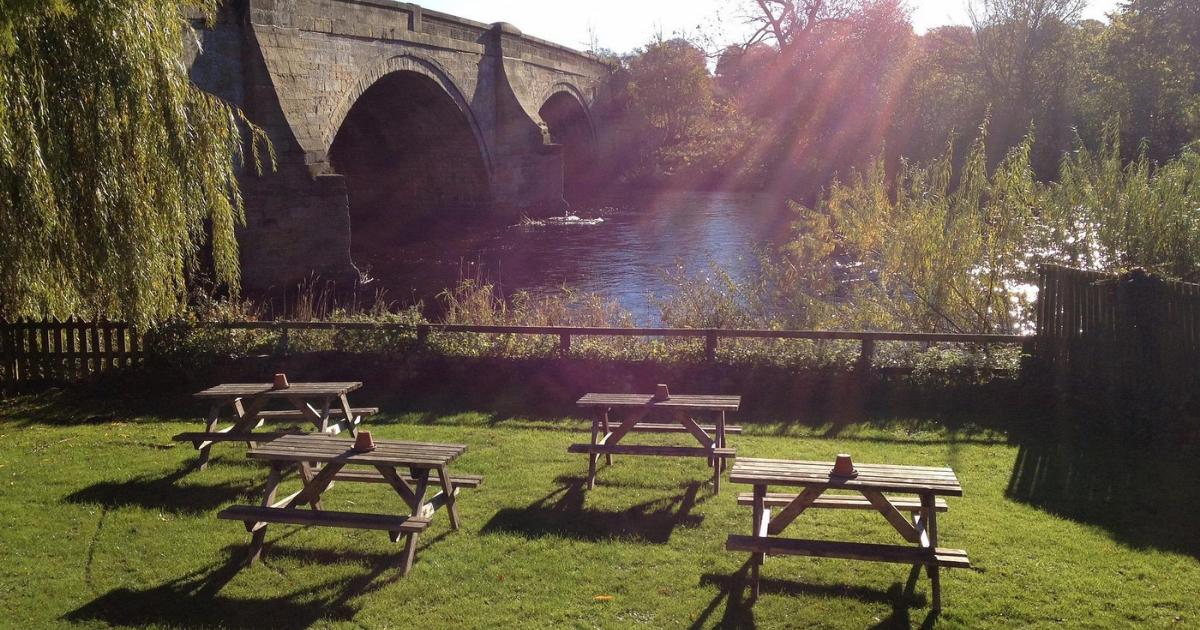
The pub is placed right next to the River Ure, making it a relaxing spot for a quick pint or meal.

The pub serves lots of pub classic dishes and does a Sunday roast. (Image: Tripadvisor)

What is The Bull Inn in West Tanfield like?

The Bull Inn’s garden has flowers planted around its edges and plenty of picnic tables to sit and have a drink while looking over the River Ure.

Advertisement

If you want to be outside but need a bit of shade, the marquee has five tables you can book and is heated in the winter.

There is also the terrace above the pub garden so you can enjoy riverside views no matter where you are sitting.

The pub’s website says: “Located at the gateway to the beautiful Yorkshire Dales, the area around West Tanfield is steeped in history and is an ideal base from which to tour the area.

“For walkers interested in exploring the countryside, routes such as the Ripon Rowel, Yoredale Way, the Staveley Circle, and the Way of the Roses are close by.

Advertisement

“For family entertainment, Lightwater Valley is just a short distance away.

“The Bull Inn has a small private dining room-cum-family room and children are welcome to eat there.”

The Bull Inn serves a range of classic pub dishes from gammon steaks and pies to beer-battered haddock and even a ploughman’s lunch.

Every Sunday, the pub has a roast available where you can have beef served with roast potatoes, Yorkshire pudding, gravy, and traditional vegetables.

Advertisement

There are also lots of sandwiches on offer for those wanting something smaller to eat.

There are plenty of dessert options like lemon curd cheesecake, banana bread and butter pudding that comes with custard, and sticky toffee pudding.

What do guests at The Bull Inn think?

One reviewer on Tripadvisor said: “Just had a fabulous meal in the most stunning location.

“My husband’s curry was absolutely gorgeous, full of flavour, and my ploughman’s lunch had a great variety from the wonderful pork pie to the delicious ham and beautiful cheeses.

Advertisement

“Also, the burger was beautifully cooked and chips were delicious.


“You couldn’t wish for a more lovely spot by the river on a warm sunny day.

“Will definitely be back again.”

Would you ever visit The Bull Inn in West Tanfield? Let us know in the comments.

Advertisement

Source link

Continue Reading

NewsBeat

Prestigious Green Flag awarded to Ropner and Wynyard parks

Published

on

Prestigious Green Flag awarded to Ropner and Wynyard parks

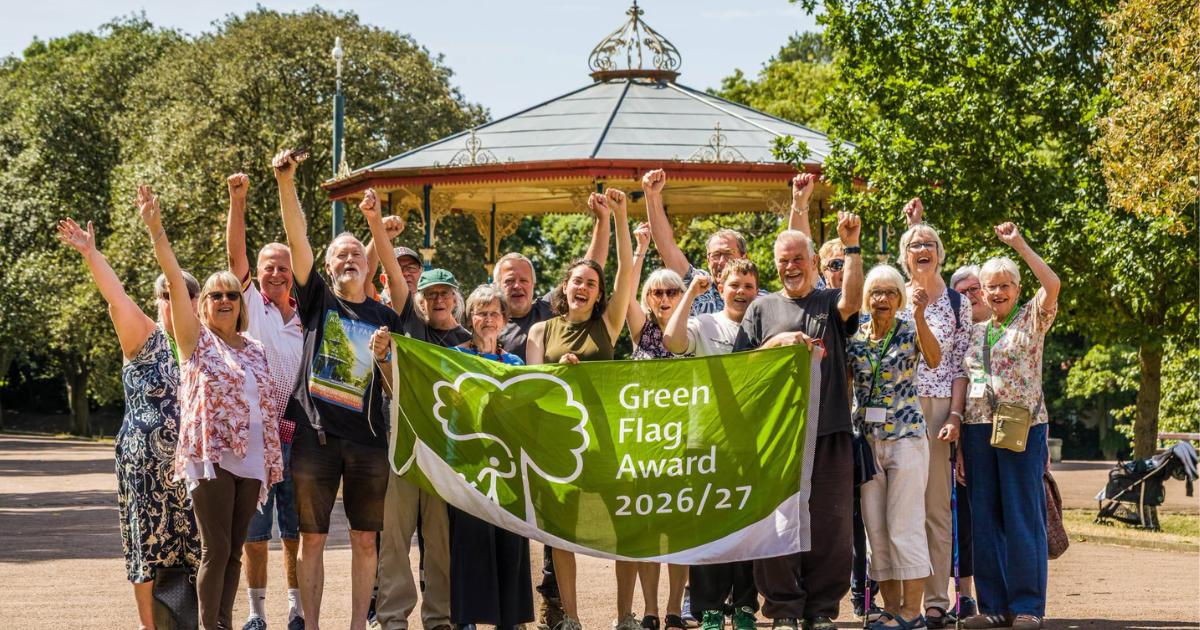
Wynyard Woodland Park and Stockton‘s historic Ropner Park have once again been awarded Green Flag status, an internationally recognised mark of quality for parks and public green spaces.

Wynyard Woodland Walk gets a Green Flag Award. (Image: Stuart Boulton)

The scheme, run by environmental charity Keep Britain Tidy, is regarded as the global benchmark for excellence and rewards sites that are welcoming, safe, well maintained and managed with sustainability in mind.

The awards recognise not only the quality of the parks themselves but also the work of the staff and volunteers who maintain them throughout the year.

Wynyard Woodland Walk gets a Green Flag Award. (Image: Stuart Boulton)

Ropner Park, one of Stockton’s most popular visitor attractions, is known for its Victorian heritage, lakeside walks and family-friendly facilities, while Wynyard Woodland Park attracts thousands of visitors with its extensive network of walking and cycling trails through ancient woodland.

Advertisement

Ropner Park in Stockton gets a Green Flag Award. (Image: Stuart Boulton)

Ropner Park in Stockton gets a Green Flag Award. (Image: Stuart Boulton)

Councillor Nigel Cooke, Stockton Cabinet Member for Environment, Leisure and Culture, said: “The wonderful news that both Wynyard Woodland Park and Stockton’s Ropner Park have won Green Flag Awards is testament to the hard work and dedication of the teams that care for these popular green spaces so that residents and visitors alike can enjoy them all year round.

“This is a fantastic achievement. Congratulations to everyone involved in managing and maintaining Wynyard Woodland Park and Ropner Park, and for working tirelessly to ensure they achieve the high standards required for the Green Flag Award.”

The latest recognition means both sites continue to rank among a select group of parks and green spaces across the UK and beyond to meet the scheme’s high standards.

Advertisement

Source link

Continue Reading

NewsBeat

Why air travel can be so hard on the body

Published

on

Why air travel can be so hard on the body

At any given point there are hundreds of thousands of people in the skies travelling by air. For many, these journeys will pass by without consequence. But for some, a routine flight may trigger a health emergency.

Although these events are rare, with the demand and availability of air travel increasing, so too is the likelihood of an in-flight emergency occurring. A study last year showed that one in every 212 flights experiences some kind of in-flight emergency, while in 2013 it only occurred on an estimated one in every 604 flights. In-flight emergencies cover everything from bumps, cuts and minor injuries through to heart attacks.

While air travel is one of the safest modes of transport, it places many unique challenges on the human body – which is why it can sometimes trigger sudden health problems.

One of the key reasons air travel is so hard on the body is due to the cabin pressure.

Advertisement

The aircraft cabin is pressurised at a level of up to 8,000 feet above sea-level. This pressure change has a significant impact on many body systems, especially those containing gases (such as the respiratory and gastrointestinal systems).

As the pressure in the cabin decreases, the amount of available oxygen decreases because the molecules are further apart. At sea-level, the air contains approximately 21% oxygen. But when flying at altitude, the air only contains the equivalent of 15% oxygen. To compensate, the body increases the number of breaths it takes. It also increases heart rate to better pump oxygen to tissues.

A healthy person probably won’t notice these changes. But for someone who has a cardiopulmonary disease (such as chronic obstructive pulmonary disease or hypertension), these changes in cabin pressure and oxygen levels may be dangerous.

This is because the reduction in oxygen and pressure changes all effect how well the heart and lungs can do their job. For someone whose heart and lung function are already impaired, the aircraft’s unique environment can therefore have an even greater impact on these systems.

Advertisement

Fluid loss and dehydration are another big challenge when it comes to air travel.

Humidity is often very low in-cabin, which dries out the skin, eyes, nose and throat. It also increases water loss from the body – with passengers losing up to 360ml an hour.

This dehydration often makes our blood thicker and reinforces the extra work the heart is having to do to pump blood round our bodies. This sticky blood also increases the risk of clotting-related conditions arising, such as deep vein thrombosis.

In-flight emergencies

Fainting is common on flights. It’s seen in at least one in three airline emergencies. Most are caused by postural hypotension, where going from sitting to standing causes blood to pool in the legs, resulting in reduced blood flow to the brain.

Advertisement

Alcohol and dehydration, combined with the atmospheric conditions onboard the aircraft, make a perfect cocktail for fainting as well. The food we eat onboard can feed into this, too. At altitude, your tastebuds are about 30% less sensitive so foods often have additional salt added for flavour. This further contributes to dehydration.

Some passengers may experience air sickness or jet belly.
Melnikov Dmitriy/ Shutterstock

Many complaints and emergencies on aircraft are the result of gastrointestinal issues. This can include airsickness – a specific form of motion sickness – but more commonly they’re issues at the other end of the body.

When the gut breaks down food, it produces gas – which, on a plane, expands in the gut. This is why everyone finds they’re more flatulent on a plane – a phenomenon aptly termed high altitude flatus expulsion. Certain foods, such as beans, broccoli, kale, onions, red meat, lentils and gluten may make things worse.

When airborne, the gas in the intestines may expand to four times the normal volume. This gas is typically harmless and doesn’t cause an emergency – though their impact on other passengers might.

Advertisement

But in rare instances, upset stomachs – termed “jet belly” – have forced flights to turnaround. For example, a 2023 flight from Atlanta to Spain had to return to the States after a passenger left a trail of diarrhoea along the aircraft.

Although mid-air cardiac emergencies are rare, they have far poorer outcomes than when they happen on land. In fact, the vast majority of in-flight deaths are due to cardiac events.

There are a few reasons for this – including varied and limited in-flight medical equipment and a lack of trained medical professionals.

Other vascular events, such as strokes, are also rare on aircraft, but they can have a particularly poor outcome for similar reasons.

Advertisement

Safe travels

As you jet off on your travels, consider drinking plenty of water before and during the flight. Set a schedule of when you need to take your medication so that you don’t fall behind on taking them.

Try to move around at least once every couple of hours if you can to ensure adequate blood circulation and prevent muscle stiffness. Avoid or limit alcohol intake as its effects at altitude are increased and it exacerbates many of the bodily issues that are brought on by flying.

People who have recently had dental work, surgery or been diving in the days prior to flying may all be at increased risk of complications due to changes in pressure and the potential gases that may have been introduced to the body. Depending on the type of diving, at least 48 hours between diving and flying may be recommended.

Not every emergency onboard a flight will necessitate landing. Ultimately, that decision rests with the captain. But behind it is a calculated decision based on input from crew, medical professionals on the ground (and sometimes onboard), as well as many other factors.

Advertisement

Correction: An earlier version of this article stated: “As the pressure in the cabin increases, the amount of available oxygen decreases”. It should have said “As the pressure in the cabin decreases”.

Source link

Advertisement
Continue Reading

NewsBeat

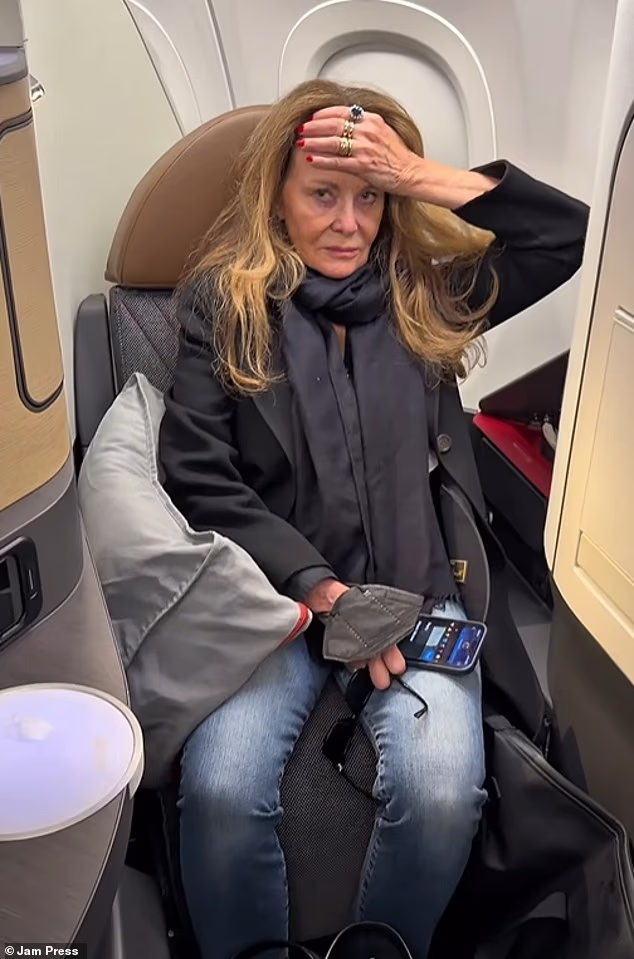
Woman accused of stealing another passenger’s first class seat on American Airlines flight from NYC to LA because hers wouldn’t recline

Published

on

A first class passenger aboard an American Airlines flight claims this woman woke him up and asked to swap seats with him because hers did not recline

An entitled American Airlines flier woke up a fellow passenger and demanded to take his first class seat because hers wouldn’t recline, the dumfounded traveler claims.

Justin Escalona was left stunned by the alleged behavior by a woman aboard his New York to Los Angeles flight on Monday.

The entrepreneur said he was dozing in his seat ahead of the 6am departure when he was rudely awakened by the passenger urging him to switch seats.

Escalona, 27, said he initially agreed as he thought that the woman just wanted to get a better view for five-and-a-half hour flight from JFK. 

Advertisement

He claims she hopped into his lay flat seat before he realized the reason for the swap was because hers did not recline.

Escalona was incredulous and grabbed his phone to record the moments after she sat down and allegedly refused to move.

‘It’s six in the morning and I am getting in a fight in the First Class section,’ he said. ‘I was half asleep, this woman she is currently in my seat, woke me up and was like “hey, you mind swapping seats?”

‘I thought she wanted a better view but no, hers won’t recline and somehow it’s my fault. She won’t get out of my seat, she’s just in it.’

Advertisement

A first class passenger aboard an American Airlines flight claims this woman woke him up and asked to swap seats with him because hers did not recline

Justin Escalona was left stunned by the exchange with a fellow passenger aboard his flight from New York to Los Angeles on Monday

Justin Escalona was left stunned by the exchange with a fellow passenger aboard his flight from New York to Los Angeles on Monday

He then filmed himself heading down the aisle to confront the woman who was sprawled out in a seat designated as 6A. 

Advertisement

‘You gotta get out of my seat, this is crazy,’ Escalona could be heard saying as the woman glared at him.

They sat in an uncomfortable silence as she continued narrowing her eyes and staring acidly at Escalona.

Eventually she let out a sigh and told him: ‘I’m going to UCLA.’

‘I went to USC so that makes it even worse,’ Escalona then joked causing the woman to start to whine.

Advertisement

‘You’re holding up the entire flight,’ he continued, panning to show several passengers who are craning their necks to watch the exchange.

‘You’ve got to get out of my seat,’ Escalona implored as the woman pretended to busy herself on her phone.

‘You were moved sir,’ she tersely replied while barely looking up from the device.

Join the discussion

Advertisement

What would you do if someone demanded your seat simply because theirs was broken?

Escalona said he was snoozing in his seat prior to the 6am takeoff when he was woken up by the woman

Escalona said he was snoozing in his seat prior to the 6am takeoff when he was woken up by the woman

Escalona filmed the argument and included a screenshot showing evidence of his First Class seat

Escalona filmed the argument and included a screenshot showing evidence of his First Class seat

‘My boarding pass says 6A, yours says 3F,’ Escalona continues before the video flashed up photo evidence of his ticket.

Advertisement

The clip then cut to the furious woman gathering her belongings and finally agreeing to move.

‘You are just such a…’ she started, before huffing and shaking her head.

Escalona then finally flopped down in his rightful seat and panned the camera to show his astounded expression.

As he settled in, another passenger could be heard chuckling before telling him: ‘You almost got robbed!’ 

Advertisement

The video sparked fury online with thousands of comments rolling in branding the woman ‘entitled.’ 

However some also criticized Escalona after they pointed out he received his first class seat as a free upgrade, while the woman had paid for her seat.

He spotlighted a comment which said: ‘People gotta realize you have to be spending hella flying for a “free upgrade.”‘

She eventually agreed to move after a tense back and forth with Escalona which he captured on camera

She eventually agreed to move after a tense back and forth with Escalona which he captured on camera

Advertisement

‘That’s what I’m saying,’ Escalona said. ‘Why are so many people acting like this was my f***ing Make-A-Wish?’

Escalona said he was flying home to Los Angeles when the incident took place.

The entrepreneur founded lifestyle streetwear brand 1340 COLLECTIVE, according to his YouTube channel.

Escalona said he founded the brand with a $100 investment and grew it into a company worth $5 million while studying film and TV production at the University of Southern California. 

Advertisement

The Daily Mail has reached out to Escalona and American Airlines for comment. 

Source link

Continue Reading

NewsBeat

Cheaper, intelligent Chinese AI models make inroads in the US

Published

on

Cheaper, intelligent Chinese AI models make inroads in the US

HONG KONG (AP) — China has a hot new product in the United States: artificial intelligence.

San Francisco-based Raffi Krikorian, the chief technology officer at Mozilla, which runs the Firefox browser, switched to Chinese AI startup Moonshot’s Kimi K3 for many of his day-to-day activities within days of the new, powerful model’s launch more than a week ago.

“It just seems snappier,” he said of K3, comparing it to the acclaimed and more expensive Claude Fable chatbot from San Francisco company Anthropic. Earlier, he had been using another high-performing Chinese model, Z.ai’s GLM-5.2, for routine tasks such as managing his calendar, documents and email.

Krikorian is one of a growing number of Americans adopting Chinese AI systems, which are gaining ground around the world because they are more affordable and increasingly efficient. U.S. companies like cryptocurrency exchange Coinbase said they’re switching to Chinese AI models to help trim costs.

Advertisement

Their popularity has frustrated some U.S. tech giants, but short of an outright ban, they’re likely to continue to appeal to independent software developers in the U.S. and elsewhere.

American-led restrictions block China from accessing some of the world’s most advanced technologies including cutting-edge AI chips and U.S. Treasury Secretary Scott Bessent has warned more sanctions could be coming to protect American intellectual property.

U.S. President Donald Trump’s administration on Wednesday accused Moonshot of using “covert” but not necessarily illegal methods to build K3 off the back of Anthropic’s Fable. Some U.S. politicians and AI companies including Anthropic have accused Chinese startups of illicit “distillation” of their models to extract their technologies, a claim that Beijing rejects as “groundless.”

China’s AI models are cheaper and ‘good enough’

The rapid rise of cutting-edge Chinese AI models this year shows the China-U.S. race in AI has moved on from early last year, when Chinese startup DeepSeek shook up the U.S. technology industry and put China on the map with an AI model that performed on par with those in the U.S. but much more cheaply.

Advertisement

The latest AI models launched by startups Z.ai, or Zhipu, in June, and Moonshot in July are nearly as intelligent as the frontier models from OpenAI and Anthropic, experts say. Also in July, China’s Alibaba previewed its Qwen3.8 Max AI model. In April, DeepSeek rolled out previews of its latest V4 model, challenging OpenAI’s GPT and Google’s Gemini.

Those constant advances are bearing fruit. Curt Meinhold, a Greensboro, North Carolina-based technology executive, said he increasingly prefers to use DeepSeek for tasks such as finding business leads or ways to generate sales.

“At the end of the day, most of us, the vast majority of us, 90 plus percent, don’t need (Anthropic’s) Mythos or Fable,” said Meinhold, who founded digital legacy platform LilyList. “Like, we just don’t need it, we need something good enough.”

Chinese AI models are reaching a “critical stage” for wide adoption, U.S. investment bank Goldman Sachs wrote in a July research report, especially when a surge of global “agentic” AI usage, which requires the AI models to autonomously conduct multistep, complex tasks, is driving higher demand for cost effective AI models.

AI prices are calculated per million tokens for both input and output, so the use of AI “agents” is dramatically compounding cost differences, according to analysts including Alex Colville of the Australian Strategic Policy Institute.

“The Chinese models, you know, I find them to be pretty close on code and research,” said Meinhold. “If I can pay a handful of cents per million output tokens versus 30 bucks or 40 bucks or 50 bucks, then it’s good enough.”

Advertisement

Moonshot’s Kimi K3 leads, but Chinese AI models have limits

Based on data over the past month, the top five most popular models on OpenRouter, a platform that tracks data across AI models, were Chinese.

Estimates from Sensor Tower, a market intelligence firm, showed Kimi had more than 930,000 downloads during the week after K3’s July release, an increase of 200% from the week before. In the U.S. it was downloaded around 86,000 times, a 387% jump.

K3 proved so popular that Moonshot had to temporarily suspend new subscriptions after overwhelming demand pushed its capacity close to its limits.

Still, while Chinese models are becoming serious competitors to the U.S., they lag American AI leaders across their overall, full-range capabilities, said Anastasios Angelopoulos, co-founder and CEO of Arena, a platform for evaluating AI systems.

Advertisement

And U.S. AI firms are also looking for more options to reduce pricing, such as with cheaper alternatives of competitive models, added Yasir Atalan, with the Center for Strategic and International Studies.

US policy could boost Chinese AI models

Most Chinese AI models are open-source — meaning anyone can examine and build on them — at a time when frontier models from U.S. companies like Anthropic and OpenAI are closed-source.

Chinese model vendors are expected to leverage open-source software to promote their global usage and adoption, said Lian Jye Su, of the technology research and advisory group Omdia.

As Chinese open-source models are increasingly almost as good as closed systems made by leading U.S. companies, said Mozilla’s Krikorian, “the open frontier is becoming increasingly Chinese-built.” While the U.S. weighs restricting Chinese AI models, a group of American tech firms including Microsoft, Meta and Nvidia signed an open letter published Friday backing “open” AI models.

Advertisement

Other U.S. tech policies also at times give China an upper hand, some experts say. China’s Z.ai released its GLM-5.2 model in mid-June, not long after the Trump administration put export controls on Anthropic’s Fable and Mythos models, keeping them offline for more than two weeks.

“Restricting an American model can immediately create an opening for a Chinese competitor,” said Arena’s Angelopoulos.

Chinese AI models look to expand globally

In China, people and businesses have rapidly embraced AI technologies that have prospered with state support. Chinese tech companies like Huawei and Tencent are also embedding AI in devices such as smartphones, AI glasses and humanoid robots.

Now China is increasingly looking to dominate AI abroad, too. At a flagship technology summit in Shanghai, Chinese President Xi Jinping championed open-source AI models and the importance of promoting greater global equity, while pledging Chinese involvement in raising AI capabilities especially in developing nations.

Advertisement

As is true for many other industries in China, intense competition at home is driving companies to expand globally. Leading Chinese AI startups are now raising more funding to support that effort, including through public share offerings.

Both China and the U.S. will want to “encourage widespread adoption of their AI ecosystems, while safeguarding technologies that could materially strengthen strategic rivals,” said Chelsey Tam, with investment research firm Morningstar.

“The competition is no longer simply the United States against China; the Chinese labs are also putting a lot of pressure on one another,” Angelopoulos said.

But as is the case in the U.S., huge investments in AI have also raised concerns over sustainability of these Chinese startups. Z.ai, for example, reported its revenue surged 132% to 724 million yuan ($107 million) last year, but net loss jumped 60% to 4.7 billion yuan ($694 million).

Advertisement

For now, Chinese AI models will likely continue to march ahead including in the U.S. “I would highly recommend anyone doing any serious AI load to at least evaluate it,” said Krikorian.

___

O’Brien reported from Providence, Rhode Island. AP Business Writer Kelvin Chan in Toronto contributed to this report.

Advertisement

Source link

Continue Reading

NewsBeat

Edinburgh Airport drop-off charge among UK’s highest as costs rise across UK

Published

on

Daily Record

Motorists face paying up to £10 just to drop off passengers at major UK airports

Scots families heading off on holiday are getting hit before they’ve even reached security, as airport drop-off charges continue to climb. New figures suggest the cost of giving a loved one a quick lift to the terminal – and nipping away again – has shot up across the UK, turning a simple goodbye into another travel bill.

Advertisement

For travellers using Edinburgh Airport, the fee is now among the steepest on the list, adding to the cost pressures already facing households. People dropping off there pay £8.50 for 10 minutes.

The RAC says the average “farewell fee” at Britain’s busiest airports has risen from £5.30 last summer to £7 – an increase of around a third in 12 months – with 16 of the UK’s 20 busiest airports putting their prices up. Drivers can now be asked to pay as much as £10 just to stop briefly at the terminal, and the analysis suggests free drop-offs have now disappeared entirely across the top 20 airports after London City removed its last free option.

At the top end are London Gatwick and London Stansted, where motorists pay £10 for a short stop outside the terminal. Edinburgh and Bristol both charge £8.50, while Leeds Bradford, Bournemouth and London City are £8.

The RAC says the UK’s approach looks even tougher when compared internationally. It points out that none of Europe’s 10 busiest airports charges drivers simply to drop passengers at the terminal – and the same applies at major global hubs including Atlanta, Dubai, Shanghai and Istanbul.

And when the fees are broken down by the minute, some charges look even more punishing. At London City Airport, £8 covers just five minutes – equivalent to £1.60 a minute – making it the most expensive in Britain on that basis. Manchester follows at £1.10 a minute, with Gatwick at £1 a minute. Edinburgh works out at 85p per minute.

Most expensive UK airport drop-off charges (RAC)

  • Gatwick – £10 (10 mins)
  • Stansted – £10 (15 mins)
  • Edinburgh – £8.50 (10 mins)
  • Bristol – £8.50 (10 mins)
  • Leeds Bradford – £8 (10 mins)
  • London City – £8 (5 mins)
  • Bournemouth – £8 (30 mins)

Britain’s priciest by cost per minute (RAC)

  • London City – £1.60
  • Manchester – £1.10
  • Gatwick – £1.00
  • Edinburgh – 85p
  • Bristol – 85p
  • Leeds Bradford – 80p

In one comparison, the RAC says paying £1 a minute can actually be more expensive than the cost per minute of a return flight for two from Gatwick to the Greek island of Zakynthos this summer. The organisation also flagged a trap for drivers at airports using barrier-free “pay later” systems. At Heathrow, Gatwick, Manchester, Stansted and Luton, motorists must pay online or by phone before midnight the following day rather than paying on the way out.

Miss that cut-off and a parking charge notice of up to £100 could drop through the letterbox. Rod Dennis, senior policy officer at the RAC, said: “It’s disappointing to see so many airports charging so much for what many regard as a simple act of kindness in dropping off family and friends.

“Having a captive audience should be no excuse for these ‘farewell fees’ – especially when they’re completely at odds with how major airports around the world operate.” He also warned: “Those that drop off but miss the signage, or forget to go online or phone the airport to pay soon afterwards, can face a parking charge notice as high as £100 – a fee that feels distinctly disproportionate to the contravention.”

The RAC said motorists should look out for cheaper or free options, such as using short- or long-stay car parks with shuttle buses to the terminal. However, that can mean extra walking or a longer transfer.

A spokesman for Edinburgh Airport said: “This increase has been driven by a substantial £8 million rise in our business rates bill. That is a significant additional cost which cannot simply be absorbed. As a membership organisation that regularly adjusts its own prices in response to rising costs, the RAC will more than understand these commercial realities.

Advertisement

“Passengers continue to have access to a free pick-up and drop-off area for up to 30 minutes, which has recently been extended and brought closer to the terminal.”

A London Gatwick spokesperson said: “Drop-off charges are part of a range of measures aimed at disincentivising ‘kiss and fly’ trips and supporting our sustainability commitment of at least 52% of passengers travelling to and from the airport by public transport by 2030.

“We don’t take decisions related to this charge lightly, however data indicates that it is effective in influencing passengers to seek alternative options. Passengers can still be dropped off for free in our long-stay car parks, with a free shuttle bus to the terminal and Blue Badge holders are exempt from the charge.

“London Gatwick also has excellent public transport connectivity, with passengers able to travel directly to more than 120 train stations across London and the South East, with eight local bus routes serving the airport 24 hours a day, seven days a week.”

Advertisement

Source link

Continue Reading

Trending

Copyright © 2025