Connect with us

NewsBeat

Why walking in a national park in the dark prompts people to turn off lights at home

Published

on

Why walking in a national park in the dark prompts people to turn off lights at home

As soon as you drive over the top of the Peak District and down into Sheffield you can see the light pollution – and it’s horrible, said a participant in a research project into darkness and light pollution.

In the last 100 years, the places where people can experience darkness have reduced dramatically. Now only 10% of the people living in the western hemisphere experience places with dark skies, where there is no artificial light. And the starry skies they can see are limited by artificial light. The number of stars that people can see from most of the western hemisphere is getting fewer and fewer.

Researchers trying to find out about public attitudes to darkness attended events over three days in the North York Moors National Park. Here, in one of the UK’s seven dark sky reserves (where light pollution is limited), the researchers explored how immersive and fun experiences, such as guided night walks and stargazing and silent discos, reshaped public perceptions of natural darkness and sparked ideas of what they might change in their lives.

Working with a professional film-maker, the research team recorded how people responded to taking part in events in darkness. Participants in the research included five tourism businesses, two representatives from the park and 94 visitors.

Advertisement
People walking with head torches in a dark sky event in North Yorkshire.
Andy Burns.

Darkness disappears

Light pollution is increasing globally by approximately 10% per year (estimated by measuring how many stars can be seen in the sky at night), diminishing night skies and disrupting ecosystems.

But increasing awareness of light pollution has led to an increase in national parks hosting events to explore this issue, according to my recent study.
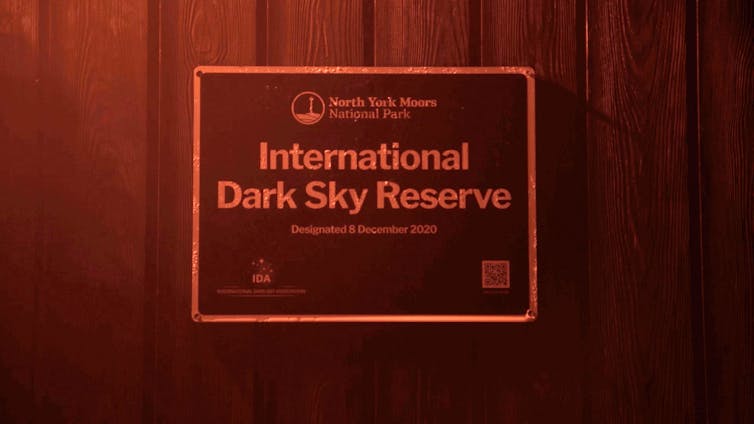
A sign saying international dark sky reserve.

Andy Burns., CC BY-SA

The study’s findings indicated that participants in the North York Moors Dark Sky Festival events not only started to feel more comfortable in natural darkness but also talked about changing their own lifestyle, including using low-impact lighting in their homes, asking neighbours to switch off lights in their gardens at night, and monitoring neighbourhood light levels.

The research team used filming and walking with visitors to capture not just what people said, but what they did in darkness. During guided walks, participants experimented with moving without head‑torches, cultivating night vision, and tuning into sound, smell and learning how to find their way around without artificial light.

Walking in silence helped visitors build a deeper connection with the nocturnal environment. One visitor said that being in the dark just for that moment of peace, and just to listen and tune in to the environment was a privilege and something to conserve.

Advertisement

One said: “I remember as a child I’d see similar stuff from a city [and that] sort of thing, and now we’re doing whatever we can do to save things like this.”

Visitors reported leaving with new skills, greater awareness and commitment, such as putting their lights at home on timers, and working on bat protection projects. These actions demonstrate that this kind of experience in nocturnal environments can change behaviour far beyond festivals.

Dark Sky activists, such as those in the North York Moors National Park, have learned that the public connect with the issues around light pollution and become more engaged if the activities are fun.

Shared experiences help people understand complex messages about climate, biodiversity, and responsible lighting, and help people feel more confident about walking in the dark. Several participants commented that walking without light was good and wasn’t as bad as they thought. Another said: “I find walking at night with a full moon is really quite a magical experience.”

Advertisement

By the end of the walk, some visitors (when on relatively easy ground) were happy to switch head torches off and enjoy feeling immersed within the nocturnal landscape.

Dark‑sky festivals show how joy and fun can build public awareness and an understanding of why darkness matters.

However, limited public transport to rural night events as well as safety concerns about walking in darkness, and the cost of festivals all restrict participation.

Why light is a problem

Research shows that artificial light at night disrupts circadian rhythms, impairs some species ability to find their way around and is a cause of declining populations of insects, bats and other nocturnal fauna.

Advertisement

There is also evidence that outdoor lighting generates needless emissions and ecological harm that is intensifying at an alarming rate.

North Yorks dark skies discussed.

To rethink this shift, the study argues that darkness could be considered a shared environmental “good”, requiring collective care to prevent overuse, damage and pollution.

Small changes in lighting shielding (which controls the spread of light), warmer coloured lights, and half lighting (switching street lighting off at midnight) can be significant and less damaging to animal life.

Advertisement

The national park’s next major step has been to establish a Northern England Dark-Sky Alliance to halt the growth of light pollution outside the park boundaries, particularly along the A1 road in northern England, which would help restore natural darkness for nocturnal migratory species, such as birds like Nightjars.

If we can make living with more darkness in our streets, and in our leisure time, feel more normal and more comfortable, then nighttime becomes not something that needs to be fixed, but a shared commons to be restored.

Jenny Hall is a speaker at an upcoming discussion on Cities Under Stars: Tackling Light Pollution in Cities, in conjunction with The Conversation, as part of this year’s Dark Skies Festival. Find out more, and come along.

Advertisement

Source link

Continue Reading
Click to comment

Leave a Reply

Your email address will not be published. Required fields are marked *

NewsBeat

England A thrash Irish counterparts with eight tries in dominant performance

Published

on

England A thrash Irish counterparts with eight tries in dominant performance

IRELAND XV: Shane Daly (Cork Constitution FC/Munster); Joshua Kenny (Terenure College RFC/Leinster), James Hume (Instonians RFC/Ulster), Dan Kelly (Munster), Zac Ward (Ballynahinch RFC/Ulster); Ciarán Frawley (UCD RFC/Leinster), Fintan Gunne (Terenure College RFC/Leinster); Billy Bohan (Galway Corinthians RFC/Connacht), Gus McCarthy (UCD RFC/Leinster), Scott Wilson (Queen’s University Belfast RFC/Ulster), Charlie Irvine (Queen’s University Belfast RFC/Ulster), Fineen Wycherley (Young Munster RFC/Munster), Max Deegan (Lansdowne FC/Leinster) (capt), Bryn Ward (Ballynahinch RFC/Ulster), Brian Gleeson (Garryowen FC/Munster).

Replacements: Diarmuid Barron (Garryowen FC/Munster), Sam Crean (Ulster), Jack Aungier (Clontarf FC/Connacht), Harry Sheridan (Dublin University FC/Ulster), Paul Boyle (Buccaneers RFC/Connacht), Matthew Devine (Galway Corinthians RFC/Connacht), Cathal Forde (Galway Corinthians RFC/Connacht), Sean Jansen (Connacht).

ENGLAND ‘A’: Joe Carpenter (Sale Sharks); Cadan Murley (Harlequins), Luke Northmore (Harlequins), Orlando Bailey (Leicester Tigers), Ollie Hassell-Collins (Leicester Tigers); Billy Searle (Leicester Tigers), Harry Randall (Bristol Bears); Tarek Haffar (Leicester Tigers), Jamie Blamire (Leicester Tigers), George Kloska (Bristol Bears), Ben Bamber (Sale Sharks), Joe Batley (Bristol Bears), Ethan Roots (Exeter Chiefs) (capt), Jack Kenningham (Harlequins), Alex Dombrandt (Harlequins).

Advertisement

Replacements: Kepueli Tuipulotu (Bath), Archie van der Flier (Leicester Tigers), Afolabi Fasogbon (Gloucester), Hugh Tizard (Saracens), Fitz Harding (Bristol Bears), Raffi Quirke (Sale Sharks), Charlie Atkinson (Gloucester), George Hendy (Northampton Saints).

Source link

Continue Reading

NewsBeat

Everything you need to know after week three of Noah Donohoe inquest

Published

on

Belfast Live
Everything you need to know after week three of Noah Donohoe inquest | Belfast Live

reach logo

At Reach and across our entities we and our partners use information collected through cookies and other identifiers from your device to improve experience on our site, analyse how it is used and to show personalised advertising. You can opt out of the sale or sharing of your data, at any time clicking the “Do Not Sell or Share my Data” button at the bottom of the webpage. Please note that your preferences are browser specific. Use of our website and any of our services represents your acceptance of the use of cookies and consent to the practices described in our Privacy Notice and Terms and Conditions.

Source link

Advertisement
Continue Reading

NewsBeat

Driving instructor shares top tips to tackling roundabouts for learner drivers

Published

on

Manchester Evening News

A driving instructor has shared his handy top tips for tackling roundabouts in the best way when learning to drive, or if you have anxiety when them on the roads

Mastering the art of driving is a vital life skill, but it’s far from simple with numerous elements to grasp, including the various rules that comes with driving through roundabouts. While experienced drivers might know how to do this without having to think twice, it can often feel daunting or nerve-wracking for new, unexperienced drivers. But there are ways to make it easier.

Adem Veli of Passman Driving is a London-based driving instructor with over 15 years of experience, having taught across popular areas in the capital. He also has a popular TikTok channel where he shares clips from his driving lessons for his 45,900 followers as he’s often seen discussing various motoring topics with his students.

Advertisement

In one video, Adem was teaching a woman named Mel, as he went on to ask her if there was anything she felt like she needed more practice on in her driving lessons.

“I’d say roundabouts,” Mel replied, explaining she didn’t yet feel confident driving through them.

Content cannot be displayed without consent

When asked what specifically it was that Mel found unnerving about roundabouts, she explained trying to get out, as she often hesitates when driving, and feels bad when she misses a gap to get into the roundabout.

He then went on to share his top tip for any student drivers about easing their anxieties about driving through a roundabout.

Advertisement

“You don’t just want to just jump out to see, obviously,” the teacher said. “But sometimes, you might see another experienced driver just shoot out, like, don’t think you have to get out with them.”

Instead, you should make sure you get a gap that you are comfortable with driving into before following the correct lanes for the direction of your choosing.

As they then arrived at a roundabout, Mel slowed down and stopped before the roundabout to look out for any other cars coming, before driving through it to turn right onto the next road.

How to correctly drive through a roundabout:

According to the Highway Code, if you’re approaching a roundabout, you should try to take in all the information around you, such as traffic signs, traffic lights and lane markings which direct you into the lane to take you to your chosen direction.

Advertisement

Make sure you known your lane as early as possible, and slowly and safely manoeuvre over to the right while also adjusting your speed and position to fit in with traffic conditions and other drivers around you.

When reaching the roundabout, you should give priority to traffic approaching from your right, unless directed otherwise by signs, road markings or traffic lights. You should also check whether road markings allow you to enter the roundabout without giving way. If so, proceed, but still look to the right before joining.

If you’re taking the first left in a roundabout, use your left signal and approach the left hand lane. Keep to the left on the roundabout and continue signalling left to leave.

When taking an exit to the right or going full circle, unless signs or markings indicate otherwise, start indicating right and approach the right hand lane. Keep to the right on the roundabout until you need to change lanes to exit the roundabout. Signal left after you have passed the exit before the one you want to show other drivers you’re crossing the lane to exit the roundabout.

Advertisement

When there are more than three lanes at the entrance to a roundabout, use the most appropriate lane on approach and through it. Sometimes, road signs will direct you to the right lane, but this is not always the case.

Source link

Continue Reading

NewsBeat

Demand for company to repay council for bin collection intervention

Published

on

Belfast Live

“What assurances do we have that Bryson will repay the cost to the council and the ratepayer?”

A Northern Ireland council has been urged to recoup ratepayers’ cash after the local authority stepped in to help a failing bin collection service.

Advertisement

An environment committee report this week, shows that Lisburn and Castlereagh City Council staff and vehicles assisted in Bryson Recycling with 20,000 properties for about a week in January.

The report states that the intervention by the council has now allowed for Bryson to be “back to business as usual”.

READ MORE: Lisburn rates row erupts over ‘grandstanding’ and confidential breach allegations

READ MORE: PSNI report on ‘dangerous junction’ labelled as ‘false’ at council meeting

Advertisement

Lisburn North independent councillor Gary Hynds said: “Councillor Givan had mentioned such council action at an earlier committee, but it was said that we did not have the resources.

“Is such intervention by the council sustainable in the future?”

The chamber was also told from senior management that Bryson has been experiencing a “period of disruption since August 2025”.

Bryson Recycling, which is responsible for collection bins from 160,000 households across four council areas, has previously identified “unprecedented illness” with its driving staff as the cause of its ongoing delays.

Advertisement

During January’s environment meeting Lisburn North DUP councillor Alan Givan had suggested council staff and lorries being potentially offered to Bryson as support, but this option was not supported in chambers.

Just days later, the council agreed to provide operational support from January 13 to assist Bryson Recycling in recovering outstanding recycling collections.

Castlereagh South Sinn Fein councillor Daniel Bassett added:”I want to say a huge thank you to the environmental services of the council.

“I’m glad Bryson has acknowledged its difficulties and put in place a recovery plan for increased staff members.

Advertisement

“I would also like to have a breakdown of costs to the council.”

The chamber also heard from Alliance councillor Bronagh Magee, that “there were still some areas that have had no bin collections for two weeks”.

Castlereagh South Alliance councillor Martin McKeever added: “I have concerns on the financial impact on ratepayers from the council stepping in. What assurances do we have that Bryson will repay the cost to the council and the ratepayer?

“I couldn’t tolerate the financial burden on the ratepayer.”

Advertisement

A council officer responded:”At the time we responded to Councillor Givan that we did not have the vehicles needed for such kerbside collections of separated recycling materials.

“As a result we had to use open back bin lorries where all separated waste was then co-mingled into the lorry and required to be separated again at Mallusk recycling centre. This really was the last resort and we would not have long term resources for this.

The officer added:”I can now say that bin collections are now back to business as usual. I can assure you there will be a full reimbursement or deduction on the council’s bill.”

The LDRS contacted Bryson Recycling.

Advertisement

A spokesperson said:”This is a contractual matter between Bryson Recycling and the council and we cannot comment on it.”

For all the latest news, visit the Belfast Live homepage here and sign up to our daily newsletter here.

Source link

Advertisement
Continue Reading

NewsBeat

Bad Bunny has the Super Bowl stage. What will he do with it?

Published

on

Bad Bunny has the Super Bowl stage. What will he do with it?

Bad Bunny has said he feels a responsibility, as someone with influence, to highlight important issues. He has consistently used his platform and music to not only showcase his culture, but support the LGBTQ community and advocate for Puerto Rico’s self-determination, which has remained an overseas US territory since 1898.

Source link

Continue Reading

NewsBeat

Andrea Bocelli rescues opening ceremony after Mariah Carey dresses like a meringue

Published

on

Andrea Bocelli rescues opening ceremony after Mariah Carey dresses like a meringue

Meanwhile in the Cortina studio from where the coverage over the next fortnight will come, were stationed a presentational trio of Balding, and former Olympians Lizzy Yarnold and Chemmy Alcott. This suggested that, at least as far as the BBC is concerned, there are seemingly no men involved in these Games.

Though, to be fair, there was a bloke to the helm for the ceremony itself. Indeed the BBC had chosen more than wisely in its commentary team. Joining Hazel Irvine behind the microphone was the incomparable racing reporter John Hunt, a man who could use the Olympics’ apparent power to act as a healing balm.

He and Irvine had much to describe. Not least in who was there in the crowd at San Siro. JD Vance was in the pricey seats, while Britain was represented by the unexpected pair of Princess Anne and Lisa Nandy, who was presumably the only available member of the cabinet solely because she has no chance of maneuvering for the Labour leadership.

Advertisement

As it all got underway, Hunt had a good line about the apparent star of the event.

“Shortly we’ll discover Mariah is for life,” he said of Ms Carey, who was about to sing, “not just for Christmas.”

He spoke a bit too soon. All we could see on the screen for what seemed an interminable grind was the kind of wretched interpretive dance that is only ever unleashed at Olympic opening ceremonies.

Eventually, on came Carey, dressed as a meringue, singing Volare, the tune that won Italy the 1958 Eurovision Song Contest. She struggled to reach the high notes before demonstrating her diva credentials by being carried off the stage. The most pressing thought, though, was that rarely can such a storied artistic heritage as that of the host nation have been so blandly represented as it was here.

Advertisement

Source link

Continue Reading

NewsBeat

Judge orders Trump administration to return 3 deported families

Published

on

Judge orders Trump administration to return 3 deported families

SAN DIEGO (AP) — A judge says the federal government must return three families hurt by the first Trump administration’s policy of separating parents from the children at the border, saying their deportations in recent months relied on “lies, deception and coercion.”

The order, issued Thursday, found the deported families should have been allowed to remain in the United States under terms of a legal settlement over the Trump administration’s separation of about 6,000 children from their parents at the border in 2018. Each mother had permission to remain in the U.S. until 2027 under humanitarian parole.

U.S. District Judge Dana Sabraw in San Diego said the administration also had to pay for their return travel costs.

One woman and her three children, including a 6-year-old U.S. citizen, were deported to Honduras in July after being ordered to check in with ICE at least 11 times over two months, which, she said, caused her to lose her job.

Advertisement

Sabraw rejected the government’s argument that the family left the U.S. voluntarily. The woman said ICE officers visited her home and asked her sign a document agreeing to leave but she refused.

“This did not make any difference to these officers. They took me and my children to a motel and removed my ankle monitor. They detained us for three days and then removed us to Honduras,” the woman said in court documents.

The other two families, identified only by their initials, bore similarities.

“Each of the removals was unlawful, and absent the removals, these families would still be in the United States and have access to the benefits and resources they are entitled to,” wrote Sabraw, who was appointed by President George W. Bush.

Advertisement

Lee Gelernt, an attorney for the American Civil Liberties Union who represents the families, welcomed the decision.

“The Trump administration has never acknowledged the illegality or gratuitous cruelty of the initial family separation policy and now has started re-deporting and re-separating these same families. The Court put its foot down and not only ordered the families return but did so at government expense,” he said.

The Homeland Security and Justice departments did not immediately respond to messages seeking comment Friday.

Under a “zero-tolerance” policy, parents were separated from their children to be criminally prosecuted when crossing the border illegally. Sabraw ordered an end to the separations in June 2018, days after Trump halted them on his own amid intense international backlash. The settlement prohibits such a policy until 2031.

Advertisement

Source link

Advertisement
Continue Reading

NewsBeat

Why countries like Ghana, Benin and Guinea are courting African American stars

Published

on

Why countries like Ghana, Benin and Guinea are courting African American stars

For instance, Liberia, Africa’s oldest republic, was founded by freed black American slaves in 1822. After Ghana became independent in 1957, a wave of black intellectuals and artists moved there from the US. Martin Luther King, Malcolm X and Muhammad Ali subsequently paid high-profile visits to Ghana, while Guinea became home to Black Panther leader Stokely Carmichael.

Source link

Continue Reading

NewsBeat

Housing Executive announces annual rent increase

Published

on

Belfast Live

All tenants are expected to be contacted over the next few weeks to advise of their new rent charges and what they need to do

The Housing Executive has announced its annual rent increase which will take place on April 6.

Advertisement

The increase will see rents go up by 4.8% which will equate to a rise of £3.94 on the average weekly rent. According to the department, the weekly rent is currently currently £82.04, excluding rates.

All tenants are expected to be contacted over the next few weeks to advise of their new rent charges and what they need to do.

Chief Executive Grainia Long said: “Rent from our tenants is a vital funding stream that is invested straight back into our homes and tenant services. It enables us to provide essential high-quality customer and neighbourhood services as well as ongoing maintenance of our homes and significant improvement work.

READ MORE: Police release photograph of individual they want to speak to in relation to UDA bannerREAD MORE: Watch as historic seafront wall protecting picturesque Co Down town is breached by stormy seas

Advertisement

“In 2026/27 we plan to spend circa £270million on improving and maintaining our homes, with more than a quarter of our homes being upgraded with work programmes.

“Importantly £42.3million of this will go to installing new energy efficient measures to make our homes warmer and future proof them for many years ahead. We understand that an increase in rent may be concerning and challenging for some tenants and we are here to help.

“Our dedicated financial inclusion team can provide, free, confidential money advice, help you to manage a budget and check your benefit entitlement. We encourage any tenant who is having difficulty paying their rent, to contact us immediately for assistance and advice. We would also reassure tenants that we will only take legal action incircumstances where rent is not fully paid and a tenant refuses to engage with us.

“We have included details of how to get in touch and the help available in our letter to each tenant.”

Advertisement

81% of Housing Executive tenants receive full or partial Housing Benefit support or Universal Credit towards their rent.

For all the latest news, visit the Belfast Live homepage here and sign up to our daily newsletter here.

Source link

Advertisement
Continue Reading

NewsBeat

I inhaled traffic fumes to find out where air pollution goes in my body

Published

on

I inhaled traffic fumes to find out where air pollution goes in my body

Grigg’s study showed a tight-fitting FFP2 mask led to less air pollution in the blood, but “we’re not saying that everyone should wear a mask”, says Grigg, adding some clinically vulnerable people including those “recovering from a heart attack or have chronic respiratory disease” might benefit while in areas of high pollution.

Source link

Continue Reading

Trending

Copyright © 2025