Connect with us
DAPA Banner
DAPA Coin
DAPA
COIN PAYMENT ASSET
PRIVACY · BLOCKDAG · HOMOMORPHIC ENCRYPTION · RUST
ElGamal Encrypted MINE DAPA
🚫 GENESIS SOLD OUT
DAPAPAY COMING

NewsBeat

Wildfire breaks out in Mumbles as smoke seen for miles around

Published

on

Wales Online

A large-scale emergency services response has been seen in the area on Tuesday evening

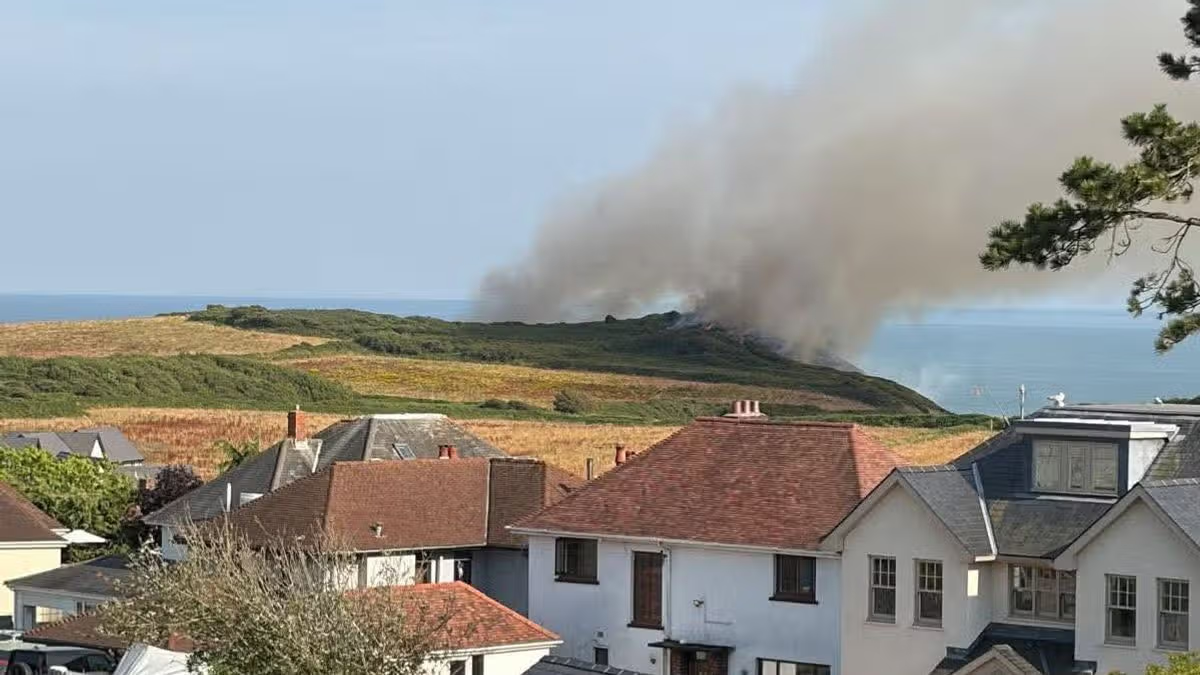
A huge fire has taken hold in Mumbles on Tuesday evening, prompting a large-scale emergency services response. Billowing smoke has been seen in the popular seaside area and from miles away this evening, as the fire service deals with the blaze.

South Wales Police confirmed it was a wildfire, which originated near Mumbles Cricket Club. Never miss a Swansea story by signing up to our newsletter here.

It said in a statement that there is currently no threat to the public, but advised the public to avoid the area.

Advertisement

A spokesman said: “At this moment the fire is not being treated as suspicious.”

County councillors for Mumbles, Angela O’Connor, Will Thomas and Hannah Williams thanked the emergency services for their efforts to bring the fire under control.

They said in a joint statement: “A huge thank you to our incredible firefighters and emergency services who responded so quickly to the fire along the cliff path this evening.

“Thankfully, it appears no one has been injured, and the fire is now almost completely out.

Advertisement

“Early indications suggest it was caused by natural factors.

“We are incredibly fortunate to have such dedicated crews who work tirelessly, often in difficult conditions, to keep our communities and our beautiful coastline safe. Thank you for everything you do.

“Please continue to avoid the affected area until it is declared safe by the emergency services.”

The fire service has been contacted for comment.

Advertisement

Get Swansea news updates on your phone by joining our WhatsApp community here. We occasionally treat members to special offers, promotions and ads from us and our partners. See our Privacy Notice.

Source link

Continue Reading
Click to comment

You must be logged in to post a comment Login

Leave a Reply

NewsBeat

How an unlikely Spain source stunned France to clinch World Cup final berth

Published

on

How an unlikely Spain source stunned France to clinch World Cup final berth

So, in a state with a history of Spanish conquest, history could be repeating itself for Spain. As in Euro 2024, they beat France in a semi-final. As in 2010, they could follow victory in the European Championships by doing the double, by adding a World Cup. Deep in the heart of Texas, Luis de la Fuente’s side took a sizeable step towards greatness.

Didier Deschamps had pronounced them as the favourites to win the World Cup. It turns out that was not just kidology. As the France manager’s epic reign came in effect to an end, it was without a second World Cup or a third consecutive final. Kylian Mbappe may yet go on to become the greatest World Cup goalscorer and player; but not yet, not in Dallas, not now.

Instead, he was outscored on the day by Mikel Oyarzabal, the unheralded striker whose goal decided Euro 2024 and who set Spain towards a still greater triumph. The Real Sociedad captain had an unlikely ally. Pedro Porro, fresh from a Premier League relegation battle with Tottenham, scored a goal to take his side into a World Cup final. But Spain need no reminding that defenders can chip in: their previous World Cup semi-final victory, 16 years ago, came courtesy of Carles Puyol. Watching on, he must have remembered; so, surely, did Sergio Ramos and Xavi, alongside him.

De la Fuente’s team are less defined by tiki-taka but they nevertheless prospered by exerting control. They are borrowing from the 2010 formula, global domination secured by reigning European champions who were immune to conceding.

Advertisement
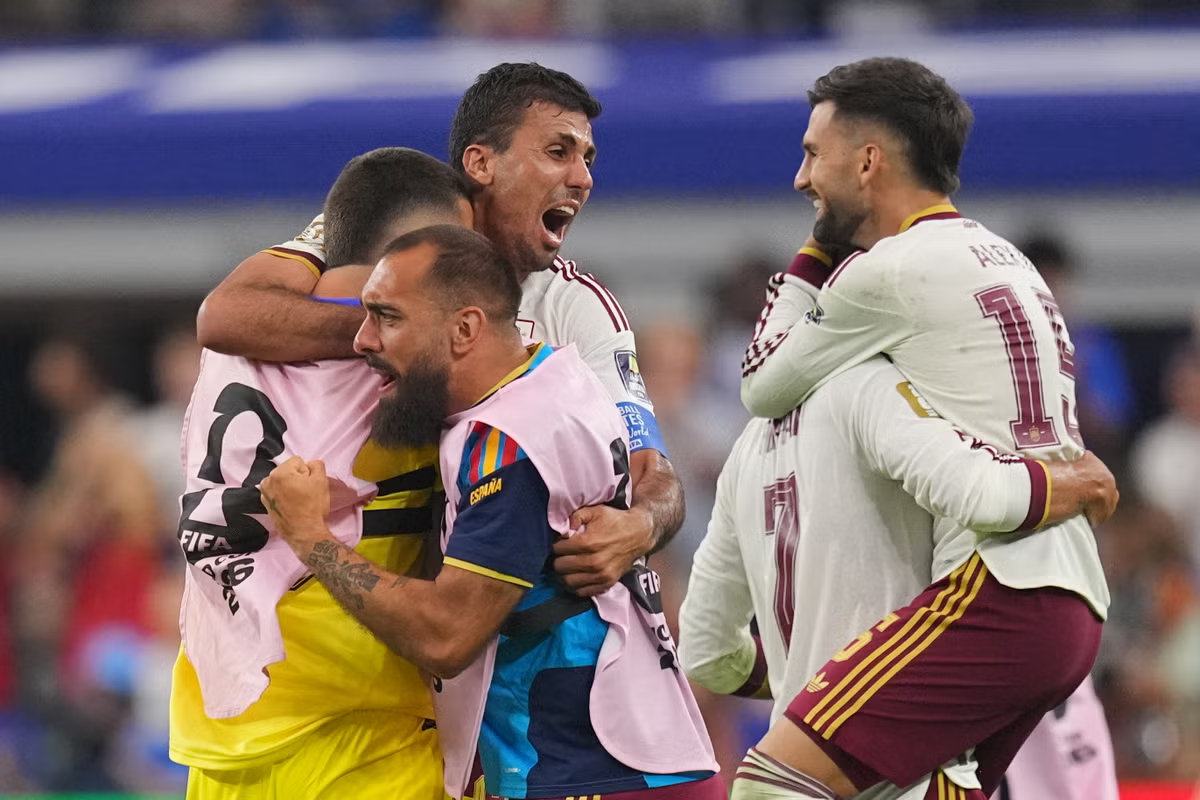
Mikel Oyarzabal of Spain celebrates with teammates after converting a penalty
Mikel Oyarzabal of Spain celebrates with teammates after converting a penalty (Getty)

An almost impenetrable defence has been breached only by Belgium’s Charles de Ketelaere. France, with their previously fabulous front four, were supposed to provide the stiffest test. But they were not the unstoppable force: not when pitted against the immovable object of the Spanish rearguard. After 35 minutes, France had an xG of 0.01. By the interval, it had crept up to 0.04. The numbers showed how negligible their threat was.

Nevertheless, France may feel Spain were scarcely more potent at the start. This was a game that swung on a mistake: sadly for Lucas Digne, he committed it. The left-back has had a fine tournament but a duel with Lamine Yamal always offered the possibility of Spanish success. So it transpired, even if not in the manner that may have been anticipated.

Kylian Mbappe and Lamine Yamal clash
Kylian Mbappe and Lamine Yamal clash (Getty)

Digne headed the ball up in the air and, preparing to clear, not noticing his opponent, volleyed Lamine Yamal instead. A day after his 19th birthday, the teenager got a kick in the ribs and Spain the gift of a penalty. Oyarzabal, who has an impeccable record of scoring in finals, this time struck in the semi-final instead, drilling in his spot kick for his fifth goal of the World Cup.

It was far from Lamine Yamal’s only contribution. The Barcelona winger has still only scored once in this World Cup – he added a terrific finish for what he thought was Spain’s third goal, only to be flagged offside – but he was excellent. He also collected a caution for hacking down Mbappe after tracking back. If nothing else, it was a sign of commitment.

Pedro Porro of Spain celebrates after the win
Pedro Porro of Spain celebrates after the win (Getty)

Oyarzabal’s opener had put France in uncharted territory, at least as far as this tournament was concerned. It was the first goal they had conceded in the knockout stages and the first time they had been behind in the World Cup in four years. They had started slowly in the 2022 final. They did again in the 2026 semi-final. This time, their response was muted; unlike against Argentina in Qatar, there was no dramatic comeback.

Instead, they stopped resembling the best team in the tournament. They were ineffectual in attack, Michael Olise was almost anonymous, Ousmane Dembele provided one wonderful diagonal pass but little else and Bradley Barcola was kept quiet by Porro. Mbappe stirred in the second half, with two shots in as many minutes. Unai Simon had to save from Desire Doue but was largely untroubled.

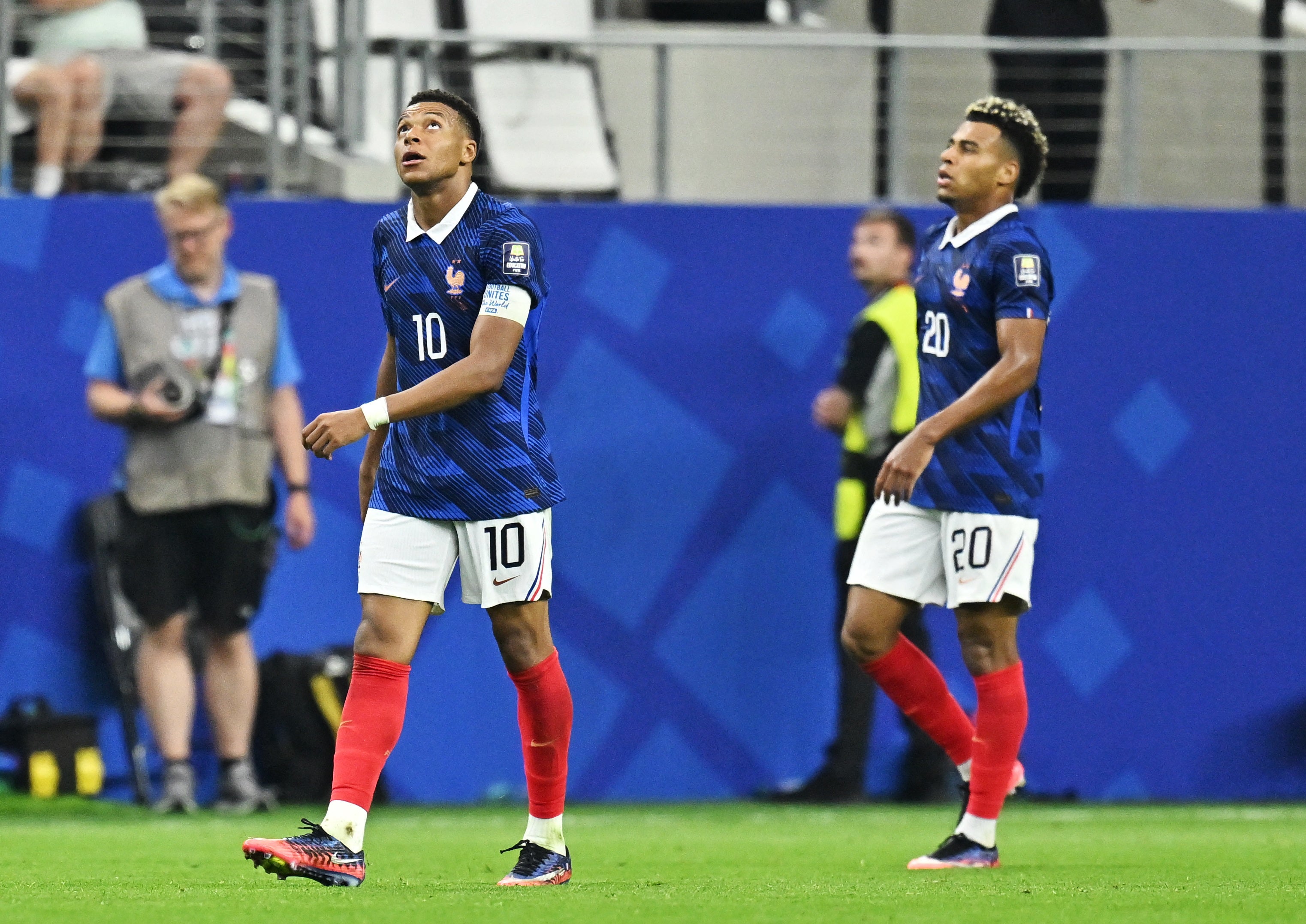
Mbappe and Doue look dejected after defeat
Mbappe and Doue look dejected after defeat (Reuters)

He was well protected with Rodri the dominant force in midfield. Spain provided the game’s classiest move, when Fabian Ruiz could have doubled the lead after a delightful combination between a series of players, meeting Lamine Yamal’s cross only for Dayot Upamecano to deflect his shot wide.

Meanwhile, France had the sense that, bit by bit, everything was going wrong. Adrien Rabiot collected an early booking, risked a second on the stroke of half-time and was removed at the break. No sooner had Oyarzabal scored then William Saliba went off, feeling his back. No sooner had Deschamps sent for Doue then Porro doubled Spain’s lead.

Advertisement
Spain celebrate their 2-0 victory in Texas
Spain celebrate their 2-0 victory in Texas (Getty)

The Tottenham right-back played a one-two with Dani Olmo, with no one tracking his run – Digne and Doue looking the culprits – and slotted a shot beyond Mike Maignan. And in a way, that summed it up: France were caught off guard by Spain. They lost to the cleverer, more cohesive team. It is au revoir to Deschamps’s France, with a sense of what might have been. It is Spain, though, who could regain the World Cup.

Source link

Continue Reading

NewsBeat

Victim of a Shirley Valentine murder: Jean had made a new life in Crete. Then one day she went for a drink with a local man and was never seen alive again. Now, 17 years after her body was found, her killer’s finally been convicted. Why IS he still free?

Published

on

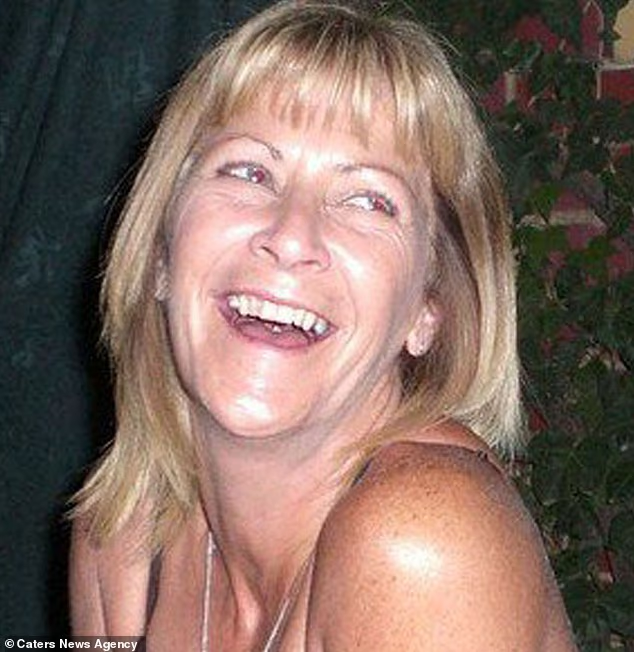
Pictured: Jean Hanlon. Her body was recovered from Heraklion harbour in March 2009 with head injuries and other signs of trauma, but police ruled her death was a tragic accident

When one of Michael Porter’s brothers rang to say their mother had gone missing on the Greek island of Crete, he knew instinctively something terrible had happened.

‘My mind jumped to a worst-case scenario – I didn’t know what it was but I knew it was bad,’ he says.

Nonetheless, Michael could never have imagined that moment would mark the start of a near two-decade quest for justice that is only now approaching a resolution.

For while 53-year-old Jean Hanlon’s body was recovered from Heraklion harbour in March 2009 with head injuries and other signs of trauma, police ruled her death was a tragic accident.

Advertisement

She had, they declared, simply drowned, likely under the influence of alcohol.

Along with his older brothers David, 47, and Robert, 51, Michael refused to believe this. The injuries his mother had sustained – among them a broken neck and shattered coccyx – told them otherwise.

Then there was the haunting final text message she had sent to a friend which read simply: ‘Help’ – and diary entries in which she spoke of being stalked and harassed by a former lover.

None of it made any difference. ‘The Greek police weren’t interested. They didn’t care and they didn’t undertake even a basic investigation,’ Michael, 41, tells me now. ‘Why, we’ll never know.’

Advertisement

Pictured: Jean Hanlon. Her body was recovered from Heraklion harbour in March 2009 with head injuries and other signs of trauma, but police ruled her death was a tragic accident

Michael Porter, pictured, could never have imagined that moment would mark the start of a near two-decade quest for justice that is only now approaching a resolution

Michael Porter, pictured, could never have imagined that moment would mark the start of a near two-decade quest for justice that is only now approaching a resolution

With Jean's phone going straight to voicemail, her anxious sons scrambled to catch a flight, learning from Greek police before they boarded their plane the dreadful news that the body of a woman had been recovered from Heraklion harbour, pictured

With Jean’s phone going straight to voicemail, her anxious sons scrambled to catch a flight, learning from Greek police before they boarded their plane the dreadful news that the body of a woman had been recovered from Heraklion harbour, pictured

Advertisement

In the event, it took 17 years – throughout which the family continued to campaign vigorously for justice – for the police to make an arrest and bring charges, and earlier this month a man was finally found guilty of Jean’s murder at the island’s Lasithi Law Courts in Neapoli.

But the conviction has come with a sting in its tail.

For despite being jailed for ten years last week following a four-day trial, the man – who under Greek law cannot be identified until the entire court process is over – has launched an appeal and will remain free until it is heard.

‘Seeing him walk out of court with his hands in his pockets, not cuffed behind his back, made me furious,’ says Michael.

Advertisement

‘At the same time his conviction is a massive victory and we all feel like Mum’s voice has finally been heard after years of the Greek authorities trying to sweep her death under the carpet.’

In fact, the toll that Michael’s quest has taken is all too evident when we talk shortly after his return to the UK after attending the trial alongside his brothers.

Speaking from his home in London – one wall adorned with a print of a favourite photograph of Jean smiling at the camera – Michael, who works for the Royal Theatrical Fund, is clearly tired.

He and his mum were close, sharing a love of dancing and musical theatre.

Advertisement

‘She was also a bit of a drama queen like me,’ he laughs.

A single mum from Dumfries in Scotland – Michael’s parents divorced when he was five – Jean worked several jobs to make ends meet, supplementing her day job as a secretary at Dumfries & Galloway Royal Infirmary with an assortment of odd jobs.

‘She supported us through everything, really. She didn’t have a lot but she made sure we had the best of what she could get,’ he says. It was not until she was 40 that Jean had her first holiday abroad, booking a trip to Crete with a friend.

‘She fell in love with the island,’ says Michael. So much so that, in 2003 and then in her late 40s, she decided to move there full-time, initially employed by a local tour operator, before she started working independently in local tavernas, returning home during the winter season.

Advertisement

‘She figured she hadn’t left an office job in Dumfries to do the same thing in Crete,’ says Michael. ‘She didn’t earn a lot of money but she was just so happy.’ 

To such an extent that by 2008 Jean, by now surrounded by new friends and settled in the Cretan seaside town of Kato Gouves, decided to make her move more permanent.

That summer, she returned to Scotland for what would be the last time to attend Robert’s wedding. ‘None of us had any idea that this would be the last time we would be together as a family,’ Michael says now.

He last spoke to his mother on March 6, 2009, three days before she vanished. ‘She seemed happy,’ he says. ‘There was nothing untoward.’

Advertisement

Then, on March 11, he received that ominous phone call: two days earlier, Jean had failed to arrive at the house of a friend, having arranged to care for her disabled daughter.

‘It raised alarm bells as Mum would never let people down but when the friend contacted police they told her to come back in 48 hours. When there was still no sign, Interpol then got involved.’

Back home, with Jean’s phone going straight to voicemail, her anxious sons scrambled to catch a flight, learning from Greek police before they boarded their plane the dreadful news that the body of a woman had been recovered from Heraklion harbour.

‘They told us they thought it was a woman aged 30 to 35 who had been in the water for weeks, so that gave us a little bit of hope to cling on to,’ says Michael.

Advertisement

It wasn’t to be. After being taken to the island mortuary on arrival by a representative from the British Consulate, it was clear the body was Jean’s.

Jean's sons, pictured L-R, Robert, Michael and David Porter. Even when they gave police their mum's diary, they took no interest

Jean’s sons, pictured L-R, Robert, Michael and David Porter. Even when they gave police their mum’s diary, they took no interest

Jean pictured with Michael. As each anniversary rolled by, Michael ¿ who became the public face of the family's campaign for justice ¿ tried to keep his mother's name alive

Jean pictured with Michael. As each anniversary rolled by, Michael – who became the public face of the family’s campaign for justice – tried to keep his mother’s name alive

‘Her clothes were laid out and we could instantly recognise some of them,’ Michael recalls.

Advertisement

He chokes back tears as he recalls seeing the body of his mum, sporting what was clearly a deep head injury.

‘It’s hard to process. You’re trying to understand how the hell this has happened, that somebody has done this. Because it was instantly obvious there had been foul play.’

This sentiment was not shared by the police, however, who told her sons that Jean had been the victim of a tragic drowning.

‘It didn’t chime with what we’d seen with our own eyes on the mortuary table but it felt like nobody wanted to listen, nobody cared and certainly no one wanted to investigate,’ he says.

Advertisement

Even when, early on, the brothers gave police their mum’s diary, in which she had written that she was being pestered by a local man – identified only by his first name – with whom she had ended a brief relationship, they took no interest. 

‘This man was stalking and harassing her, coming to her house uninvited, asking her for money, asking her for sex,’ says Michael. ‘Later on the police claimed they didn’t get the diary until 2014.’

And so it was Jean’s sons, rather than the police, who pieced together their mother’s last known movements.

‘At the trial we learned they hadn’t even bothered searching her apartment,’ he says.

Advertisement

She had spent the day shopping before meeting a friend for coffee – mentioning in passing that she thought a car had been following her – before heading to a local taverna, where she was hired as a waitress for the summer season.

‘After that things become hazy, although the fact there was a pile of worn clothes and an ironing board at her home suggests she returned home and changed,’ says Michael. ‘We think a man was there too and used the toilet as the seat was up which mum would never do.’

That evening, a Belgian friend named Peter had called Jean’s mobile phone. ‘She told him she was in the Marina Cafe bar near the port in Heraklion with a man,’ says Michael. 

‘Peter worried that she sounded drugged, so he asked her to pass the phone to the man and had a brief chat with him. The man did not give a name but said he was from Kato Gouves.’

Advertisement

An hour later, she sent Peter that one-word text saying: ‘Help’. 

‘He told police he called her back and she insisted everything was fine. I think it was more out of frustration than because she genuinely felt unsafe, because if Mum had really been frightened she would have screamed,’ Michael insists.

Jean also called Peter later that evening but he had already gone to bed and failed to pick up.

After that, nothing.

Advertisement

None of this convinced the police to investigate further, although by December 2009 – nine months after Jean was killed –family pressure led to a second coroner’s report.

This revealed Jean had died from multiple injuries, including a broken neck, inflicted before she entered the water. It appeared to present irrefutable evidence that Jean’s death was far from an accident but the police verdict remained unchanged. ‘It was still, “She had too much to drink, she drowned”,’ says Michael.

‘They stereotyped her as this middle-aged woman who liked to go out. It made me so angry.’

In fact, cajoling an apathetic local police force into delving deeper into this perplexing mystery would develop into a grinding battle of wills that would last for years to come.

Advertisement

As each anniversary rolled by, Michael – who became the public face of the family’s campaign for justice – tried to keep his mother’s name alive, continually pleading with the Greek authorities for help to unravel the truth surrounding her death.

On two occasions hopes were raised when prosecutors grudgingly agreed to reopen the case, only for them to quickly fade when the files were closed once more.

Her sons battled on regardless, doing whatever they could to keep Jean’s name alive.

Then, in 2023, came an apparent breakthrough: further family pressure led to a fresh inquiry into their mother’s death, which ruled for the first time that it was the result of ‘foul play’.

Advertisement

Then came the Kafkaesque twist: while she may have been unlawfully killed, too much time had passed, meaning there was little chance of identifying her killer.

‘It was devastating,’ says Michael. ‘Getting the case reopened required so much work in a foreign country with different rules. It’s incredibly stressful and it takes away your grief or your connection to your loved one.’

Later that year, Michael contacted a private investigator. ‘Within three months he produced a 29-page dossier with all the information and evidence available, the biggest part being Mum’s diary,’ says Michael.

The investigator also pointed the finger at a suspect: the man who, two years later, would appear in that Cretan courtroom. He was the same man who had been harassing Jean and whose voice Peter immediately recognised as belonging to the man he’d spoken to on Jean’s phone on the night of her death.

Advertisement

‘When police asked how he knew that voice after 17 years, Peter said he would never forget the night he didn’t save his friend,’ says Michael.

‘He felt incredible guilt that he had been asleep when she rang him again.’

Yet they were to face even more hurdles.

While the man was charged with Jean’s murder early last year, the prosecutor subsequently closed the case citing a lack of evidence.

Advertisement

‘The lawyer and the private investigator put together an appeal and, for the first time in Greek history, the senior prosecutor overruled his predecessor.’

Finally, last December, he was charged with intentional homicide, although to the brothers’ astonishment, as he had no previous convictions, he wasn’t placed on remand but told instead not to leave the island.

The eventual trial last month – Michael describes it as a ‘circus’ – was traumatic, not least because he learned the exact nature of his mum’s appalling injuries. 

‘We found out for the first time that she died from a blow to the back of the head with a blunt object which splintered the brain stem and that she wasn’t fully dead when she entered the water. That was horrible,’ he says quietly.

Advertisement

They also learned that the suspect had been diagnosed with schizophrenia and bipolar disorder and was on daily medication which, if not taken, led him to become aggressive.

Today, while confident that his mother’s killer’s appeal will not succeed, Michael cannot be sure. ‘History has shown us not to take anything for granted,’ he says.

In the event, it took 17 years ¿ throughout which the family continued to campaign vigorously for justice ¿ for the police to make an arrest and bring charges

In the event, it took 17 years – throughout which the family continued to campaign vigorously for justice – for the police to make an arrest and bring charges

Michael will never know for sure the exact events of that terrible night, although he has his theory. 

Advertisement

‘I think mum was in a good mood because she had just got a job and she let this man take her for a drink against her better judgment. Then something happened to upset him,’ he says.

Seventeen years on, the impact of Jean’s loss still looms large. ‘I don’t think any of us have properly grieved, because we had to instantly go into fighting mode,’ Michael says.

‘It’s sad because in the fight for justice, you can actually forget that’s your mum. So many years were wasted.’

He takes solace in the fact that his mother would have been so proud of the way her sons never gave up.

Advertisement

‘It didn’t feel like a choice,’ he says. ‘She fought for us our whole lives – and she deserved for us to fight for her.’

Source link

Continue Reading

NewsBeat

Fourth day of Dovestones fire as Greater Manchester residents told to stay indoors and health warnings issued

Published

on

Manchester Evening News

The major wildfire on the moors above Dovestones reservoir continued for a fourth consecutive day on Tuesday (July 14) with residents across Greater Manchester told once again to ‘stay indoors’.

The huge fire, which started on Saturday night (July 11) and prompted a major incident to be declared, ‘remains active’ but is now in a ‘steady state’, the Greater Manchester Fire and Rescue Service (GMFRS) confirmed as they continued to work at the scene.

More than 70 firefighters, 15 engines and wildfire units remained in attendance near Greenfield, Oldham on Tuesday night with major efforts still ongoing to contain the area and prevent further spread.

Click here to get the biggest stories straight to your inbox in our Daily Newsletter

Advertisement

A large plume continued to blow over parts of Greater Manchester, with residents across the region once again complaining of the strong smell of smoke and difficulty with breathing in some areas.

Smog has continued to mask parts of the region, with the smoke blown over large swathes of Greater Manchester on Sunday, with the smell prominent in areas as far as Eccles as well as Stockport and Sale.

Smoke billows over Greater Manchester from moor fires

In an update on Tuesday night, the Greater Manchester Fire and Rescue Service said people in the area surrounding the fire would continue to experience smoke, worsened by a separate wildfire on Tintwistle Moor nearby, and that it could continue to spread for miles.

In areas with visible smoke, residents were once again urged to ‘stay indoors’ and also keep their windows and doors closed where possible, despite soaring temperatures nearing 30C again on Tuesday.

Advertisement

“For the fourth consecutive day, crews from Greater Manchester Fire and Rescue Service are tackling the moorland fire near Dovestone Reservoir,” the latest statement read.

“More than 70 firefighters, 15 fire engines and four specialist wildfire units from across Greater Manchester are at the scene. Our crews are working hard in challenging conditions to contain the fire.

Advertisement

“People in the surrounding area may continue to experience smoke from the wildfire, with a separate wildfire at nearby Tintwistle Moor contributing to a large plume of smoke that has affected parts of Greater Manchester today. If there is visible smoke, stay indoors and keep windows and doors closed where necessary.

“Members of the public are urged not to travel to the Dovestone area and areas affected by smoke from the wildfire. Road closures remain in place to allow emergency services and partner agencies to carry out their essential work.”

The fire service confirmed that the blaze was in a ‘steady state’ and that efforts were ongoing to contain it in ‘challenging conditions’.

New air quality maps have since shown the impact of the smoke billowing from the flames – with Stockport hardest hit on Tuesday.

And according to comments from Greater Manchester residents online, the smog had spread even further afield with those living in parts of Cheshire, Stockport, Wythenshawe and Salford complaining of the smell.

The scale of the incident also prompted health experts to issue warnings. Young children, elderly people and those with underlying respiratory conditions continue to be advised to limit exposure to the smoke as much as possible – but even healthy adults have also been cautioned against exercising outside.

Matt Swallow, a GP specialising in respiratory medicine who is the clinical lead at the Asthma and Lung charity, told the M.E.N that it was ‘sensible’ to avoid exercising outdoors in these conditions.

“Wildfire smoke has lots of fine particles in it, which can traveller deeper into the lungs and cause irritation and inflammation,” he said. Matt also added that even those living further afield should take precautions.

He went on: “If you can see it, or smell it, you are breathing it in. People within a couple of miles will have the highest exposure, but these particles can travel hundreds of miles.”

Advertisement

“You can’t just judge it by distance. If smoke levels are elevated, try and avoid it as much as possible, and stay inside.”

A police investigation into the cause of the fire, now raging on for four days remains ongoing. It comes as 20-year-old Shania Care-Slede appeared in court on Tuesday morning. She was charged with one count of arson, while being reckless as to whether life was endangered, and one count of dangerous driving.

Ms Care-Slede, of Market Street, Hyde, was not asked to enter pleas to the charges and is next due to appear in court for a plea hearing on August 18. She was remanded in custody.

Advertisement

Officers from GMP say they are continuing to pursue a number of lines of enquiry and are seeking to identify any other individuals who may have been involved. Detectives are reviewing video footage that has been submitted to the force.

Detective Inspector Andrew Day said: “While we have secured charges against one individual, our investigation remains ongoing. Detectives are carefully reviewing all available evidence to identify anyone else who may have been involved in criminality linked to this incident.

“We’re committed to pursuing all those responsible. I would also like to thank the public for the support they have shown so far and encourage anyone with information or footage that may assist our enquiries to come forward.”

Anyone with footage or information that may assist the investigation can submit it via the Dovestones Fire Evidence Submission Portal: https://gmp.uk.evidence.com/axon/community-request/public/dovestonesfire

Advertisement

Source link

Continue Reading

NewsBeat

Can England’s upstart Jude dethrone his idol Messi in battle of the Number 10s (with a little help from his mum)?

Published

on

Jude Bellingham of England celebrates during the FIFA World Cup 2026 Quarter Final match between Norway and England at Miami Stadium on July 11

Among Jude Bellingham’s countless viral online appearances, one recently posted interview might fray the nerves of England fans already biting their nails over tonight’s showdown with Argentina.

Drooling over the preternatural gifts of Lionel Messi, our youthful talisman sounds so deeply in awe of his opposite number that many might fear he will freeze in his very presence when the pair share a pitch for the first time in Atlanta.

Happily, this post, in which Bellingham says he studies videos of Messi to learn from him – and implies that it would be an honour to lose to ‘the greatest player in history’ – is an AI-generated fake, perhaps created with malicious intent.

That said, Jude’s admiration for Lionel is very real. He has modelled himself on the little master since boyhood and, a few days ago, when a reporter asked him whether Messi or France’s Kylian Mbappe was ‘the real king’, his response was unequivocal.

Advertisement

‘Messi,’ Bellingham shot back. ‘He’s been the king for 20 years and he’s not dethroned.’

Indeed not. Eight sumptuous goals, two assists, and four undisputed man-of-the match awards at this World Cup are proof of that.

Yet Messi turned 39 last month and now plays a stunningly effective version of walking football (the new sport for middle-aged has-beens), idling around disdainfully as inferiors toil to find an opening for him, then striking like a cobra when the moment comes.

Though his crown hasn’t yet slipped, soon it surely must and, when it does, Bellingham – 16 years his junior and biologically young enough to be his son – along with France’s Hammersmith-born prodigy Michael Olise and Spain’s 19-year-old ‘nino prodigo’ Lamine Yamal, will be among a handful of would-be usurpers.

Advertisement

Jude Bellingham of England celebrates during the FIFA World Cup 2026 Quarter Final match between Norway and England at Miami Stadium on July 11

Bellingham with his mother Denise on the pitch Borussia Dortmund v Real Madrid, UEFA Champions League at Wembley Stadium, London in 2024

Bellingham with his mother Denise on the pitch Borussia Dortmund v Real Madrid, UEFA Champions League at Wembley Stadium, London in 2024

After his heroics against Mexico and Norway, some English fans are crowing that Bellingham has already reached Messi’s rarefied level. 

Advertisement

Such talk is premature and may never pass muster. When, recently, the Argentinian himself named the rising stars who might take his mantle, Bellingham didn’t even rate a mention.

Cometh the hour, however, cometh the man. In World Cups past, the trophy has been lifted by teams gifted with one outstanding individual: think Pele in Sweden, 1958; Maradona in Mexico, 1986; Messi himself in Qatar four years ago.

It was the ability of these now-legendary figures to produce match-defining performances on the biggest stage that secured their place in football’s pantheon.

Tonight we will find out unequivocally whether Bellingham, who plays in a deeper-lying position than Messi but already has six goals (plus an equally decisive, last-ditch clearance during England’s victory over Mexico), has what it takes to join them.

Advertisement

When England stalwart Paul Merson remarked this week that elite football tournaments are won by ‘X-factor individuals’ rather than teams, he may have had Bellingham and Messi in mind.

Some pundits go so far as to bill the semi-final as a straight shootout between these rival Number 10s. So, on the field and off it, how do they compare?

Superficially, there are very visible disparities between them. At 6ft 1in, Bellingham towers six inches over his rival and, with his elegant athleticism, he glides to every corner of the pitch, a Rolls-Royce to Messi’s zippy little Porsche.

Before the media cameras, they are different beings, too. Where Messi invariably grunts a few guarded remarks, Bellingham is pure box-office, wearing his Lion-sized heart on his sleeve and turning on the charm that enhances his movie-star looks.

Advertisement

After England’s manager Thomas Tuchel declared the team ‘lucky’ to have beaten Norway in the quarter-final, his ‘world-class’ star belittled him by stating a truism: that the German, who only played low-level football, could have no idea what it was like to face such formidable opponents in the sweltering heat of Miami.

Not one for public shows of emotion, Messi would probably have shrugged and agreed with the boss.

Whisper it in the presence of Falklands War veterans, in fact, but by dint of his metrosexual charisma, the young Englishman is far more appealing to many Gen Z Argentinians than their ageing compatriot, megastar though he may be.

Lionel MessiArgentina looks on during the FIFA World Cup 2026 Quarter Final match between Argentina and Switzerland on July 11

Lionel MessiArgentina looks on during the FIFA World Cup 2026 Quarter Final match between Argentina and Switzerland on July 11

Advertisement
Messi's mother Celia gives the 2009 Ballon d'Or trophy to her son at Nou Camp stadium in Barcelona

Messi’s mother Celia gives the 2009 Ballon d’Or trophy to her son at Nou Camp stadium in Barcelona

One Instagram reel doing the rounds in Buenos Aires this week shows a sky-blue shirted fan in despair as his hysterical girlfriend screams at the TV. 

‘Does your girlfriend have a crush on Bellingham, too?’ reads the caption.

Another video, aimed at his many gay male fans, shows him stripped to his shorts. ‘How can you stay straight after seeing this picture,’ smiles the popular Argentinian streamer who posted it.

Advertisement

When it comes to their respective playing records there appears to be another yawning chasm between them. 

Messi has won the Ballon d’Or for the world’s best player eight times – three more than the man with whom he is most often compared, Cristiano Ronaldo – and has scored at least 910 goals, ten times more than Bellingham, who has yet to win the Ballon.

Comparing the pair’s feats at the same age, however, the contest becomes more equal. Indeed, Bellingham has a far better World Cup record than Messi at 23, having scored seven times to his once.

It’s when we come to the similarities between tonight’s leading lights, though, that things become more intriguing.

Advertisement

Take their backgrounds, which both proudly describe as ‘working-class’ – though that terminology carries rather different meanings in the dirt-poor barrios of Rosario and the affluent West Midlands market town of Stourbridge.

Of Spanish and Italian descent, Messi’s father, Jorge, worked at a metal factory and his mother, Celia, made magnets (which helped the ball stick to Lionel’s feet, locals like to joke).

He honed his dribbling skills on scrubland near his grim concrete house, which is now a boarded-up shrine, and his earliest influence was his maternal granny, Celia Olivera Cuccittini, who arranged his first trial match, aged six, and was always there to watch him. 

Blessed with breathtaking speed, balance and ball control, at 13 he came to the notice of Barcelona’s South American scouts and decamped with his family to Spain.

Advertisement

As he then stood just 4ft 7in, the average height for a nine-year-old, the club feared he might never be tall enough to fulfil his talent, but growth hormone treatment helped him grow a further foot.

Such developmental problems didn’t beset Bellingham, a budding Adonis from birth. Unlike Messi, as an infant he was bored by football – he would wander away from early games to make daisy chains for his mother, Denise, he says amusingly.

But as he watched his policeman father, Mark, scoring prolifically for minor teams such as Halesowen Town, his passion for the game grew, and by 16 he had become the youngest player to represent Birmingham City.

Messi runs with the ball during the World Cup Quarter Final match at Kansas City Stadium

Messi runs with the ball during the World Cup Quarter Final match at Kansas City Stadium

Advertisement

While Messi began his career at Barca, one of the world’s leading clubs, the Bellinghams steered Jude along a different path, advising him to bypass the Premier League and join unfashionable German team Borussia Dortmund, who develop and fast-track young players.

Though both roads ultimately led to the top, there have been bumps along the way.

For Messi, the most formidable stumbling block has come in the similarly squat shape of Diego Armando Maradona.

Leaving aside who is the greater player – a question that leaves the global jury hung – in Argentina, at least, Messi has never been revered like his predecessor, who is afforded godly status, and probably never will be. As I have learned on my visits, the reason is buried deep in the Argentinian national psychology.

Advertisement

It is a country where tragedy and heroism go hand in hand, and where public figures such as Maradona and Evita Peron, who open their souls and lay bare their flaws, are put on a pedestal, the only proviso being their undying love for their benighted homeland.

That the introverted and seemingly passionless Messi has never been able to demonstrate his patriotism in the same melodramatic manner made it difficult, for many years, for Argentinians – much as they respected his artistry – to take him to their hearts.

His unwillingness to be drawn into the perpetual political struggle that divides his countrymen, unlike the avowedly communist Maradona who sported a tattoo of Che Guevara and counted Cuban revolutionary Fidel Castro as a friend, further alienated him from fans.

Not long ago, Argentina’s ‘chainsaw’ president, Right-wing populist Javier Milei, mockingly declared that Messi’s famous left foot and his socialist views were well matched.

Advertisement

Yet as his team moves closer to a fourth World Cup triumph, Milei appears keen to claim him as an ally. Leftist Argentinians were dismayed, earlier this year, when Messi and his new teammates at Inter Miami – the Major League Soccer club partly owned by David Beckham – met Donald Trump at the White House.

With rampant inflation causing hardship to millions of his countrymen, some also find his ultra extravagant lifestyle distasteful.

With commercial interests ranging from real estate to a stake in Apple TV, his on and off-field income totals £105million, according to Forbes magazine’s list of highest-paid athletes, and he is already estimated to be a dollar billionaire.

Meanwhile, his childhood sweetheart Antonella Roccuzzo, 38, with whom he has three sons and whom he married in 2017, is belatedly forging a lucrative career as an influencer.

Advertisement

Adding to their ranch in Rosario and sprawling property near Barcelona, they recently bought an £8million waterfront mansion in Fort Lauderdale. 

Bellingham celebrated his goal with Noni Madueke (left) and Harry Kane (right) against Croatia on June 17

Bellingham celebrated his goal with Noni Madueke (left) and Harry Kane (right) against Croatia on June 17

Then there is his exotic car collection, one of the finest in the world, which reportedly includes a 1957 Ferrari 335 S Spider Scaglietti that is said to have set him back £20million.

All this, and yet it appears that it isn’t enough. For in 2016 a Spanish court convicted Messi and his father, who handles his business affairs, of evading tax on £3.5million of hidden image-rights income. They were initially sentenced to 21-month jail sentences, but these were later commuted to substantial fines.

Advertisement

A further shadow was cast over the pair’s financial dealings that same year, when the Panama Papers – a huge cache of financial and legal documents leaked in 2016 – revealed that they owned an undisclosed shell company in the Central American country.

In fairness, though Messi may never be deified by his compatriots, he is now a long way down the road to redemption.

Any perception that he didn’t bleed for the sky blue and white striped shirt, like Maradona, was dispelled by the tears he shed after almost singlehandedly leading Argentina to glory at the 2022 World Cup in Qatar. He scored in every knock-out round, and netted twice in the final.

That he can still outperform the world’s best as a strolling 39-year-old is only enhancing his air of immortality.

Advertisement

Over the past two years, of course, the young pretender has also found himself struggling to recover the love of his country. In Bellingham’s case, the opprobrium was born of the unpleasant arrogant streak he seemed to be acquiring as his star rose.

For a while, as we cringed at his posturing and preening, and apparent disrespect for officials and opponents, his behaviour seemed in danger of destroying him. 

Tuchel said his mother found Bellingham’s antics ‘repulsive’ and, incredible though it now seems, some informed football observers even argued against his selection for the World Cup.

We can now see that, as with many other great sportsmen –from Muhammad Ali to Ian Botham – Bellingham’s ego is an essential part of his makeup.

Advertisement

Yet it took clever psychology from Tuchel, who briefly dropped him and warned that his place in the team was far from guaranteed, to help him direct it to his own, and England’s, advantage.

With his Californian influencer girlfriend and post-football ambitions (on a recent karaoke car-pool jaunt with James Corden he declared his aim to star in a James Bond film), Bellingham is clearly relishing his new life as an A-lister.

In many ways, however, this admirable young man represents the finest qualities of Englishness. He speaks three languages, privately supports a charity that educates Kenyan children, and this week admitted his mother had coached him on how to avoid the yellow card that would have seen him banned for tonight’s match.

Now the whole nation loves Jude again. And if the usurper in waiting can summon another match-winning performance, in the presence of greatness, his coronation may not be long in coming.

Advertisement

Source link

Continue Reading

NewsBeat

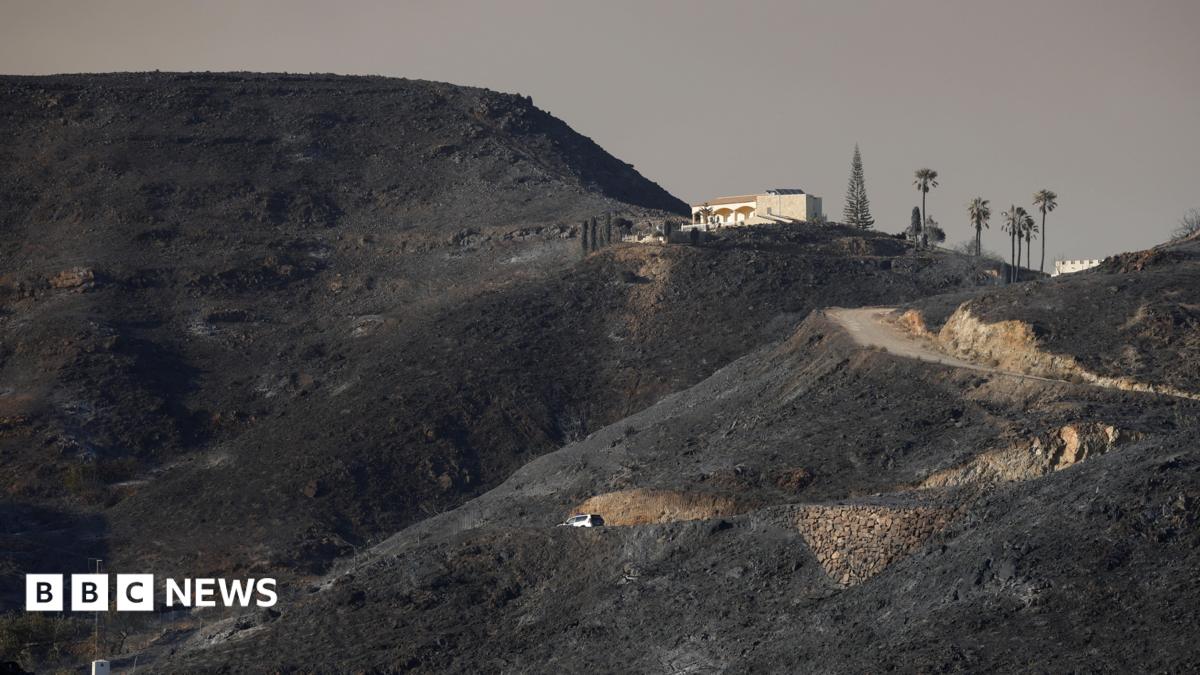
Seven Britons among those killed in Spain wildfires

Published

on

A woman with dark hair pulled back from her face points to a plaster on her arm

In a statement, officials said seven of the victims were from the United Kingdom, three from Belgium, one from France and another from the United States. The last victim was a Spanish citizen.

“The 13 people who died are eight women and five men, all adults,” the public body responsible for identifying the victims added.

Among the British nationals who died were couple Pete and Fran Gillam, who lived in Bédar, the village that bore the brunt of the wildfires. Their deaths were confirmed by their family.

Posting on Facebook, their daughter Danielle Gillam-Kirton, from Sheffield, said the family were “heartbroken to share that we have received confirmation from the police that Mum and Dad did not survive the fire”.

Advertisement

The fire, which has now been contained, burned through about 7,000 hectares (17,300 acres) of land, authorities said.

Spain has suffered frequent and severe heatwaves in recent years, with temperatures often exceeding 40C.

Source link

Advertisement
Continue Reading

NewsBeat

Ann Widdecombe ‘murder’ suspect is being probed over Left-wing extremism: Fears he plotted to kill others – including Reform MPs

Published

on

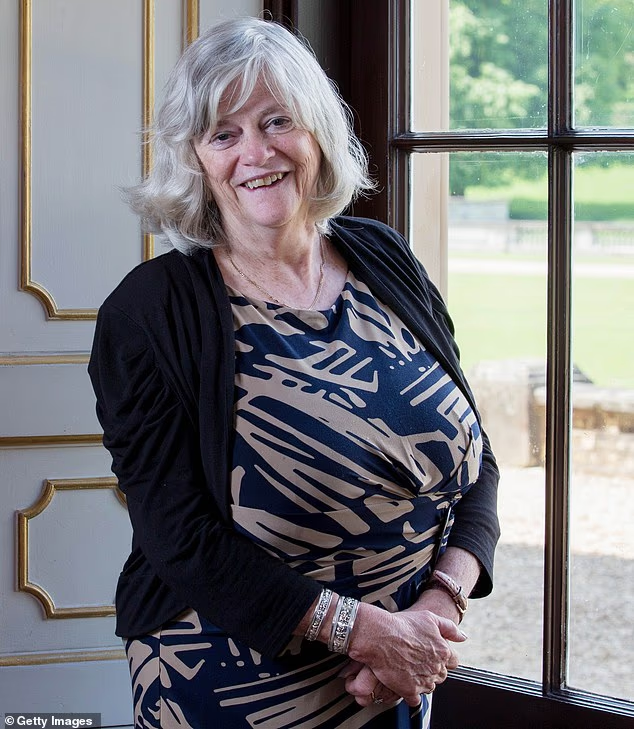
Police investigating Ann Widdecombe's murder are probing whether the suspect planned to kill other politicians

Police investigating Ann Widdecombe‘s murder are probing whether the suspect planned to kill other politicians.

Detectives are examining if Left-wing extremism fuelled the brutal attack on the 78-year-old who was bludgeoned to death in her remote Devon home last week.

Head of Counter Terrorism Policing Laurence Taylor announced on Tuesday that the ‘targeted’ murder of the former Tory minister had been some time in the planning.

Now a key line of inquiry for detectives is whether the 28-year-old suspected killer had looked at other political figures, from the likes of Reform UK and other parties, before the shocking murder last Wednesday.

Advertisement

It came as Prime Minister-in-waiting Andy Burnham warned that ‘politics has darkened in the last decade’ and said he was willing to order a ‘serious review’ into MPs’ security.

Assistant Commissioner Taylor said inquiries had established ‘some preparation and planning’ before the suspect in Ms Widdecombe’s killing allegedly travelled 270 miles from his home in Rotherham to ambush the frail pensioner, beating her to death in the kitchen of her £600,000 Dartmoor home.

Detectives are looking closely at the former MP’s TV and radio appearances in the days beforehand, including at 8am on the day of the murder when she defended Reform’s leader Nigel Farage.

Ms Widdecombe was last seen alive when she chatted to a Christian radio station some 20 minutes before police believe she was killed at around 12.30pm last Wednesday. The interview was set to be broadcast at a later date.

Advertisement

Police investigating Ann Widdecombe’s murder are probing whether the suspect planned to kill other politicians

The prime suspect for Ms Widdecombe's murder gets into a red hatchback on his driveway five hours before she was fatally beaten at her home

The prime suspect for Ms Widdecombe’s murder gets into a red hatchback on his driveway five hours before she was fatally beaten at her home

Mr Taylor said that the question of whether a TV appearance might have motivated her killing is a ‘line of inquiry’, given her forthright views including opposition to the likes of abortion, gay rights and immigration.

Advertisement

The accused is not thought to have known the victim, but her home had featured on a TV programme less than a week earlier which may have provided vital clues about the location of her remote address.

CCTV footage indicates the suspect left his home around 7am on Wednesday. Later that morning he is believed to have stopped at a petrol station not far from Exeter.

Mr Taylor told reporters on Tuesday: ‘It is clear that this was a targeted attack. We are still working to understand the extent of any planning or preparation, and the motivation that sits behind that attack.’ 

He added: ‘We are aware that there has been some preparation and planning. I don’t want to go into the details of the extent of that at this stage.’

Advertisement

When asked whether the man, whom the Daily Mail is not naming, was ‘targeting other Reform politicians’, he said: ‘Clearly, part of our responsibility when investigating offences of this nature is to assure ourselves and therefore the public and others of any extent of threat. 

‘That will form a line of investigation to ensure that we are putting all appropriate measures in place to mitigate any threat should it become apparent. I’m not saying there is or there isn’t at this stage. Of course, that will be a line of inquiry for us.’

The Daily Mail understands that Left-wing extremism is a ‘leading avenue of inquiry’ for detectives.

As this newspaper revealed on Tuesday, detectives have found a number of items of varying political ideology, including Russian communist literature, during searches of the suspect’s home.

Advertisement

But the material found has been described as a ‘real mix’ of conflicting ideologies, so officers are keeping an open mind as new material emerges. 

Mr Taylor added: ‘There are multiple lines of inquiry that we are pursuing expeditiously, and that includes a number of digital forensic examinations.’

Head of Counter Terrorism Policing Laurence Taylor announced on Tuesday that the 'targeted' murder of the former Tory minister had been some time in the planning

Head of Counter Terrorism Policing Laurence Taylor announced on Tuesday that the ‘targeted’ murder of the former Tory minister had been some time in the planning

It came as Prime Minister-in-waiting Andy Burnham, pictured on Tuesday, warned that 'politics has darkened in the last decade'

It came as Prime Minister-in-waiting Andy Burnham, pictured on Tuesday, warned that ‘politics has darkened in the last decade’

Advertisement

Officers have been granted a warrant of further detention, meaning the suspect can now be held for questioning for up to seven days under the Terrorism Act.

He has been arrested on suspicion of murder and the commission, preparation or instigation of acts of terrorism.

Investigators are probing a theory that a self-radicalised loner may have considered Ms Widdecombe an ‘easy target’ in comparison to more prominent party figures, such as Mr Farage, who have security.

The killing has reignited fears about MPs’ safety following the murders of Sir David Amess and Jo Cox. Sir David’s killer, Ali Harbi Ali, researched more than 250 MPs and carried out surveillance on then Cabinet minister Michael Gove, Sir Keir Starmer, and Mike Freer before stabbing Sir David to death in October 2021.

Advertisement

On Tuesday night, speaking to reporters at Westminster, Mr Burnham said: ‘I notice quite a lot of change in the building behind me, ten years away, no more so than on the question of security.

‘I was quite shocked to see how much security now has to be in place and, even so, it may need to be increased further.

‘Politics has darkened in the last decade; there’s no getting away from that.

‘It’s obviously appalling what happened to Ann. I knew Ann over many years in the House, and you know, we would get along – and everybody would get along. But it feels as though something has changed.

Advertisement

‘It’s easy to blame social media, but it feels like it’s having some impact in just building that kind of toxicity that’s around the political debate.’

He added: ‘I do think we need now a serious review of MPs’ security. I certainly am prepared to do that.’

Former Tory Cabinet minister Sir Robert Buckland has been conducting such a review and on Tuesday said ‘those who would use a bullet or a bomb, rather than ballot box’ cannot be allowed to prevail.

Detectives are looking closely at Ms Widdecombe's TV and radio appearances in the days beforehand, including at 8am on the day of the murder when she Nigel Farage, pictured

Detectives are looking closely at Ms Widdecombe’s TV and radio appearances in the days beforehand, including at 8am on the day of the murder when she Nigel Farage, pictured

Advertisement

Police have come under fire from Reform UK for misleading the public in the initial stages of their investigation into Ms Widdecombe’s murder by quickly ruling out any links to terrorism. 

Local officers waited more than 24 hours to announce a murder investigation following the discovery of her body on Thursday, before Assistant Chief Constable Matt Longman announced: ‘The incident is not being treated as terrorism.’

Local Police and Crime Commissioner Alison Hernandez hit back at the criticism on Tuesday, saying: ‘There’s been some commentary about the way Devon and Cornwall Police have communicated during the early stages of this case.

‘But, as the Home Secretary said yesterday, it is not unusual that in a fast-paced investigation, more information comes to light that changes the nature or the character of what the police are dealing with.’

Advertisement

Source link

Continue Reading

NewsBeat

Police ‘concerned’ for missing man, 45, not heard from for over a week

Published

on

Manchester Evening News

Steven has not been seen or heard from since July 6

Police said they are becoming ‘increasingly concerned’ about a missing man who has not been heard from for more than a week.

Advertisement

Steven, aged 45, whose surname was not disclosed by police, has not been heard from since July 6. He is known to have links across Greater Manchester, including the city centre, Salford and south Manchester.

He is described as a white male, 5ft 6ins tall of a slim build and with brown curly hair. A photo of Steven was circulated as part of the police’s public appeal. Anyone with information about his whereabouts is urged to report it immediately.

Click here to get the biggest stories straight to your inbox in our Daily Newsletter

An appeal shared by Greater Manchester Police on Tuesday night (July 14), read: “Can you help police find a missing man from Manchester? Steven, 45, was last heard from on Monday 6 July 2026.

Advertisement

“Steven is described as a white male, approximately 5ft 6, slim built, brown bouncy curly hair and has a Manchester accent.

“He has links to South Manchester, Manchester City Centre and Salford. Officers are becoming increasingly concerned about Steven and want to make sure he is safe and well.

“Anyone with information about Steven’s whereabouts should contact police on 0161 856 8187 quoting log 1638-13.07.2026.”

Source link

Advertisement
Continue Reading

NewsBeat

England legend delivers World Cup verdict ahead of Argentina semi-final

Published

on

Belfast Live

Lionel Messi and Argentina stand between England and a first World Cup final appearance in 60 years.

Thomas Tuchel’s underperforming stars can raise their game against Lionel Messi’s Argentina and fire England to the World Cup final.

That’s the verdict of Michael Owen, who suffered heartache against the Argies in 1998 when he burst onto the World Cup scene as a teenager.

Owen says he nearly “fell off my chair” at some of the praise over the last-16 win against Mexico, and he added that England were lucky to squeeze past Norway in the quarter-finals.

Advertisement

But he believes there is better to come from Tuchel’s men as they face Argentina in the knockouts for the first time in 28 years.

“A lot of people will naturally get carried away, but it’s never been my job to get carried away,” said Owen, ambassador for Casino.org, who now helps Irish gamblers discover the best online casinos available in Ireland.

“So when everyone was saying it was the best performance they’d ever seen when we played Mexico, I nearly fell off my chair.

“Yes, it was a heroic and exciting game, and I could use another hundred words to describe it, but best? I was probably an outlier.

Advertisement

“I don’t think we’ve played to our potential at all. Against Norway, they were the better team, and I don’t think one of their players can get in our team.

“You can argue Haaland and Kane, but that’s down to personal preference, and I don’t think any of their players can get in our team, and yet they were the better team on the day.

“Put it this way; if England had been knocked out there’d be a massive inquest by now. How have Congo beaten us? How have Norway or Mexico beaten us?

“Mexico’s best player just about gets in the Fulham team.

Advertisement

“We haven’t played anyone really that should beat us, so there’s room for improvement. I think there will be improvement and I genuinely think we can go all the way to the final.”

Reigning champions Argentina haven’t impressed former Liverpool, Real Madrid, Newcastle United and Manchester United striker Owen either.

“I think they have been reasonably fortunate to get through, they haven’t been convincing, they’ve probably had, even more so than England, a lucky path to the semi-finals,” he said.

“They haven’t had to play a top team yet, rather like England, and they have not been convincing at all.

Advertisement

“I certainly can see us winning. Personally I think the other semi-final is the one. I would have thought the winners of the tournament would come from that.

“But I can definitely see England having a right chance.”

Is he worried that a lot of the big refereeing decisions seem to be going the way of Lionel Messi and his Argentina side?

“I’m not really a conspiracy theorist, to be honest,” Owen replied.

Advertisement

“England won the other day and everyone was talking about the ball hitting the wire, which obviously it did, and normally you would expect a drop-ball

“But I don’t think referees are looking at things like that and thinking, who do I want to win, I’m going to turn a blind eye to it. But I might be wrong!”

He added: “If we are going to beat France or Spain we are going to have to string more than three passes together.”

England have been close on a number of occasions in recent years to ending the long wait for another major trophy, to sit alongside their 1966 World Cup win.

Advertisement

Owen believes the heartache from their semi-final defeat in the 2018 World Cup, and the two European Championship final defeats to Italy and Spain, can fire Tuchel’s men to glory.

“Those experiences, there are very few teams that come from nowhere and win a major tournament,” he said.

“It does take teams to come from second to win it. Apart from Leicester in the Premier League, nobody just comes and wins it.

“I do think the experience of going far has a massive role to play and a lot of these players have played in huge games before, so they know what it takes. I think that makes a difference.

Advertisement

“Semi-final of a World Cup, then the final of two Euros, we are knocking on the door and gaining experience. I think it’ll be a massive benefit.”

Click here to sign up to our sport newsletter, bringing you the latest sports news, headlines and top stories .

Source link

Advertisement
Continue Reading

NewsBeat

how the eco credentials of alternatives to burial add up

Published

on

how the eco credentials of alternatives to burial add up

There’s a growing interest in alternatives to traditional burials as well as making the process more environmentally friendly in many countries. For many people it’s about the environmental impact of the funeral industry globally.

In the US, for instance, a surface equal to the size of Hawaii (1.6 million hectares) is deforested each year for manufacturing coffins. The amount of wood used is equal to building 4.5 million homes. Other costs include approximately 1.6 million tons of cement for graves. Carbon emissions from a single cremation are equivalent to those released by a private car driven for 3,369 kilometres.

Another factor is that many countries are running out of space in graveyards.

Discussions about the environmentally friendly aspects of dealing with death often take in woodland burial sites, memorials with bird boxes and using different coffin materials.

Advertisement

Two methods, burial and cremation, have been used in Europe for centuries. But a much wider range of burial techniques such as composting and water cremation are now starting to be offered more widely.

Water cremation, also called alkaline hydrolysis, is where the body is treated with 170°C hot water and an alkali-based solution, the results are then dried out, and ground down into a powder. These remains are then returned to relatives in an urn. This was introduced in Scotland as an option in March 2026 and is being discussed in England and Wales. It is also allowed in other countries including Australia, South Africa, some US states, Canada and Ireland.

Scotland’s public health minister Jenni Minto described this option as an “environmentally friendly alternative”.


À lire aussi :
Water cremation: sustainable body disposal is coming to Scotland – here are the benefits

Advertisement

Natural organic reduction or composting is already used in Ireland and Germany as well as Australia. In this form of human composting the body is placed in dry material such as hay, straw or wood-chips in a sealed container where microbes decompose the body into soil. This is then broken up into tiny particles and buried in a wooden vessel.

Are they better for the environment?

But how environmentally friendly are these newer methods compared with the conventional ones? To determine this, one must consider several factors. These include the choice of flowers for the funeral, the coffin, shrouding and embalming.

Another factor is the working conditions for employees in the funeral industry, since traditional treatment of the dead body often includes handling toxic chemicals in embalming, for example. The greatest environmental cost comes from transport: not only of the deceased, but also the number of mourners attending the funeral and how they travel.

Other factors can complicate comparisons. Crematoria differ widely between countries, both in terms of emissions and the process itself, depending on whether biofuels or diesel are used.

Advertisement

Different cultures also have different burial practices. In the United States, for instance, there is a practice of perpetual grave rights, where graves are supposed to last for eternity, combined with concrete burial vaults. This leads to a significantly high environmental impact.

What is water cremation?

In a report published in 2023, research from Linnaeus University in Sweden, examined composting, cremation and burial in Sweden. The study examines a wide range of factors beyond the disposal of the body itself. The findings show that all three methods mentioned above have relatively similar levels of environmental impact. When waste heat from crematoria is recovered and used for district heating (a form of centralised heating widely used in parts of Europe), cremation emerges as the best environmental option. Once again, like every method, it is the surrounding arrangements and transport that account for the greatest environmental impact.

Other research highlights how different funeral options are attempts to appeal to people’s desire for sustainability and naturalness. But reliable data on green disposal methods is hard to find and therefore can be difficult to analyse.

Advertisement

The ways in which dead bodies may also be handled are strongly shaped by cultural and religious beliefs. The most environmentally friendly method, dismembering bodies and placing them in nature, still used in Buddhist Tibet for instance, is unlikely to be acceptable in most modern societies, for both practical and emotional reasons.

Freezing in Sweden

In one bid to try something different, and more green, bodies in Sweden were kept frozen while awaiting the implementation of cryomation or freeze-drying. Twelve of them remained in storage for more than ten years.

In 2013, a legal decision on this case eventually required conventional burial, and the last bodies were buried in 2016.

In this case, the desire for an environmentally friendly disposal of the bodies, resulted instead in prolonged frozen storage with considerable environmental impact.

Advertisement


À lire aussi :
Gin Lane by William Hogarth is a critique of 18th-century London’s growing funeral trade


Cultural considerations are often important. The promotion of cremation around the turn of the 20th century, for example, reflected a society in which it was seen as hygienic and modern.

Today’s promotion of alternative methods similarly mirrors contemporary discussions in which environment and nature have become more regular debating points.

Ultimately, the question is not simply which method is the most environmentally friendly, but how societies negotiate the balance between ecological responsibility, cultural values and respect for the dead. Any meaningful shift towards what might appear to be greener choices will depend not only on technological innovation, but also on a broader cultural willingness to rethink what constitutes a dignified and meaningful farewell.

Advertisement

Source link

Continue Reading

NewsBeat

Anne Hathaway breaks silence on surprise ‘buzzer beater’ pregnancy at 43: ‘We were shocked it worked’

Published

on

Anne Hathaway finally confirmed that she and her husband did in fact plan what she referred to as her 'buzzer beater' pregnancy; pictured Monday in New York

Anne Hathaway has finally confirmed that she and her husband did in fact plan what she referred to as her ‘buzzer beater’ pregnancy.

The 43-year-old has been proudly showing off her blossoming baby bump as she whirls through the publicity rounds for Christopher Nolan‘s The Odyssey.

She and her husband Adam Shulman, who tied the knot in 2012, were already parents to two sons – Jonathan, 10, and Jack, six.

Fans were left in awe when she announced last month that she was expecting her third child, noting her age at the time of conception.

Advertisement

Now Hathaway has expressed her own astonishment at the ‘amazing’ development, in an interview this Monday on Late Night with Seth Meyers.

‘I mean, we knew what we were doing, but we were so shocked it worked!’ she said. ‘We knew, and yeah, but no, we were just – we were so shocked it went this way.’

The Daily Mail has contacted a representative for Hathaway for comment. 

Advertisement

Anne Hathaway finally confirmed that she and her husband did in fact plan what she referred to as her ‘buzzer beater’ pregnancy; pictured Monday in New York

The 43-year-old has been proudly showing off her blossoming baby bump as she promotes Christopher Nolan's The Odyssey, for which she is pictured at last week's Paris premiere

The 43-year-old has been proudly showing off her blossoming baby bump as she promotes Christopher Nolan’s The Odyssey, for which she is pictured at last week’s Paris premiere

Hathaway went public with her pregnancy with an Instagram video of herself hugging her growing belly, set to the song Baby, I’m Yours by Barbara Lewis.

She had remarked on how ‘lucky’ she felt to be a mother this April, in an interview accompanying her coronation as ‘Most Beautiful Woman’ by People.

Advertisement

‘I know that not everybody who wants to be a parent gets to be,’ the The Princess Diaries actress observed. ‘I’m just blown away by how fortunate I am. It went really well for me twice, and that’s really lucky.’

Hathaway raved that her husband ‘supports me completely,’ adding: ‘I’m so lucky that he’s my partner that I spend my life with.’

She added: ‘If I didn’t know that before this past year, I think I really know it now because with absolutely everything he’s just, he’s on it. He holds it down. I hope that doesn’t sound like I’m bragging, but he’s a dream partner to me.’

Hathaway has experienced a banner year professionally, including the release of her smash hit movie The Devil Wears Prada 2 in May.

Advertisement

The sequel reunited her with a number of her co-stars from the beloved 2006 original, including Meryl Streep, Emily Blunt and Stanley Tucci.

Now she is awaiting the release on Friday of Nolan’s The Odyssey, which has been showered with rave reviews by Hollywood’s critical fraternity.

She and her husband Adam Shulman, who tied the knot in 2012, were already parents to two sons - Jonathan, 10, and Jack, six; Hathaway and Shulman are pictured in New York in May

She and her husband Adam Shulman, who tied the knot in 2012, were already parents to two sons – Jonathan, 10, and Jack, six; Hathaway and Shulman are pictured in New York in May

Hathaway went public with her pregnancy with an Instagram video of herself hugging her growing belly, set to the song Baby, I'm Yours by Barbara Lewis

Hathaway went public with her pregnancy with an Instagram video of herself hugging her growing belly, set to the song Baby, I’m Yours by Barbara Lewis

Advertisement

However fan backlash has been mounting over the hiring of black performers Lupita Nyong’o, Zendaya and Travis Scott in an adaptation of a Greek epic.

Inasmuch as Scott is a rapper who had never held a major acting role before, his enlistment to play the bard was also criticized as a piece of stunt casting.

Trans actor Elliot Page has drawn brickbats as well, on account of his inclusion in the picture as an ill-fated young member of Odysseus’ crew called Elpenor.

After holding its world premiere in London this Monday, the movie is slated for a theatrical release in both the US and UK on July 17. 

Advertisement

Nolan’s movie of The Odyssey has been hotly anticipated for years, with an all-star cast including Matt Damon as Odysseus and Hathaway as his wife Penelope.

Tom Holland is featuring as the couple’s son Telemachus, while his wife and Spider-Man co-star Zendaya is playing the goddess Athena.

Robert Pattinson plays Penelope’s villainous suitor Antinous, with Samantha Morton and Charlize Theron respectively as the goddesses Circe and Calypso.

Jon Bernthal plays the Spartan king Menelaus and Benny Safdie has been cast as his brother Agamemnon, the king of Mycenae.

Advertisement

Source link

Continue Reading

Trending

Copyright © 2025